Development Goals for Sales Reps: The 2026 Manager's Playbook
Vague goals like "sell more" don't develop anyone. Here's how to set development goals for sales reps that build skills, move quota, and stay measurable in 2026 — with examples and a copy-ready tracking table.
Most "development goals" handed to sales reps are quota targets wearing a costume. "Close 20% more this quarter" is an outcome, not a development plan — it tells a rep where to arrive but nothing about the skills that get them there. Real development goals build capability: better discovery, cleaner pipeline hygiene, sharper objection handling, more disciplined prospecting. Do that well and the quota number takes care of itself.
This is a manager's playbook for setting development goals for sales reps that are specific, coachable, and measurable — the kind that survive a mid-year review instead of quietly evaporating in week three.
TL;DR#
- Development goals ≠ quota targets. Outcomes measure results; development goals build the skills that produce them. You need both, tracked separately.
- Use SMART, but bias toward behaviors you can observe weekly — calls booked, discovery questions asked, follow-up cadence hit — not just revenue at quarter-end.
- Segment by tenure. A ramping SDR, a mid-level AE, and a senior closer need different tracks. A single template for all three fails all three.
- Bad data kills good goals. A rep told to "book more meetings" on a stale list is set up to fail; clean contact data is a prerequisite, not a nice-to-have.
- Review cadence beats goal-setting genius. A mediocre goal reviewed every two weeks outperforms a perfect goal reviewed once a year.
What Are Development Goals for Sales Reps (and What They Aren't)?#
A development goal targets a skill or behavior a rep can improve with practice and coaching. A performance target measures an outcome — revenue, win rate, quota attainment. The confusion between the two is why so many "goals" feel demoralizing: you're asking someone to hit a number without naming the muscle they need to build.
Think of it like coaching a runner. "Run a sub-40 10K" is the outcome. The development goals are "add one interval session a week" and "hold cadence above 175 steps per minute." Work the second list and the first takes care of itself.
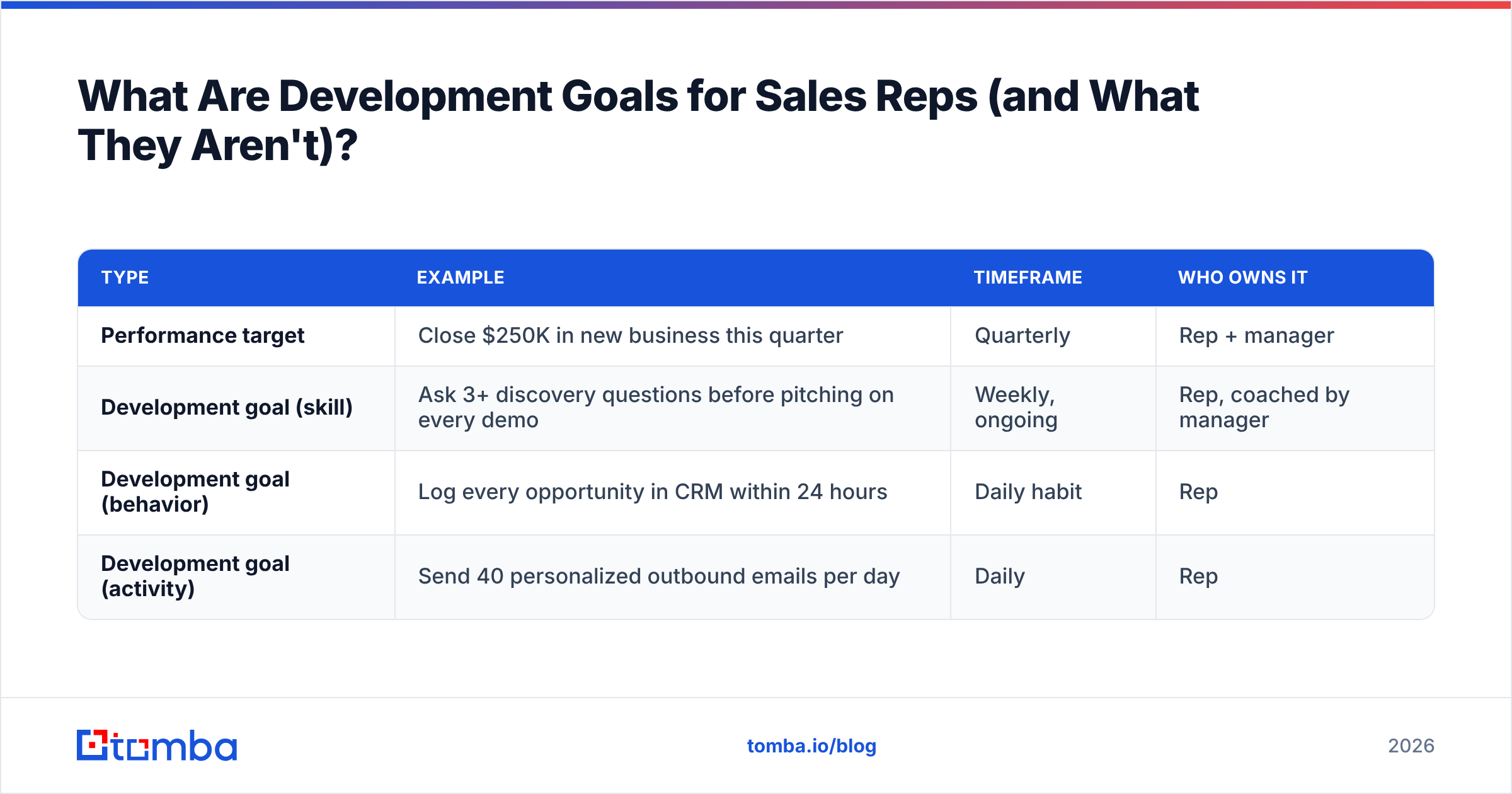
Here's the practical split:
| Type | Example | Timeframe | Who owns it |
|---|---|---|---|
| Performance target | Close $250K in new business this quarter | Quarterly | Rep + manager |
| Development goal (skill) | Ask 3+ discovery questions before pitching on every demo | Weekly, ongoing | Rep, coached by manager |
| Development goal (behavior) | Log every opportunity in CRM within 24 hours | Daily habit | Rep |
| Development goal (activity) | Send 40 personalized outbound emails per day | Daily | Rep |
Notice that three of the four rows are things a rep can control today, without waiting for a deal to close. That controllability is the whole point — it's what makes a goal motivating instead of anxiety-inducing. Your win rate is a lagging indicator; the behaviors above are leading ones.

How Do You Write a SMART Development Goal That Actually Sticks?#
SMART (Specific, Measurable, Achievable, Relevant, Time-bound) is the standard framework, and it works — but sales managers routinely botch the "Measurable" part by defaulting to revenue. Measure the behavior, not just the result.
Compare these two versions of the same intent:
- Weak: "Get better at discovery calls."
- SMART: "By the end of Q1, ask at least three open-ended discovery questions before presenting pricing on 90% of demos, verified by call recordings reviewed in weekly 1:1s."
The second is specific (three questions, before pricing), measurable (90% of demos, from recordings), achievable (it's a habit, not a talent), relevant (discovery drives deal quality), and time-bound (end of Q1). It's also coachable — you and the rep can listen to a call together and instantly agree whether it happened.
A quick checklist for pressure-testing any development goal you write:
- Can the rep influence it directly this week? If it depends entirely on a prospect saying yes, it's an outcome, not a development goal.
- Can you observe it without ambiguity? "Improve rapport" is unobservable. "Open every call by referencing the prospect's recent company news" is observable.
- Is there a number? Even soft skills get a proxy metric — questions asked, response rate, calls that reach a next step.
- Does it ladder up to a business outcome? If nobody can explain how the goal moves pipeline or response rate, cut it.
- Is it one of three, not one of twelve? A rep working three focused goals will beat a rep juggling a dozen every time.
According to HubSpot's sales research, reps who follow a structured, repeatable process consistently outperform those who improvise — and development goals are how you install that process one habit at a time.
Which Development Goals Matter Most by Career Stage?#
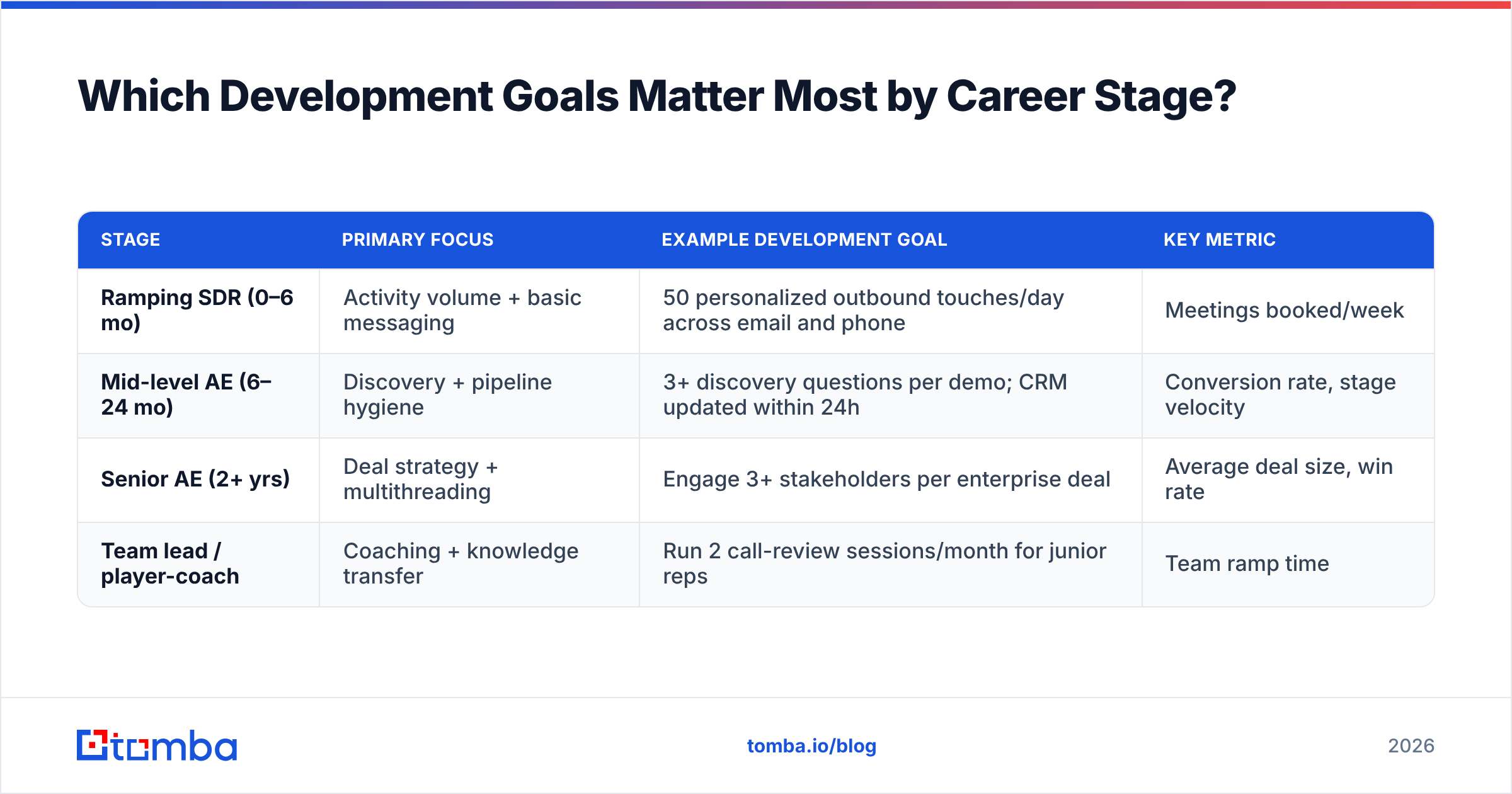
The single biggest mistake in sales enablement is handing the same goal template to a rep on week two and a rep on year five. Their bottlenecks are completely different. Segment your goals by tenure.
| Stage | Primary focus | Example development goal | Key metric |
|---|---|---|---|
| Ramping SDR (0–6 mo) | Activity volume + basic messaging | 50 personalized outbound touches/day across email and phone | Meetings booked/week |
| Mid-level AE (6–24 mo) | Discovery + pipeline hygiene | 3+ discovery questions per demo; CRM updated within 24h | Conversion rate, stage velocity |
| Senior AE (2+ yrs) | Deal strategy + multithreading | Engage 3+ stakeholders per enterprise deal | Average deal size, win rate |
| Team lead / player-coach | Coaching + knowledge transfer | Run 2 call-review sessions/month for junior reps | Team ramp time |
For the SDR, the constraint is almost always volume and consistency — and that volume only pays off if it lands on real, reachable contacts. Pointing 50 daily touches at a list riddled with bounced addresses and wrong numbers burns the rep out and teaches them the wrong lesson. This is where solid sales prospecting infrastructure matters: verified emails and direct dials turn activity goals into booked-meeting goals. A phone finder and verified email data mean your SDR's dials actually connect instead of hitting dead numbers.
For the mid-level AE, the constraint shifts to quality of conversation — discovery depth, qualification rigor, and keeping the CRM honest. For senior reps, it's complexity management: multithreading, navigating procurement, and forecasting accurately.
How Do You Track Development Goals Without Drowning in Spreadsheets?#
The goal is worthless if you can't see progress between now and the review. You need a lightweight tracking rhythm, not a 40-column dashboard nobody updates.
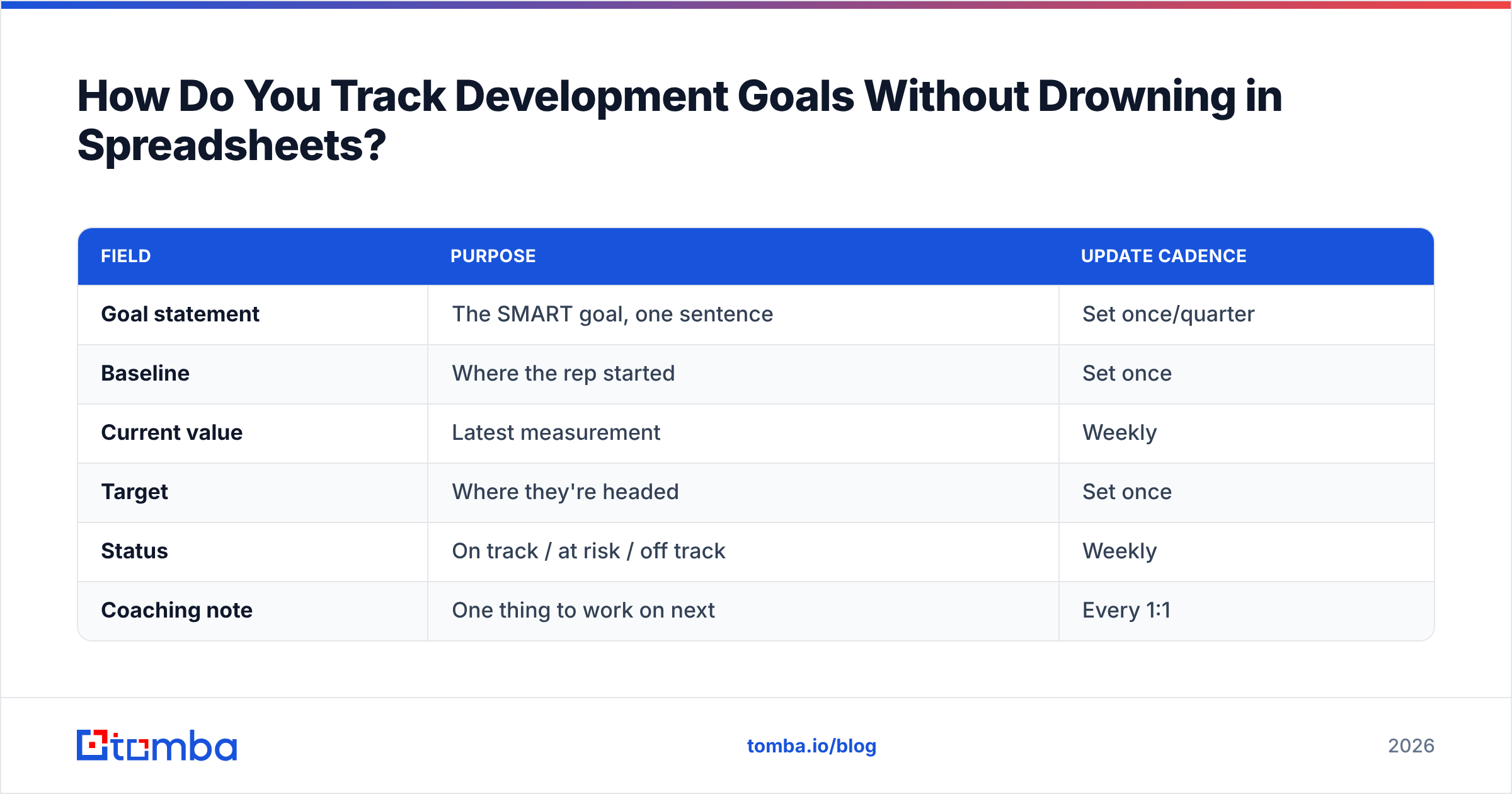
A simple, durable structure most teams can run in a shared sheet or their CRM:
| Field | Purpose | Update cadence |
|---|---|---|
| Goal statement | The SMART goal, one sentence | Set once/quarter |
| Baseline | Where the rep started | Set once |
| Current value | Latest measurement | Weekly |
| Target | Where they're headed | Set once |
| Status | On track / at risk / off track | Weekly |
| Coaching note | One thing to work on next | Every 1:1 |
Three principles keep this from rotting:
- Fewer goals, measured often. Two or three goals reviewed in every 1:1 beats ten goals reviewed at quarter-end. Gartner's sales research repeatedly finds that consistent coaching cadence, not goal quantity, drives rep improvement.
- Automate the measurement. If a rep has to manually tally their own activity, the data will be wrong and the goal will die. Pull activity counts, email response rates, and pipeline movement from your CRM and outreach tools automatically. Clean data enrichment also keeps your CRM records complete enough to measure against.
- Separate the scoreboard from the coaching. The tracker tells you what happened. The 1:1 conversation is where you diagnose why and agree on the next micro-adjustment. Don't let the spreadsheet replace the conversation.
What Do Strong Development Goals Look Like in Practice?#
Templates are useful, but examples are stickier. Here are field-tested development goals mapped to the skill they build. Adapt the numbers to your sales cycle.
Prospecting and outreach
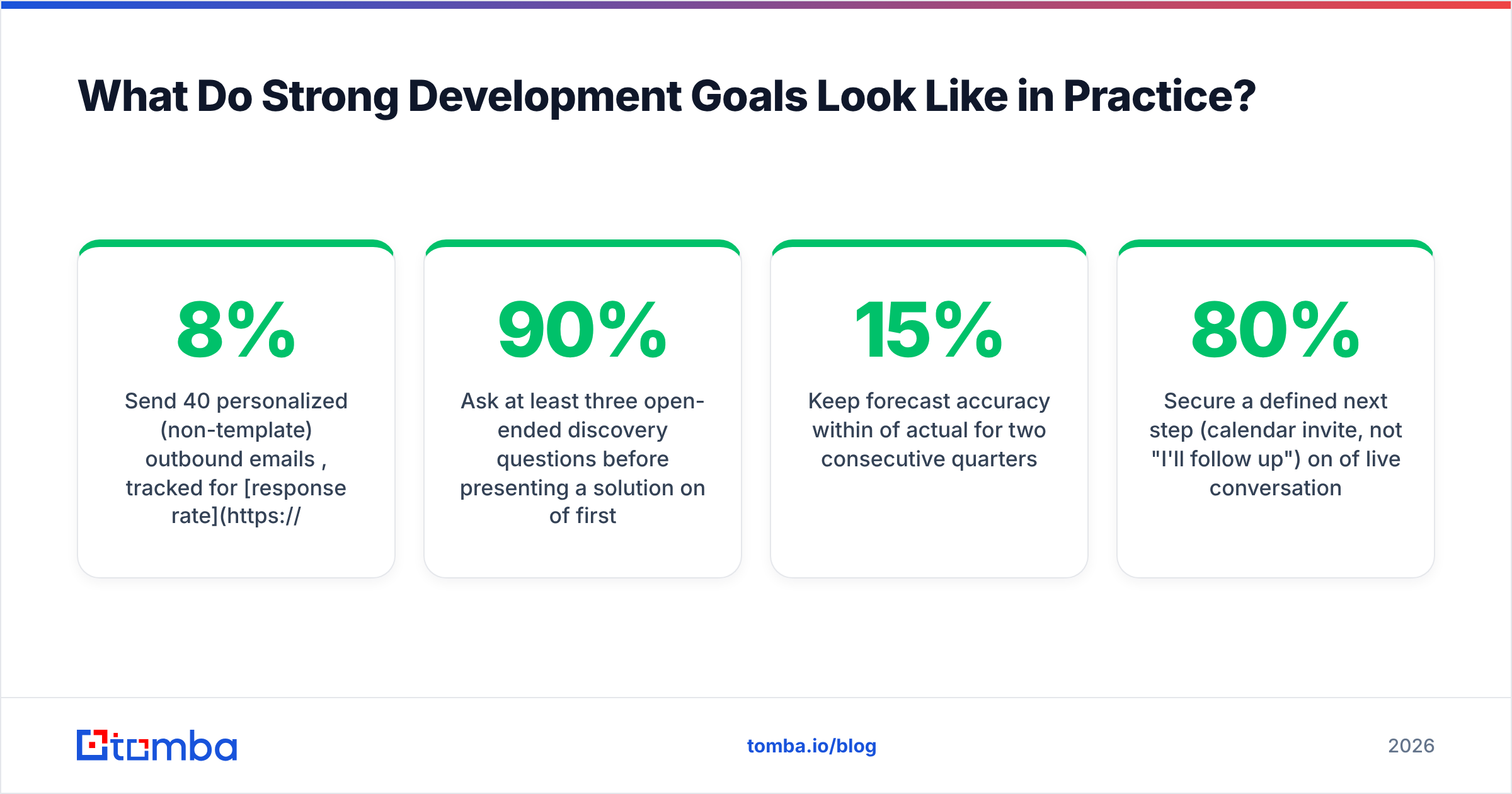
- Send 40 personalized (non-template) outbound emails per day, tracked for response rate above 8%.
- Build one new target account list of 25 verified contacts each week using a repeatable research process.
Discovery and qualification
- Ask at least three open-ended discovery questions before presenting a solution on 90% of first calls.
- Qualify out at least two poor-fit deals per month rather than dragging them through the pipeline.
Pipeline and process discipline
- Update every open opportunity in the CRM within 24 hours of any interaction.
- Keep forecast accuracy within 15% of actual for two consecutive quarters.
Deal advancement
- Secure a defined next step (calendar invite, not "I'll follow up") on 80% of live conversations.
- Multithread into at least three stakeholders on every deal over $50K.
Skill and knowledge growth
- Complete one product certification per quarter and present a five-minute teach-back to the team.
- Review two of your own recorded calls monthly and submit one improvement note.
The pattern across all of these: a verb, a number, and a timeframe. If a goal on your list is missing any of the three, it's a wish, not a goal.
How Do Data Quality and Tooling Affect Goal Attainment?#
You can set flawless goals and still watch reps miss them if the raw inputs are broken. Two silent goal-killers dominate:
Stale or wrong contact data. An SDR told to "book five meetings a week" is really being asked to reach the right person. If a quarter of their list bounces or routes to a switchboard, you've quietly doubled the workload behind every goal. Verified emails and direct phone numbers aren't a productivity luxury — they're the denominator under every activity goal. This is exactly where an email finder and email verification earn their keep: they turn "dial more" into "connect more."
Manual measurement. When reps self-report their own numbers, the data drifts and the goal loses its teeth. Wherever possible, wire the measurement into tools that count automatically — CRM activity logs, outreach platform reports, and enrichment that keeps records current. Peer reviews on directories like G2 consistently rank data accuracy as the top differentiator between sales-intelligence tools, precisely because everything downstream depends on it.
The takeaway for managers: audit the inputs before you blame the rep. A missed activity goal is often a data problem in disguise. Give your team clean, verified contacts and accurate CRM records, and their development goals suddenly become achievable instead of aspirational.
What's the Right Cadence for Reviewing Development Goals?#
Set quarterly, review weekly, recalibrate monthly.
- Weekly (in the 1:1): Glance at the tracker. Is each goal on track, at risk, or off? Pick one coaching point. Five minutes, not fifty.
- Monthly: Zoom out. Is the goal still the right constraint, or has the rep's bottleneck moved? Retire goals that are now habits and promote new ones.
- Quarterly: Reset the slate. Tie the next quarter's development goals to the rep's career path and the team's number.
The teams that get the most out of development goals aren't the ones with the cleverest frameworks — they're the ones that show up to the review every single week. Consistency compounds. A rep who improves one behavior 2% a week is unrecognizable in six months.
Start With the Inputs Your Goals Depend On#
Great development goals fall apart on bad data. Before you ask a rep to hit an activity target, make sure the contacts behind that activity are real, reachable, and current. Tomba's Email Finder helps your team build verified prospect lists by domain, name, or company — so "send 40 personalized emails a day" lands in real inboxes instead of bouncing. Pair it with email verification and enrichment, check the Tomba pricing that fits your team size, and give every activity goal on your board a fighting chance to convert. Set the goals, fix the inputs, and let the numbers follow.
Related guides#
Ready to find emails that actually work?
Join 150,000+ professionals who stopped guessing and started sending. Free credits on signup — no credit card required.
Get the Tomba newsletter
Practical outbound tactics and product updates — once every two weeks.
About the author