DevRev Pricing in 2026: Reviews, Pros, Cons & Real Costs
A neutral breakdown of DevRev pricing, real reviews, and the pros and cons of its usage-based AgentOS model — plus where it fits and where a leaner tool wins.

TL;DR
- DevRev uses usage-based pricing, not simple per-seat tiers. There's a free/startup entry point, a mid-market plan, and a custom Enterprise quote — your real bill scales with AI actions, tickets, and data volume.
- Pros: one unified platform for support, product, and CRM; strong AI agents ("AgentOS"); generous startup program; genuinely modern data model.
- Cons: pricing is hard to predict, usage overages surprise teams, and the platform is heavy for a small sales org that just needs contacts and outreach.
- Best fit: product-led SaaS companies that want support + engineering + revenue in one system.
- Worse fit: lean outbound teams — you'll overpay for capabilities you won't touch. A focused stack (email finder + CRM + sequencer) is cheaper and faster to deploy.
This guide to DevRev pricing reviews pros and cons is a neutral walkthrough. DevRev gets talked about as "the AI-native CRM," but the pricing page raises more questions than it answers. Here you'll see what DevRev actually costs, what its reviews say, and the honest trade-offs — so you can decide before a sales call, not during one.
What is DevRev and who is it for?#
DevRev is an AI-native platform that fuses three things most companies buy separately: customer support, product management, and CRM. The pitch is that support tickets, product feedback, engineering work items, and revenue data all live in one graph, with AI agents ("AgentOS") acting on top of them.
That's a bigger swing than a typical sales tool. Most CRMs manage the deal; DevRev tries to connect the deal to the bug that's blocking it and the ticket the customer filed about it. For a product-led SaaS company where support and engineering are the growth engine, that unification is the whole point.
For a cold-outbound sales team, though, that same breadth is overhead. If your day is "find the right contact, verify the email, send the sequence, book the meeting," you don't need a product graph — you need clean data and a fast pipeline. Keep that distinction in mind; it's the single biggest driver of whether DevRev's pricing is worth it for you.

How does DevRev pricing actually work?#
DevRev prices on usage, not just seats — that's the core thing to understand. Instead of one clean "$X per user per month" number, your cost is a blend of who has access and how much your team and your customers actually do inside the platform (AI actions, automations, tickets, data ingested).
At a high level, DevRev's model breaks into three buckets. Always confirm live numbers on the official DevRev pricing page, because usage-based vendors adjust limits often.
- Free / startup tier — DevRev is known for an aggressive free entry point and a startup program that hands qualifying early-stage companies a large credit allowance. Great for getting hooked; not representative of your steady-state bill.
- Growth / mid-market plan — a published per-seat rate that also meters AI usage and support volume on top. The seat price is the floor, not the ceiling.
- Enterprise — fully custom. SSO, advanced security, higher usage ceilings, dedicated support, and negotiated rates. You will talk to sales.
The trap is treating the headline seat price as your total. With usage-based platforms, the metered layer — AI agent runs, workflow executions, data volume — is where the real spend hides. Two companies with identical seat counts can see very different invoices.
DevRev pricing at a glance#
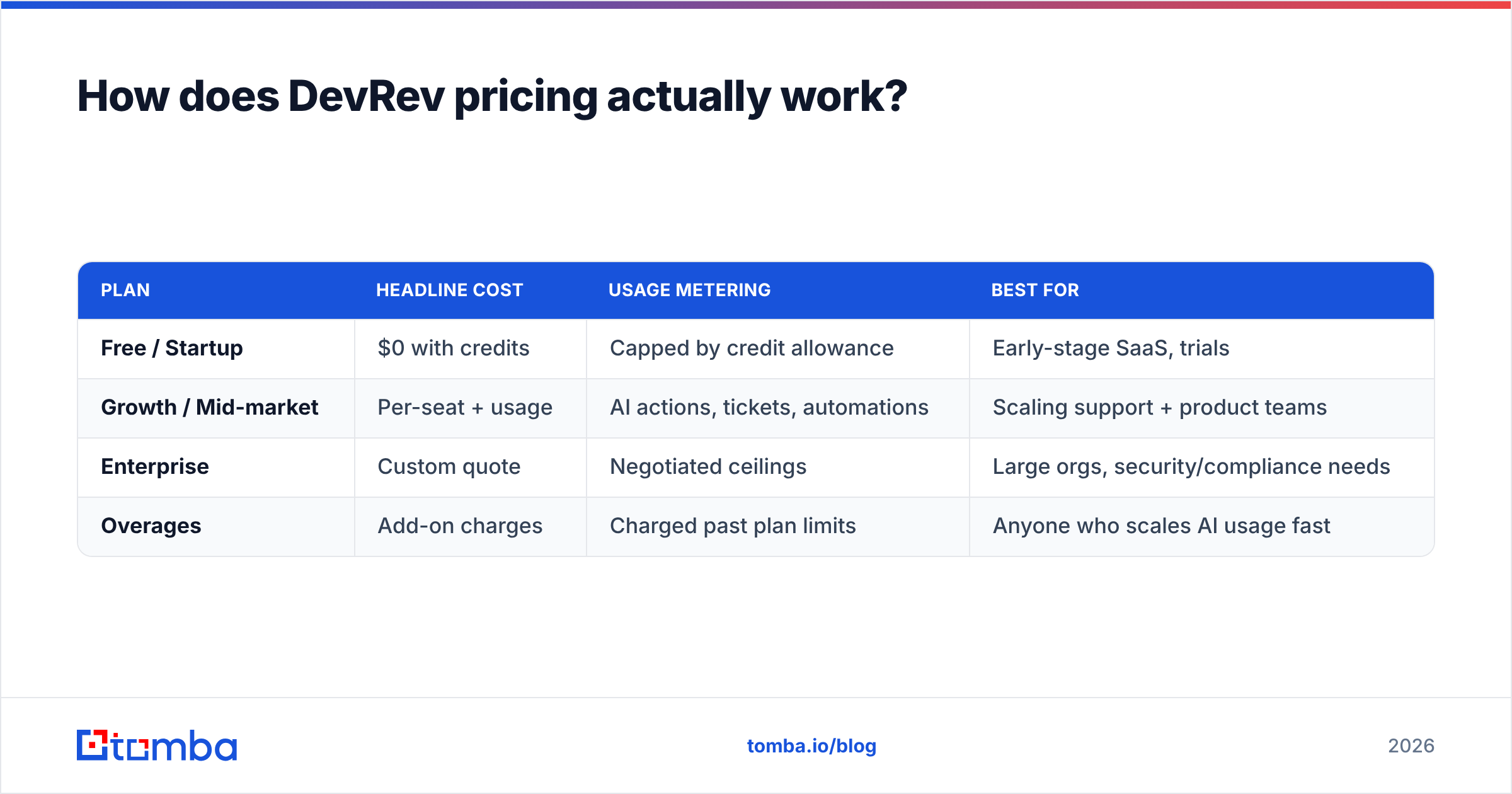
| Plan | Headline cost | Usage metering | Best for |
|---|---|---|---|
| Free / Startup | $0 with credits | Capped by credit allowance | Early-stage SaaS, trials |
| Growth / Mid-market | Per-seat + usage | AI actions, tickets, automations | Scaling support + product teams |
| Enterprise | Custom quote | Negotiated ceilings | Large orgs, security/compliance needs |
| Overages | Add-on charges | Charged past plan limits | Anyone who scales AI usage fast |
The pattern that shows up again and again in DevRev reviews on G2: people love the free start, then get surprised when growth pushes them into metered overages or an Enterprise conversation sooner than budgeted.
What do DevRev reviews say — the honest pros and cons?#
Pull the marketing language out and DevRev reviews cluster around a consistent set of themes. Here's the balanced read.
Pros reviewers repeat:
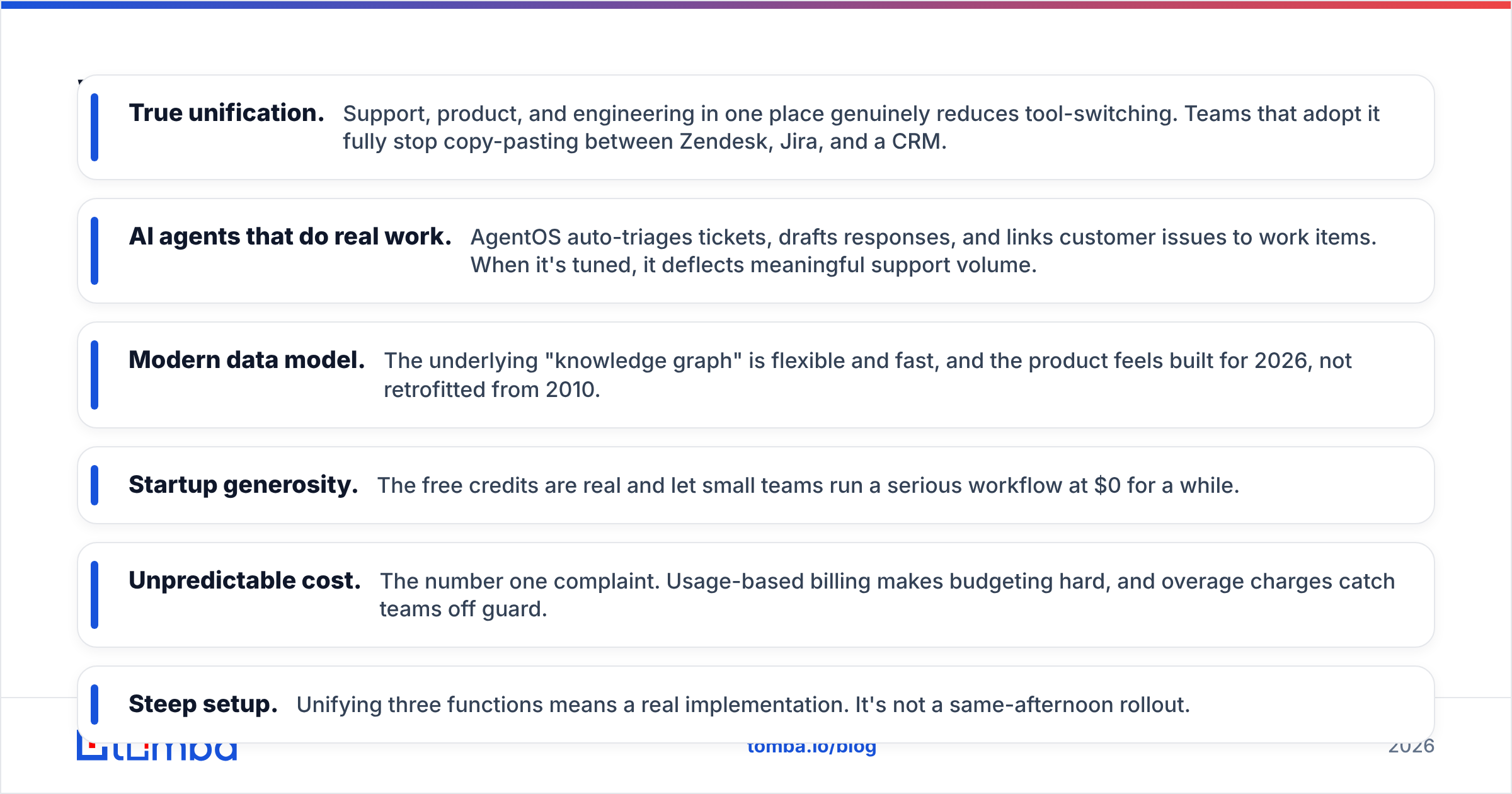
- True unification. Support, product, and engineering in one place genuinely reduces tool-switching. Teams that adopt it fully stop copy-pasting between Zendesk, Jira, and a CRM.
- AI agents that do real work. AgentOS auto-triages tickets, drafts responses, and links customer issues to work items. When it's tuned, it deflects meaningful support volume.
- Modern data model. The underlying "knowledge graph" is flexible and fast, and the product feels built for 2026, not retrofitted from 2010.
- Startup generosity. The free credits are real and let small teams run a serious workflow at $0 for a while.
Cons reviewers repeat:
- Unpredictable cost. The number one complaint. Usage-based billing makes budgeting hard, and overage charges catch teams off guard.
- Steep setup. Unifying three functions means a real implementation. It's not a same-afternoon rollout.
- Overkill for narrow use cases. Sales-only or support-only teams feel like they're paying for a suite to use one drawer of it.
- Sales-gated pricing. Getting a firm total for your situation usually means a call, which slows evaluation.

None of these are disqualifying — they're the normal trade-offs of an ambitious, consolidated platform. The question is whether your team's shape matches what you're paying for.
Is DevRev worth it for a sales team specifically?#
For a pure prospecting-and-outbound motion, DevRev is usually more platform than you need — and you'll feel it in the bill. The value of DevRev is the loop between support, product, and revenue. If your team never touches the support or product side, most of what you're paying to enable sits idle.
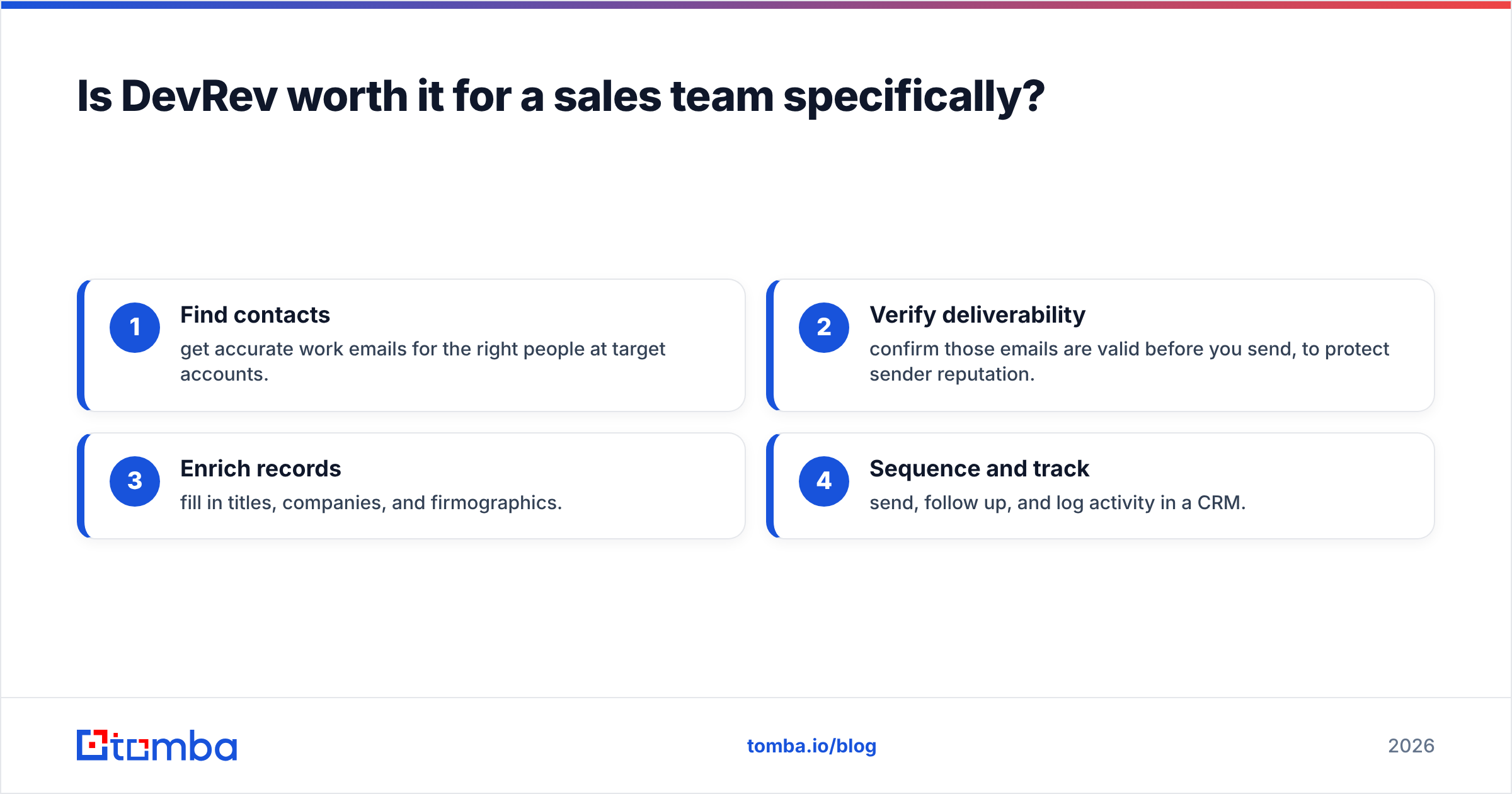
A typical outbound sales workflow needs four capabilities:
- Find contacts — get accurate work emails for the right people at target accounts.
- Verify deliverability — confirm those emails are valid before you send, to protect sender reputation.
- Enrich records — fill in titles, companies, and firmographics.
- Sequence and track — send, follow up, and log activity in a CRM.
DevRev can participate in step 4 as a CRM, but it doesn't natively do steps 1–3 the way a dedicated data tool does. So you'd still bolt on an email finder and a verifier — which means you're paying DevRev's usage-based premium and a data vendor. For a lean team, that math rarely wins.
This is where a focused, flat-rate stack tends to beat a consolidated suite on both cost and speed to value.
DevRev vs a focused sales-data stack: cost comparison#
Here's an honest side-by-side for the specific job of "get contacts and run outbound." This isn't DevRev-bad, focused-good — it's about matching spend to the job.
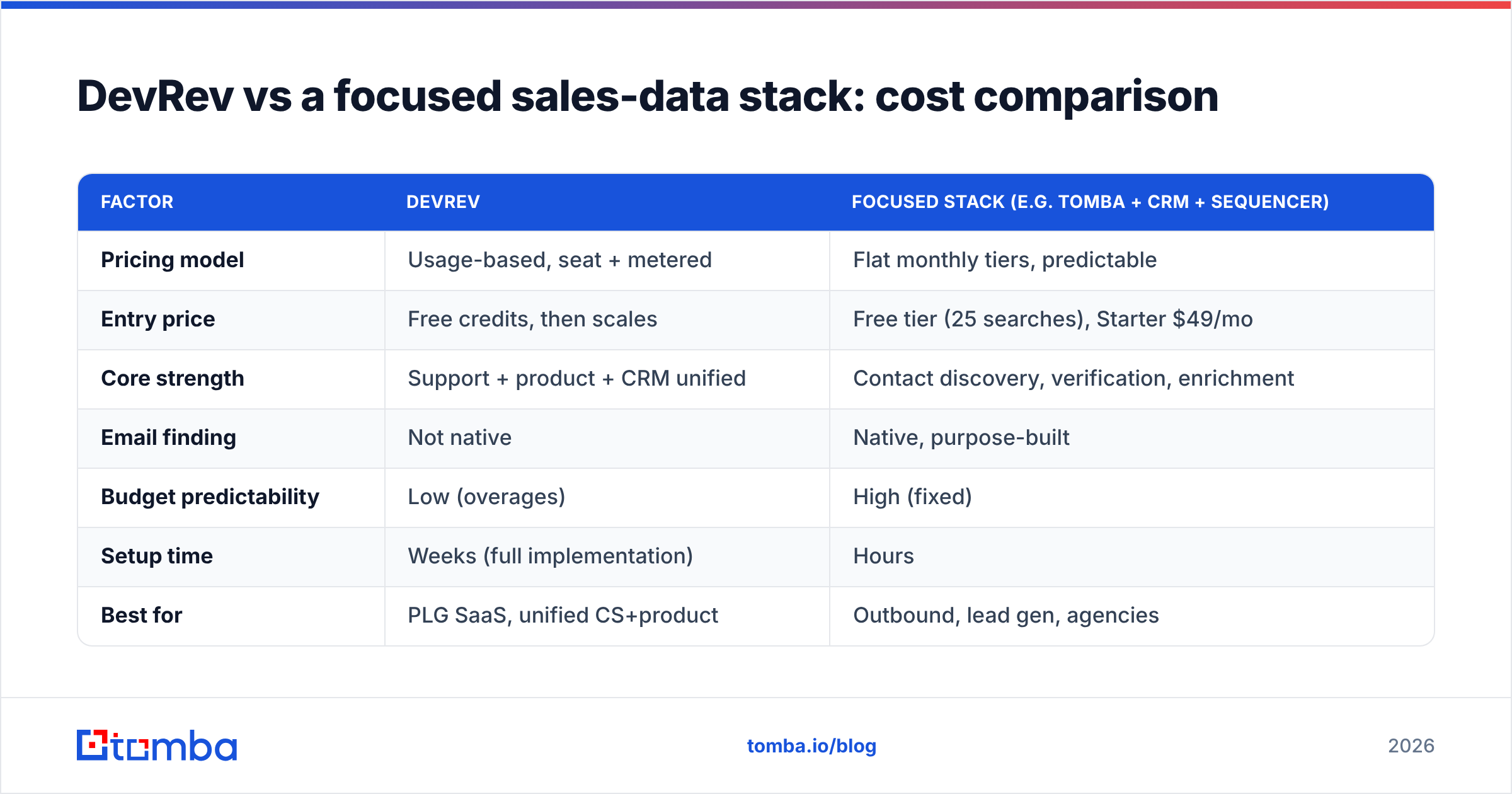
| Factor | DevRev | Focused stack (e.g. Tomba + CRM + sequencer) |
|---|---|---|
| Pricing model | Usage-based, seat + metered | Flat monthly tiers, predictable |
| Entry price | Free credits, then scales | Free tier (25 searches), Starter $49/mo |
| Core strength | Support + product + CRM unified | Contact discovery, verification, enrichment |
| Email finding | Not native | Native, purpose-built |
| Budget predictability | Low (overages) | High (fixed) |
| Setup time | Weeks (full implementation) | Hours |
| Best for | PLG SaaS, unified CS+product | Outbound, lead gen, agencies |
If your problem is "we need reliable contact data and clean outbound," you can assemble a predictable stack for a fraction of a scaling DevRev bill. Tomba's transparent Tomba pricing — Free (25 searches/mo), Starter $49/mo, Growth $99/mo, Pro $249/mo — is a flat number you can forecast, with no usage-meter surprise on your invoice. You can also pair the finder with a built-in email verifier and data enrichment so steps 1–3 above are covered in one place.
How can you predict and control DevRev costs?#
If DevRev is the right platform for you (unified support + product + revenue), you can still avoid bill shock. Analysts like Gartner have flagged usage-based SaaS budgeting as a recurring finance headache — the fix is discipline up front.
- Model your usage before signing. Estimate monthly AI actions, ticket volume, and automation runs. Ask sales to translate those into a real number, not just the seat price.
- Set overage alerts. Insist on usage caps or notifications so a busy month doesn't silently 2x your invoice.
- Negotiate the ceiling, not the floor. On Enterprise, the seat rate matters less than where metered charges kick in. Push the usage thresholds up.
- Right-size seats. Not everyone needs full access. Read-only or limited roles keep the seat floor sane.
- Revisit quarterly. Usage-based means your optimal plan drifts. Re-check every quarter, not every renewal.
Do this and DevRev's model works in your favor — you pay for genuine growth, not shelfware. Skip it and you become one of the "surprise overage" reviews.
Who should choose DevRev, and who should skip it?#
Choose DevRev if you're a product-led SaaS company that wants support tickets, product feedback, engineering work, and revenue data in one AI-driven system — and you have the appetite to implement it properly and manage usage. For that profile, the unification is a real competitive edge and the pricing is defensible.
Skip DevRev if your core need is outbound sales or lead generation. You'll pay for a platform whose main value (the support–product–revenue loop) you won't use, and you'll still need to add contact-data tooling. A focused, flat-rate stack gets you to sent-emails faster and cheaper, and it won't spring an overage on you at quarter-end.
The middle case — a growing team that does both real support and real outbound — is where you actually price both options and compare total cost of ownership, not headline numbers.
The bottom line on DevRev pricing reviews pros and cons#
Here's the short verdict on DevRev pricing reviews pros and cons. DevRev is a strong, modern, genuinely ambitious platform with a pricing model that rewards the right buyer and punishes the wrong one. The pros — unification, capable AI agents, a generous start — are real. The cons — cost unpredictability, setup weight, and overkill for narrow use cases — are equally real and show up again and again in reviews. Your fit comes down to one question: are you buying the support-product-revenue loop, or just the "R"?
If you're mostly here for the revenue side — finding the right people and reaching them — you don't need a consolidated suite to start. Point Tomba Email Finder at your target accounts, verify the addresses, and run outbound on a flat, predictable plan. Start free with 25 searches, scale to Starter at $49/mo when you're ready, and keep your budget as easy to read as your pipeline. Spend the platform money when the platform problem actually shows up — not before.
Related guides#
Ready to find emails that actually work?
Join 150,000+ professionals who stopped guessing and started sending. Free credits on signup — no credit card required.
Get the Tomba newsletter
Practical outbound tactics and product updates — once every two weeks.
About the author