Dexi.io Pricing, Reviews, Pros and Cons (2026 Honest Breakdown)
A neutral 2026 breakdown of Dexi.io pricing, real user reviews, and the honest pros and cons — plus what scraped data actually costs before it becomes usable B2B leads.
Dexi.io (once known as CloudScrape) is a web scraping and data-extraction platform. It lets teams pull structured data from websites at scale. This Dexiio pricing reviews pros and cons guide gives you a straight answer for 2026. The first thing you'll notice: the pricing isn't on a public page with tidy $/month buttons. That one fact changes how you should budget for it.
This is a neutral, third-party breakdown. We cover what Dexi.io really costs, what reviews say, where it shines, and where it frustrates people. No hype. No vendor script.
TL;DR: Dexiio Pricing Reviews Pros and Cons at a Glance#
- Pricing is quote-based. Dexi.io does not publish transparent self-serve tiers; you talk to sales and get a custom number that scales with volume, robots, and support. Budget for a mid-market-to-enterprise spend, not a $29 hobby plan.
- It's a scraper, not a lead database. Dexi.io extracts data you point it at. It does not hand you verified B2B emails or contacts out of the box.
- Reviews are mixed-positive: praised for flexible extraction and automation, criticized for a steep learning curve and opaque pricing.
- Best fit: technical teams doing recurring, large-scale web data extraction with engineering resources to maintain robots.
- Wrong fit: sales and marketing teams who just want accurate emails and phone numbers fast — a purpose-built email finder gets you there for a fraction of the cost.
What is Dexi.io and who is it for?#
Think of Dexi.io as a programmable robot factory for the web. You build "robots" that navigate pages, click, paginate, and extract fields into structured output (JSON, CSV, API). It's closer to an ETL and automation platform than to a point-and-click "give me the emails" tool.
The platform historically targets three jobs:
- Price and product monitoring — e-commerce and retail teams tracking competitor catalogs.
- Market and web data aggregation — pulling structured datasets from many sources on a schedule.
- Data pipelines — feeding extracted data into downstream systems via integrations and APIs.
That positioning matters for your budget. Dexi.io competes with enterprise extraction platforms, and its pricing reflects that audience rather than the self-serve SMB crowd. If your actual goal is B2B contact data, you're looking at a build-it-yourself pipeline where a specialized tool would just answer the question.

How much does Dexi.io cost in 2026?#
Short answer: you have to ask, and it won't be cheap. Dexi.io uses custom, sales-led quotes rather than a public price list. That means the number you get depends on your extraction volume, number of active robots, concurrency, data retention, and the level of support you need.
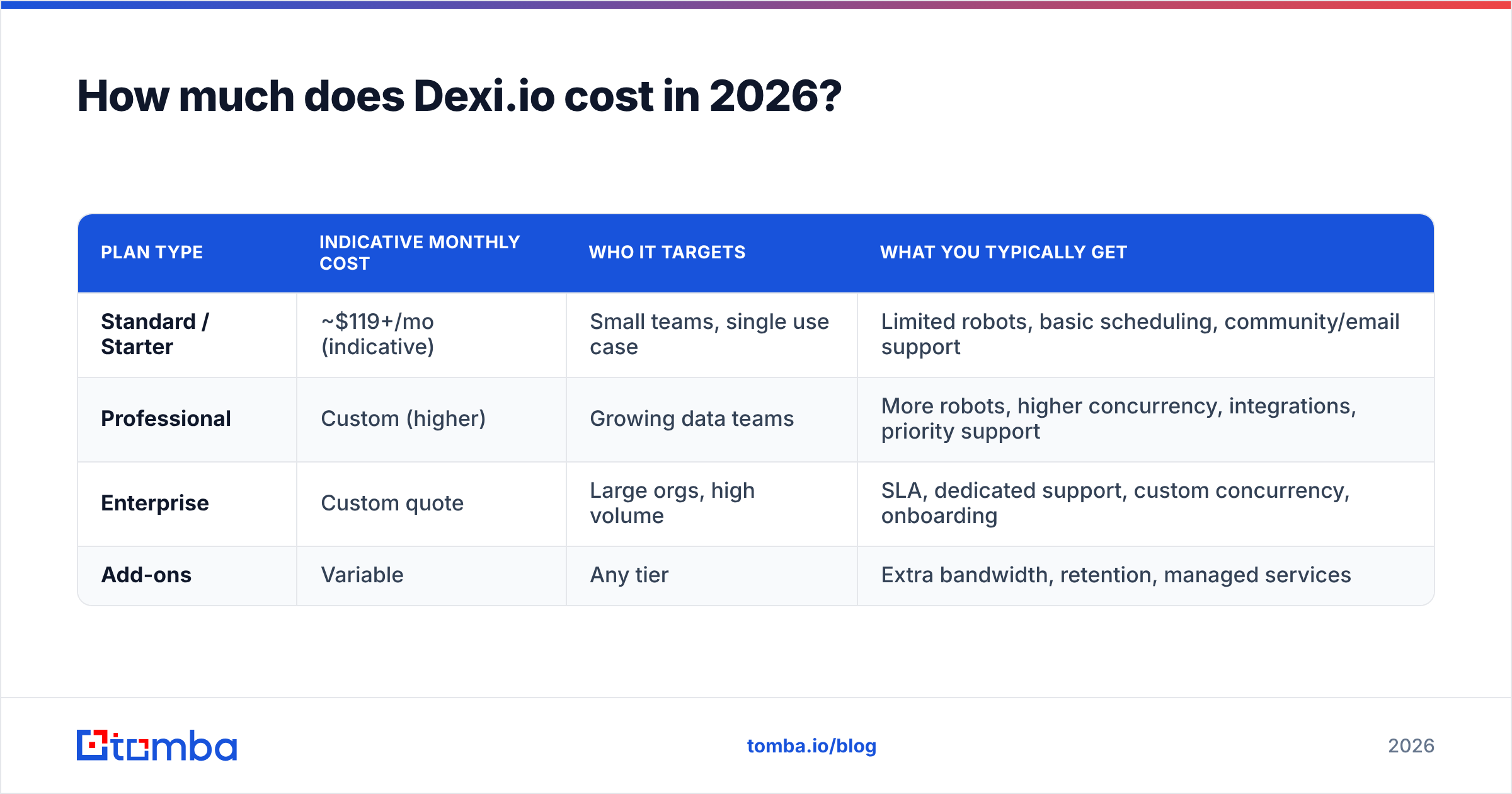
Because the vendor doesn't publish fixed tiers, treat any specific figure you see online as indicative and confirm directly. Based on historical listings and third-party review sites, the shape of the pricing has generally looked like this:
| Plan type | Indicative monthly cost | Who it targets | What you typically get |
|---|---|---|---|
| Standard / Starter | ~$119+/mo (indicative) | Small teams, single use case | Limited robots, basic scheduling, community/email support |
| Professional | Custom (higher) | Growing data teams | More robots, higher concurrency, integrations, priority support |
| Enterprise | Custom quote | Large orgs, high volume | SLA, dedicated support, custom concurrency, onboarding |
| Add-ons | Variable | Any tier | Extra bandwidth, retention, managed services |
The important takeaway is not the exact dollar amount — it's the model. Quote-based pricing means:
- Slow procurement. Expect a demo and a back-and-forth before you know your cost.
- Hard-to-predict scaling. Costs rise with volume in ways that aren't self-service transparent.
- Negotiation matters. Your price may differ from another company's for the same usage.
For comparison, transparent tools let you see the ceiling before you commit. Tomba, for example, publishes flat Tomba pricing: a Free tier (25 searches/mo), Starter at $49/mo, Growth at $99/mo, and Pro at $249/mo. You know your number in ten seconds, not ten emails.
Dexi.io reviews: what real users say#
Pulling from public review platforms like G2 and Capterra, the sentiment clusters into clear themes. Reviews skew positive on capability and negative on accessibility.
What reviewers like:
- Powerful, flexible extraction. Users doing complex, multi-step scraping praise how much you can model — pagination, logins, conditional flows.
- Automation and scheduling. Recurring jobs and pipelines are a strength for teams that live in data ops.
- Integrations and API. The platform plugs into downstream systems rather than being a dead-end CSV export.
- Responsive support at higher tiers. Enterprise customers report solid help during onboarding.
What reviewers criticize:
- Steep learning curve. This is the most common complaint. Non-technical users struggle; robots take time to build and maintain.
- Opaque pricing. Several reviewers note frustration at not being able to see costs upfront.
- Maintenance overhead. When target sites change layout, robots break — a recurring tax on your team's time.
- Overkill for simple needs. People who wanted "just get me the data" found the platform heavier than the job required.
That last point is the crux for most sales and marketing readers. If your end goal is contacts, a scraping platform makes you the data engineer, the verifier, and the compliance owner — all before a single email lands in your CRM.
What are the pros and cons of Dexi.io?#
Here's the honest ledger, condensed.
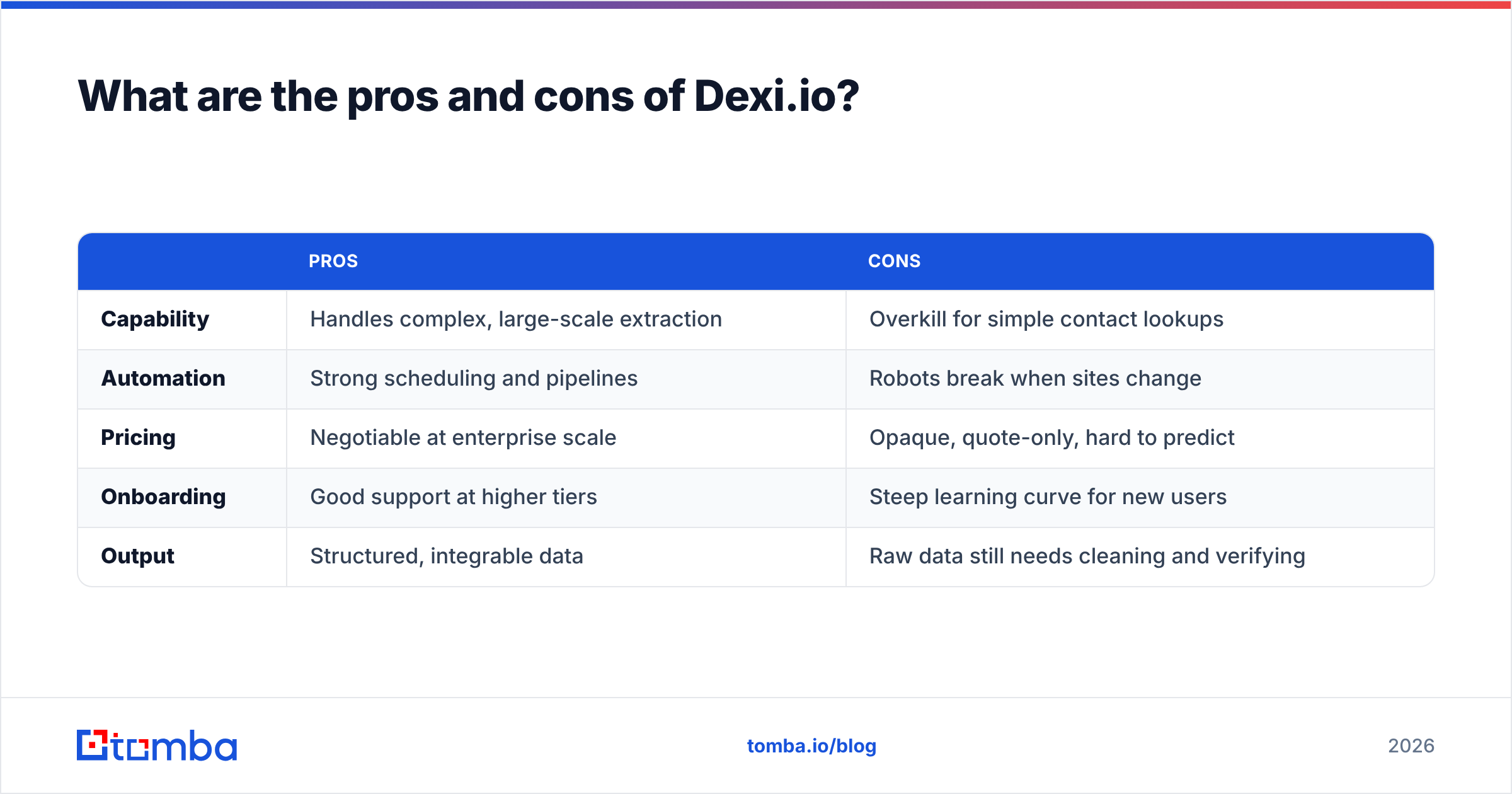
| Pros | Cons | |
|---|---|---|
| Capability | Handles complex, large-scale extraction | Overkill for simple contact lookups |
| Automation | Strong scheduling and pipelines | Robots break when sites change |
| Pricing | Negotiable at enterprise scale | Opaque, quote-only, hard to predict |
| Onboarding | Good support at higher tiers | Steep learning curve for new users |
| Output | Structured, integrable data | Raw data still needs cleaning and verifying |
The pattern is consistent: Dexi.io is a strong general-purpose extraction engine with an enterprise cost and complexity profile. Whether that's a pro or a con depends entirely on whether extraction is your actual problem — or just a means to an end you could reach more directly.
Is Dexi.io worth it for B2B lead generation?#
For pure lead generation, usually no — and the reason is scope. Scraping a website gets you raw strings on a page. It does not get you deliverable, verified business emails, and it certainly doesn't verify them against live mail servers.
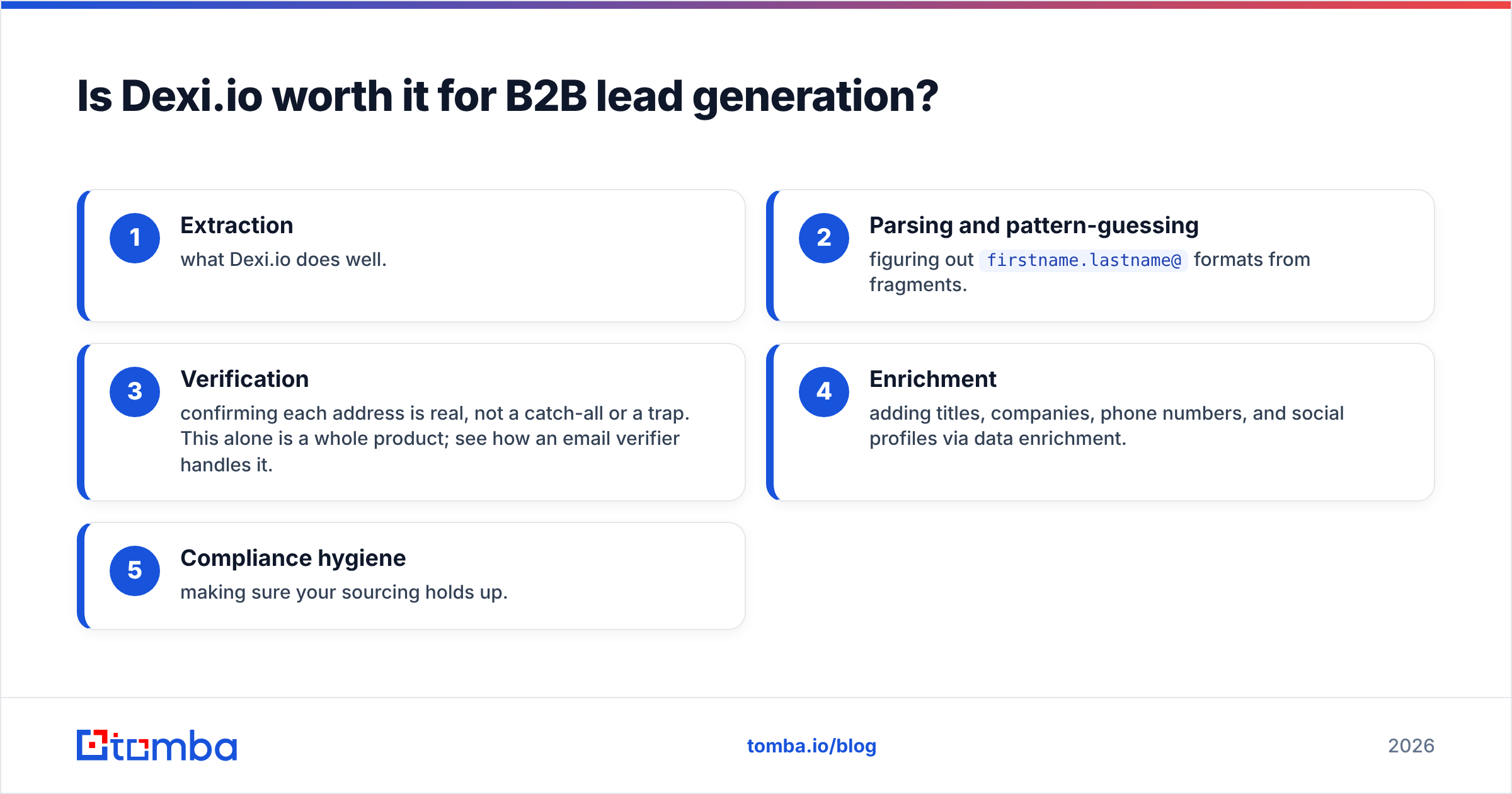
Turning scraped data into usable leads means bolting on several steps Dexi.io doesn't own:
- Extraction — what Dexi.io does well.
- Parsing and pattern-guessing — figuring out
firstname.lastname@formats from fragments. - Verification — confirming each address is real, not a catch-all or a trap. This alone is a whole product; see how an email verifier handles it.
- Enrichment — adding titles, companies, phone numbers, and social profiles via data enrichment.
- Compliance hygiene — making sure your sourcing holds up.
Each step you hand to a general scraper is a step your team maintains forever. A dedicated contact-data tool collapses all five into one API call.

Dexi.io vs a purpose-built email finder: which should you buy?#
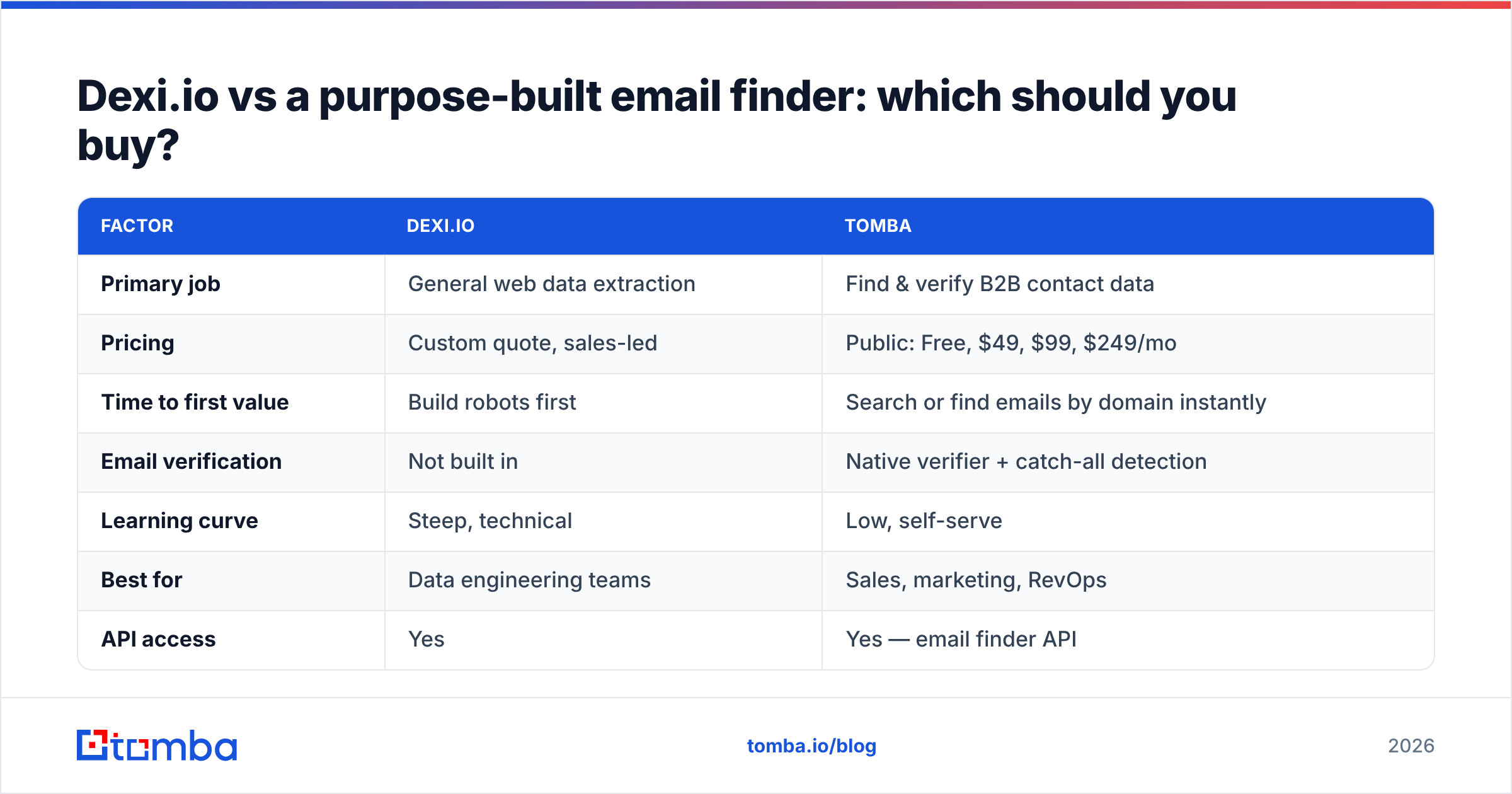
This isn't apples-to-apples — and that's the point. If you need to monitor 10,000 product pages nightly, Dexi.io is the right category and Tomba isn't. If you need verified decision-maker emails for outbound, the reverse is true. Match the tool to the job.
| Factor | Dexi.io | Tomba |
|---|---|---|
| Primary job | General web data extraction | Find & verify B2B contact data |
| Pricing | Custom quote, sales-led | Public: Free, $49, $99, $249/mo |
| Time to first value | Build robots first | Search or find emails by domain instantly |
| Email verification | Not built in | Native verifier + catch-all detection |
| Learning curve | Steep, technical | Low, self-serve |
| Best for | Data engineering teams | Sales, marketing, RevOps |
| API access | Yes | Yes — email finder API |
The honest verdict: these tools solve different problems and can even coexist. Use an extraction platform for large structured datasets. Use a contact-data platform when the deliverable is people you can email. Buying a scraping suite to do lead-gen is like renting a commercial kitchen to make morning coffee — technically possible, wildly over-scoped.
How do you actually turn web data into deliverable contacts?#
If contacts are the goal, skip the robot-building detour and go straight to a tool built for it. The workflow most B2B teams want looks like this:
- Start from a company domain. Feed a domain and get the known email addresses and patterns back — the job of a company email search instead of a custom scraper.
- Verify before you send. Every address runs through verification so bounces stay low and your email deliverability and sender reputation stay intact.
- Enrich for context. Add role, seniority, company size, and phone numbers so reps personalize instead of guess.
- Scale in bulk. Upload a list of domains or names and process them together with a bulk email finder rather than babysitting scheduled robots.
That's the same "data pipeline" idea reviewers praise Dexi.io for — minus the maintenance tax, minus the opaque quote, and with verification baked in rather than bolted on.
Frequently asked questions#
Is Dexi.io free? No. Dexi.io does not offer a meaningful free plan for ongoing use; access is via custom, sales-led pricing. If you want a genuinely free starting point for contact data, Tomba's Free tier gives you 25 searches per month with no card required.
Why isn't Dexi.io pricing public? Because it's an enterprise-style, usage-and-support-scaled product. The vendor tailors quotes to volume and needs. The trade-off is transparency: you can't self-evaluate cost without contacting sales.
Does Dexi.io find email addresses? Not as a native, verified feature. You can attempt to extract emails present on pages, but you'd still handle parsing, verification, and enrichment yourself. A dedicated finder does all three.
Is Dexi.io hard to learn? Reviews consistently cite a steep learning curve. Building and maintaining robots is a technical task. If your team lacks engineering time, factor that cost in.
What's the cheapest way to get verified B2B emails instead? A purpose-built tool with transparent pricing. Tomba starts free and scales to $49/mo — no quote call, no robot maintenance, verification included.
The verdict#
That's the full Dexiio pricing reviews pros and cons picture in one place. Dexi.io is a capable, enterprise-grade web extraction platform that earns its positive reviews on flexibility and automation — and earns its criticism on opaque pricing and a steep learning curve. It's a strong choice if your problem is large-scale, recurring web data extraction and you have the technical team to run it.
But if you landed here because you need accurate, verified B2B contacts — emails, phone numbers, and enriched profiles — Dexi.io is the wrong altitude. You'd be building and maintaining a pipeline to reach an outcome a specialized tool delivers in one call, with pricing you can actually see.
Skip the robot factory. Point Tomba's Email Finder at a name or a domain and get verified, ready-to-use business emails in seconds — start free with 25 searches a month, then scale on flat, published pricing when you're ready. No quote call required.
Related guides#
Ready to find emails that actually work?
Join 150,000+ professionals who stopped guessing and started sending. Free credits on signup — no credit card required.
Get the Tomba newsletter
Practical outbound tactics and product updates — once every two weeks.
About the author