Dialing Innovations Pricing, Reviews, Pros and Cons (2026)
An honest, vendor-neutral breakdown of Dialing Innovations pricing, real user reviews, and the pros and cons that matter before you sign a contract for a hosted dialer or call-center platform in 2026.
Dialing Innovations Pricing, Reviews, Pros and Cons (2026)
Dialing Innovations sells hosted PBX, predictive dialers, and full call-center software to sales teams that live on the phone. The pitch is broad: one platform for inbound, outbound, IVR, agent monitoring, and CRM-style contact management. But the pricing is quote-driven, the feature list is sprawling, and the reviews are thin compared to the household VoIP names. So is it the right dialer for your team, or are you signing up for setup fees and per-seat surprises you didn't budget for?
This is a neutral, buyer-side breakdown — pricing, real pros, real cons, and where it fits against the alternatives.
TL;DR: Is Dialing Innovations worth it?#
- Best fit: small-to-mid outbound teams and BPOs that want an all-in-one hosted dialer plus PBX without stitching together three tools.
- Pricing reality: mostly custom/quote-based with per-seat and per-extension components, plus potential setup and number/DID costs — budget beyond the sticker.
- Strengths: feature breadth (predictive/preview dialing, IVR, call recording, agent dashboards), white-label options, and human onboarding support.
- Weaknesses: dated UI, sparse public pricing, a learning curve, and a much smaller review footprint than RingCentral, Five9, or Aircall.
- The bigger lever: a dialer only pays off if the numbers you load are accurate. Bad data caps your connect rate no matter which platform dials it.
What is Dialing Innovations?#
Dialing Innovations is a cloud communications provider focused on outbound-heavy phone operations. Think of it less as a slick startup VoIP app and more as a Swiss-army telephony platform: hosted PBX for your internal phones, a call-center module for agent teams, predictive and preview dialers for high-volume outbound, IVR menus for inbound routing, and call recording plus reporting layered on top.
The everyday analogy: most modern VoIP tools (Aircall, Dialpad) are like a polished consumer coffee machine — one button, looks great, does the common jobs well. Dialing Innovations is closer to a commercial espresso rig — more knobs, more power, more ways to configure it exactly how a call floor wants, and a steeper learning curve to match. Technically, it bundles PBX, ACD (automatic call distribution), and a dialer engine into one hosted stack you rent per seat.
It tends to show up on the shortlists of collections agencies, appointment-setting shops, lead-gen BPOs, and inside-sales teams that need volume dialing and white-label control more than they need a beautiful mobile app.

How much does Dialing Innovations pricing cost in 2026?#
Short answer: it's mostly quote-based, so treat any single number you see online with suspicion. Unlike transparent per-seat SaaS, Dialing Innovations pricing is assembled from several moving parts, and the total depends on seat count, dialer type, number of DIDs, and whether you want white-label.
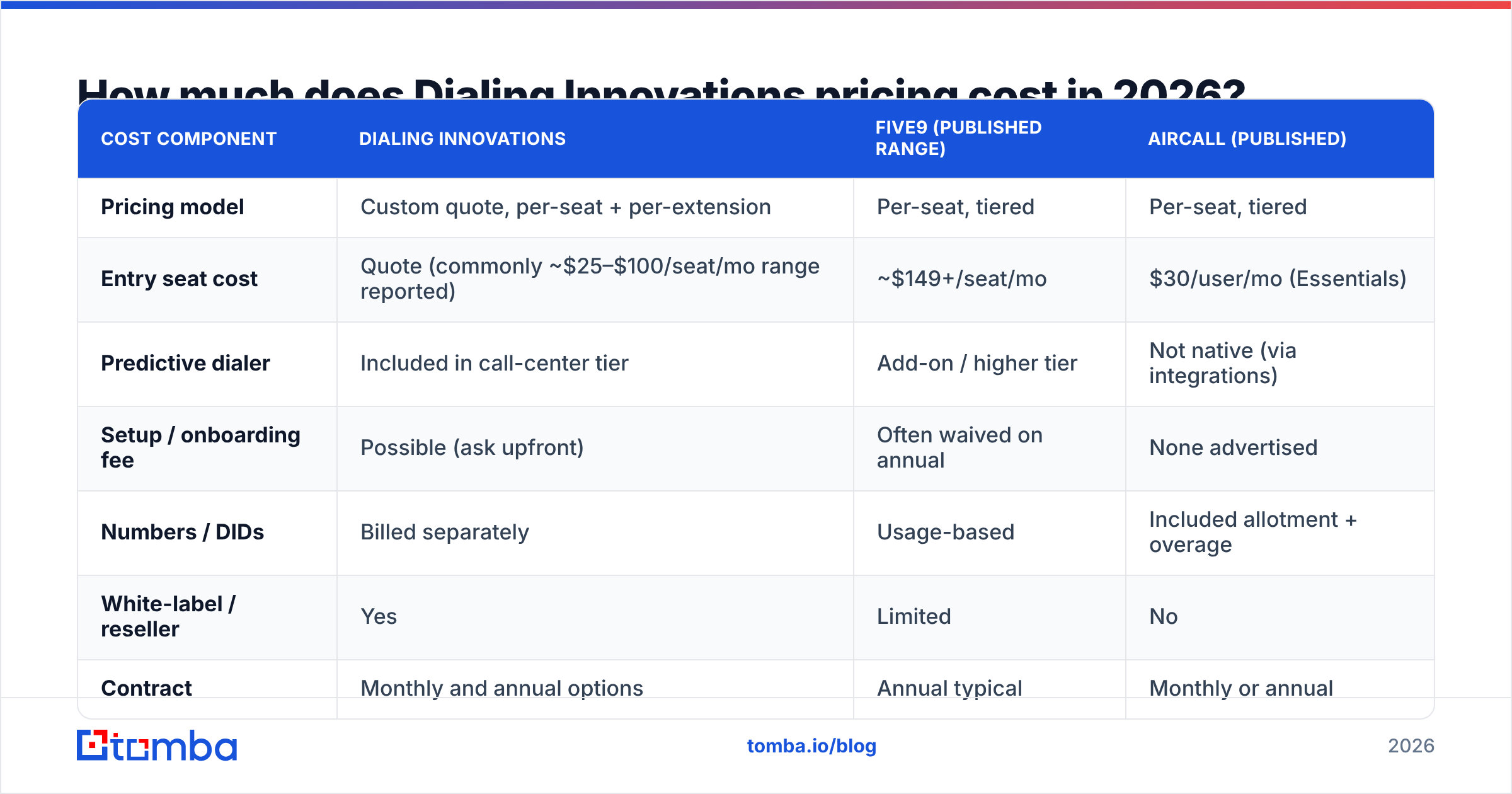
Here's how the cost structure typically breaks down, and how it compares to the publicly listed pricing of mainstream alternatives:
| Cost component | Dialing Innovations | Five9 (published range) | Aircall (published) |
|---|---|---|---|
| Pricing model | Custom quote, per-seat + per-extension | Per-seat, tiered | Per-seat, tiered |
| Entry seat cost | Quote (commonly ~$25–$100/seat/mo range reported) | ~$149+/seat/mo | $30/user/mo (Essentials) |
| Predictive dialer | Included in call-center tier | Add-on / higher tier | Not native (via integrations) |
| Setup / onboarding fee | Possible (ask upfront) | Often waived on annual | None advertised |
| Numbers / DIDs | Billed separately | Usage-based | Included allotment + overage |
| White-label / reseller | Yes | Limited | No |
| Contract | Monthly and annual options | Annual typical | Monthly or annual |
Two takeaways. First, the headline per-seat figure is not the whole bill — DIDs, minutes, and setup can add 20–40% depending on volume. Second, Dialing Innovations can undercut enterprise CCaaS players like Five9 on raw seat price while offering more dialer power than a lightweight tool like Aircall. That middle-ground positioning is the whole reason it exists.
Before you commit, get a written quote that itemizes: seats, extensions, dialer license, per-minute or bundled minutes, DID costs, recording storage, and any one-time setup. If a line item is "TBD," that's your negotiation lever.
What do Dialing Innovations reviews actually say?#
Reviews are limited but directionally consistent. Because Dialing Innovations serves a niche and doesn't chase G2 badges the way big CCaaS vendors do, you'll find far fewer verified reviews than for RingCentral or Five9. Cross-reference the few you find on G2 and Capterra rather than trusting the vendor site alone.
The recurring themes from users and comparable hosted-dialer feedback:
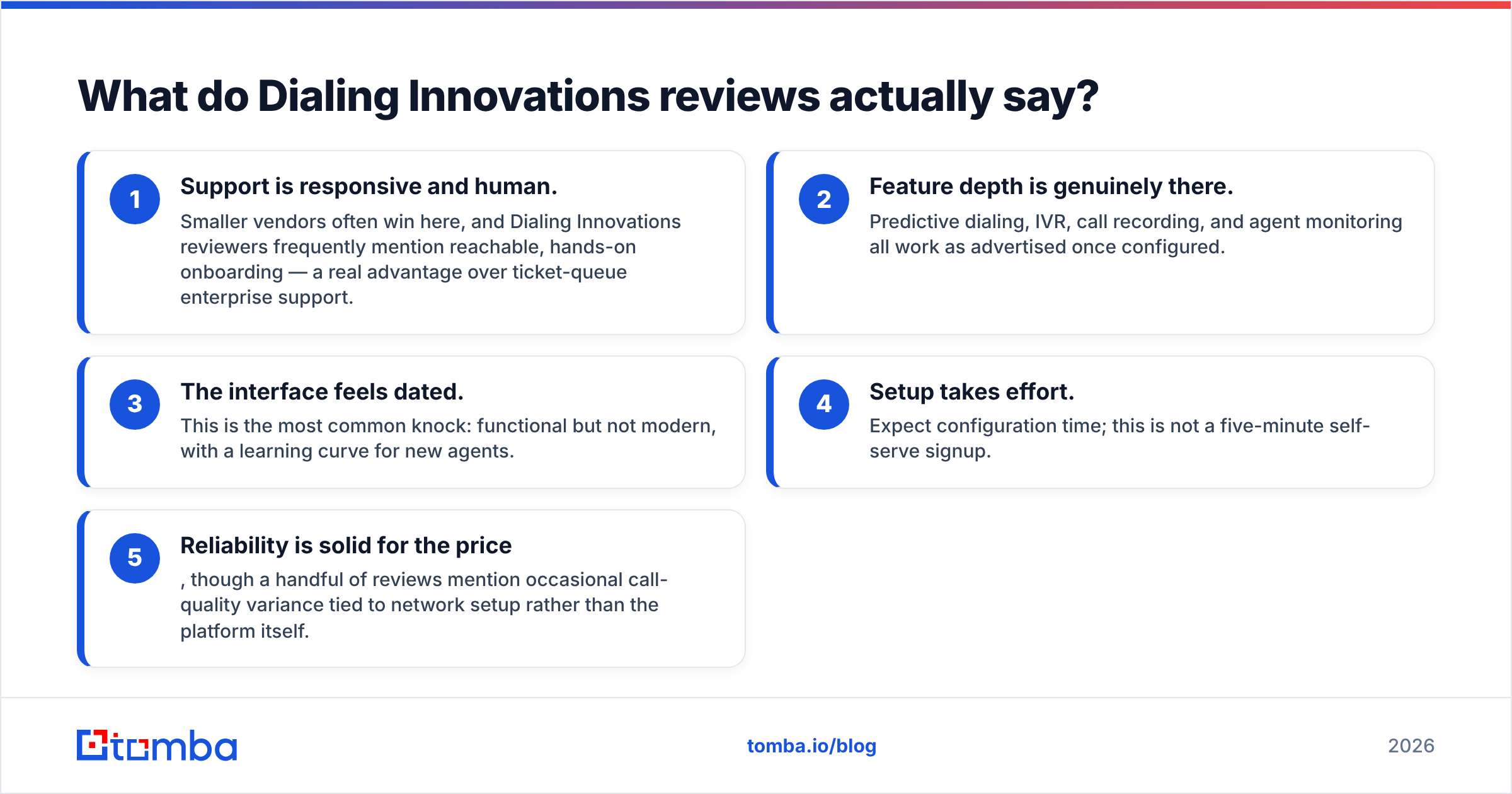
- Support is responsive and human. Smaller vendors often win here, and Dialing Innovations reviewers frequently mention reachable, hands-on onboarding — a real advantage over ticket-queue enterprise support.
- Feature depth is genuinely there. Predictive dialing, IVR, call recording, and agent monitoring all work as advertised once configured.
- The interface feels dated. This is the most common knock: functional but not modern, with a learning curve for new agents.
- Setup takes effort. Expect configuration time; this is not a five-minute self-serve signup.
- Reliability is solid for the price, though a handful of reviews mention occasional call-quality variance tied to network setup rather than the platform itself.
Net read: buyers who take time to configure it and value phone support are satisfied; buyers expecting a plug-and-play consumer app are frustrated. Know which camp you're in.
Dialing Innovations pros and cons#
Here's the honest ledger.
Pros
- All-in-one telephony: PBX + call center + dialer in one bill, fewer vendors to manage.
- Powerful outbound: predictive and preview dialing suited to high-volume calling.
- White-label / reseller friendly: attractive if you resell communications or run a BPO under your own brand.
- Competitive seat pricing versus enterprise CCaaS, with room to negotiate.
- Responsive support and onboarding, a common small-vendor strength.
Cons
- Opaque pricing: you can't self-serve a clear price; every deal is a quote.
- Dated UX: the interface and admin console feel a generation behind newer tools.
- Learning curve: configuration and agent training take real time.
- Thin third-party reviews: harder to validate claims independently.
- Add-on costs: DIDs, minutes, and setup can inflate the "cheap seat" story.
Who should choose Dialing Innovations (and who shouldn't)?#
Choose it if you run an outbound-heavy floor — appointment setting, collections, telesales, or a BPO — that needs predictive dialing and white-label control, and you're comfortable trading a polished UI for configurability and a negotiable price. The support-forward model suits teams that would rather call a human than file a ticket.
Look elsewhere if you're a small SaaS or startup sales team that wants a modern, self-serve app with a great mobile experience and Slack/HubSpot integrations out of the box. In that case Aircall, Dialpad, or JustCall will feel dramatically smoother. And if you need Fortune-500-grade CCaaS scale with omnichannel (chat, email, social) baked in, Five9 or Genesys are the heavier-duty picks — at heavier-duty prices.
A simple decision filter:
| Your situation | Better-fit choice |
|---|---|
| High-volume outbound, white-label, price-sensitive | Dialing Innovations |
| Modern UI, easy setup, SMB sales team | Aircall / Dialpad |
| Enterprise omnichannel contact center | Five9 / Genesys |
| Occasional calling bolted onto CRM | JustCall / built-in CRM dialer |
What actually determines your dialer ROI?#
The data you load matters more than the dialer that dials it. This is the part most "best dialer" comparisons skip. You can buy the most sophisticated predictive dialer on the market, but if 30% of your phone numbers are wrong, disconnected, or belong to the wrong contact, your connect rate — and your agents' morale — collapse.
Think of the dialer as the engine and your contact list as the fuel. A Ferrari engine runs terribly on contaminated fuel. Before you obsess over predictive-versus-preview dialing modes, fix the inputs:
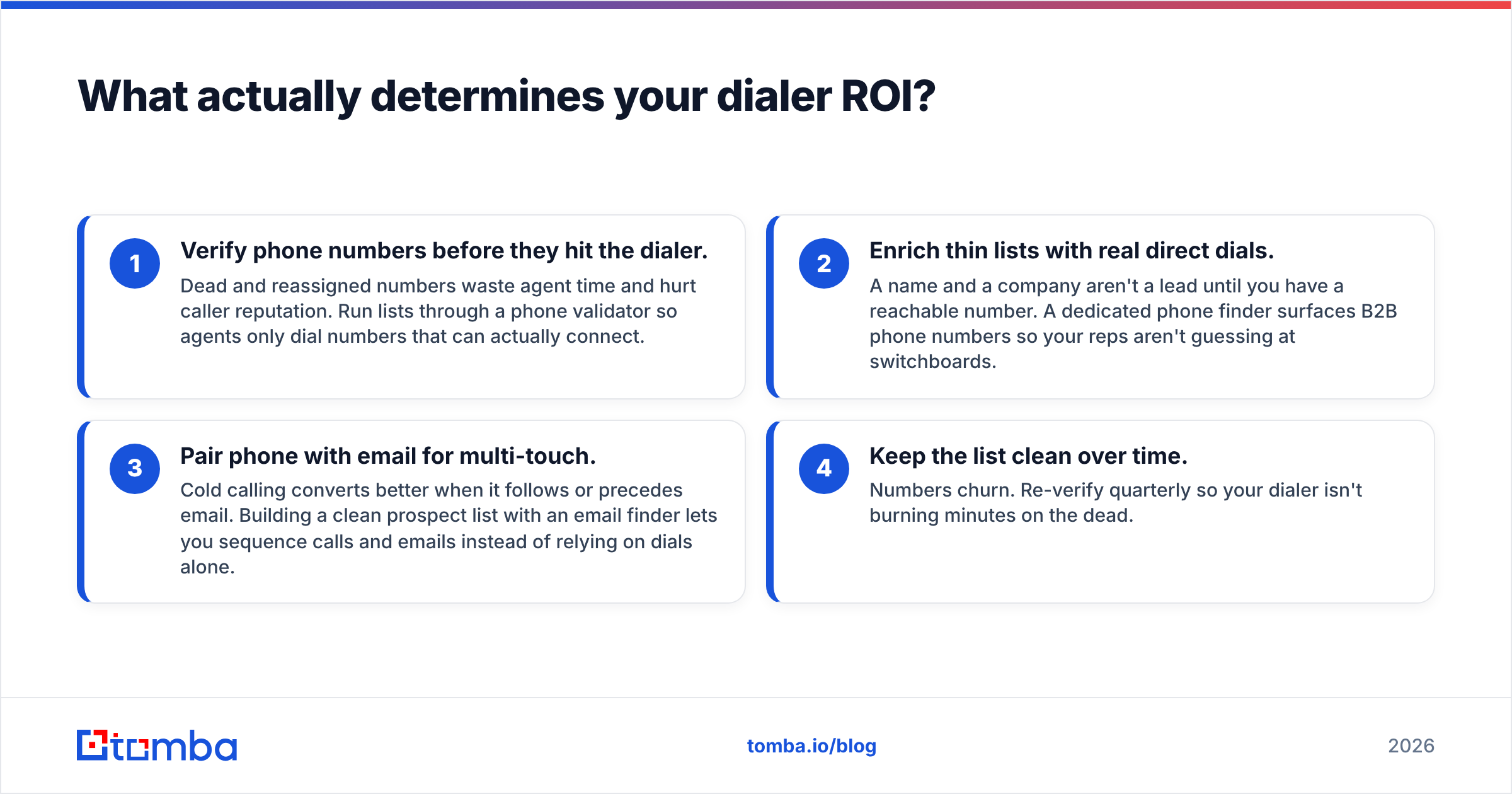
- Verify phone numbers before they hit the dialer. Dead and reassigned numbers waste agent time and hurt caller reputation. Run lists through a phone validator so agents only dial numbers that can actually connect.
- Enrich thin lists with real direct dials. A name and a company aren't a lead until you have a reachable number. A dedicated phone finder surfaces B2B phone numbers so your reps aren't guessing at switchboards.
- Pair phone with email for multi-touch. Cold calling converts better when it follows or precedes email. Building a clean prospect list with an email finder lets you sequence calls and emails instead of relying on dials alone.
- Keep the list clean over time. Numbers churn. Re-verify quarterly so your dialer isn't burning minutes on the dead.
No dialer vendor — Dialing Innovations included — fixes bad data for you. That's a separate, upstream job, and it's usually the cheapest lever on your whole cost-per-connection.
How does Dialing Innovations pricing compare to building a lean stack?#
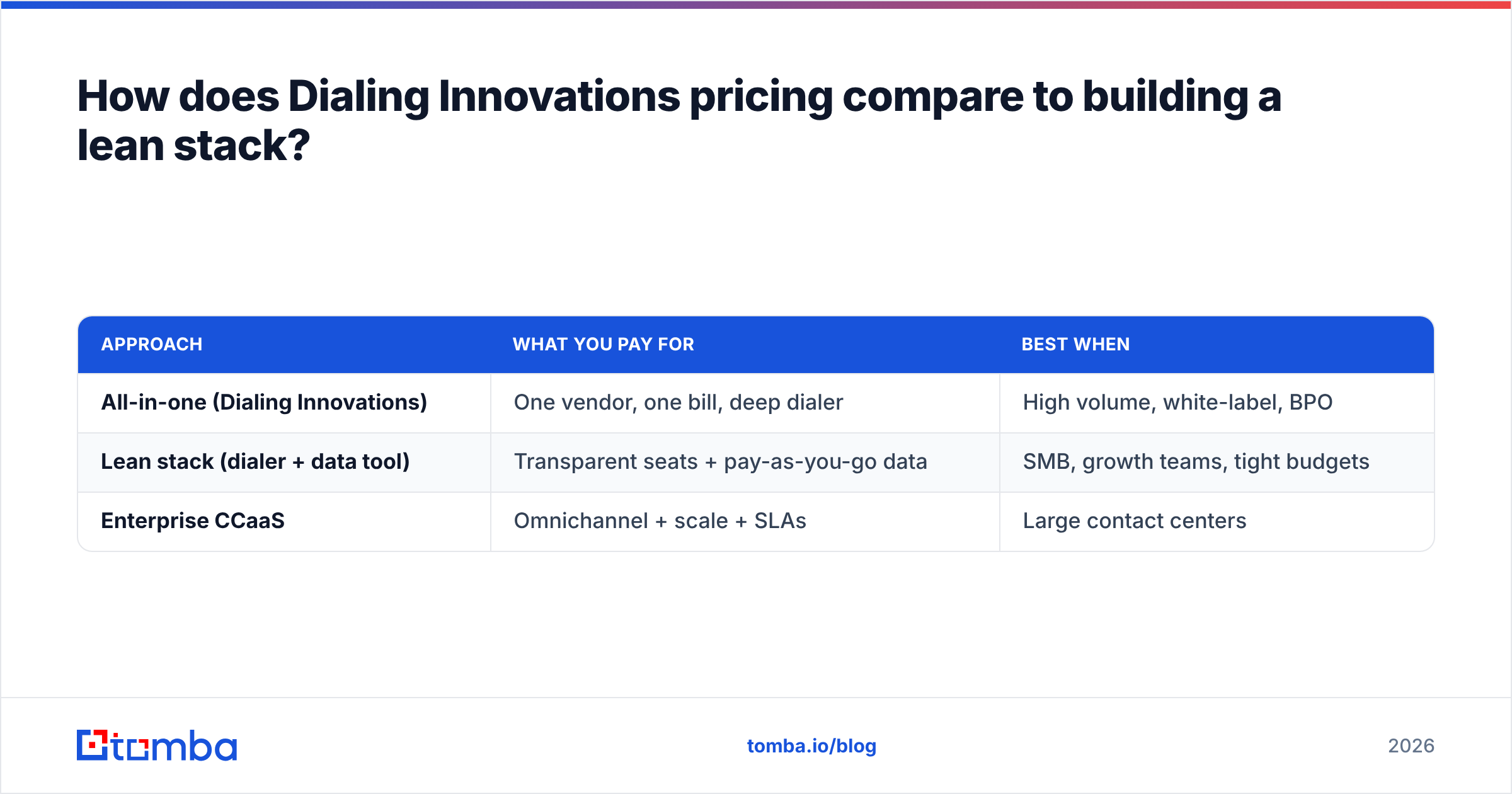
For many small teams, the smarter move is a lean stack: a modern, transparent dialer (or even a CRM-native one) plus a dedicated data layer for accurate numbers and emails. You get predictable pricing and better inputs, often for less than an all-in-one quote.
| Approach | What you pay for | Best when |
|---|---|---|
| All-in-one (Dialing Innovations) | One vendor, one bill, deep dialer | High volume, white-label, BPO |
| Lean stack (dialer + data tool) | Transparent seats + pay-as-you-go data | SMB, growth teams, tight budgets |
| Enterprise CCaaS | Omnichannel + scale + SLAs | Large contact centers |
If you go the lean route, a data tool like Tomba covers the fuel side. Tomba's pricing is transparent and self-serve — a Free tier with 25 searches a month, Starter at $49/mo, Growth at $99/mo, and Pro at $249/mo — so you're not stuck in a quote cycle just to find out what accurate contact data costs.
Frequently asked questions#
Is Dialing Innovations cheaper than Five9 or RingCentral? Often on raw per-seat price, yes — but the comparison isn't apples-to-apples. Enterprise CCaaS platforms bundle omnichannel, compliance tooling, and scale that Dialing Innovations doesn't emphasize. Compare total cost including DIDs, minutes, and setup, not just seat price.
Does Dialing Innovations have a free trial? Availability changes, so ask directly. Because pricing is quote-based, most buyers get a guided demo and a trial as part of the sales conversation rather than a self-serve signup.
Is there a setup fee? Sometimes. Setup and onboarding fees can appear depending on configuration and seat count. Get it in writing before you sign — it's a common source of "surprise" first invoices.
Will a better dialer fix my low connect rate? Only partly. If your numbers are stale or wrong, no dialer saves you. Verify and enrich your list first — that usually moves connect rate more than switching platforms.
The bottom line#
Dialing Innovations is a legitimate, feature-deep hosted-dialer platform that earns its place for outbound-heavy, price-sensitive, white-label operations — provided you go in with eyes open about the dated UI, the setup effort, and the quote-based pricing that hides real costs in DIDs, minutes, and onboarding. It's not the pick for a startup that wants a beautiful self-serve app, and it's not enterprise CCaaS.
Whichever dialer you land on, remember the lever that outperforms all of them: clean, accurate contact data. A dialer only makes money when it reaches real people at real numbers. Feed it verified B2B phone numbers and enriched contacts from Tomba's Email Finder and phone tools, and every seat you pay for — on Dialing Innovations or anywhere else — starts connecting more, faster. Start free and see how much of your dialing budget you've been wasting on bad numbers.
Related guides#
Ready to find emails that actually work?
Join 150,000+ professionals who stopped guessing and started sending. Free credits on signup — no credit card required.
Get the Tomba newsletter
Practical outbound tactics and product updates — once every two weeks.
About the author