Dialpad vs MightyCall: The Honest 2026 Business Phone Comparison
Dialpad brings AI-native calling; MightyCall wins on price and simplicity. Here's an honest 2026 breakdown of features, pricing, and which phone system fits your team.
Dialpad vs MightyCall: The Honest 2026 Business Phone Comparison
Choosing a business phone system in 2026 usually comes down to a simple tension: do you pay more for AI that transcribes, coaches, and summarizes every call, or do you pay less for a clean, reliable VoIP line that just works? Dialpad and MightyCall sit on opposite ends of that spectrum. This is a neutral, side-by-side look at where each one earns its price.
TL;DR — Dialpad vs MightyCall at a glance#
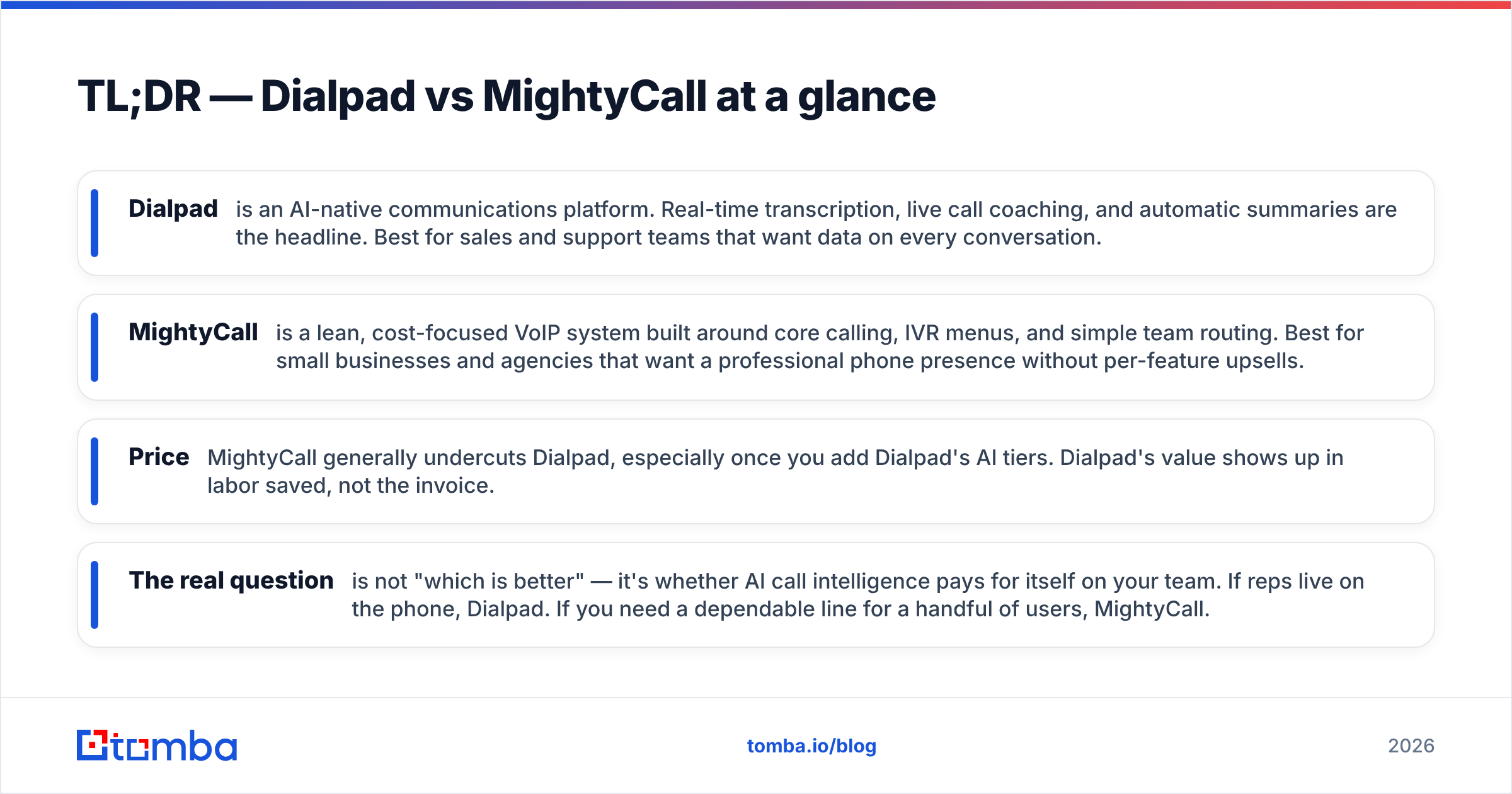
- Dialpad is an AI-native communications platform. Real-time transcription, live call coaching, and automatic summaries are the headline. Best for sales and support teams that want data on every conversation.
- MightyCall is a lean, cost-focused VoIP system built around core calling, IVR menus, and simple team routing. Best for small businesses and agencies that want a professional phone presence without per-feature upsells.
- Price: MightyCall generally undercuts Dialpad, especially once you add Dialpad's AI tiers. Dialpad's value shows up in labor saved, not the invoice.
- The real question is not "which is better" — it's whether AI call intelligence pays for itself on your team. If reps live on the phone, Dialpad. If you need a dependable line for a handful of users, MightyCall.

What is Dialpad?#
Dialpad is a cloud communications platform (UCaaS) built AI-first. Instead of bolting transcription onto an old PBX, Dialpad designed its stack around real-time voice intelligence. When a call connects, Dialpad Ai transcribes it live, detects sentiment, surfaces coaching cards to reps, and writes a summary with action items the moment you hang up.
The platform spans voice, video, SMS, and team messaging, plus a dedicated contact-center product (Dialpad Ai Contact Center) and a sales-focused tier (Dialpad Ai Sales Center) with real-time assist and objection-handling prompts. It integrates with the CRMs sales teams actually use — Salesforce, HubSpot, and others — so call notes and dispositions sync automatically.
In plain terms: Dialpad is like having a note-taker, a coach, and a data analyst riding along on every call. That's powerful if your revenue depends on conversation quality. It's overkill if you just need customers to reach you.
What is MightyCall?#
MightyCall is a virtual phone system aimed squarely at small businesses, agencies, and solo operators. Its pitch is straightforward: get a professional business number, set up an auto-attendant (IVR) menu, route calls to your team, and manage everything from a web and mobile app — without enterprise pricing or an enterprise learning curve.
The feature set covers the fundamentals well: call routing, business hours rules, voicemail-to-text, call recording, a shared team inbox, and toll-free or local numbers. Higher tiers add supervision features like call monitoring, whispering, and barging, plus basic reporting and integrations. There's no sprawling AI layer — and for a lot of buyers, that's the point.
Think of MightyCall as a well-built receptionist desk: it answers, routes, and records reliably, and it doesn't try to sell you a robot analyst you'll never open.
Dialpad vs MightyCall: Full feature and pricing comparison#
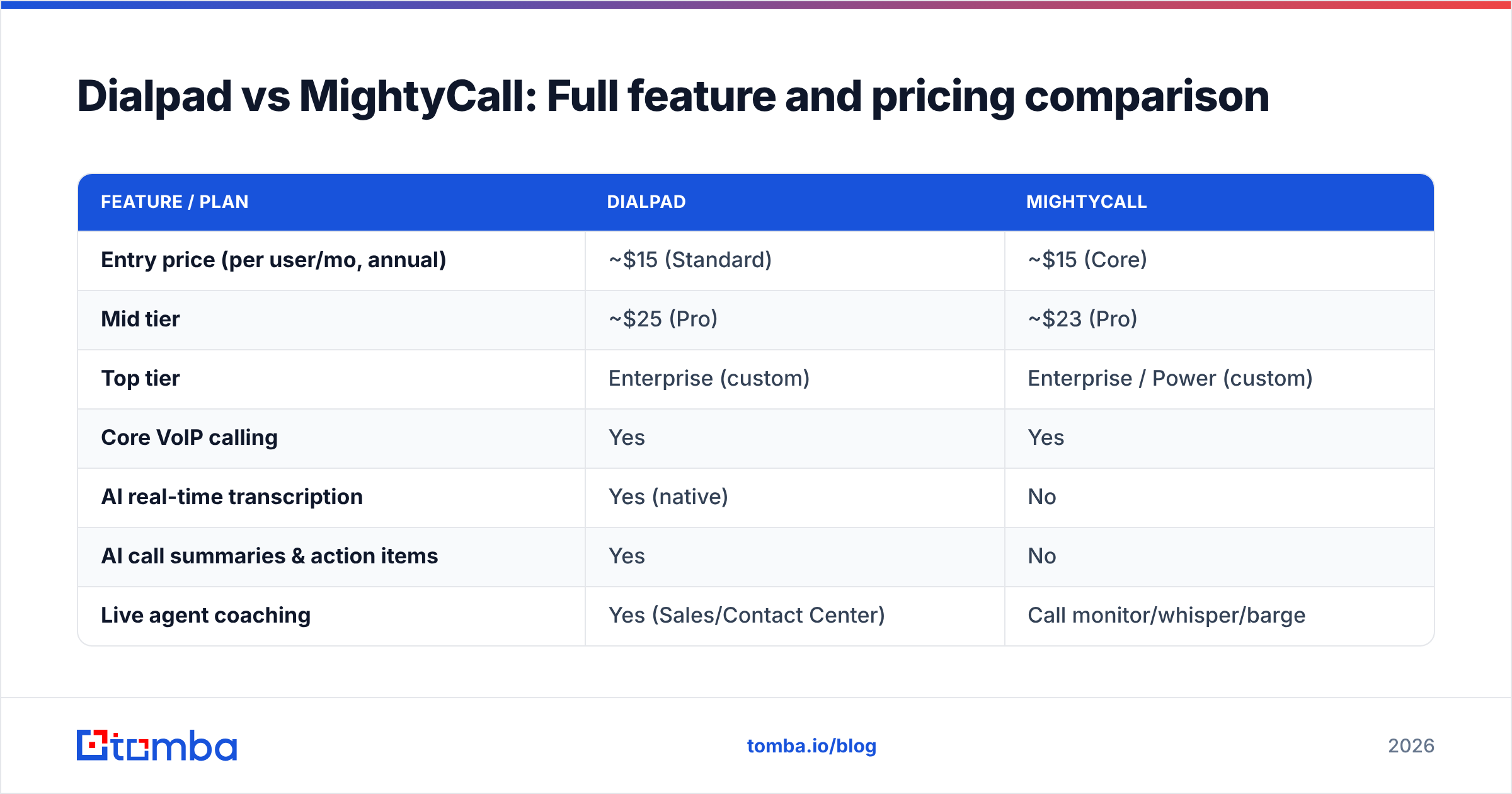
Pricing below reflects publicly listed 2026 plans (billed annually where noted). Always confirm current rates on each vendor's site before you commit, since VoIP pricing shifts often.
| Feature / Plan | Dialpad | MightyCall |
|---|---|---|
| Entry price (per user/mo, annual) | ~$15 (Standard) | ~$15 (Core) |
| Mid tier | ~$25 (Pro) | ~$23 (Pro) |
| Top tier | Enterprise (custom) | Enterprise / Power (custom) |
| Core VoIP calling | Yes | Yes |
| AI real-time transcription | Yes (native) | No |
| AI call summaries & action items | Yes | No |
| Live agent coaching | Yes (Sales/Contact Center) | Call monitor/whisper/barge |
| IVR / auto-attendant | Yes | Yes |
| SMS / MMS | Yes | Yes |
| Video meetings | Yes | No (voice-focused) |
| CRM integrations | Broad (Salesforce, HubSpot) | Core CRMs + Zapier |
| Best fit | AI-driven sales & support | Cost-conscious SMBs & agencies |
A few honest takeaways from the table:
- Entry prices look similar, but the value diverges fast. Dialpad's cheapest tier gives you AI basics; to unlock the full sales-coaching stack you move up to Pro or a Contact/Sales Center plan, which costs more.
- MightyCall is voice-first. If you need integrated video conferencing, Dialpad covers it natively while MightyCall expects you to keep Zoom or Google Meet.
- AI is the whole ballgame. Everything Dialpad charges a premium for — transcription, summaries, real-time assist — MightyCall simply doesn't offer. That's not a knock; it's a different product philosophy.
- Both scale to teams, but MightyCall's supervisor tools (monitor, whisper, barge) give managers meaningful oversight without the AI price tag.
Is Dialpad better than MightyCall for sales teams?#
For high-volume outbound and inbound sales, Dialpad has a real edge — but only if you'll use what you pay for. The Ai Sales Center surfaces live objection-handling prompts, flags competitor mentions, and auto-logs call outcomes to your CRM. Managers get searchable transcripts instead of relying on reps' memory, which shortens coaching cycles and makes ramp faster for new hires.
That said, tools don't dial themselves. The best call-intelligence platform in the world still needs accurate contact data feeding the top of the funnel. If your reps burn time hunting for direct numbers, no amount of AI coaching fixes the real bottleneck. Pairing a dialer with a reliable phone finder — and verified email as a fallback channel — usually moves connect rates more than switching phone vendors does.
MightyCall's answer for sales teams is simpler and cheaper: route leads to the right rep, record for quality, and let a manager listen in when needed. For a five-person agency doing consultative outreach, that's often enough. You lose the analytics, but you keep the budget.

Which is easier to set up and use?#
Both platforms are cloud-based with web and mobile apps, so there's no hardware PBX to rack. The difference is surface area.
- MightyCall is genuinely fast to stand up. Pick a number, build your IVR tree in a visual editor, assign extensions, and you're live in an afternoon. Fewer features means fewer decisions.
- Dialpad is also polished, but the AI configuration, coaching playbooks, and CRM field mappings add setup steps. The payoff is bigger; so is the initial lift.
If your team is non-technical or you want minimal admin overhead, MightyCall's simplicity is a feature, not a limitation. If you have a RevOps or sales-ops owner who'll tune the AI and integrations, Dialpad rewards that investment.
What about call quality and reliability?#
Both vendors run on established cloud voice infrastructure and publish strong uptime. In practice, call quality on either system depends more on your network — bandwidth, jitter, and whether reps are on wired connections or hotel Wi-Fi — than on the vendor logo. Neither Dialpad nor MightyCall is the reason a call drops on a bad connection.
One neutral tip: test both during a free trial from the exact environments your team actually works in. A demo from a fiber office tells you little about a rep dialing from a co-working space. Check third-party reviews on G2 for consistent patterns rather than one-off complaints.
Dialpad vs MightyCall: pros and cons#
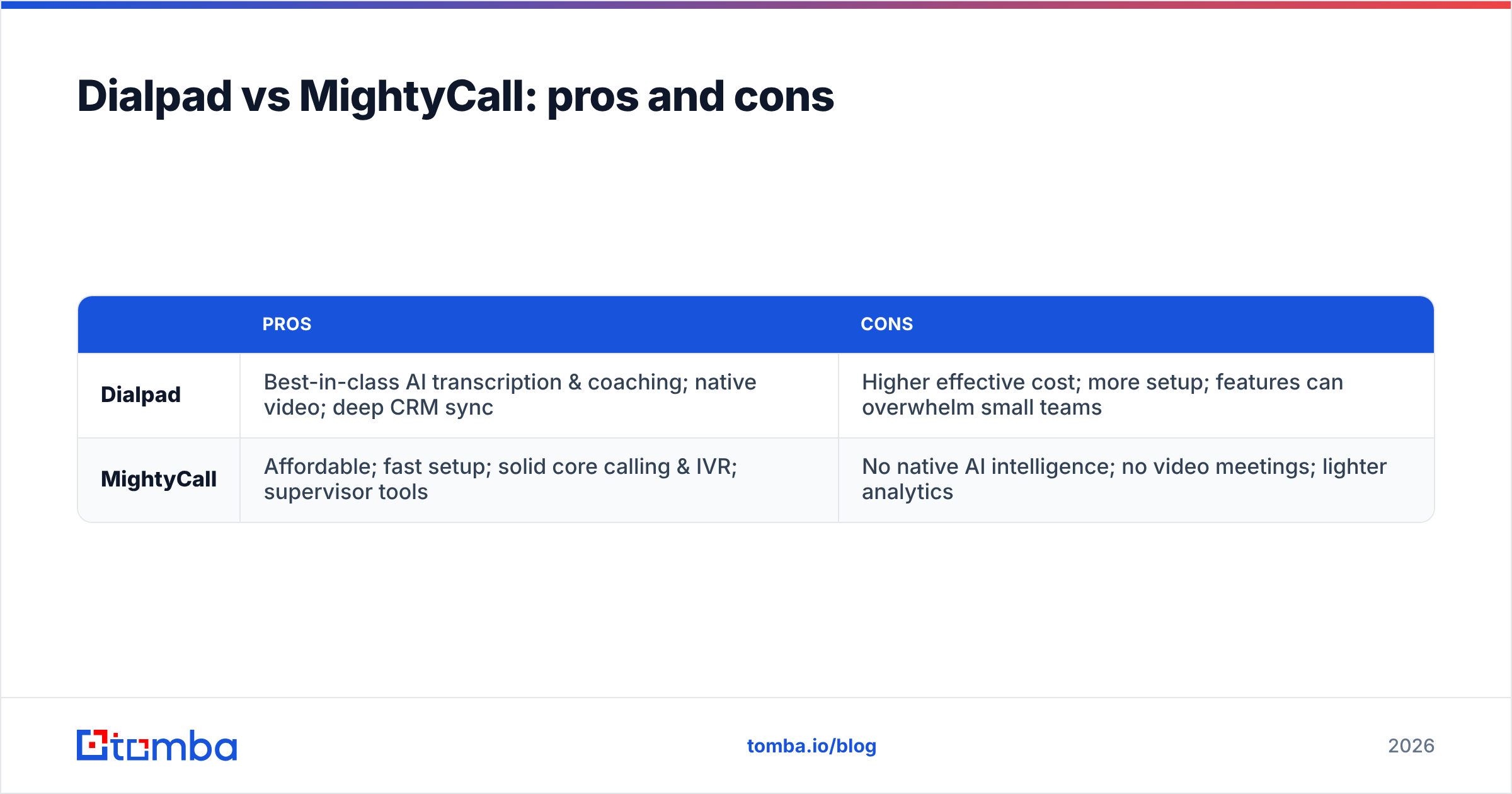
| Pros | Cons | |
|---|---|---|
| Dialpad | Best-in-class AI transcription & coaching; native video; deep CRM sync | Higher effective cost; more setup; features can overwhelm small teams |
| MightyCall | Affordable; fast setup; solid core calling & IVR; supervisor tools | No native AI intelligence; no video meetings; lighter analytics |
Which business phone system should you choose in 2026?#
Choose Dialpad if conversations are your revenue engine and you'll actually use call intelligence — transcripts, summaries, live coaching. Sales orgs scaling headcount, contact centers, and any team where "what did the customer say?" is a daily question get outsized value here.
Choose MightyCall if you want a dependable, professional phone system at a predictable price, without paying for AI you won't open. Agencies, local service businesses, real-estate teams, and lean startups tend to land here and stay happy.
There's no universal winner — there's a winner for your workflow. Map your must-haves against the comparison table above, run both trials in parallel, and let connect rates and rep feedback decide.
Where email and phone data fit into the picture#
Here's the part both vendor sites gloss over: your phone system is a channel, not a pipeline. Whether you land on Dialpad's AI stack or MightyCall's clean VoIP, the dialer is only as good as the contacts you load into it. Wrong numbers, missing direct lines, and stale records quietly tank every metric your shiny phone platform reports.
That's where accurate contact discovery earns its keep. Before a rep ever picks up the phone, you want verified decision-maker details — direct numbers and reliable email as a second touch. Tomba's email finder surfaces professional email addresses by name, domain, or company, its email verifier keeps your lists clean so bounces don't wreck sender reputation, and data enrichment fills the gaps your CRM leaves behind. Fair-priced too — plans start free (25 searches/mo) and scale from $49/mo, with full Tomba pricing published up front.
The bottom line on Dialpad vs MightyCall#
Dialpad and MightyCall aren't really competing for the same buyer. Dialpad sells intelligence; MightyCall sells simplicity and price. Decide which problem is actually costing you money — poor call insight, or an overbuilt bill — and the choice gets obvious.
Then handle the input side. A great phone system dialing bad data is expensive noise. Feed your Dialpad or MightyCall setup with verified contacts using the Tomba Email Finder, start free, and make every one of those calls count. Your reps will notice the difference faster than any feature comparison can promise.
Related guides#
Ready to find emails that actually work?
Join 150,000+ professionals who stopped guessing and started sending. Free credits on signup — no credit card required.
Get the Tomba newsletter
Practical outbound tactics and product updates — once every two weeks.
About the author