Dialpad vs Nextiva (2026): The Honest VoIP Comparison
Dialpad vs Nextiva, compared without the sales spin: pricing, AI features, call quality, and which business phone system actually fits your team in 2026.
Choosing a business phone system usually comes down to two very different bets: a platform built around AI-native calling, or an all-in-one communications suite that does voice, video, and messaging under one roof. Dialpad and Nextiva are the two names that keep landing on that shortlist — and they win for different reasons.
This is a straight comparison. No "both are great, pick what works for you" cop-out. By the end you'll know which one fits your team, where each one quietly costs more than the sticker price, and how to make sure the phone system isn't the weak link in your outbound motion.
TL;DR — Dialpad vs Nextiva in 30 seconds#
- Dialpad wins on AI. Real-time transcription, live call coaching, and AI-generated call summaries are baked into the core product, not sold as a premium tier.
- Nextiva wins on all-in-one breadth. Voice, video, team chat, and a customer-experience layer (surveys, CRM-lite, social) under one contract, with a reputation for uptime.
- Pricing is close at entry, diverges at scale. Both start in the mid-$20s per user; Nextiva's higher tiers add CX tooling, Dialpad's add AI seats and contact-center features.
- Call quality is a wash for most teams — both run on redundant cloud infrastructure with 99.9%+ uptime SLAs. Your internet and headset matter more than the vendor here.
- Neither tool finds you numbers to dial. A phone system routes calls; it doesn't build your prospect list. That gap is where most outbound teams leak pipeline.
What is Dialpad, and who is it for?#
Dialpad is a cloud communications platform built AI-first. Its headline feature, Dialpad Ai, transcribes calls in real time, surfaces coaching cues while you're still on the line, and writes a summary the moment you hang up. For sales and support teams that live on the phone, that's the whole pitch: less note-taking, faster ramp for new reps, and searchable transcripts instead of "I think the customer said…"
Dialpad sells three related products — Business Communications (the phone system), Ai Contact Center, and Ai Sales — so a growing team can start with basic calling and expand into a full contact center without switching vendors. It leans younger, more tech-forward, and more sales-native than most UCaaS suites.
The trade-off: Dialpad's video and team-messaging features are competent but not the reason anyone buys it. If your team needs a Slack-killer or a Zoom replacement, Dialpad is a phone system that happens to also do those things — not the other way around.
What is Nextiva, and who is it for?#
Nextiva is an all-in-one business communications suite. Voice is the anchor, but the platform stretches into video meetings, team collaboration, and a customer-experience layer that includes call surveys, a lightweight CRM, and social/messaging channels. Nextiva's positioning is "run your whole customer conversation in one place," and it targets established SMBs and mid-market companies that want fewer vendors, not more features to configure.
Nextiva has spent years building a reputation for reliability and support — it consistently rates well for uptime and customer service on review sites like G2. For a 40-person company that just wants phones that work, a predictable bill, and a support line that picks up, that reputation carries real weight.
The trade-off runs the opposite direction from Dialpad: Nextiva's AI features are newer and less central to the product. You're buying breadth and stability, not a cutting-edge coaching engine.
Dialpad vs Nextiva: the head-to-head comparison#
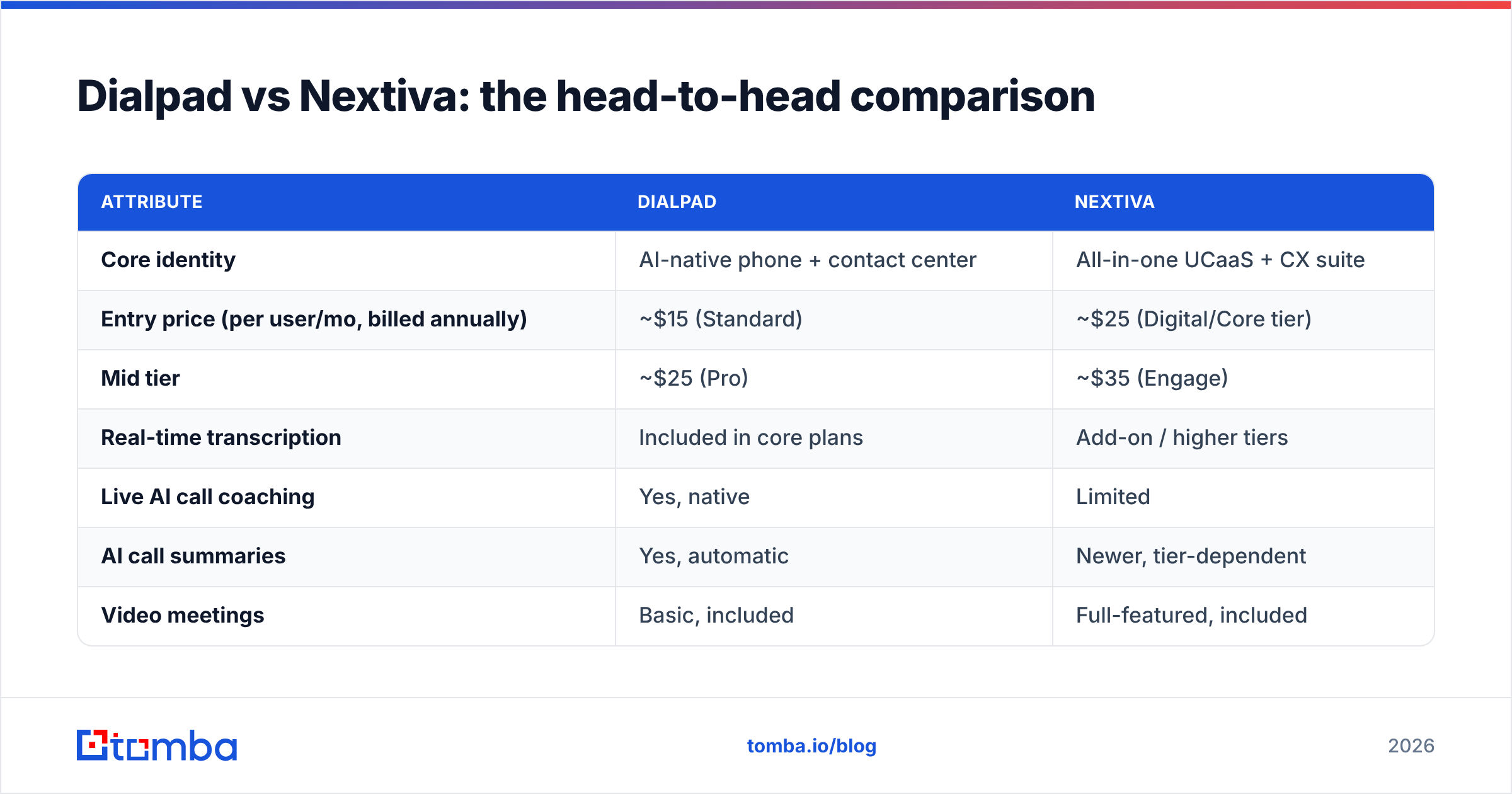
Here's where the two platforms actually differ, feature by feature.
| Attribute | Dialpad | Nextiva |
|---|---|---|
| Core identity | AI-native phone + contact center | All-in-one UCaaS + CX suite |
| Entry price (per user/mo, billed annually) | ~$15 (Standard) | ~$25 (Digital/Core tier) |
| Mid tier | ~$25 (Pro) | ~$35 (Engage) |
| Real-time transcription | Included in core plans | Add-on / higher tiers |
| Live AI call coaching | Yes, native | Limited |
| AI call summaries | Yes, automatic | Newer, tier-dependent |
| Video meetings | Basic, included | Full-featured, included |
| Team messaging | Included | Included |
| CX tools (surveys, social) | Contact-center tiers | Built into higher tiers |
| Uptime SLA | 99.9%+ | 99.9%+ |
| Best fit | Sales/support teams that live on calls | SMB/mid-market wanting one vendor |
Prices shift with promotions and seat counts, so confirm current numbers on dialpad.com and nextiva.com before you sign. The shape of the comparison, though, is stable: Dialpad gives you more AI for less at entry, Nextiva gives you more communication channels and a broader CX story as you move up.
Is Dialpad better than Nextiva for sales teams?#
For outbound and inbound sales specifically, Dialpad has the edge — and it's mostly about the AI.
Think of it like the difference between a car with lane assist and one without. Both get you there. But Dialpad's real-time coaching nudges reps mid-call ("competitor mentioned," "long monologue — ask a question"), and the automatic post-call summary means your CRM notes write themselves. For a team onboarding new SDRs every quarter, that shortens ramp time in a way Nextiva doesn't match today.
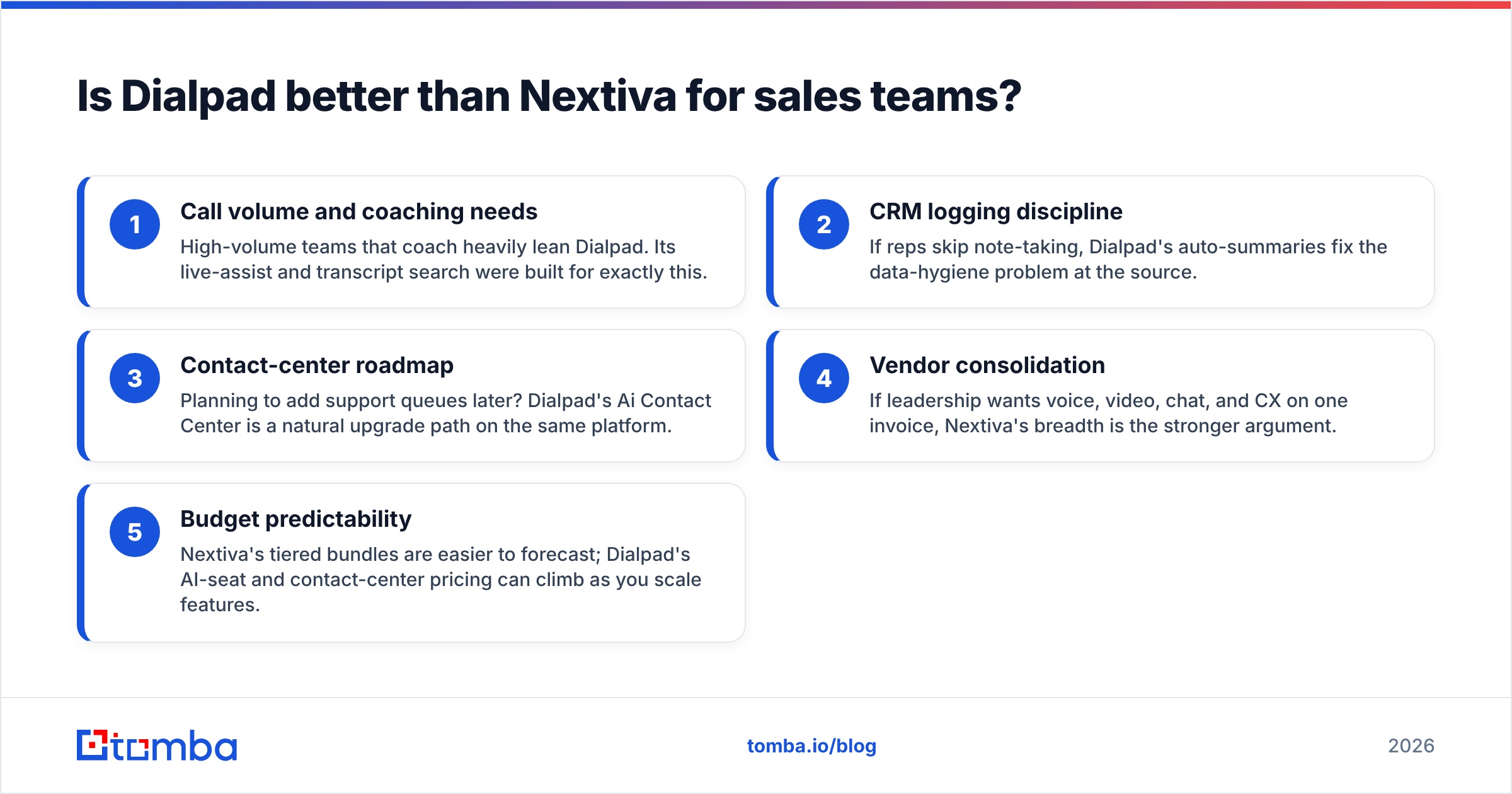
Consider these five decision factors when the use case is sales:
- Call volume and coaching needs — High-volume teams that coach heavily lean Dialpad. Its live-assist and transcript search were built for exactly this.
- CRM logging discipline — If reps skip note-taking, Dialpad's auto-summaries fix the data-hygiene problem at the source.
- Contact-center roadmap — Planning to add support queues later? Dialpad's Ai Contact Center is a natural upgrade path on the same platform.
- Vendor consolidation — If leadership wants voice, video, chat, and CX on one invoice, Nextiva's breadth is the stronger argument.
- Budget predictability — Nextiva's tiered bundles are easier to forecast; Dialpad's AI-seat and contact-center pricing can climb as you scale features.
Where Nextiva pulls ahead is the blended team — sales plus support plus marketing — that values one platform and one support relationship over best-in-class calling AI. That's a legitimate reason to choose it, not a consolation prize.
Where both tools quietly cost more than the sticker price#
Every VoIP comparison focuses on the monthly per-seat number. The real cost lives in the add-ons.
Dialpad gates its most valuable AI behind higher tiers and contact-center SKUs. International calling, additional numbers, and premium integrations stack on top. The entry price is genuinely low, but a sales team using the features Dialpad is famous for is rarely on the entry plan.
Nextiva bundles more into each tier, but the jump between tiers is where CX tooling, unlimited conferencing, and advanced analytics live. Toll-free minutes and some integrations are metered or extra. The "all-in-one" bill is predictable but not small.
The honest read: budget for the tier that actually includes the features you're comparing them for, not the headline number. A $15 plan you have to upgrade twice isn't a $15 plan.

Dialpad vs Nextiva: call quality and reliability#
This is the section where most comparisons overpromise. The truth is boring: for the vast majority of businesses, call quality between Dialpad and Nextiva is indistinguishable.
Both run on redundant, geographically distributed cloud infrastructure. Both publish 99.9%+ uptime SLAs. Both support the codecs and QoS settings that keep calls clear. When calls sound bad on either platform, the culprit is almost always local: under-provisioned bandwidth, Wi-Fi instead of wired connections, or a cheap headset.
If reliability is your top priority, two things matter more than the vendor logo:
- Your network. Prioritize voice traffic (QoS), give heavy callers wired connections, and make sure upstream bandwidth isn't saturated by video calls.
- Number quality. A perfect call to a wrong or dead number is still a wasted dial. Validating your phone list with a tool like a phone validator removes disconnected and misformatted numbers before your reps ever hit "call."
Nextiva's edge here is perception and support: years of uptime reputation and a support team that resolves issues fast. Dialpad's edge is that its AI keeps working even when a call is imperfect — a garbled line still gets transcribed and summarized.
Which should you choose in 2026?#
Here's the decision, compressed:
- Choose Dialpad if your team lives on the phone, you want AI coaching and automatic call notes as a core feature (not an upsell), and you see a contact center in your future.
- Choose Nextiva if you want one vendor for voice, video, chat, and customer experience, you value a long track record of uptime and support, and predictable bundled pricing matters more than best-in-class calling AI.
Both are strong platforms. The wrong choice isn't picking one over the other — it's assuming the phone system alone will fill your pipeline.
The gap neither Dialpad nor Nextiva fills#
A phone system is a pipe. It routes calls, records them, and — in Dialpad's case — analyzes them brilliantly. What it does not do is tell you who to call or how to reach them.
That's the part outbound teams underestimate. You can have the best call-coaching AI on the market and still burn your day dialing gatekeepers, wrong numbers, and generic info@ lines. The bottleneck moves upstream, to the quality of the contact data feeding your dialer.
This is where a dedicated prospecting layer earns its keep. Before a single call goes out, you want:
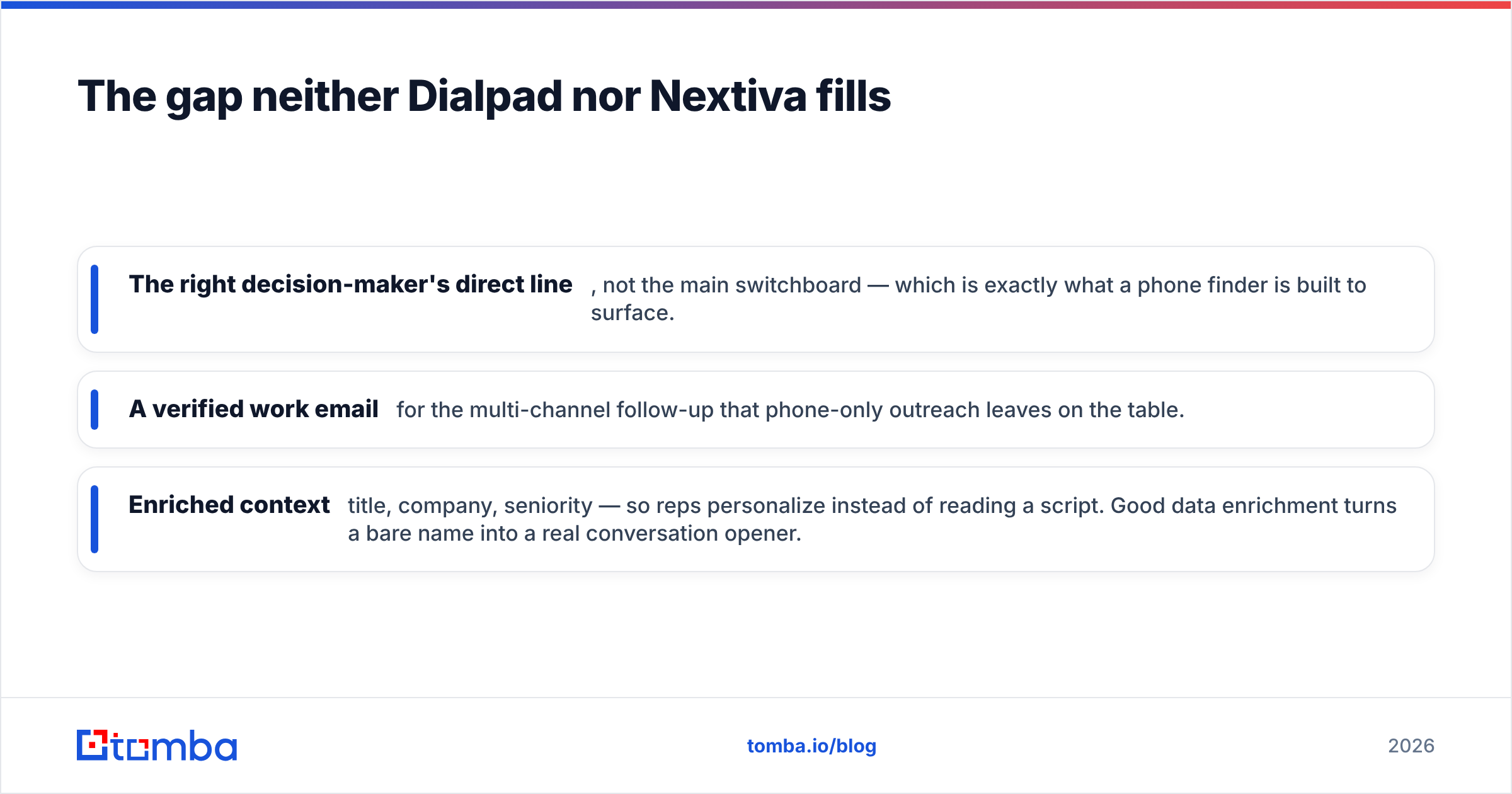
- The right decision-maker's direct line, not the main switchboard — which is exactly what a phone finder is built to surface.
- A verified work email for the multi-channel follow-up that phone-only outreach leaves on the table.
- Enriched context — title, company, seniority — so reps personalize instead of reading a script. Good data enrichment turns a bare name into a real conversation opener.
Pair whichever phone system you pick with a clean, verified contact list and the whole motion works. Skip that step and you're paying for a Ferrari to sit in traffic.
How Tomba fits alongside your phone system#
Dialpad and Nextiva handle the conversation. Tomba handles the part that happens before the phone rings — finding and verifying who to contact.
Start with the Tomba Email Finder to pull verified professional emails by name, company, or domain, then layer in phone numbers and enrichment so your reps open Dialpad or Nextiva with a list that's actually worth dialing. Tomba runs on a free tier (25 searches/month), with paid plans from $49/mo (Starter), $99/mo (Growth), and $249/mo (Pro) — see the full Tomba pricing breakdown to match a plan to your volume.
Your phone system decides how good the call sounds. Your contact data decides whether the call was worth making. Get both right, and 2026 outbound stops leaking pipeline at the top of the funnel.
Related guides#
Ready to find emails that actually work?
Join 150,000+ professionals who stopped guessing and started sending. Free credits on signup — no credit card required.
Get the Tomba newsletter
Practical outbound tactics and product updates — once every two weeks.
About the author