Dialpad vs RingCentral 2026: Full Comparison and Verdict
Dialpad and RingCentral both promise a cloud phone system that scales, but they win on different fronts. Here is an honest, feature-by-feature breakdown to help your sales team pick.
Choosing a business phone system feels simple until you open two pricing pages side by side and realize you are comparing apples to a slightly different apple. Dialpad and RingCentral are two of the biggest names in cloud calling, and both will happily sell you a plan today. The right pick depends on whether you value built-in AI or raw platform breadth.
TL;DR: Dialpad vs RingCentral in 30 seconds#
- Pick Dialpad if you want AI baked into every call — live transcription, real-time coaching, and sentiment analysis — without bolting on a third-party tool.
- Pick RingCentral if you need a mature, do-everything UCaaS platform with the deepest integration library and rock-solid enterprise telephony.
- Pricing is close at the entry level (both start near $20–$30 per user/month), but RingCentral's higher tiers get pricier faster.
- Call quality is strong on both; RingCentral has a longer track record of five-nines uptime, Dialpad wins on AI-driven call features.
- Neither tool finds your prospects for you. A dialer is only as good as the phone numbers and emails you feed it — that gap is where your pipeline actually lives.
What is Dialpad and who is it for?#
Dialpad is an AI-first business communications platform. It bundles voice, video, messaging, and a contact-center product on top of a proprietary speech engine called Dialpad Ai. The pitch is that intelligence should be native, not an add-on: every call is transcribed in real time, coached live, and summarized automatically when you hang up.
That focus makes Dialpad a natural fit for sales and support teams that live on the phone. If your reps are running dozens of cold calls a day, the automatic note-taking and objection-handling prompts remove a lot of manual busywork. Dialpad leans younger and lighter than the legacy players — the interface is clean, onboarding is fast, and you do not need a telecom engineer to configure it.
Where Dialpad shows its age limits is at the true enterprise edge: highly complex call routing, niche compliance requirements, and the very long tail of third-party integrations. It is catching up quickly, but RingCentral simply started earlier.
What is RingCentral and who is it for?#
RingCentral is the incumbent's incumbent. Its flagship product, RingEX (formerly RingCentral MVP), is a full unified-communications suite covering phone, SMS, team messaging, video meetings, and fax. It has been a Gartner Magic Quadrant leader for UCaaS for years, and that maturity shows in the details: granular admin controls, extensive analytics, and a marketplace with hundreds of pre-built integrations.
RingCentral is built for organizations that treat the phone system as critical infrastructure. Multi-site deployments, international numbers in 100+ countries, and strict uptime SLAs are its home turf. If you are a 500-seat company with a compliance team, RingCentral rarely gets you fired.
The trade-off is complexity and cost. The admin console has a learning curve, and the AI features — while now genuinely useful under the "RingSense" and RingCentral AI banners — arrived later and often sit on higher tiers or as paid add-ons. You are buying breadth, and breadth has a price.
Dialpad vs RingCentral: the head-to-head comparison table#
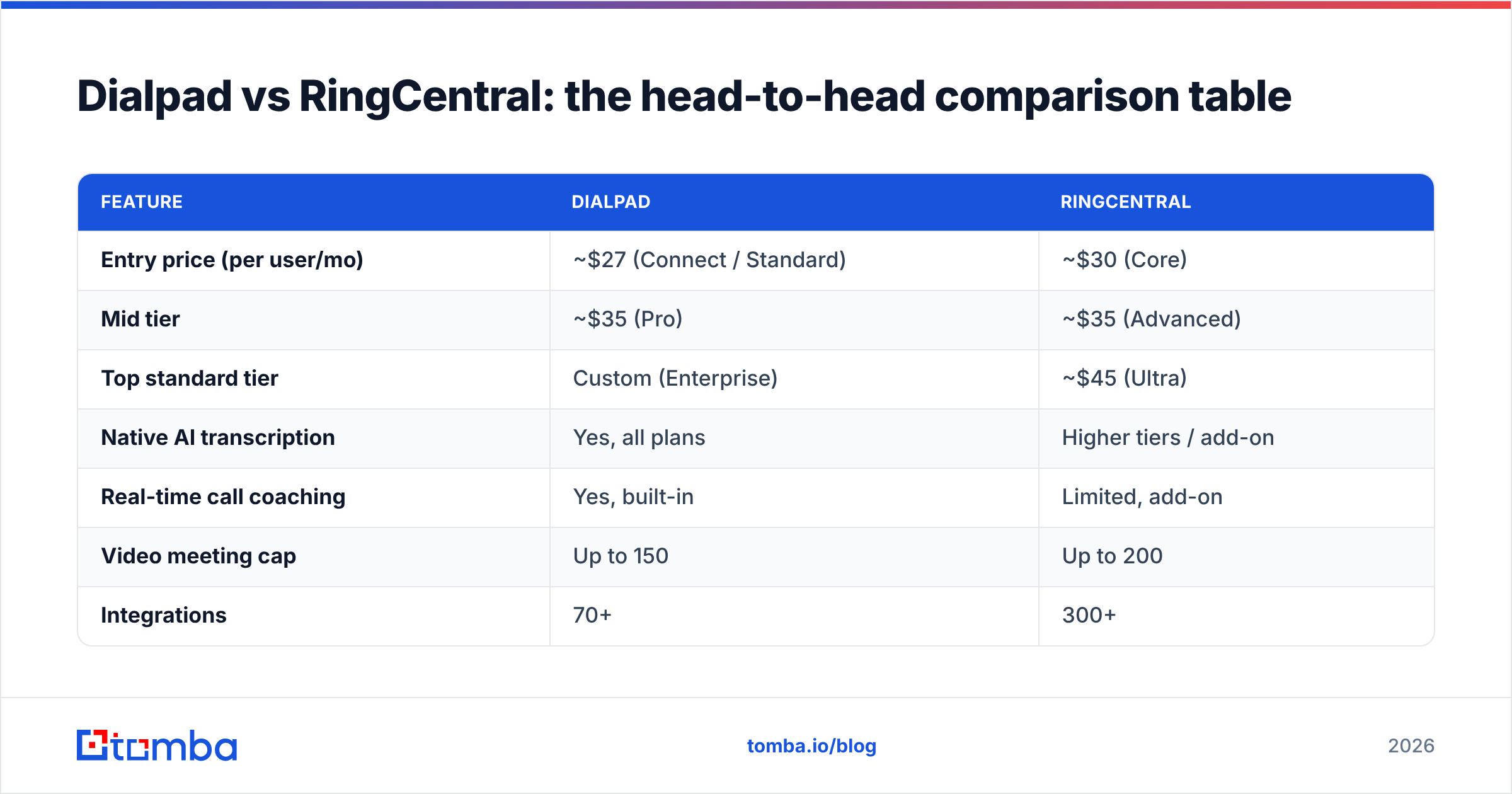
Here is where the two platforms actually diverge. Prices reflect standard published annual-billing rates in 2026 and shift with promotions, so confirm on each vendor's site before you buy.
| Feature | Dialpad | RingCentral |
|---|---|---|
| Entry price (per user/mo) | ~$27 (Connect / Standard) | ~$30 (Core) |
| Mid tier | ~$35 (Pro) | ~$35 (Advanced) |
| Top standard tier | Custom (Enterprise) | ~$45 (Ultra) |
| Native AI transcription | Yes, all plans | Higher tiers / add-on |
| Real-time call coaching | Yes, built-in | Limited, add-on |
| Video meeting cap | Up to 150 | Up to 200 |
| Integrations | 70+ | 300+ |
| International numbers | 70+ countries | 100+ countries |
| Uptime SLA | 100% (Enterprise) | 99.999% |
| Best for | AI-driven sales & support | Enterprise UCaaS breadth |
The short read: Dialpad hands you more intelligence for less money at the low end, while RingCentral gives you more platform, more integrations, and more geographic reach as you scale up.
Is Dialpad better than RingCentral for sales teams?#
For a phone-heavy sales team, Dialpad usually wins on day-to-day experience. The reason is simple: the AI features that matter for selling are included, not upsold.
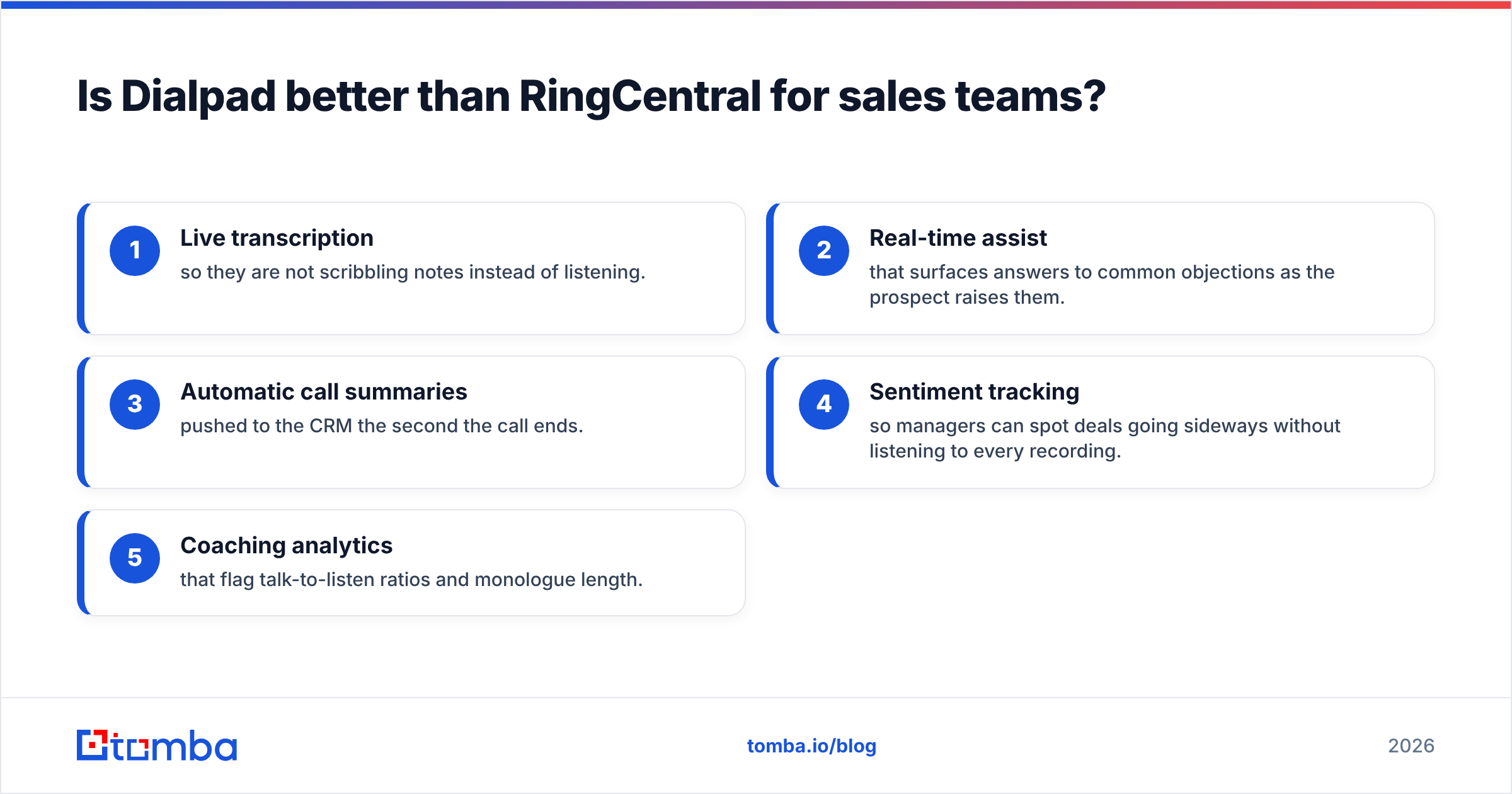
Consider what a rep actually needs mid-call:
- Live transcription so they are not scribbling notes instead of listening.
- Real-time assist that surfaces answers to common objections as the prospect raises them.
- Automatic call summaries pushed to the CRM the second the call ends.
- Sentiment tracking so managers can spot deals going sideways without listening to every recording.
- Coaching analytics that flag talk-to-listen ratios and monologue length.
Dialpad ships all five on mainstream plans. RingCentral can match most of them, but you often climb to Ultra or attach RingSense to get parity, which narrows or erases the price gap. If AI coaching is your priority and you have fewer than a few hundred seats, Dialpad is the more direct route.
That said, "better for sales" is not "better for everyone." A distributed enterprise that needs contact centers in twelve countries, deep Salesforce integration with custom objects, and a fax workflow for legal will find RingCentral's depth hard to beat.
How do pricing and contracts compare?#
Both vendors use the familiar per-seat, tiered model with a discount for annual billing. The entry tiers land within a few dollars of each other, so price alone rarely decides it there. The divergence happens higher up.
Dialpad keeps its published tiers lean and pushes complex needs into a custom Enterprise quote. RingCentral publishes more tiers and layers add-ons — additional AI, advanced analytics, and contact-center seats — that stack onto the base price. Read the line items carefully: a "$30 plan" can become a $55 plan once you add the pieces your team assumed were standard.
A few contract realities to check before signing either one:
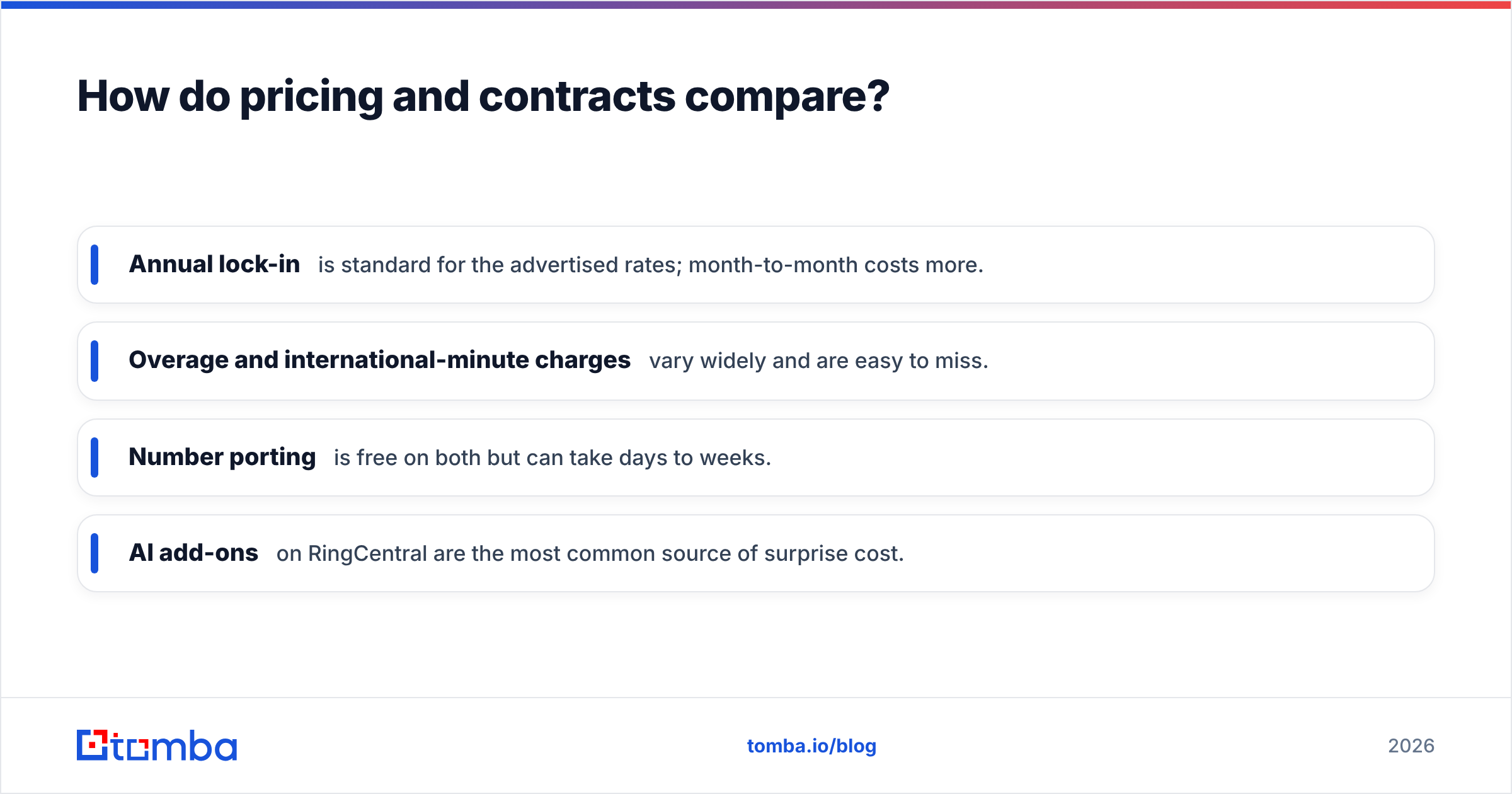
- Annual lock-in is standard for the advertised rates; month-to-month costs more.
- Overage and international-minute charges vary widely and are easy to miss.
- Number porting is free on both but can take days to weeks.
- AI add-ons on RingCentral are the most common source of surprise cost.
If you want to sanity-check your own tooling spend the same way, our breakdown of transparent Tomba pricing is a useful mental model: know exactly what a credit or seat buys before you commit.
Which has better call quality and reliability?#
This is close to a tie, with a slight structural edge to RingCentral on paper. RingCentral advertises 99.999% uptime — roughly five minutes of downtime per year — backed by a global network of redundant data centers and years of enterprise operating history. For a business that cannot tolerate a dead phone system, that track record carries weight.
Dialpad counters with a 100% uptime SLA on its Enterprise plan and a network built on Google Cloud, which delivers excellent voice quality in practice. Real-world reports on G2 put both platforms in the same high band for call clarity, with occasional complaints on each side tied to local network conditions rather than the platform itself.
The honest takeaway: call quality will not be the reason you regret either choice. Your office bandwidth and headset matter more than the marginal difference between these two vendors.
What about integrations and ecosystem?#
RingCentral wins the raw numbers game with 300+ integrations in its app gallery versus Dialpad's growing but smaller library. If you rely on an unusual combination of CRM, help desk, and workflow tools, RingCentral is statistically more likely to have a native connector ready.
Dialpad covers the essentials — Salesforce, HubSpot, Zoom, Google Workspace, Microsoft 365 — cleanly, and its AI data flows into those systems well. For most sales orgs running a mainstream stack, the difference is academic. For an enterprise with legacy or niche systems, RingCentral's breadth becomes a real advantage.
Why your dialer is only half the battle#
Here is the part both vendor comparison pages skip: neither Dialpad nor RingCentral solves your actual bottleneck. A world-class phone system that dials a bad number is still a wasted call. The most expensive line item in any outbound motion is not the software — it is rep time burned on wrong numbers, dead extensions, and prospects who left the company two quarters ago.
That is a data problem, not a telephony problem. Before a call ever hits your Dialpad or RingCentral queue, someone had to source a verified direct-dial and a reachable email. If that step is guesswork, no amount of AI coaching saves the call.
This is where a dedicated data layer earns its keep. Tomba's phone finder surfaces B2B direct-dial numbers, its data enrichment fills in job titles and company details, and its email finder gives your reps a second channel when the phone goes to voicemail. Feed clean, verified contacts into whichever dialer you pick, and both platforms suddenly look a lot more effective.

Dialpad vs RingCentral: pros and cons summary#
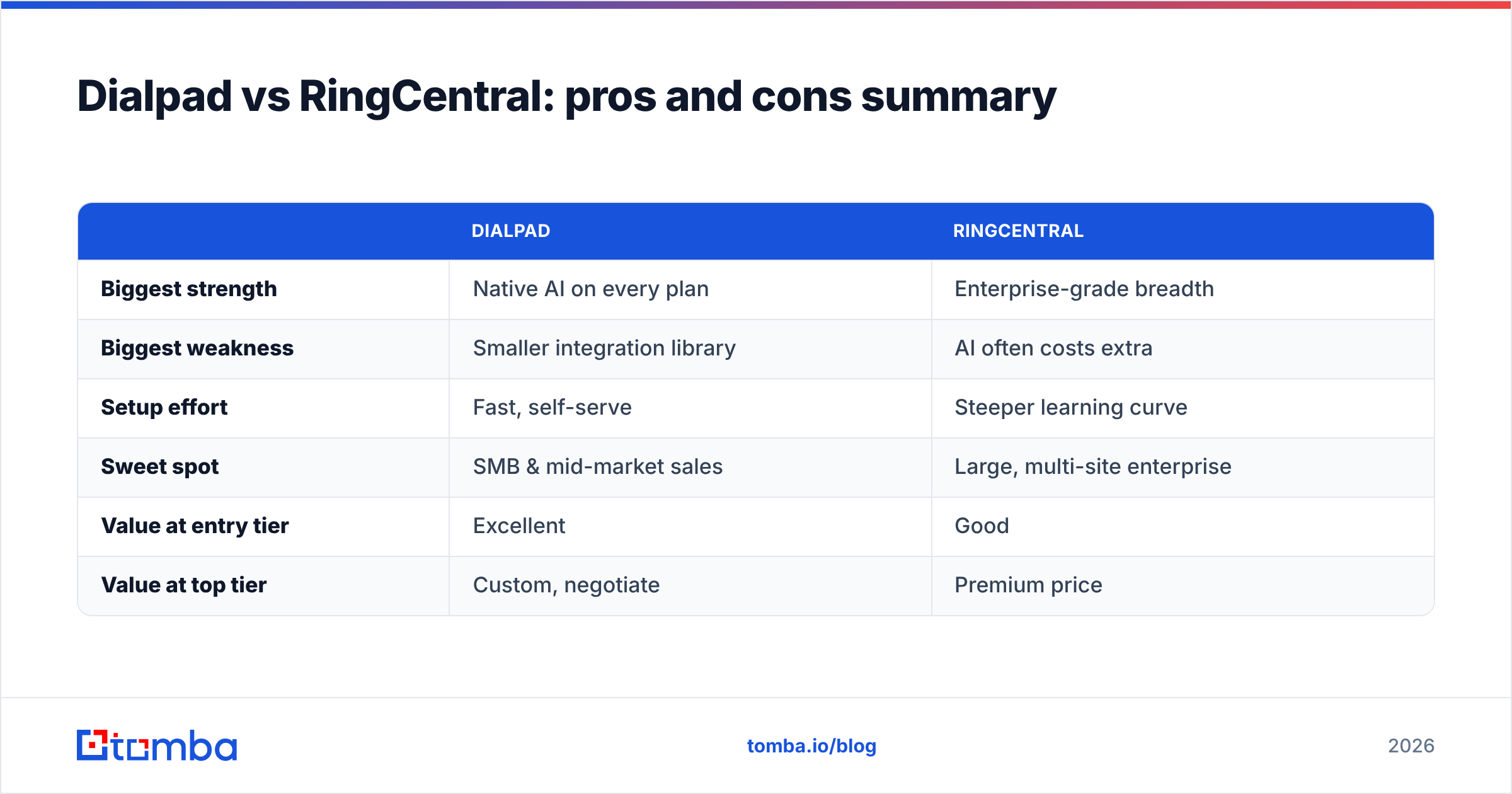
| Dialpad | RingCentral | |
|---|---|---|
| Biggest strength | Native AI on every plan | Enterprise-grade breadth |
| Biggest weakness | Smaller integration library | AI often costs extra |
| Setup effort | Fast, self-serve | Steeper learning curve |
| Sweet spot | SMB & mid-market sales | Large, multi-site enterprise |
| Value at entry tier | Excellent | Good |
| Value at top tier | Custom, negotiate | Premium price |
So which should you choose?#
Choose Dialpad if you are a sales or support team under a few hundred seats that wants AI coaching, transcription, and summaries included rather than upsold. You will spend less to get more intelligence, and your reps will be productive faster.
Choose RingCentral if you are a larger, more complex organization that needs the widest integration ecosystem, international coverage in 100+ countries, and a long, proven enterprise uptime record. You will pay more, but you are buying insurance and reach.
For most growing B2B teams in 2026, the deciding factor is not the phone system at all — it is whether the contacts flowing into it are accurate. Both Dialpad and RingCentral will carry your voice perfectly to whatever number you dial. Make sure that number is right. Start by feeding your dialer verified direct-dials and emails from the Tomba Email Finder and phone finder, then let your platform of choice do what it does best: connect the call. Fix the data first, and the tool comparison stops being a make-or-break decision.
You can compare current plans directly on dialpad.com and ringcentral.com before you commit — and either way, keep your contact data clean going in.
Related guides#
Ready to find emails that actually work?
Join 150,000+ professionals who stopped guessing and started sending. Free credits on signup — no credit card required.
Get the Tomba newsletter
Practical outbound tactics and product updates — once every two weeks.
About the author