Diffbot Pricing Reviews Pros and Cons (2026 Analysis)
A neutral breakdown of Diffbot pricing, real user reviews, and the honest pros and cons of the web-data and Knowledge Graph platform in 2026 — plus where it fits and where a cheaper tool wins.
Diffbot Pricing Reviews Pros and Cons (2026 Analysis)
Diffbot is one of the most ambitious data companies on the market. It reads the web like a search engine and turns pages into structured records. That power comes with a high price and a learning curve. Not every team should pay for it. This neutral, third-party Diffbot pricing reviews pros and cons guide breaks down the real costs so you can decide whether it belongs in your stack.
TL;DR — Is Diffbot Worth It in 2026?#
- What it is: Diffbot is a web-data extraction and Knowledge Graph platform — automatic APIs that parse articles, products, and organizations, plus a crawler and a graph of billions of entities.
- Pricing reality: Entry pricing starts around $299/mo for the Startup plan, jumping to roughly $899/mo for Plus, with Enterprise quoted custom. There is a free trial, but no permanent free tier.
- Best fit: Engineering-led teams doing large-scale web scraping, market intelligence, or building datasets from unstructured pages.
- Worst fit: Sales and marketing teams that just need verified contact data — you will overpay for capabilities you never touch.
- Bottom line: Diffbot is excellent at what it does, but it is a developer platform, not a plug-and-play prospecting tool. Pair it with a focused email finder if outreach is your real goal.
What Is Diffbot and Who Is It For?#
Think of Diffbot as a robot research assistant that can read any web page and hand you back a clean spreadsheet row. Where a human sees a messy product listing or a news article, Diffbot's machine-learning models identify the title, author, price, publish date, and body text automatically — no custom scraper per site.
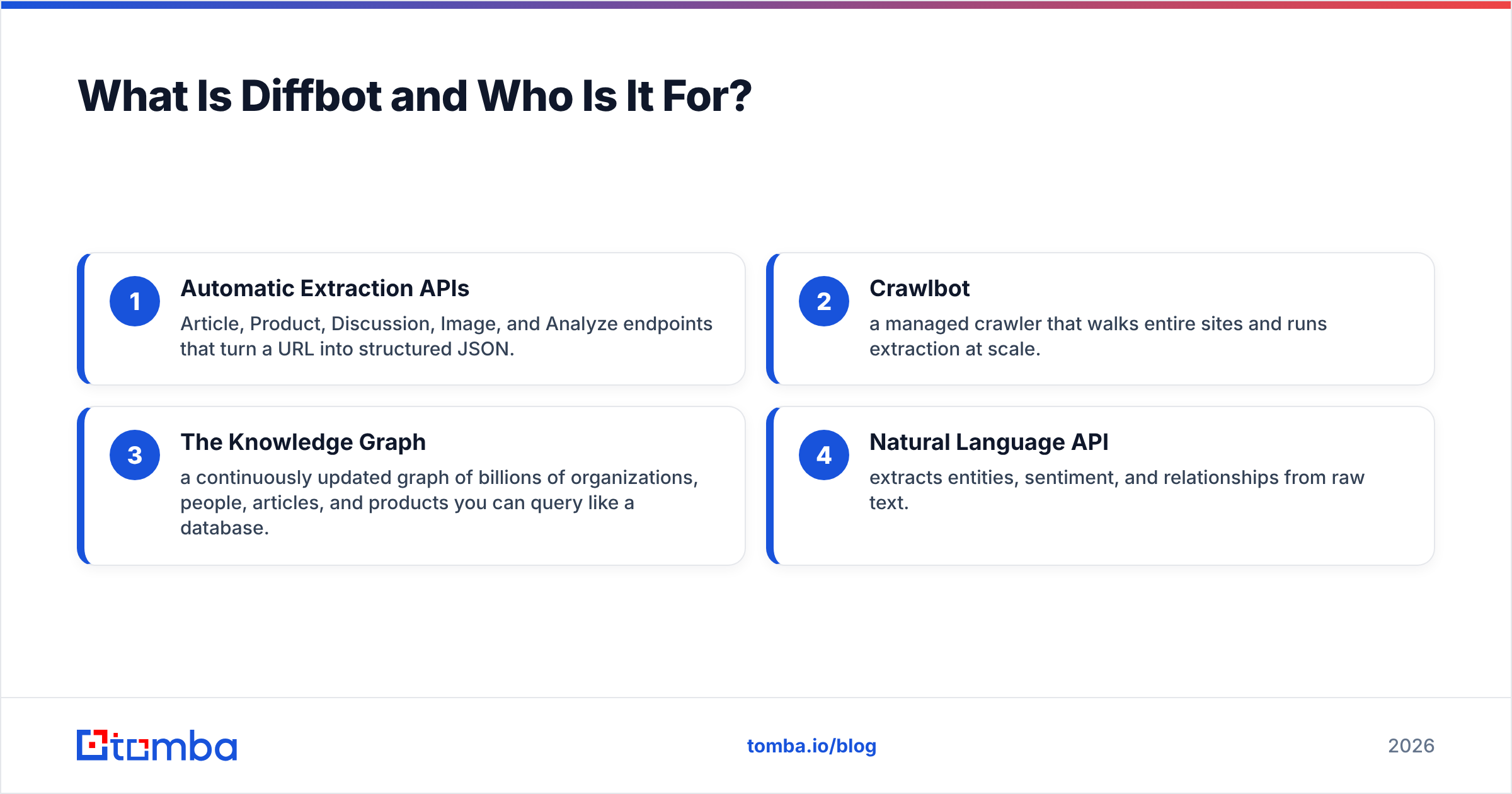
The platform has three core pieces:
- Automatic Extraction APIs — Article, Product, Discussion, Image, and Analyze endpoints that turn a URL into structured JSON.
- Crawlbot — a managed crawler that walks entire sites and runs extraction at scale.
- The Knowledge Graph — a continuously updated graph of billions of organizations, people, articles, and products you can query like a database.
- Natural Language API — extracts entities, sentiment, and relationships from raw text.
That combination is genuinely rare. According to Diffbot's own product documentation, the Knowledge Graph tracks billions of entities refreshed on a rolling basis. This is why you see Diffbot in market-intelligence, machine-learning, and competitive-research use cases far more than in day-to-day sales workflows.

If your job is to build a dataset — every SaaS company in a category, every product on a set of retailers, every article mentioning a topic — Diffbot is built for you. If your job is to email 200 decision-makers this quarter, keep reading, because the economics change fast.
How Much Does Diffbot Cost in 2026?#
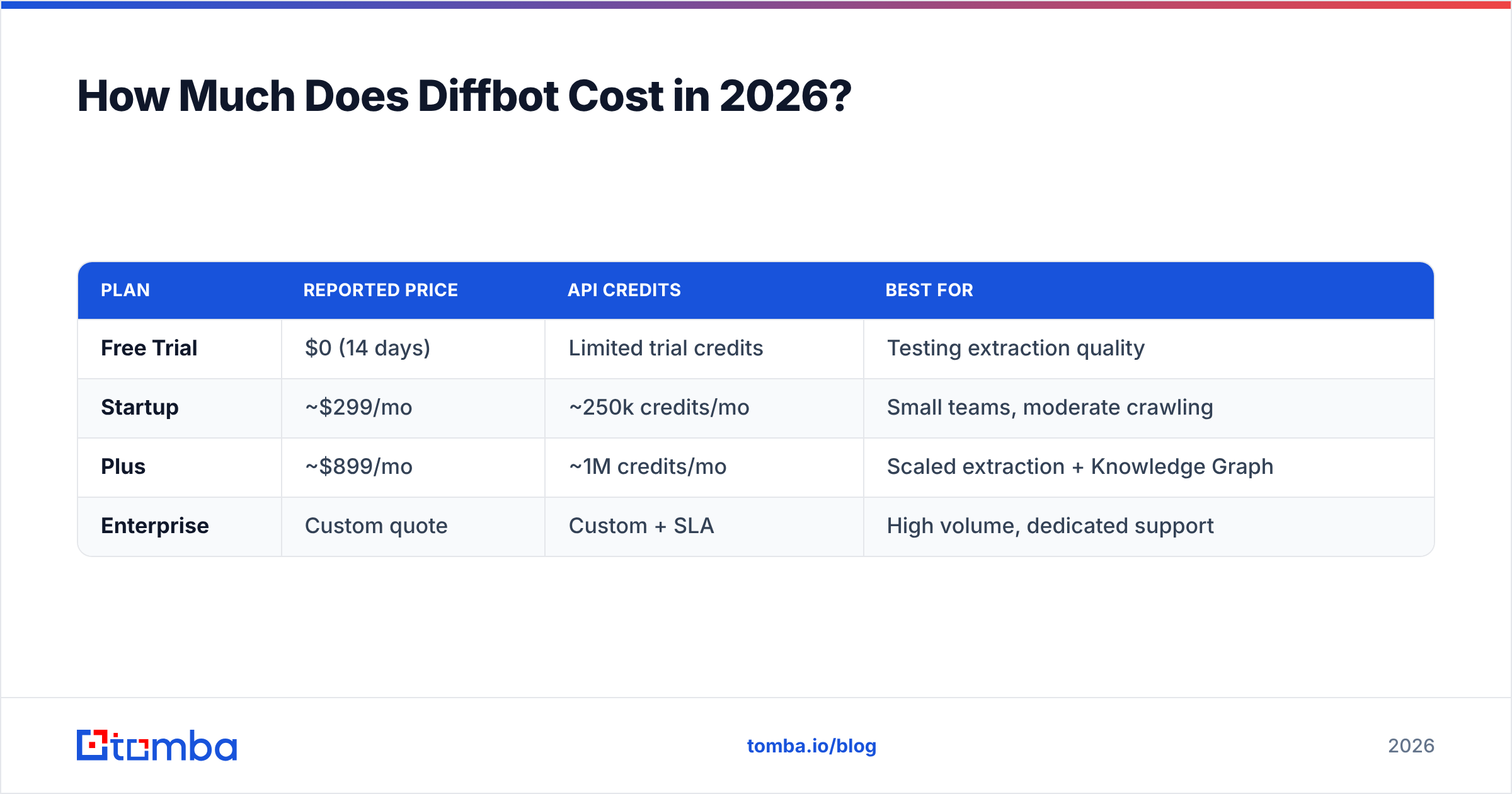
Short answer: expect to start at about $299/mo and climb quickly. Diffbot prices on a mix of monthly plan tiers and API credit consumption, so your real bill depends on call volume, not just the sticker price.
Here is how the publicly listed structure generally breaks down. Always confirm current numbers on Diffbot's site before you commit, since credit allowances shift over time.
| Plan | Reported price | API credits | Best for |
|---|---|---|---|
| Free Trial | $0 (14 days) | Limited trial credits | Testing extraction quality |
| Startup | ~$299/mo | ~250k credits/mo | Small teams, moderate crawling |
| Plus | ~$899/mo | ~1M credits/mo | Scaled extraction + Knowledge Graph |
| Enterprise | Custom quote | Custom + SLA | High volume, dedicated support |
A few things to understand before that first invoice:
- Credits are the real currency. Each API call consumes credits, and heavy Crawlbot jobs or Knowledge Graph queries burn them faster than a handful of Article API calls. Two teams on the same plan can have wildly different effective costs.
- No permanent free tier. Unlike many data tools, Diffbot's free access is a time-boxed trial, not an always-on starter plan.
- The jump from Startup to Plus is steep. Going from ~$299 to ~$899 is a 3x leap, and many teams hit the Startup credit ceiling faster than expected once crawling ramps up.

For a developer team with budget, $299/mo for structured web data at this quality is defensible. For a two-person sales team, it is a lot of money for infrastructure you would only use a fraction of.

What Do Diffbot Reviews Actually Say?#
The consensus across review sites: powerful and accurate, but technical and pricey. On G2, Diffbot consistently earns strong marks for extraction accuracy and data freshness, while the most common complaints cluster around cost and the engineering effort required to get value.
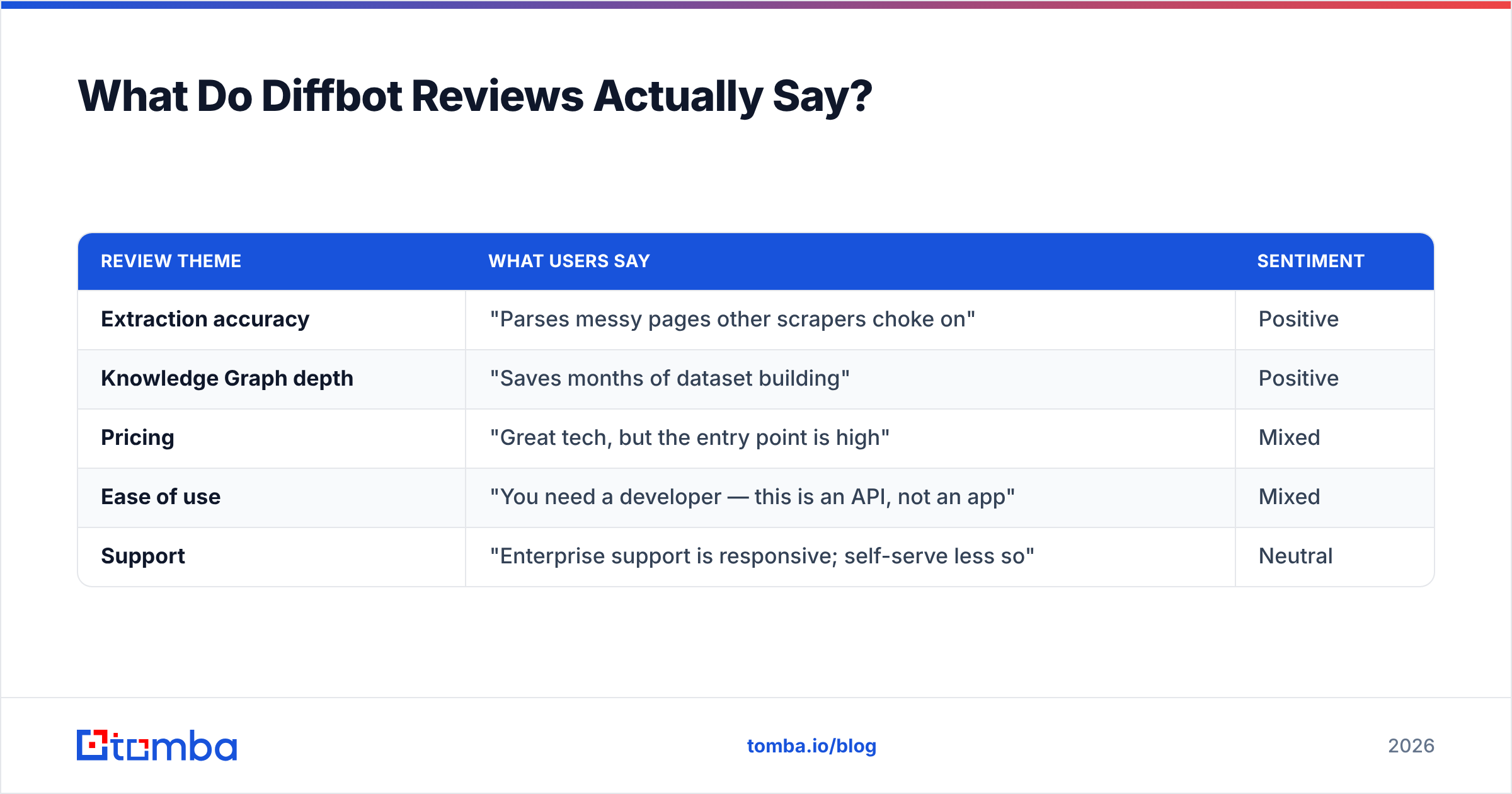
Here is a fair synthesis of recurring themes from public reviews:
| Review theme | What users say | Sentiment |
|---|---|---|
| Extraction accuracy | "Parses messy pages other scrapers choke on" | Positive |
| Knowledge Graph depth | "Saves months of dataset building" | Positive |
| Pricing | "Great tech, but the entry point is high" | Mixed |
| Ease of use | "You need a developer — this is an API, not an app" | Mixed |
| Support | "Enterprise support is responsive; self-serve less so" | Neutral |
The pattern is clear: reviewers who are engineers or data scientists tend to love Diffbot. Reviewers who expected a point-and-click tool tend to feel it is over-engineered for their need. Neither group is wrong — they simply arrived with different jobs to be done.
One recurring caution worth flagging: because billing is credit-based, several reviewers mention surprise overages during their first heavy crawl. If you adopt Diffbot, instrument your credit usage early.
What Are the Pros and Cons of Diffbot?#
Let's put the honest trade-offs side by side. This is the part most vendor pages skip.
Pros#
- Best-in-class extraction. Diffbot's models handle unstructured, inconsistent pages better than most rule-based scrapers. You are not maintaining a brittle CSS selector for every source.
- Knowledge Graph is a genuine moat. Querying a pre-built graph of billions of entities is faster than crawling from scratch, and it stays fresh.
- Scales to serious volume. Crawlbot plus enterprise infrastructure can process web-scale jobs that would crush a homegrown scraper.
- Structured, developer-friendly output. Clean JSON, solid API design, and good docs make integration predictable.
- Strong for ML and research. If you are training models or doing market intelligence, the data shape fits.
Cons#
- High entry price. Starting near $299/mo prices out small teams and solo operators.
- Steep for non-engineers. There is no friendly no-code interface; you need someone comfortable with APIs.
- Credit costs can surprise you. Volume-based billing makes budgeting harder than a flat per-seat fee.
- Overkill for contact data. If you only need business emails and phone numbers, you are paying for a web-scale engine to do a task a specialized tool does better and cheaper.
- No permanent free tier. The trial ends, and there is no lightweight ongoing option to grow into.

Diffbot vs. Purpose-Built Contact Data Tools#
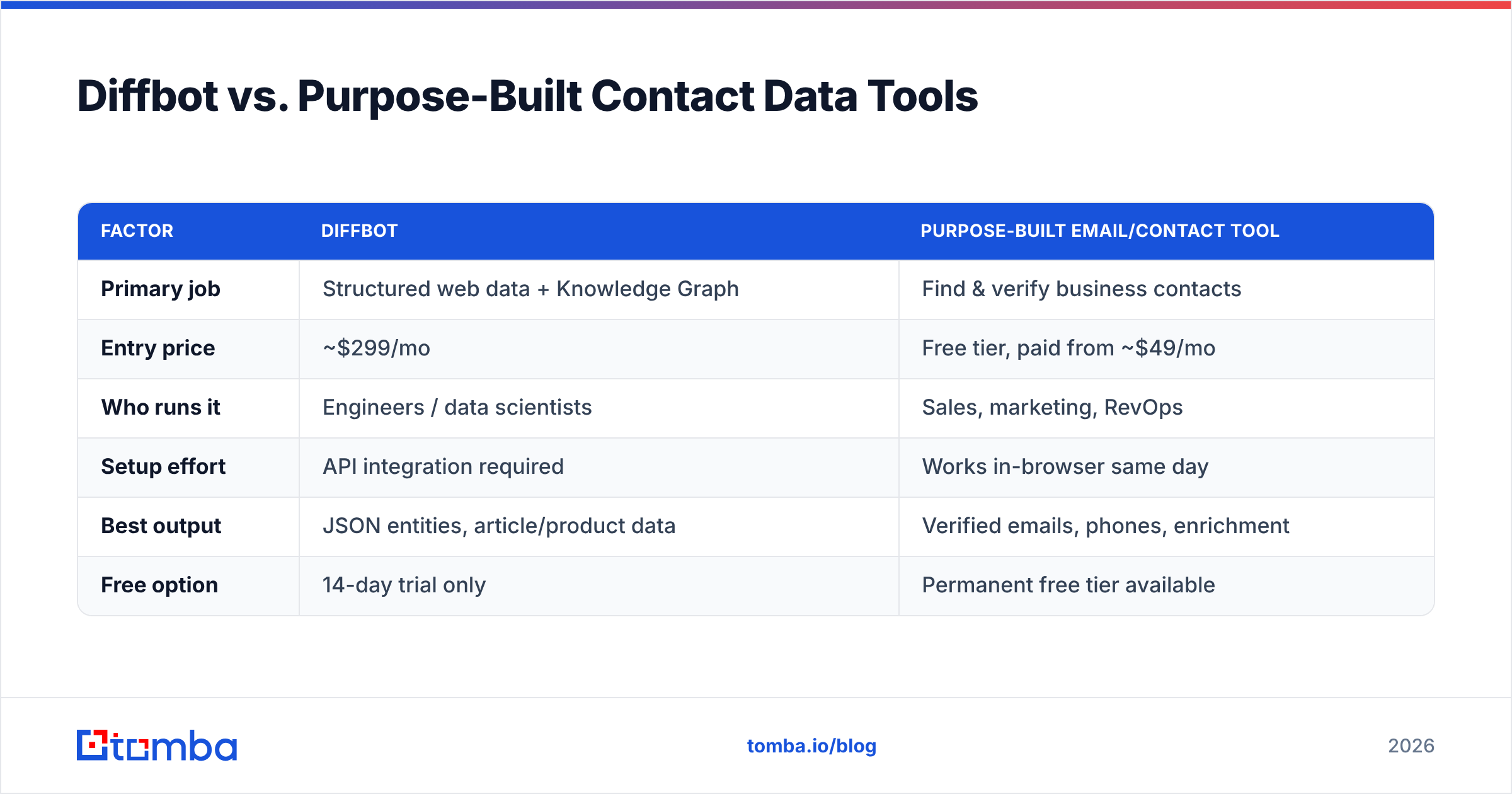
Here is where a lot of buyers get it wrong. Diffbot and a tool like Tomba are not really competitors — they solve different problems. Diffbot builds datasets from the open web. Contact-data tools deliver verified emails and phone numbers for outreach. Choosing between them is really a question of what you are trying to accomplish.
| Factor | Diffbot | Purpose-built email/contact tool |
|---|---|---|
| Primary job | Structured web data + Knowledge Graph | Find & verify business contacts |
| Entry price | ~$299/mo | Free tier, paid from ~$49/mo |
| Who runs it | Engineers / data scientists | Sales, marketing, RevOps |
| Setup effort | API integration required | Works in-browser same day |
| Best output | JSON entities, article/product data | Verified emails, phones, enrichment |
| Free option | 14-day trial only | Permanent free tier available |
If your goal is prospecting, data enrichment, or filling a CRM with people you can actually contact, a focused tool wins on cost and speed. Tomba's pricing starts with a free tier (25 searches/mo) and a Starter plan at $49/mo — a fraction of Diffbot's entry point — because it does one job well rather than everything at web scale.
If your goal is building a proprietary dataset of companies, products, or news from thousands of sources, Diffbot's engine is worth the premium and there is no cheap shortcut.
Plenty of teams end up using both: Diffbot to map a market or enrich firmographic data at scale, and a dedicated email finder to turn those target accounts into reachable people. They are complementary layers, not either/or.
Is There a Cheaper Diffbot Alternative?#
It depends entirely on which half of Diffbot you actually need.
- If you need web extraction and crawling: Alternatives like ScrapingBee, Apify, or Bright Data compete on price and flexibility, though few match Diffbot's automatic-extraction accuracy out of the box.
- If you need the Knowledge Graph's firmographic data: Traditional B2B data providers (Clearbit-style enrichment, ZoomInfo-tier databases) overlap on company data, usually at their own premium.
- If you actually just need contact data for outreach: This is the most common misdiagnosis. You do not need a Knowledge Graph — you need accurate emails. That is where a specialized Tomba Email Finder or Tomba API delivers the same practical outcome for a tenth of the cost.
Be honest with yourself about the job. A surprising number of teams license Diffbot, use 10% of its surface area for contact lookups, and quietly churn when renewal comes around. The tool did nothing wrong — it was the wrong fit.
How to Decide: A Quick Buyer's Checklist#
Run through these before you sign anything:
- Do you have engineering resources? No developer means Diffbot's API-first model will stall. Choose a tool with a UI.
- Is your data need "the whole web" or "specific contacts"? Whole web → Diffbot. Specific contacts → a dedicated finder.
- Can you predict your call volume? Credit billing rewards teams that can forecast usage and punishes those who can't.
- What's your budget floor? If $299/mo is a stretch, start with a free-tier contact tool and revisit Diffbot when scale justifies it.
- Do you need results this week? Diffbot is an integration project; a browser-based email finder produces leads the same afternoon.
If you answered "specific contacts, limited budget, need it now" to most of these, you already have your answer — and it isn't a $299/mo web-scale engine.
Final Verdict on Diffbot Pricing Reviews Pros and Cons#
Diffbot is a superb platform aimed at a specific buyer: technical teams building structured datasets from the open web, who value extraction accuracy and a ready-made Knowledge Graph enough to pay a premium for it. For that buyer, the ~$299/mo starting price and credit-based billing are reasonable, and the reviews back up the quality.
For everyone else — especially sales, marketing, and RevOps teams whose real need is reaching people — Diffbot is more engine than you need. You would be buying a data refinery to fetch a glass of water.
If your actual goal is finding and verifying business contacts, skip the web-scale overhead. Start free with the Tomba Email Finder: find professional email addresses by domain, name, or company, verify them, and push them straight into your CRM — no engineering project, no credit-burn anxiety, and a free tier to prove it works before you spend a dollar. Match the tool to the job, and your budget will thank you.
Related guides#
Ready to find emails that actually work?
Join 150,000+ professionals who stopped guessing and started sending. Free credits on signup — no credit card required.
Get the Tomba newsletter
Practical outbound tactics and product updates — once every two weeks.
About the author