The Difference Between Leads and Prospects in B2B Sales
Leads and prospects are not the same thing, and treating them alike quietly kills your pipeline. Here is the practical distinction, plus a framework to move contacts from raw list to sales-ready.
Sales teams throw the words "lead" and "prospect" around as if they mean the same thing. They don't, and the gap between them is where most B2B pipelines leak revenue. Call everyone a lead and your reps waste hours chasing contacts who were never going to buy. Call everyone a prospect and your forecast turns into fiction.
This guide settles the difference between leads and prospects in B2B sales, shows you the exact line where one becomes the other, and gives you a repeatable way to move contacts across it without guesswork.
TL;DR: Leads vs Prospects in 30 Seconds#
- A lead is any contact who has entered your world but has not been qualified. Raw, unvetted, top-of-funnel.
- A prospect is a lead that has been qualified against a fit-and-intent standard and matches your ideal customer profile. Vetted, sales-ready, mid-funnel.
- The dividing line is qualification — a deliberate check on fit, need, budget, authority, and timing. No qualification, no prospect.
- Order of operations: generate leads → qualify → convert the good ones into prospects → work prospects toward opportunities.
- Getting this wrong inflates your pipeline, burns rep time, and wrecks forecast accuracy. Getting it right doubles the value of every hour your team spends selling.
What Is a Lead in B2B Sales?#
A lead is the widest part of the funnel: a person or company that has shown the faintest signal of possible interest, or simply matches a demographic filter you scraped. A lead can be someone who downloaded an ebook, filled a webinar form, dropped a business card in a bowl, or appeared on a purchased list. The defining trait is that you have not yet verified whether they are a real fit.
Leads come from two broad directions:
- Inbound leads — they raised a hand. Content downloads, demo requests, newsletter signups, chatbot conversations.
- Outbound leads — you found them. List building, domain search, event lists, LinkedIn scraping, data vendors.
Both are unvetted by default. An inbound ebook download might be a student writing a thesis. An outbound list of 5,000 "CMOs" might be riddled with people who left the company two years ago. Until you check, a lead is a hypothesis, not a customer.
Marketers often slice leads further into a marketing qualified lead — see the full definition of an MQL — which is a lead that hit a behavioral score threshold but still hasn't been human-verified by sales. An MQL is a hotter lead, not yet a prospect.
What Is a Prospect in B2B Sales?#
A prospect is a lead that survived qualification. Someone looked at the contact — a human or a scoring system with real fit criteria — confirmed they match your ideal customer profile, and determined there is a plausible path to a deal. The prospect has been filtered for fit and intent, which is exactly what a raw lead lacks.
A contact earns "prospect" status when you can answer yes to most of these:
- Fit — do they resemble your best existing customers (industry, size, tech stack, geography)?
- Need — do they have a problem your product solves?
- Authority — is this person, or their team, involved in the buying decision?
- Budget — could they realistically afford and justify the spend?
- Timing — is there any reason to act in the next few quarters?
You will recognize this as a loose version of BANT, MEDDIC, or whatever qualification framework your org runs. The framework is less important than the discipline. HubSpot's sales qualification guide walks through several of these in depth, and Salesforce's lead management overview frames the same handoff from a CRM point of view.
The moment a lead clears that bar, it becomes a prospect and belongs in an active sequence. Everything before that bar is still lead territory.
Leads vs Prospects: The Core Difference at a Glance#
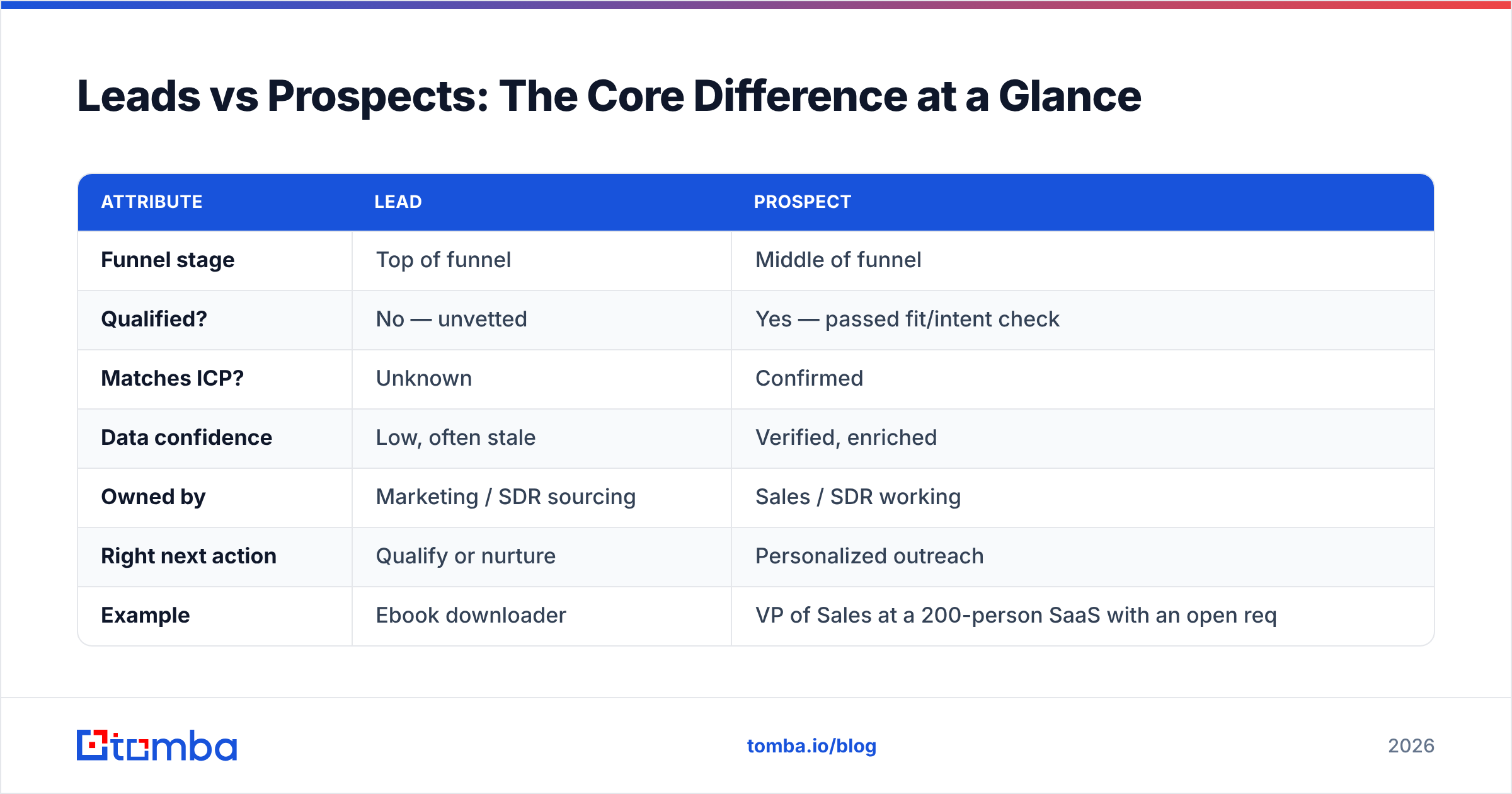
Here is the distinction in a single table you can pin above your reps' desks.
| Attribute | Lead | Prospect |
|---|---|---|
| Funnel stage | Top of funnel | Middle of funnel |
| Qualified? | No — unvetted | Yes — passed fit/intent check |
| Matches ICP? | Unknown | Confirmed |
| Data confidence | Low, often stale | Verified, enriched |
| Owned by | Marketing / SDR sourcing | Sales / SDR working |
| Right next action | Qualify or nurture | Personalized outreach |
| Example | Ebook downloader | VP of Sales at a 200-person SaaS with an open req |
| Forecast weight | None | Enters pipeline math |
Read the table top to bottom and the theme is obvious: a prospect is simply a lead you've earned the right to trust. The transformation is entirely about verification and fit, not about how excited you are.
Why Does the Difference Between Leads and Prospects Actually Matter?#
Because muddling the two corrupts every downstream number. Three concrete failures show up when teams treat leads and prospects as interchangeable.
- Pipeline inflation. Dump 4,000 unqualified leads into "pipeline" and your forecast becomes a fantasy. Gartner's research on sales forecasting accuracy consistently ties bad forecasts to poor pipeline hygiene at the qualification stage — see Gartner's sales insights for the pattern.
- Wasted rep hours. A rep working a raw list spends the majority of their day on bounced emails, wrong titles, and people who never had a need. A rep working prospects spends that same day in real conversations.
- Broken attribution. When marketing reports "leads generated" and sales reports "prospects worked," and nobody defines the line between them, the two teams fight over credit instead of fixing the funnel.
The fix is a shared, written definition of when a lead becomes a prospect — and a data process that makes the transition reliable rather than a gut call.
How Do You Turn a Lead Into a Prospect?#
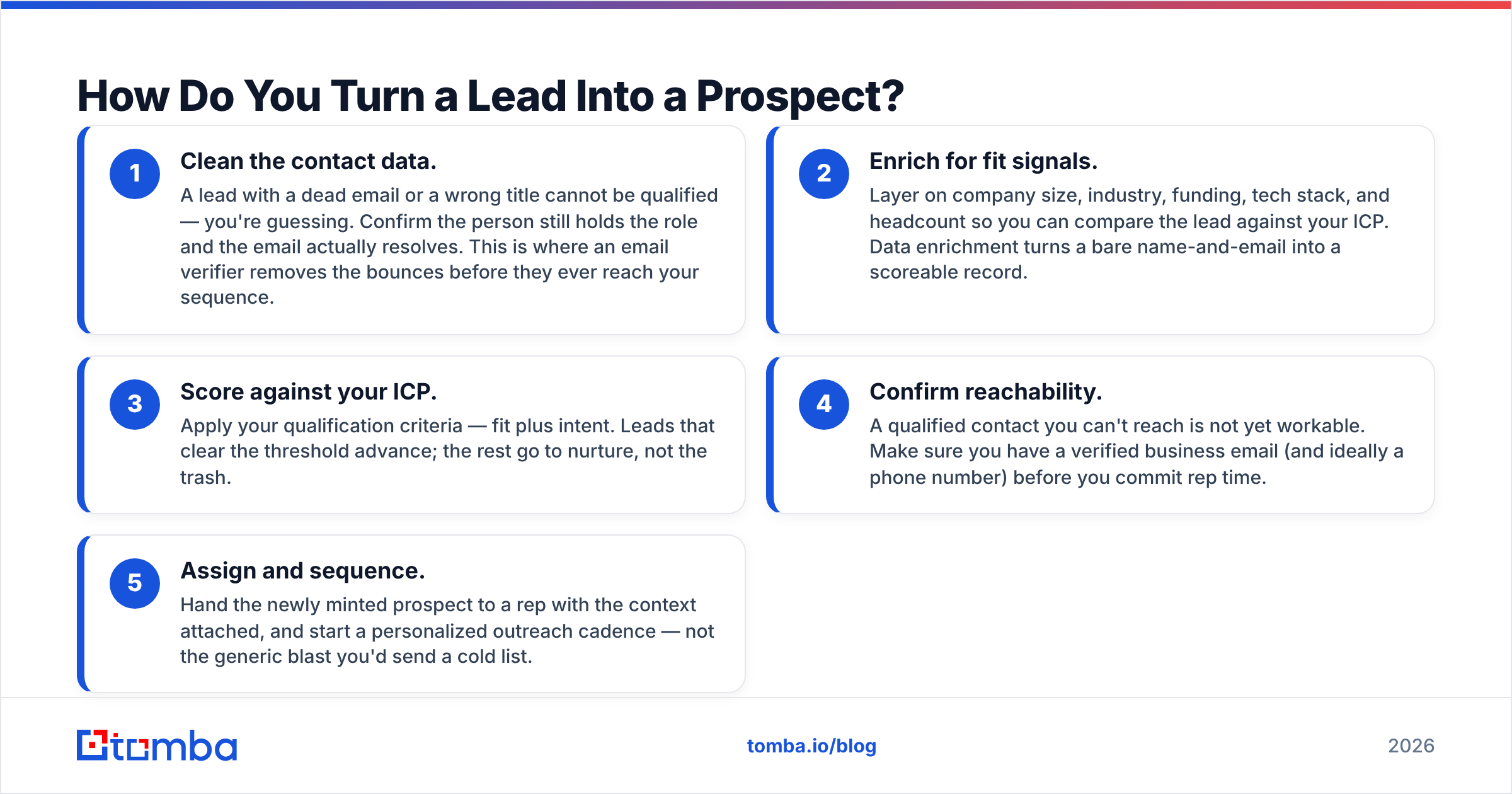
Conversion is a pipeline, not a moment. Run every lead through these five steps and the good ones come out the other side as prospects.
- Clean the contact data. A lead with a dead email or a wrong title cannot be qualified — you're guessing. Confirm the person still holds the role and the email actually resolves. This is where an email verifier removes the bounces before they ever reach your sequence.
- Enrich for fit signals. Layer on company size, industry, funding, tech stack, and headcount so you can compare the lead against your ICP. Data enrichment turns a bare name-and-email into a scoreable record.
- Score against your ICP. Apply your qualification criteria — fit plus intent. Leads that clear the threshold advance; the rest go to nurture, not the trash.
- Confirm reachability. A qualified contact you can't reach is not yet workable. Make sure you have a verified business email (and ideally a phone number) before you commit rep time.
- Assign and sequence. Hand the newly minted prospect to a rep with the context attached, and start a personalized outreach cadence — not the generic blast you'd send a cold list.
Notice that steps 1 and 2 are pure data quality. You cannot honestly qualify what you cannot trust, which is why accurate contact data sits underneath the entire lead-to-prospect motion.
Lead, Prospect, Opportunity: Where Does the Chain End?#
Prospect is not the finish line. The full B2B chain runs:
- Lead → unqualified contact enters the funnel.
- Prospect → qualified, ICP-matched, in active outreach.
- Opportunity → the prospect has confirmed a real, active buying process (budget acknowledged, timeline discussed). This is a deal in your CRM with a dollar value and a close date.
- Customer → the opportunity closed-won.
Each stage is a tighter filter than the last. The difference between a lead and a prospect is qualification; the difference between a prospect and an opportunity is a committed buying intent you can attach money to. Keeping these labels distinct is what lets you run stage-conversion math — lead-to-prospect rate, prospect-to-opportunity rate — and spot exactly where deals stall.
What Data Do You Need at Each Stage?#
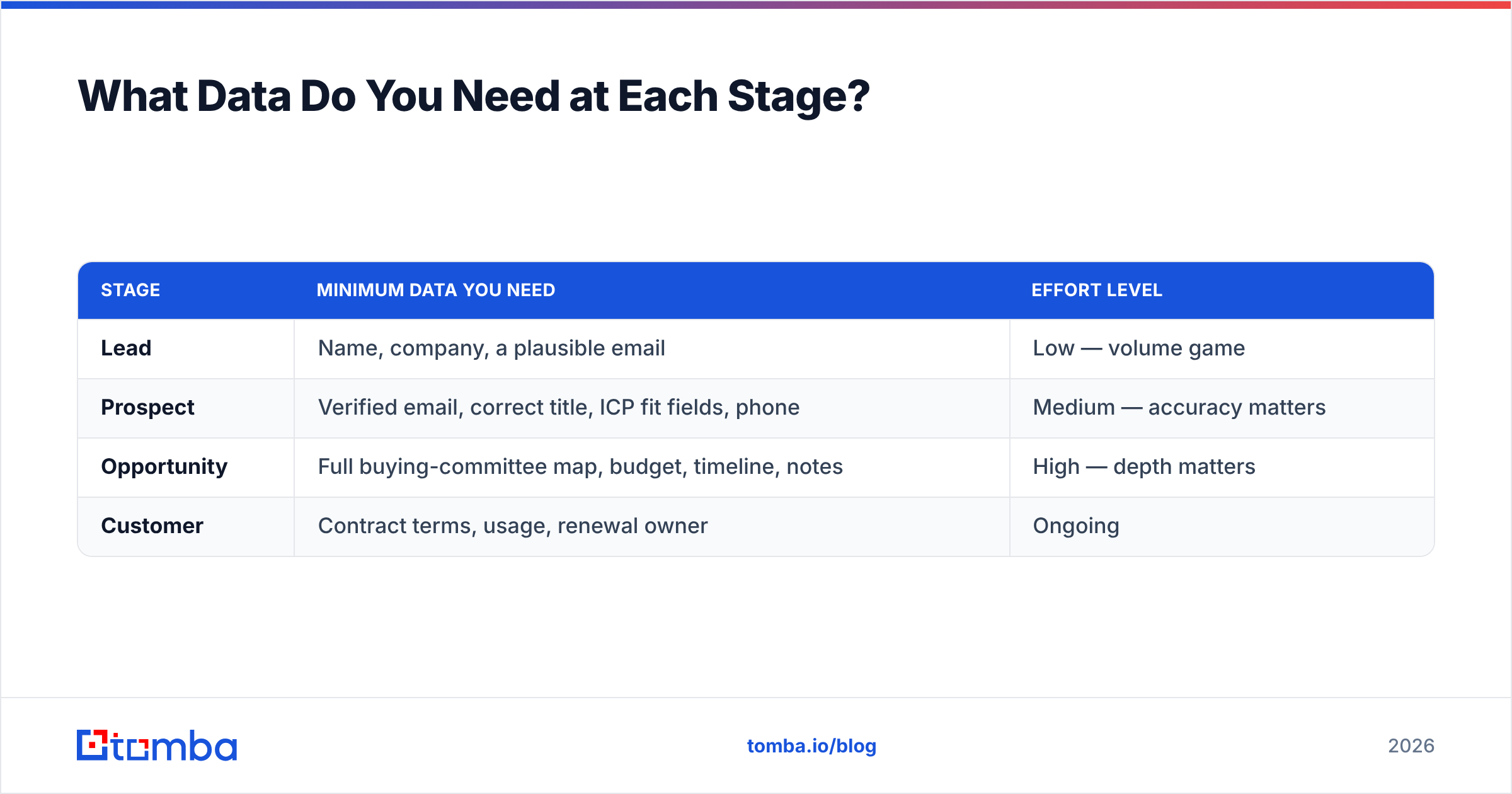
The data bar rises as contacts move down the funnel. Trying to hold every contact to prospect-grade data is expensive; holding prospects to lead-grade data is fatal. Match the effort to the stage.
| Stage | Minimum data you need | Effort level |
|---|---|---|
| Lead | Name, company, a plausible email | Low — volume game |
| Prospect | Verified email, correct title, ICP fit fields, phone | Medium — accuracy matters |
| Opportunity | Full buying-committee map, budget, timeline, notes | High — depth matters |
| Customer | Contract terms, usage, renewal owner | Ongoing |
The jump that trips teams up is lead → prospect. That's the exact point where a plausible-looking email has to become a verified, enriched, role-confirmed record. Skip it and you'll qualify on bad data, which is worse than not qualifying at all.
Common Mistakes When Handling Leads and Prospects#
- Treating MQLs as prospects. A high lead score is a signal to qualify, not proof of fit. A human or a stricter rule still has to confirm it.
- Qualifying on stale data. A "VP of Marketing" who left 18 months ago will fail every sequence. Verify the role before you score it.
- Skipping nurture for unqualified leads. A lead that isn't a prospect today may be one next quarter. Route it to nurture; don't delete it.
- One-size outreach. Blasting prospects with the same message you'd send a cold lead wastes the qualification work you just did.
- No shared definition. If marketing and sales can't agree in writing on what "prospect" means, your funnel metrics are noise. G2's sales glossary is a fine neutral reference to anchor the definitions your two teams sign off on.
How to Build Prospects You Can Trust#
The whole distinction collapses if the underlying contact data is wrong. A "qualified prospect" built on a guessed email and an outdated title is just a lead wearing a costume. That's why the practical answer to the lead-versus-prospect problem is a reliable data layer: find the real contact, verify it, enrich it, then qualify.
That's exactly the job of the Tomba Email Finder. Point it at a company domain or a name, and it returns verified professional email addresses — with a confidence score and source citations — so the contacts entering your qualification step are real people you can actually reach. Pair it with the email verifier to strip bounces and the enrichment tools to add the ICP fields you score against, and every lead-to-prospect decision rests on data you trust instead of a hopeful guess.
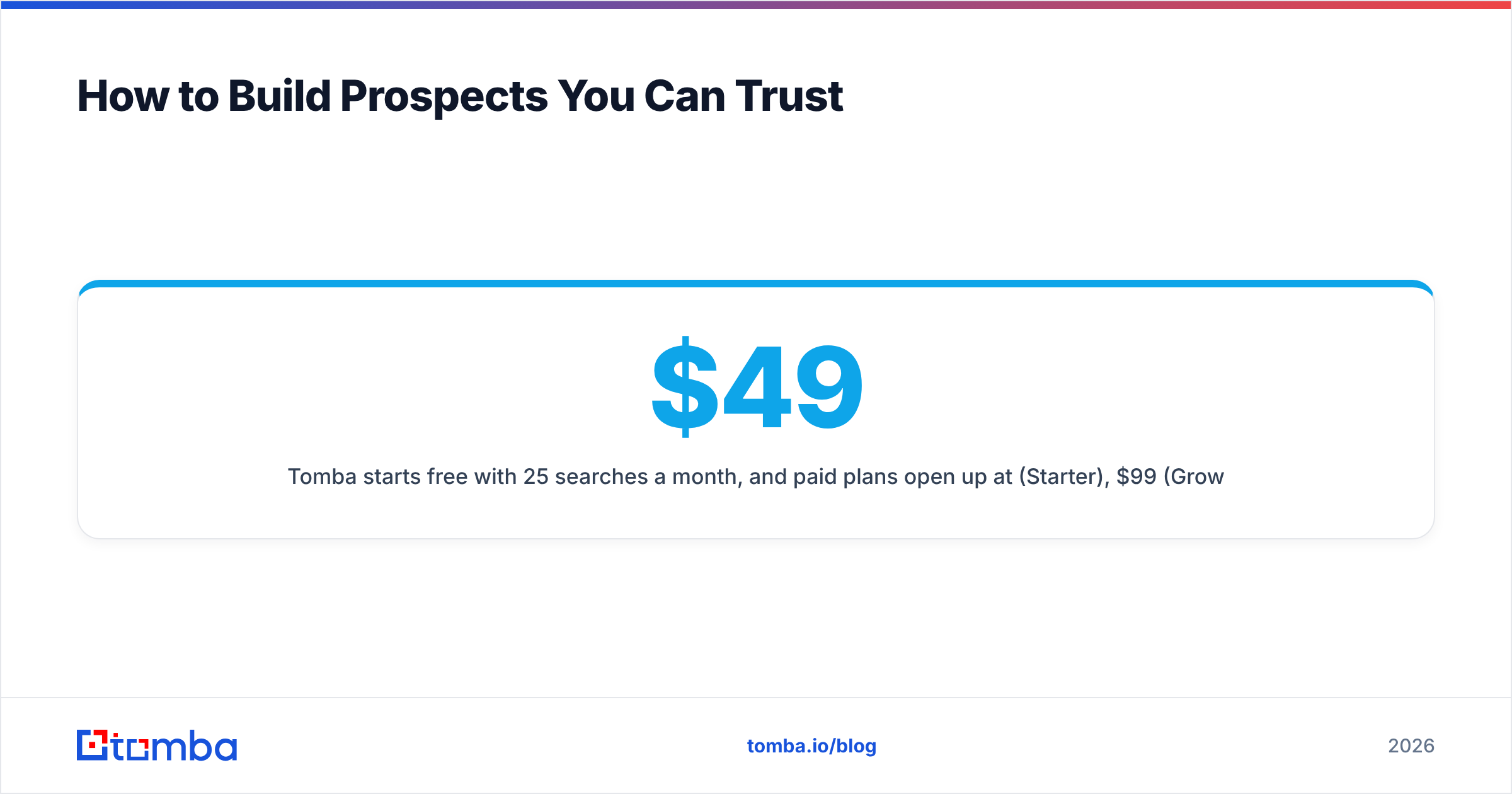
Tomba starts free with 25 searches a month, and paid plans open up at $49/mo (Starter), $99/mo (Growth), and $249/mo (Pro). You can see the full breakdown on the Tomba pricing page. If your reps are burning hours qualifying contacts on shaky data, that's the cheapest fix on your stack — turn your raw leads into prospects you can actually close.
Related guides#
Ready to find emails that actually work?
Join 150,000+ professionals who stopped guessing and started sending. Free credits on signup — no credit card required.
Get the Tomba newsletter
Practical outbound tactics and product updates — once every two weeks.
About the author