DiscoverOrg vs Enrow in 2026: Which One Should You Buy?
DiscoverOrg is now ZoomInfo, and Enrow is a pay-per-valid-email finder. One costs five figures a year, the other under $100 a month. Here's which one actually fits your pipeline.
TL;DR
- DiscoverOrg no longer exists as a product you can buy. It merged with ZoomInfo in 2019 and the brand was retired — if a rep pitches you "DiscoverOrg," you are being quoted a ZoomInfo contract.
- Enrow is a modern, narrow tool: waterfall email finding plus verification, billed per valid email, with no annual seat minimum.
- These two are not really competitors. One is a full B2B intelligence platform with org charts, intent data, and technographics. The other is a data pipe that turns names into deliverable inboxes.
- Budget gap is enormous: ZoomInfo lands in the five figures per year for most teams; Enrow-class tools run under $100/month at typical SMB volume.
- If you only need accurate emails at a fair price with an API you can actually self-serve, a dedicated email finder beats both on cost-per-usable-record.
What are you actually comparing when you search "DiscoverOrg vs Enrow"?#
You are comparing two different categories of product that happen to both end with an email address in your CRM.
Think of it like comparing a supermarket to a water filter. The supermarket sells you everything — produce, meat, cleaning supplies — and charges an annual membership. The water filter does exactly one thing, does it cheaply, and does it well. Asking which is "better" only makes sense once you know whether you came for groceries or for water.
DiscoverOrg (now ZoomInfo) is the supermarket: company records, org charts, direct dials, intent signals, technographics, workflow automation, CRM sync. Enrow is the filter: you feed it a first name, last name, and domain, and it returns a verified, deliverable email — or nothing, and it doesn't charge you for the miss.
Most teams searching this comparison are actually asking a budget question: do I need the whole platform, or do I just need emails that land?
What happened to DiscoverOrg?#
DiscoverOrg was founded in 2007 and built its reputation on human-verified org charts and direct dials in IT, marketing, finance, and HR departments. Its differentiator was research rigor — real analysts calling into companies to confirm reporting structures, not just scraped profiles.
In February 2019, DiscoverOrg acquired ZoomInfo. Later that year the combined company adopted the ZoomInfo name, and by 2020 the DiscoverOrg brand had been fully retired. Today, if you go to any DiscoverOrg URL you land on zoominfo.com.
This matters practically for three reasons:
- The pricing model changed. DiscoverOrg's legacy plans are gone. You buy ZoomInfo Sales, Marketing, or Operations bundles with annual commitments and per-seat licensing.
- The data changed. ZoomInfo's contributory network model (users share contact data in exchange for access) sits alongside the old research-team approach. Coverage went way up; some buyers argue precision on niche titles went down.
- Comparison content is stale. Half the "DiscoverOrg vs X" articles still ranking were written before the merger. Any pricing figure they quote for DiscoverOrg is fiction.
So when you evaluate "DiscoverOrg," evaluate ZoomInfo. The rest of this post does exactly that.
What is Enrow and who is it for?#
Enrow is a European email-finding and verification service built around two ideas that older tools got wrong.
Waterfall enrichment. Instead of relying on a single database, Enrow queries multiple providers in sequence until one returns a hit. If provider A whiffs on a contact, provider B or C gets a shot. This raises hit rate on hard-to-find contacts — small companies, non-US domains, recently hired people.
Pay only for valid results. Credits are consumed when a verified email comes back, not when you burn a lookup on a dead end. That single billing decision changes the math dramatically compared to legacy tools where a 60% hit rate means you paid full price for 40% nothing.
Enrow is a fit if you run outbound at moderate volume, care mostly about deliverability, and have zero interest in paying for intent data or org charts you'll never open. It is not a fit if you need company firmographics, buying-committee mapping, or a database you can browse and filter without knowing who you're looking for.

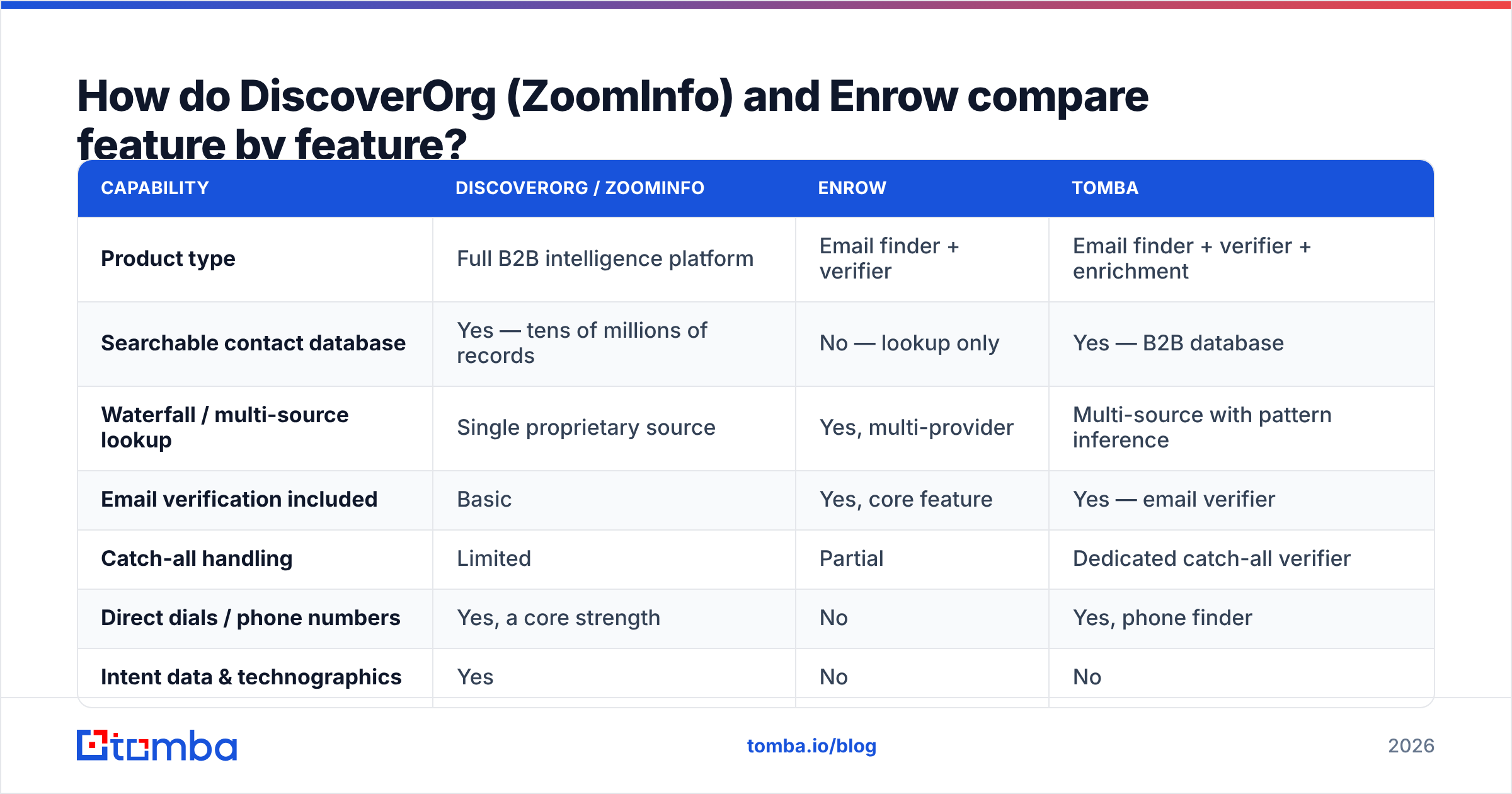
How do DiscoverOrg (ZoomInfo) and Enrow compare feature by feature?#
| Capability | DiscoverOrg / ZoomInfo | Enrow | Tomba |
|---|---|---|---|
| Product type | Full B2B intelligence platform | Email finder + verifier | Email finder + verifier + enrichment |
| Searchable contact database | Yes — tens of millions of records | No — lookup only | Yes — B2B database |
| Waterfall / multi-source lookup | Single proprietary source | Yes, multi-provider | Multi-source with pattern inference |
| Email verification included | Basic | Yes, core feature | Yes — email verifier |
| Catch-all handling | Limited | Partial | Dedicated catch-all verifier |
| Direct dials / phone numbers | Yes, a core strength | No | Yes, phone finder |
| Intent data & technographics | Yes | No | No |
| Org charts | Yes, legacy strength | No | No |
| Self-serve signup | No — sales call required | Yes | Yes |
| Public API | Yes, extra cost | Yes | Yes — Tomba API on all paid plans |
| Free tier | No | Trial credits | 25 searches/month, free forever |
| Contract | Annual, per seat | Monthly, cancel anytime | Monthly or annual |
The pattern is clear once it's laid out: ZoomInfo wins on breadth, Enrow wins on unit economics and speed to value, and a mid-tier finder covers the overlap where most teams actually operate.
Which one is more accurate on email data?#
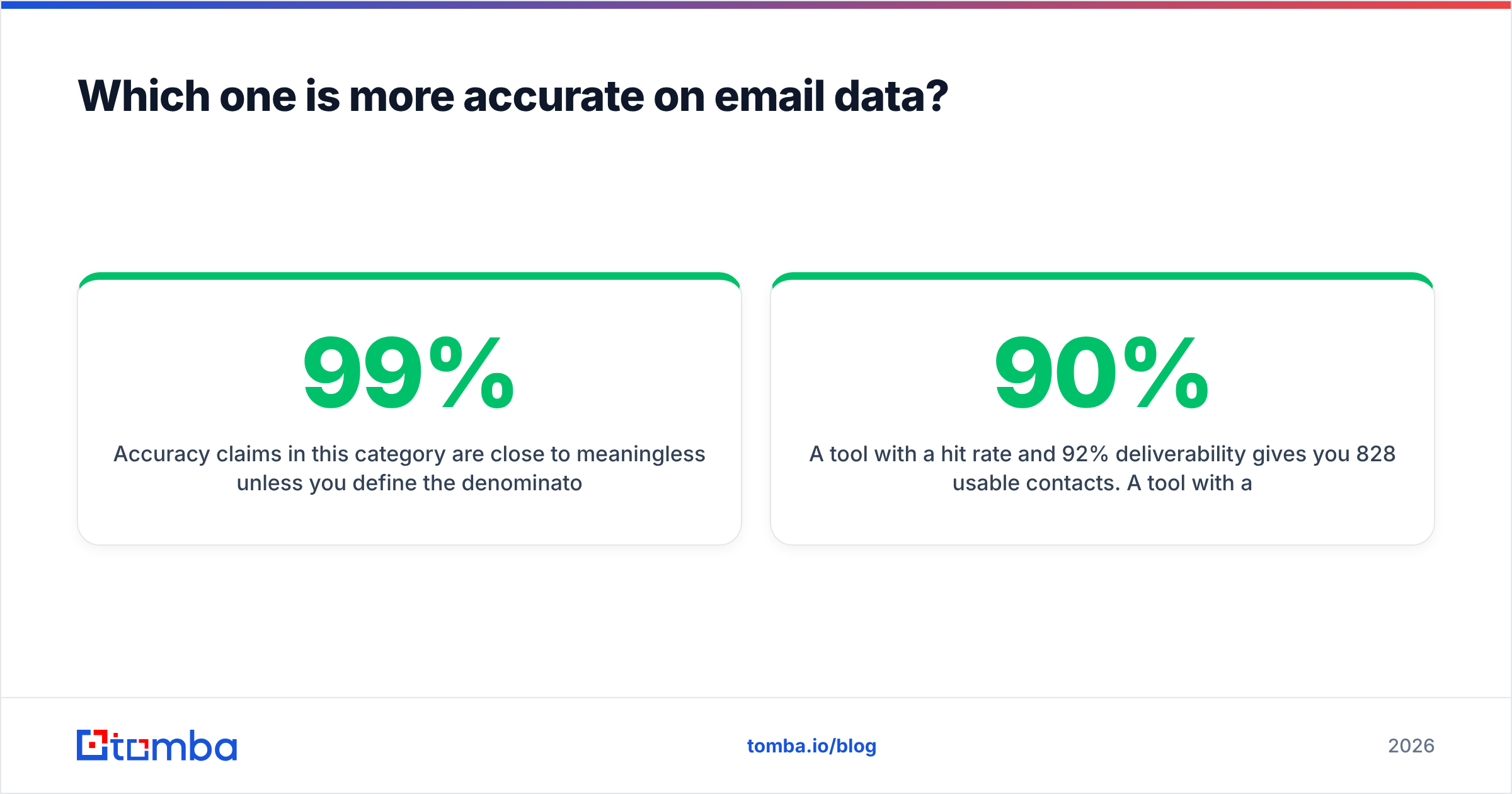
Accuracy claims in this category are close to meaningless unless you define the denominator. A vendor claiming "99% accuracy" usually means: of the emails we chose to return, 99% pass verification. That says nothing about how many of your contacts they could find at all.
Two numbers matter, and you should demand both:
- Hit rate — of 1,000 contacts you submit, how many come back with any email?
- Deliverability rate — of those hits, how many actually accept mail without bouncing?
A tool with a 90% hit rate and 92% deliverability gives you 828 usable contacts. A tool with a 55% hit rate and 99% deliverability gives you 545. The second one has the prettier marketing page and the worse outcome.

On the accuracy axis specifically:
- ZoomInfo is strongest in US mid-market and enterprise, particularly for direct dials. Coverage thins noticeably outside North America and in companies under ~50 employees. Its email data is good but not its headline product — you're paying mostly for the graph around the contact.
- Enrow's waterfall approach genuinely helps hit rate on the long tail, because it isn't limited to one vendor's snapshot. The trade-off is cost variance: a hard contact might route through three providers.
- Catch-all domains are where most tools quietly fail. Roughly a fifth of B2B domains accept all mail, so standard SMTP verification returns "unknown." Whether a tool guesses, discards, or actually resolves those addresses determines a real chunk of your usable list.
Run your own test before you sign anything. Take 200 contacts you already have confirmed emails for, strip the emails, and submit the names and domains to each tool. Score both numbers. It takes an afternoon and it is the only benchmark that reflects your ICP.
What does each one actually cost?#
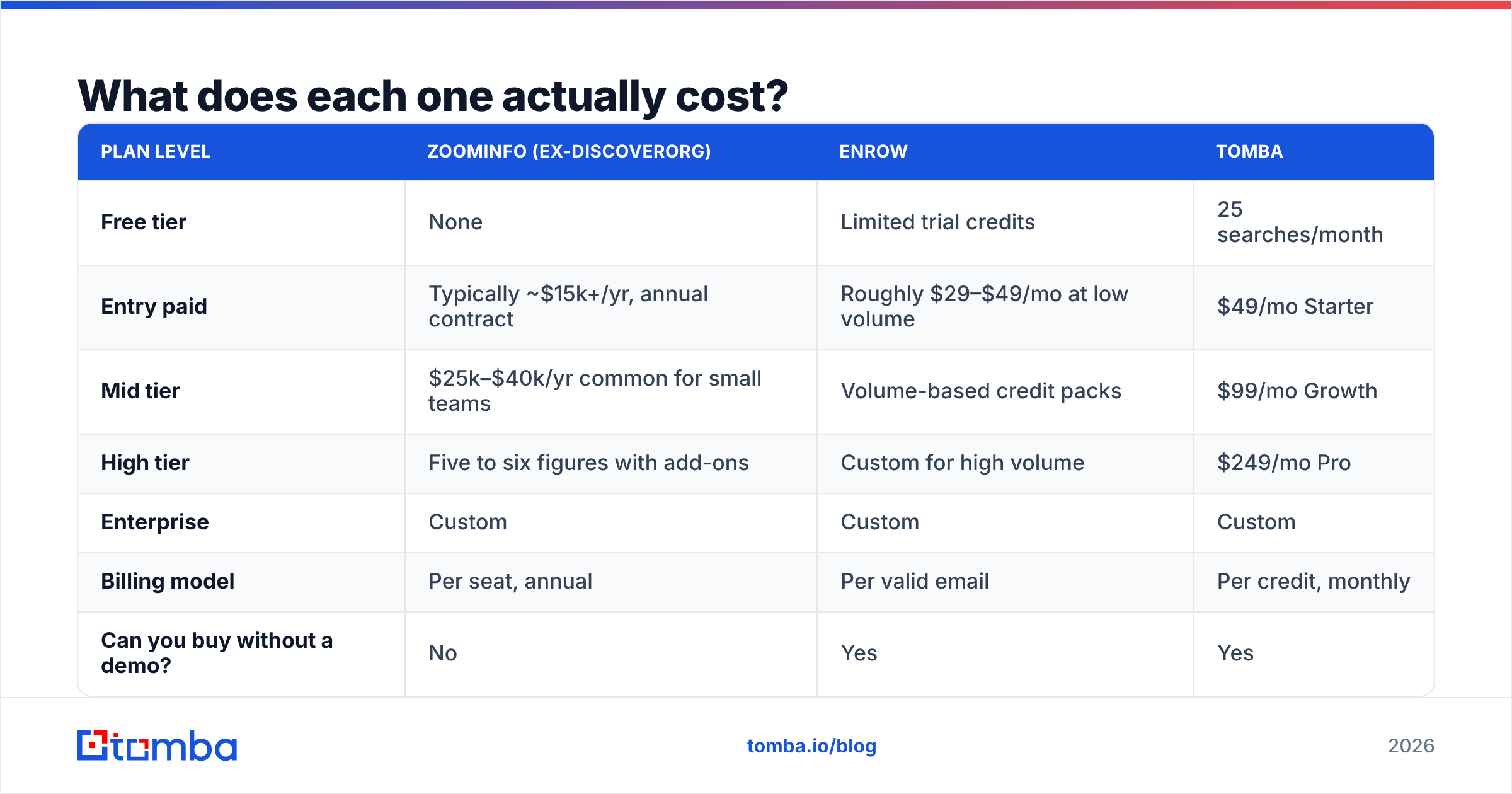
| Plan level | ZoomInfo (ex-DiscoverOrg) | Enrow | Tomba |
|---|---|---|---|
| Free tier | None | Limited trial credits | 25 searches/month |
| Entry paid | Typically ~$15k+/yr, annual contract | Roughly $29–$49/mo at low volume | $49/mo Starter |
| Mid tier | $25k–$40k/yr common for small teams | Volume-based credit packs | $99/mo Growth |
| High tier | Five to six figures with add-ons | Custom for high volume | $249/mo Pro |
| Enterprise | Custom | Custom | Custom |
| Billing model | Per seat, annual | Per valid email | Per credit, monthly |
| Can you buy without a demo? | No | Yes | Yes |
ZoomInfo does not publish pricing, and quotes swing wildly based on seats, data volume, export limits, and whether you want intent. Public reviews on G2 consistently reference annual commitments in the $15,000–$40,000 range for small-to-mid teams, plus notoriously firm auto-renewal terms. Budget for a procurement cycle, not a credit card.
Enrow and comparable finders are self-serve. You can test on Tuesday and be running lists by Thursday. Full Tomba pricing is published for the same reason — if a vendor hides the number, the number is negotiable, and "negotiable" means someone is paying too much.
When should you pick DiscoverOrg (ZoomInfo)?#
Buy the platform when the platform is the point:
- You sell enterprise deals with buying committees. Org charts and reporting lines are worth real money when a deal needs seven stakeholders aligned. No email finder gives you that.
- Cold calling is a primary channel. ZoomInfo's direct-dial coverage in North America is the strongest mainstream option. If your reps live on the phone, this is the argument that justifies the invoice.
- You want intent signals baked in. Surfacing accounts researching your category, inside the same tool where you build lists, saves a genuine workflow step.
- You have a RevOps function to operate it. ZoomInfo rewards teams who wire it into Salesforce, build enrichment rules, and monitor usage. Buy it without that and you'll pay enterprise rates for a contact search bar.
- Your budget is already allocated. If a $30k line item exists and the alternative is losing it, the ROI question is different than if it comes out of a $500/month tooling budget.
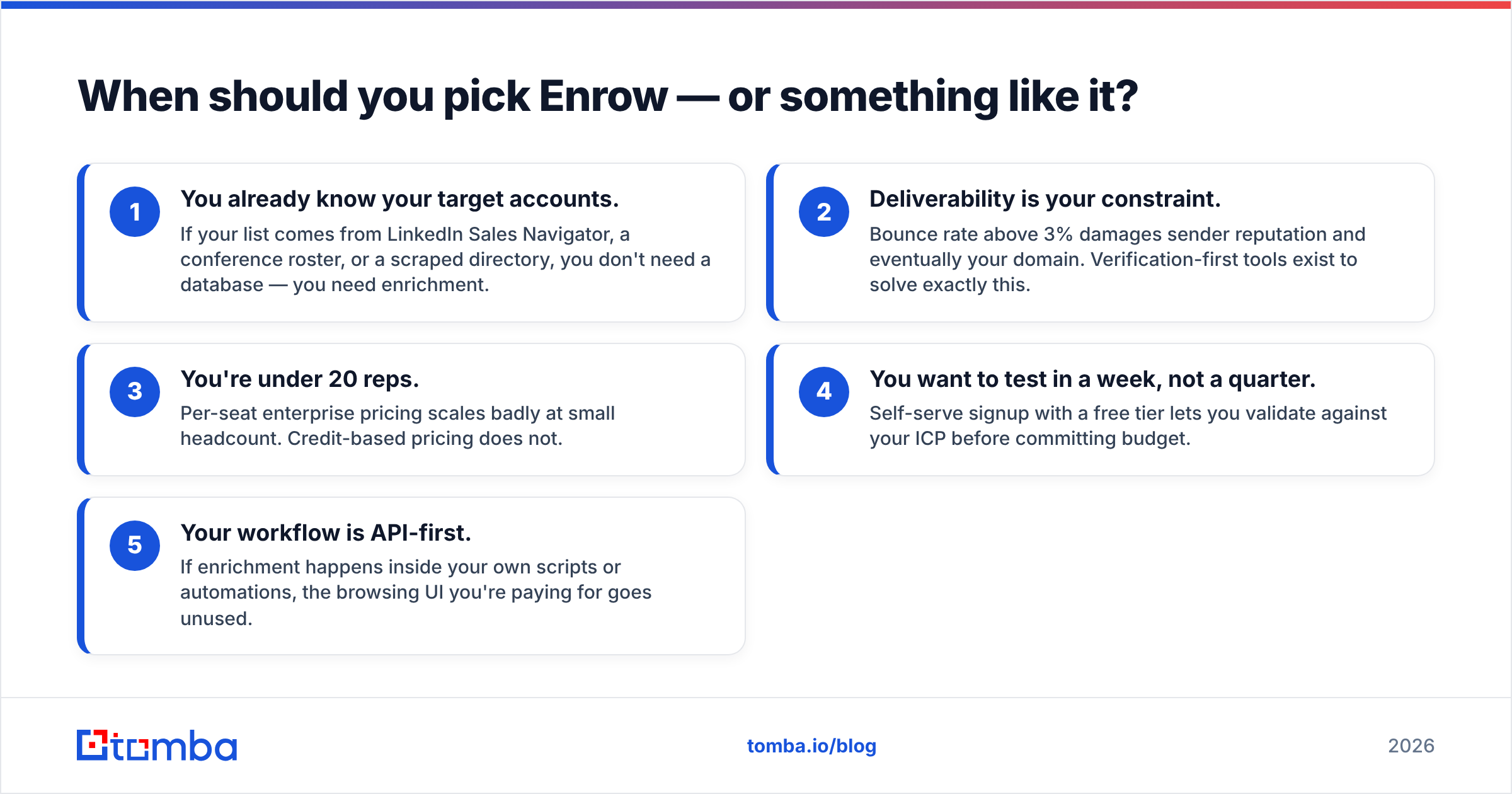
When should you pick Enrow — or something like it?#
Pick the lean tool when your bottleneck is emails, not intelligence:
- You already know your target accounts. If your list comes from LinkedIn Sales Navigator, a conference roster, or a scraped directory, you don't need a database — you need enrichment.
- Deliverability is your constraint. Bounce rate above 3% damages sender reputation and eventually your domain. Verification-first tools exist to solve exactly this.
- You're under 20 reps. Per-seat enterprise pricing scales badly at small headcount. Credit-based pricing does not.
- You want to test in a week, not a quarter. Self-serve signup with a free tier lets you validate against your ICP before committing budget.
- Your workflow is API-first. If enrichment happens inside your own scripts or automations, the browsing UI you're paying for goes unused.

Is there a middle option between the two?#
Yes, and it's where most teams land after the sticker shock wears off.
The gap in this market is a tool with a real searchable database and honest per-credit pricing and verification you don't buy separately. That's the slot Tomba occupies: domain search to pull every public email at a company, an email finder for name-plus-domain lookups, a verifier and catch-all resolver on the same credits, and bulk processing for lists you already have.

Practically, the decision usually resolves like this:
- Need org charts, intent, and direct dials at enterprise scale → ZoomInfo, and negotiate hard on the renewal clause.
- Need verified emails from a list you already own, at the lowest cost per valid record → Enrow or a comparable finder.
- Need both list-building and verification without an annual contract → a mid-tier platform with a free tier you can test today.
How do you decide in under ten minutes?#
Answer these four questions honestly:
What's your monthly contact volume? Under 5,000 lookups, enterprise pricing is indefensible. Over 100,000 with multi-channel needs, platform economics start working.
Is phone a real channel for you? If reps genuinely dial, ZoomInfo's direct-dial coverage is the one thing lean tools cannot replicate. If your team hasn't picked up a phone in a year, stop paying for numbers.
Where does your list come from? Sourced externally → you need enrichment. Sourced from nothing → you need a database.
Who operates the tool? A dedicated RevOps owner can extract value from a platform. A founder doing outbound at 11pm needs an API key and clear docs.
Then run the 200-contact test described above against your shortlist. Vendors will send you their own benchmark; ignore it. Your ICP is the only benchmark that predicts your results.
Ready to test the middle path?#
If your honest answer is "I mostly need emails that don't bounce, at a price I can approve myself," start with the Tomba Email Finder. The free tier gives you 25 searches a month with no card, Starter is $49/month, and every plan includes verification, catch-all handling, and full API access rather than charging for each separately. Run your 200-contact accuracy test on it alongside whatever quote ZoomInfo sends you — and let the hit rate, not the sales deck, make the call.
Related guides#
Ready to find emails that actually work?
Join 150,000+ professionals who stopped guessing and started sending. Free credits on signup — no credit card required.
Get the Tomba newsletter
Practical outbound tactics and product updates — once every two weeks.
About the author