DiscoverOrg vs GetProspect (2026): Which Data Tool Wins?
One is now ZoomInfo's enterprise data engine with annual contracts; the other is a self-serve email finder you can start on for free. Here's how DiscoverOrg and GetProspect actually compare on data, pricing, and workflow in 2026.
DiscoverOrg vs GetProspect is a common search in 2026. But it is not a fair match. One tool is now part of ZoomInfo. The other is a cheap, self-serve email finder. Here is what that gap means for your budget.
TL;DR
- DiscoverOrg is gone as a standalone product. It merged with ZoomInfo in 2019. Today you buy ZoomInfo Sales instead: annual contract, seat-based, sales call required.
- GetProspect is the opposite shape. It is a self-serve email finder with a free tier, a LinkedIn extension, and monthly plans.
- They are not real rivals. ZoomInfo sells org charts and intent data to big teams. GetProspect sells contacts to founders and small teams.
- The cost gap is about 20x. Think five figures a year for ZoomInfo. Think double digits a month for GetProspect.
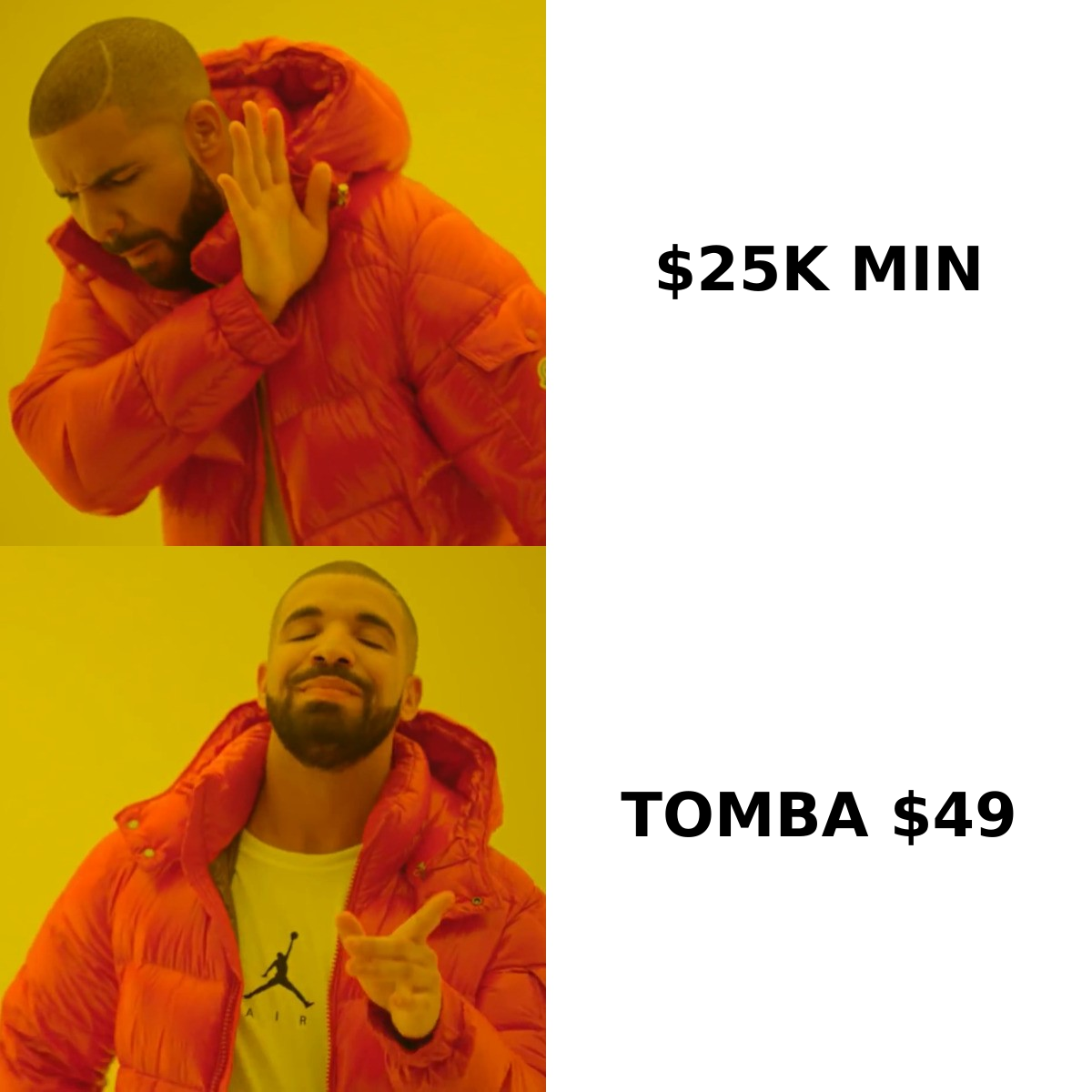
- Need verified work emails at a set price? A focused finder like Tomba (free tier, then $49/mo) often wins on cost per usable contact.
What happened to DiscoverOrg?#
ZoomInfo bought DiscoverOrg and then merged it in. The deal closed in February 2019. The combined company kept the ZoomInfo name. By 2021 the DiscoverOrg product name was retired. Search for "DiscoverOrg login" today and you land on ZoomInfo.
That matters here in three ways:
- You cannot buy DiscoverOrg anymore. Any "DiscoverOrg pricing" page is old news or an affiliate page. It will push you into a ZoomInfo demo request.
- The DNA survived. DiscoverOrg was known for human-checked org charts and IT maps. Researchers called companies to confirm who reported to whom. That research layer is why ZoomInfo Sales still costs enterprise money.
- Buying got harder, not easier. DiscoverOrg was already an annual contract. Now ZoomInfo bundles Sales, Marketing, Talent, and Operations. So the entry price crept up.
The honest reframe for DiscoverOrg vs GetProspect in 2026 is simple. It is an enterprise data platform against a self-serve email finder.
What is GetProspect built for?#
GetProspect is a B2B lead database and email finder. The loop is simple. Filter the database by job title, company size, industry, or location. Or run a LinkedIn search and pull contacts with the Chrome extension. You get a name, a work email, a company, and sometimes a phone.
The product bets on three things:
- Self-serve onboarding. Sign up, get free monthly credits, and pull contacts in minutes. No sales rep calls you.
- LinkedIn first. Most users start from a Sales Navigator list, not a database query.
- Monthly billing. You can spend $49 in January and nothing in February.
The trade-off is depth. You do not get verified org charts, buying-committee maps, intent signals, or deep tech-stack filters. Those are what make ZoomInfo stick inside a 200-rep sales team.
DiscoverOrg vs GetProspect: head-to-head#
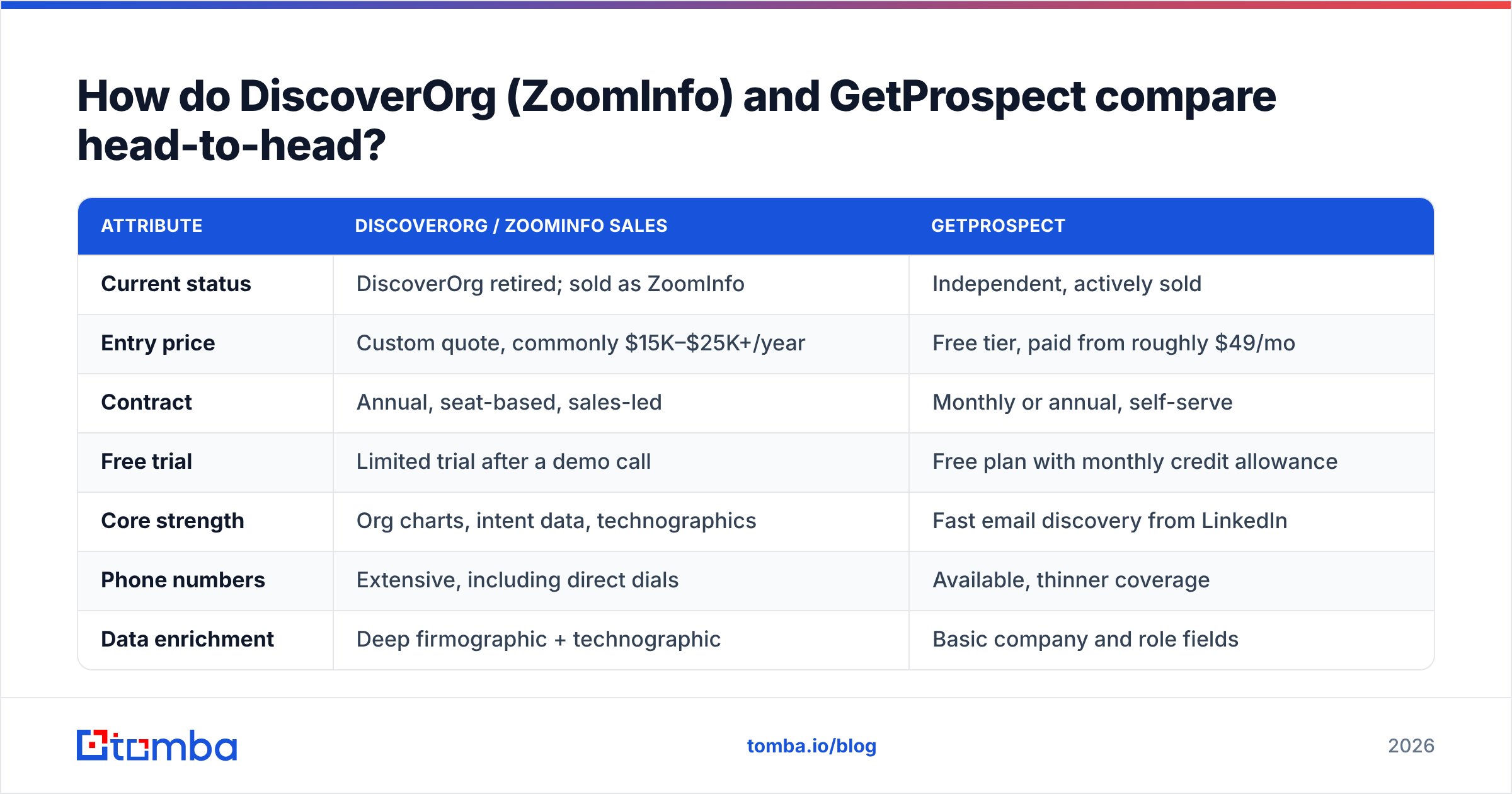
Here is the side-by-side. ZoomInfo does not publish prices. The numbers below come from buyer reviews on G2. Treat them as a range, not a quote.
| Attribute | DiscoverOrg / ZoomInfo Sales | GetProspect |
|---|---|---|
| Status | Retired; sold as ZoomInfo | Independent, still sold |
| Entry price | Custom, often $15K–$25K+/year | Free tier, paid from $49/mo |
| Contract | Annual, seat-based, sales-led | Monthly or annual, self-serve |
| Free trial | Limited, after a demo call | Free plan with monthly credits |
| Core strength | Org charts, intent, tech stack | Fast email finding from LinkedIn |
| Phone numbers | Wide, with direct dials | Available, thinner coverage |
| Enrichment | Deep firmographic and tech data | Basic company and role fields |
| API access | Yes, usually a paid add-on | Yes, on paid plans |
| CRM sync | Native Salesforce and HubSpot | HubSpot, Pipedrive, Zapier |
| Best fit | 20+ rep teams with budget | Founders, agencies, small teams |
| Ramp time | Weeks of setup and training | Same day |
Read the table as a fork in the road, not a scoreboard. Nobody leaves ZoomInfo because GetProspect has better intent data. They leave because the renewal quote hit $34,000 and they used maybe 12% of the platform.

Which one has better data accuracy?#
Accuracy claims are messy. Vendors measure different things. Three numbers get squashed into one:
- Match rate — how many of your searches returned any email.
- Deliverability — how many of those emails accept mail.
- Freshness — how recently the record was checked. Job changes break this first.
ZoomInfo wins on freshness for large accounts. It inherited DiscoverOrg's human research plus a contributory network. So C-level and IT records at bigger firms stay current. Coverage thins for firms under 50 staff, for non-US markets, and for new startups.
GetProspect does well on match rate for LinkedIn contacts. That is what it is tuned for. The friction is verification depth. Catch-all domains often come back as "valid" with no real delivery signal. That inflates your list and then hurts your sender score.

Whatever you buy, split discovery and verification into two steps. Run discovery where coverage fits your ICP. Then push every address through a dedicated email verifier before it hits a sequencer. A three-cent check is cheaper than a burned domain.
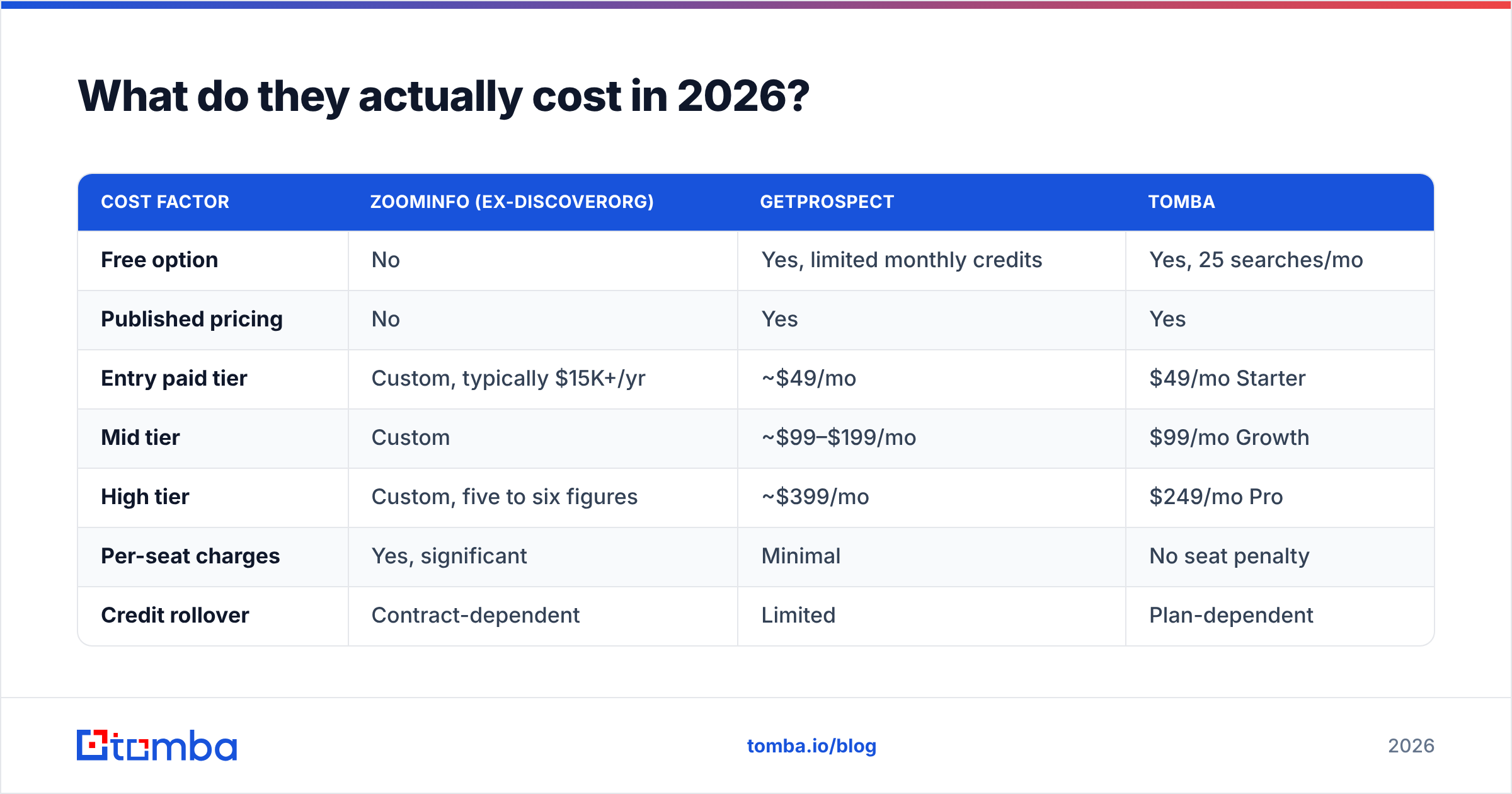
DiscoverOrg vs GetProspect pricing in 2026#
This is where DiscoverOrg vs GetProspect stops being close.
| Cost factor | ZoomInfo (ex-DiscoverOrg) | GetProspect | Tomba |
|---|---|---|---|
| Free option | No | Yes, limited credits | Yes, 25 searches/mo |
| Public pricing | No | Yes | Yes |
| Entry tier | Custom, from $15K/yr | ~$49/mo | $49/mo Starter |
| Mid tier | Custom | ~$99–$199/mo | $99/mo Growth |
| High tier | Custom, five to six figures | ~$399/mo | $249/mo Pro |
| Per-seat charges | Yes, large | Minimal | None |
| Credit rollover | Contract-dependent | Limited | Plan-dependent |
| Minimum term | 12 months | 1 month | 1 month |
Two hidden costs deserve names.
Seat inflation. Enterprise data tools price per seat. Add a marketing ops person, a RevOps analyst, and two reps, and the quote jumps. Self-serve tools price on credits, not headcount.
Unused capacity. Annual deals front-load your spend. Usage ramps slowly. Teams often burn less than half their credits in year one. There is no refund.
Is your team stuck on this call? Put one number on a slide. Take total annual spend. Divide it by contacts that were found, verified, deliverable, and in your ICP. That cost per usable contact reorders most shortlists. Check the low end against Tomba pricing in about thirty seconds.

DiscoverOrg vs GetProspect: which should you choose?#
Match the tool to your problem, not to the feature list.
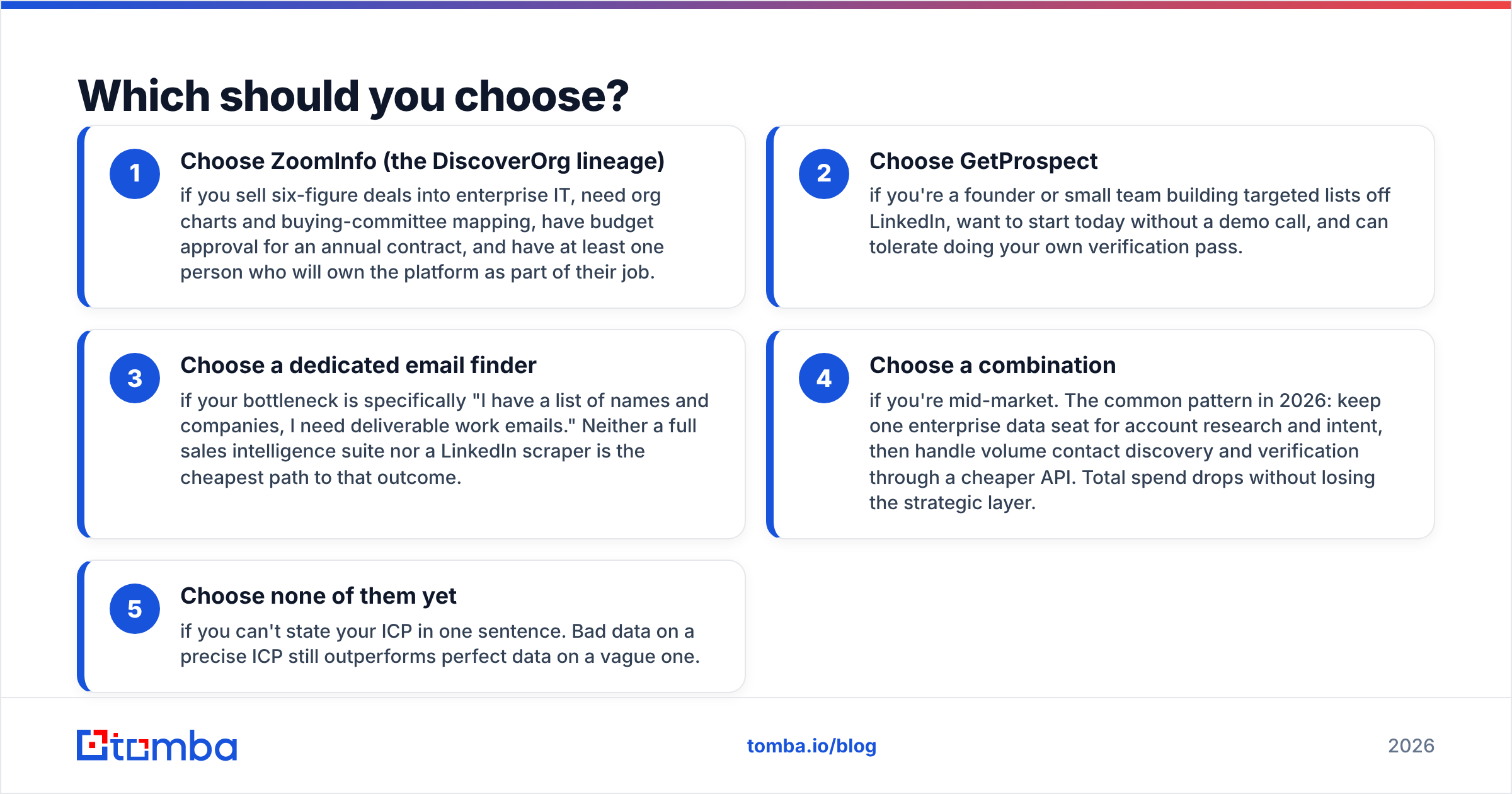
- Pick ZoomInfo if you sell six-figure deals into enterprise IT. You need org charts and buying-committee maps. You have budget and an owner for the tool.
- Pick GetProspect if you are a founder or a small team building lists off LinkedIn. You want to start today, with no demo call.
- Pick a dedicated email finder if your problem is narrow. You have names and companies. You need emails that land.
- Pick a mix if you are mid-market. Keep one enterprise seat for research. Send volume discovery and verification through a cheaper API.
- Pick nothing yet if you cannot state your ICP in one sentence. Good data on a sharp ICP beats perfect data on a vague one.
Where does a dedicated email finder fit?#
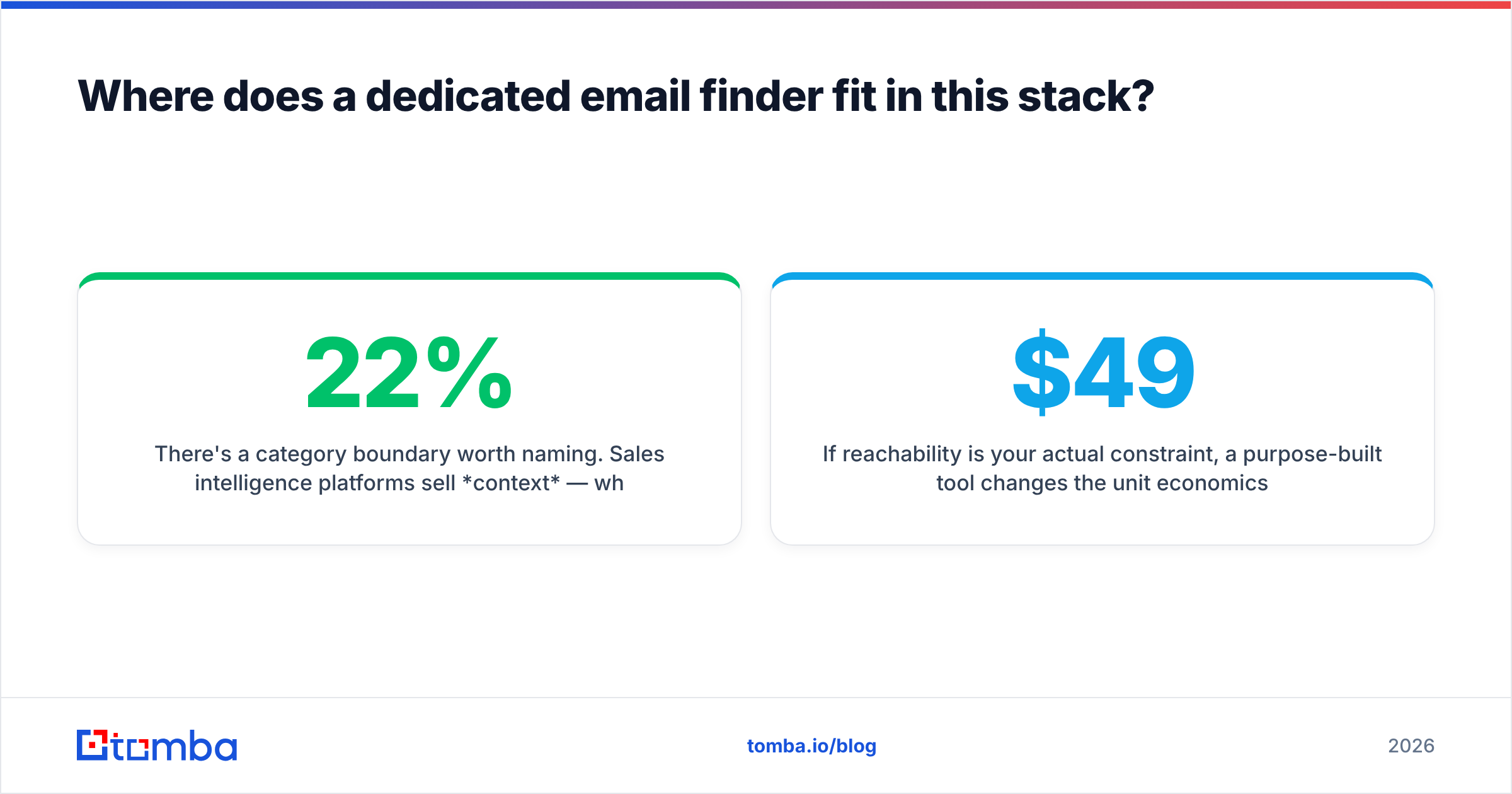
There is a category line worth drawing. Sales intelligence tools sell context: who to call, when, and why. Email finders sell reach: the working address for one person. Most teams over-buy the first and under-buy the second. Then 22% of the sequence bounces.
If reach is your real limit, a focused tool changes the math. Tomba's email finder works from a name and domain, a domain alone, or a LinkedIn profile. Every result carries a confidence score and its sources. Plans start free at 25 searches a month, then run $49/mo, $99/mo, and $249/mo. Prices are public. Billing is monthly. There is no seat tax.
At volume, go programmatic. The Tomba API enriches records at the point of capture: a form fill, a new CRM record, a scraped list. That beats batch exports that go stale before your rep opens them. Add bulk verification and your bounce rate stops being a monthly surprise.
Frequently asked questions#
Is DiscoverOrg still available in 2026? No. DiscoverOrg merged with ZoomInfo in 2019 and the brand was retired. Every purchase now goes through ZoomInfo Sales.
Is GetProspect a real ZoomInfo alternative? For contact discovery, in part. For intent data, org charts, and tech-stack data, no. It replaces the email-finding piece, not the platform.
Which has better GDPR and CCPA posture? Both publish compliance docs and handle data subject requests. ZoomInfo has more mature DPA tooling, because it sells to large firms. Check current terms with each vendor before you sign.
Can I negotiate ZoomInfo pricing? Yes, a lot. Quotes swing with seat count, module mix, and timing. End-of-quarter talks and multi-year deals move the number. Ask for credit rollover in writing.
Do I still need verification if the vendor says the data is verified? Yes. "Verified" often means syntax and domain checks at collection time, not delivery today. Job changes alone break about 2–3% of B2B records each month.
The bottom line#
DiscoverOrg vs GetProspect is not a fair fight. The two tools are not in the same weight class, or even the same decade. One is an enterprise platform behind a sales call and an annual contract. The other is a self-serve finder you can try before lunch. Decide whether you are buying context or buying reach.
If it is reach, start with the Tomba Email Finder. Run the free tier against 25 hard-to-find prospects. Check the confidence scores. Send the results through verification. Then compare bounce rates with your current tool. The test costs nothing and it settles the argument fast.
Related guides#
Ready to find emails that actually work?
Join 150,000+ professionals who stopped guessing and started sending. Free credits on signup — no credit card required.
Get the Tomba newsletter
Practical outbound tactics and product updates — once every two weeks.
About the author