DiscoverOrg vs GrowMeOrganic: Which B2B Data Tool Wins?
One is an enterprise data platform that no longer exists under its old name. The other is a sub-$100 prospecting stack. Here is the honest breakdown of cost, coverage, and accuracy before you sign anything.
DiscoverOrg vs GrowMeOrganic is a strange match-up in 2026. One of the two tools no longer exists under that name. The other costs less than a team lunch. Here is what you get, what you pay, and what to buy instead.
TL;DR
- DiscoverOrg is not a product you can buy in 2026. It merged with ZoomInfo in 2019. The joint platform now sells under the ZoomInfo name. So DiscoverOrg vs GrowMeOrganic really means big-ticket ZoomInfo against a lean outbound stack.
- ZoomInfo (ex-DiscoverOrg) sells annual, seat-based contracts. Buyers report quotes from $15,000 to $40,000+ per year. GrowMeOrganic lists month-to-month plans that start under $100.
- ZoomInfo wins on org charts, intent signals, direct dials, and large-company integrations. GrowMeOrganic wins on price, LinkedIn scraping speed, and a built-in sender.
- Neither is a pure accuracy play. If you just need a correct work email, a finder plus a verifier costs far less.
- Buy ZoomInfo if your deal sizes cover a five-figure data bill. Buy GrowMeOrganic if you are a solo founder or a small agency. Buy neither if you only need clean emails at volume.
What happened to DiscoverOrg?#
DiscoverOrg was a research-heavy B2B database. It was known for hand-checked org charts and IT install data. In 2019 it bought ZoomInfo, kept the ZoomInfo brand, and retired its own name. The human-checked contacts, the tech data, and the org charts all live inside the ZoomInfo platform today.
That matters for your shortlist. If a rep offers to sell you "DiscoverOrg," they are selling a ZoomInfo contract. Any pricing page or review that still uses the old name is at least six years stale. The packaging has changed several times since.
So the real question is simple. Do you need a full revenue data platform? Or do you need a cheap way to pull contacts from LinkedIn into a sequence?
What is GrowMeOrganic?#
GrowMeOrganic is a prospecting suite built around a Chrome extension. You browse LinkedIn or Sales Navigator and scrape a list. The tool adds emails. Then you push those contacts into a built-in cold email sender with follow-ups. It also bundles a verifier, a local business scraper, and simple list management.
It is priced like self-serve software. Tiers are public, billing is monthly, and there is no purchase cycle to sit through. Plans are flat rather than metered. That suits a two-person agency. It does not suit a 200-seat company that has to audit usage.
The trade-off is depth. You get a scraper, an enrichment layer, and a sender. You do not get org charts, buying committee maps, or intent scores.

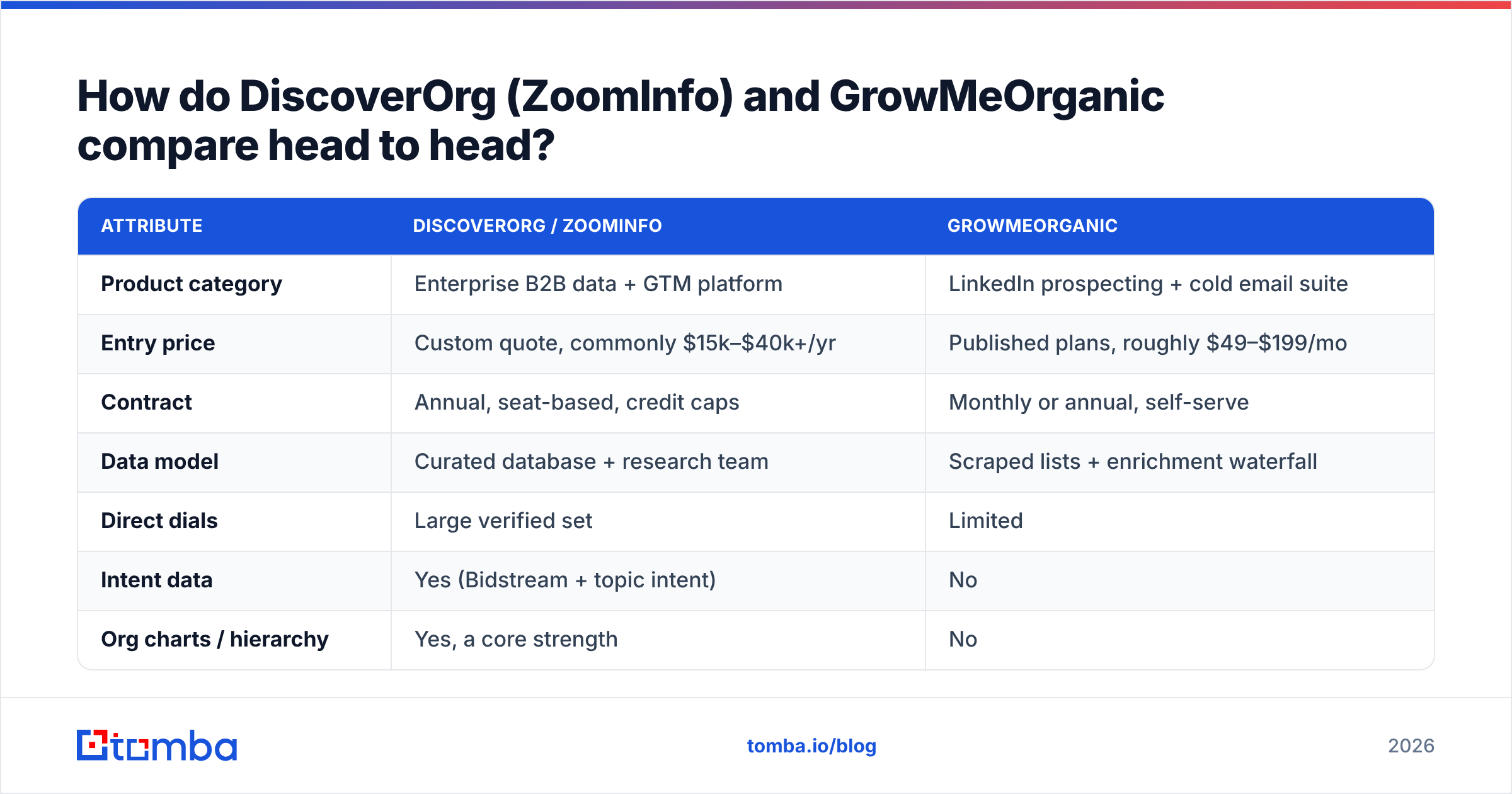
DiscoverOrg vs GrowMeOrganic: how do they compare head to head?#
| Attribute | DiscoverOrg / ZoomInfo | GrowMeOrganic |
|---|---|---|
| Product category | Enterprise B2B data + GTM platform | LinkedIn prospecting + cold email suite |
| Entry price | Custom quote, commonly $15k–$40k+/yr | Published plans, roughly $49–$199/mo |
| Contract | Annual, seat-based, credit caps | Monthly or annual, self-serve |
| Data model | Curated database + research team | Scraped lists + enrichment waterfall |
| Direct dials | Large verified set | Limited |
| Intent data | Yes (Bidstream + topic intent) | No |
| Org charts / hierarchy | Yes, a core strength | No |
| Built-in email sending | Add-on (Engage) | Included |
| Chrome extension | Yes | Yes, core workflow |
| CRM sync | Salesforce, HubSpot, Dynamics, native | HubSpot/Zapier-level |
| Best fit | Enterprise AE teams, ABM, RevOps | Founders, agencies, solo SDRs |
| Procurement effort | Demo, quote, legal, 2–6 weeks | Credit card, 5 minutes |

The table makes the split clear. These two tools are not real rivals. They answer different questions. ZoomInfo answers "who sits on the buying committee at these 400 accounts, and when are they shopping?" GrowMeOrganic answers "how do I email 3,000 people I found on LinkedIn this week without paying for four tools?"
Trouble starts when a buyer with the second question gets sold the first answer.
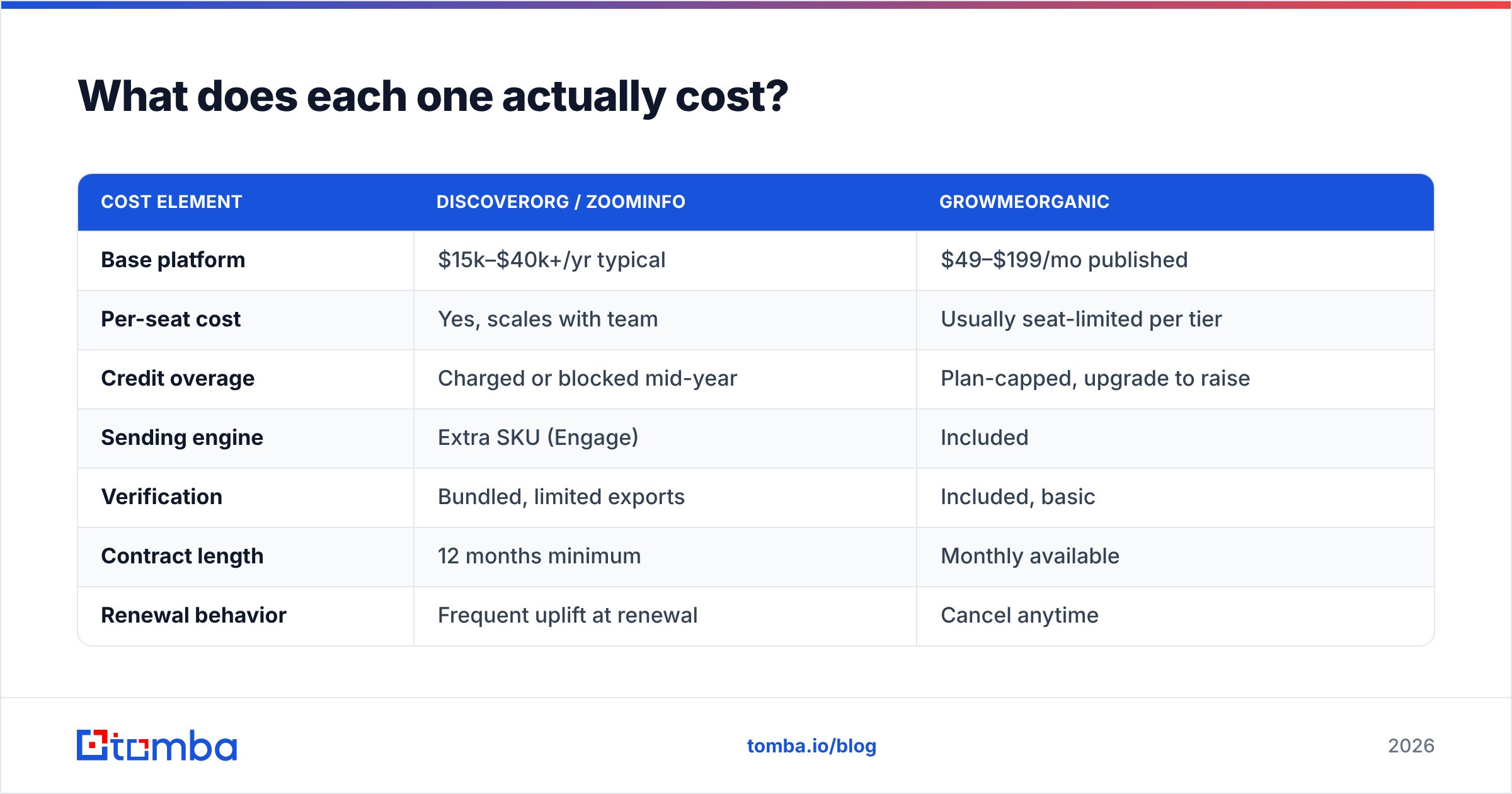
DiscoverOrg vs GrowMeOrganic: what does each one cost?#
ZoomInfo does not publish prices. You can still learn the shape of the deal from buyer reviews on G2 and from public filings. Expect annual contracts, per-seat licences, and credit caps that reset once a year. Intent, enrichment, workflows, and the Engage sender are sold as separate line items.
| Cost element | DiscoverOrg / ZoomInfo | GrowMeOrganic |
|---|---|---|
| Base platform | $15k–$40k+/yr typical | $49–$199/mo published |
| Per-seat cost | Yes, scales with team | Usually seat-limited per tier |
| Credit overage | Charged or blocked mid-year | Plan-capped, upgrade to raise |
| Sending engine | Extra SKU (Engage) | Included |
| Verification | Bundled, limited exports | Included, basic |
| Contract length | 12 months minimum | Monthly available |
| Renewal behavior | Frequent uplift at renewal | Cancel anytime |
Two cost traps deserve a name. First, ZoomInfo credits reset once a year, not monthly. Burn 80% of your exports in Q1 and you spend Q3 locked out or writing a change order. Second, the renewal. Buyers often report double-digit price jumps once the data sits inside Salesforce. Switching then means rebuilding routing, scoring, and enrichment jobs.
GrowMeOrganic has its own trap. "Unlimited" plans are throttled in practice. And if a scraped list bounces, that is your problem, not the vendor's. Cheap contacts that bounce cost more than good contacts that land.
Which has better data accuracy?#
Accuracy splits by data type. A single blended "accuracy %" tells you almost nothing here.

Where ZoomInfo is genuinely strong:
- Company and org data — parent and child company links, headcount by team, and reporting lines are researched, not guessed. Nothing under $100 a month competes.
- Direct dials — the DiscoverOrg heritage shows up most in phone data. If you call first, this is what you are paying for.
- Tech signals — install data helps if you sell an integration or a rip-and-replace.
Where it is weaker than buyers expect:
- Email freshness in the long tail — coverage runs deep in mid-market and enterprise. It thins out in small business and outside North America. Records can lag job changes by a quarter or more.
- Catch-all domains — a "valid" flag on a catch-all domain is a guess. Something has to probe the mailbox first. Run those through a dedicated catch-all verifier before you trust them.
GrowMeOrganic's accuracy is mostly borrowed. It guesses emails from name patterns and third-party lookups. That works on standard domains like first.last@. It slips on anything odd. The built-in check is fine as a first pass. It is not enough as a last one.
Here is the honest framing. ZoomInfo sells research you cannot copy. GrowMeOrganic sells convenience. Neither is built to answer the one question that matters: is this exact mailbox live right now? That is why many teams still add a dedicated email verifier at the end of the workflow.
Who should choose DiscoverOrg / ZoomInfo?#
Pick it when all of these are true:
- Your deal sizes are big. One extra closed deal should pay for the year.
- You sell to committees. Knowing the org chart changes the play, and a scraper cannot fake that.
- You have RevOps help. The platform pays off when data feeds routing, scoring, and territory plans.
Three more tests matter just as much:
- Phone matters to you. Direct dials are still the hardest data to source cheaply.
- You need vendor paperwork: SOC 2, DPAs, GDPR posture, and a named contact to escalate to.
- Your legal team will never approve a Chrome extension from a small vendor.
If fewer than three of those apply, you are buying status, not leverage.
Who should choose GrowMeOrganic?#
Pick it when:
- You are a founder, freelancer, or small agency, and the whole budget is under $300 a month.
- Your prospecting starts on LinkedIn. The extension workflow beats export-then-import.
- You want one bill instead of four. Scraper, finder, verifier, and sender in one plan cuts real friction.
- You test offers often and cannot wait on a purchase cycle.
Skip it when you need clean CRM data, EU paperwork your legal team accepts, or an API your engineers can build on. Be honest about sending, too. A bundled sender will not stop you burning a domain. Warm the domain, watch sender reputation, and keep bounces under 2%.
Is there a middle option between the two?#
Yes. It is where most teams land: unbundle.
DiscoverOrg vs GrowMeOrganic feels like a bad choice because both are bundles. One bundles research, intent, and org data you may never open. The other bundles scraping and sending you may already own. Buying the parts alone usually costs less. It also does better on the metric that counts: contacts that are real and reachable.
A typical unbundled stack:
- Sourcing — LinkedIn, a niche database, event lists, or your own site traffic. You likely have this already.
- Resolution — an email finder that turns a name plus a domain into a verified work address. A domain search returns every public mailbox at a company.
- Verification — SMTP checks before you send, including catch-all handling.
- Enrichment — add job title, seniority, and company size only for records that survive step 3.
- Sending — whatever sequencer you already pay for.
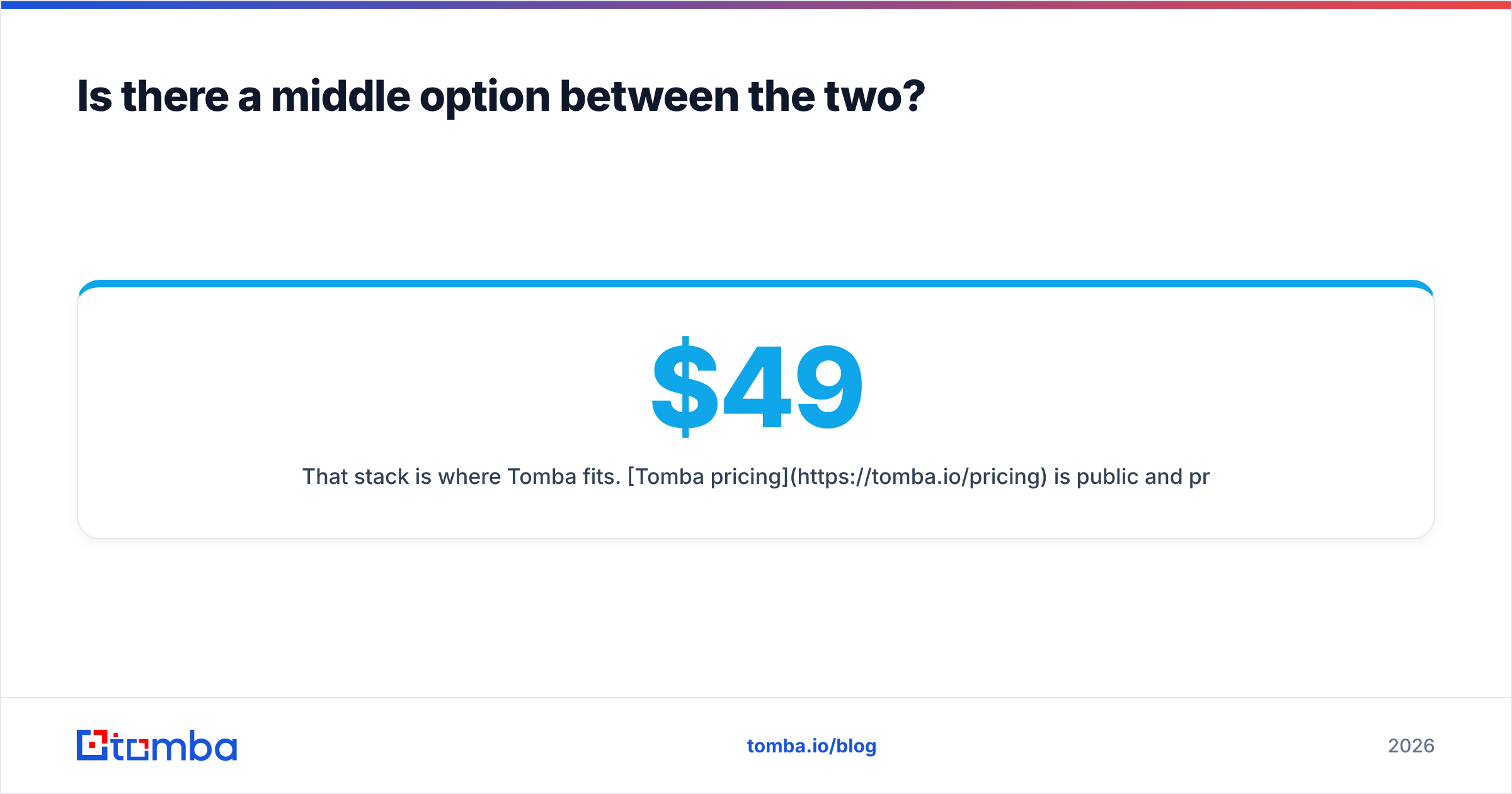
That is where Tomba fits. Tomba pricing is public and easy to plan around. The free tier gives you 25 searches a month. Starter is $49/mo, Growth is $99/mo, Pro is $249/mo, and Enterprise is on request. There is no annual lock-in and no seat minimum. If you want to script it, the Tomba API finds, verifies, and enriches in one flow. Bulk email finder jobs handle list-level work.
Be clear about the trade. Tomba gives you no intent data, no buying committee maps, and no research team. If that is why you are looking at ZoomInfo, buy ZoomInfo. If it is not, you are paying five figures for a lookup that costs a few hundred dollars a year.
How do you decide in five steps?#
- Write down the one job. "Map the committee at 300 accounts" and "get 5,000 valid emails this quarter" are different jobs. They carry different price ceilings. Most bad buys skip this step.
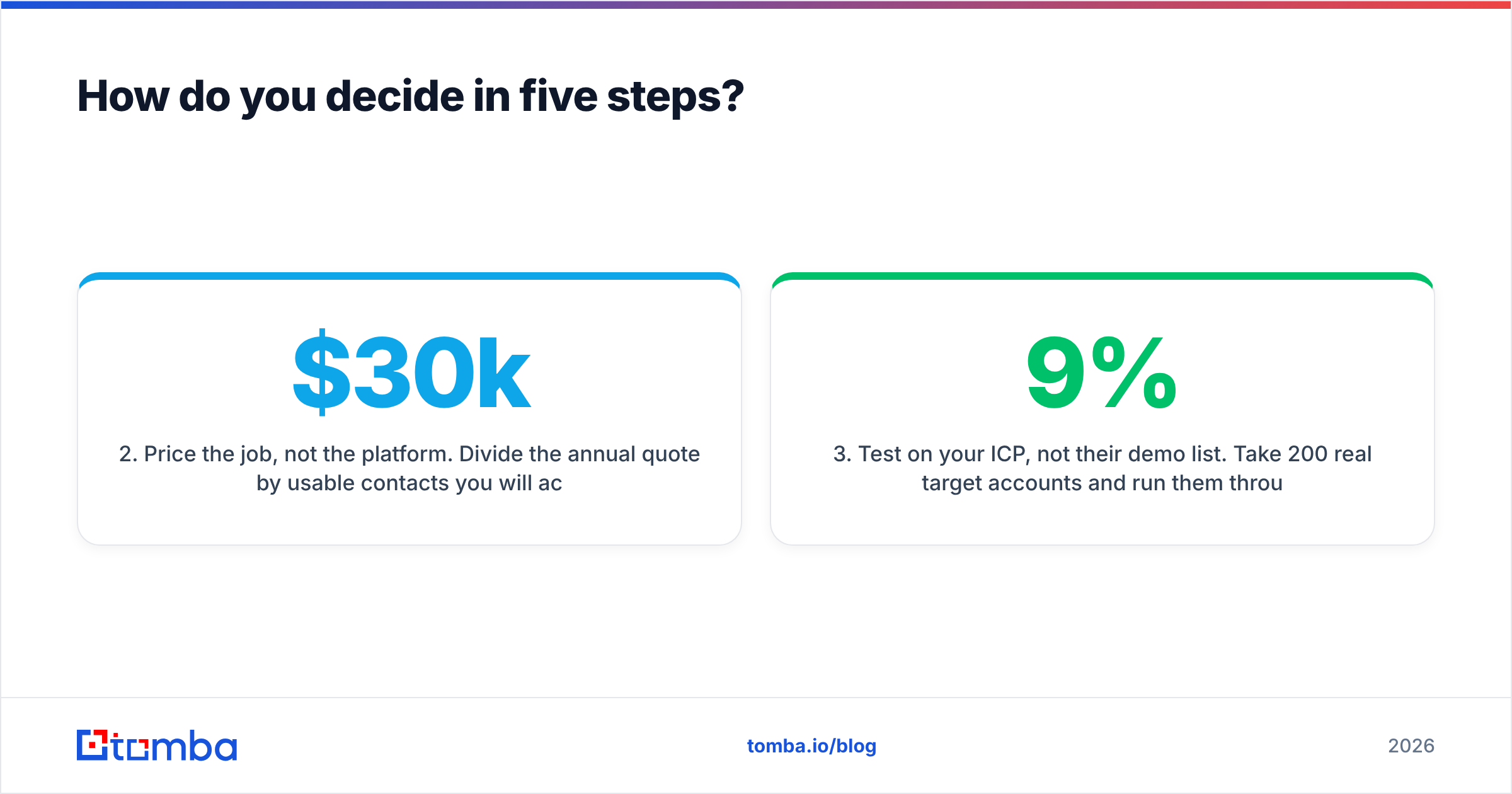
- Price the job, not the platform. Divide the yearly quote by the contacts you will really export and send. A $30k deal that yields 20,000 usable records costs $1.50 each.
Then test before you sign:
- Test on your own list. Run 200 real target accounts through each trial. Track match rate and bounce rate apart. A high match rate with a 9% bounce is worse than a lower one that lands.
- Check the exit before the entry. Ask about renewal uplift, credit rollover, and whether you keep exported data if you cancel. Get it in writing.
- Assume you will unbundle later. Keep sourcing, resolution, and sending swappable. Teams that hardwire one vendor pay for it at every renewal.
Verdict: DiscoverOrg vs GrowMeOrganic, which one wins?#
Neither, for most readers. That is the useful answer.
DiscoverOrg-as-ZoomInfo wins for large teams with committee sales, phone-heavy outreach, and RevOps staff to run the data. The dataset is deep. At the right deal size, the cost holds up.
GrowMeOrganic wins for small teams doing LinkedIn-first outbound on a tight budget. They value one bill over best-in-class parts. The tool is honest about what it is.
But maybe you read the DiscoverOrg vs GrowMeOrganic pitch and thought this: "I just want accurate work emails, without a five-figure contract or a scraper's hit rate." Then you have found the real need. Start with the Tomba Email Finder. The free tier gives you 25 searches against your own target list. Measure match rate and bounce rate on real prospects first. Then run it head to head with whichever tool you were leaning toward, and let the bounce report pick the winner.
Related guides#
Ready to find emails that actually work?
Join 150,000+ professionals who stopped guessing and started sending. Free credits on signup — no credit card required.
Get the Tomba newsletter
Practical outbound tactics and product updates — once every two weeks.
About the author