DiscoverOrg vs Lead411: 2026 B2B Data Comparison
DiscoverOrg is now ZoomInfo, and Lead411 costs a fraction of it. Here's how the two actually compare on data depth, intent signals, contracts, and real 2026 pricing.
TL;DR — DiscoverOrg vs Lead411 at a glance
- DiscoverOrg is not a standalone product any more. It merged with ZoomInfo in 2019. The DiscoverOrg data now sits inside ZoomInfo SalesOS. If a rep pitches you "DiscoverOrg," you are buying ZoomInfo.
- Lead411 is the mid-market option. You can pay month to month, some plans allow unlimited views, and Bombora intent data is built in. The bill is a fraction of a ZoomInfo contract.
- ZoomInfo and DiscoverOrg usually land between $15,000 and $40,000 a year for a small team with intent add-ons. Lead411 starts near $99 per user per month.
- DiscoverOrg wins on org charts, tech stack data, and enterprise coverage. Lead411 wins on open pricing, short contracts, and verified direct dials for SMB and mid-market targets.
- If you only need verified work emails for a list you already have, you need neither. A focused email finder does that job for a rounding error of the price.
What happened to DiscoverOrg?#
DiscoverOrg bought ZoomInfo in 2019. The merged company then took the ZoomInfo name. That matters more than it sounds. The DiscoverOrg brand was built on org charts made by hand. Analysts called companies to confirm who reports to whom. ZoomInfo's strength was scale. It gathered hundreds of millions of contacts from email signatures, web crawls, and a shared contributor network.
The merged product kept both halves. What you buy today under ZoomInfo is the ZoomInfo contact graph. The DiscoverOrg research layer sits on top of some accounts. Most of them are enterprise IT, marketing, HR, and finance teams.
So a DiscoverOrg vs Lead411 shortlist in 2026 is really ZoomInfo SalesOS (with legacy DiscoverOrg data) vs Lead411. Any vendor page still selling a DiscoverOrg-branded plan is recycling old copy or reselling.
What is Lead411 and who is it for?#
Lead411 is a B2B contact and company database. It sells itself as the anti-ZoomInfo. Pricing is public. Some tiers allow unlimited views. You can pay month to month, and no multi-year deal is forced on you.
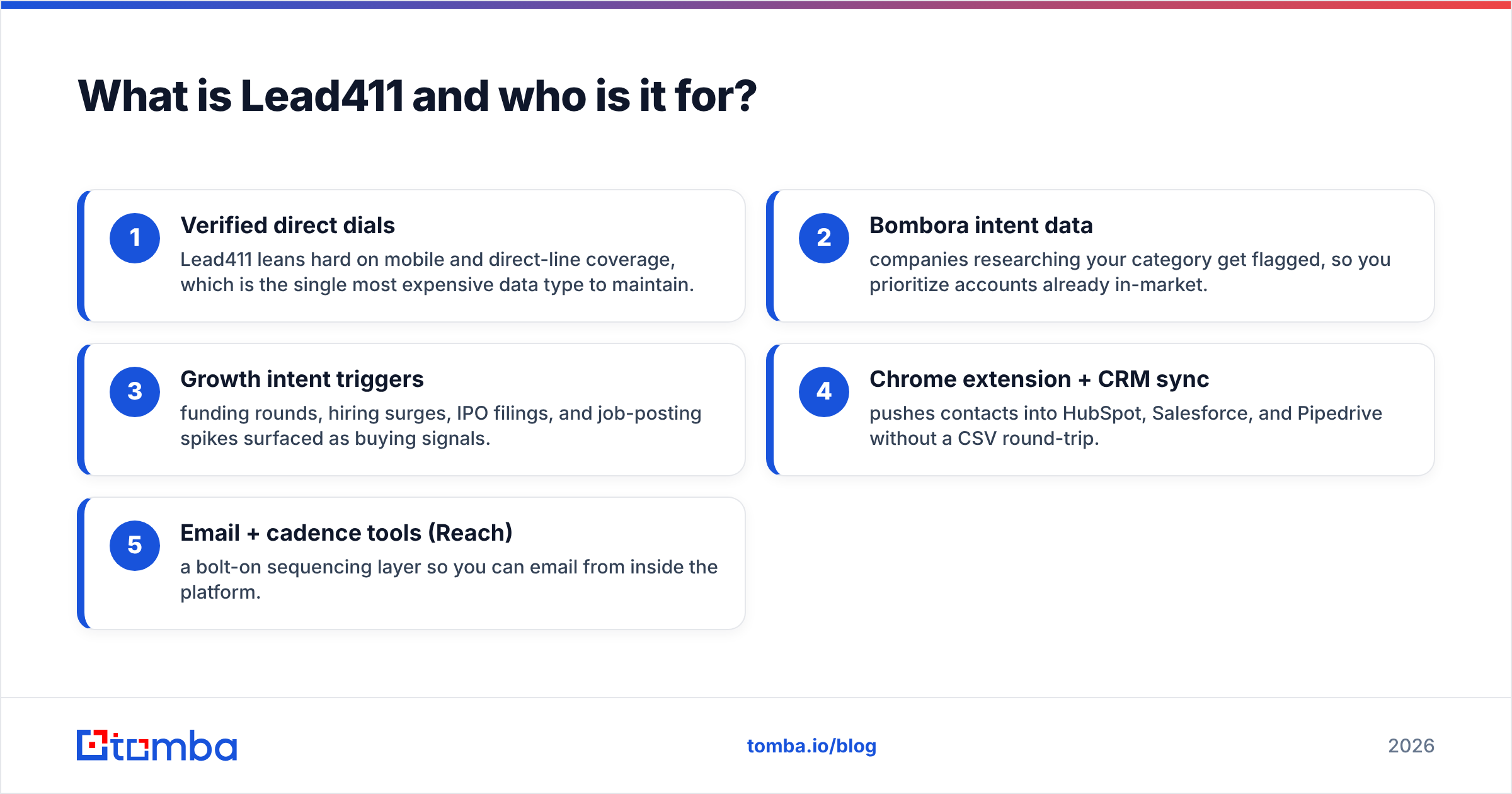
Its data set is smaller than ZoomInfo's. It leans on five things:
- Verified direct dials — Lead411 pushes hard on mobile and direct-line numbers. That data is the most expensive type to keep fresh.
- Bombora intent data — firms reading up on your category get flagged. You call the ones already shopping.
- Growth triggers — funding rounds, hiring spikes, IPO filings, and job posts show up as buying signals.
- Chrome extension and CRM sync — contacts push into HubSpot, Salesforce, and Pipedrive with no CSV step.
- Email and cadence tools (Reach) — a bolt-on layer, so you can send from inside the platform.
The typical buyer is a sales team of 5 to 50 people. They want intent signals without a long procurement cycle.
DiscoverOrg vs Lead411: a feature-by-feature comparison#
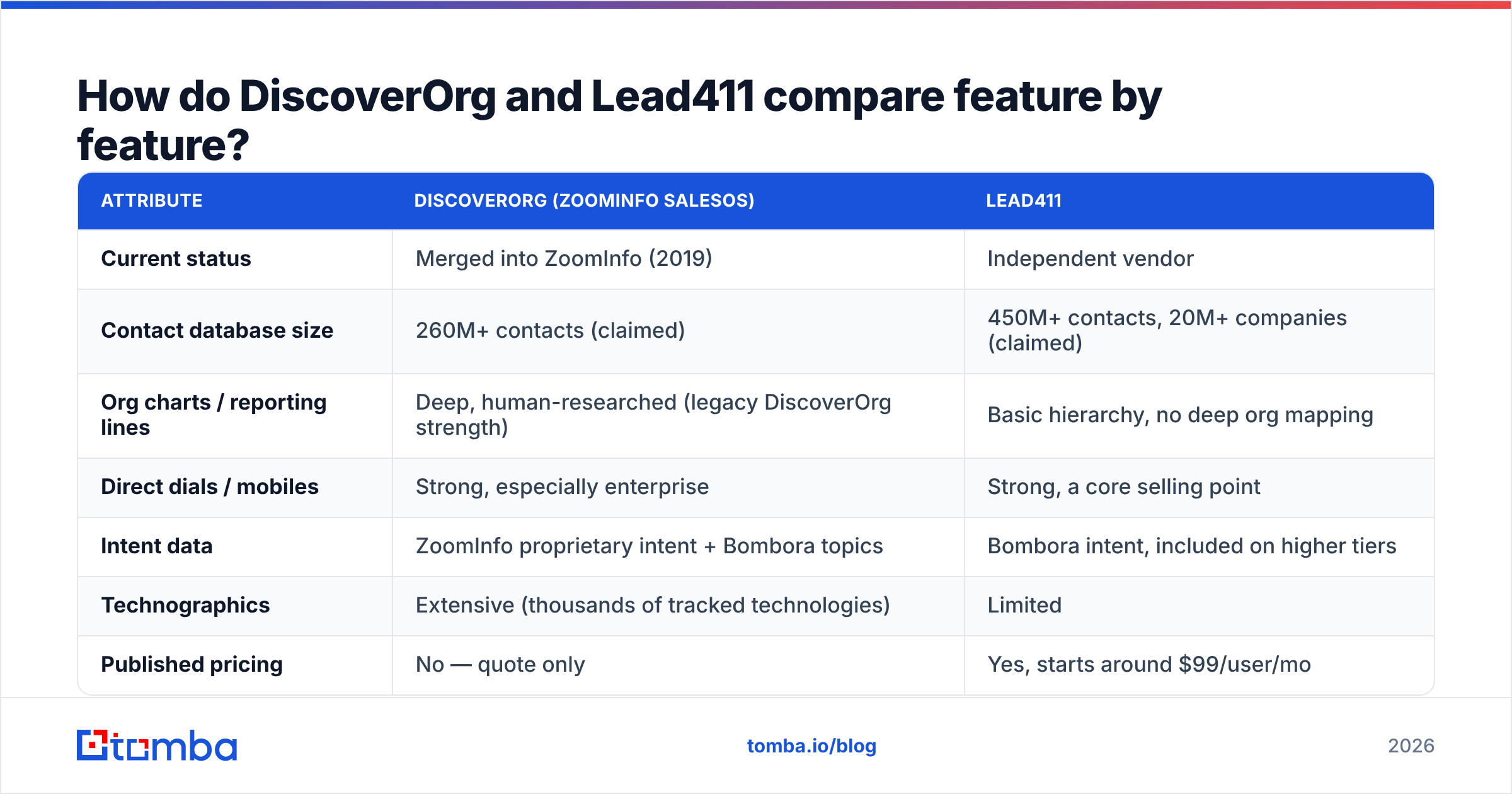
| Attribute | DiscoverOrg (ZoomInfo SalesOS) | Lead411 |
|---|---|---|
| Current status | Merged into ZoomInfo (2019) | Independent vendor |
| Contact database size | 260M+ contacts (claimed) | 450M+ contacts, 20M+ companies (claimed) |
| Org charts / reporting lines | Deep, human-researched (legacy DiscoverOrg strength) | Basic hierarchy, no deep org mapping |
| Direct dials / mobiles | Strong, especially enterprise | Strong, a core selling point |
| Intent data | ZoomInfo proprietary intent + Bombora topics | Bombora intent, included on higher tiers |
| Technographics | Extensive (thousands of tracked technologies) | Limited |
| Published pricing | No — quote only | Yes, starts around $99/user/mo |
| Contract length | Typically 12 months minimum, often multi-year | Month-to-month available |
| Typical annual spend (3 seats) | $15,000–$40,000+ | $3,500–$8,000 |
| Free trial | Limited, gated demo first | Free trial with credits |
| Export credits | Tiered, often the real cost driver | Unlimited views on select plans; export caps apply |
| Best fit | Enterprise ABM, IT-focused selling | SMB/mid-market outbound, budget-conscious teams |
The table hides one thing worth saying plainly. ZoomInfo prices each deal by hand. The number you get depends on what the rep thinks you can pay. Teams report the same seat count quoted from $15K to $60K. Data add-ons, export credits, and bundles like Engage or Chat drive the gap.
Which one has better data quality?#
Neither wins outright. They win on different things.
DiscoverOrg and ZoomInfo win on breadth and company detail. Say your target is a VP of Infrastructure at a 5,000-person maker in Germany. ZoomInfo will have the account, the org chart, the tech stack, and likely three contacts near your buyer. Lead411 will often have the company, but less depth inside the department.
Lead411 wins on fresh data for smaller firms. Enterprise-first databases stay accurate longest at the top of the market. They rot fastest at the bottom. Small firms restructure and people move often. Lead411 re-checks those records at a good pace. The direct-dial hit rate is strong for the price.
Both share the flaw of every large B2B database. Records decay 22% to 30% a year. A contact you pulled in January is worse by July. Neither vendor checks a record at the moment you export it. So good outbound teams run every list through a separate email verifier before the first send. Bounce rates above 3% start to hurt your sender reputation. No vendor SLA protects your domain.
One rule helps in any DiscoverOrg vs Lead411 trial. Treat every export as a guess, not a fact. Verify, then send.
What does DiscoverOrg vs Lead411 cost in 2026?#
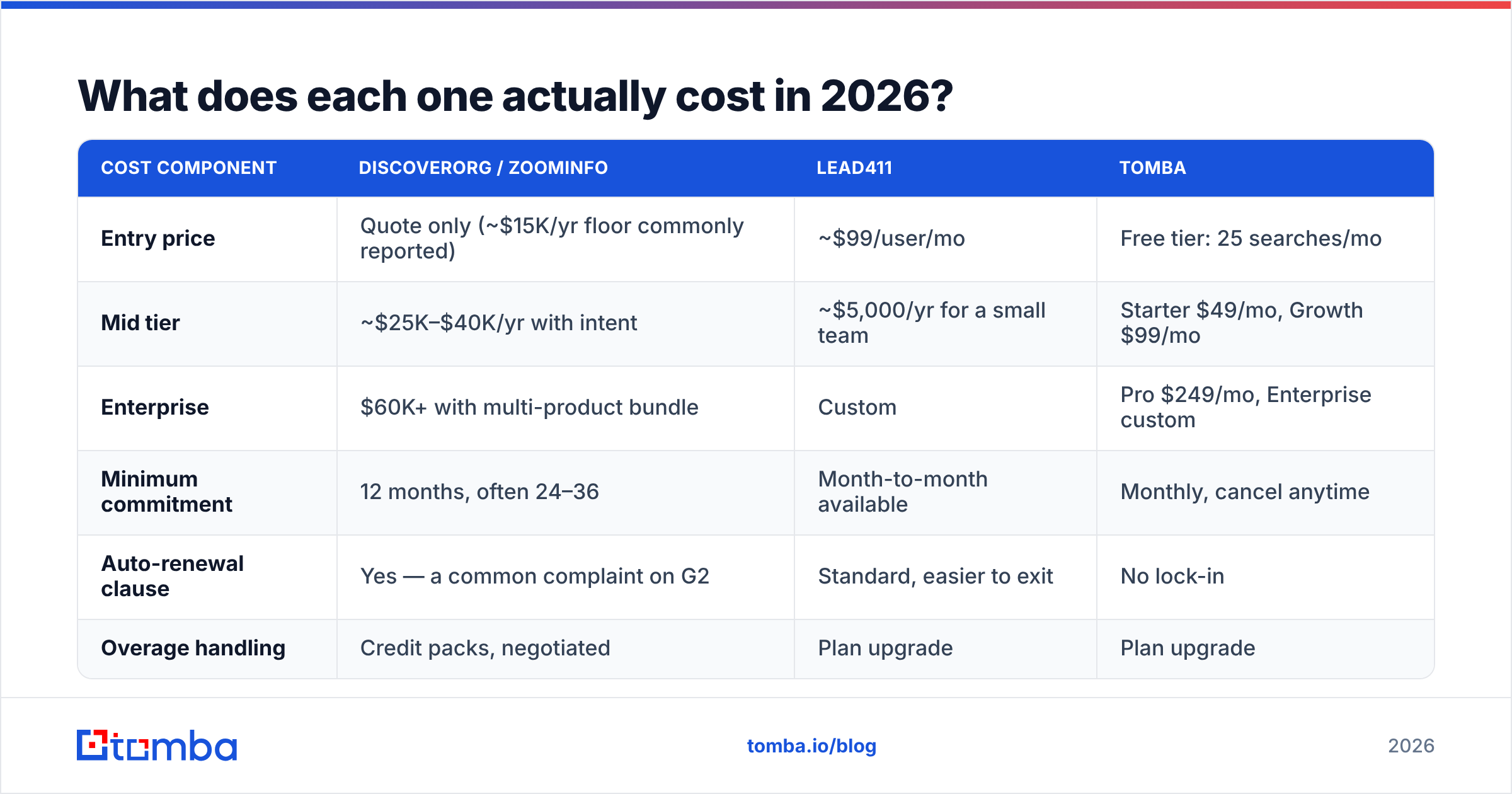
| Cost component | DiscoverOrg / ZoomInfo | Lead411 | Tomba |
|---|---|---|---|
| Entry price | Quote only (~$15K/yr floor commonly reported) | ~$99/user/mo | Free tier: 25 searches/mo |
| Mid tier | ~$25K–$40K/yr with intent | ~$5,000/yr for a small team | Starter $49/mo, Growth $99/mo |
| Enterprise | $60K+ with multi-product bundle | Custom | Pro $249/mo, Enterprise custom |
| Minimum commitment | 12 months, often 24–36 | Month-to-month available | Monthly, cancel anytime |
| Auto-renewal clause | Yes — a common complaint on G2 | Standard, easier to exit | No lock-in |
| Overage handling | Credit packs, negotiated | Plan upgrade | Plan upgrade |
The auto-renewal line deserves its own paragraph. ZoomInfo contracts often renew on their own. You get a notice window, often 30 to 60 days before the term ends. Miss it and you owe another year. Public G2 and Reddit threads describe this again and again. Read the exit clause before you sign. Put the notice date in a shared calendar the same day. Get the renewal cap in writing.

Is Lead411 a real replacement for DiscoverOrg?#
For most mid-market teams, yes. Two caveats apply.
Caveat one: org charts. Some deals need you to map a 12-person buying group inside a Fortune 500 account. Lead411 will leave gaps there that ZoomInfo fills. That research layer is costly to rebuild. It is the last real moat the DiscoverOrg data has.
Caveat two: tech stack data. "Companies running Snowflake and Segment but not dbt" is a ZoomInfo query. Lead411's tech data is thinner. If that filter drives your whole list build, it can justify the price gap on its own.
Outside those two cases, the gap closes fast. Most teams run standard outbound. They build a list by title and firmographic, enrich it, verify it, then send. Lead411 covers that at a quarter of the cost. The intent layer is the same Bombora feed ZoomInfo resells.
Other paths exist too. BookYourData sells pay as you go with a bounce guarantee. That suits teams that buy lists in bursts. Apollo bundles data with sequencing at a low entry price. Each one solves a different shape of the problem. The best database depends on what you need: depth, breadth, flexibility, or just clean addresses.
When do you not need either platform?#
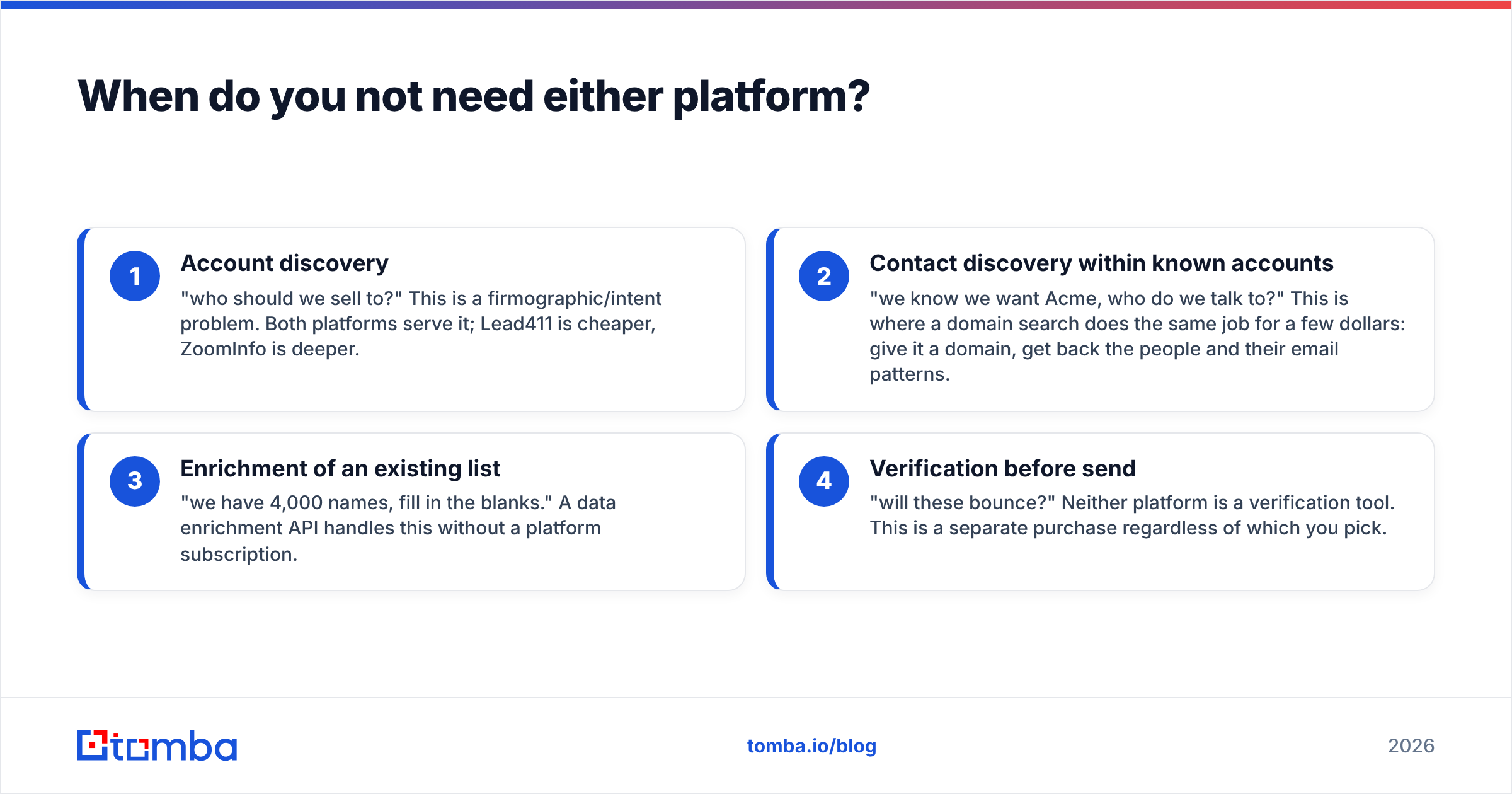
Ask what you are really buying. Most teams weighing DiscoverOrg vs Lead411 say they "need good contact data." Break that down and it is usually one of four jobs.
- Account discovery — "who should we sell to?" That is a firmographic and intent problem. Both tools serve it. Lead411 is cheaper. ZoomInfo is deeper.
- Contact discovery inside known accounts — "we want Acme, so who do we call?" A domain search does this for a few dollars. Give it a domain and get back the people and their email patterns.
- Enrichment of a list you own — "we have 4,000 names, fill in the blanks." A data enrichment API handles it with no platform fee.
- Verification before send — "will these bounce?" Neither platform is a verifier. That is a separate buy either way.
Jobs 2, 3, and 4 are the real workload for many outbound teams. If that is you, you are paying $25,000 a year for a search engine you use like a lookup API. Run that math before you book the demo.
The split is simple. Use a database platform when you do not know your buyers yet and need signal to find them. Use a finder plus a verifier when you know the accounts and only need correct addresses.
How should you run a DiscoverOrg vs Lead411 trial?#
Do not judge either tool on database size. Every vendor's count is unaudited. It includes records they would never sell you. Run this test instead.
- Build a 100-row gold list from accounts you closed or lost. You already know the right answers.
- Ask each vendor to match it during the trial. Measure match rate, not database size.
- Export the matches and verify them yourself. Use a neutral email verification pass, not the vendor's own score. Count the hard bounces.
- Call 20 direct dials. Wrong-number rate is the least measured metric in this category.
- Price three full years. Include renewal increases and export credit packs. Compare that to three years of a cheaper stack.
- Read the exit clause out loud to whoever signs. If it auto-renews, put the notice date in a shared calendar first.
Teams that run this test often find a small match-rate gap between a $25K tool and a $5K one. For SMB targets, the cheaper tool sometimes wins.
DiscoverOrg vs Lead411: which should you choose?#
Choose DiscoverOrg and ZoomInfo if you sell to large firms, your deals need many contacts inside one buying group, tech stack filters drive your lists, and you have budget for a five-figure contract. The org-chart data is real, and no cheap tool matches it.
Choose Lead411 if you sell to SMB or mid-market, you want intent data without an enterprise deal, direct dials matter more than org charts, and you would rather stay month to month while you test the channel.
Choose neither if you already know your accounts, your bottleneck is verified addresses, and you pull thousands of records a month rather than hundreds of thousands. That is a tooling problem, not a database problem. It costs far less to solve.
Whichever way the DiscoverOrg vs Lead411 call goes, do not skip verification. Data from any provider decays. A 12% bounce rate on a warmed domain costs far more than checking first.
Ready to stop paying enterprise prices for addresses?#
Your real job may be simpler than a platform. If you need work email addresses at accounts you already picked, start with the Tomba Email Finder. Give it a domain and a name. You get back a verified work address, a confidence score, and the sources behind it. The free tier covers 25 searches a month, so you can test it against your own gold list first. Paid plans start at $49/mo, less than one seat-month of most enterprise contracts. See Tomba pricing for the full breakdown, or wire it into your stack with the Tomba API and skip the platform entirely.
Related guides#
Ready to find emails that actually work?
Join 150,000+ professionals who stopped guessing and started sending. Free credits on signup — no credit card required.
Get the Tomba newsletter
Practical outbound tactics and product updates — once every two weeks.
About the author