DiscoverOrg vs Startup Tracker: 2026 B2B Data Comparison
DiscoverOrg (now ZoomInfo) sells enterprise-grade org charts at enterprise prices. Startup Tracker sells early-stage funding signal. Here's which one actually fits your pipeline in 2026 — and when neither is the right buy.
TL;DR
- DiscoverOrg no longer exists as a standalone product. It merged with ZoomInfo in 2019 and its org-chart and technographic data now ships inside ZoomInfo SalesOS. When a vendor page says "DiscoverOrg," you're buying ZoomInfo.
- Startup Tracker is a different category entirely. It tracks newly funded, early-stage companies — funding rounds, headcount jumps, new domains — rather than deep contact records inside the Fortune 5000.
- Price gap is the real story. ZoomInfo contracts typically land in the five-figure annual range with seat minimums; startup-signal tools sit in the tens-to-low-hundreds of dollars per month.
- Neither is an email finder. Both give you accounts and signal; you still need a verification layer before you send, or your bounce rate does the deciding for you.
- The cheapest working stack for most teams under 20 reps: a signal source for who to target plus a per-lookup email finder for how to reach them — usually under $100/month combined.
What is DiscoverOrg in 2026?#
DiscoverOrg was, for about fifteen years, the gold standard for B2B org charts. Its pitch was human-verified data: researchers on the phone confirming reporting lines, budgets, and installed technology inside mid-market and enterprise accounts. If you sold six-figure software into IT departments, DiscoverOrg told you who owned the budget and who they reported to.
In February 2019 DiscoverOrg acquired ZoomInfo and took the ZoomInfo name. The DiscoverOrg brand was retired; the datasets were merged. Today the org-chart depth, intent signals, and technographics that made DiscoverOrg valuable live inside ZoomInfo SalesOS. You can read the corporate history on Wikipedia if you want the acquisition timeline.
This matters practically. If you're evaluating "DiscoverOrg" today, you are evaluating a platform sale — seats, minimum contract length, credit pools, add-on modules — not a data subscription. That changes the comparison completely.
What you actually get:
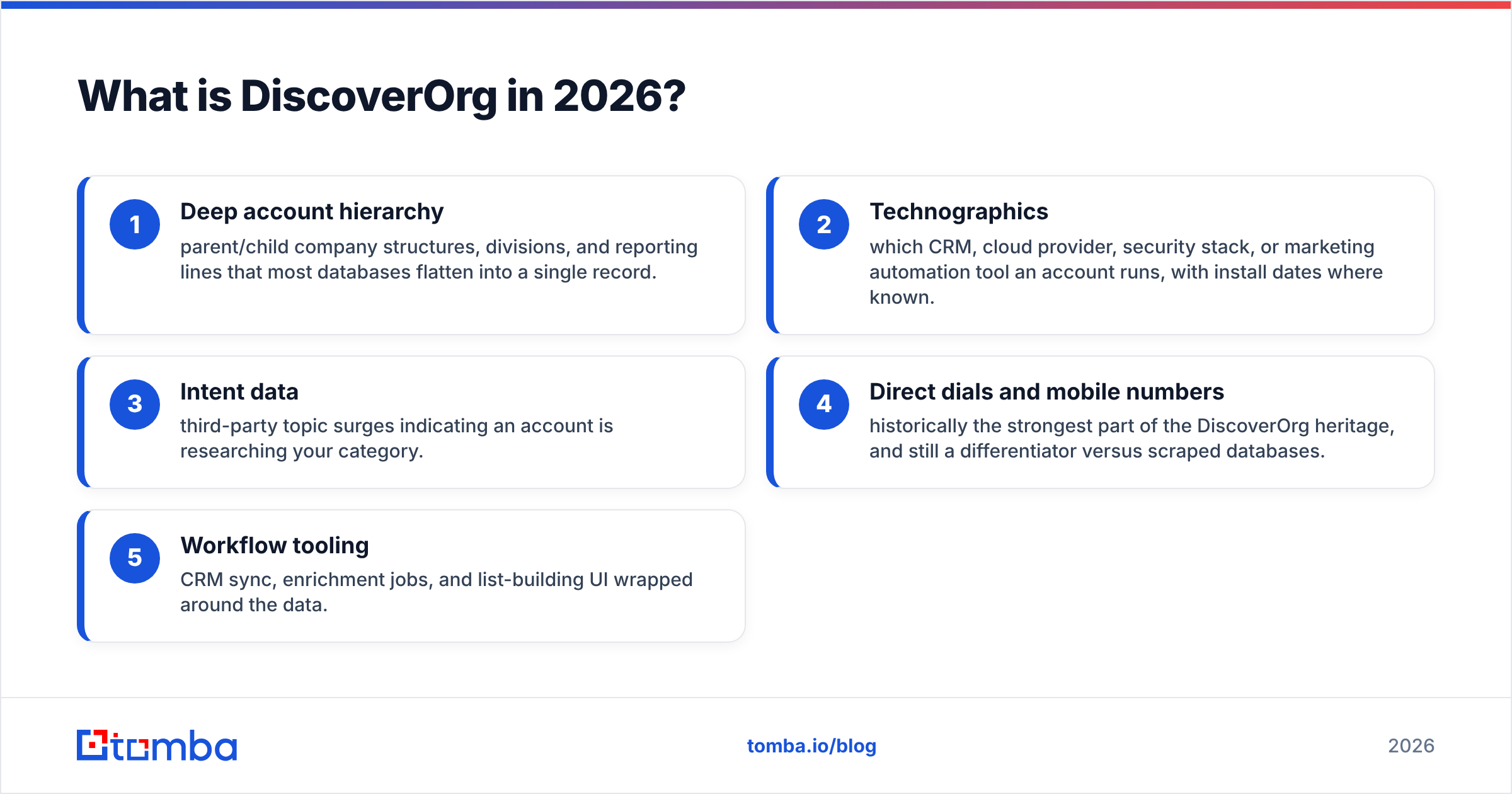
- Deep account hierarchy — parent/child company structures, divisions, and reporting lines that most databases flatten into a single record.
- Technographics — which CRM, cloud provider, security stack, or marketing automation tool an account runs, with install dates where known.
- Intent data — third-party topic surges indicating an account is researching your category.
- Direct dials and mobile numbers — historically the strongest part of the DiscoverOrg heritage, and still a differentiator versus scraped databases.
- Workflow tooling — CRM sync, enrichment jobs, and list-building UI wrapped around the data.

What is Startup Tracker and who is it for?#
Startup Tracker sits in the opposite corner of the B2B data market. Rather than mapping the internals of large enterprises, it monitors the formation and funding of new companies — seed and Series A rounds, incorporation records, hiring surges, new product launches, fresh domain registrations.
The buyer profile is completely different. Startup-tracking tools are bought by:
- Agencies and dev shops chasing newly funded companies that suddenly have a budget and no vendor relationships.
- Fintech, HR tech, and infra sellers whose ICP is "company that just raised and now needs payroll/observability/compliance."
- VCs and corp dev teams sourcing deal flow before a company shows up in mainstream databases.
- Recruiters targeting companies that just announced a hiring plan.
The value is timing, not depth. A record might be thin — company name, domain, round size, investor, founder LinkedIn — but it arrives days after the round closes, which is when the buying window opens. Six months later, that same account is in every database on earth and has already picked its vendors.
That's the honest framing of DiscoverOrg vs Startup Tracker: one is a map of established organizations, the other is a radar for new ones. They rarely compete for the same dollar.
DiscoverOrg vs Startup Tracker: how do they compare?#
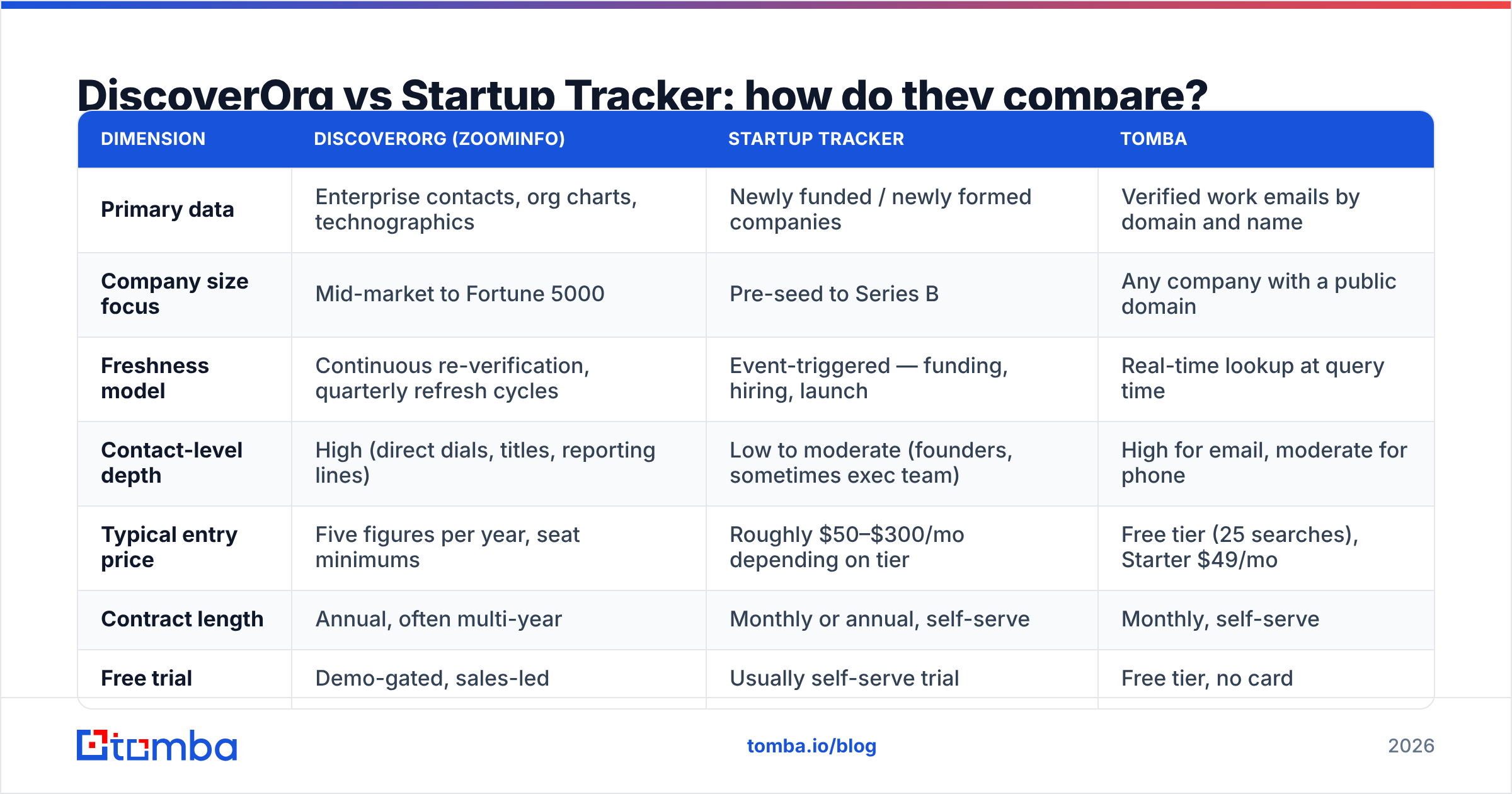
| Dimension | DiscoverOrg (ZoomInfo) | Startup Tracker | Tomba |
|---|---|---|---|
| Primary data | Enterprise contacts, org charts, technographics | Newly funded / newly formed companies | Verified work emails by domain and name |
| Company size focus | Mid-market to Fortune 5000 | Pre-seed to Series B | Any company with a public domain |
| Freshness model | Continuous re-verification, quarterly refresh cycles | Event-triggered — funding, hiring, launch | Real-time lookup at query time |
| Contact-level depth | High (direct dials, titles, reporting lines) | Low to moderate (founders, sometimes exec team) | High for email, moderate for phone |
| Typical entry price | Five figures per year, seat minimums | Roughly $50–$300/mo depending on tier | Free tier (25 searches), Starter $49/mo |
| Contract length | Annual, often multi-year | Monthly or annual, self-serve | Monthly, self-serve |
| Free trial | Demo-gated, sales-led | Usually self-serve trial | Free tier, no card |
| API access | Add-on, extra cost | Varies by plan | Included from Starter |
| Best fit | Enterprise ABM with a named account list | Time-sensitive outbound to fresh companies | Teams that need reachable emails at any scale |
Two lines in that table drive most decisions: entry price and contract length. ZoomInfo is a procurement event. Startup-signal tools are a credit-card purchase. If your team is under ten reps and your average contract value is below $20k, the math on a five-figure annual data contract is brutal — you need roughly 200+ sourced meetings a year just to justify the line item before you've paid a rep.
Is DiscoverOrg's data actually more accurate?#
Mostly yes, with an asterisk — and the asterisk is the part vendors skip.
DiscoverOrg's human-verification heritage is real. On direct dials into large enterprises, it remains among the strongest sources in the market, and independent reviews on G2 consistently rank ZoomInfo highly on data quality for enterprise segments. If your ICP is "VP of Infrastructure at a 5,000-person insurer," you will find that person, their manager, and their stack.
The asterisk: accuracy is segment-dependent and decays. Three things degrade any static database, including this one.
- Job-change velocity. B2B roles turn over fast enough that a record verified six months ago has a meaningful chance of being stale. A "verified" flag is a claim about the past, not the present.
- Long-tail thinness. Databases built for enterprise coverage thin out below ~50 employees. If your ICP is a 12-person startup that raised last month, an enterprise database is the wrong instrument — that record may not exist at all, which is exactly the gap startup trackers fill.
- Pattern-guessed emails. Every large database contains some share of algorithmically inferred addresses that were never SMTP-checked. They look identical to verified records in the export.
That third point is why a separate verification step is not optional. Whatever database you buy, running the export through an email verifier before your sequencing tool touches it is the difference between a 1% bounce rate and a 9% one. Mailbox providers treat bounce rate as a reputation signal, and a bad send doesn't just lose that campaign — it damages email deliverability for every campaign after it.
What does each option really cost per usable contact?#
Sticker price and effective price diverge sharply here, so run the numbers on contacts you can actually use.
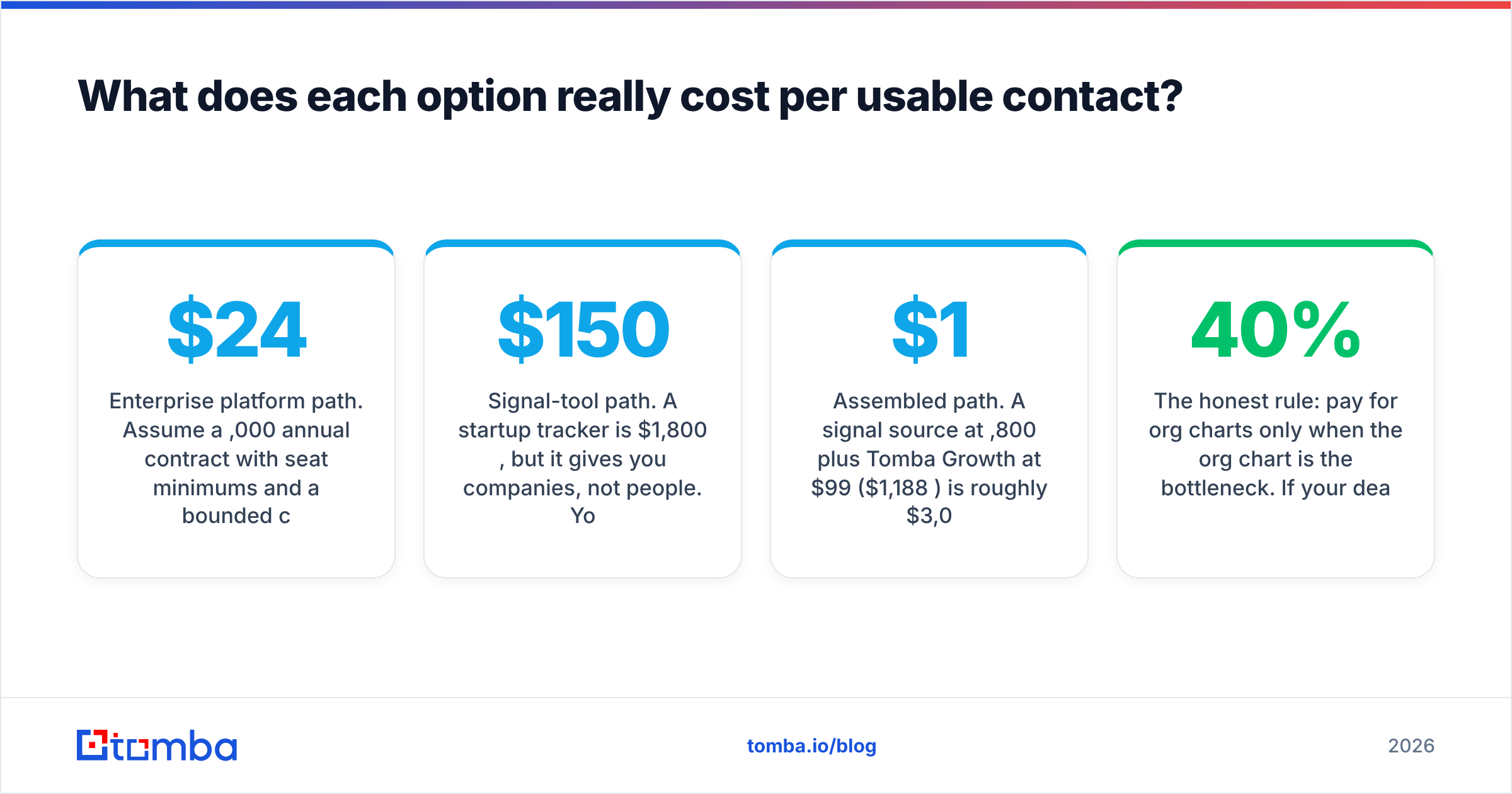
Take a hypothetical five-rep team needing 20,000 usable contacts a year.
Enterprise platform path. Assume a $24,000 annual contract with seat minimums and a bounded credit pool. That's $1.20 per contact before you account for records that bounce, records outside your ICP, and credits you never spend because the fiscal year ended. If 15% of exported emails are unusable, effective cost is closer to $1.41. You also pay in procurement time, a security review, and an annual renewal negotiation.
Signal-tool path. A $150/month startup tracker is $1,800/year, but it gives you companies, not people. You still need contacts. Budget a lookup layer on top.
Assembled path. A signal source at $1,800/year plus Tomba Growth at $99/month ($1,188/year) is roughly $3,000 total — under $0.15 per contact at the same volume, with verification built in rather than billed separately. You give up org charts and intent data. For transactional and mid-market motions, that's a trade most teams should take; for enterprise ABM into named accounts, it isn't.
The honest rule: pay for org charts only when the org chart is the bottleneck. If your deals die because you couldn't find the seventh stakeholder in a buying committee, ZoomInfo earns its price. If your deals die because you didn't hear about the company until after the budget was allocated, a startup tracker earns its price. If your deals die because 40% of your emails bounce, neither one is your problem — your verification layer is.
Which one should you choose for your motion?#
Match the tool to the failure mode you actually have.
- Enterprise ABM, 50+ named accounts, multi-threaded deals — ZoomInfo (the DiscoverOrg lineage). You need hierarchy, direct dials, and intent. Nothing cheaper replicates the org chart.
- Selling infrastructure, fintech, or HR tools to newly funded companies — a startup tracker. Freshness beats depth. A three-person company has no org chart worth buying.
- Agency or services business chasing budget events — startup tracker for the trigger, plus a domain search to pull the founder and ops emails once you know the company.
- SMB or mid-market SaaS, under 20 reps, self-serve budget — skip both platforms. Build a target list from public sources and resolve contacts with a per-lookup finder. You'll spend under $1,200/year.
- Data or RevOps team enriching an existing CRM — an API-first data enrichment layer beats a seat-based platform, because you're paying for records, not logins.
- Recruiting or talent sourcing — startup tracker for hiring-surge signal; enterprise databases are optimized for buyer titles, not engineering ICs.
Where does Tomba fit against either one?#
Tomba isn't trying to be a sales-intelligence platform, and pretending otherwise would be dishonest. It doesn't ship org charts, it doesn't sell intent data, and it won't tell you which accounts just raised a Series A.
What it does is the layer both of those categories leave unfinished: turning a company and a name into a verified, deliverable email address at the moment you need it.
That's a different purchasing model. Instead of buying a static snapshot of a database and hoping the records held up, you query at send time. A contact found today was resolved today. For the failure mode that kills most outbound programs — bounces, spam folders, wasted sequence slots — real-time resolution beats a bigger static file.
Practical shapes this takes:
- Post-signal enrichment. Your startup tracker surfaces 200 newly funded companies. Push the domains through bulk email finder and get founder and ops contacts back with confidence scores.
- Pre-send hygiene on an enterprise export. You already pay for ZoomInfo. Run the export through verification before it hits your sequencer to kill the pattern-guessed records.
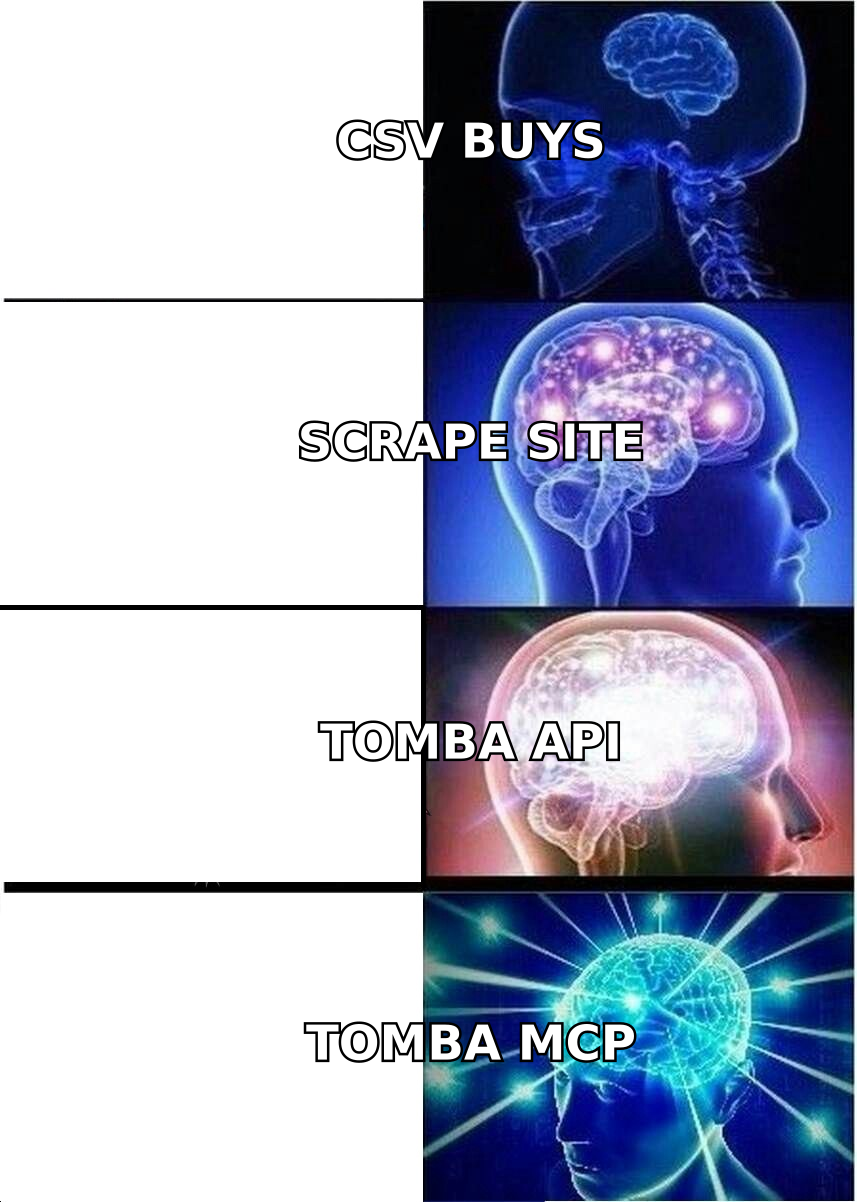
- Programmatic enrichment. The Tomba API drops into your data pipeline so records enrich on CRM write, not on a quarterly batch job.
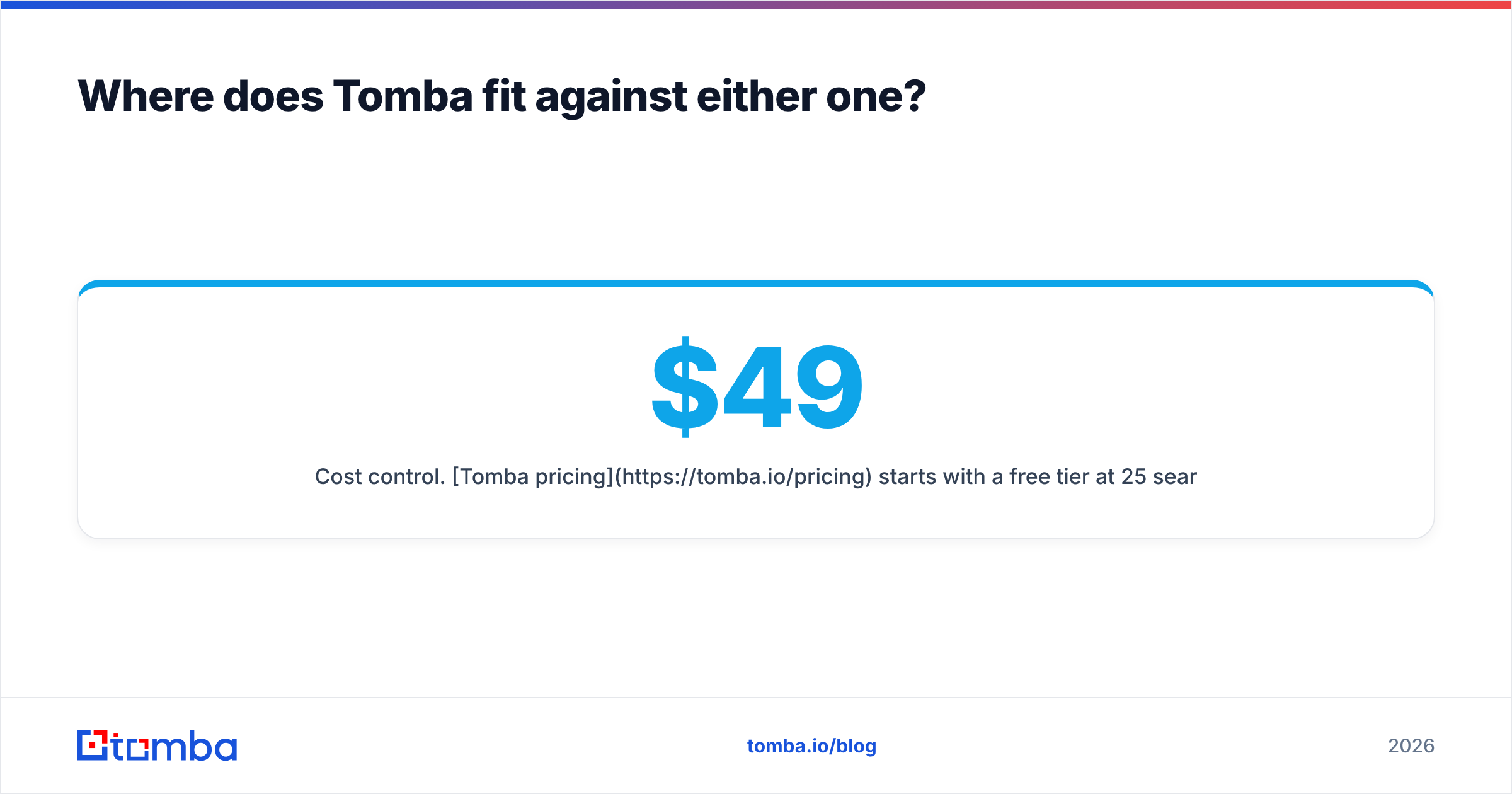
- Cost control. Tomba pricing starts with a free tier at 25 searches/month, Starter at $49/mo, Growth at $99/mo, and Pro at $249/mo — no seat minimums, no annual lock-in, no procurement cycle.
It's also worth naming the peers honestly: for teams that want a large pre-built contact database with transparent, self-serve pricing rather than a sales-led platform, providers like BookYourData cover that middle ground well. The category is not a two-horse race, and the best stack is usually assembled, not bought whole.
What's the verdict?#
DiscoverOrg vs Startup Tracker isn't really a head-to-head — it's a diagnostic. Whichever one you're drawn to tells you what your pipeline is missing.
If you can't get into big accounts, the DiscoverOrg lineage inside ZoomInfo is still the deepest map available, and the five-figure price reflects genuine research cost. If you keep arriving after the budget is spent, a startup tracker's freshness is worth more than any org chart. And if your list is fine but your sends bounce, buying either platform is an expensive way to avoid fixing the actual problem.
For the majority of teams reading this — under 20 reps, mid-market ICP, self-serve budget — the assembled stack wins on cost per usable contact by roughly an order of magnitude. Signal source for targeting, verification layer for reachability, CRM for everything else.
Start with the reachability problem, because it's the cheapest to fix and the most expensive to ignore. Run a domain through the Tomba Email Finder on the free tier, check the confidence scores against a list you already trust, and see how much of your current database survives contact with reality. If the answer surprises you, you've found your bottleneck — and it wasn't the org chart.
Related guides#
Ready to find emails that actually work?
Join 150,000+ professionals who stopped guessing and started sending. Free credits on signup — no credit card required.
Get the Tomba newsletter
Practical outbound tactics and product updates — once every two weeks.
About the author