DiscoverOrg vs Wiza (2026): Which B2B Data Tool Wins?
DiscoverOrg is now ZoomInfo, Wiza is a LinkedIn-first exporter, and they solve different problems at wildly different prices. Here is the honest breakdown of coverage, accuracy, contracts, and who should pick which.
DiscoverOrg vs Wiza is not a fair fight. It is two different products doing two different jobs. DiscoverOrg is now ZoomInfo, sold on annual contracts. Wiza is a self-serve LinkedIn exporter you can cancel today. Here is the honest breakdown of coverage, accuracy, contracts, and cost.
TL;DR
DiscoverOrg no longer exists on its own. It merged with ZoomInfo in 2019. If a rep pitches you "DiscoverOrg," you are buying a ZoomInfo seat on an annual contract.
Wiza is a LinkedIn-first exporter, not a database. It only knows people you can find in a LinkedIn or Sales Navigator search, and it enriches them on demand.
The price gap is huge. ZoomInfo deals often land in five figures per year. Wiza plans start in the low hundreds per month.
Neither is the cheapest source of verified work emails. If you have a company list and need the right contacts, an email finder covers it for far less.
Pick by motion. Enterprise ABM with intent data → ZoomInfo. Founder-led or agency outbound off LinkedIn → Wiza. High volume, domain-driven prospecting → a finder plus verifier stack.
What are DiscoverOrg and Wiza in 2026?#
Start with the naming problem. It trips up half the buyers who search this comparison.
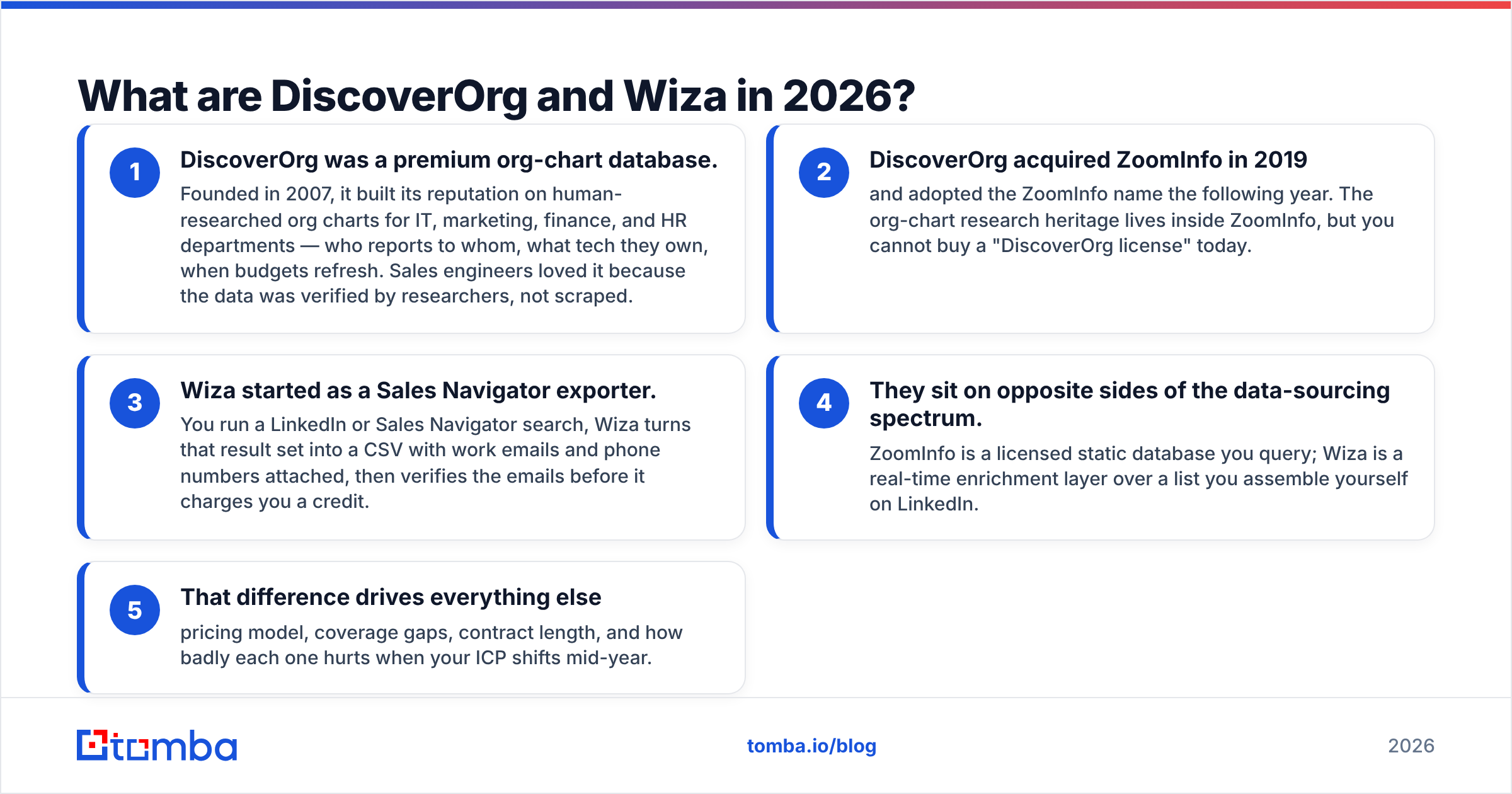
DiscoverOrg was a premium org-chart database. Founded in 2007, it built its name on human-researched org charts. Sales teams could see who reports to whom, what tech a team owns, and when budgets refresh. Researchers checked the data by hand.
DiscoverOrg bought ZoomInfo in 2019 and took the ZoomInfo name the year after. That org-chart heritage lives on inside ZoomInfo. You cannot buy a "DiscoverOrg license" today.
Wiza started as a Sales Navigator exporter. You run a search, and Wiza turns the results into a CSV with work emails and phone numbers. It verifies each email before it charges you a credit.
The two sit on opposite ends of the sourcing spectrum. ZoomInfo is a static database you query. Wiza is a live enrichment layer over a list you build yourself.
That one difference drives everything else. It sets the pricing model, the coverage gaps, the contract length, and the pain when your ICP shifts mid-year.
If you are comparing DiscoverOrg vs Wiza, you are choosing between two habits. Buy the whole haystack, or bring your own haystack and rent the magnet.
DiscoverOrg vs Wiza: head-to-head comparison#
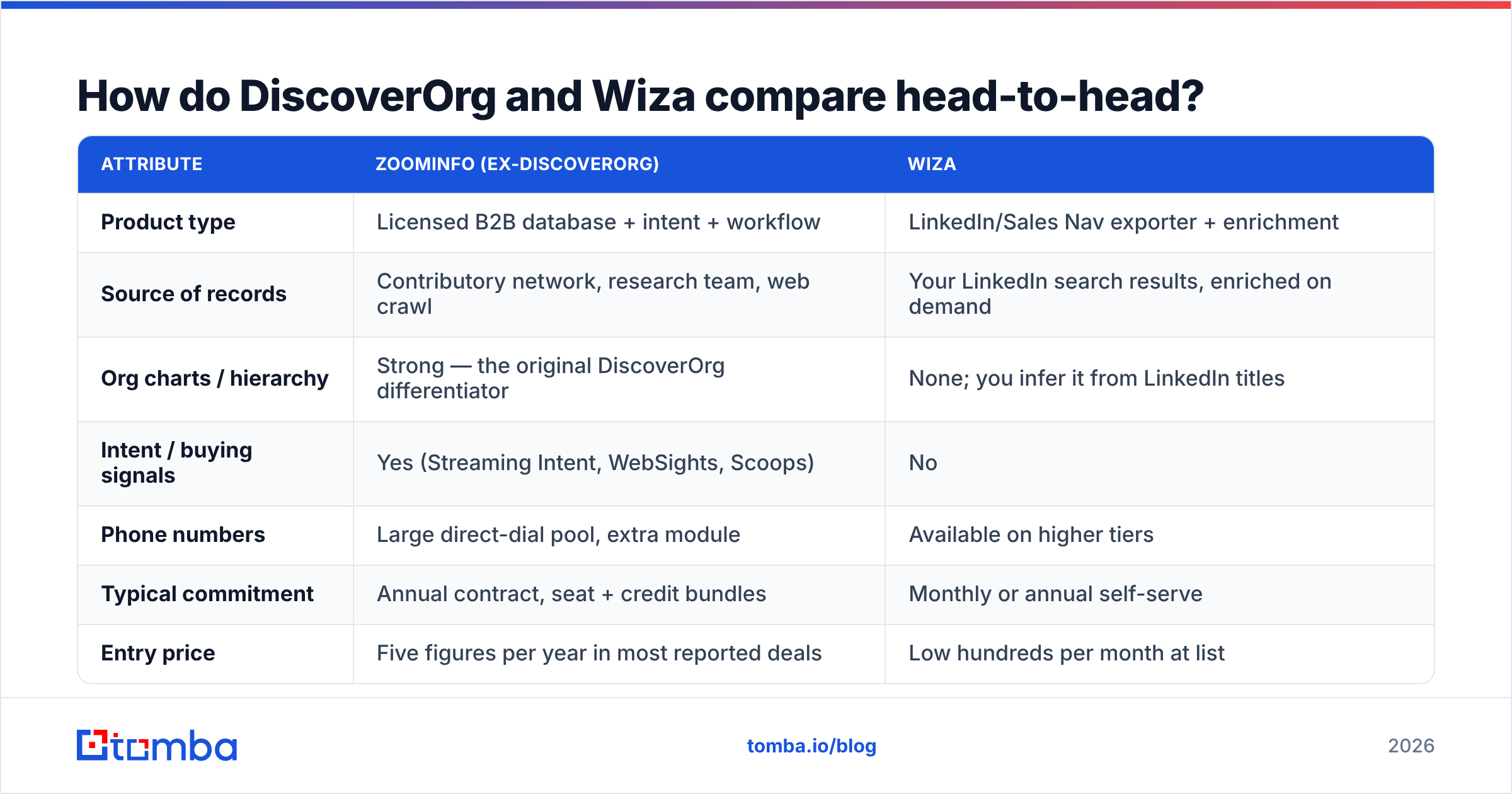
| Attribute | ZoomInfo (ex-DiscoverOrg) | Wiza |
|---|---|---|
| Product type | Licensed B2B database + intent + workflow | LinkedIn/Sales Nav exporter + enrichment |
| Source of records | Contributory network, research team, web crawl | Your LinkedIn search results, enriched on demand |
| Org charts / hierarchy | Strong — the original DiscoverOrg differentiator | None; you infer it from LinkedIn titles |
| Intent / buying signals | Yes (Streaming Intent, WebSights, Scoops) | No |
| Phone numbers | Large direct-dial pool, extra module | Available on higher tiers |
| Typical commitment | Annual contract, seat + credit bundles | Monthly or annual self-serve |
| Entry price | Five figures per year in most reported deals | Low hundreds per month at list |
| Free trial | Sales-gated demo, limited trial | Free credits on signup |
| Best for | Enterprise ABM, RevOps, territory planning | Founders, recruiters, agencies, SDR teams |
| Worst for | Small teams with variable ICPs | Anyone who needs non-LinkedIn coverage |
The table hides one thing worth saying plainly. These tools rarely lose deals to each other.
A 400-seat enterprise weighing ZoomInfo is not seriously looking at Wiza. A two-person agency on Wiza was never getting a ZoomInfo quote approved. The overlap sits in the middle: teams of 5 to 50 seats who need good contact data and are working out how much platform they really need.
Which one has better data accuracy?#
Neither wins outright. The DiscoverOrg vs Wiza answer depends on which record type you care about.
ZoomInfo is strong on breadth and company data. Revenue bands, employee counts, tech stacks, and org structure are where the DiscoverOrg research heritage still shows. Say you need the VP of Supply Chain at a mid-market manufacturer, plus the COO above her. ZoomInfo is the more likely source.
ZoomInfo is weak on contact freshness. A database is a snapshot. Someone who changed jobs six months ago can sit in the index until the next refresh. Reported bounce rates on cold exports vary a lot by segment, and SMB and non-US records go stale fastest. The G2 reviews show the same pattern: enterprise tech data is solid, the rest is uneven.
Wiza is strong on recency. It enriches a profile you just pulled from LinkedIn, so the title and company are as current as the profile itself. Wiza also verifies emails before charging you, so you do not pay for hard bounces. Its published accuracy claim sits above 95% for validated emails.
Wiza is weak wherever LinkedIn is thin. No profile means no record. That leaves out many buyers in operations, trades, healthcare, education, and non-US small business. Your ceiling is also whatever Sales Navigator will show you, and Sales Navigator has its own export limits.

Whichever you pick, run the output through an independent email verifier before it hits your sequencer.
Vendor-side verification is a vendor's opinion of its own data. A second pass costs pennies per thousand. It is the cheapest insurance you can buy on your sender reputation.

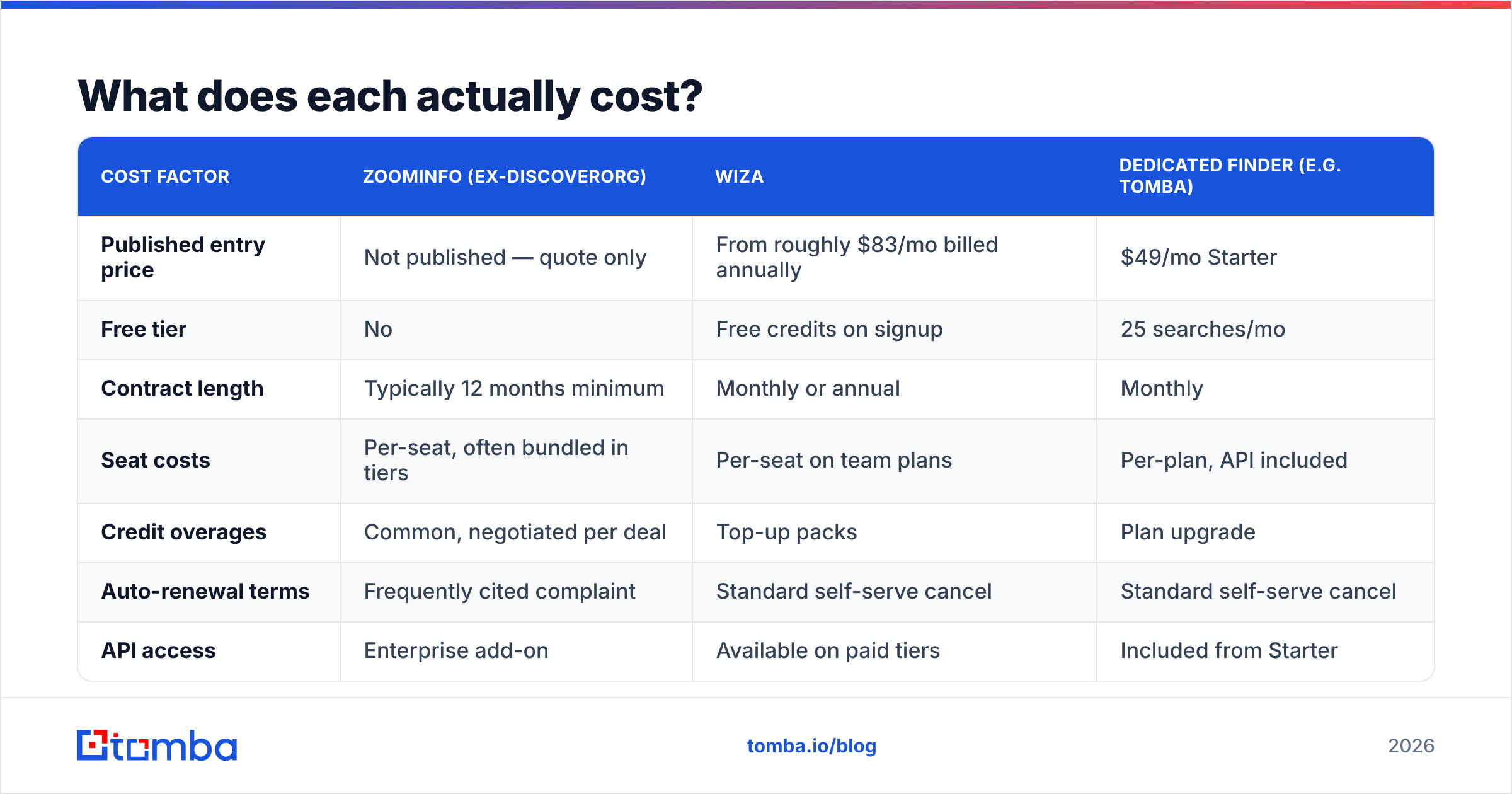
What does each actually cost?#
Cost is where most DiscoverOrg vs Wiza evaluations end. So be precise about what you are signing.
| Cost factor | ZoomInfo (ex-DiscoverOrg) | Wiza | Dedicated finder (e.g. Tomba) |
|---|---|---|---|
| Published entry price | Not published — quote only | From roughly $83/mo billed annually | $49/mo Starter |
| Free tier | No | Free credits on signup | 25 searches/mo |
| Contract length | Typically 12 months minimum | Monthly or annual | Monthly |
| Seat costs | Per-seat, often bundled in tiers | Per-seat on team plans | Per-plan, API included |
| Credit overages | Common, negotiated per deal | Top-up packs | Plan upgrade |
| Auto-renewal terms | Frequently cited complaint | Standard self-serve cancel | Standard self-serve cancel |
| API access | Enterprise add-on | Available on paid tiers | Included from Starter |
Two warnings from buyers who have been through both cycles.
ZoomInfo contracts are negotiated, not listed. Reported deals cluster between roughly $15,000 and $40,000 a year for small teams. The number climbs fast with seats, intent modules, and export rights. Any list price you see is a starting position. Ask about export caps, mid-term seat true-ups, and renewal uplift language. The renewal is where the friction usually shows up.
Wiza credits are spent on attempts, not just wins. The model is generous next to most rivals. Still, broad Sales Navigator searches with loose filters burn credits on people you would never email. Tighten the search before you export, not after.
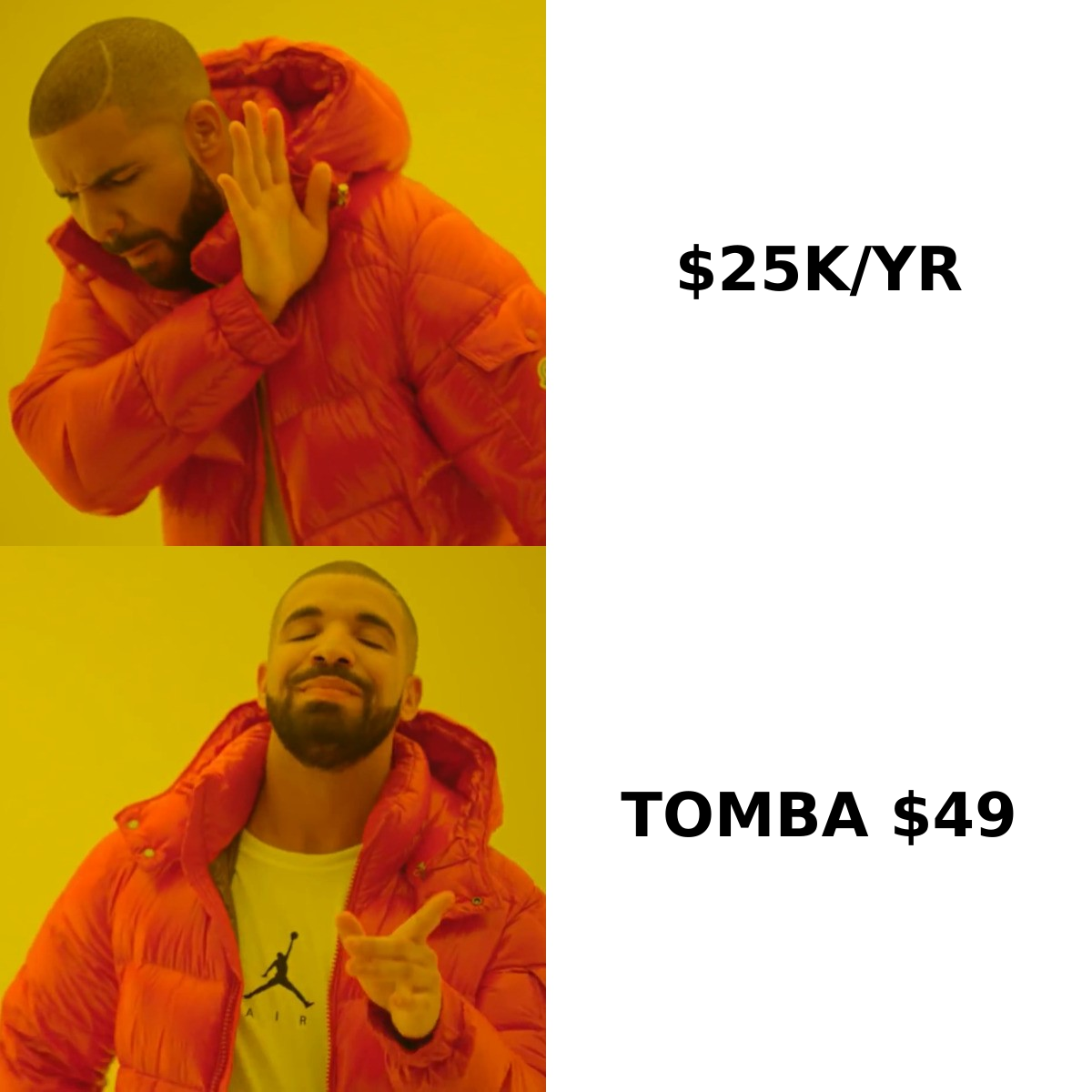
For teams that just need contacts against a known list of companies, both numbers look heavy. Tomba pricing starts at $49/mo for Starter, $99/mo for Growth, and $249/mo for Pro. A free tier gives you 25 searches a month to test patterns first.
Who should buy ZoomInfo (the DiscoverOrg successor)?#
Buy it if three or more of these describe you.
You run account-based marketing with a defined enterprise ICP. Intent signals and org charts pay for themselves when one closed deal covers the contract.
You need filters no scraper can rebuild. Revenue bands, funding stage, tech installs, and hiring signals shape your territories.
RevOps owns the data layer. Records flow into Salesforce or HubSpot on a schedule, instead of reps exporting CSVs by hand.
Compliance requires a vendor with signed data-processing agreements and security review documents.
Deal sizes justify it. At $30k ACV, a five-figure data contract is a rounding error. At $3k ACV, it is a governance problem.
Skip it if your ICP is still moving. Annual contracts and shifting target markets pair badly. You will pay for segments you walked away from in month four.
Who should buy Wiza?#
Wiza fits one specific and very common motion.
You already prospect on LinkedIn. Sales Navigator is your search engine, and you want the results in a CSV or your CRM.
You are a recruiter, agency, or founder-led team. The person choosing the tool is the person using it.
You need speed over completeness. A 500-contact list built in an afternoon beats a perfect database you cannot afford.
You want to cancel without a phone call. Self-serve pricing and monthly billing remove the procurement tax.
Skip it if many of your buyers are not on LinkedIn. Skip it too if you need to enrich a list of companies you already have. That is a domain problem, not a profile problem. For that job, domain search or a LinkedIn finder hits the same records without Sales Navigator seat limits.
Is there a middle option between the two?#
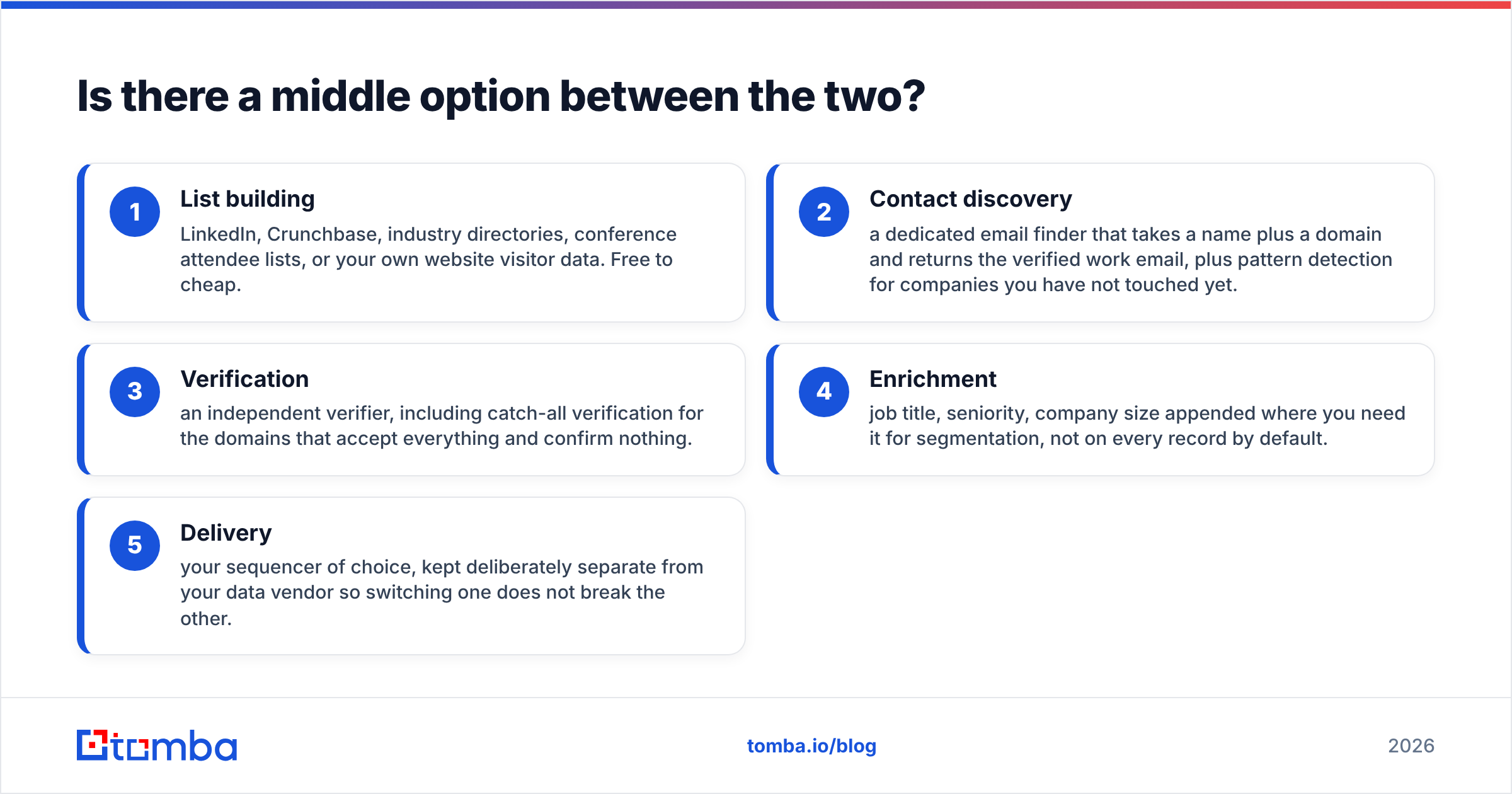
Yes. Most teams of 5 to 50 people land on it: unbundle the stack.
Enterprise platforms bundle database, intent, workflow, and enrichment into one contract. That is how enterprise software is sold. Most teams use maybe 30% of it. Unbundling means paying for each layer on its own, and only where you need it.
List building. LinkedIn, Crunchbase, industry directories, event attendee lists, or your own site visitors. Free to cheap.
Contact discovery. An email finder takes a name plus a domain and returns the verified work email. It also detects patterns at companies you have never touched.
Verification. An independent verifier, including catch-all verification for domains that accept everything and confirm nothing.
Enrichment. Title, seniority, and company size added where segmentation needs it, not on every record by default.
Delivery. Your sequencer, kept separate from your data vendor. Switching one should not break the other.
A 10-person team can run this stack for a few hundred dollars a month. The bundled version starts with a procurement cycle and a signature.
The trade-off is real. You lose intent data and org charts. Be honest about whether your reps ever opened those tabs.
How should you test both before committing?#
Run the same test on any contact data vendor. It takes an afternoon, and it has killed more bad contracts than any review site.
Build a 100-row control list from accounts you already won or lost. You know the real contacts, so you can grade the output.
Export the same 100 rows from each tool. Same filters, same seniority, same geography.
Measure match rate and bounce rate separately. Ninety emails with 15% bounces is worse than 70 emails with 1% bounces. Verify both files with the same third-party verifier so the grading stays neutral.
Check 10 records by hand. Open the LinkedIn profile. Is the title current? Did the person move on? Stale data hides inside aggregate stats.
Price it per usable contact, not per credit. Divide the annual cost by the contacts that survived verification and matched your ICP. That number is the only fair way to compare vendors.
Ask about exit. Can you keep your enriched records if you leave? Some enterprise agreements limit that. Get the answer in writing before you sign.
To run this test without meeting either sales team, a bulk email finder processes the control list in one upload. You get a baseline to compare both quotes against.
The bottom line on DiscoverOrg vs Wiza#
DiscoverOrg is a legacy brand name for what is now ZoomInfo. It is a deep enterprise data platform with enterprise pricing, contracts, and renewal talks. Wiza is a focused, self-serve LinkedIn exporter. It does one job well and does not pretend to do more. Neither is wrong. They answer different questions.
So ask a narrower question than "which platform wins." Ask this instead: what share of my pipeline starts from a company name I already know? If the answer is most of it, the DiscoverOrg vs Wiza debate is beside the point. You need reliable name-plus-domain to verified-email lookup, at volume, with an API you can wire into whatever you build next.
That is what the Tomba Email Finder does. The free tier gives you 25 searches a month to test your ICP against real domains. Starter is $49/mo when it works. The Tomba API, CLI, and Chrome extension are included, not sold as add-on modules. Run your control list through it next to whichever quote sits in your inbox, then let cost per usable contact pick the winner.
Related guides#
Ready to find emails that actually work?
Join 150,000+ professionals who stopped guessing and started sending. Free credits on signup — no credit card required.
Get the Tomba newsletter
Practical outbound tactics and product updates — once every two weeks.
About the author