Discovery Call Script: A Proven 2026 Framework for B2B Sales
A discovery call script should shape the conversation, not read it aloud. Here's a full 2026 framework — question blocks, timing, qualification math, and the mistakes that kill deals in the first 90 seconds.
TL;DR
- A discovery call script is a structure, not a monologue. The best ones fix the sequence and timing of question blocks, then let the rep improvise wording.
- Target a 55/45 prospect-to-rep talk ratio. If you're above 50% talk time on discovery, you're pitching, not qualifying.
- The single biggest predictor of a good discovery call happens before the call: correct contact data, verified email, and 10 minutes of account research.
- Use a qualification framework (MEDDIC, SPICED, or a trimmed BANT) as a checklist you fill in silently — never as the question order.
- End every call with an explicit next step on the calendar. "I'll follow up next week" is how 40% of pipeline quietly dies.
What Is a Discovery Call Script?#
A discovery call script is a written sequence of question blocks, transitions, and timing markers that guides a first substantive sales conversation with a qualified prospect. It is not a word-for-word recitation. Think of it like a jazz chart: the chord changes are fixed, the solo is yours.
The distinction matters because most reps fail in one of two directions. Either they wing it entirely — the call meanders, no qualification data gets captured, and the CRM entry reads "great convo, they're interested" — or they read a rigid script aloud, the prospect hears an interrogation, and the call ends politely at minute 14.
A working script solves for three things at once:
- Coverage — every qualification field your pipeline needs gets answered, without you having to remember them mid-call.
- Sequence — questions land in an order that builds psychological momentum instead of triggering defensiveness.
- Timing — you know at minute 12 whether you're behind, so the call doesn't end without a next step.
Everything else — rapport lines, industry anecdotes, objection responses — is improvisation on top of that skeleton.
Why Do Most Discovery Calls Fail Before They Start?#
Because the rep showed up cold to a call they booked warm.
Discovery is a research-dependent activity. The prospect gave you 30 minutes on the assumption that you already know what their company does. Spending the first eight minutes asking "So tell me a bit about your business" burns that goodwill immediately, and it's the most common reason a call slides from consultative to transactional.
Pre-call prep that actually moves the needle:
- Company context (4 min) — recent funding, headcount trend, new exec hires, product launches. LinkedIn and the company's own newsroom cover most of it.
- Person context (3 min) — tenure in role, prior company, what they post about. A rep who joined six weeks ago has different pain than one three years in.
- Tech stack context (2 min) — what they already run. Check their job postings and use a website tech stack lookup to see what's actually deployed.
- Data hygiene (1 min) — confirm the contact details are current. If your calendar invite bounced or went to a stale address, the call never happens at all. Running the address through an email verifier before the meeting is cheap insurance.
That's ten minutes. It's the difference between "you clearly did your homework" and "let me stop you there."

What Does a 30-Minute Discovery Call Script Look Like?#
Here's the block structure. Times are targets, not laws — but if you blow past a block by more than three minutes, cut something later.
Block 1 — Frame the call (0:00–2:00)
"Thanks for the time. I've got 30 on the calendar. My plan is to spend most of it understanding how you're handling [specific process] today, and if it looks like there's a fit, I'll show you what that could look like on our side. If it's not a fit, I'll tell you that too. Sound reasonable? Anything you want to make sure we cover?"
That last question does real work. It surfaces the prospect's actual agenda, which is frequently not the one you assumed.
Block 2 — Current state (2:00–9:00)
You're mapping the process before you go near pain. Neutral, factual, easy to answer:
- "Walk me through how [process] works today, start to finish."
- "Who else touches that workflow?"
- "How long has it run that way?"
- "What tools are involved?"
Block 3 — Problem and impact (9:00–18:00)
This is the core of the call. Move from what happens to what it costs.
- "Where does that break down most often?"
- "What does that cost you in a typical month — hours, dollars, deals?"
- "What have you already tried to fix it?"
- "What happened when you tried that?"
The "what have you already tried" question is the most underused in B2B sales. It tells you the budget precedent, the internal politics, and whether you're walking into a graveyard of failed vendors.
Block 4 — Decision process (18:00–24:00)
- "If you decided to solve this, who else weighs in?"
- "What does that approval path look like — is there a threshold where it goes to finance?"
- "Is there a date this needs to be solved by, or is it a 'when we get to it' thing?"
Block 5 — Recap and next step (24:00–30:00)
Play back what you heard, in their words. Then book something specific:
"So: three people manually building lists, roughly 12 hours a week, and the bounce rate is putting your domain at risk. Did I get that right? Anything I missed? — Next step I'd suggest is a 45-minute working session with you and [name from Block 4] where I show exactly how this maps. I've got Thursday at 10 or Friday at 2. Which is easier?"
Which Qualification Framework Should Your Script Use?#
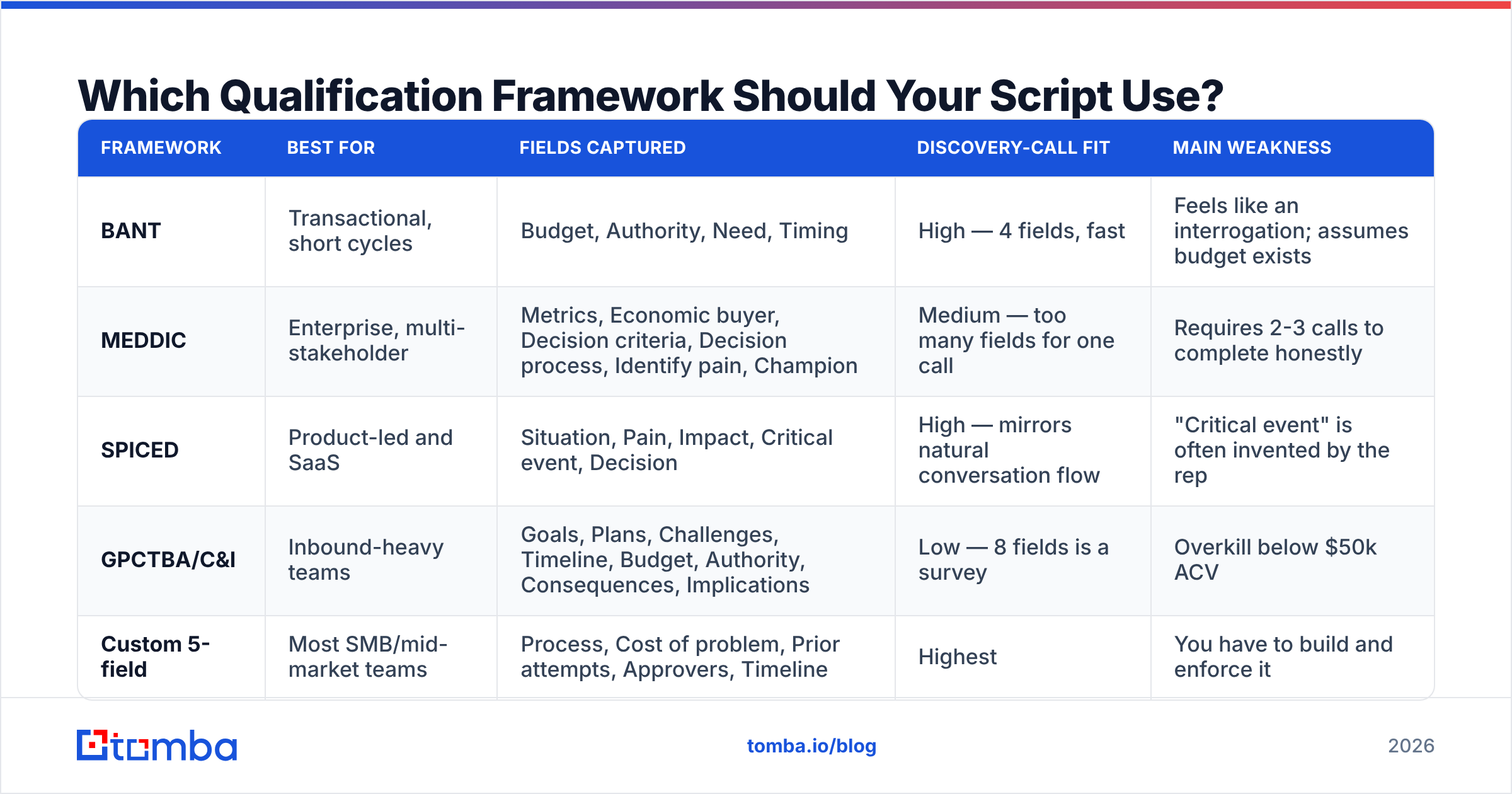
Pick one, fill it silently, never read it aloud. Here's how the common frameworks compare for discovery specifically:
| Framework | Best for | Fields captured | Discovery-call fit | Main weakness |
|---|---|---|---|---|
| BANT | Transactional, short cycles | Budget, Authority, Need, Timing | High — 4 fields, fast | Feels like an interrogation; assumes budget exists |
| MEDDIC | Enterprise, multi-stakeholder | Metrics, Economic buyer, Decision criteria, Decision process, Identify pain, Champion | Medium — too many fields for one call | Requires 2-3 calls to complete honestly |
| SPICED | Product-led and SaaS | Situation, Pain, Impact, Critical event, Decision | High — mirrors natural conversation flow | "Critical event" is often invented by the rep |
| GPCTBA/C&I | Inbound-heavy teams | Goals, Plans, Challenges, Timeline, Budget, Authority, Consequences, Implications | Low — 8 fields is a survey | Overkill below $50k ACV |
| Custom 5-field | Most SMB/mid-market teams | Process, Cost of problem, Prior attempts, Approvers, Timeline | Highest | You have to build and enforce it |
If you run deals under $25k ACV with a one-to-two-call cycle, SPICED or a trimmed custom set beats MEDDIC every time. HubSpot's sales qualification guide walks through the tradeoffs in more depth, and G2's buyer behavior research is a decent sanity check on how much of the decision is already made before you get the call.
The rule that holds across all of them: the framework is your note-taking template, not your question list. A prospect should never be able to reverse-engineer which acronym you're running.
How Do You Ask Better Discovery Questions?#
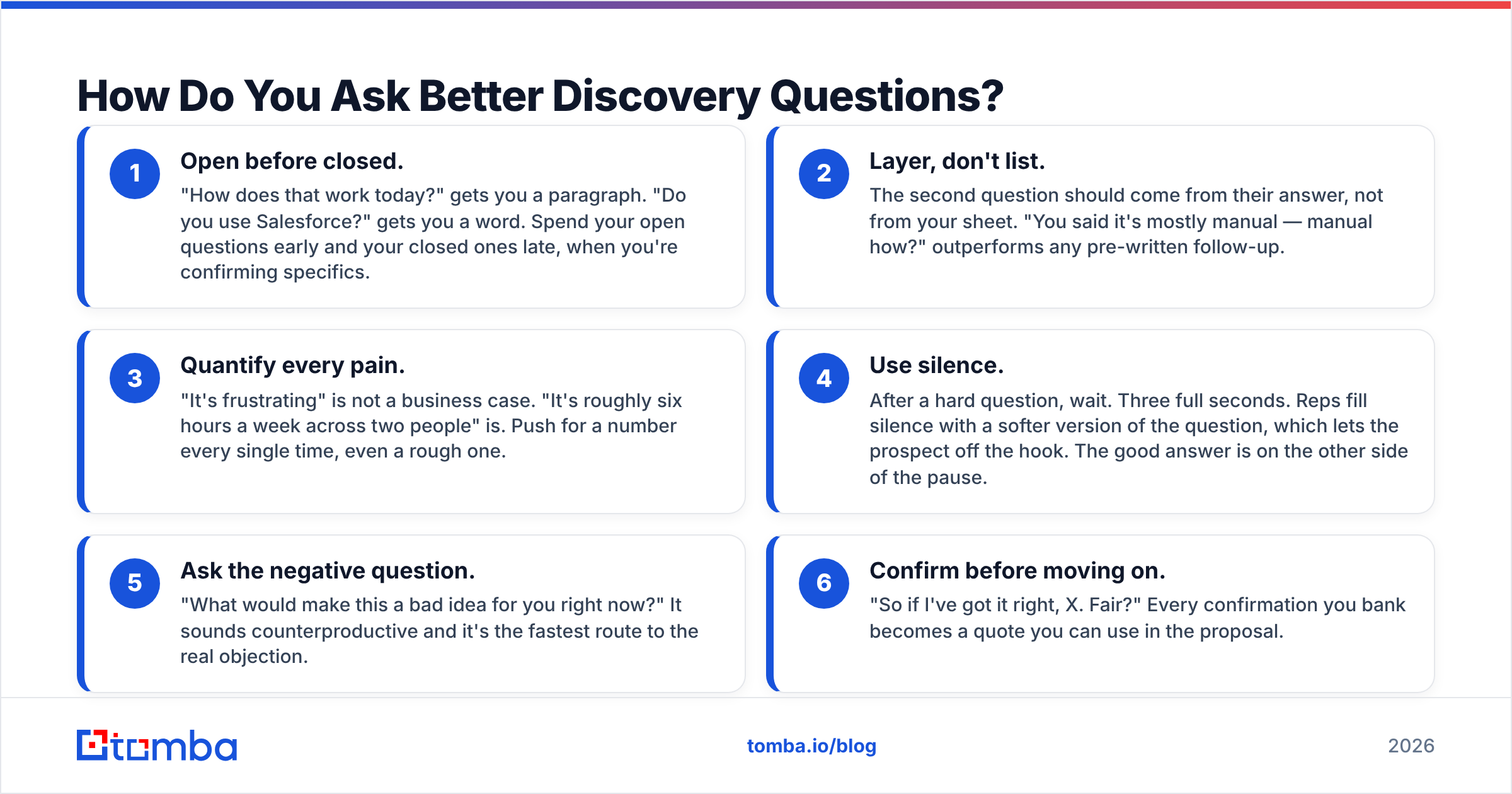
Four mechanics separate good discovery questions from bad ones.
- Open before closed. "How does that work today?" gets you a paragraph. "Do you use Salesforce?" gets you a word. Spend your open questions early and your closed ones late, when you're confirming specifics.
- Layer, don't list. The second question should come from their answer, not from your sheet. "You said it's mostly manual — manual how?" outperforms any pre-written follow-up.
- Quantify every pain. "It's frustrating" is not a business case. "It's roughly six hours a week across two people" is. Push for a number every single time, even a rough one.
- Use silence. After a hard question, wait. Three full seconds. Reps fill silence with a softer version of the question, which lets the prospect off the hook. The good answer is on the other side of the pause.
- Ask the negative question. "What would make this a bad idea for you right now?" It sounds counterproductive and it's the fastest route to the real objection.
- Confirm before moving on. "So if I've got it right, X. Fair?" Every confirmation you bank becomes a quote you can use in the proposal.
What Should You Never Do on a Discovery Call?#
- Demo. If you open a screen share in the first 30 minutes, you've converted discovery into a product tour and given up your leverage. Say: "I could show you, but I'd be guessing at what matters to you — give me five more minutes of context first."
- Discount preemptively. Price comes up at minute 20 in half of all discovery calls. Answer with a range, tie it to the impact number they already gave you, and move on.
- Talk more than they do. Gong's conversation research consistently puts top-performer talk ratios in the 43–47% range on discovery. If you don't have call recording, count it manually once a week — the number will surprise you.
- Skip the next step. A call that ends with "send me some info" has a materially lower conversion rate than one that ends with a calendar invite. Book the next meeting while you're both live.
- Take zero notes. Not because you'll forget, but because the exact phrasing the prospect used is the phrasing that will win internal approval later.
How Do You Adapt the Script by Call Type?#
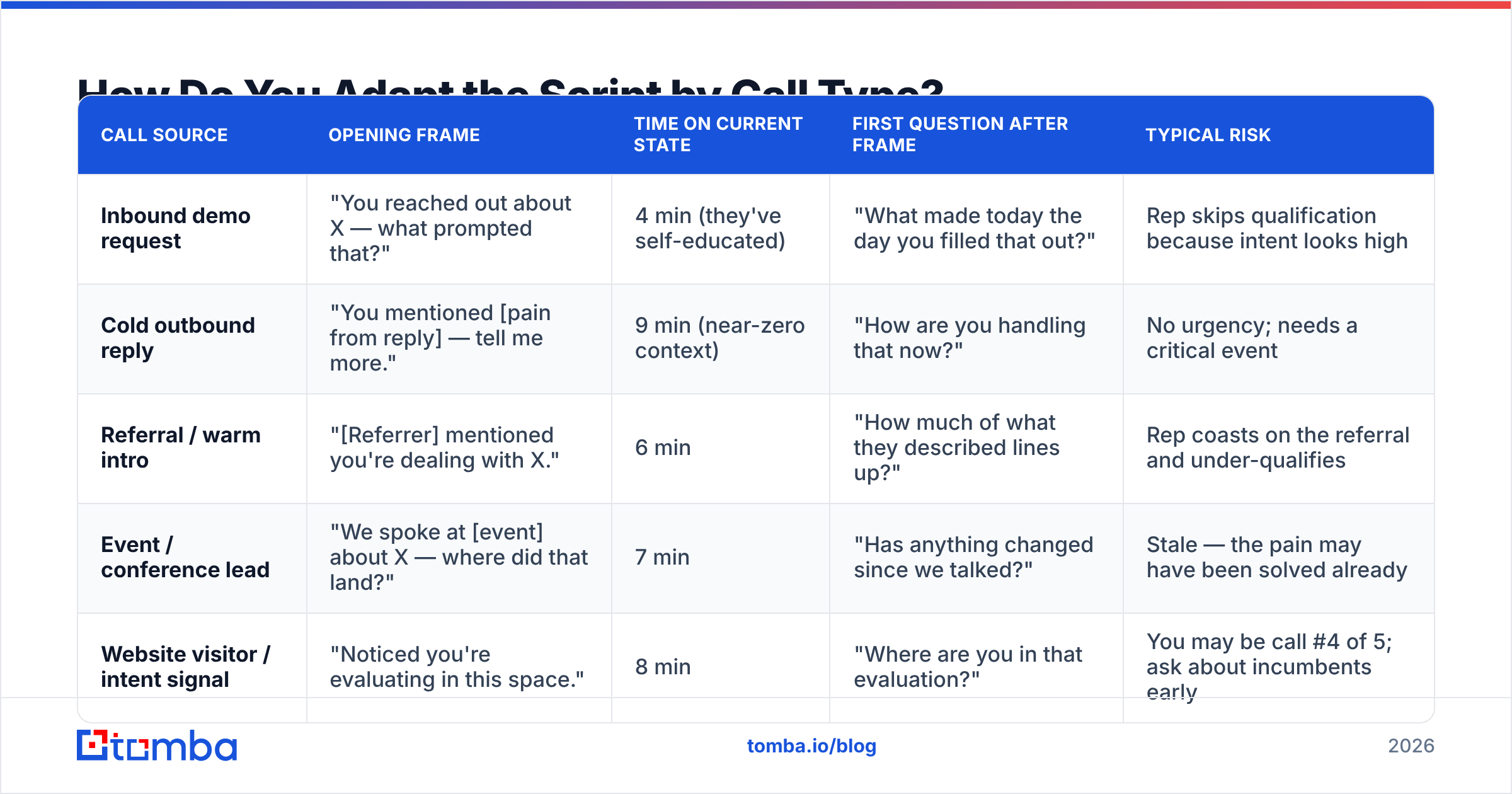
One script does not fit every source. The framing block changes; the middle stays intact.
| Call source | Opening frame | Time on current state | First question after frame | Typical risk |
|---|---|---|---|---|
| Inbound demo request | "You reached out about X — what prompted that?" | 4 min (they've self-educated) | "What made today the day you filled that out?" | Rep skips qualification because intent looks high |
| Cold outbound reply | "You mentioned [pain from reply] — tell me more." | 9 min (near-zero context) | "How are you handling that now?" | No urgency; needs a critical event |
| Referral / warm intro | "[Referrer] mentioned you're dealing with X." | 6 min | "How much of what they described lines up?" | Rep coasts on the referral and under-qualifies |
| Event / conference lead | "We spoke at [event] about X — where did that land?" | 7 min | "Has anything changed since we talked?" | Stale — the pain may have been solved already |
| Website visitor / intent signal | "Noticed you're evaluating in this space." | 8 min | "Where are you in that evaluation?" | You may be call #4 of 5; ask about incumbents early |
For the last row: if you're running website visitor reveal or similar intent tooling, the single most valuable question is "who else are you talking to?" — asked casually, at minute 20, after trust is established.
How Do You Measure Whether Your Script Works?#
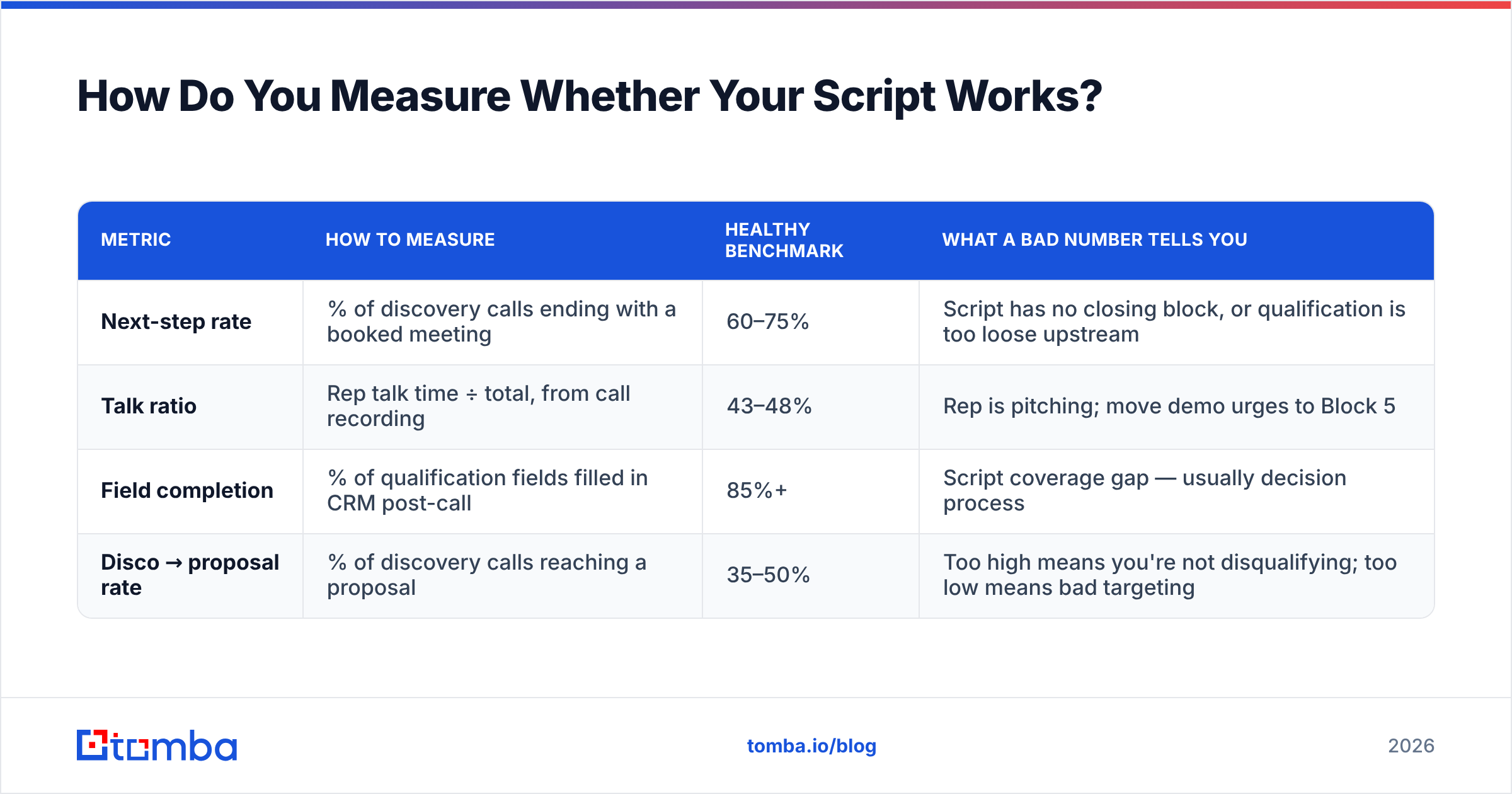
Track four numbers per rep, per month. Anything else is vanity.
| Metric | How to measure | Healthy benchmark | What a bad number tells you |
|---|---|---|---|
| Next-step rate | % of discovery calls ending with a booked meeting | 60–75% | Script has no closing block, or qualification is too loose upstream |
| Talk ratio | Rep talk time ÷ total, from call recording | 43–48% | Rep is pitching; move demo urges to Block 5 |
| Field completion | % of qualification fields filled in CRM post-call | 85%+ | Script coverage gap — usually decision process |
| Disco → proposal rate | % of discovery calls reaching a proposal | 35–50% | Too high means you're not disqualifying; too low means bad targeting |
The disqualification point deserves emphasis. A discovery script that advances 90% of calls isn't good — it means nobody is saying no, which means your forecast is fiction. Roughly a quarter to a third of discovery calls should end with a mutual "not now."
Track these alongside your overall win rate so you can tell whether script changes are moving the outcome or just moving activity.
Does the Script Matter More Than the List?#
No — and this is where a lot of teams misallocate effort.
You can run flawless discovery on the wrong person and get nothing. You can run mediocre discovery on the right person and still advance the deal. Targeting and data quality sit upstream of everything in this article.
Concretely, before a script can help you:
- The contact has to be real. Bounced invites, wrong-department contacts, and long-departed employees kill more discovery calls than bad questioning ever will.
- The persona has to be right. A discovery call with someone two levels below the approver isn't discovery — it's an unpaid research interview.
- The volume has to be there. Script improvements compound across call volume. A 5% next-step lift on 20 calls a month is one extra meeting; on 200 calls it's ten.
That's the argument for putting real effort into how you source contacts in the first place. Tools like Tomba's email finder, domain search, or a curated B2B database exist to make sure the person on the other end of the call is the person who can actually say yes. BookYourData is another solid option in this space if you prefer buying pre-built lists over building them by domain — different workflow, same goal of getting a clean, reachable contact into the calendar.
What Does a Filled-Out Script Look Like in Practice?#
Short worked example, RevOps buyer, mid-market SaaS:
Frame: "30 minutes, most of it on how you're handling lead routing today. If it's not a fit I'll say so. Anything you want to make sure we hit?" → They want to talk about attribution, not routing. Noted. Adjust.
Current state: Four-person RevOps team, routing rules in Salesforce, manual overrides in a shared sheet, ~2,000 inbound leads/month.
Problem + impact: Overrides take one analyst roughly 9 hours a week. Two enterprise leads routed to SMB reps last quarter; one closed at a third of the expected ACV. Tried building it in Flow, broke on edge cases, abandoned after six weeks.
Decision process: Buyer owns budget to $30k. Above that, CRO signs. Wants it live before the January fiscal reset — that's the critical event.
Recap + next step: Play back the 9 hours and the misrouted enterprise deal. Book a 45-minute working session with the buyer plus the Salesforce admin, Thursday 10am, confirmed on calendar before hanging up.
Notice how little of that is the script. The script just made sure nothing was missing.
Where Should You Start?#
Rewrite one block, not the whole thing. Most teams get the biggest lift from Block 4 (decision process), because it's the block reps skip when the call is going well — and it's the block that determines whether the deal is real.
Then fix the input side. A tight script pointed at stale contacts produces tight, well-structured calls with people who can't buy. Run your target accounts through Tomba's Email Finder to get verified, current contacts for the exact roles your script is written for — the free tier covers 25 searches a month if you want to test the data quality before committing, and paid plans start at $49/mo when you're ready to scale the volume. Good discovery starts with the right person on the line.
Related guides#
Ready to find emails that actually work?
Join 150,000+ professionals who stopped guessing and started sending. Free credits on signup — no credit card required.
Get the Tomba newsletter
Practical outbound tactics and product updates — once every two weeks.
About the author