Discovery Call Script PDF: The 2026 Framework That Books Demos
Most discovery call script PDFs are interrogation checklists. Here's the 2026 framework — question sequence, timing, objection branches, and what to do before you ever dial.
TL;DR
- A discovery call script PDF is only useful if it encodes a sequence, not a question bank. Order beats volume every time.
- The 2026 standard call is 30 minutes split roughly 5 / 15 / 7 / 3: rapport and frame, diagnosis, mutual fit, next step.
- Talk-time targets matter more than word choice. Gong's public research repeatedly puts winning discovery calls near a 46/54 rep-to-prospect ratio.
- Five question themes cover 90% of real discovery: current state, cost of inaction, decision process, success criteria, and timing.
- Bad contact data kills more discovery calls than bad scripts — you can't run a framework on a wrong-title, wrong-email prospect.
You can download a hundred discovery call script PDFs and still run bad calls. The template is not the problem. The problem is that most PDFs are a flat list of 40 questions with no branching logic, no timing, and no instruction for what to do when the prospect says "we're just looking right now."
This guide gives you the structure a discovery call script PDF should contain, so you can build one your team actually opens twice.
What is a discovery call script PDF, really?#
Think of it like a pilot's pre-flight checklist. A pilot isn't reading the checklist because they forgot how to fly — they're reading it because under pressure, humans skip steps. Discovery calls are exactly that: a high-cognitive-load conversation where you're listening, qualifying, taking notes, and steering all at once. Something gets dropped.
A discovery call script PDF is a one-page (max two) artifact that holds the parts of the call you must not drop:
- The frame — the 20-second opener that sets the agenda and earns permission to ask questions.
- The question sequence — grouped by theme, in the order that builds context rather than jumping around.
- The branch points — what you say when they answer "no budget," "we already use X," or "send me a deck."
- The scoring block — the 4-6 fields you must fill before the call ends (usually mapped to MEDDIC, BANT, or your own qualification model).
- The exit — the specific next-step language that converts a good call into a calendared second meeting.
Anything else is bloat. If your PDF has 40 questions on it, your reps are reading, not listening.

Why do most discovery call scripts fail?#
Three failure modes, in order of how often they show up in call reviews.
Failure 1: The interrogation. The rep works down the question list. The prospect answers in one-word bursts. No follow-up, no "tell me more about that." Discovery becomes a form-filling exercise and the prospect disengages by minute eight.
Failure 2: Premature pitching. The prospect mentions a pain point at minute four and the rep launches into a feature demo. The call ends with the prospect knowing your product and you knowing nothing about their org chart, budget cycle, or the incumbent vendor they're under contract with until Q3.
Failure 3: The soft exit. The call goes well, everyone's friendly, and it ends with "I'll send over some information." That's a lost deal with extra steps. Gong's research on sales conversations has consistently found that calls ending with a specific scheduled next step convert dramatically better than calls ending with a promise to follow up.
A well-built script PDF fixes all three by embedding timing markers, a hard "no pitching before minute 15" rule, and a mandatory close block.
What should the question sequence look like?#
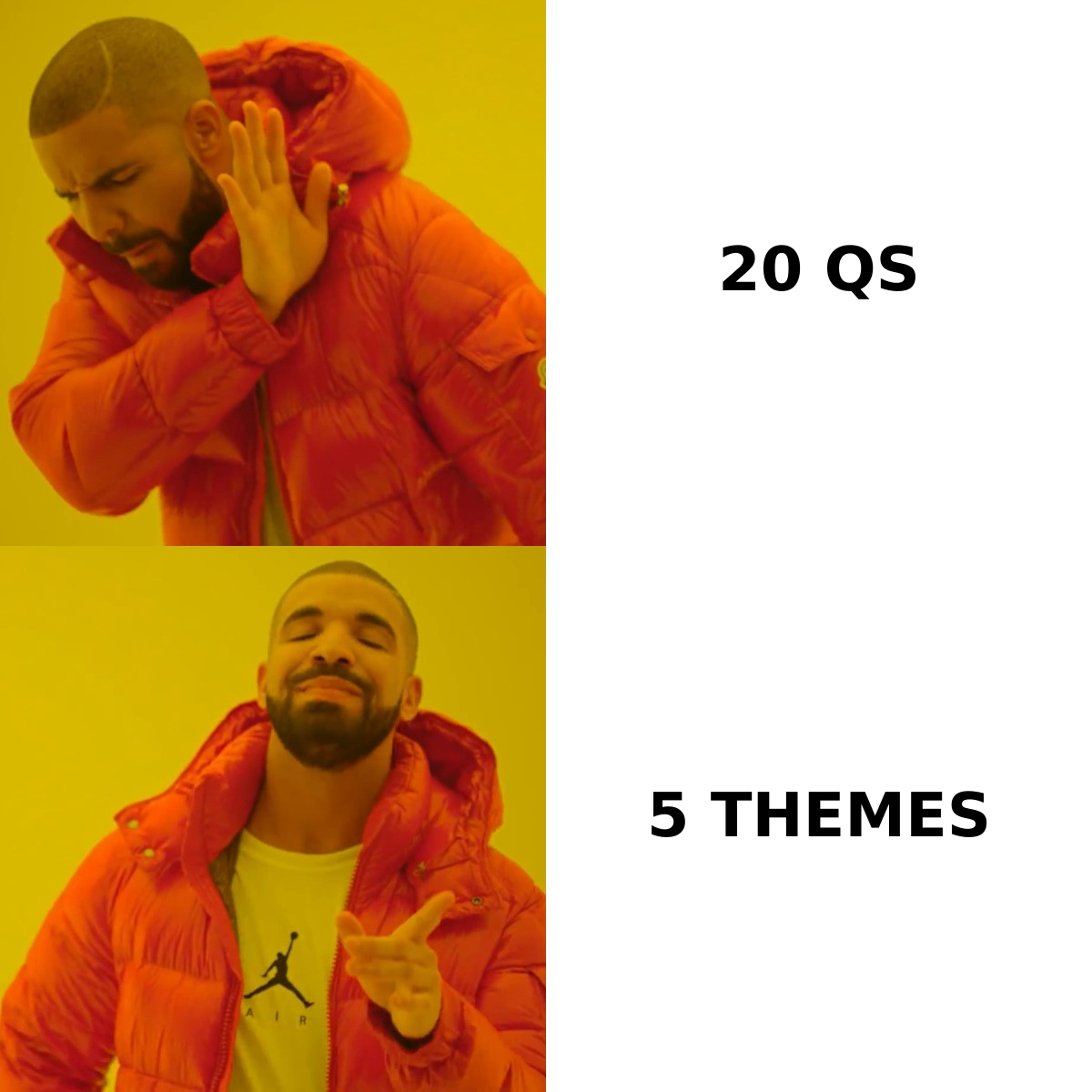
Here's the core five-theme structure. Each theme has a primary question and one or two follow-ups. That's it — around 12-15 questions total, not 40.
- Current state — "Walk me through how your team handles [process] today." Follow-up: "How long has it worked that way?" You're mapping the status quo before you attack it.
- Cost of inaction — "What happens if this stays the same for the next two quarters?" Follow-up: "Has anyone tried to quantify that?" This is where deals are won. If the prospect can't articulate cost, there is no urgency and no deal.
- Decision process — "Who else would need to weigh in before something like this gets signed off?" Follow-up: "What did the last similar purchase look like internally?" Past process predicts future process better than anything they'll tell you about the current one.
- Success criteria — "If we're on a call twelve months from now and this worked, what's different?" Follow-up: "How would you measure that?" This gives you the language for your business case.
- Timing and constraints — "What's driving the timeline on your end?" Follow-up: "Is there anything on the calendar — contract renewal, headcount plan, board target — that anchors it?"
Notice the order. Current state before pain. Pain before process. Process before success criteria. Success criteria before timing. Each theme gives you the vocabulary to ask the next one intelligently.
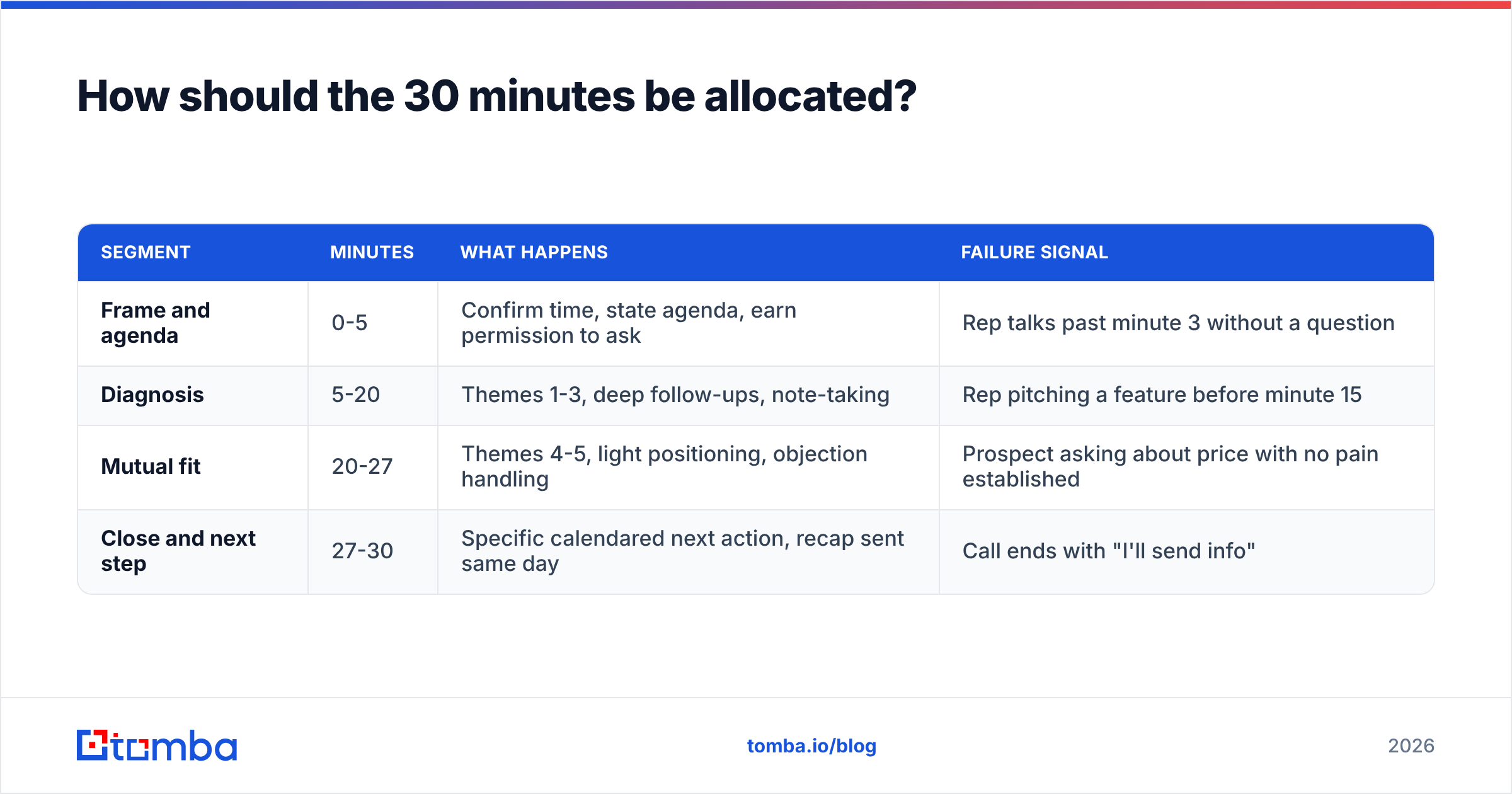
How should the 30 minutes be allocated?#
Time is the constraint nobody scripts for. Here's the allocation that holds up across most B2B mid-market motions:
| Segment | Minutes | What happens | Failure signal |
|---|---|---|---|
| Frame and agenda | 0-5 | Confirm time, state agenda, earn permission to ask | Rep talks past minute 3 without a question |
| Diagnosis | 5-20 | Themes 1-3, deep follow-ups, note-taking | Rep pitching a feature before minute 15 |
| Mutual fit | 20-27 | Themes 4-5, light positioning, objection handling | Prospect asking about price with no pain established |
| Close and next step | 27-30 | Specific calendared next action, recap sent same day | Call ends with "I'll send info" |
Two things make this work in practice. First, a visible clock or timer during the call. Second, a note in the PDF at each boundary — literally "MINUTE 15: STOP DIAGNOSING, START POSITIONING." Reps who see the marker respect it.
Aim for the rep speaking roughly 45% of the time and the prospect 55%. If you're recording calls with a conversation intelligence tool, that ratio is the single easiest metric to coach against. And if you're evaluating tools for it, there are solid Gong alternatives worth comparing before you commit to enterprise pricing.
PDF, Notion doc, or CRM-embedded — which format wins?#
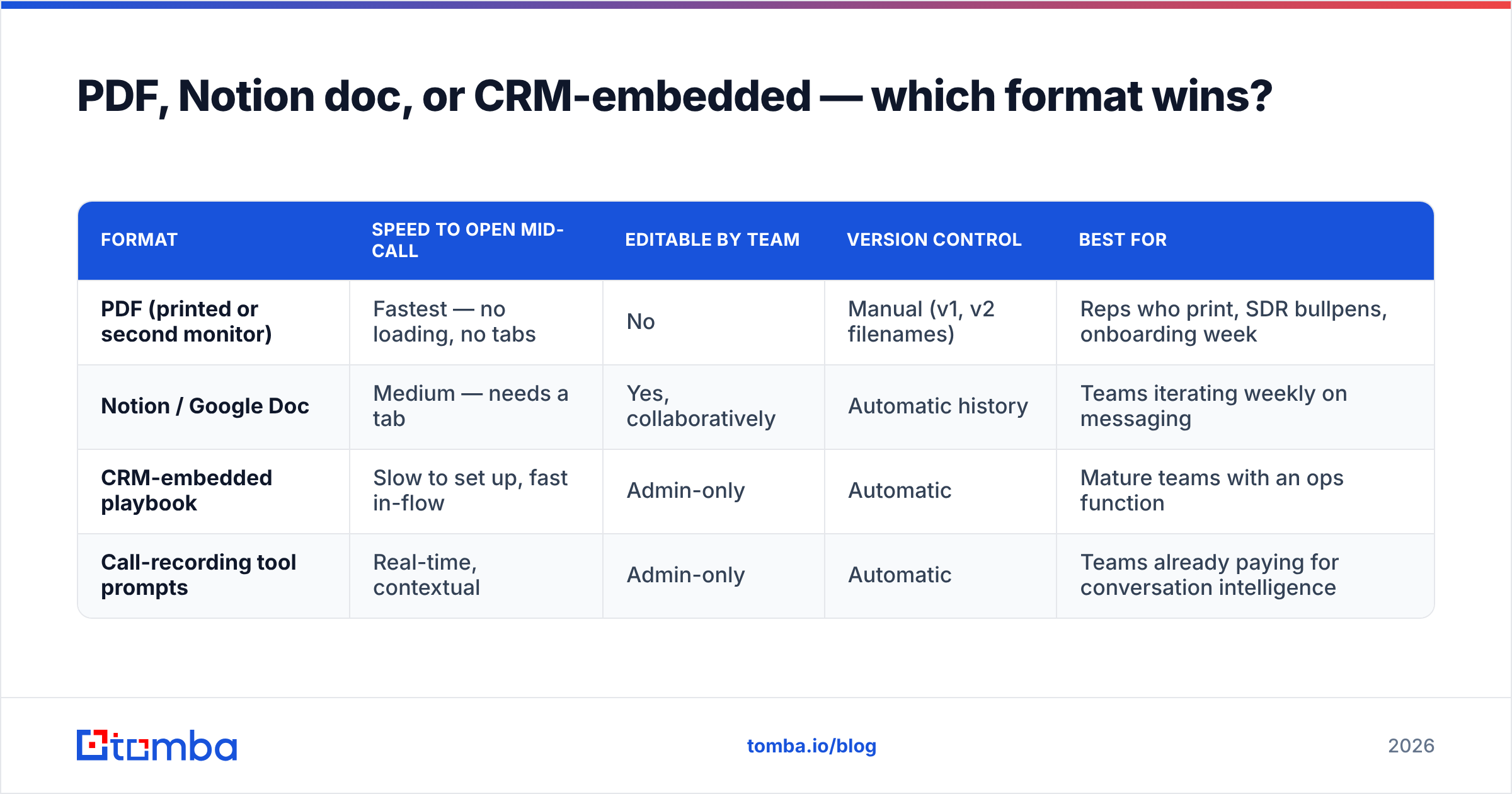
The format debate matters more than people admit. Reps use what's fastest to reach mid-call.
| Format | Speed to open mid-call | Editable by team | Version control | Best for |
|---|---|---|---|---|
| PDF (printed or second monitor) | Fastest — no loading, no tabs | No | Manual (v1, v2 filenames) | Reps who print, SDR bullpens, onboarding week |
| Notion / Google Doc | Medium — needs a tab | Yes, collaboratively | Automatic history | Teams iterating weekly on messaging |
| CRM-embedded playbook | Slow to set up, fast in-flow | Admin-only | Automatic | Mature teams with an ops function |
| Call-recording tool prompts | Real-time, contextual | Admin-only | Automatic | Teams already paying for conversation intelligence |
The honest answer: PDF for training, CRM-embedded for scale. New reps need a physical artifact they can annotate during ramp. Experienced reps need it inside the CRM where they're already logging notes. Most teams should build the PDF first, prove the sequence works, then embed it.
Don't skip the PDF stage because it feels low-tech. A one-page printout survives a laptop crash, a Zoom failover, and a call taken from a phone in a parking lot.
What goes in the objection branch section?#
This is the part almost every free discovery call script PDF omits, and it's the part reps actually need. Four branches cover most calls:
- "We don't have budget right now." Don't concede or push. Ask: "Understood — is that a this-quarter thing or a this-year thing?" You're separating a timing objection from a priority objection. They're completely different deals.
- "We already use [competitor]." Ask: "How's that going?" then stay silent. Genuinely silent. The gap between what they bought and what they got is where your wedge lives. Never trash the incumbent — you'll trash the buyer who chose it.
- "Just send me some information." Ask: "Happy to — what specifically would be most useful, and who else would be reading it?" This converts a brush-off into either a real request or a clear signal to disqualify.
- "This isn't a priority." Ask: "What is, right now?" Then decide honestly whether you're adjacent to that priority or not. Half of these are legitimate disqualifications, and disqualifying fast is a feature.
Write the exact words in the PDF. Not "handle the budget objection" — the literal sentence. Reps under pressure need language, not categories.
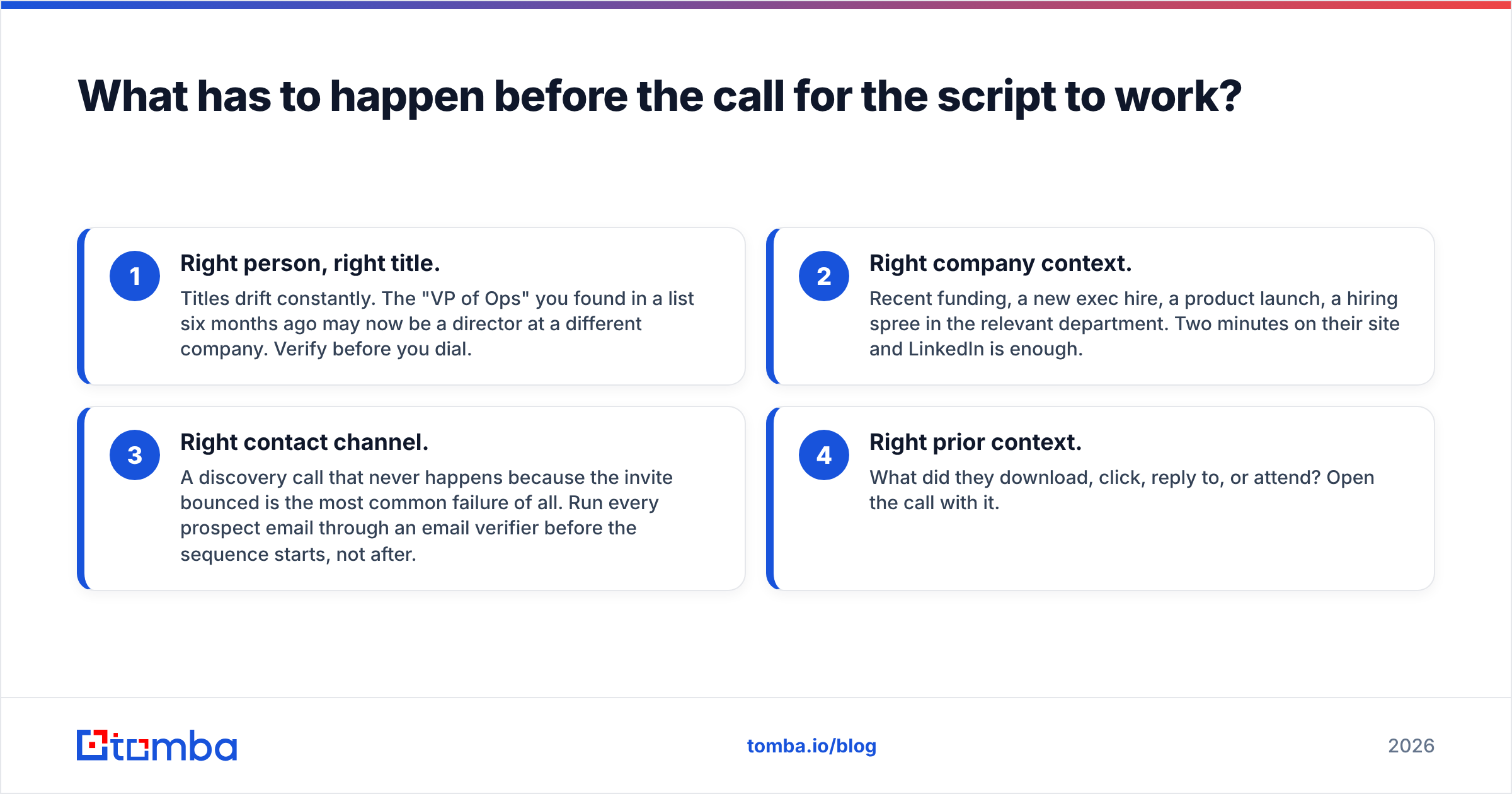
What has to happen before the call for the script to work?#
A perfect script run against the wrong person is a wasted 30 minutes. Pre-call prep is the unglamorous half of discovery, and it's where most of the leverage sits.
Your pre-call block should confirm four things:
- Right person, right title. Titles drift constantly. The "VP of Ops" you found in a list six months ago may now be a director at a different company. Verify before you dial.
- Right company context. Recent funding, a new exec hire, a product launch, a hiring spree in the relevant department. Two minutes on their site and LinkedIn is enough.
- Right contact channel. A discovery call that never happens because the invite bounced is the most common failure of all. Run every prospect email through an email verifier before the sequence starts, not after.
- Right prior context. What did they download, click, reply to, or attend? Open the call with it.
This is where prospecting data quality directly touches call quality. If you're building lists from scratch, an email finder that returns verified addresses and current titles saves you the "sorry, I don't handle that anymore" opener. And if you're enriching an existing CRM, contact enrichment backfills the title, company size, and phone fields your script's qualification block depends on.
Teams that skip this step end up with beautifully scripted calls booked with the wrong buyer persona — and no script fixes that.
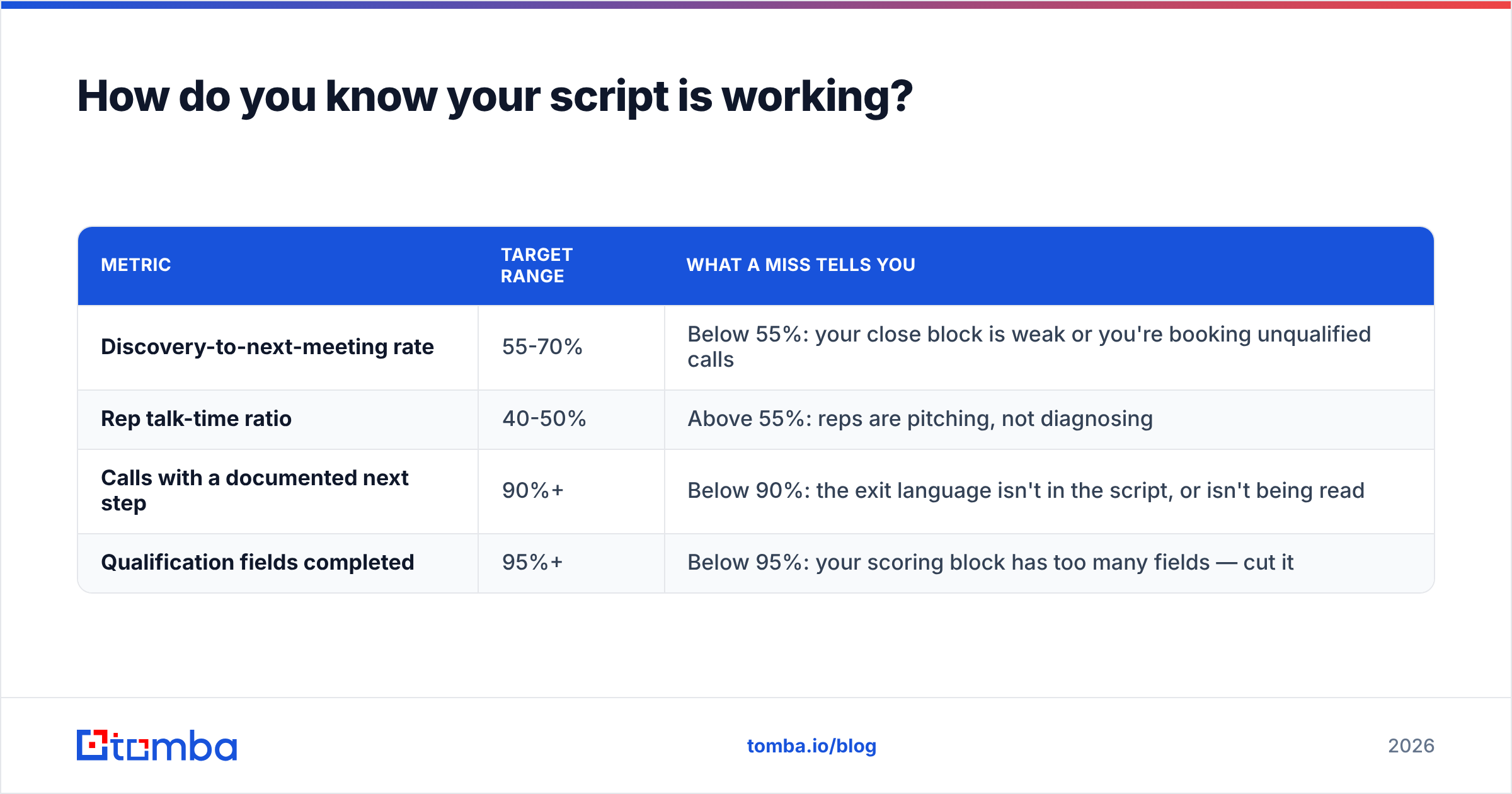
How do you know your script is working?#
Four metrics, tracked monthly. Don't add more.
| Metric | Target range | What a miss tells you |
|---|---|---|
| Discovery-to-next-meeting rate | 55-70% | Below 55%: your close block is weak or you're booking unqualified calls |
| Rep talk-time ratio | 40-50% | Above 55%: reps are pitching, not diagnosing |
| Calls with a documented next step | 90%+ | Below 90%: the exit language isn't in the script, or isn't being read |
| Qualification fields completed | 95%+ | Below 95%: your scoring block has too many fields — cut it |
Review five recorded calls a month against the script. Not fifty — five, deeply. Mark where the rep deviated and whether the deviation helped. The deviations that help become the next version of the PDF. That's how a script stays alive instead of becoming shelf-ware after week three.
One caution on benchmarks: ranges like these vary heavily by deal size and motion. A $2K/month SMB product and a $250K enterprise platform will not share a discovery-to-next-meeting rate. Set your baseline from your own last 50 calls, then improve against that.
What does a complete one-page script look like?#
Structurally, your PDF should fit this skeleton:
- Header block (2 lines): prospect name, company, title, source, one line of prior context.
- Frame script (3 lines, verbatim): the exact opener, agenda statement, and permission ask.
- Five theme blocks (2 lines each): primary question plus one follow-up. Bold the primary.
- Timing markers (inline): minute boundaries printed in the margin.
- Objection branches (4 lines): the literal response sentence for each of the four common objections.
- Qualification block (5 checkboxes): budget signal, decision process, success metric, timeline anchor, competing solution.
- Close script (2 lines, verbatim): the specific next-step ask and the fallback if they hesitate.
That fits on one page at 10pt. If it doesn't fit, something in it isn't earning its place.
For a broader view of how discovery fits into pipeline stages and handoffs, HubSpot's sales resources and peer reviews on G2's sales software category are useful for benchmarking what other teams are running.
Where should you spend your next hour?#
If your discovery calls are underperforming, the fix is usually not a better script — it's better inputs into the script. Reps calling verified decision-makers with current titles and real context outperform reps with a beautiful PDF and a stale list, every time.
Start by fixing the data. Tomba's Email Finder returns verified professional email addresses by domain, name, or company, so the discovery calls you book are with people who actually exist in the role you think they hold. The free tier gives you 25 searches a month to test your list quality before committing; paid plans start at $49/month on Starter, with Growth at $99/month for teams running higher volume — full Tomba pricing is public.
Build the one-page PDF this week. Fix the list this week too. The script only pays off when it's pointed at the right person.
Related guides#
Ready to find emails that actually work?
Join 150,000+ professionals who stopped guessing and started sending. Free credits on signup — no credit card required.
Get the Tomba newsletter
Practical outbound tactics and product updates — once every two weeks.
About the author