Ditlead vs Overloop AI: Which Outbound Tool Wins in 2026?
Ditlead bundles multichannel sequencing and a light CRM for a low flat fee. Overloop AI sells an autonomous prospecting agent. We compare pricing, deliverability controls, and data quality to find which one actually books meetings.
TL;DR
- Ditlead is a low-cost, multichannel sequencer with unlimited-ish sending accounts, a built-in warmup pool, LinkedIn automation, and a light CRM. It suits agencies and lean teams that send high volume across many inboxes.
- Overloop AI is a prospecting agent: you describe an ICP, it drafts a list, writes the copy, and runs the campaign. It suits founders and small teams who want fewer decisions, not more levers.
- Ditlead wins on price-per-seat and infrastructure control. Overloop AI wins on time-to-first-campaign and hands-off operation.
- Neither tool solves the part that actually decides your reply rate: contact data quality. Both source or infer emails, and both will happily send to addresses that bounce.
- Best setup for most teams: pick the sequencer that matches your workflow, then feed it verified emails from a dedicated finder instead of trusting whatever the platform auto-generates.
What are Ditlead and Overloop AI?#
They solve the same outcome — booked meetings from cold outbound — from opposite directions.
Ditlead is an all-in-one outbound platform built around volume economics. You connect email accounts (Google, Microsoft, SMTP/IMAP), run them through a built-in warmup network, then push contacts through sequences that mix email, LinkedIn touches, and manual call tasks. There's a pipeline view, a shared inbox, reply detection, and a basic CRM so you don't need a second tool for early-stage deals. Its pitch is straightforward: most of what Instantly, Smartlead, and a light CRM do, at one flat price with generous account limits.
Overloop AI took a different fork in the road. The original Overloop (previously Prospect.io) was a conventional multichannel sequencer. The current product leads with an AI sales agent: you give it a description of your ideal customer, it builds a prospect list from its database, drafts personalized outbound, and executes the campaign with minimal setup. You review and approve rather than assemble.
That difference matters more than any feature checkbox. Ditlead assumes you know what you're doing and want cheap infrastructure. Overloop AI assumes you'd rather not think about it.

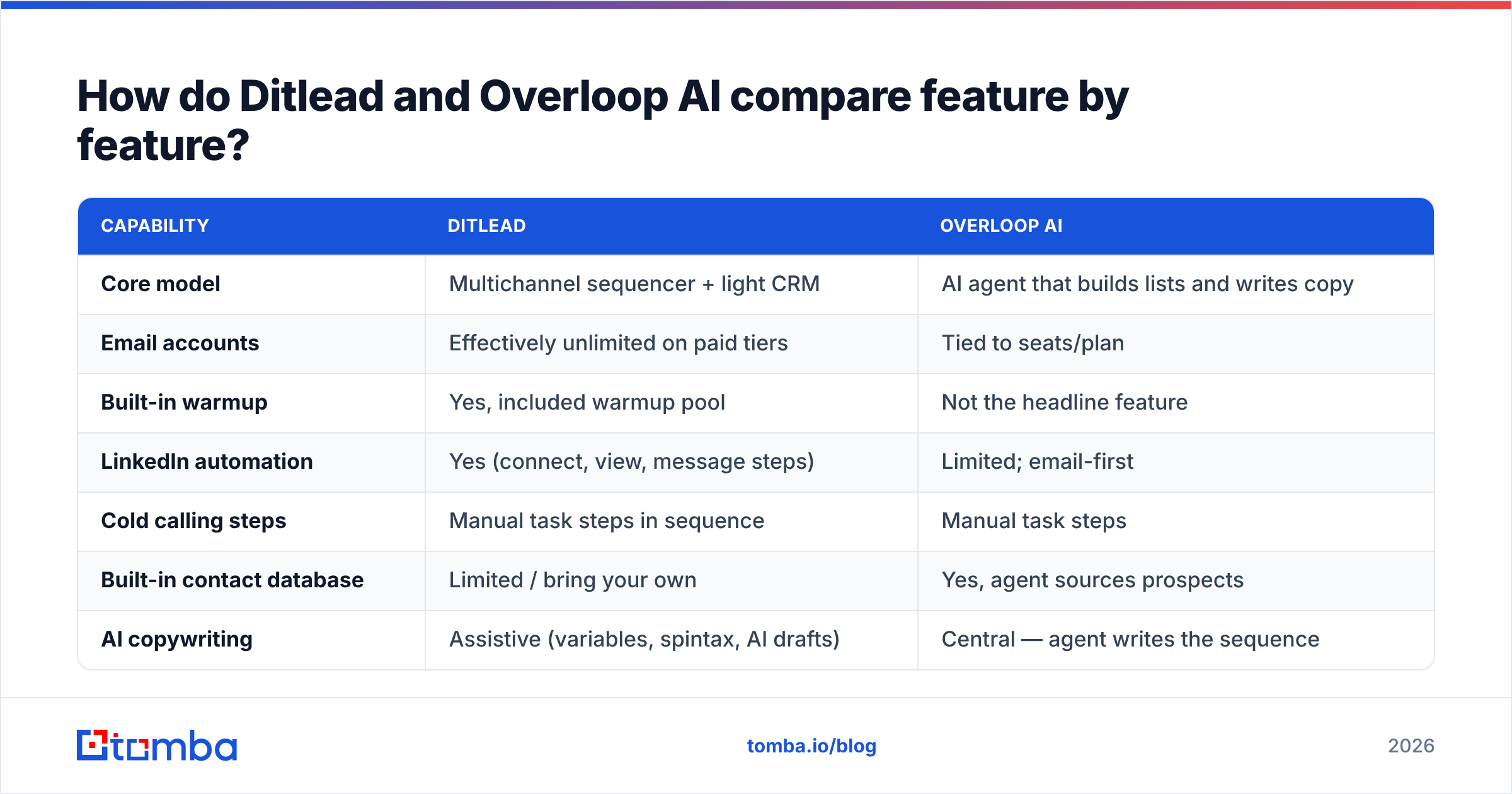
How do Ditlead and Overloop AI compare feature by feature?#
| Capability | Ditlead | Overloop AI |
|---|---|---|
| Core model | Multichannel sequencer + light CRM | AI agent that builds lists and writes copy |
| Email accounts | Effectively unlimited on paid tiers | Tied to seats/plan |
| Built-in warmup | Yes, included warmup pool | Not the headline feature |
| LinkedIn automation | Yes (connect, view, message steps) | Limited; email-first |
| Cold calling steps | Manual task steps in sequence | Manual task steps |
| Built-in contact database | Limited / bring your own | Yes, agent sources prospects |
| AI copywriting | Assistive (variables, spintax, AI drafts) | Central — agent writes the sequence |
| CRM / pipeline | Included | Included, plus native CRM syncs |
| Deliverability controls | Granular (sending limits, rotation, warmup) | Managed, fewer knobs |
| Best for | Agencies, high-volume SDR teams | Founders, non-technical operators |
| Learning curve | Moderate — many settings | Low — describe ICP and go |
Read that table as a fork, not a scoreboard. If you run five clients across forty inboxes, "effectively unlimited sending accounts + rotation + warmup" is the entire product and Overloop AI's agent is noise. If you're a two-person startup that has never written a sequence, Overloop AI's agent removes six decisions you're not equipped to make yet, and Ditlead's settings panel is a liability.
Which one is cheaper?#
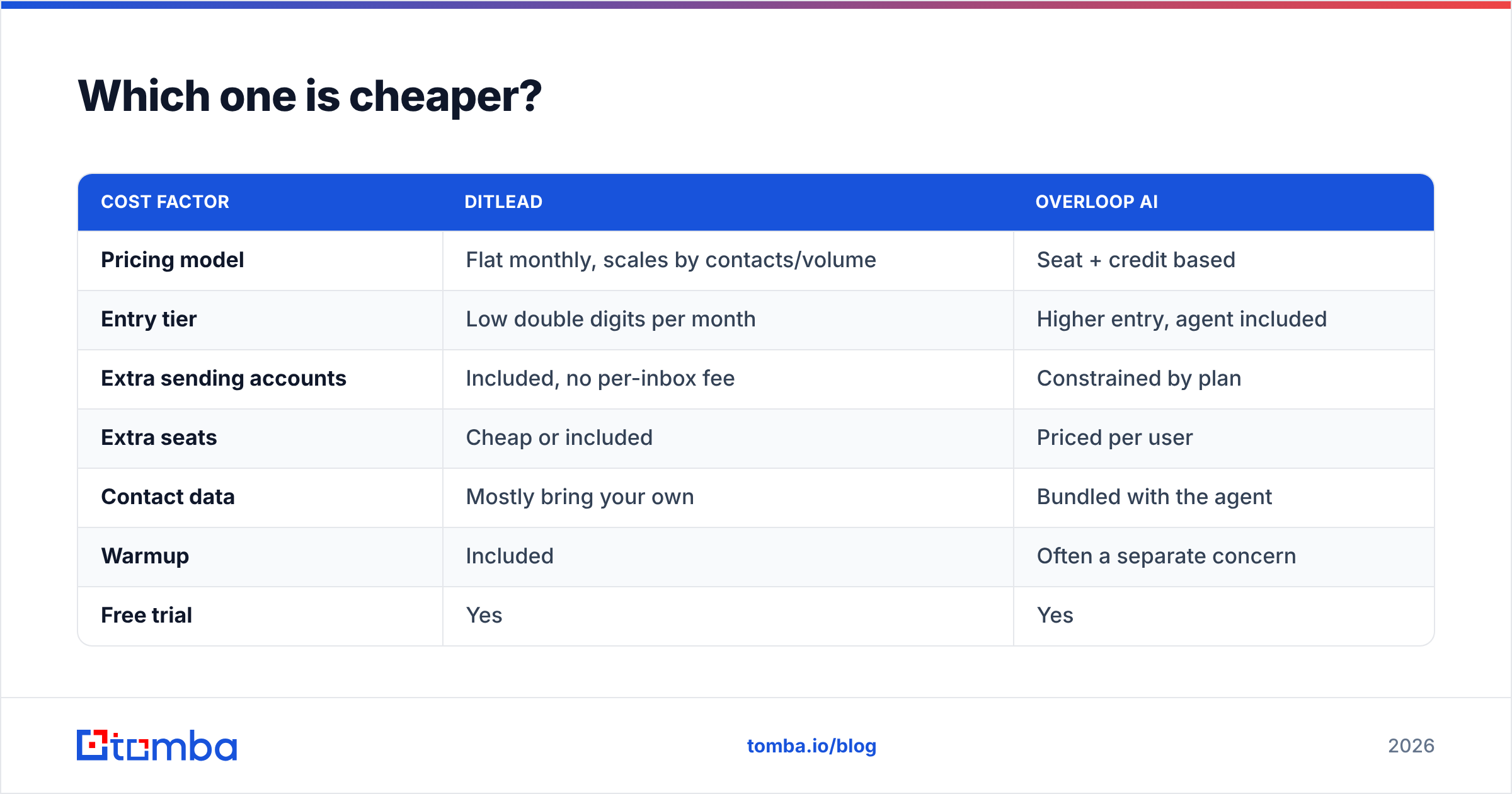
Ditlead, clearly — but "cheaper" depends on what you're counting.
| Cost factor | Ditlead | Overloop AI |
|---|---|---|
| Pricing model | Flat monthly, scales by contacts/volume | Seat + credit based |
| Entry tier | Low double digits per month | Higher entry, agent included |
| Extra sending accounts | Included, no per-inbox fee | Constrained by plan |
| Extra seats | Cheap or included | Priced per user |
| Contact data | Mostly bring your own | Bundled with the agent |
| Warmup | Included | Often a separate concern |
| Free trial | Yes | Yes |
Two caveats before you build a budget on this. First, both vendors change list prices regularly — check their live pricing pages before committing. Second, the sticker price is rarely the real cost of outbound. If you spend $30/month on a sequencer and then burn a domain because 22% of your list bounced, the sequencer was not the expensive part. Domain reputation recovery costs weeks, and weeks of a rep's calendar cost more than any annual SaaS contract on this page.
That's why per-seat comparisons between outbound tools tend to mislead. The variable that swings ROI hardest — list accuracy — is priced separately from both platforms.
Is Overloop AI's agent actually worth the premium?#
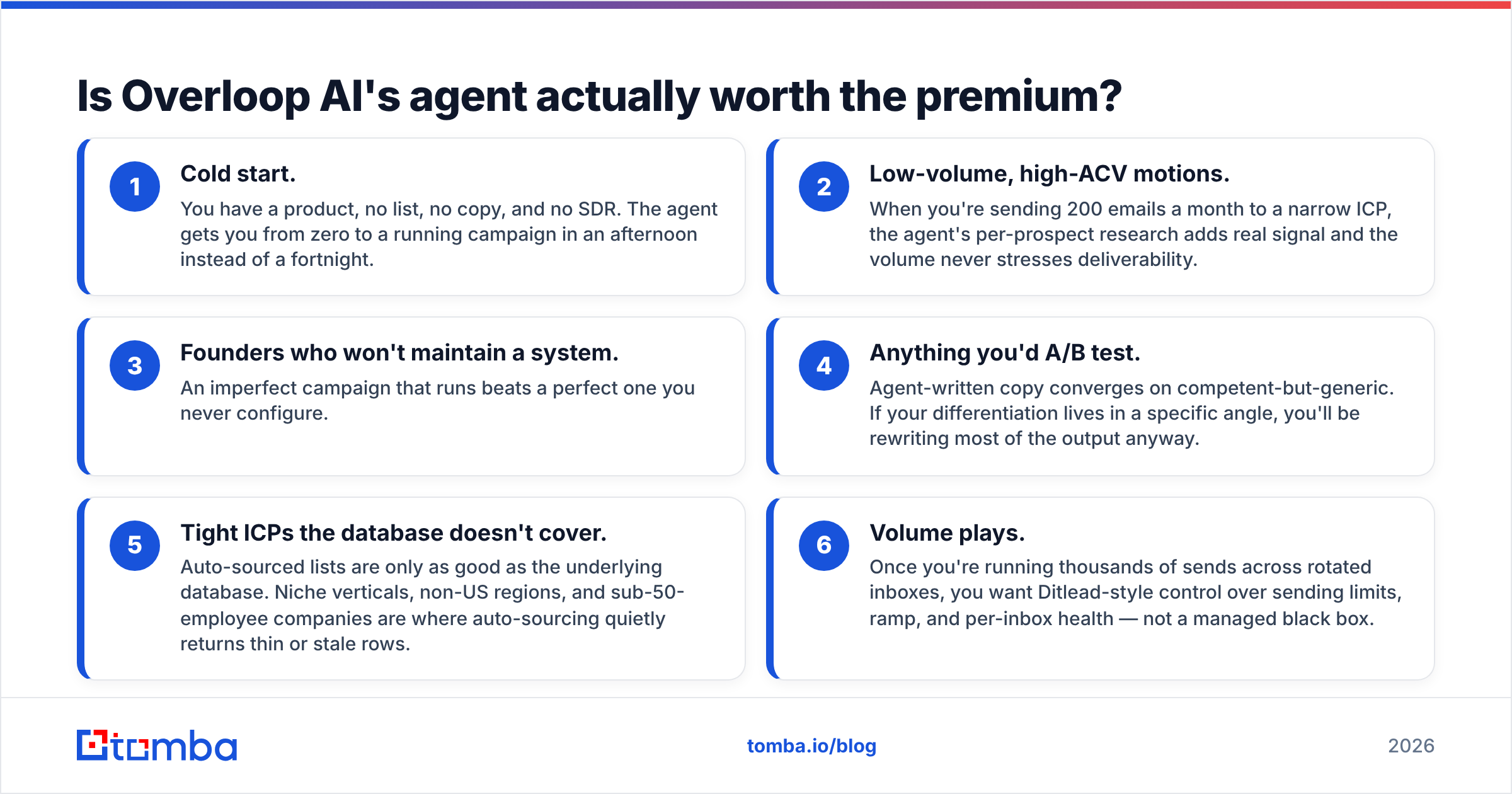
Sometimes. Here's the honest split.
Where the agent earns its keep:
- Cold start. You have a product, no list, no copy, and no SDR. The agent gets you from zero to a running campaign in an afternoon instead of a fortnight.
- Low-volume, high-ACV motions. When you're sending 200 emails a month to a narrow ICP, the agent's per-prospect research adds real signal and the volume never stresses deliverability.
- Founders who won't maintain a system. An imperfect campaign that runs beats a perfect one you never configure.
Where the agent underdelivers:
- Anything you'd A/B test. Agent-written copy converges on competent-but-generic. If your differentiation lives in a specific angle, you'll be rewriting most of the output anyway.
- Tight ICPs the database doesn't cover. Auto-sourced lists are only as good as the underlying database. Niche verticals, non-US regions, and sub-50-employee companies are where auto-sourcing quietly returns thin or stale rows.
- Volume plays. Once you're running thousands of sends across rotated inboxes, you want Ditlead-style control over sending limits, ramp, and per-inbox health — not a managed black box.
The pattern across G2 reviews of sales engagement tools is consistent: teams love AI setup speed and then complain about the same two things — generic copy and list quality. Neither complaint is unique to Overloop AI. It's structural to any tool that bundles list building with sending.
What about Ditlead's multichannel and CRM side?#
Ditlead's real advantage is architectural, not feature-count. Because it doesn't charge per inbox, it lets you do the thing every experienced outbound operator does anyway: spread volume thinly across many warmed accounts on many secondary domains.
That matters because inbox providers judge you per sending identity. Twenty accounts sending 25 emails a day each look like twenty humans. One account sending 500 looks like a machine, and Google and Microsoft both filter accordingly. Ditlead's pricing model doesn't punish the correct behavior; seat-based tools often do.
The LinkedIn layer is the second draw. Mixing a profile view and a connection request between email touches lifts reply rates on most B2B motions, and doing it inside the same sequence beats coordinating two tools. Just keep the daily action limits conservative — LinkedIn's automation enforcement has grown noticeably stricter, and a restricted profile is a worse outcome than a slower cadence.
The CRM is genuinely light. It's fine for tracking a first-touch pipeline. If you already run HubSpot or Salesforce, treat Ditlead's pipeline as a staging area and sync out, not as a system of record.
What do both tools get wrong about data?#
Both platforms treat contact data as a commodity input. It isn't — it's the input that determines whether everything downstream works.
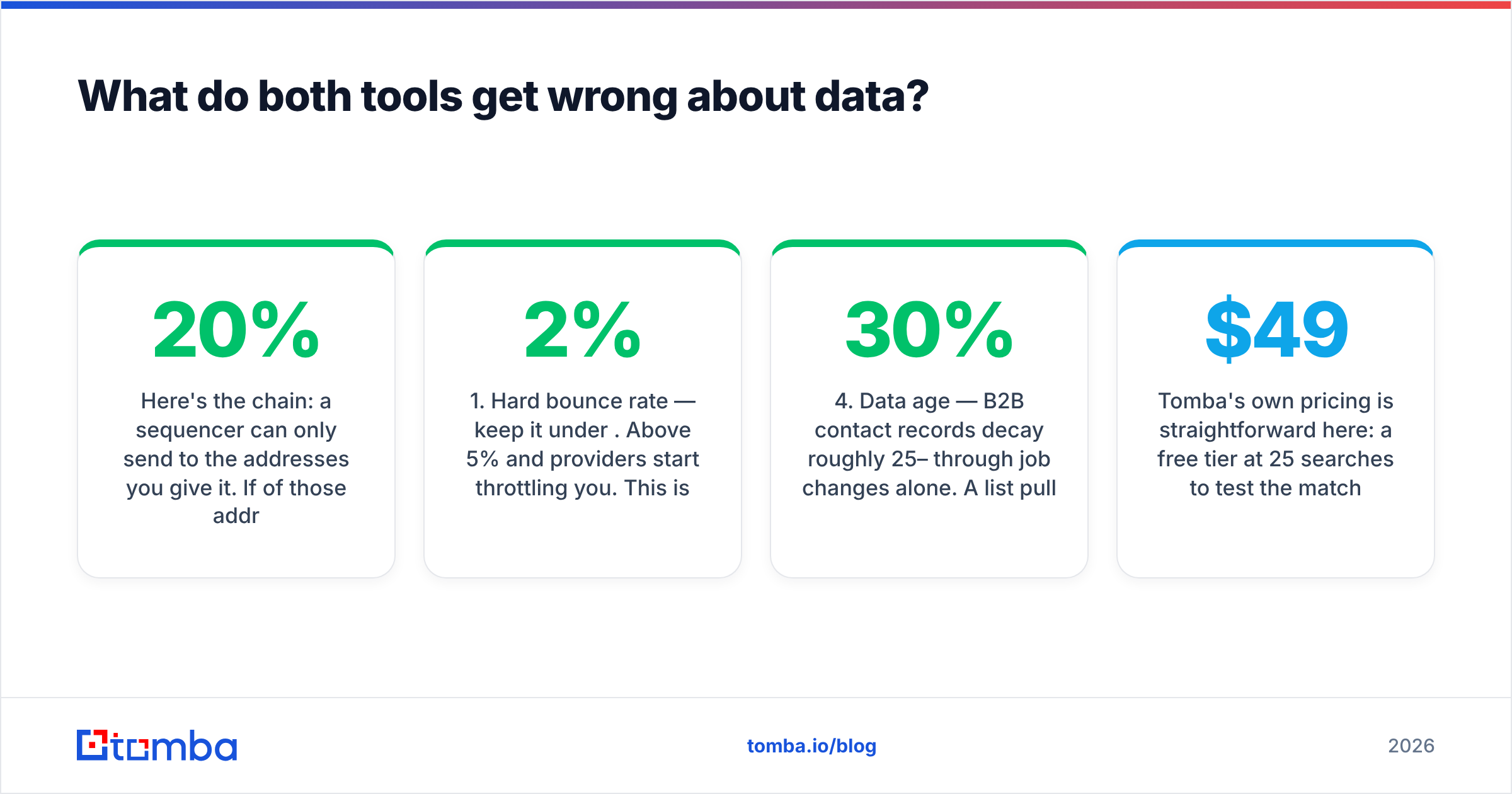
Here's the chain: a sequencer can only send to the addresses you give it. If 20% of those addresses don't exist, your bounce rate spikes on day one. Bounce rate feeds sender reputation. Sender reputation determines whether the other 80% land in the inbox or the spam folder. So a data problem you didn't measure shows up three weeks later as a "deliverability problem" you can't fix with settings.
Concretely, watch these four numbers:
- Hard bounce rate — keep it under 2%. Above 5% and providers start throttling you. This is a list problem, never a copy problem.
- Catch-all share of your list — catch-all domains accept everything at SMTP time and tell you nothing. They need a separate verification pass, not a green checkmark.
- Role-account share —
info@,sales@, andsupport@inflate list size and depress reply rate. Strip them before import. - Data age — B2B contact records decay roughly 25–30% per year through job changes alone. A list pulled six months ago is not the list you think it is.
Neither Ditlead nor Overloop AI is built to solve these. Ditlead mostly expects you to arrive with a clean CSV. Overloop AI generates the list for you, which is convenient right up until you discover you have no visibility into how those addresses were sourced or when they were last confirmed.

The fix is boring and it works: source and verify contacts in a dedicated layer, then hand the sequencer a list you'd bet your domain on. A proper email finder resolves name plus company to a real address with a confidence score, and an email verifier runs SMTP-level checks before anything enters a sequence. For list-scale work, a bulk email finder handles thousands of rows at once, and the Tomba API lets you verify at the moment of import rather than in a monthly cleanup you'll forget to run.
Tomba's own pricing is straightforward here: a free tier at 25 searches/month to test the match rate against your ICP, Starter at $49/mo, Growth at $99/mo, and Pro at $249/mo. Run 100 of your existing contacts through it before you decide — measured match and bounce rates on your segment beat any vendor's published accuracy figure, including ours.
Which should you choose in 2026?#
Choose Ditlead if:
- You run an agency or manage outbound for multiple brands.
- You need many sending accounts without per-inbox pricing.
- You want LinkedIn steps inside the same sequence as email.
- You're comfortable configuring warmup, sending limits, and rotation yourself.
- Budget discipline matters more than setup speed.
Choose Overloop AI if:
- You're a founder or small team with no existing outbound system.
- You'd rather approve a campaign than build one.
- Your ICP is broad enough that a bundled database covers it well.
- Volume is modest and per-prospect value is high.
- You value native CRM syncing over sending-infrastructure control.
Choose neither (yet) if: you haven't validated your ICP. No sequencer, agent, or AI copywriter fixes messaging sent to the wrong people. Send fifty manually researched emails first. If none reply, buying software won't change the answer — it'll just automate the same result faster.
If you're still evaluating the wider field, it's worth comparing against a broader set of options before committing to an annual plan; our Overloop alternative breakdown covers where the rest of the category lands on price and data coverage.
What's the practical setup that works with either tool?#
Same stack, either direction:
- Define the ICP narrowly — one industry, one title band, one company-size range. Broad lists are the root cause of most "the tool doesn't work" complaints.
- Source contacts in a dedicated data layer, not inside the sequencer. You want provenance and confidence scores you can audit.
- Verify every address before import, and route catch-all domains through a separate check rather than assuming or discarding them.
- Warm the sending accounts for two to three weeks before real volume. Ditlead includes this; with Overloop AI, confirm what your plan covers.
- Cap daily volume per inbox at a conservative number and add accounts rather than raising the per-account limit.
- Track reply rate by segment, not campaign average. Averages hide the fact that one segment is working and three are dragging it down.
Do those six things and both tools perform respectably. Skip step two and three and neither will.
The bottom line#
Ditlead is the better buy for operators who want control and cheap scale. Overloop AI is the better buy for teams who want a working campaign without becoming outbound engineers. Neither is a mistake — they're answers to different questions.
What is a mistake is treating either one as a complete outbound stack. The sequencer is the delivery mechanism. The list is the product. Fix the list first.
Start by testing your contact data against your actual ICP. The Tomba Email Finder resolves professional email addresses by domain, name, or company with confidence scoring on every result, and the free tier gives you 25 searches to benchmark match rate before you spend anything. Run your next hundred prospects through it, then load the verified output into whichever platform you picked — your bounce rate, and your domain reputation, will tell you it was the right call.
Related guides#
Ready to find emails that actually work?
Join 150,000+ professionals who stopped guessing and started sending. Free credits on signup — no credit card required.
Get the Tomba newsletter
Practical outbound tactics and product updates — once every two weeks.
About the author