Ditlead vs ZoomInfo (2026): Which B2B Sales Tool Wins?
Ditlead is a $30/mo sequencer with data bolted on. ZoomInfo is a five-figure data platform with sequencing bolted on. Here's which one actually fits your motion — and when a third option beats both.
TL;DR
- Ditlead and ZoomInfo are not the same category. Ditlead is a multichannel sequencer (email + LinkedIn + calls) starting around $30/user/mo with a bundled contact database. ZoomInfo is an enterprise B2B data platform that starts in the five figures annually.
- If you already know who to contact, Ditlead does the job for roughly 1–3% of ZoomInfo's cost.
- If your problem is "we don't know who to contact", ZoomInfo's intent signals, org charts, and firmographic filters have no real equivalent at Ditlead's price.
- Most SMB teams overbuy. A dedicated email finder plus a cheap sequencer usually beats a bundled seat license on both cost and data freshness.
- Watch the contract shape. ZoomInfo is annual, seat-based, with credit caps and auto-renew clauses. Ditlead is month-to-month. That difference matters more than any feature checkbox.
What are Ditlead and ZoomInfo, actually?#
They solve different halves of the same problem, and the confusion costs teams real money.
Ditlead is an outbound execution tool. You bring or build a list, and Ditlead runs the sequence: cold email across rotating mailboxes, LinkedIn steps, calling, a light CRM pipeline, and inbox rotation with warmup. It bundles some contact lookup, but lookup is not the product — sending is. Think of it as the delivery truck.
ZoomInfo is the warehouse. Its core asset is a contact and company database with firmographics, technographics, org hierarchy, and buying-intent signals sourced from a co-op network of connected inboxes and web activity. ZoomInfo added sequencing (Engage) and conversation intelligence (Chorus) on top, but the database is what you're paying for and what the pricing reflects. See zoominfo.com for the current product split.
The practical consequence: comparing them feature-for-feature produces a nonsense scorecard. The real question is which half of the problem is currently costing you pipeline — targeting, or execution.
How do Ditlead and ZoomInfo compare on price and features?#
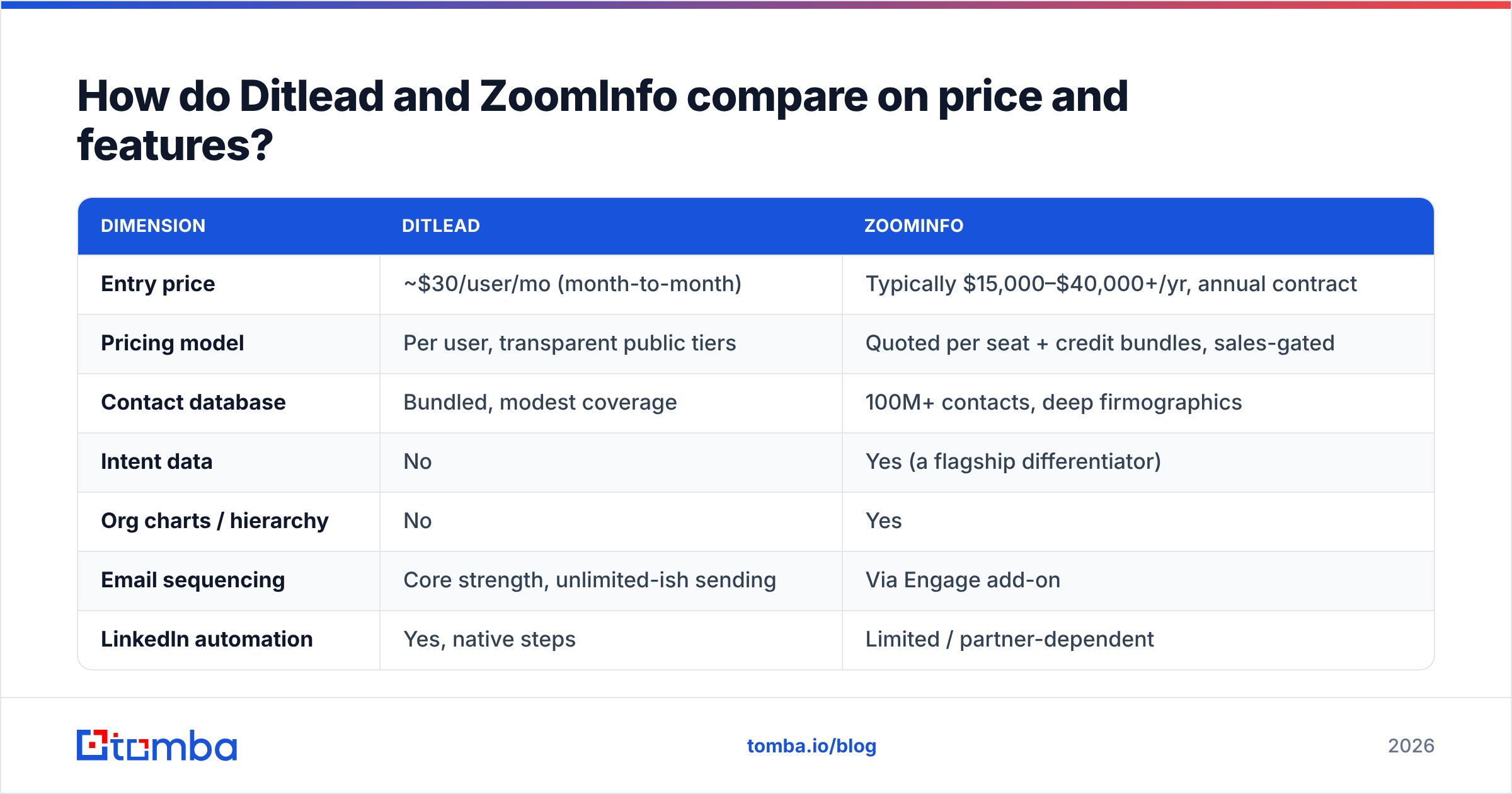
| Dimension | Ditlead | ZoomInfo |
|---|---|---|
| Entry price | ~$30/user/mo (month-to-month) | Typically $15,000–$40,000+/yr, annual contract |
| Pricing model | Per user, transparent public tiers | Quoted per seat + credit bundles, sales-gated |
| Contact database | Bundled, modest coverage | 100M+ contacts, deep firmographics |
| Intent data | No | Yes (a flagship differentiator) |
| Org charts / hierarchy | No | Yes |
| Email sequencing | Core strength, unlimited-ish sending | Via Engage add-on |
| LinkedIn automation | Yes, native steps | Limited / partner-dependent |
| Calling / dialer | Yes, built in | Yes (Engage + Chorus) |
| Mailbox rotation + warmup | Yes | No native warmup |
| CRM sync | HubSpot, Pipedrive, Zapier | Salesforce, HubSpot, Dynamics, deep native |
| Free trial | Yes, self-serve | Demo-gated trial |
| Best for | SMB / agency outbound teams | Mid-market and enterprise GTM |
Two lines in that table decide most evaluations: entry price and intent data. If intent signals will not change what your reps do tomorrow morning, you are paying an enterprise premium for a directory.

Is ZoomInfo's data actually better?#
Yes — on breadth. On freshness for any specific segment, it's genuinely contested.
ZoomInfo's advantage is coverage depth: it will have a record for almost any US mid-market company, including reporting lines and technology stack. That is hard to replicate. Independent buyer reviews on G2 consistently praise coverage and consistently flag the same three complaints: stale direct dials, aggressive renewal terms, and credit exhaustion mid-quarter.
Ditlead's bundled data is thinner. It's fine for filling in an obvious pattern at a known company, weak for building a net-new list from scratch in a niche vertical.
Here's what neither vendor advertises: database recency beats database size for cold outbound. A record scraped 14 months ago and never re-validated bounces regardless of how many fields it carries. That's why a growing number of teams decouple the two jobs — they buy targeting from one source and resolve the actual mailbox at send time with a live email verifier rather than trusting a cached row.
If you're building lists from company domains rather than buying them wholesale, a domain search run against your ICP list is often faster and cheaper than paginating through a platform's filter UI, and every address comes back checked at the moment you pull it.
Which one fits your team size and motion?#
Use these five checks in order. The first one that clearly matches you is your answer.
- You have fewer than 10 reps and a defined ICP. Ditlead plus a dedicated finder wins. ZoomInfo's floor price alone would consume most of your tooling budget, and you won't use intent.
- You're an agency running outbound for multiple clients. Ditlead. Mailbox rotation, per-client workspaces, and month-to-month billing map directly to how agencies get paid. ZoomInfo's seat licensing punishes multi-tenant use.
- Your sales cycle involves 6+ stakeholders across departments. ZoomInfo. Org charts and hierarchy mapping are the single feature that genuinely justifies the price, and no $30/mo tool replicates them.
- Marketing needs account-level intent to prioritize territories. ZoomInfo, or a dedicated intent vendor. This is not a sequencer's job.
- You already own Salesforce, Outreach, or Salesloft. Buy data only. Adding Ditlead means a second sending stack your ops team has to reconcile — you want enrichment feeding your existing sequencer instead.
Most teams that agonize over this comparison land on #1 or #2 and buy for #3 anyway, because the enterprise demo was impressive. Budget for the motion you run today.
What does each one actually cost over a year?#
Sticker price is not the number that matters. Model the fully loaded cost.
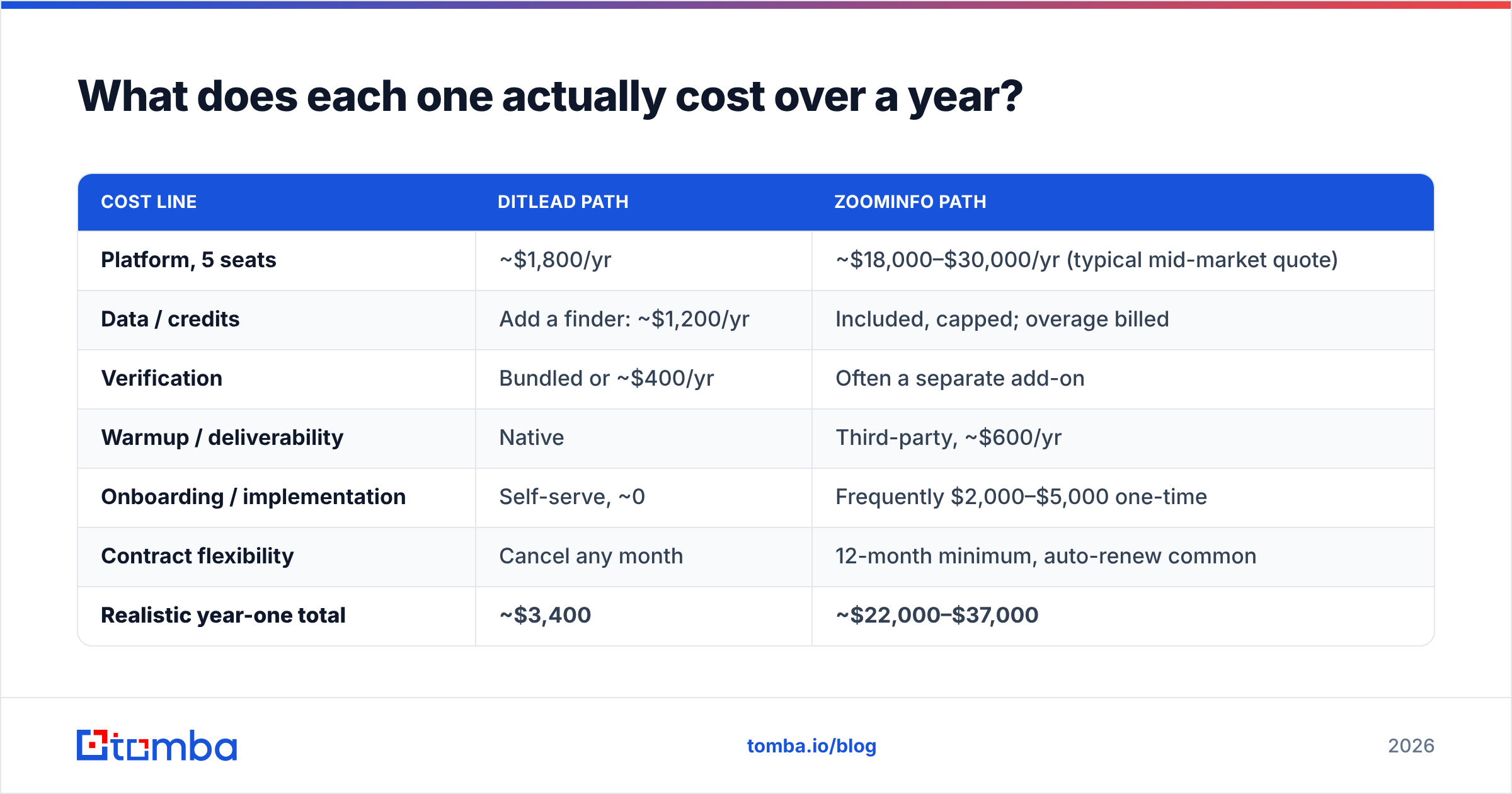
| Cost line | Ditlead path | ZoomInfo path |
|---|---|---|
| Platform, 5 seats | ~$1,800/yr | ~$18,000–$30,000/yr (typical mid-market quote) |
| Data / credits | Add a finder: ~$1,200/yr | Included, capped; overage billed |
| Verification | Bundled or ~$400/yr | Often a separate add-on |
| Warmup / deliverability | Native | Third-party, ~$600/yr |
| Onboarding / implementation | Self-serve, ~0 | Frequently $2,000–$5,000 one-time |
| Contract flexibility | Cancel any month | 12-month minimum, auto-renew common |
| Realistic year-one total | ~$3,400 | ~$22,000–$37,000 |
The gap is roughly 7–10x. That is defensible if intent data or org charts change your win rate by even a few points on six-figure deals. It is indefensible if your reps are using ZoomInfo as an expensive contact lookup box — which, in practice, is what a large share of seats get used for.
Before signing anything annual, ask the rep three questions in writing: what happens to unused credits at renewal, what the renewal uplift cap is, and whether exported records remain usable after the contract ends. The answers vary, and they're rarely on the pricing page.

What are the best alternatives to both?#
Neither tool is the only shape of solution. Three others are worth pricing:
- Apollo.io — the closest thing to a middle path. Database plus sequencing in one product at mid-hundreds per month. Data quality is uneven by region, and heavy senders often outgrow the deliverability controls. If it's on your list, compare it against a purpose-built Apollo alternative before committing to an annual plan.
- BookYourData — a solid pay-as-you-go option if you want vetted B2B contact lists without a subscription. Credits don't expire, and the accuracy guarantee is unusually explicit for the category. Good fit when your list-building is project-based rather than continuous.
- Unbundled stack (finder + verifier + sequencer) — the approach most cost-disciplined teams land on. Pull addresses on demand, verify at send time, and run sequences in whatever tool your team already knows. You control each layer independently and swap any one without renegotiating a bundle.
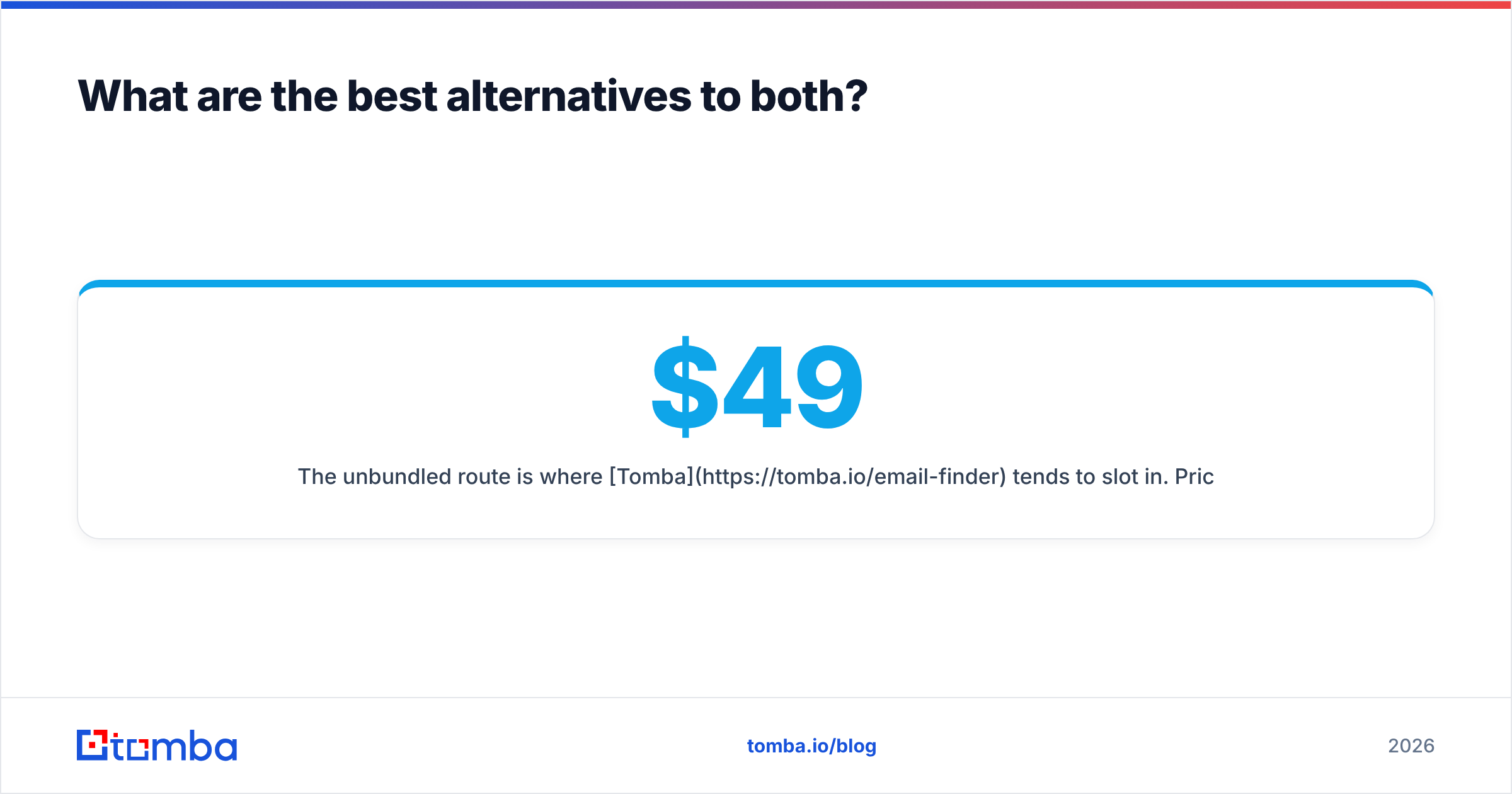
The unbundled route is where Tomba tends to slot in. Pricing runs from a free tier at 25 searches/mo to Starter at $49/mo, Growth at $99/mo, and Pro at $249/mo — see Tomba pricing for the full breakdown. That's a rounding error against a ZoomInfo quote, and it covers the specific job most teams actually needed: turning a name and a company into a deliverable address.
How do you run a fair 14-day evaluation?#
Vendor demos are rigged toward vendor strengths. Run your own test instead.
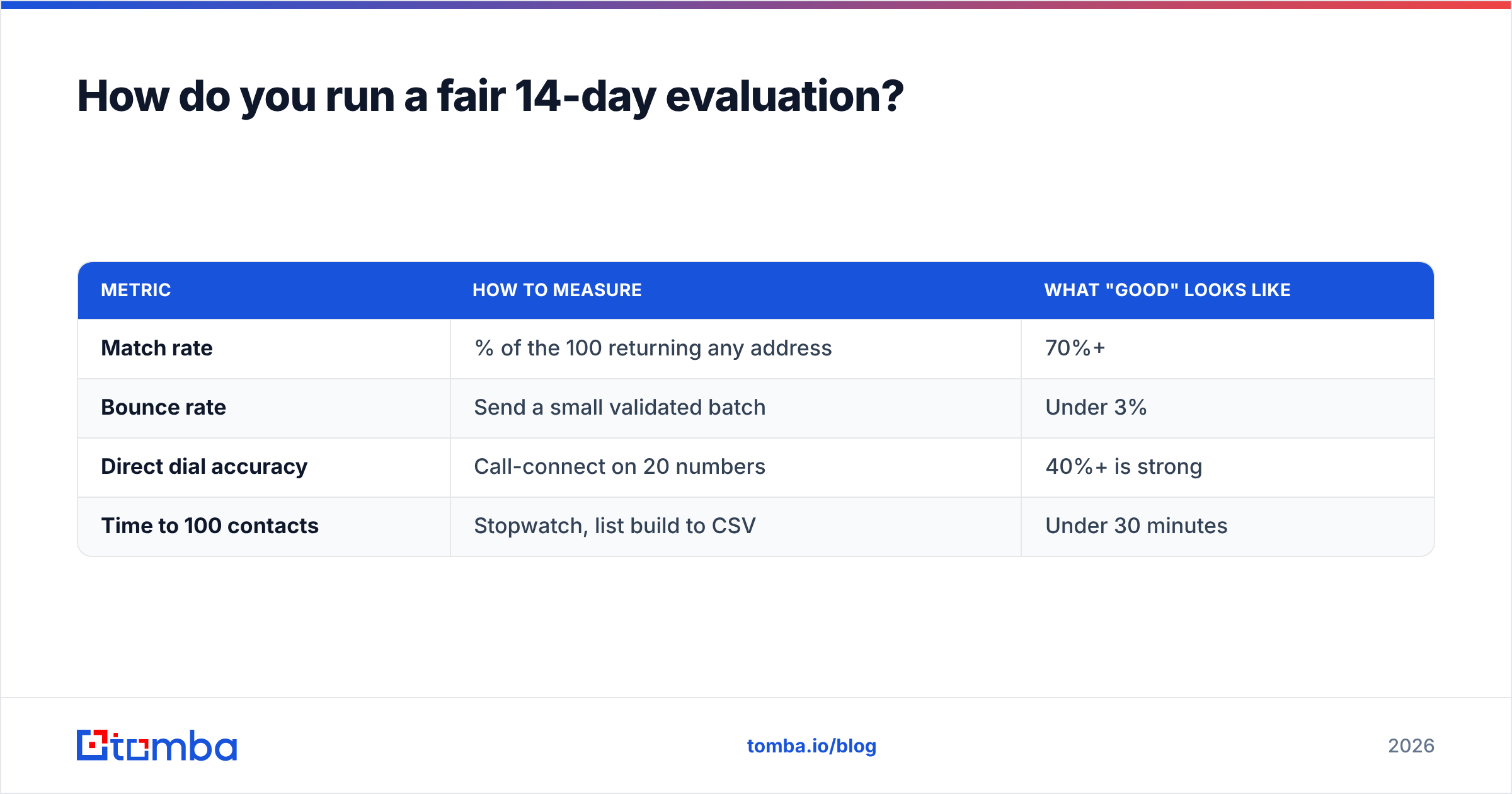
Build one control list. Pick 100 real target contacts — names and company domains you already know are correct, spread across your actual ICP, not the vendor's showcase verticals.
Measure four things, same list, both tools:
| Metric | How to measure | What "good" looks like |
|---|---|---|
| Match rate | % of the 100 returning any address | 70%+ |
| Bounce rate | Send a small validated batch | Under 3% |
| Direct dial accuracy | Call-connect on 20 numbers | 40%+ is strong |
| Time to 100 contacts | Stopwatch, list build to CSV | Under 30 minutes |
Then check the boring things. Export limits (can you take your data out?), API rate limits, seat-add cost mid-contract, and whether support answers in hours or days. Teams discover these after signing far too often.
If you're evaluating during a busy quarter, run the finder test through a spreadsheet workflow rather than a UI — a Google Sheets or bulk CSV run gives you a clean side-by-side match-rate number in one pass instead of clicking through a hundred profiles.
What's the verdict on Ditlead vs ZoomInfo?#
Buy ZoomInfo if you're mid-market or enterprise, sell into complex buying committees, need intent signals to allocate territory, and have a RevOps function that will actually operationalize the data. The price is real, but so is the asset.
Buy Ditlead if you're a small team or agency running high-volume multichannel outbound into an ICP you can already describe, and you'd rather own the sending stack than the directory. Month-to-month billing alone de-risks the decision.
Buy neither if your real bottleneck is deliverable addresses. That's a narrower, cheaper problem than either vendor's pitch implies, and solving it with a dedicated tool leaves your sequencing and CRM choices untouched.
The failure mode to avoid is buying a platform to solve a data problem, then discovering the data underneath it was 18 months stale. Ask for a match-rate test on your list, not theirs.
Start with the layer that actually blocks pipeline. If your reps have the target accounts but keep bouncing on the send, run 25 free searches through the Tomba Email Finder, check the match rate against your own control list, and compare that against whatever a ZoomInfo seat would cost you this year. If the finder closes the gap, you've just saved five figures. If it doesn't, you'll have hard evidence for the enterprise purchase instead of a demo-day impression — which is a better position to negotiate from either way.
Related guides#
Ready to find emails that actually work?
Join 150,000+ professionals who stopped guessing and started sending. Free credits on signup — no credit card required.
Get the Tomba newsletter
Practical outbound tactics and product updates — once every two weeks.
About the author