Do Cold Emails Work in 2026? Data, Benchmarks, and Fixes
Cold email still books meetings in 2026 — but only under conditions most senders ignore. Here are the real benchmarks, the four failure points, and what separates a 1% reply rate from 8%.
TL;DR
- Cold email still works in 2026, but the median campaign does not. Well-run campaigns land 5-12% reply rates; sloppy ones sit under 1% and burn the sending domain.
- The single biggest predictor of failure is data quality, not copy. A list with 25% invalid addresses will hit spam filters before anyone reads your subject line.
- Google and Yahoo's bulk-sender rules (SPF, DKIM, DMARC, one-click unsubscribe, spam complaints under 0.3%) turned deliverability from a nice-to-have into a gate.
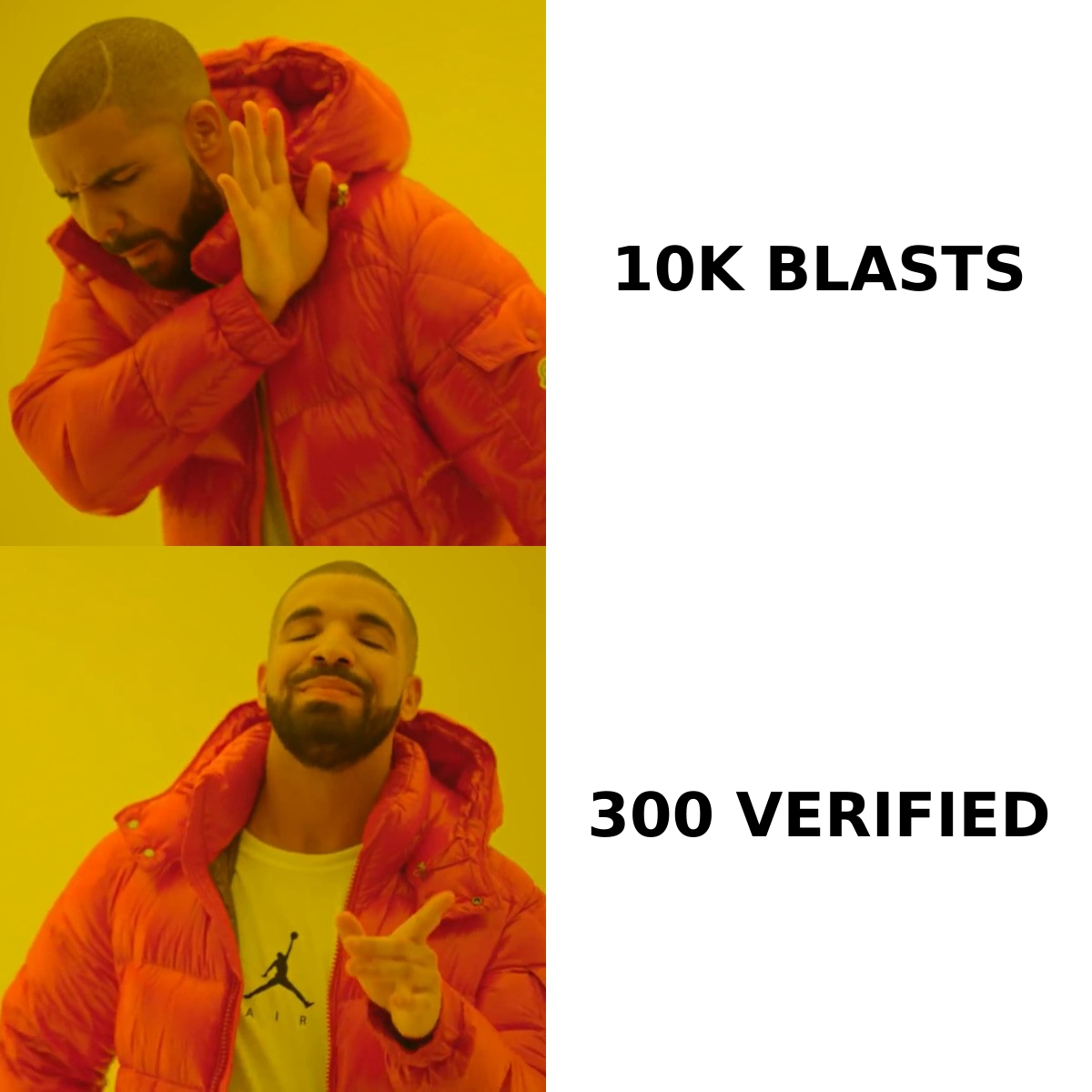
- Volume stopped being the lever. Sending 10,000 unverified emails now produces worse results than 300 verified, researched ones.
- Cold email works best as a first touch in a multi-channel sequence — email plus phone plus LinkedIn beats email alone by a wide margin.
Do cold emails actually work in 2026?#
Yes — conditionally. Cold email remains one of the cheapest ways to start a B2B conversation, and it is still the default outbound channel for most SaaS, agency, and services companies. What changed is the failure rate. The tactics that worked in 2018 (buy a list, blast it, iterate on subject lines) now get you filtered before delivery.
The honest framing: cold email is a channel with a very wide outcome distribution. The top decile of senders books meetings consistently and profitably. The bottom half gets sub-1% reply rates, torches domain reputation within a quarter, and concludes "cold email is dead." Both groups are using the same channel. The difference is operational discipline across four variables — data, deliverability, targeting, and message.
If you are asking whether cold email is worth building a motion around, the more useful question is: can you execute all four? If you can only execute two, the expected return is close to zero, and you would be better off putting the budget into a different channel.
What reply rates should you actually expect?#
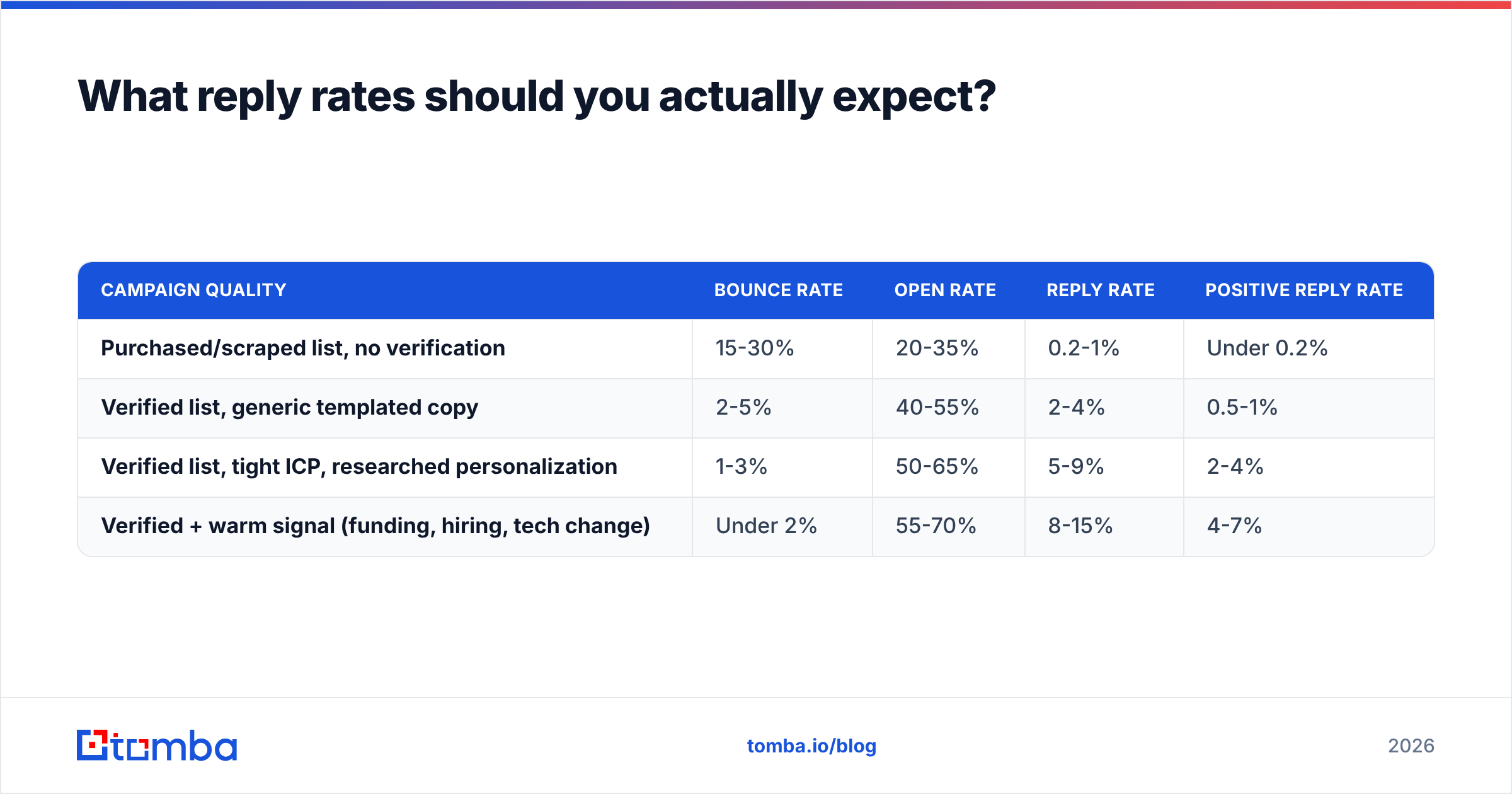
Benchmarks get quoted carelessly, so anchor on ranges rather than a single number. Reply rate depends heavily on list quality, ICP tightness, offer, and sequence length.
| Campaign quality | Bounce rate | Open rate | Reply rate | Positive reply rate |
|---|---|---|---|---|
| Purchased/scraped list, no verification | 15-30% | 20-35% | 0.2-1% | Under 0.2% |
| Verified list, generic templated copy | 2-5% | 40-55% | 2-4% | 0.5-1% |
| Verified list, tight ICP, researched personalization | 1-3% | 50-65% | 5-9% | 2-4% |
| Verified + warm signal (funding, hiring, tech change) | Under 2% | 55-70% | 8-15% | 4-7% |
Two notes on reading this table. First, open rate has become a soft metric — Apple Mail Privacy Protection and similar features inflate it, so treat it as directional only. Reply rate and positive reply rate are the numbers that pay you. Second, "positive reply" means a response that moves toward a meeting, not "unsubscribe me" or "wrong person."
A practical target for a new campaign: get bounces under 3% first, then optimize for reply rate. Chasing copy improvements while 20% of your list is invalid is optimizing the wrong variable.
Why do most cold email campaigns fail?#
Four failure points, roughly in order of how often they kill campaigns:
Bad data. Invalid addresses drive hard bounces, hard bounces drive spam-folder placement, and spam-folder placement makes every other variable irrelevant. Most B2B contact data decays at roughly 25-30% per year as people change jobs — a list from 18 months ago is substantially rotten. Run every list through an email verifier before the first send, not after the bounces come in.
Broken authentication. Google and Yahoo's bulk sender requirements made SPF, DKIM, and DMARC mandatory for anyone sending meaningful volume, plus one-click unsubscribe and a spam complaint rate below 0.3%. Missing any of these is not a "deliverability optimization" — it is a hard block. Check your SPF record and DMARC policy before you write a single line of copy.
Wrong audience. A perfect email to someone who does not have the problem you solve is still a bad email. Most low-performing campaigns have an ICP defined as "companies with 50-500 employees in North America," which is not an ICP — it is a firmographic filter. Real targeting includes a trigger: they just hired for a role your product supports, they use a tool you integrate with, they announced expansion.
Self-centered copy. The email that opens with "I'm reaching out because we're a leading provider of..." dies on arrival. The prospect owes you nothing. Your first three lines have to demonstrate you know something specific about their situation, and your ask has to be small enough to say yes to in five seconds.
Notice that only one of these four is about writing. Teams that treat cold email as a copywriting problem spend months A/B testing subject lines on a foundation that cannot support any result.
Is cold email still legal and compliant?#
Yes, with jurisdiction-specific rules you should not improvise around.
In the United States, CAN-SPAM permits unsolicited commercial email as long as you use accurate headers and subject lines, disclose that it is an advertisement where required, include a valid physical postal address, and honor opt-out requests within 10 business days.
In the EU and UK, GDPR and PECR are stricter. B2B cold email to corporate addresses is generally defensible under legitimate interest, but you need a documented balancing test, a clear opt-out in every message, and a lawful basis for how you sourced the data. Sending to personal addresses (a Gmail account belonging to an individual) is a much weaker position.
Canada's CASL is the strictest of the three — it operates on a consent model with narrow exemptions, and penalties are real. If Canadian prospects are a meaningful share of your list, get legal input rather than reading a blog post.
Practical compliance floor for any campaign: real company identity, real postal address, working one-click unsubscribe, suppression list honored across all sending domains, and no attempt to disguise that the message is commercial.
How does cold email compare to other outbound channels?#
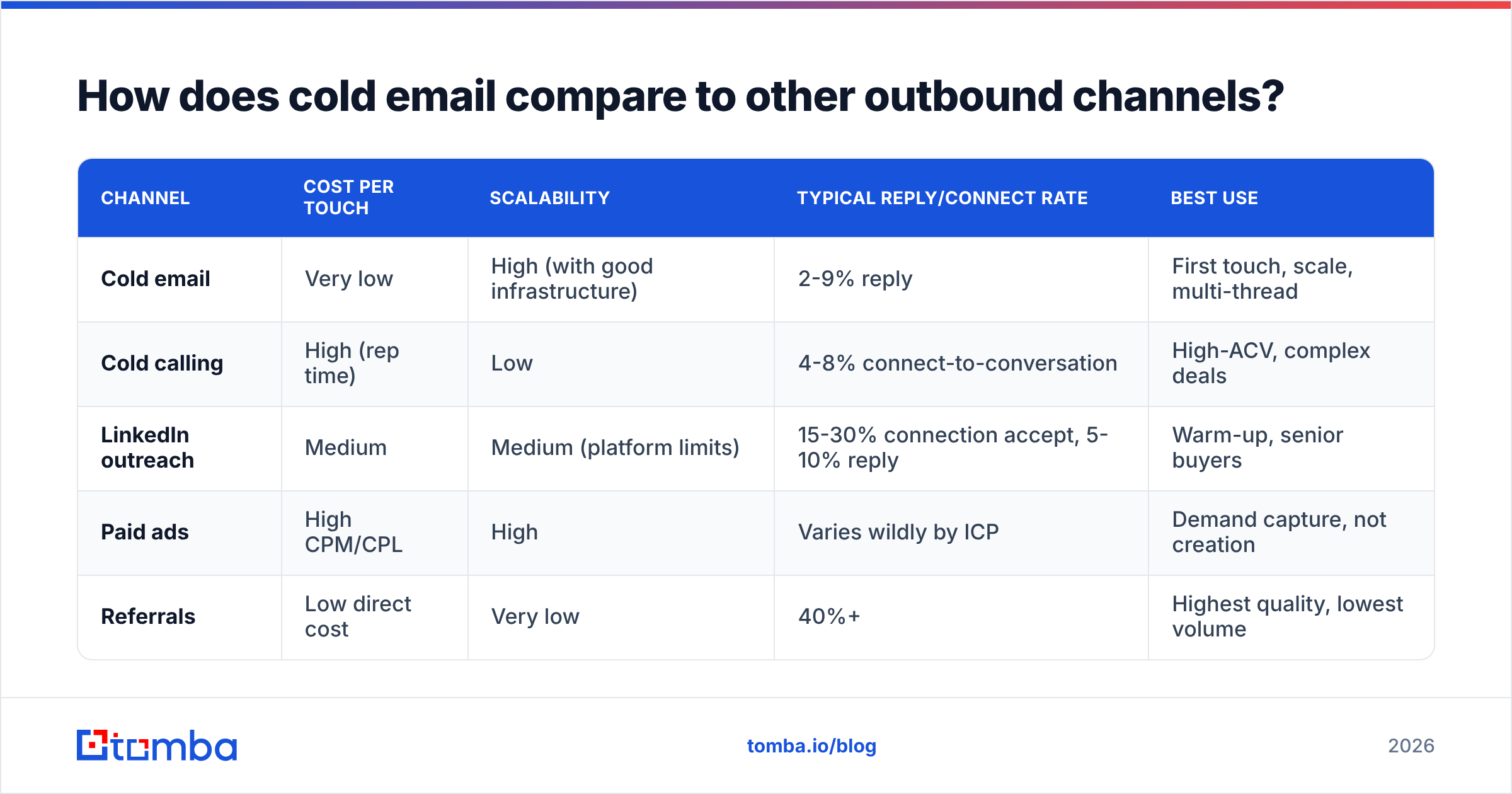
Cold email is not competing with LinkedIn and phone — it works with them. But the trade-offs matter when you are deciding where to put a limited budget.
| Channel | Cost per touch | Scalability | Typical reply/connect rate | Best use |
|---|---|---|---|---|
| Cold email | Very low | High (with good infrastructure) | 2-9% reply | First touch, scale, multi-thread |
| Cold calling | High (rep time) | Low | 4-8% connect-to-conversation | High-ACV, complex deals |
| LinkedIn outreach | Medium | Medium (platform limits) | 15-30% connection accept, 5-10% reply | Warm-up, senior buyers |
| Paid ads | High CPM/CPL | High | Varies wildly by ICP | Demand capture, not creation |
| Referrals | Low direct cost | Very low | 40%+ | Highest quality, lowest volume |
The pattern that outperforms single-channel work: email as the opener, LinkedIn as the reinforcement, phone as the closer on engaged accounts. A LinkedIn outreach touch after an unanswered email often converts the same prospect who ignored the email alone, simply because you have shown up twice in different contexts.
What separates a 1% reply rate from an 8% one?#
Six operational differences, in the order they matter:
Verified data at the source. Not "we clean the list quarterly" — verification at the moment of import, with catch-all domains handled separately. A catch-all verifier matters because catch-all domains accept everything at SMTP time and then bounce silently, which is worse than a clean rejection.
Separate sending domains. Never send cold outreach from your primary corporate domain. Buy lookalike domains, warm them for 3-4 weeks, and cap each mailbox at 30-50 sends per day. If a domain gets burned, you lose the domain, not your company's email.
Segment size under 200. A segment small enough that a single message is genuinely relevant to everyone in it. If you cannot write one email that fits all 200 people, the segment is too broad.
A first line that could not be copy-pasted. Reference something they published, shipped, hired for, or announced. Generic personalization tokens ("I saw you work at {{company}}") signal automation immediately.
A low-friction ask. "Worth a 15-minute call Thursday?" converts better than "let me know if you'd like to explore a partnership." Ask for the smallest next step that still moves the deal.
3-5 touches, then stop. Most positive replies land on touches 2-4. Beyond touch 5, you are generating spam complaints, not pipeline. Set the sequence to end and move the contact to a nurture list.
How do you build a list that does not bounce?#
Sourcing determines everything downstream, so treat it as the highest-leverage step.
Start from the account, not the contact. Define 100-300 target companies using firmographic fit plus a trigger. Then find the right person at each — usually the person who owns the problem, not the person with the biggest title. For a 40-person company, that is often a director; for a 4,000-person company, it may be a manager two levels below the VP you were tempted to email.
For contact discovery, domain search is the fastest path once you have the account list: pull every publicly available address on the domain, identify the email pattern, then use the email finder to resolve specific names. Verify each result before it enters the sequence. For larger builds, bulk verify the whole file in one pass rather than address by address.
A few sourcing rules that save campaigns:
- Never buy a static list. By the time it is packaged and sold, it has already decayed, and the same list is being emailed by dozens of other senders.
- Suppress aggressively. Existing customers, open opportunities, competitors, past unsubscribes, and anyone who bounced before. One suppression list across all sending domains.
- Skip role accounts. info@, sales@, support@, and hello@ inflate your list size and your complaint rate simultaneously.
- Re-verify anything older than 60 days. Data decay is continuous, not an event.
If you are evaluating providers, tools like BookYourData offer pay-as-you-go verified B2B contact data with accuracy guarantees, which suits teams that want to buy a targeted slice rather than run continuous discovery. Compare that against a search-and-verify workflow, where you build lists from your own account research. Both work; they fit different team shapes. Provider comparisons on G2 are a reasonable starting point for narrowing the field, though weigh recent reviews more heavily than aggregate scores.
What does a cold email that works look like?#
Structure over cleverness. A working cold email is short, specific, and easy to answer.
Subject line: 3-6 words, lowercase, no hype. "question about your API docs" beats "Transform Your Developer Experience Today."
Line 1: the specific observation. What you noticed about them, in one sentence, with enough detail that it could not apply to anyone else.
Line 2-3: the connection. Why that observation makes your solution relevant, framed as their outcome, not your feature list. One proof point if you have a strong one — a number, a comparable customer, a result.
Line 4: the ask. One question, answerable in a word, requesting the smallest viable next step.
Signature: real name, real company, real postal address, working unsubscribe.
Total: under 120 words. If your draft is longer, you are explaining instead of intriguing. Save the detail for the reply.
Follow-ups should add something, not just bump the thread. Touch 2 can be a relevant case study, touch 3 a different angle on the same problem, touch 4 a short break-up note. "Just following up" is the single most ignorable sentence in outbound. Testing subject line variants with a subject line tester is worth doing, but only after your deliverability and data are solid — copy optimization on a broken foundation returns nothing.
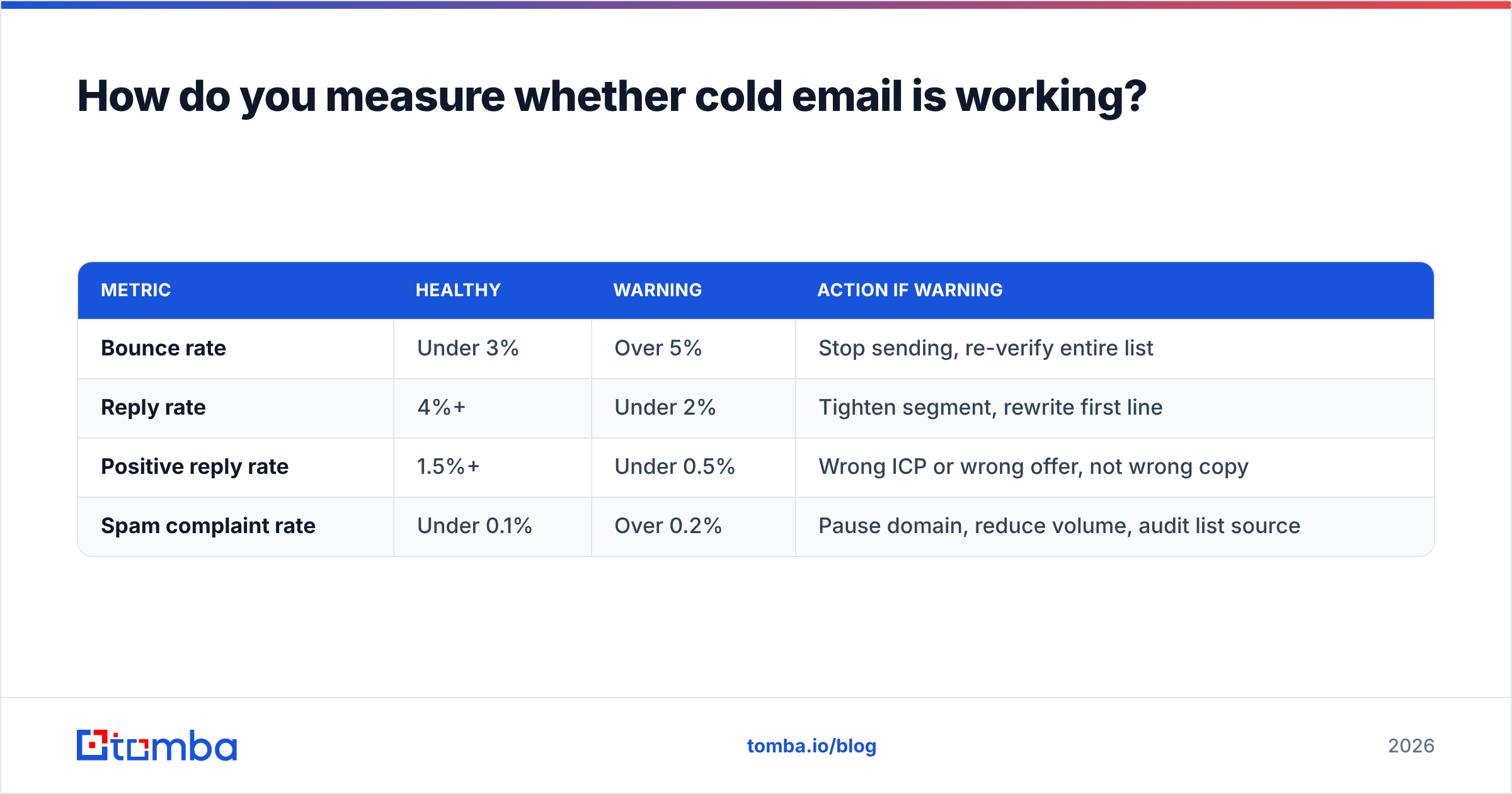
How do you measure whether cold email is working?#
Track four numbers, weekly, per campaign:
| Metric | Healthy | Warning | Action if warning |
|---|---|---|---|
| Bounce rate | Under 3% | Over 5% | Stop sending, re-verify entire list |
| Reply rate | 4%+ | Under 2% | Tighten segment, rewrite first line |
| Positive reply rate | 1.5%+ | Under 0.5% | Wrong ICP or wrong offer, not wrong copy |
| Spam complaint rate | Under 0.1% | Over 0.2% | Pause domain, reduce volume, audit list source |
The one to watch obsessively is spam complaint rate. It is the metric mailbox providers use, and crossing 0.3% puts your domain in a hole that takes months to climb out of. If complaints rise, the answer is almost never "better copy" — it is a targeting or consent problem.
Attribute conservatively. A prospect who ignored three emails, then saw a LinkedIn post, then booked a demo through your website is not a cold email win in the strict sense — but the emails contributed. Track influenced pipeline alongside directly-sourced pipeline so you do not kill a channel that is doing upper-funnel work.
Give any new campaign at least 400-500 sends before judging it. Below that, you are reading noise. And judge on positive replies and meetings booked, not on opens — email deliverability changes have made open rate close to meaningless as a decision metric.
So should you invest in cold email?#
Invest if: your ACV justifies the setup cost, your ICP is identifiable from public data, you can commit to verified data and proper authentication, and you can sustain the motion for at least a quarter before evaluating.
Skip it if: you are selling to consumers, your ICP is impossible to identify programmatically, you cannot separate sending infrastructure from your primary domain, or you are looking for results inside three weeks. Cold email compounds; it does not spike.
The channel is not dead. What died is the version of it that treated volume as a substitute for accuracy. In 2026, the constraint is quality of data and relevance of message, and both are solvable problems with the right workflow.
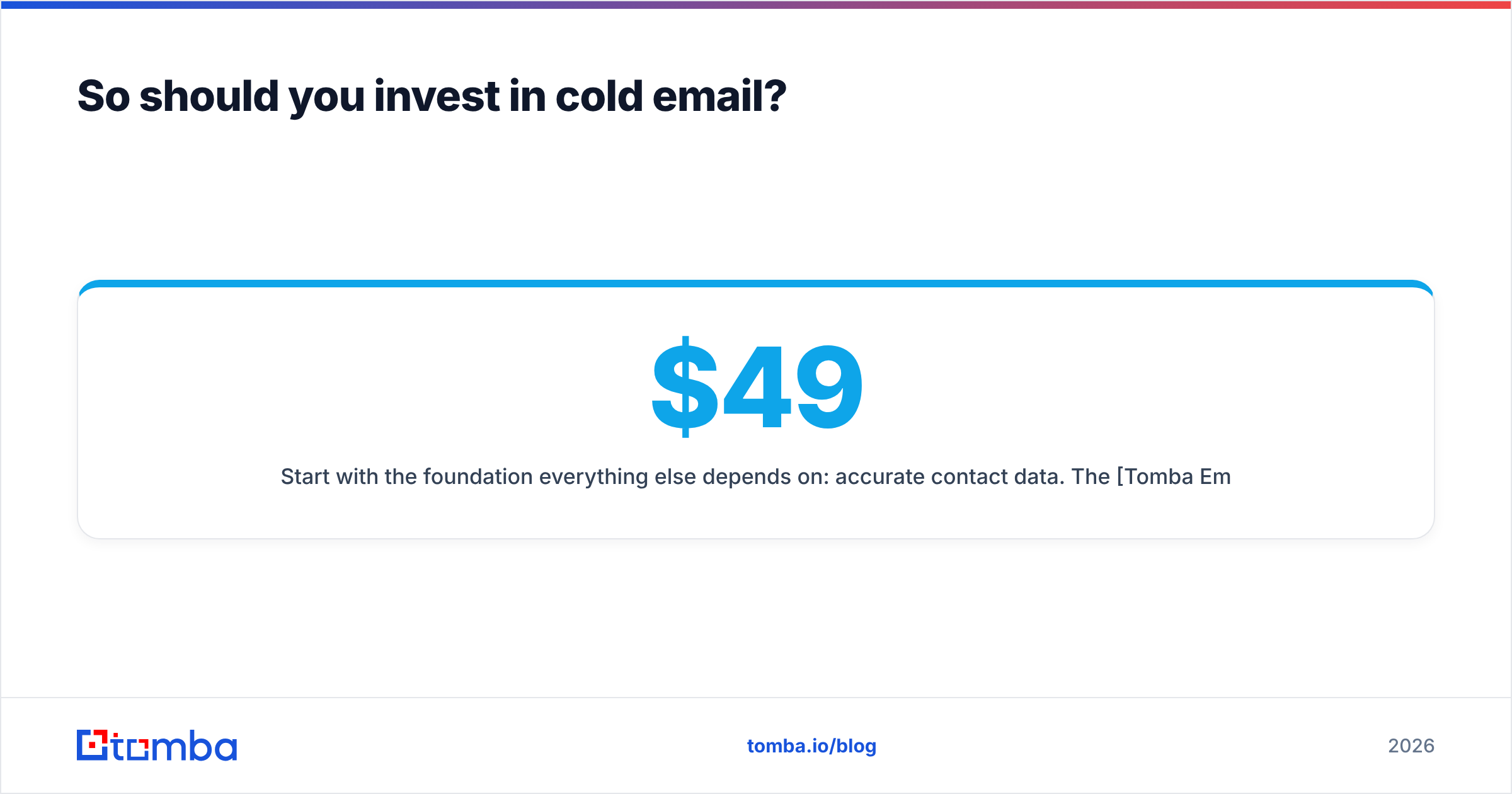
Start with the foundation everything else depends on: accurate contact data. The Tomba Email Finder resolves verified professional email addresses from a name and domain, with real-time verification built into the lookup so invalid addresses never reach your sequence. The free tier includes 25 searches per month to test the data quality against your own account list; paid plans start at $49/mo for Starter, $99/mo for Growth, and $249/mo for Pro — see Tomba pricing for full credit allocations. Build the list right, and the rest of cold email becomes a solvable problem.
Related guides#
Ready to find emails that actually work?
Join 150,000+ professionals who stopped guessing and started sending. Free credits on signup — no credit card required.
Get the Tomba newsletter
Practical outbound tactics and product updates — once every two weeks.
About the author