Dolibarr Pricing, Reviews, Pros and Cons: 2026 Buyer's Guide
Dolibarr is free to download — but that is not the same as free to run. Here is what Dolibarr actually costs in 2026, what real reviewers complain about, and when a lighter stack beats a full ERP.
TL;DR
- Dolibarr the software is genuinely free and open source (GPLv3). Dolibarr the system you actually run costs money — hosting, modules, migrations, and somebody's time.
- Managed hosting through DoliCloud and partner providers generally lands in the €9–€30 per user per month band depending on tier and commitment; self-hosting shifts that cost from a subscription line to a sysadmin line.
- Reviewers consistently praise the price-to-capability ratio and module breadth, and consistently criticise the dated UI, uneven module quality, and thin documentation for advanced setups.
- Dolibarr is a strong fit for 3–50 person product, services, and trading businesses that want invoicing + CRM + stock in one place and have some technical capacity in-house.
- It is a poor fit if you want a modern sales-engagement CRM out of the box. Dolibarr stores contacts well; it does not find them. Pair it with a dedicated data layer.
What is Dolibarr, and who actually uses it?#
Dolibarr ERP & CRM is an open-source business management suite that has been in active development since 2003. It is PHP + MySQL/MariaDB, installs on almost any shared host, and ships as a modular core: you switch on Invoices, Products, Stock, Projects, Third Parties, HR, POS, and about sixty other modules only if you need them.
Think of it like a hardware store rather than a finished kitchen. IKEA sells you a kitchen with a fixed layout and a fixed price. Dolibarr sells you the cabinets, the fittings, and a manual — the result can be exactly what you want, or it can be a weekend you never get back. That distinction drives most of the dolibarr pricing reviews pros and cons debate you will find online.
The typical user profile, based on the public community and the official project site, skews toward:
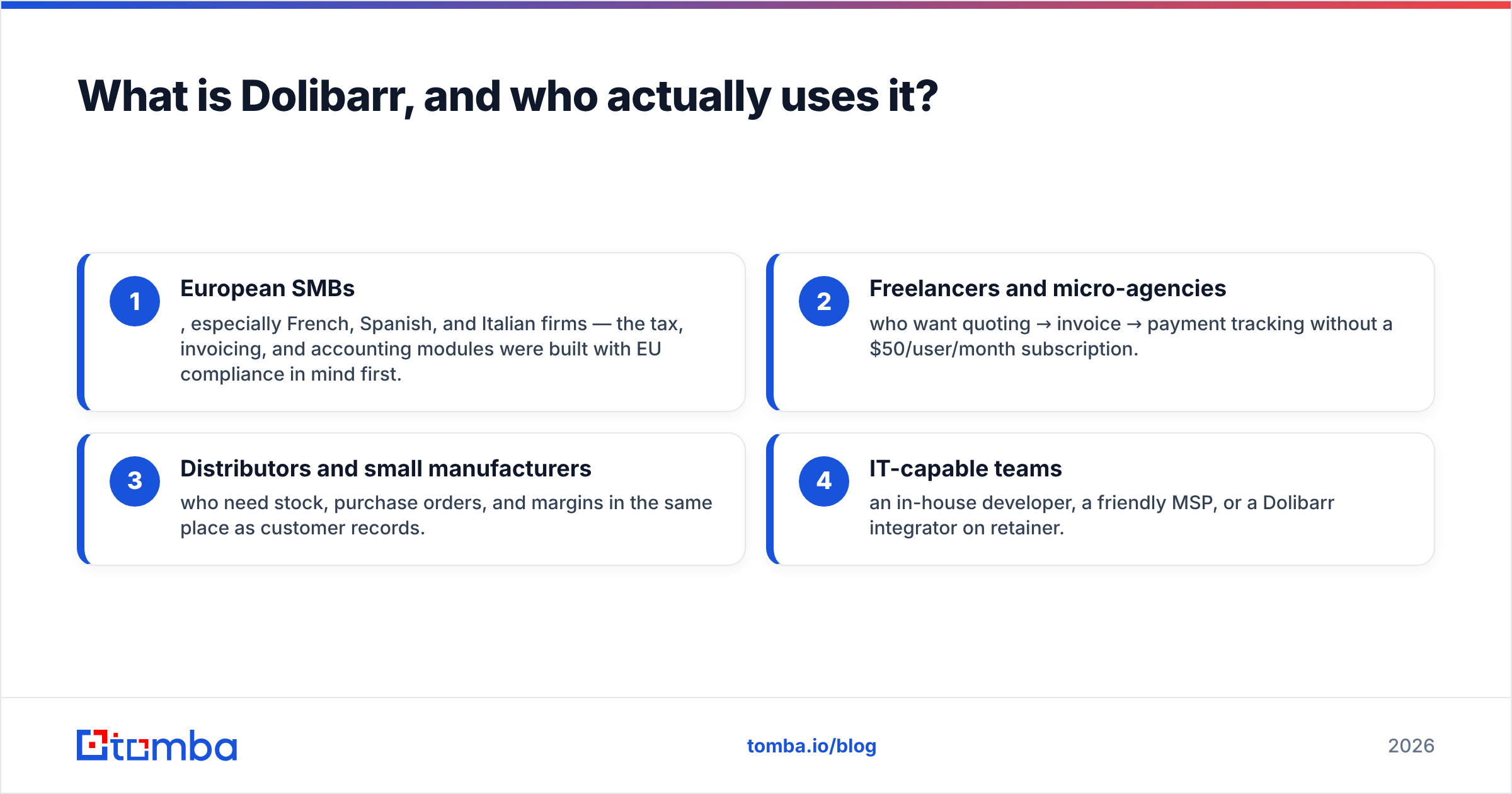
- European SMBs, especially French, Spanish, and Italian firms — the tax, invoicing, and accounting modules were built with EU compliance in mind first.
- Freelancers and micro-agencies who want quoting → invoice → payment tracking without a $50/user/month subscription.
- Distributors and small manufacturers who need stock, purchase orders, and margins in the same place as customer records.
- IT-capable teams — an in-house developer, a friendly MSP, or a Dolibarr integrator on retainer.
If none of those four describe you, keep reading, but keep the total-cost section in mind.
What does Dolibarr really cost in 2026?#
Here is the honest answer: the licence is €0, and the deployment is not.
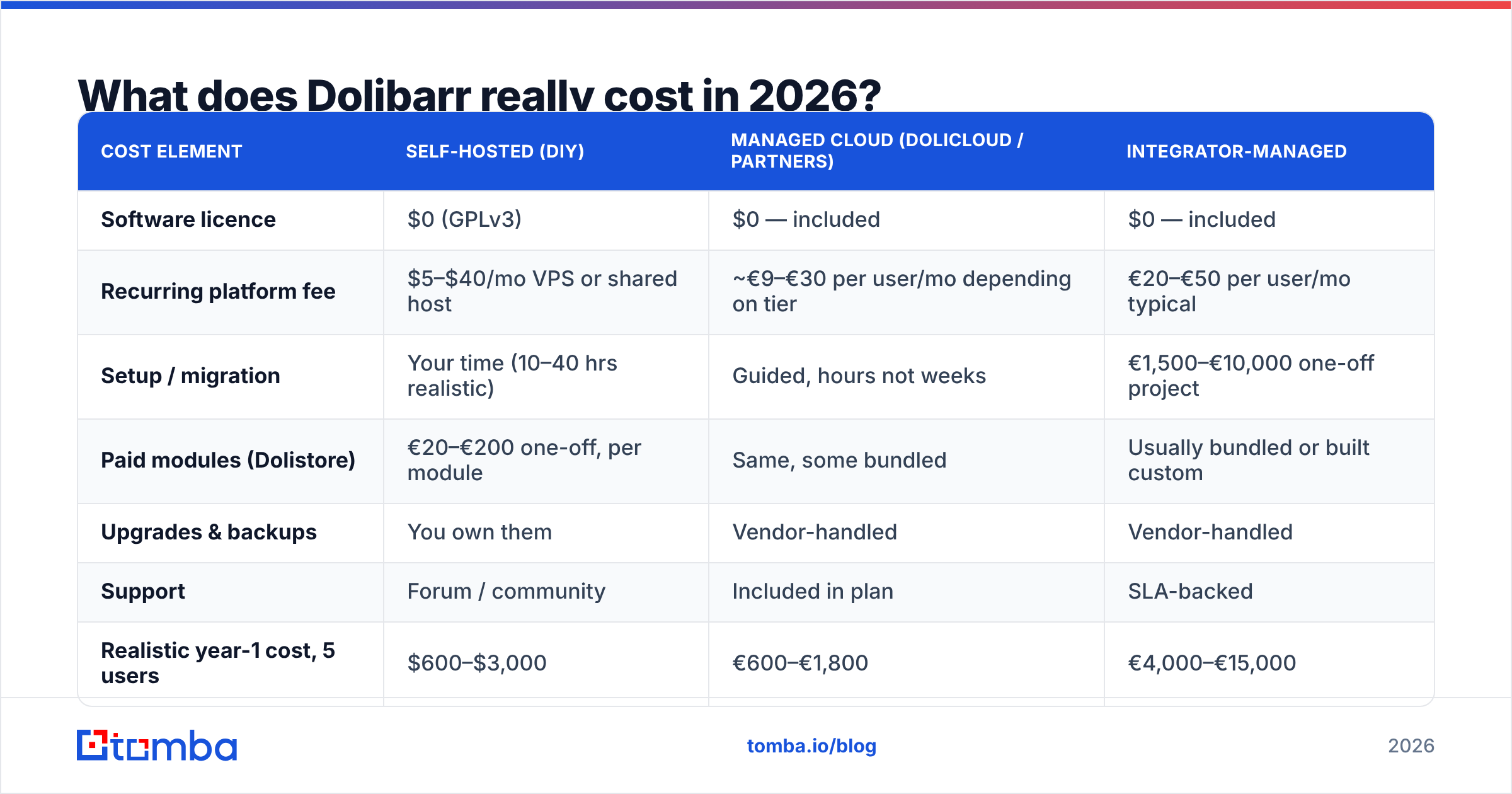
There are three routes to running Dolibarr, and each moves the cost to a different budget line.
| Cost element | Self-hosted (DIY) | Managed cloud (DoliCloud / partners) | Integrator-managed |
|---|---|---|---|
| Software licence | $0 (GPLv3) | $0 — included | $0 — included |
| Recurring platform fee | $5–$40/mo VPS or shared host | ~€9–€30 per user/mo depending on tier | €20–€50 per user/mo typical |
| Setup / migration | Your time (10–40 hrs realistic) | Guided, hours not weeks | €1,500–€10,000 one-off project |
| Paid modules (Dolistore) | €20–€200 one-off, per module | Same, some bundled | Usually bundled or built custom |
| Upgrades & backups | You own them | Vendor-handled | Vendor-handled |
| Support | Forum / community | Included in plan | SLA-backed |
| Realistic year-1 cost, 5 users | $600–$3,000 | €600–€1,800 | €4,000–€15,000 |
Two things to flag before you copy those numbers into a spreadsheet.
First, published SaaS tiers move. Check DoliCloud directly for current per-user rates and annual discounts rather than trusting a blog post — including this one.
Second, the Dolistore marketplace is where budgets quietly leak. A "free ERP" that needs a €79 advanced-stock module, a €49 payment-gateway connector, and a €120 custom PDF template is a €248 ERP with a €0 headline. That is not a scandal — those modules are cheap compared to enterprise ERP add-ons — but it belongs in your forecast.
The hidden cost people forget: your own hours#
Self-hosting Dolibarr means you own five recurring jobs: security patches, PHP version compatibility, database backups, module-upgrade regression testing, and mail deliverability from the server that sends your invoices. That last one bites hardest — plenty of teams discover their invoice emails are landing in spam because the box has no SPF record and no DKIM signing. Budget four to eight hours a month of competent technical attention. If you cannot name the person who owns those hours, choose managed hosting.
What do Dolibarr reviews say?#
Aggregate sentiment across review platforms is positive but heavily conditioned. Reading through public feedback on G2's ERP category and comparable directories, the same five themes repeat almost verbatim:
- "Unbeatable value." The most common praise. Teams replacing a $300/month stack with a $15/month VPS are, understandably, delighted.
- "The UI feels like 2012." The most common complaint. Recent releases have modernised it considerably, but next to a Notion-era SaaS product it still reads as functional rather than pleasant.
- "Module quality is uneven." Core modules (invoices, third parties, products) are solid and battle-tested. Long-tail community modules range from excellent to abandoned. Check the last update date before you install anything.
- "Great community, thin docs." You will find your answer on the forum. You will not always find it in the manual.
- "Upgrades need testing." Major-version jumps with many custom modules require a staging environment. Teams that skip staging report broken PDF templates and orphaned custom fields.
The pattern is consistent: satisfaction correlates almost perfectly with in-house technical capability. Technical teams rate Dolibarr highly. Non-technical teams who self-hosted rate it poorly. Non-technical teams on managed hosting land in the middle.
What are the pros and cons of Dolibarr?#
Pros
- No licence tax on growth. Adding your eleventh user does not add $600/year. For a growing team, this is the single biggest structural advantage over seat-priced SaaS.
- One database for CRM, quotes, invoices, and stock. No Zapier tax to keep a deal record and an invoice in sync.
- Real data ownership. Your MySQL database, your export, your migration path. No vendor can price-hike you into a corner or gate an API behind an enterprise tier.
- Modular, so it stays light. Turn off HR, projects, and POS and Dolibarr is a lean quote-to-cash tool rather than a bloated ERP.
- Mature ecosystem. Twenty-plus years of development, an active marketplace, and integrators in most European markets.
Cons
- Setup is a project, not a signup. Even managed, expect configuration work on numbering formats, tax rules, PDF templates, and permissions.
- Sales engagement is basic. There is no native sequencer, no deliverability tooling, no intent data, no enrichment. It records the relationship; it does not generate it.
- UI/UX lags modern SaaS. Adoption friction is real with sales teams used to slicker tools.
- Reporting is functional, not analytical. Expect to export to a BI tool for anything beyond standard sales and stock reports.
- Mobile experience is weak compared to purpose-built mobile CRMs.
- Support is what you pay for. Free means forum-speed. Urgent means an integrator retainer.
How does Dolibarr compare to other SMB options?#
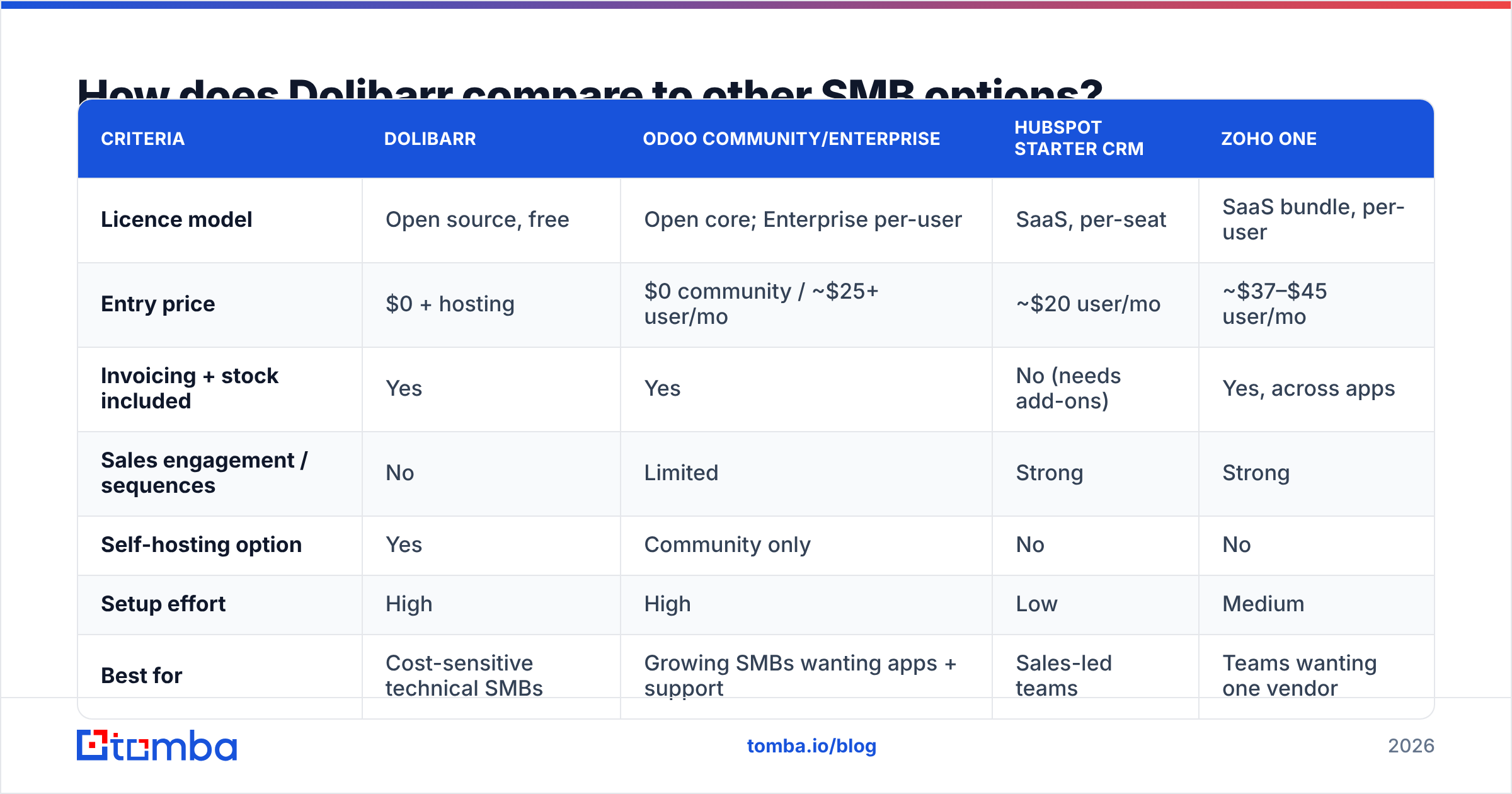
The right comparison set depends on whether you are buying an ERP that happens to have CRM, or a CRM that happens to invoice.
| Criteria | Dolibarr | Odoo Community/Enterprise | HubSpot Starter CRM | Zoho One |
|---|---|---|---|---|
| Licence model | Open source, free | Open core; Enterprise per-user | SaaS, per-seat | SaaS bundle, per-user |
| Entry price | $0 + hosting | $0 community / ~$25+ user/mo | ~$20 user/mo | ~$37–$45 user/mo |
| Invoicing + stock included | Yes | Yes | No (needs add-ons) | Yes, across apps |
| Sales engagement / sequences | No | Limited | Strong | Strong |
| Self-hosting option | Yes | Community only | No | No |
| Setup effort | High | High | Low | Medium |
| Best for | Cost-sensitive technical SMBs | Growing SMBs wanting apps + support | Sales-led teams | Teams wanting one vendor |
A blunt way to read that table: if invoicing and stock are the core problem, Dolibarr and Odoo are the shortlist. If pipeline velocity is the core problem, a sales-first CRM plus a separate accounting tool will make your reps happier and cost more.
For teams weighing an all-in-one against a best-of-breed stack, HubSpot's own CRM comparison material is worth reading precisely because it argues the opposite case — read both sides before you commit a year of process to either.
Who should choose Dolibarr, and who should walk away?#
Choose Dolibarr if:
- You run a 3–50 person services, trading, or light-manufacturing business.
- Invoicing, quotes, and stock genuinely need to live beside your customer records.
- You have — or will hire — technical capacity, or you are happy paying for managed hosting.
- Predictable, seat-independent costs matter more than polish.
- Data residency or ownership is a compliance requirement.
Walk away if:
- Your bottleneck is outbound pipeline, not back-office admin.
- Nobody on the team can, or wants to, own a server.
- You need native sequencing, call recording, or conversation intelligence.
- Your team will abandon any tool that does not feel modern on a phone.
How do you fill Dolibarr with contacts worth having?#
This is the gap nobody mentions in a pricing review, and it is the one that decides whether your ERP earns its keep.
Dolibarr's Third Parties and Contacts modules are competent storage. They will happily store 4,000 records. They will just as happily store 4,000 bad records — outdated addresses, guessed email formats, and duplicates from three different CSV imports. The ERP has no opinion about whether an address is deliverable. Your invoices, quotes, and dunning notices do.
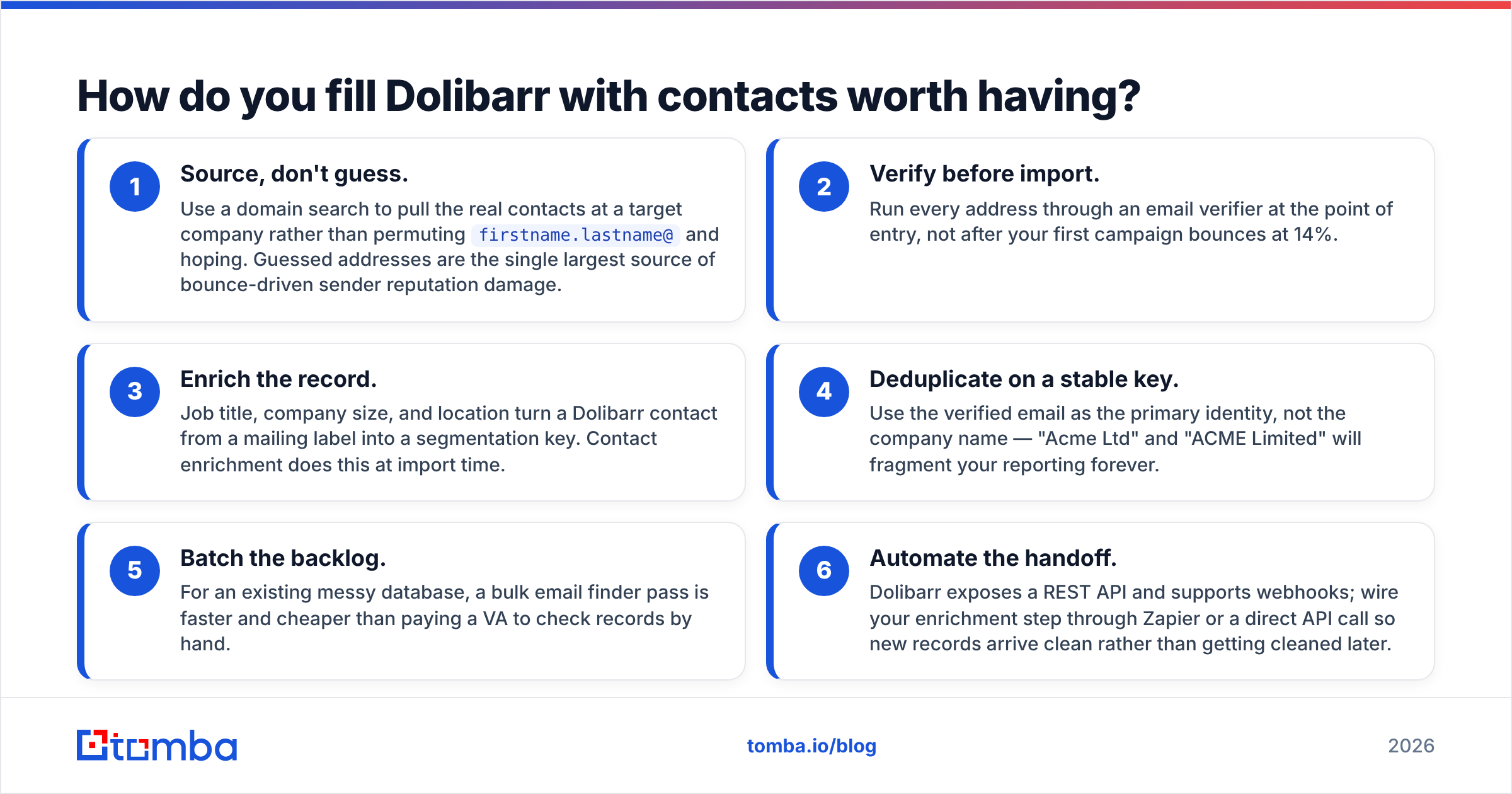
A practical intake pipeline that keeps a Dolibarr instance clean:
- Source, don't guess. Use a domain search to pull the real contacts at a target company rather than permuting
firstname.lastname@and hoping. Guessed addresses are the single largest source of bounce-driven sender reputation damage. - Verify before import. Run every address through an email verifier at the point of entry, not after your first campaign bounces at 14%.
- Enrich the record. Job title, company size, and location turn a Dolibarr contact from a mailing label into a segmentation key. Contact enrichment does this at import time.
- Deduplicate on a stable key. Use the verified email as the primary identity, not the company name — "Acme Ltd" and "ACME Limited" will fragment your reporting forever.
- Batch the backlog. For an existing messy database, a bulk email finder pass is faster and cheaper than paying a VA to check records by hand.
- Automate the handoff. Dolibarr exposes a REST API and supports webhooks; wire your enrichment step through Zapier or a direct API call so new records arrive clean rather than getting cleaned later.
Do those six things and Dolibarr's low cost is real savings. Skip them and you have built a very economical warehouse for data that nobody trusts.
Is Dolibarr worth it in 2026?#
Yes — with a specific caveat. Dolibarr is worth it if you value control and cost predictability more than convenience, and if you are honest about the total cost rather than the licence cost. Priced properly, a five-user managed instance at roughly €100/month with clean data will out-earn a $500/month all-in-one that half the team ignores.
Priced dishonestly — "it's free, let's just install it" — Dolibarr becomes the most expensive software you never finished configuring.
The decision is not really Dolibarr versus Odoo versus HubSpot. It is: where does your revenue actually get stuck? If it gets stuck in admin, an ERP fixes it. If it gets stuck at the top of the funnel, no ERP will help — you need better contact data going in.
That is the part Dolibarr cannot solve for you. Before your next import, run your target account list through the Tomba Email Finder and see how many of your existing records survive verification. The free tier covers 25 searches a month so you can test the hit rate on your own list before spending anything, and paid Tomba pricing starts at $49/month when you are ready to clean the whole database. Fill the ERP you already chose with contacts that actually reply — that is where the return on this whole exercise lives.
Related guides#
Ready to find emails that actually work?
Join 150,000+ professionals who stopped guessing and started sending. Free credits on signup — no credit card required.
Get the Tomba newsletter
Practical outbound tactics and product updates — once every two weeks.
About the author