9 Best Dolicloud Alternatives in 2026 (Free and Paid ERP)
Dolicloud makes hosted Dolibarr easy, but it is not the only way to run an open-source ERP and CRM. Here are nine Dolicloud alternatives compared on hosting, price, CRM depth, and how well each one handles your sales data.
TL;DR
Dolicloud is managed hosting for Dolibarr, the open-source ERP and CRM. You are not replacing an ERP. You are replacing who runs it. So the first choice is the hosting model, not the feature list.
The strongest Dolicloud alternatives fall into three camps: other Dolibarr hosts (or self-hosting), open-source ERP suites like Odoo and ERPNext, and sales-first tools like HubSpot, Zoho, or Bitrix24.
Price per seat is misleading. Odoo and Dynamics 365 charge per user. ERPNext on Frappe Cloud and self-hosted Dolibarr charge per instance. A 12-person team can see a 6x swing on the same feature set.
Migration cost is the real switching tax. Dolibarr's data model does not map cleanly onto Odoo or Dynamics. CSV exports also drop most of your linked documents.
Any ERP is only as good as the contact data inside it. Cleaning and verifying records before import is the cheapest quality win in the whole project.
What is Dolicloud, and what are you actually replacing?#
Dolicloud is a commercial SaaS that hosts Dolibarr ERP & CRM for you. It covers setup, backups, updates, module installs, and support. You get the open-source suite without touching a server.
That matters once you start shopping for Dolicloud alternatives. Two very different searches hide behind the same phrase.
Say Dolibarr itself works fine, and only the hosting, price, or support bothers you. Then your options are other Dolibarr hosts, a VPS you manage, or a Docker image on your own hardware. Your data stays put, and migration takes hours.
Say the modules feel thin instead: weak manufacturing, clunky reports, no marketing automation, a CRM that feels bolted on. Then you are replacing the ERP, not the host. That is a quarter-long project, not a weekend one. Be honest about which job you are doing before you sit through nine demos.
Why do teams leave Dolicloud in the first place?#
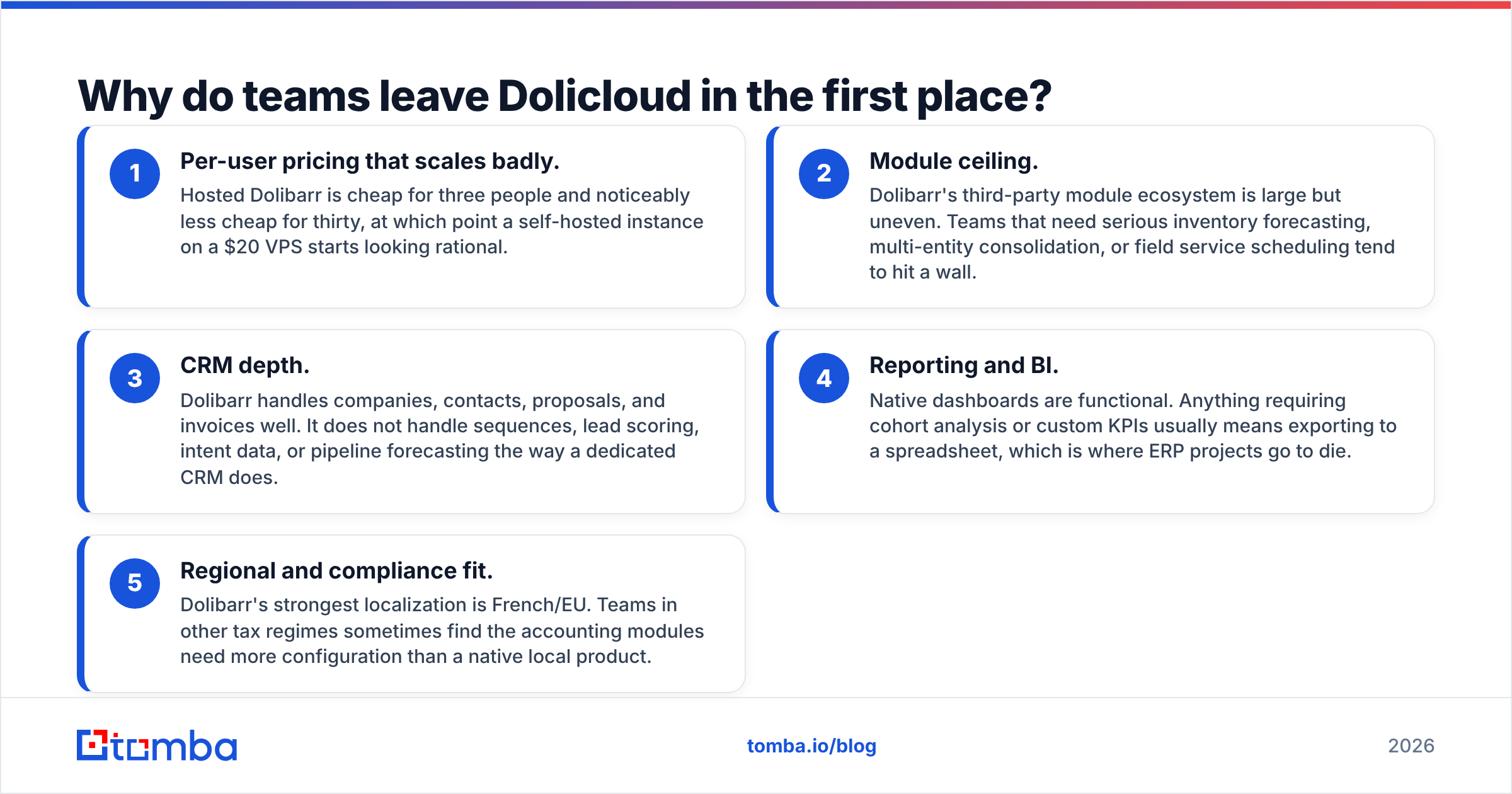
Five complaints push most teams toward Dolicloud alternatives:
Per-user pricing that scales badly. Hosted Dolibarr is cheap for three people. It is much less cheap for thirty. At that size, a self-hosted instance on a $20 VPS starts to look rational.
Module ceiling. The third-party module ecosystem is large but uneven. Teams that need stock forecasting, multi-entity accounts, or field service scheduling tend to hit a wall.
CRM depth. Dolibarr handles companies, contacts, proposals, and invoices well. It does not handle sequences, lead scoring, intent data, or pipeline forecasts the way a dedicated CRM does.
Reporting. Native dashboards cover the basics. Anything with cohort analysis or custom KPIs ends up in a spreadsheet. That is where ERP projects go to die.
Regional fit. Dolibarr is strongest in France and the rest of the EU. Teams in other tax regimes often find the accounting modules need more setup than a local product.
None of these is a reason to panic-migrate. But if two or more apply, a shortlist is worth building.

How should you compare Dolicloud alternatives?#
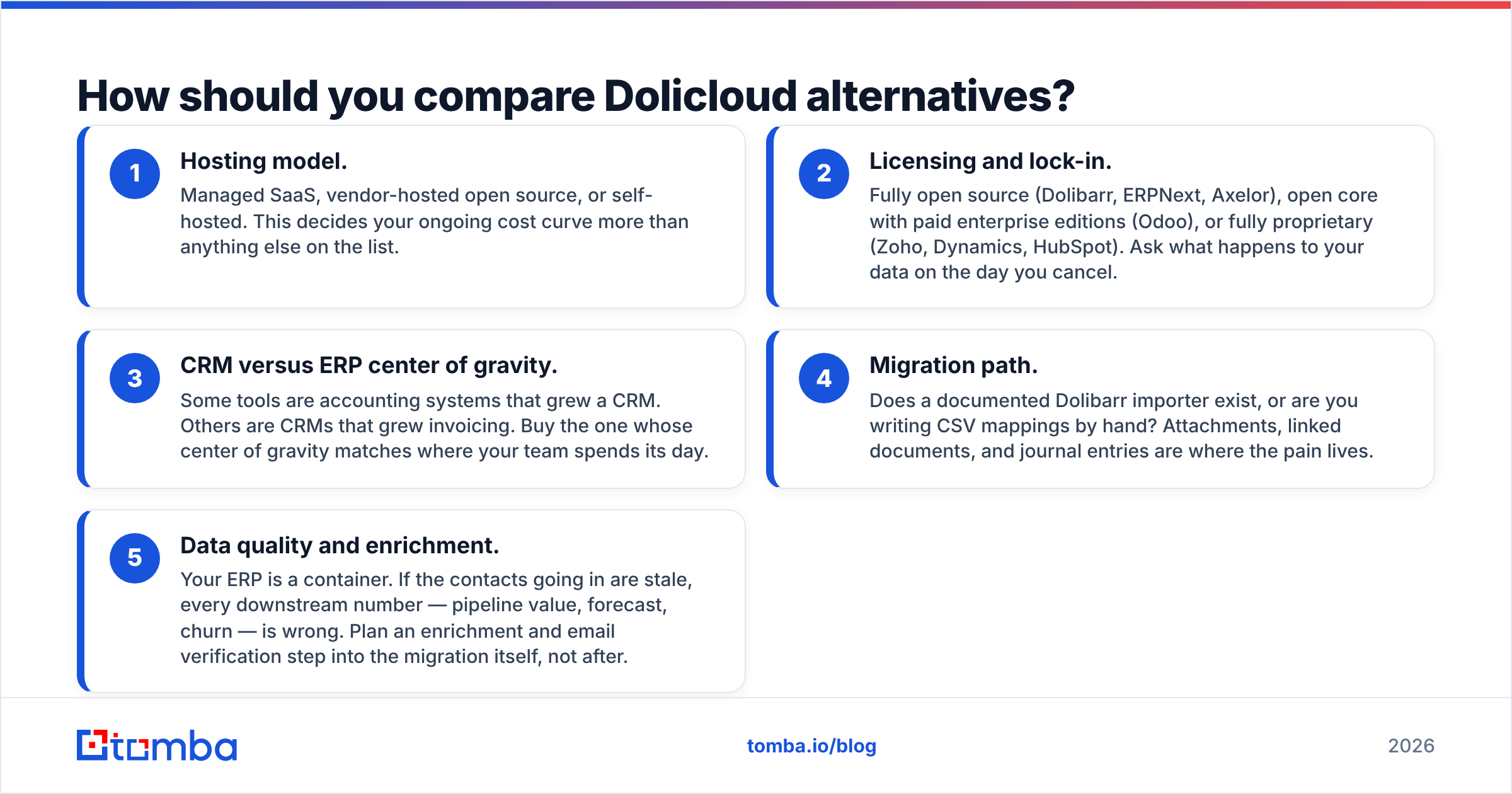
Score every candidate on the same five axes before you open a single feature grid. Most teams skip this step. It is why so many ERP migrations stall at 60%.
Hosting model. Managed SaaS, vendor-hosted open source, or self-hosted. This sets your cost curve more than anything else on the list.
Licensing and lock-in. Some Dolicloud alternatives are fully open source (Dolibarr, ERPNext, Axelor). Some are open core with paid editions (Odoo). Some are closed (Zoho, Dynamics, HubSpot). Ask what happens to your data the day you cancel.
CRM or ERP center of gravity. Some tools are accounting systems that grew a CRM. Others are CRMs that grew invoicing. Buy the one that matches where your team spends the day.
Migration path. Is there a documented Dolibarr importer, or will you write CSV mappings by hand? Attachments, linked documents, and journal entries are where the pain lives.
Data quality. Your ERP is a container. If the contacts going in are stale, every number that comes out is wrong. Plan an enrichment and email verification step into the migration itself, not after.
Which Dolicloud alternatives are worth shortlisting in 2026?#
Nine Dolicloud alternatives make the 2026 shortlist. The open-source group comes first.
| Tool | Best for | Hosting model | Entry price (list) | Dolibarr data fit |
|---|---|---|---|---|
| Self-hosted Dolibarr | Cost control, full ownership | Your VPS or on-prem | $10–30/mo server cost | Native — direct DB move |
| Other Dolibarr hosts | Same app, different SLA | Managed SaaS | ~€8–15/user/mo | Native |
| Odoo | Broadest module coverage | SaaS or Odoo.sh | ~$25/user/mo (Standard) | Manual mapping required |
| ERPNext / Frappe Cloud | Open-source ERP without per-seat fees | Managed or self-hosted | From ~$10/site/mo | Manual mapping required |
| Axelor | Low-code process customization | SaaS or self-hosted | ~€35/user/mo cloud | Manual mapping required |
The proprietary group trades ownership for polish, support, and a bigger bill.
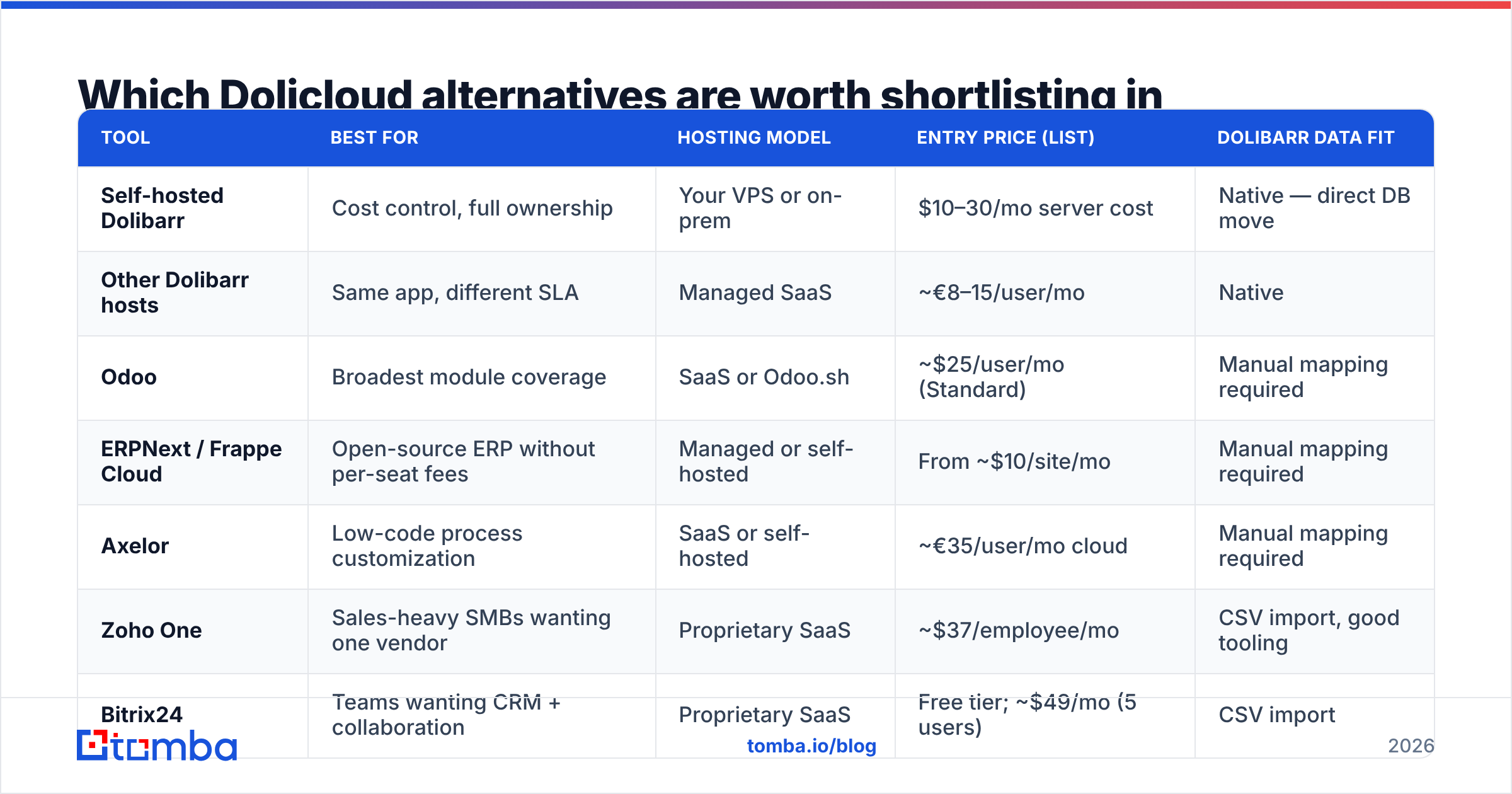
| Tool | Best for | Hosting model | Entry price (list) | Dolibarr data fit |
|---|---|---|---|---|
| Zoho One | Sales-heavy SMBs wanting one vendor | Proprietary SaaS | ~$37/employee/mo | CSV import, good tooling |
| Bitrix24 | Teams wanting CRM + collaboration | Proprietary SaaS | Free tier; ~$49/mo (5 users) | CSV import |
| HubSpot | Pipeline and marketing first | Proprietary SaaS | Free CRM; $15/seat/mo Starter | CSV import, strong API |
| Dynamics 365 Business Central | Mid-market finance and compliance | Microsoft cloud | ~$70/user/mo Essentials | Partner-led migration |
List prices are the ones each vendor published in early 2026. Annual terms, regional pricing, and partner discounts move these numbers. Check the vendor's own pricing page before you budget.
Self-hosted Dolibarr — the cheapest alternative nobody demos#
This is the most overlooked option. Dolibarr is GPL software. Running it yourself costs a VPS, a domain, a TLS certificate, and a backup routine. For a team that is comfortable with servers, that is $15–30 a month in total, whatever the headcount. It is the cheapest of the Dolicloud alternatives here.
Choose it if: your only objection to Dolicloud is price, you already run other services, and someone on staff can handle a monthly apt upgrade.
Skip it if: nobody owns infrastructure. An unpatched ERP full of customer financial data costs far more than a hosting bill.
Odoo — the widest functional surface#
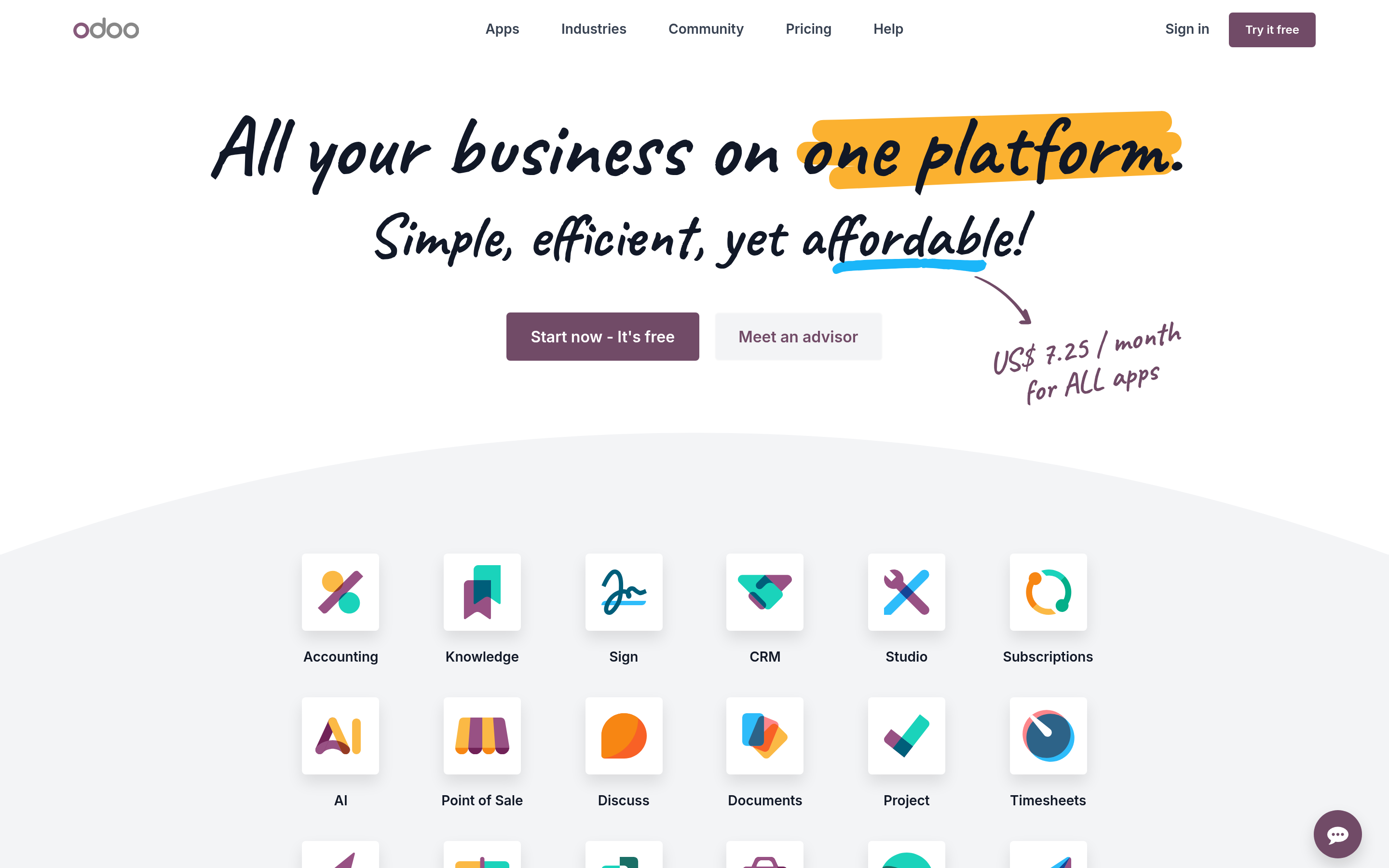
Odoo is the most common landing spot for teams outgrowing Dolibarr. The module catalogue covers manufacturing, ecommerce, field service, subscriptions, POS, and recruitment. The interface is also more modern than Dolibarr's.
The trade-off is the open-core model. The Community edition is free, but it leaves out studio customization, accounting reports, and several apps most teams assume are standard. Costs climb fast once you add per-user Enterprise licences and partner fees.
Choose it if: you need real manufacturing or multi-warehouse logistics.
Skip it if: you liked how simple Dolibarr was. Odoo is a bigger machine with a steeper learning curve.
ERPNext on Frappe Cloud — open source without the seat tax#
ERPNext is the closest cousin to Dolibarr. It is fully open source, gates no features behind a paid tier, and has strong accounting and stock control. Frappe Cloud charges per site rather than per user. That flips the economics for teams above roughly ten people.
Choose it if: you want full open source and your headcount is growing.
Skip it if: you depend on a Dolibarr module with no ERPNext equivalent. The ecosystem is smaller.
Axelor — low-code when your process is unusual#
Axelor bundles an ERP and CRM with a BPM engine and a low-code studio. Does your business run a workflow that no standard package models well? This is where you can build it without forking source code.
Choose it if: process customization is the requirement.
Skip it if: you want to be live in three weeks.
Zoho One — the everything-bundle for sales-led SMBs#
Zoho sells more than 40 apps on one subscription: CRM, Books, Inventory, Desk, Campaigns, and more. It suits a sales-heavy company that wants invoicing attached to a real CRM rather than the reverse. It also removes eight separate vendor relationships.
Choose it if: your center of gravity is sales and support, with accounting in a supporting role.
Skip it if: you dislike lock-in. Exporting cleanly from Zoho is possible, but not fun.
Bitrix24 — CRM plus collaboration on a real free tier#
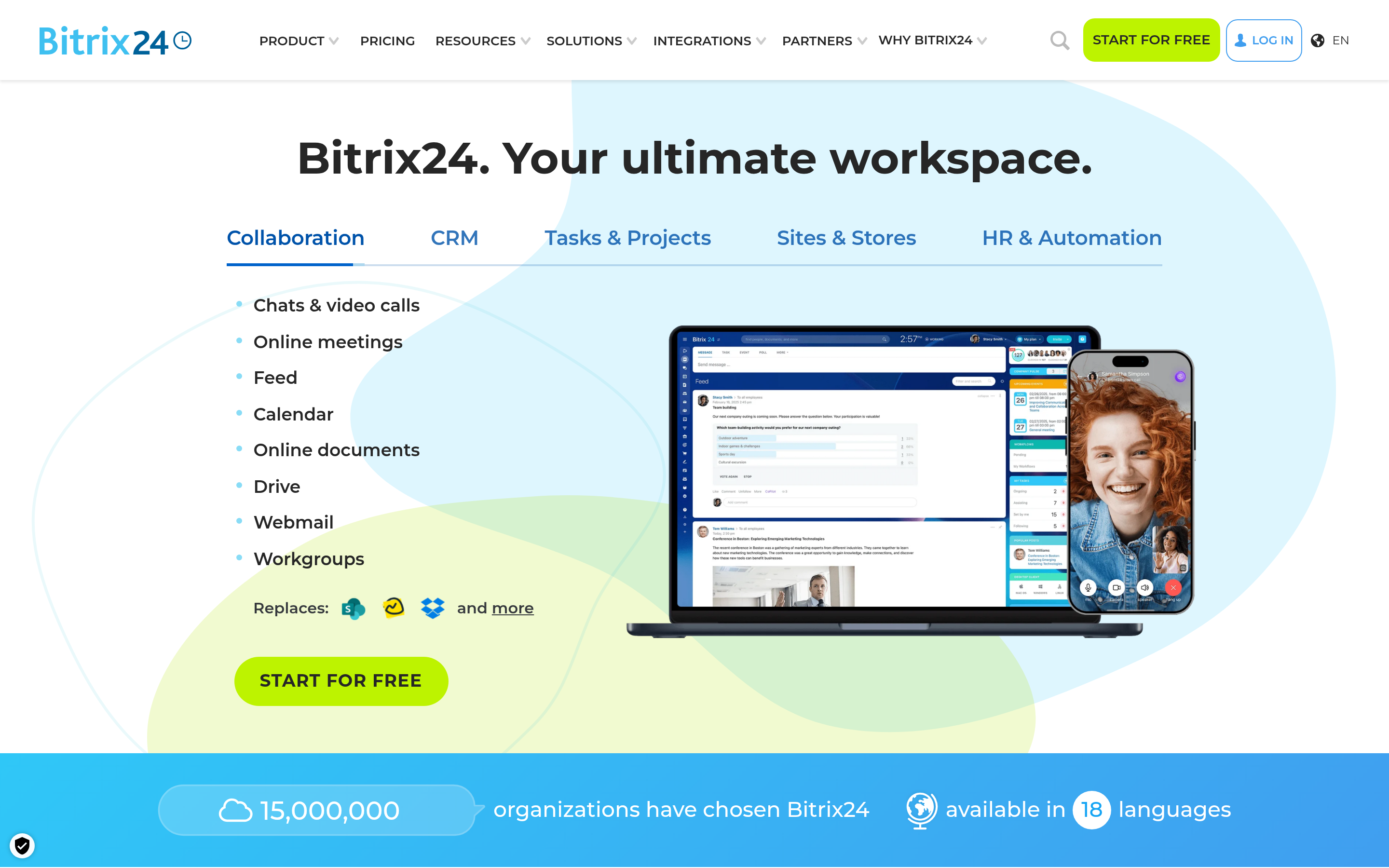
Bitrix24 combines CRM, tasks, chat, telephony, and a company intranet. The free tier is unusually generous. That makes it an easy pilot for small teams who mainly need pipeline tracking and shared docs, not double-entry accounting.
Choose it if: collaboration and CRM matter more than ledgers.
Skip it if: you need serious accounting. You will still buy something else.
HubSpot — when the real problem was the CRM#
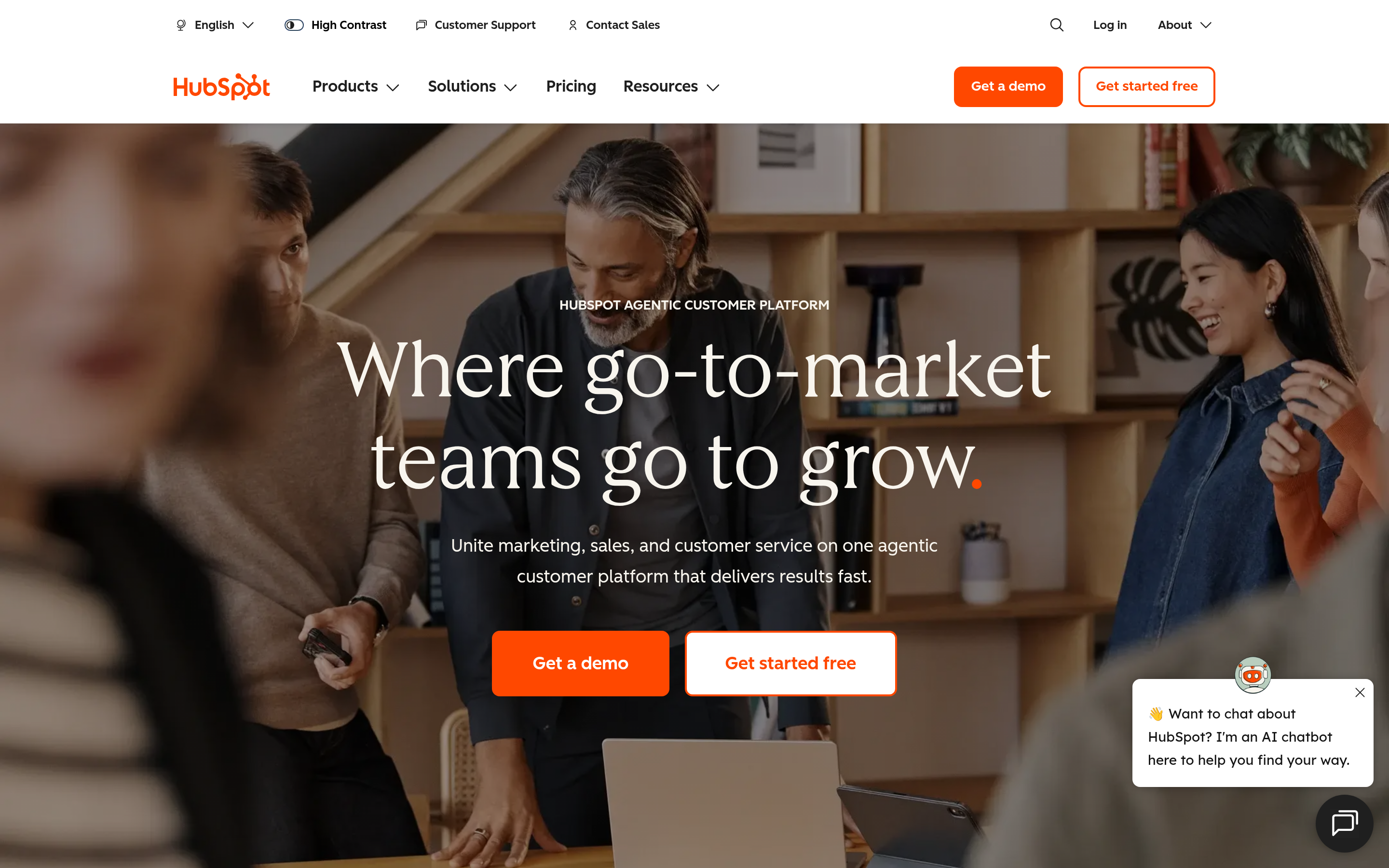
Are your Dolibarr complaints all about pipeline visibility, sequences, and reporting? Then you may not need a new ERP at all. Keep invoicing where it is and put a proper CRM in front of it. HubSpot's free tier is a legitimate start, and the HubSpot integration path lets enriched contacts flow in automatically instead of by CSV.
Choose it if: revenue teams are the loudest complainers.
Skip it if: finance owns the project. HubSpot is not an ERP.
Microsoft Dynamics 365 Business Central — the mid-market end of the range#
Business Central is the enterprise answer. You get deep financials, multi-entity consolidation, audit trails, and native Microsoft 365 integration. It is also the priciest option here, and it effectively requires an implementation partner.
Choose it if: you are past ~50 employees, run on Microsoft, and have audit requirements.
Skip it if: you are the person who will personally configure it.
BookYourData and data-first alternatives#
One more path is worth naming. Some teams find their ERP is fine and the data was the problem. Providers like BookYourData sell verified B2B contact lists directly. That is a fair choice when you need coverage in a new segment rather than better software. Pair a bought list with your own verification pass, and you avoid importing decay into a brand-new system.
How do the pricing models actually compare at scale?#
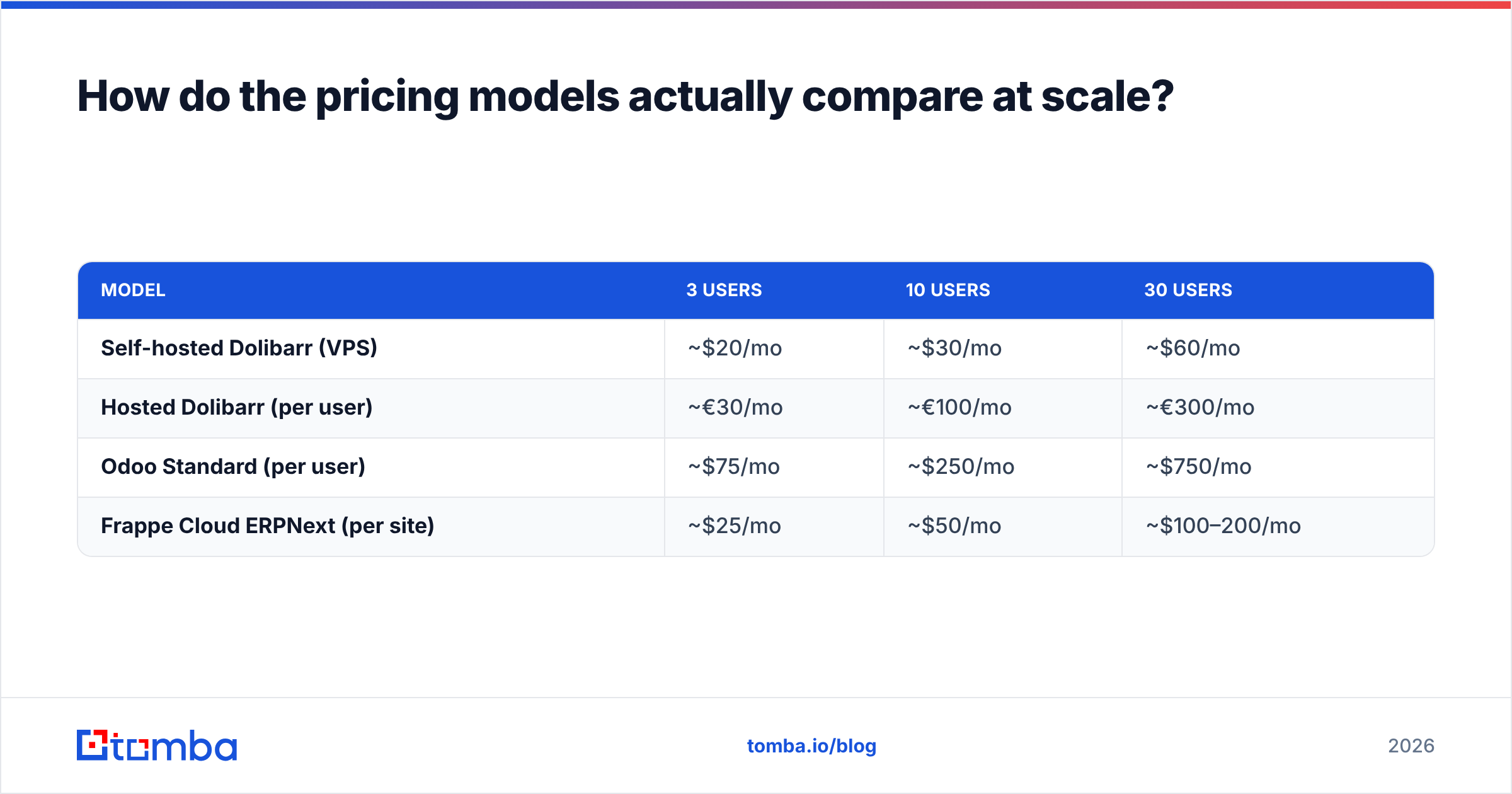
Seat pricing is where budgets break. Most Dolicloud alternatives price one of two ways: per user, or per instance. Here is the same team costed across four models.
| Model | 3 users | 10 users | 30 users |
|---|---|---|---|
| Self-hosted Dolibarr (VPS) | ~$20/mo | ~$30/mo | ~$60/mo |
| Hosted Dolibarr (per user) | ~€30/mo | ~€100/mo | ~€300/mo |
| Odoo Standard (per user) | ~$75/mo | ~$250/mo | ~$750/mo |
| Frappe Cloud ERPNext (per site) | ~$25/mo | ~$50/mo | ~$100–200/mo |
The per-site models flatten as you grow. The per-seat models do not. Do you expect to double headcount within two years? Then model the 30-user column before you sign anything.

What breaks during migration, and how do you avoid it?#
Every one of these Dolicloud alternatives promises an easy import. Three failure modes still account for most stalled moves.
Attachments and linked documents. CSV exports carry field values, not the PDF quote attached to opportunity #4,112. Export the file store separately and plan how it re-links. The other option is to accept that old documents live in an archive.
Custom fields and extra fields. Dolibarr's extrafields are flexible and rarely documented. Inventory them before you export. Every undocumented field is a question someone will ask in month three.
Contact rot. This is the silent one. B2B contact data decays by roughly 22–30% a year as people change jobs. So a five-year-old Dolibarr database can be more than half stale. Migrate it as-is and you pay to store dead records and forecast against phantom accounts.
The fix is a cleanup pass between export and import: dedupe, verify every address, and re-enrich the records worth keeping.
A bulk email finder run against your company list rebuilds contacts at accounts where your old champion left. A data enrichment pass fills in the job titles, company sizes, and domains that make segmentation possible in the new system. If your migration is scripted, the Tomba API folds both steps into the ETL job instead of your calendar.
Which Dolicloud alternative should you actually pick?#
Match the Dolicloud alternatives on your shortlist to the reason you are leaving:
You only want a cheaper host: self-host Dolibarr, or move to another Dolibarr provider. Zero migration risk.
You outgrew Dolibarr's modules: Odoo for manufacturing depth, ERPNext for open source without per-seat fees.
Your process is genuinely non-standard: Axelor.
Sales is the bottleneck, not finance: HubSpot or Bitrix24 in front of your existing invoicing.
You want one vendor for everything: Zoho One.
You are mid-market with audit requirements: Dynamics 365 Business Central, with a partner.
Then run a two-week pilot with real data, not the vendor's demo set. Import 200 of your own accounts. Run one real quote-to-invoice cycle. See what breaks.
Get the contact layer right before you migrate#
Whichever of these Dolicloud alternatives you choose, the system inherits the data you feed it. Clean, current contacts turn a new ERP into a forecasting tool. Stale ones turn it into an expensive filing cabinet.
Use the Tomba Email Finder to rebuild contacts at every account before you import. Find the person who holds the role today, verify the address, and enrich the record with title and company data in one pass.
The free tier covers 25 searches a month, so you can test it against a sample of your Dolibarr export first. Paid plans start at $49/mo on Tomba pricing when you are ready to run the full list. Migrate the accounts that are still real, and leave the decay behind.
Related guides#
Ready to find emails that actually work?
Join 150,000+ professionals who stopped guessing and started sending. Free credits on signup — no credit card required.
Get the Tomba newsletter
Practical outbound tactics and product updates — once every two weeks.
About the author