Done For You Cold Email Services: What You Actually Pay For
Done-for-you cold email agencies quote $3,000 to $10,000 a month. Here is what sits behind that number, which parts you could run yourself for a fraction, and the contract terms that decide whether you keep anything when the retainer ends.
TL;DR
- "Done for you cold email" means an outside team owns the whole pipeline: list building, domains and inboxes, copy, sending infrastructure, replies triage, and reporting. You get meetings on your calendar, not a tool login.
- Realistic 2026 pricing is $3,000-$10,000/month, often plus a $1,500-$5,000 setup fee, sometimes plus $100-$300 per booked meeting. Anything under $1,500/month is almost always recycled lists and shared infrastructure.
- The single biggest cost driver inside those retainers is data quality, and it is the part you can most easily insource. Verified contact data runs cents per record; agencies mark it up 5-20x inside the retainer.
- A good vendor sends on domains you own, hands over the list, and reports on bounce rate and spam placement — not just "emails sent."
- Hybrid is the highest-ROI setup for most teams under $20M ARR: own the data and domains, rent the copy and campaign operations.
What is a done for you cold email service?#
A done for you cold email service is an outsourced outbound function. You hand over an ideal customer profile and an offer; the vendor returns booked meetings. Everything between those two points — infrastructure, data, copy, sending, reply handling — sits on their side of the wall.
Think of it like hiring a catering company instead of a chef. The catering company brings the kitchen, the ingredients, the staff, and the plates. That is faster than building a kitchen, but you never learn to cook, and when the contract ends the kitchen leaves with them.
The category splits into three shapes that get marketed with identical language:
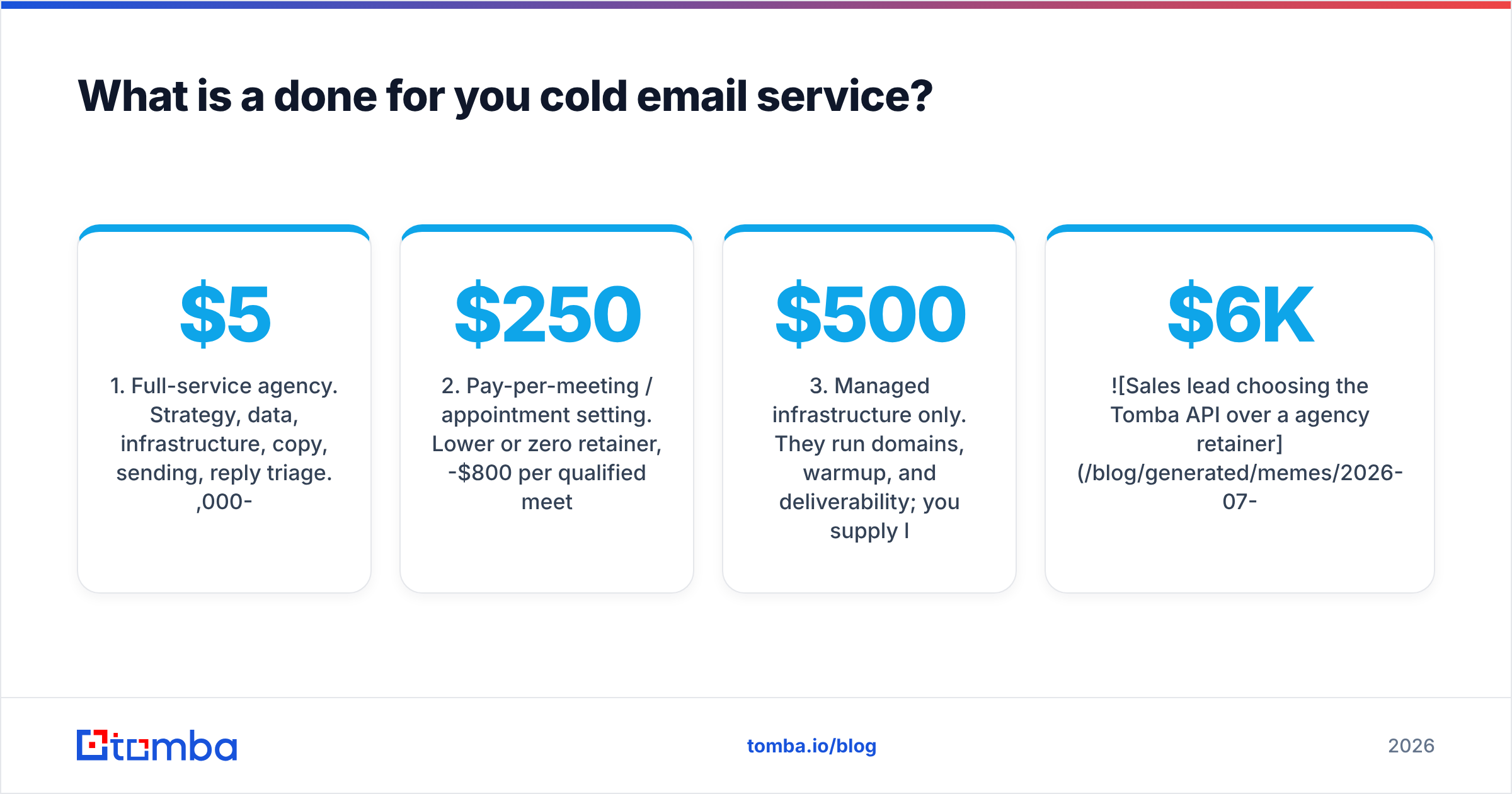
- Full-service agency. Strategy, data, infrastructure, copy, sending, reply triage. $5,000-$10,000/month. Usually a 3-6 month minimum. Typically 2-6 clients per account manager.
- Pay-per-meeting / appointment setting. Lower or zero retainer, $250-$800 per qualified meeting. Incentives push toward volume, so qualification standards need to be in the contract, not the pitch deck.
- Managed infrastructure only. They run domains, warmup, and deliverability; you supply lists and copy. $500-$2,000/month. The cheapest honest version of "done for you."
Most confusion in this market comes from vendors in bucket 3 pricing themselves like bucket 1.

What do you actually get for the money?#
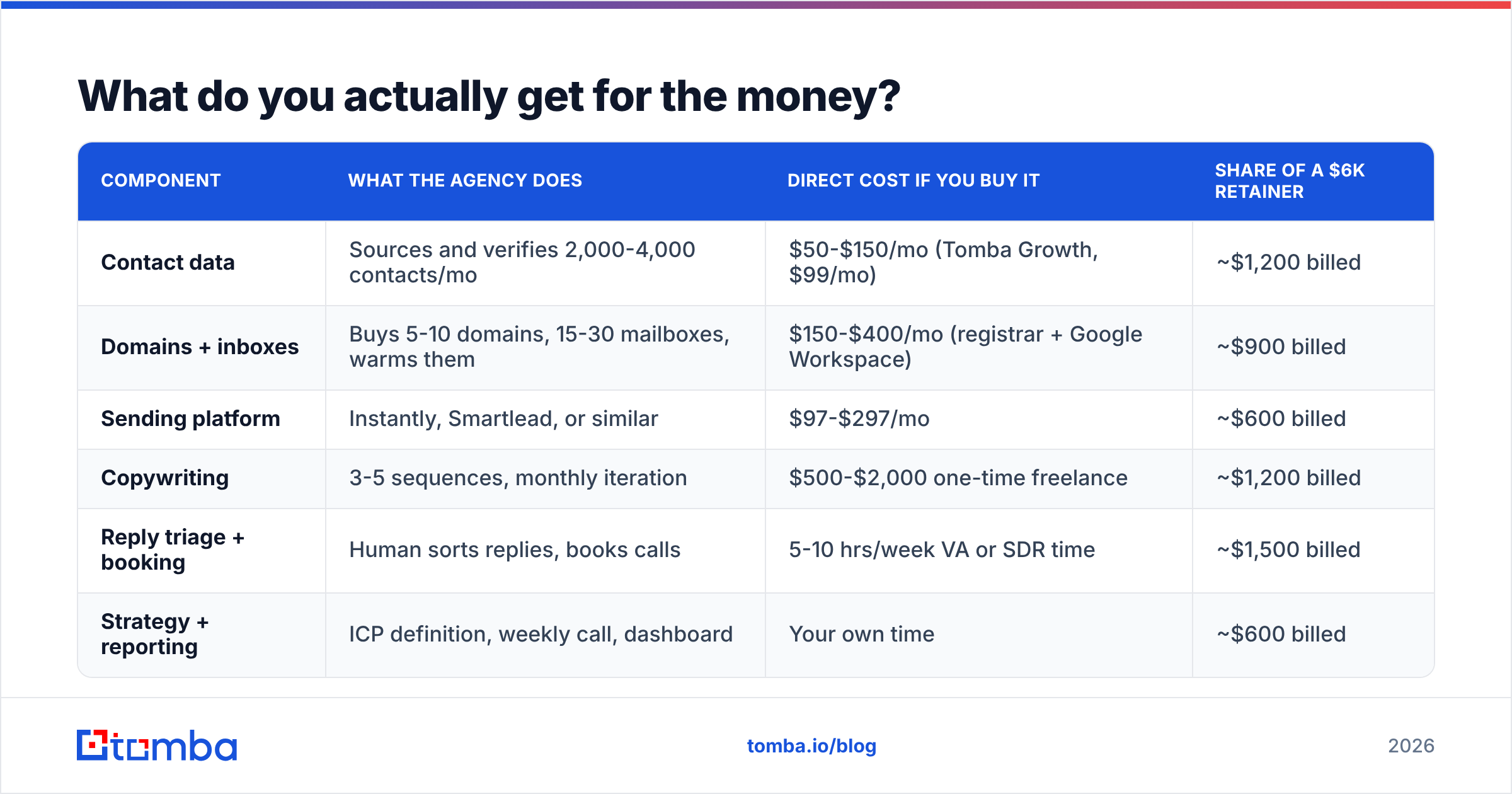
Break the retainer into its parts and the math gets uncomfortable fast. Here is what sits inside a typical $6,000/month engagement, and what each component costs at market rate if you buy it directly.
| Component | What the agency does | Direct cost if you buy it | Share of a $6k retainer |
|---|---|---|---|
| Contact data | Sources and verifies 2,000-4,000 contacts/mo | $50-$150/mo (Tomba Growth, $99/mo) | ~$1,200 billed |
| Domains + inboxes | Buys 5-10 domains, 15-30 mailboxes, warms them | $150-$400/mo (registrar + Google Workspace) | ~$900 billed |
| Sending platform | Instantly, Smartlead, or similar | $97-$297/mo | ~$600 billed |
| Copywriting | 3-5 sequences, monthly iteration | $500-$2,000 one-time freelance | ~$1,200 billed |
| Reply triage + booking | Human sorts replies, books calls | 5-10 hrs/week VA or SDR time | ~$1,500 billed |
| Strategy + reporting | ICP definition, weekly call, dashboard | Your own time | ~$600 billed |
The direct-cost column totals roughly $400-$900/month in recurring spend plus a one-time copy investment. The gap is not fraud — it pays for expertise, accountability, and the fact that somebody else wakes up at 3am when a domain gets blacklisted. But you should know you are paying roughly 6-8x on data and infrastructure, and roughly market rate on the human judgment.
That framing tells you where to negotiate. Push back on the data line item, not the strategy line item.
How much does done for you cold email cost in 2026?#
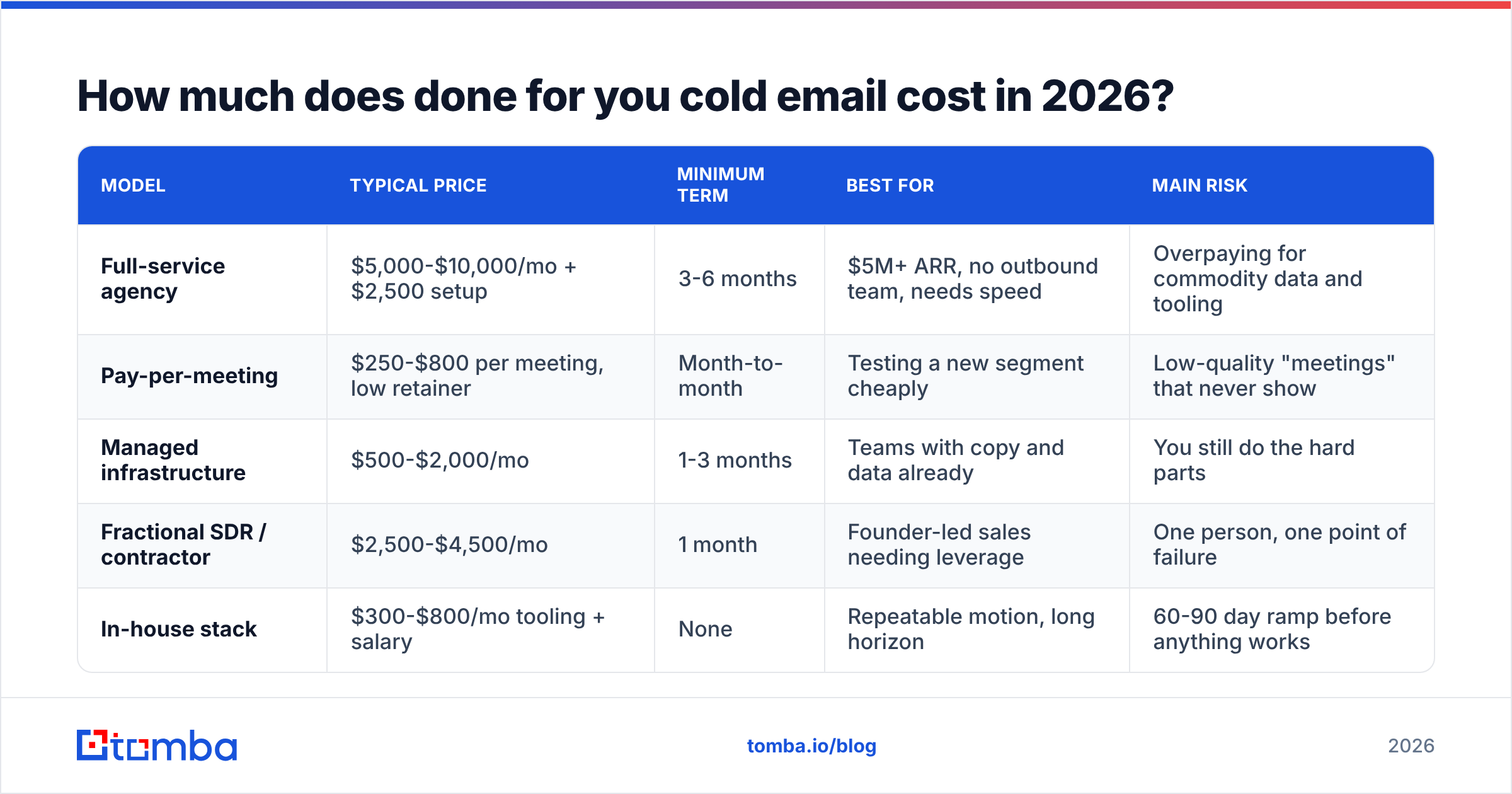
| Model | Typical price | Minimum term | Best for | Main risk |
|---|---|---|---|---|
| Full-service agency | $5,000-$10,000/mo + $2,500 setup | 3-6 months | $5M+ ARR, no outbound team, needs speed | Overpaying for commodity data and tooling |
| Pay-per-meeting | $250-$800 per meeting, low retainer | Month-to-month | Testing a new segment cheaply | Low-quality "meetings" that never show |
| Managed infrastructure | $500-$2,000/mo | 1-3 months | Teams with copy and data already | You still do the hard parts |
| Fractional SDR / contractor | $2,500-$4,500/mo | 1 month | Founder-led sales needing leverage | One person, one point of failure |
| In-house stack | $300-$800/mo tooling + salary | None | Repeatable motion, long horizon | 60-90 day ramp before anything works |
A note on payback math: if your average contract value is $12,000 and you close 20% of qualified meetings, each meeting is worth $2,400 in pipeline-adjusted revenue. A $6,000/month retainer needs roughly 8-12 genuine meetings per month to be defensible after cost of delivery. Ask any vendor to model that in writing before signing. Most credible ones will; the ones who deflect to "brand awareness" are telling you something.
Is a done-for-you agency better than building in-house?#
It depends on one variable: whether cold email is a temporary channel test or a permanent muscle.
Choose done-for-you when:
- You need pipeline in 30 days and have no domains warmed.
- Your team has zero deliverability knowledge and your primary domain is your only sending asset. Burning it is a catastrophic, slow-to-reverse mistake.
- The segment is unproven and you want a fast read before hiring.
- Your founders' time is worth more than $300/hour and outbound would consume 15 hours a week of it.
Build in-house when:
- Outbound is already producing and you are scaling a known-good motion.
- Your ICP is unusual enough that generic list building will fail. Niche technical buyers, regulated industries, and non-US markets all fall here.
- You want the data asset. Lists you build compound; lists an agency builds usually walk out the door.
- Your sales cycle requires deep product knowledge in the first reply. Outsourced repliers cannot fake this.
The honest answer for most B2B companies between $1M and $20M ARR is hybrid. Own the two things that compound — your verified contact data and your sending domains — and rent the two things that are genuinely specialist skills: copy testing and daily campaign operations.
What separates a good vendor from a lead-gen mill?#
Run every candidate through this list before the second call.
- Whose domains? Good vendors register secondary domains in your company's name and give you registrar access. Mills send from domains they own and reuse across clients, which means your reputation is entangled with strangers.
- Where does the data come from? Ask for the source and the verification method. If the answer is "our proprietary database" with no detail on refresh frequency, assume it is a scraped list resold to your competitors last quarter. Vendors who publish their data sources are a different species than those who won't.
- What is the bounce rate guarantee? Anything above 3% is a deliverability problem in progress. Above 5% and Google and Microsoft start filtering you regardless of copy quality. Get the number in the contract with a remedy attached.
- Do you see the raw list? You should get the full sending list as a CSV, monthly, no exceptions. If they refuse, they are protecting a margin, not a methodology.
- Who writes the replies? A skilled human reading intent beats an autoresponder by a wide margin. Ask how many clients that person covers. Above ten and your replies are being skimmed.
- What happens at the end? The exit clause matters more than the onboarding deck. You want domains, lists, sequences, and reply history transferred within 14 days of termination.
Vendor directories like G2 are useful for spotting review patterns, but read the 3-star reviews specifically. That is where churn reasons live.
Why does data quality decide the whole outcome?#
Because everything downstream is multiplied by it. A brilliant sequence sent to a 30%-stale list produces bounces, spam complaints, and a poisoned domain. A mediocre sequence sent to a clean, well-targeted list still books meetings.
Cold email deliverability behaves like a credit score. One month of high bounce rates takes three months of careful sending to repair, and mailbox providers do not publish the formula. HubSpot's research on email engagement consistently shows list hygiene outperforming creative optimization when the two are compared directly.
This is why the smartest move inside a done-for-you arrangement is to supply the data yourself. Running a domain through a domain search to pull role-relevant contacts, then pushing every address through an email verifier before it touches a sequence, costs a fraction of what the retainer allocates to the same work — and the list stays yours.
For teams that want purchased lists rather than self-service lookup, BookYourData is a solid pay-as-you-go option with a bounce guarantee, and it pairs well with a verification pass before send. Either route beats accepting an unlabeled CSV from an agency.

How do you keep control of your data and domains?#
Write these five items into the agreement. They cost the vendor nothing if they are legitimate, and they are the exact terms a mill will resist.
- Domain ownership. Secondary domains registered to your entity, admin access shared on day one.
- Mailbox ownership. Google Workspace or Microsoft 365 accounts under your billing, not theirs.
- Data portability. Monthly CSV export of every contact emailed, including verification status and source.
- Sequence portability. Copy and templates delivered in plain text on request, licensed to you.
- Reply history. Full thread export at termination, in a format your CRM can ingest.
If you are running the hybrid model, keep the contact pipeline on your side entirely. A bulk email finder run against your target account list, exported to the agency's sending tool, gives them exactly what they need to execute while the asset stays in your systems. Teams with engineering resources go further and wire the Tomba API into their CRM so enrichment happens on record creation, not in a monthly batch.
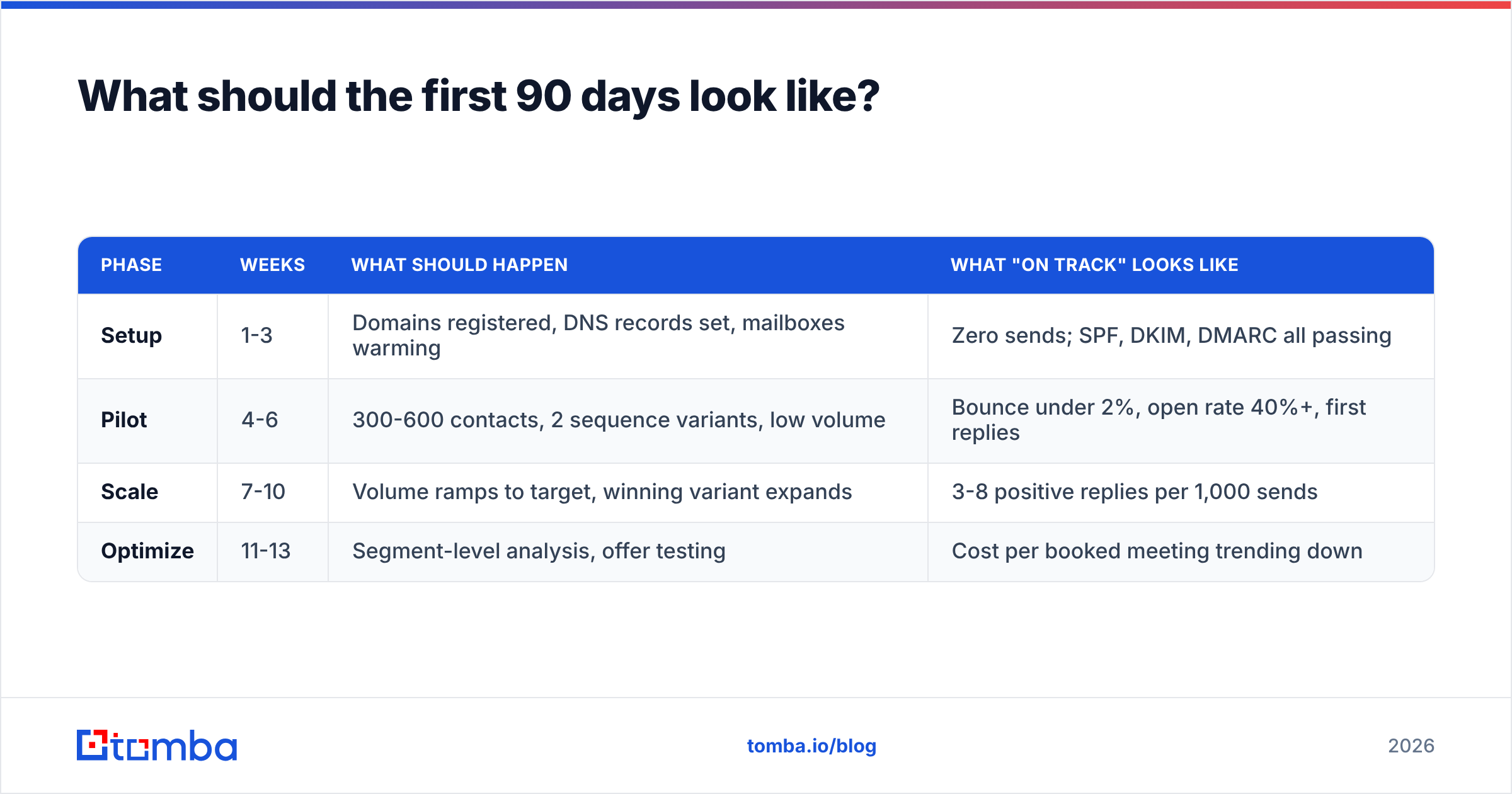
What should the first 90 days look like?#
| Phase | Weeks | What should happen | What "on track" looks like |
|---|---|---|---|
| Setup | 1-3 | Domains registered, DNS records set, mailboxes warming | Zero sends; SPF, DKIM, DMARC all passing |
| Pilot | 4-6 | 300-600 contacts, 2 sequence variants, low volume | Bounce under 2%, open rate 40%+, first replies |
| Scale | 7-10 | Volume ramps to target, winning variant expands | 3-8 positive replies per 1,000 sends |
| Optimize | 11-13 | Segment-level analysis, offer testing | Cost per booked meeting trending down |
If week 6 arrives and you have seen no replies at all, the problem is the list or the offer, not the copy. Push the vendor to prove which. Vendors who respond to weak results by rewriting subject lines a third time are guessing.
Also insist on the right metrics. "Emails sent" and "open rate" are vanity numbers in 2026 — Apple Mail Privacy Protection has made open tracking directionally useful at best. Track reply rate, positive reply rate, meetings held (not booked), and pipeline created.
Is done for you cold email worth it?#
Yes, in two specific situations: when you need a fast, low-risk read on a new segment, and when you have budget but no time and no deliverability expertise in-house. In both cases you are buying speed and a safety net around your primary domain, and both are genuinely worth paying for.
It is a poor deal when you already have a working motion, when your ICP is niche enough that generic list building fails, or when the retainer is mostly marked-up data you could source yourself for under $100 a month. Those engagements tend to produce six months of activity reports and a quiet non-renewal.
The middle path wins most often. Rent the operating skill, own the assets. Build your contact data in-house so the list improves every month regardless of which vendor is sending, keep domains and mailboxes in your name, and pay an agency for the daily execution and creative testing they genuinely do better than a first-time in-house hire.
If you are going the hybrid route, start with the data layer. The Tomba Email Finder pulls verified professional addresses by domain, name, or company, with a free tier at 25 searches a month to test accuracy against your own known contacts before committing. Paid plans start at $49/month, and full Tomba pricing scales to bulk volumes well below what any agency bills for the same list. Build the asset once, and every campaign after it — yours or an agency's — runs on cleaner ground.
Related guides#
Ready to find emails that actually work?
Join 150,000+ professionals who stopped guessing and started sending. Free credits on signup — no credit card required.
Get the Tomba newsletter
Practical outbound tactics and product updates — once every two weeks.
About the author