Drift Pricing Reviews Pros and Cons: Real 2026 Costs
Drift hides its price behind a sales call, and the quotes buyers report start in the five figures. Here is what Drift actually costs in 2026, what reviewers praise, what they regret, and when a cheaper stack wins.
Drift does not publish a price. That one fact shapes every Drift pricing reviews pros and cons debate you will read. This guide gives you the real numbers, the praise, the regrets, and a cheaper path.
TL;DR
- Drift does not publish prices. Every plan runs through a sales call. Buyers report annual contracts of $20,000–$60,000+ once seats and add-ons are counted.
- Reviewers love the routing, the meeting booking, and the ABM playbooks. They complain about cost, seat math, rigid contracts, and the work needed to keep bots useful.
- Drift is now part of Salesloft. You are buying into a wider sales suite, not a standalone chat tool.
- Drift only pays off if you already have real, qualified traffic. Below about 20,000 relevant monthly visitors, the math rarely works.
- Your gap may be finding buyers rather than chatting with the ones already on your site. If so, a $49–$99/month data stack will out-earn a five-figure chat contract.
What is Drift and what are you actually paying for?#
Drift is a chat platform for marketing and sales teams. It started in 2015 as a chat widget with one idea: forms are friction. Let buyers talk to a bot or a rep the moment they show interest. That idea became a category, and Drift spent years defining it.
Today the platform bundles several things that used to be separate purchases:
- Chatbots and playbooks — rule-based and AI-assisted chat flows. They qualify visitors by page, referrer, company details, or account list.
- Live chat with routing — the chat goes to the right rep by territory, account owner, or round robin. Mobile alerts keep reps in the loop.
- Meeting booking — the visitor books a slot inside the chat. Reviewers name this as the top reason they renewed.
- Account intelligence (Drift Intel) — a reverse-IP lookup names the company behind a visit. You can then greet a target account differently than anonymous traffic.
- Conversational email and video — reply detection on outbound email, plus short async video. Sold in higher tiers or as add-ons.
In February 2024, Salesloft bought Drift. That matters for a pricing review. You are no longer buying an independent point solution with a self-serve on-ramp. You are buying a module inside a suite, and suite deals tend to push contracts up, not down.
The official product pages live at drift.com. You will not find a price list there. That is the first pro and con of this whole analysis.
How much does Drift cost in 2026?#
Short answer: expect a five-figure annual commitment, and expect to negotiate.
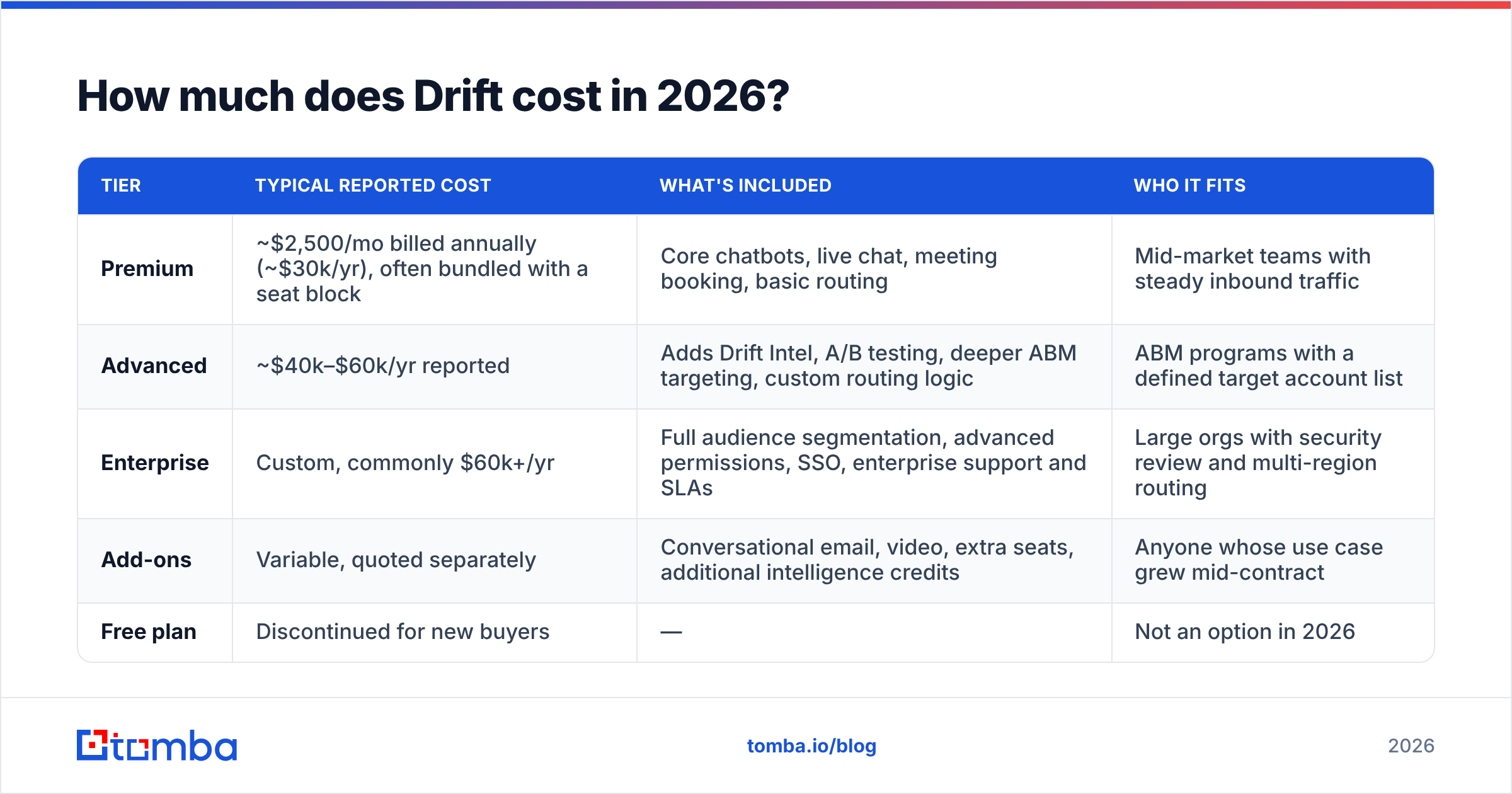
Drift dropped public self-serve pricing years ago. Every deal is quote-based and annual by default. Price is scoped by seats, traffic volume, and which intelligence modules you turn on. The numbers below come from buyers and reviewers on sites like G2 and from procurement threads. Treat them as ranges to anchor a negotiation, not as a rate card.
| Tier | Typical reported cost | What's included | Who it fits |
|---|---|---|---|
| Premium | Core chatbots, live chat, meeting booking, basic routing | Mid-market teams with steady inbound traffic | |
| Advanced | ~$40k–$60k/yr reported | Adds Drift Intel, A/B testing, deeper ABM targeting, custom routing logic | ABM programs with a defined target account list |
| Enterprise | Custom, commonly $60k+/yr | Full audience segmentation, advanced permissions, SSO, enterprise support and SLAs | Large orgs with security review and multi-region routing |
| Add-ons | Variable, quoted separately | Conversational email, video, extra seats, additional intelligence credits | Anyone whose use case grew mid-contract |
| Free plan | Discontinued for new buyers | — | Not an option in 2026 |
Three cost mechanics catch buyers off guard:
- Seat blocks, not per-seat flexibility. Plans usually come with a minimum seat bundle. Adding your fifteenth SDR is cheap. Shrinking from fifteen to eight mid-term is not.
- Annual, upfront, and hard to unwind. Month-to-month is rare. Reviewers often describe trouble downgrading before renewal. A bad quarter is still a paid quarter.
- Traffic tiers. Some contracts are scoped by monthly visitors or identified accounts. A good demand-gen campaign can quietly trigger an overage talk.
What do Drift reviews actually say?#
Review sentiment on Drift is positive on the product and negative on the commercials. That split is consistent enough to predict.
What reviewers praise:
- Speed to meeting. The book-a-meeting-inside-chat flow converts. Teams compress a multi-day form-to-SDR-to-calendar cycle into one chat.
- Routing that actually works. Territory, named-account, and round-robin routing hold up under real load. Mobile alerts mean reps do not lose the thread after hours.
- Playbook depth. You can build a different experience for pricing-page visitors, comparison readers, and existing customers.
- ABM signal. Drift Intel spots a target-account visitor and pings the account owner. ABM teams call that feature "worth the line item."
- Support and onboarding at higher tiers. Enterprise customers rate the CSM relationship well.
What reviewers criticize:
- Price transparency. The top complaint is not the number. It is having to sit through discovery calls to learn the number.
- Total cost versus attributed pipeline. Teams with modest traffic struggle to tie enough sourced pipeline to a $30k+ line item.
- Maintenance burden. Bots decay. Someone has to own playbook hygiene, or conversion quietly drops over two quarters.
- Contract rigidity. Downgrade friction and auto-renewal terms show up in negative reviews far more often than product bugs.
- Reporting depth. Attribution reporting is called adequate. It does not replace a real BI layer.
- Post-acquisition uncertainty. Some buyers have roadmap questions after the Salesloft deal and want clarity on standalone longevity.
Drift pricing reviews pros and cons at a glance#
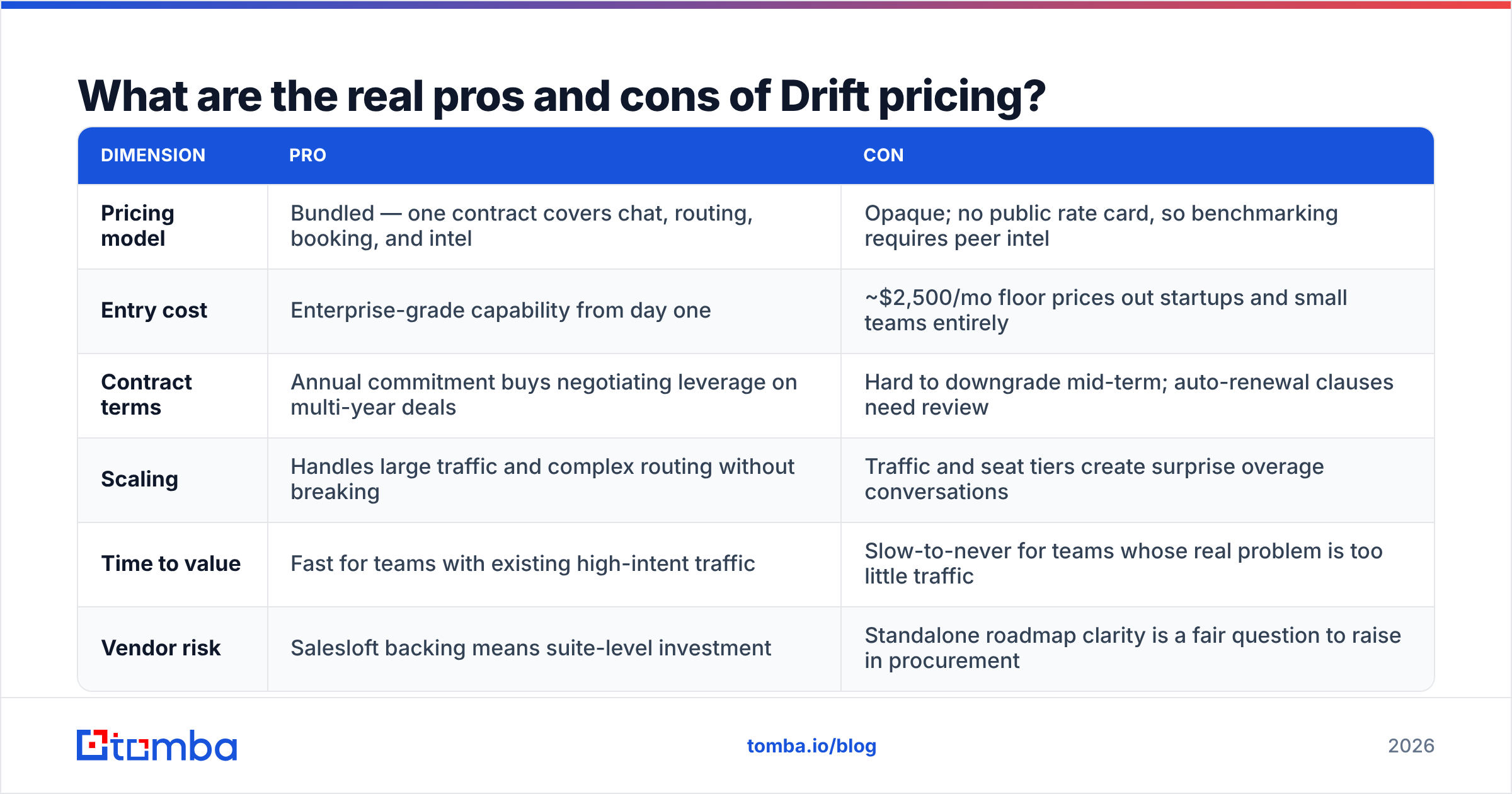
Here is the honest ledger, stated as a buyer would state it internally.
| Dimension | Pro | Con |
|---|---|---|
| Pricing model | Bundled — one contract covers chat, routing, booking, and intel | Opaque; no public rate card, so benchmarking requires peer intel |
| Entry cost | Enterprise-grade capability from day one | ~$2,500/mo floor prices out startups and small teams entirely |
| Contract terms | Annual commitment buys negotiating leverage on multi-year deals | Hard to downgrade mid-term; auto-renewal clauses need review |
| Scaling | Handles large traffic and complex routing without breaking | Traffic and seat tiers create surprise overage conversations |
| Time to value | Fast for teams with existing high-intent traffic | Slow-to-never for teams whose real problem is too little traffic |
| Vendor risk | Salesloft backing means suite-level investment | Standalone roadmap clarity is a fair question to raise in procurement |
The pattern is simple. Drift's pricing works well for companies that need to convert demand they already have. It works badly for companies that need to create demand in the first place.
Who should actually buy Drift?#
Run this filter before you take the demo:
- You get 20,000+ relevant monthly visitors. Below that, a chat layer just polishes a small funnel. Reviewers who regret the spend almost always sit here.
- Your ACV clears $25,000. One extra closed deal should cover a real slice of the annual contract. At a $6k ACV you need a lot of extra wins.
- You have a named-account list. Drift Intel plus ABM playbooks is where the premium tiers earn out. Without a target list, you are paying for a generic greeting.
- Someone owns conversation ops. Not "someone will look at it." A named owner with hours set aside for playbook review. Otherwise the investment decays.
- Your reps reply in minutes, not hours. Live chat with slow humans behind it is worse than a form. It promises speed and fails to deliver.
Miss two or more of those and the honest advice is to spend the same budget on pipeline creation instead.
What are the best Drift alternatives by budget?#
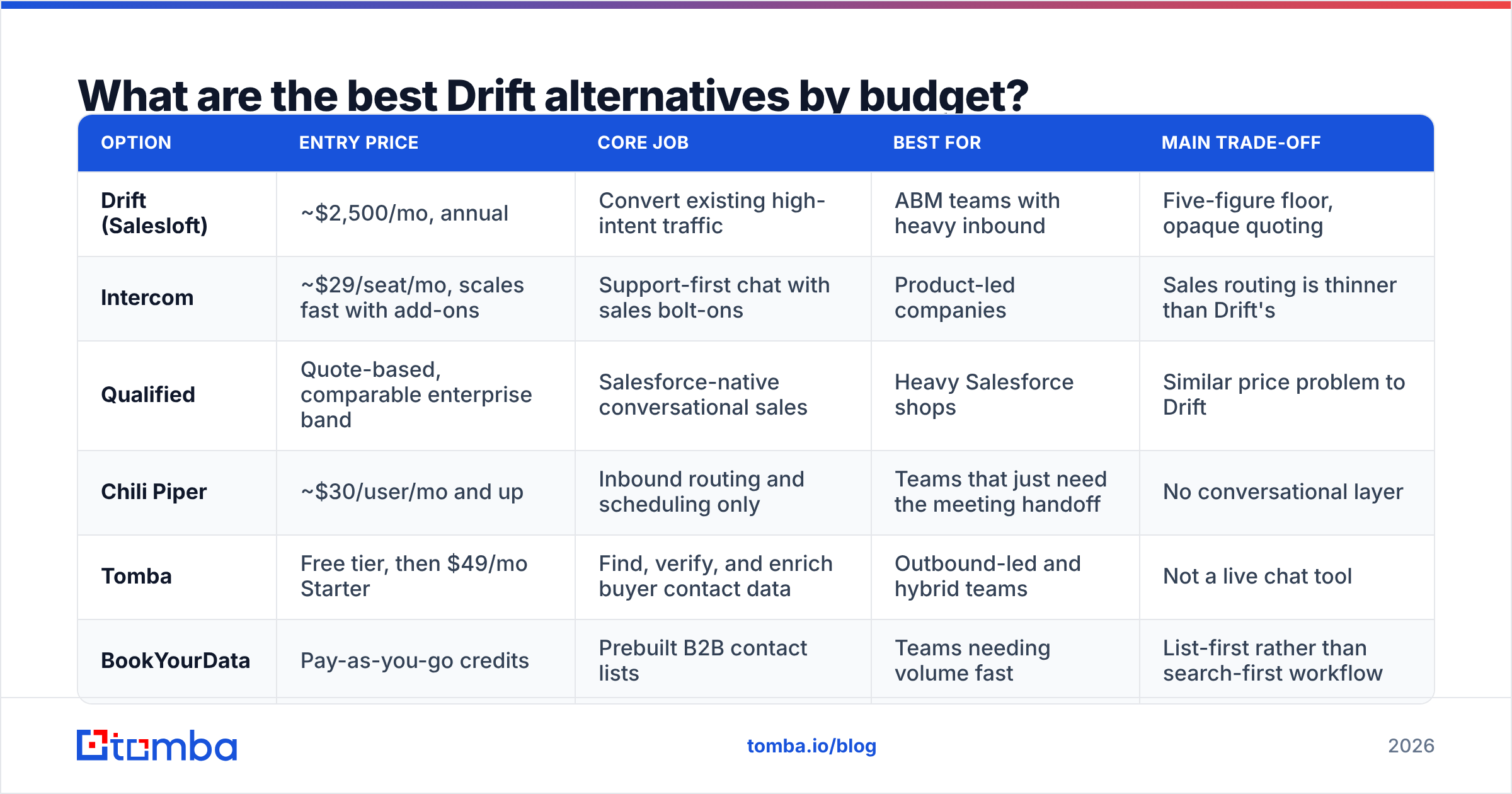
The alternatives split into two groups that people wrongly treat as one. Conversion tools help the traffic you have. Pipeline creation tools get you in front of buyers who never visited. Comparing Drift to a chat rival is easy. Comparing it to a data stack is the comparison that actually moves budgets.
| Option | Entry price | Core job | Best for | Main trade-off |
|---|---|---|---|---|
| Drift (Salesloft) | ~$2,500/mo, annual | Convert existing high-intent traffic | ABM teams with heavy inbound | Five-figure floor, opaque quoting |
| Intercom | ~$29/seat/mo, scales fast with add-ons | Support-first chat with sales bolt-ons | Product-led companies | Sales routing is thinner than Drift's |
| Qualified | Quote-based, comparable enterprise band | Salesforce-native conversational sales | Heavy Salesforce shops | Similar price problem to Drift |
| Chili Piper | ~$30/user/mo and up | Inbound routing and scheduling only | Teams that just need the meeting handoff | No conversational layer |
| Tomba | Free tier, then $49/mo Starter | Find, verify, and enrich buyer contact data | Outbound-led and hybrid teams | Not a live chat tool |
| BookYourData | Pay-as-you-go credits | Prebuilt B2B contact lists | Teams needing volume fast | List-first rather than search-first workflow |
Two of those deserve a note. BookYourData is a solid pay-as-you-go route when you want a list you can buy once and own outright. That is a different buying motion from a subscription, and a legitimate one. Tomba sits on the other side. You search for contacts on demand, verify them, and enrich as you go.
How do you build pipeline without a five-figure chat contract?#
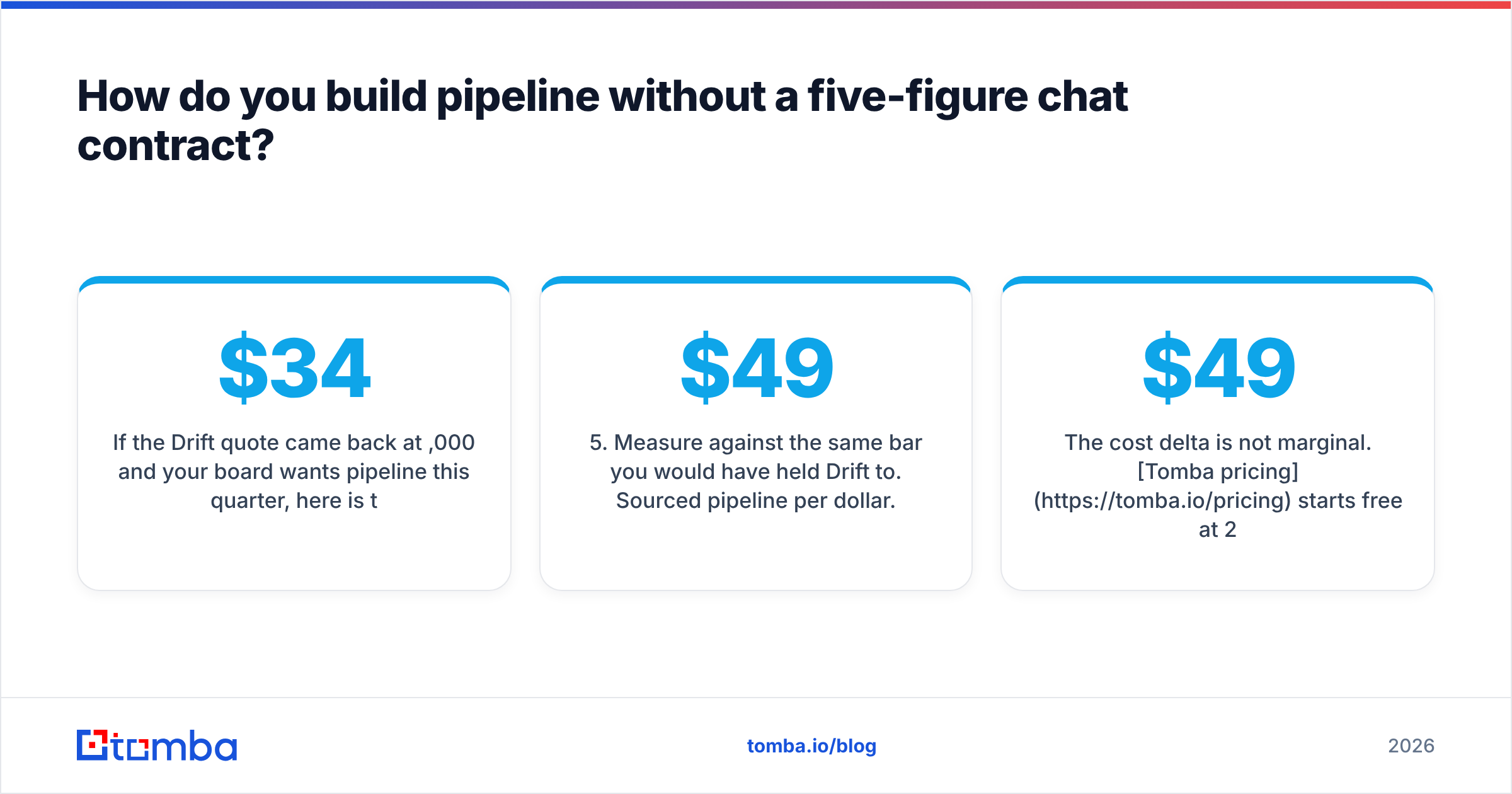
Say the Drift quote came back at $34,000 and your board wants pipeline this quarter. Here is the swap most teams should model.
1. Identify the traffic you already have. Reverse-IP company lookup is the part of Drift Intel people miss when they churn. Website visitor reveal does the same job. It turns anonymous sessions into named companies, with no chat platform attached.
2. Turn those companies into contacts. A company name is not a lead. Run domain search against the accounts that visited. You get the actual decision-makers, with role and seniority attached, instead of hoping the right person opens a chat window.
3. Verify before you send. Bounce rate is what kills the whole plan. Push every address through an email verifier first. That includes catch-all domains, where most "verified" lists quietly leak bad contacts.
4. Reach out with context, not a greeting. You know the account visited, which page, and who owns the decision. That beats any bot script. It also works whether or not the prospect ever comes back to your site.
5. Measure against the same bar you would have held Drift to. Sourced pipeline per dollar. If a $49–$99/month stack sources more than a $2,800/month chat contract, that is your answer. It is also easy to defend in a board deck.
The cost gap is not marginal. Tomba pricing starts free at 25 searches per month, then moves to $49/mo Starter, $99/mo Growth, and $249/mo Pro. Even the Pro plan runs about a tenth of a mid-tier Drift contract. It also attacks the constraint most teams really have: not enough qualified conversations, rather than poor handling of the ones already happening.
Should you negotiate or walk away?#
If Drift genuinely fits, negotiate rather than accept. Levers reviewers report working:
- Ask for the rate card in writing before the demo. A vendor that resists is telling you something about renewal behavior.
- Push for a multi-year discount only if you have twelve months of stable traffic data. Otherwise you are locking in a guess.
- Cap traffic-tier overages explicitly. Get the overage rate in the contract, not in a later email.
- Negotiate downgrade rights at renewal. This is the most common regret in negative reviews, and it is negotiable at signature.
- Time your purchase to quarter-end. Standard advice, and it still works.
If it does not fit, walking away is not a failure of ambition. Small traffic, low ACV, no named-account list, no dedicated owner: chat is a conversion multiplier, and multiplying a small number gives you a small number.
The bottom line#
Drift is a strong product with an expensive, opaque price model. The reviews say exactly that. High praise for routing and meeting capture. Steady frustration with pricing transparency and contract flexibility. If you have the traffic, the ACV, and an operational owner, it earns its keep. If any of those are missing, the honest read on Drift pricing reviews pros and cons is that you would pay enterprise rates to solve a problem you do not have yet.
Most teams evaluating Drift do not have a conversion problem. They have a "not enough of the right people know we exist" problem. If that is you, start by finding the buyers instead of waiting for them. The Tomba Email Finder locates verified professional email addresses by name, company, or domain, with a free tier so you can test the workflow first. Run it against your target account list for a month. Then compare sourced pipeline to the Drift quote sitting in your inbox, and let the numbers decide the renewal.
Related guides#
Ready to find emails that actually work?
Join 150,000+ professionals who stopped guessing and started sending. Free credits on signup — no credit card required.
Get the Tomba newsletter
Practical outbound tactics and product updates — once every two weeks.
About the author