Dubb Alternatives: 9 Video Sales Tools Compared for 2026
Dubb bundles video recording, hosting, landing pages and CRM tracking into one seat. Here are nine alternatives that do parts of that job cheaper, faster, or better — and how to pick between them.
TL;DR
- Dubb is a video sales platform: record, host, wrap the video in a branded landing page, then track opens and plays back into your CRM. It is strong on the "video as a sales asset" side and thin on data.
- Most teams shopping for Dubb alternatives want one of three things: a cheaper per-seat price, better async video UX for non-sales teammates, or deeper CRM/sequencing than a video tool can offer.
- Vidyard and Loom are the two most common swaps. Vidyard wins on sales-specific tracking; Loom wins on adoption and speed.
- Sendspark, Potion, and Hippo Video are the AI-personalisation lane — dynamic first frames, cloned voice, variable landing pages at scale.
- Whichever you pick, video does nothing if the email never lands. Contact accuracy and list hygiene move reply rate more than production value does.
What is Dubb, and why do people look for alternatives?#
Dubb is a video communication platform aimed at sellers. You record from the desktop app, Chrome extension, or mobile; the video gets hosted on a Dubb landing page with your branding, a call-to-action button, a calendar link, and a reply box; then Dubb reports who watched, how far they got, and pushes that activity into HubSpot, Salesforce, or Pipedrive. It also ships email and SMS sending, basic automation, and a presentation/screen-record mode.
That bundle is the appeal and also the friction. Four complaints come up repeatedly in review sites like G2 and in sales-team Slack channels:
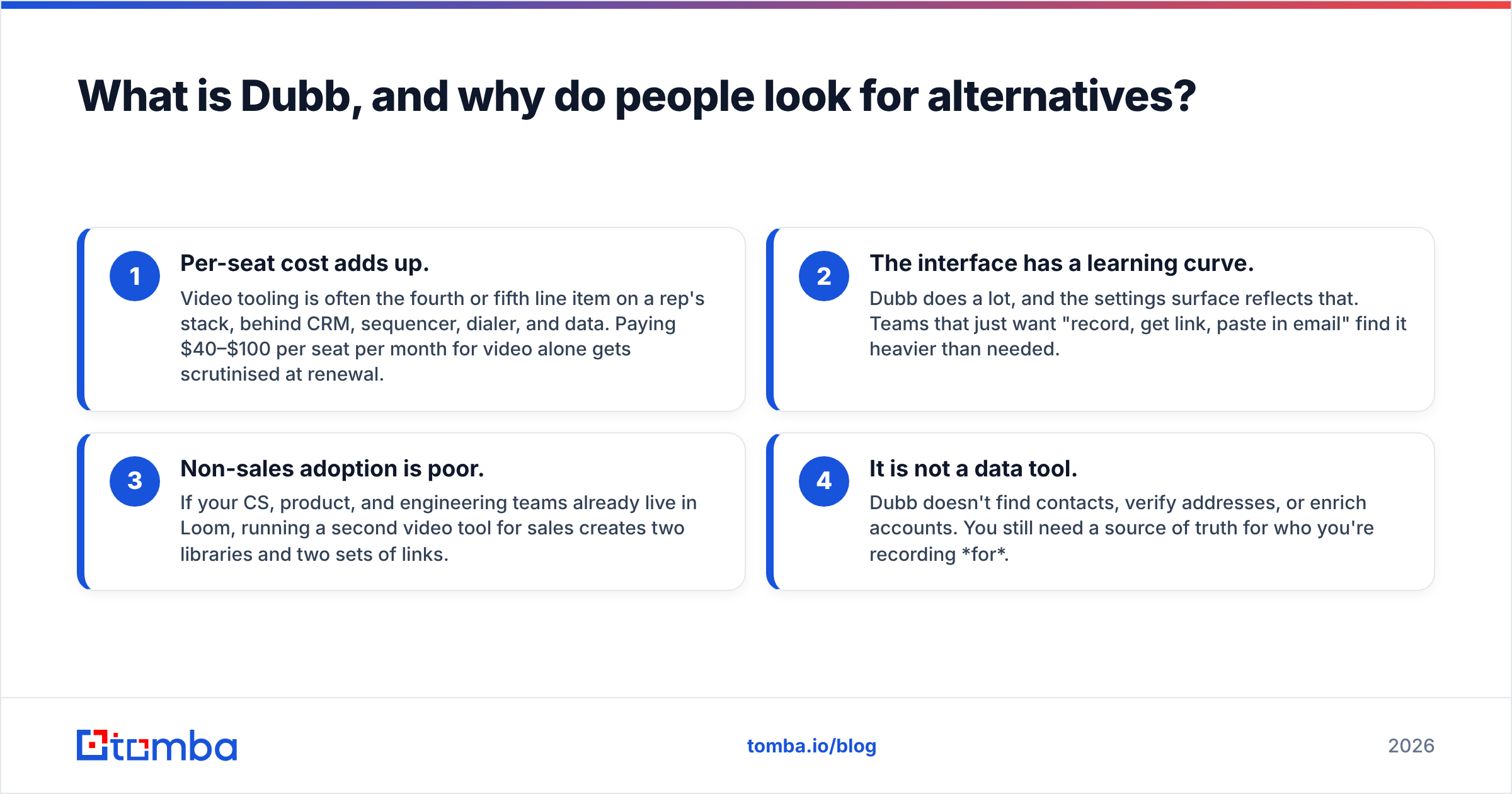
- Per-seat cost adds up. Video tooling is often the fourth or fifth line item on a rep's stack, behind CRM, sequencer, dialer, and data. Paying $40–$100 per seat per month for video alone gets scrutinised at renewal.
- The interface has a learning curve. Dubb does a lot, and the settings surface reflects that. Teams that just want "record, get link, paste in email" find it heavier than needed.
- Non-sales adoption is poor. If your CS, product, and engineering teams already live in Loom, running a second video tool for sales creates two libraries and two sets of links.
- It is not a data tool. Dubb doesn't find contacts, verify addresses, or enrich accounts. You still need a source of truth for who you're recording for.
None of those are disqualifying. But they explain why "Dubb alternatives" is a live search — the category has splintered into video-first, sales-first, and AI-personalisation-first tools that each solve a slice better.

What should you actually compare when evaluating Dubb alternatives?#
Skip the feature-count arms race. Six criteria decide whether a video tool survives past month three:
- Time-to-send. Measure it. From "I want to record" to "link is in my draft," anything over 90 seconds and reps stop doing it. Loom and Sendspark are fast; heavier platforms with mandatory landing-page config are not.
- Where the video lives. A hosted landing page gives you CTAs, branding, and a reply surface. A raw share link gives you speed and fewer spam signals. Some tools do both; some force one.
- Tracking fidelity and CRM write-back. "Someone watched" is useless. You want which contact, what percentage, how many rewatches, and an automatic timeline event in your CRM plus a task or alert.
- Deliverability behaviour. Video thumbnails are usually animated GIFs plus a tracked link. Both raise spam-filter interest. Ask whether the tool uses a shared tracking domain (bad) or lets you set a custom one (good), and how heavy the embedded HTML is.
- Personalisation at scale. Recording 200 individual videos is not a strategy. The AI lane — dynamic backgrounds, name overlays, one base recording variabilised across a list — is where volume teams have moved.
- Total stack cost. A $29 video tool that duplicates your sequencer is more expensive than a $59 one that replaces it. Price the stack, not the seat.

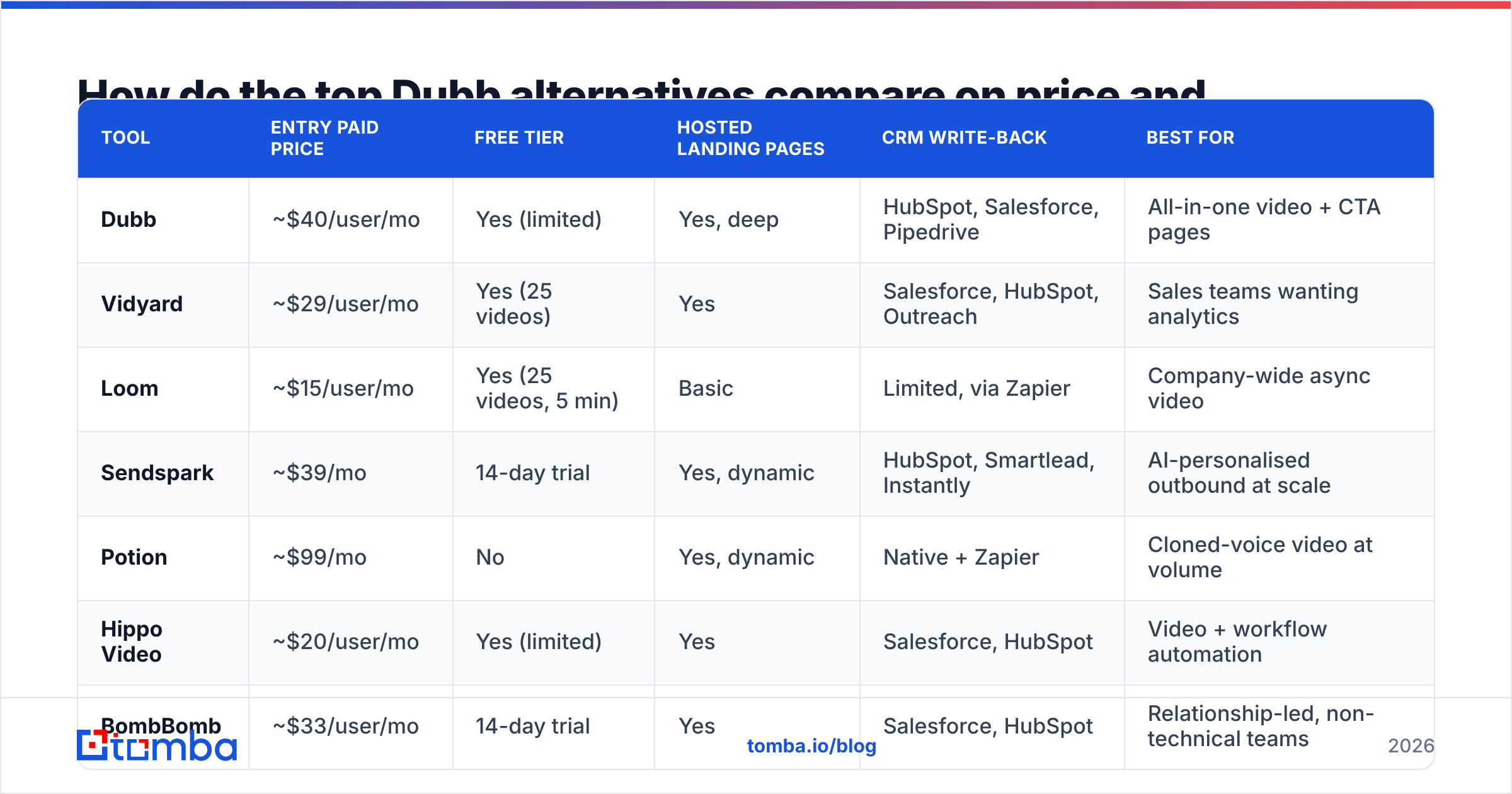
How do the top Dubb alternatives compare on price and features?#
Pricing below reflects publicly listed plans at the time of writing. Vendors change tiers often — check the vendor page before you buy.
| Tool | Entry paid price | Free tier | Hosted landing pages | CRM write-back | Best for |
|---|---|---|---|---|---|
| Dubb | ~$40/user/mo | Yes (limited) | Yes, deep | HubSpot, Salesforce, Pipedrive | All-in-one video + CTA pages |
| Vidyard | ~$29/user/mo | Yes (25 videos) | Yes | Salesforce, HubSpot, Outreach | Sales teams wanting analytics |
| Loom | ~$15/user/mo | Yes (25 videos, 5 min) | Basic | Limited, via Zapier | Company-wide async video |
| Sendspark | ~$39/mo | 14-day trial | Yes, dynamic | HubSpot, Smartlead, Instantly | AI-personalised outbound at scale |
| Potion | ~$99/mo | No | Yes, dynamic | Native + Zapier | Cloned-voice video at volume |
| Hippo Video | ~$20/user/mo | Yes (limited) | Yes | Salesforce, HubSpot | Video + workflow automation |
| BombBomb | ~$33/user/mo | 14-day trial | Yes | Salesforce, HubSpot | Relationship-led, non-technical teams |
| Warmly (Warm Welcome) | ~$25/user/mo | Yes | Yes | Zapier-first | SMB and solo founders |
| Tolstoy | ~$59/mo | Yes | Interactive | Shopify, HubSpot | Interactive branching video |
Vidyard — the closest like-for-like swap#
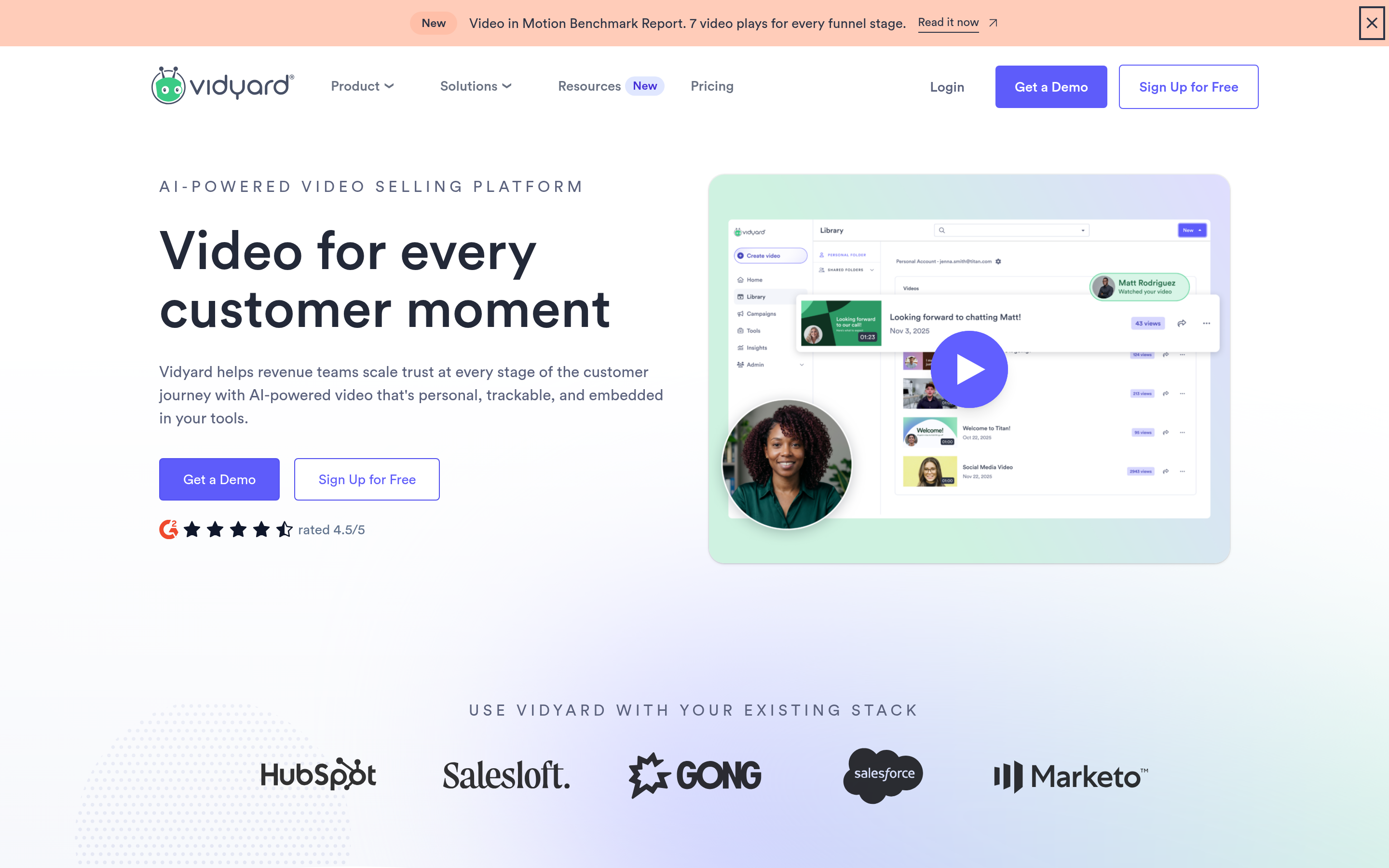
Vidyard is the default answer for teams leaving Dubb who still want a sales-grade video platform. You get a Chrome extension, screen + camera recording, GIF thumbnails, hosted video pages, and per-viewer analytics that push into Salesforce, HubSpot, and Outreach. Its free tier is genuinely usable (25 videos), and the AI script assistant plus AI avatars have matured.
Where it beats Dubb: analytics depth and enterprise integrations. Where it doesn't: Vidyard's landing pages are less configurable than Dubb's, and per-seat pricing at scale lands in the same neighbourhood. Choose Vidyard if tracking and CRM hygiene matter more than page design.
Loom — the adoption winner#
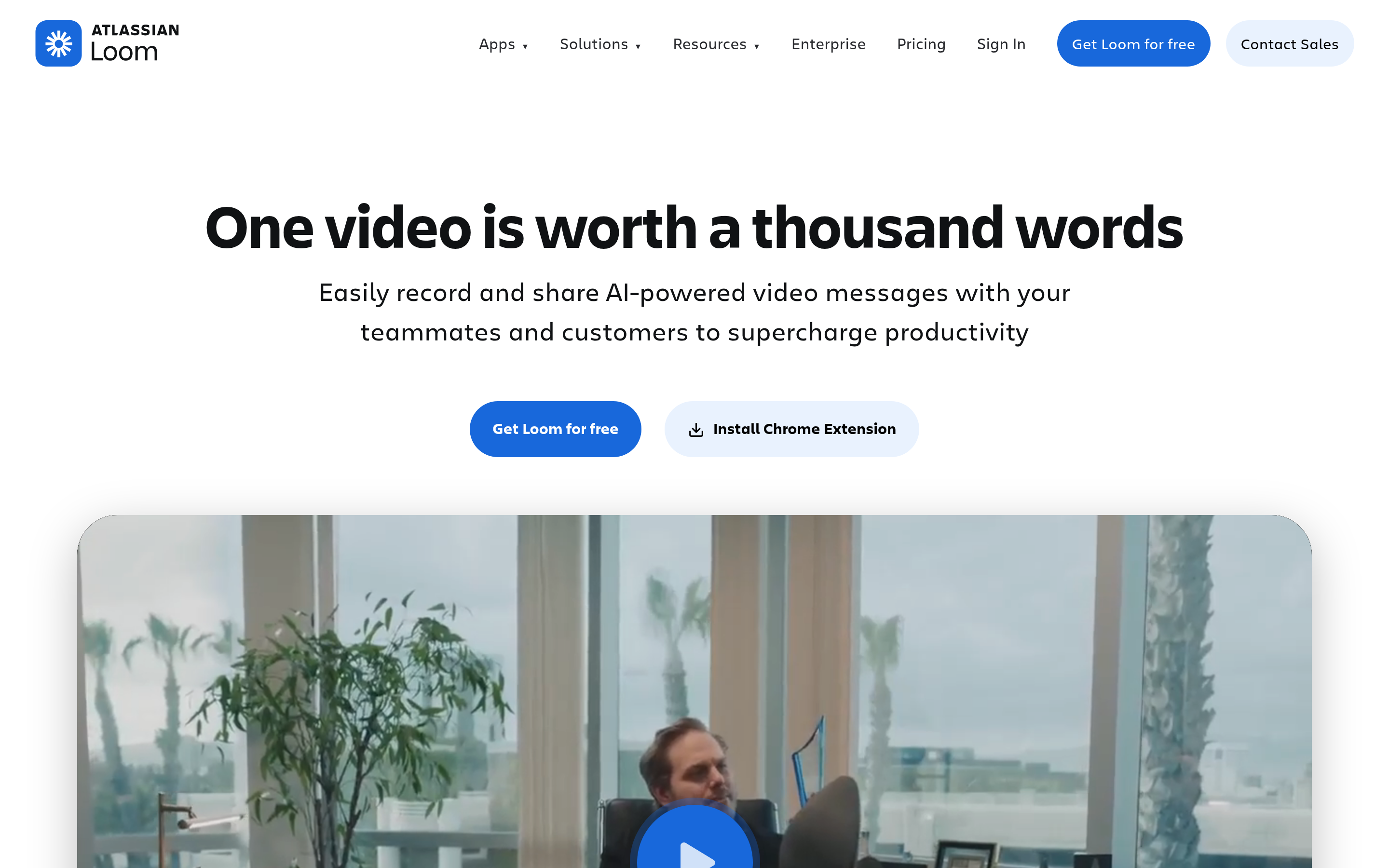
Loom isn't a sales tool and doesn't pretend to be. It's the fastest path from thought to shareable video, with the best editing UX in the category and near-universal recognition — recipients know what a Loom link is, which reduces click hesitancy.
The trade-off is real: no sales-specific tracking beyond view counts, no CTA-driven landing pages, thin CRM integration without Zapier glue. If you're a founder or a small team where sales, support, and product all record video, Loom's $15/seat and company-wide adoption usually beats a specialist tool nobody else logs into.
Sendspark — dynamic video for outbound at volume#
Sendspark is built for the cold-outreach use case specifically. Record one base video, then let it generate personalised variants: the prospect's website in the background, their name on a whiteboard, a dynamic first frame. It integrates directly with sending platforms like Instantly and Smartlead rather than assuming you'll paste links manually.
This is the tool to look at if your problem is "I need 500 personalised videos this month, not 20." It also means the quality ceiling is lower than a genuinely bespoke recording — dynamic personalisation is convincing until a prospect looks closely.
Potion — cloned voice, higher price#
Potion goes further than Sendspark on AI: it clones your voice and lip-syncs a base recording so each video says the prospect's name and company out loud. Results are good enough that reply-rate case studies are plausible. It's also roughly $99/month entry, so it only pays back if you're sending real volume.
Hippo Video, BombBomb, Warm Welcome, Tolstoy#
- Hippo Video bundles video with workflow automation and sales-page playlists; strong if you want video plus light sequencing in one tool.
- BombBomb is the veteran, heavily used in real estate, mortgage, and insurance. Simple, relationship-focused, non-technical.
- Warm Welcome targets solos and small teams — video widgets on your website, video voicemail, low price.
- Tolstoy is the odd one out: interactive branching video where viewers choose a path. Better for onboarding, product demos, and site conversion than for one-to-one outreach.
Is video actually worth it, or is this a solved-problem tax?#
Honest answer: video helps at the middle of the funnel far more reliably than at the top.
Where video consistently earns its keep:
- Post-discovery recaps. A three-minute walkthrough sent after a call, addressed to the people who weren't on it, travels through the buying committee better than a deck.
- Re-engaging stalled deals. A 45-second "here's what changed since we last spoke" outperforms another text follow-up.
- Objection handling. Showing the workaround beats describing it.
- Renewals and expansion. Familiar face, low stakes, high open rate.
Where video underperforms the hype:
- Pure cold first-touch. GIF thumbnails inflate email size, add an external image request, and introduce a tracked redirect. Every one of those is a signal filters weigh. If your email deliverability is already borderline, adding video to a cold sequence can lower net replies even while lifting reply rate among the emails that land.
- Unverified lists. A personalised video sent to a dead address is the most expensive bounce in your stack — you spent two minutes producing it.
That second point is the one nobody selling video tools will lead with. Reply rate is a ratio, and the denominator is "emails that reached a real human inbox." A 2x lift in reply rate on a list where 22% of addresses bounce is worse than a flat text sequence on a clean list.
Where does contact data fit into a video outreach stack?#
Video tools assume you already know who to record for and where to send it. That assumption is where most video programs quietly fail.
A workable order of operations:
- Build the account list from your ICP — industry, headcount, tech stack, hiring signals.
- Find the right contacts. Use a domain search to pull every discoverable role at a company, then narrow to the two or three people whose job the video actually speaks to. Recording for a title you guessed is wasted effort.
- Verify before you record. Run every address through an email verifier and quarantine anything risky. This is a five-second step that protects both your sender reputation and your recording time. For domains that accept everything, a dedicated catch-all verifier tells you whether the mailbox is plausible rather than just "unknown."
- Enrich for the script. You need one true, specific detail per prospect — a recent funding round, a job posting, a page on their site. Generic video is worse than generic text because it takes longer to sit through.
- Then record. Segment your list so the top 20% gets a real one-to-one video, and the rest gets either a dynamic variant or plain text.
- Route the signal. When someone watches 80% of a video, that's a buying signal. It should create a task, not just a dashboard row.
Steps 2 and 3 sit upstream of every tool in the comparison table, and none of those tools do them. That's the gap most teams paper over with a scraped CSV and hope.
Which Dubb alternative should you pick?#
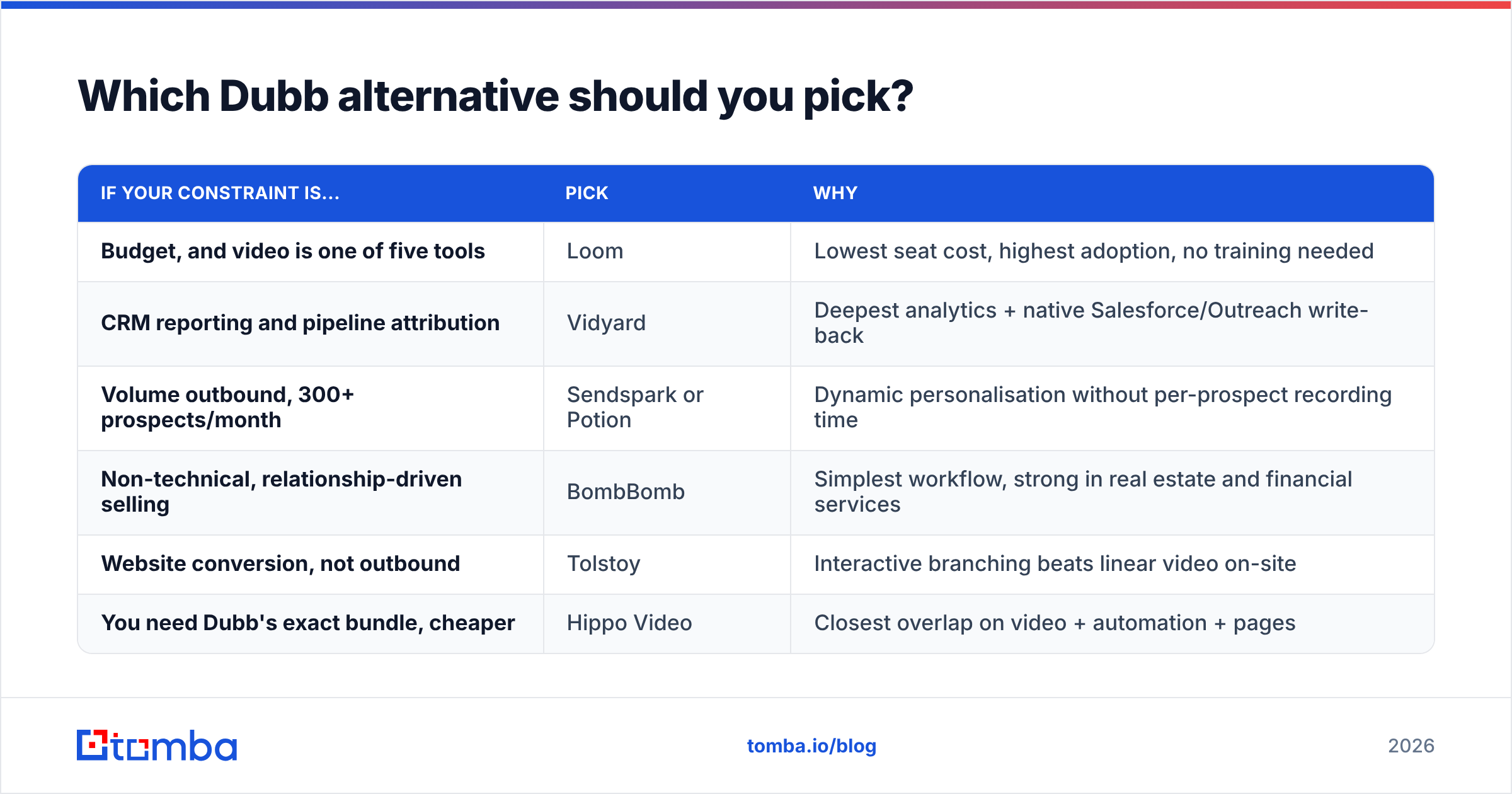
Match the tool to the constraint, not to the feature list:
| If your constraint is... | Pick | Why |
|---|---|---|
| Budget, and video is one of five tools | Loom | Lowest seat cost, highest adoption, no training needed |
| CRM reporting and pipeline attribution | Vidyard | Deepest analytics + native Salesforce/Outreach write-back |
| Volume outbound, 300+ prospects/month | Sendspark or Potion | Dynamic personalisation without per-prospect recording time |
| Non-technical, relationship-driven selling | BombBomb | Simplest workflow, strong in real estate and financial services |
| Website conversion, not outbound | Tolstoy | Interactive branching beats linear video on-site |
| You need Dubb's exact bundle, cheaper | Hippo Video | Closest overlap on video + automation + pages |
Two decisions people get wrong:
Don't buy an AI-personalisation tool before you've proven manual video works. Scale a process that converts. Scaling one that doesn't just produces 500 videos nobody watches.
Don't count on video to fix a targeting problem. If your reply rate is 0.5%, the issue is almost never format. It's list quality, offer, or timing. Fix the list first — it's cheaper and faster than any of these subscriptions.
What about the total cost of the stack?#
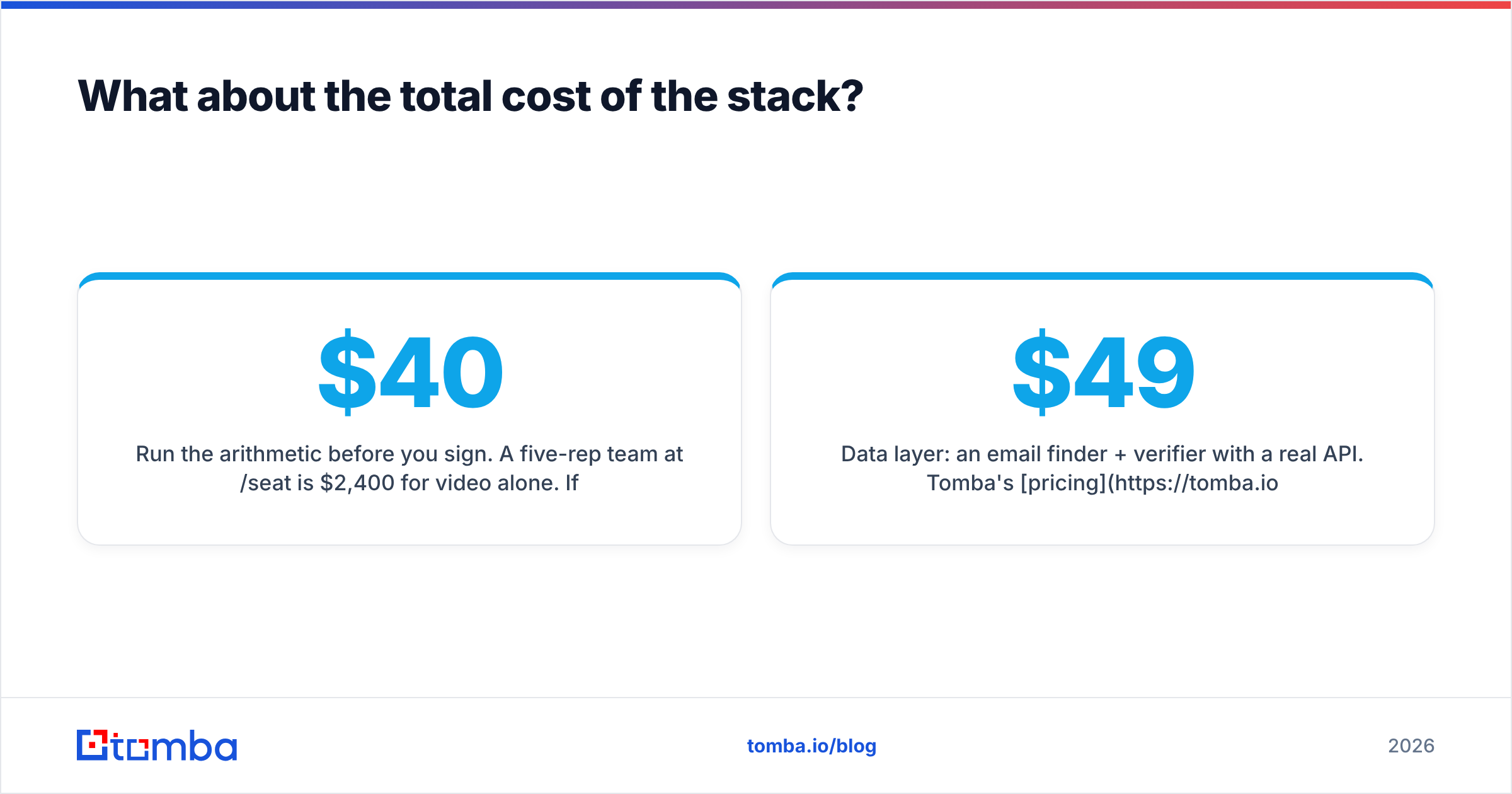
Run the arithmetic before you sign. A five-rep team at $40/seat is $2,400/year for video alone. If that video tool duplicates sequencing you already pay for, you're paying twice for the same job.
A leaner shape for most SMB teams:
- Data layer: an email finder + verifier with a real API. Tomba's pricing runs from a free tier with 25 searches/month, through Starter at $49/mo and Growth at $99/mo, up to Pro at $249/mo — sized to how many contacts you actually source, not how many seats you have.
- Sending layer: whatever sequencer you already own.
- Video layer: Loom or Vidyard free tier until video proves out, then upgrade the two reps who actually use it.
That's a materially cheaper stack than an all-in-one, and each piece is replaceable without ripping out the others.
Frequently asked questions#
Is there a free Dubb alternative? Yes. Loom's free plan gives 25 videos up to five minutes each; Vidyard's free plan gives 25 videos with basic analytics. Both are enough to test whether your team will actually record.
Does Dubb have a free plan? Dubb offers a limited free tier, but landing-page customisation, analytics depth, and automation sit on paid plans.
Do video emails hurt deliverability? They can. Animated GIF thumbnails and tracked redirect links both add risk. Use a custom tracking domain, keep the HTML light, and consider linking a plain text URL for cold first-touch.
Can I use video in an automated sequence? Yes — Sendspark, Hippo Video, and Vidyard all integrate with major sequencers. Just don't automate video into an unverified list.
Start with the list, then pick the camera#
Every tool above competes on production, hosting, and tracking. None of them competes on whether the address you're sending to exists, belongs to the person you researched, or will accept mail from your domain. That layer decides whether the rest of the stack has anything to work with.
Build it first. Use the Tomba Email Finder to source verified, role-matched contacts by domain or by name before you hit record — free for your first 25 searches a month, $49/mo on Starter when you're ready to scale. Then pick whichever Dubb alternative fits your budget, and spend your recording time on prospects who will actually receive the video.
Related guides#
Ready to find emails that actually work?
Join 150,000+ professionals who stopped guessing and started sending. Free credits on signup — no credit card required.
Get the Tomba newsletter
Practical outbound tactics and product updates — once every two weeks.
About the author