9 Best Dubsado Alternatives in 2026: Honest Comparison
Dubsado's workflows are powerful, but the learning curve, dated UI, and per-brand pricing push plenty of service businesses to look elsewhere. Here are nine Dubsado alternatives compared on price, automation depth, and who each one actually fits.

TL;DR
- Most people search for Dubsado alternatives for three reasons: the workflow builder has a steep learning curve, the interface feels dated next to newer tools, and multi-brand setups get expensive fast.
- HoneyBook is the easiest switch for solo creatives. Bonsai is the best fit for consultants who need contracts plus accounting. Moxie is the closest like-for-like on automation depth at a lower price.
- Táve and Studio Ninja are photography-specific and beat every generalist on shoot logistics. Plutio and Copilot win when you need a real client portal.
- No client-management CRM fills your pipeline. If your problem is "not enough qualified leads reaching the proposal stage," a CRM swap won't fix it — prospecting data will.
- Budget realistically: $20–$79/month for the CRM, plus whatever you spend on lead sourcing and outreach on top.
What is Dubsado, and why do people leave it?#
Dubsado is a client-management platform built for service businesses — photographers, designers, coaches, agencies, virtual assistants. It bundles lead capture forms, proposals, contracts with e-signature, invoicing, scheduling, and a workflow engine that chains those pieces into automated sequences. Pricing sits at roughly $20/month on the Starter plan and $40/month on Premier (annual billing), with a free trial capped by client count rather than days.
It is genuinely good software. The reason the search volume for Dubsado alternatives keeps climbing is not that it's broken — it's that the tool asks a lot of you before it pays you back.
The four complaints that show up most consistently in G2 reviews and community threads:
- The setup tax. Dubsado's workflows are conditional and powerful, which means building your first one takes hours, not minutes. Plenty of users pay for onboarding help. If you're a solo operator, that's a real cost.
- Interface age. The UI has improved but still feels heavier than newer competitors. Navigation between projects, forms, and templates involves more clicks than most people want.
- Per-brand pricing. Running two businesses under one account requires the higher tier plus multi-brand add-ons. Agencies with sub-brands feel this immediately.
- Weak mobile and portal experience. The client-facing side is functional but not the polished portal that Copilot or Plutio ship as their core product.
None of those are dealbreakers on their own. Stacked together, they explain why the "should I switch?" question comes up around month six — right when you've invested enough to feel the friction but not enough to feel locked in.

Which Dubsado alternatives are worth considering in 2026?#
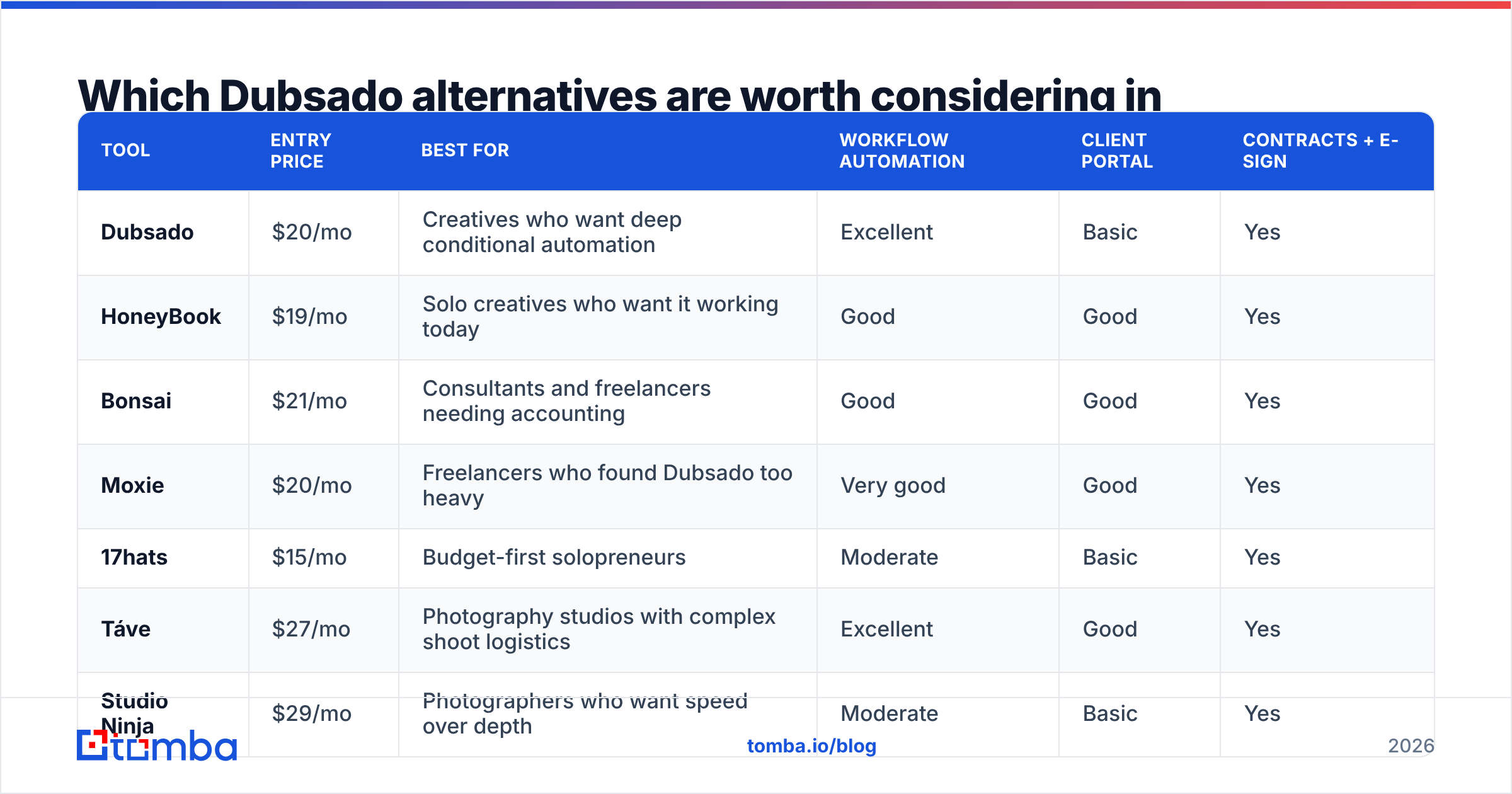
Here's the shortlist, compared on the attributes that actually drive switching decisions. Prices reflect published annual-billing rates and change often — verify before you commit.
| Tool | Entry price | Best for | Workflow automation | Client portal | Contracts + e-sign |
|---|---|---|---|---|---|
| Dubsado | $20/mo | Creatives who want deep conditional automation | Excellent | Basic | Yes |
| HoneyBook | $19/mo | Solo creatives who want it working today | Good | Good | Yes |
| Bonsai | $21/mo | Consultants and freelancers needing accounting | Good | Good | Yes |
| Moxie | $20/mo | Freelancers who found Dubsado too heavy | Very good | Good | Yes |
| 17hats | $15/mo | Budget-first solopreneurs | Moderate | Basic | Yes |
| Táve | $27/mo | Photography studios with complex shoot logistics | Excellent | Good | Yes |
| Studio Ninja | $29/mo | Photographers who want speed over depth | Moderate | Basic | Yes |
| Plutio | $19/mo | Small agencies needing projects + CRM in one | Good | Excellent | Yes |
| Copilot | $39/mo | Productized services with a premium client UX | Moderate | Excellent | Via app |
Two things jump out. First, the price band is narrow — almost everything lands between $15 and $40/month, so cost is rarely the deciding factor. Second, the real differentiator is which half of the job you care about more: internal automation depth (Dubsado, Táve, Moxie) or the client-facing experience (Copilot, Plutio, HoneyBook).
How do you actually choose between them?#
Work through these five questions in order. The answer usually falls out by question three.
- How many hours will you spend on setup? If the honest answer is "under four," rule out Dubsado, Táve, and Moxie's advanced automations. HoneyBook and 17hats get you sending proposals the same afternoon. Depth you never configure is depth you never get.
- Does your client experience sell the engagement? For premium retainers and productized services, the portal is part of the pitch. Copilot and Plutio treat it as the product; the others treat it as a feature.
- Do you need bookkeeping in the same tool? Bonsai includes expense tracking, tax estimates, and 1099-friendly reporting. Everyone else expects you to bolt on QuickBooks or Xero, which is fine — until you're reconciling two systems every quarter.
- Is your work vertical-specific? Photographers get materially more from Táve or Studio Ninja: shoot scheduling, second-shooter coordination, gallery delivery hooks. A generalist CRM makes you rebuild that logic by hand.
- How many brands or entities do you run? Multi-brand is where Dubsado's pricing bites hardest and where Plutio's flat-rate teams model looks cheapest.
Is HoneyBook actually better than Dubsado?#
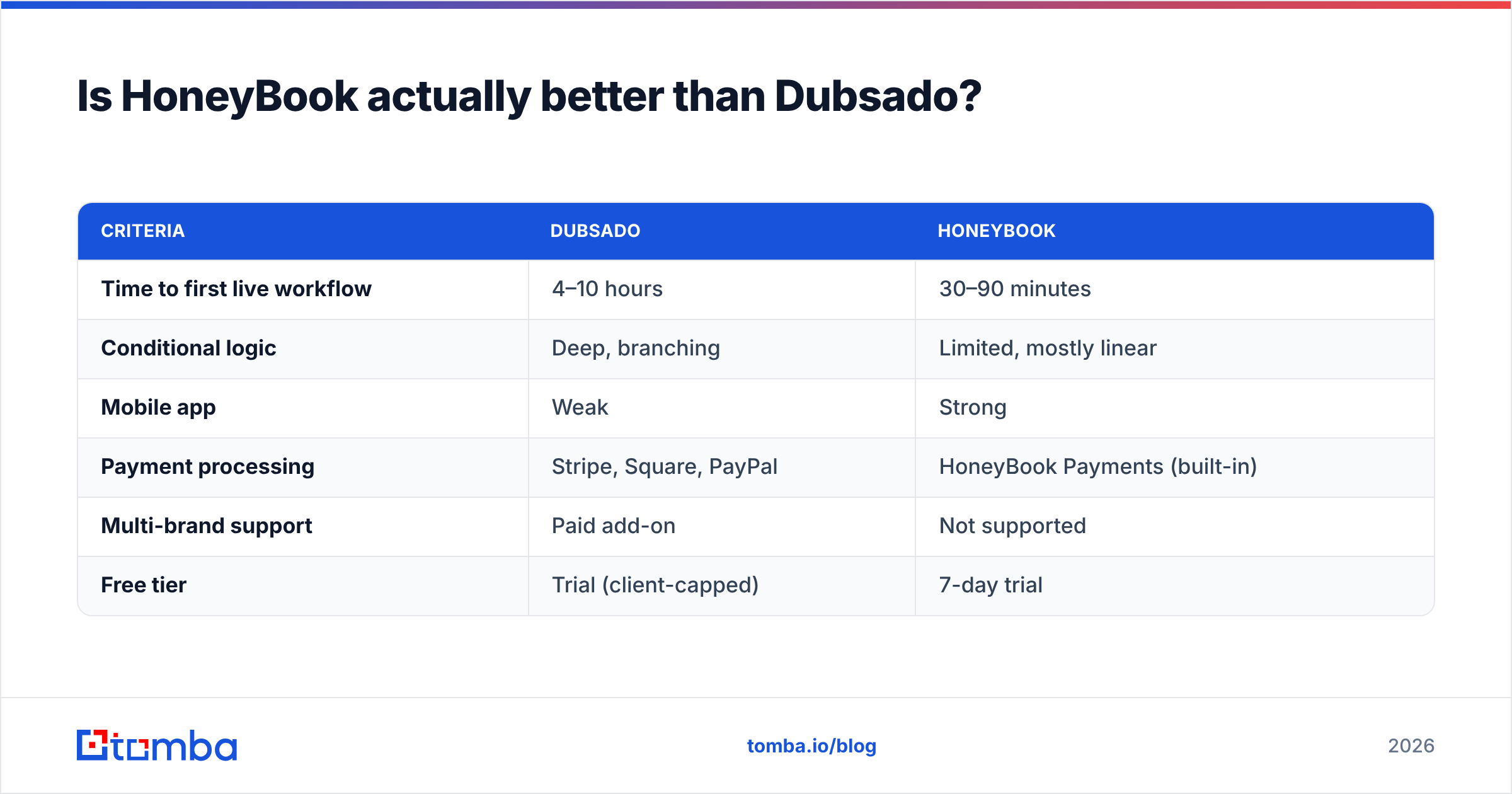
Better at onboarding, worse at automation. That's the whole comparison in one line.
HoneyBook wins on time-to-first-proposal. Templates are opinionated, the mobile app is legitimately good, and the payment flow converts well. If you bill under $200K/year and your process is basically "inquiry → proposal → contract → invoice → done," HoneyBook removes friction Dubsado adds.
Dubsado wins the moment your process branches. Conditional workflows — send X if the client selects package B, wait 3 days, then trigger Y unless the questionnaire came back — are where Dubsado earns its reputation. HoneyBook's automations are linear by comparison.
| Criteria | Dubsado | HoneyBook |
|---|---|---|
| Time to first live workflow | 4–10 hours | 30–90 minutes |
| Conditional logic | Deep, branching | Limited, mostly linear |
| Mobile app | Weak | Strong |
| Payment processing | Stripe, Square, PayPal | HoneyBook Payments (built-in) |
| Multi-brand support | Paid add-on | Not supported |
| Free tier | Trial (client-capped) | 7-day trial |
The practical rule: if you've already built Dubsado workflows and they work, switching to HoneyBook is a downgrade in capability you'll notice within a month. If you bought Dubsado and never finished setup, HoneyBook is the tool you should have bought.
What about Bonsai, Moxie, and the consultant-focused options?#
Bonsai is the best pick for consultants and agencies that want one subscription covering proposals, contracts, time tracking, invoicing, and bookkeeping. The contract templates are lawyer-reviewed and the tax features are genuinely useful for US-based freelancers. Where it falls short: automation is shallower than Dubsado, and the CRM side is more "contact list" than pipeline.
Moxie (formerly Hectic) is the closest thing to "Dubsado, but lighter." It has real conditional automation, a decent portal, time tracking, and a pricing model that doesn't punish growth. It's the alternative to try first if your only complaint about Dubsado is the weight, not the feature set.
17hats is the budget option. Lower price, simpler feature set, older interface. It's a fine landing spot if you're downgrading deliberately, and a frustrating one if you expected parity.
Plutio deserves more attention than it gets. It combines project management (tasks, kanban, time tracking) with CRM and invoicing, so agencies running client delivery and client billing in separate tools can consolidate. The portal is white-labelable, which matters for anyone reselling services.
Copilot is the premium play. If you run a productized service — bookkeeping, design subscriptions, fractional roles — the client-facing experience Copilot ships beats every tool on this list. You pay for it, and contracts run through app integrations rather than native e-sign.
What do Dubsado alternatives not solve?#
Every tool in this comparison manages clients you already have. None of them find you new ones.
This is the single most common mistake in the "which CRM should I switch to?" decision: swapping tools when the actual bottleneck is upstream. Signs you're solving the wrong problem:
- Your workflows are fine — there just aren't enough projects flowing through them.
- Your close rate on proposals is healthy (over 30%), but you send four proposals a month.
- You spend more time hunting for prospect contact details than configuring automations.
If any of that describes you, the fix isn't a new CRM. It's a repeatable way to identify target accounts, find the decision-maker's email, verify it before you send, and get outreach into the CRM you already own. That's a data problem, not a workflow problem.
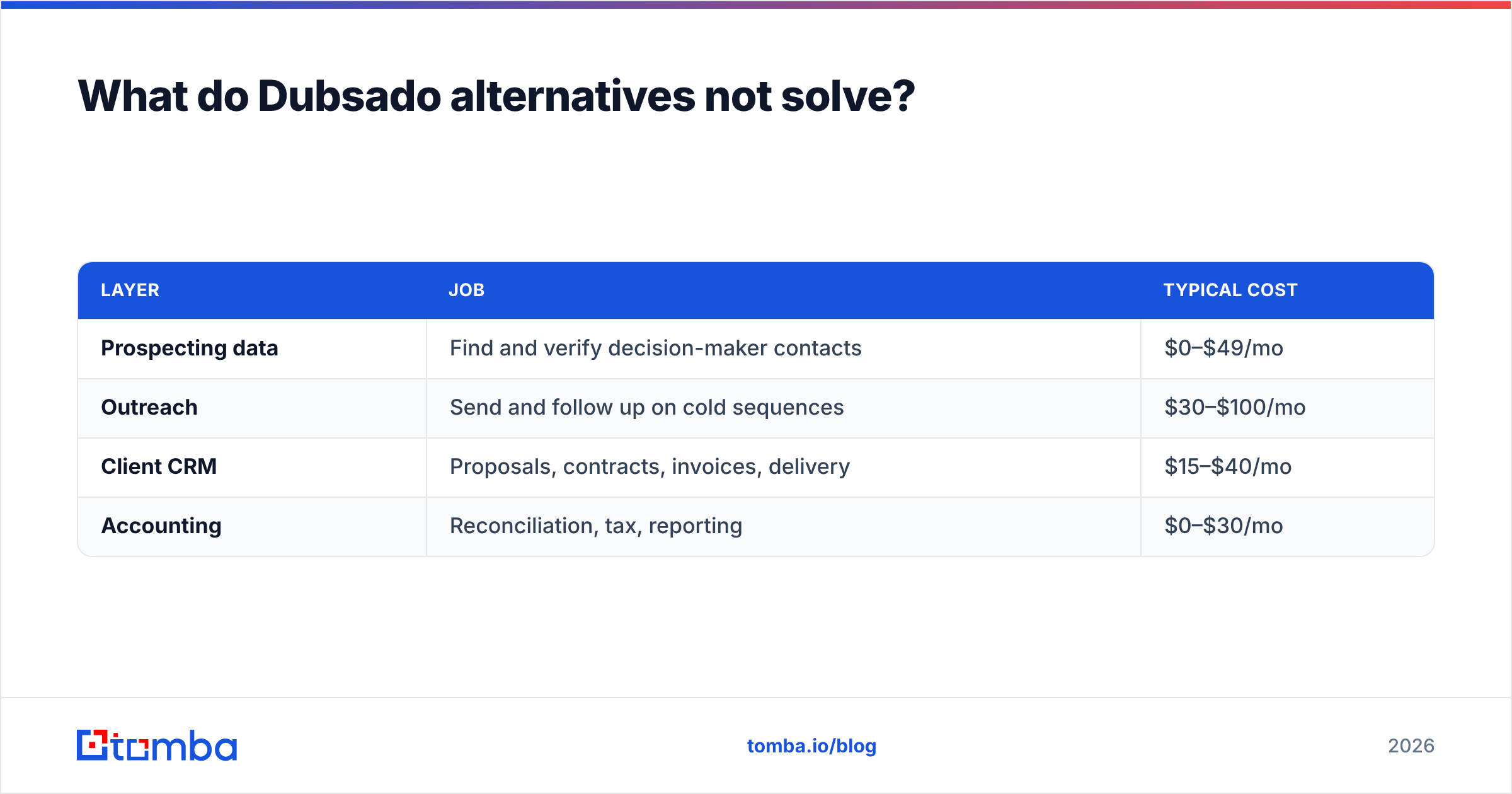
A practical stack for service businesses looks like this:
| Layer | Job | Typical cost |
|---|---|---|
| Prospecting data | Find and verify decision-maker contacts | $0–$49/mo |
| Outreach | Send and follow up on cold sequences | $30–$100/mo |
| Client CRM | Proposals, contracts, invoices, delivery | $15–$40/mo |
| Accounting | Reconciliation, tax, reporting | $0–$30/mo |
Notice that the CRM layer — the one people agonize over — is rarely the biggest line item or the biggest lever. Getting 40 qualified conversations a month instead of 8 changes your business. Getting a slightly nicer proposal template does not.
For the prospecting layer, an email finder plus an email verifier covers the essentials: give it a name and company domain, get a deliverable address back, and check it before it burns your sender reputation. Tomba's domain search is the workflow most service businesses actually use — point it at a target company's website and pull every published contact with role and confidence scores attached, then push the good ones into whichever CRM you landed on.
How do you migrate off Dubsado without losing anything?#
Migration is where switches die. Four steps, in order:
- Export everything before you cancel. Dubsado lets you export clients, projects, and invoices as CSV. Contracts and completed forms often need to be downloaded individually as PDFs — budget an afternoon. Do this while your subscription is still active; access ends when billing does.
- Rebuild one workflow, not all of them. Pick your highest-volume path (usually inquiry → proposal → signed) and rebuild only that in the new tool. Run it live for two weeks. If it holds, migrate the rest. If it doesn't, you've lost two weeks instead of two months.
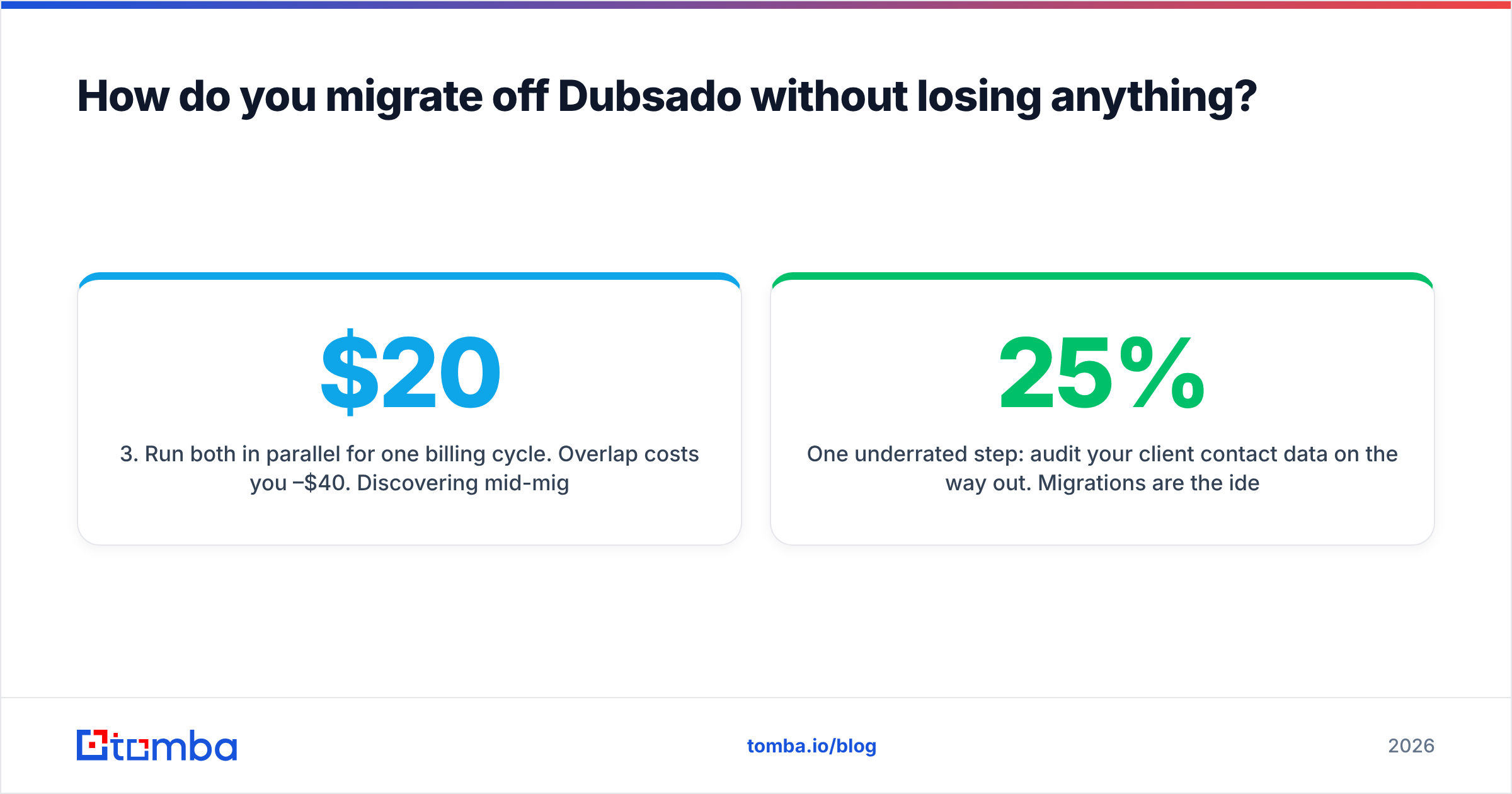
- Run both in parallel for one billing cycle. Overlap costs you $20–$40. Discovering mid-migration that recurring invoices didn't transfer costs you a client relationship.
- Re-point your integrations last. Calendar, payment processor, accounting sync, and any Zapier integration or automation connecting your lead forms to your CRM. These break quietly — test each one with a real record, not a dummy.
One underrated step: audit your client contact data on the way out. Migrations are the ideal moment to catch the 15–25% of records that have gone stale since you collected them. Bounced invoice reminders and undelivered contract links are silent revenue leaks, and a bulk pass through a bulk verify run is cheaper than chasing them one at a time.
Which Dubsado alternative should you pick?#
Short answers by situation:
- Solo creative, want it running today → HoneyBook
- Consultant who hates bookkeeping → Bonsai
- Loved Dubsado's power, hated its weight → Moxie
- Photographer with complex shoots → Táve
- Small agency doing delivery and billing → Plutio
- Productized service, premium clients → Copilot
- Tightest possible budget → 17hats
- Your workflows are fine, your pipeline isn't → don't switch CRMs at all
Check current pricing on each vendor's own site and on Capterra before committing — this category changes plans and limits frequently, and the free trial is always the better test than any comparison table, including this one.
Fix the pipeline, not just the CRM. If proposals aren't the bottleneck — prospects are — start upstream. Tomba's Email Finder turns a name and company domain into a verified, deliverable email address, with a free tier of 25 searches a month to test it against your own target list. Paid plans start at $49/month on Starter, $99/month on Growth, and scale to Pro at $249/month; full Tomba pricing is public, and the Tomba API plugs the same data into whichever client-management tool you end up choosing.
Related guides#
Ready to find emails that actually work?
Join 150,000+ professionals who stopped guessing and started sending. Free credits on signup — no credit card required.
Get the Tomba newsletter
Practical outbound tactics and product updates — once every two weeks.
About the author