Dun Bradstreet vs Tomba: Which B2B Data Tool Wins in 2026?
Dun & Bradstreet sells firmographic company data at enterprise prices. Tomba finds and verifies work emails at $49/mo. Here's the honest breakdown of which one your team actually needs — and when you need both.
Dun Bradstreet vs Tomba is not a fair fight, because the two tools do different jobs. D&B maps companies. Tomba finds and verifies the work email of the person you want to reach.
TL;DR
- Dun & Bradstreet and Tomba solve different problems. D&B sells company-level firmographics, credit risk scores, and the DUNS Number registry. Tomba finds and verifies the individual work email addresses you actually send to.
- Price gap is enormous. D&B contracts typically land in the five-figure annual range with custom quotes and multi-year terms. Tomba starts free (25 searches/mo) and tops out at $249/mo on Pro.
- If your job is compliance, credit, supplier risk, or account scoring at enterprise scale, D&B is hard to replace. If your job is filling a pipeline with reachable contacts this quarter, D&B is the wrong shape of tool.
- Many teams run both. D&B defines the account list; an email finder turns those accounts into contactable humans.
- Watch the contract, not the sticker. D&B's cost structure — seat minimums, data-refresh add-ons, API call tiers — is where budgets quietly blow up.
If you searched "Dun Bradstreet vs Tomba," you probably hit the same wall a lot of RevOps teams hit. You have an account list, or you're being told to buy one. You can't tell whether a legacy data giant or a modern email-finding tool is the right buy. The short answer: these two products barely overlap. Knowing where they don't overlap is what saves you from a $40,000 mistake.
What is Dun & Bradstreet, exactly?#
Dun & Bradstreet is a 180-year-old commercial data company. Its core asset is the Data Cloud, a database of hundreds of millions of business records. Every record is keyed to a DUNS Number — a nine-digit ID that D&B assigns to each business location. That ID runs through a lot of institutional plumbing. US federal contracting once required it. Credit teams use it to pull payment histories. Procurement teams use it to check whether a supplier is stable.
What D&B actually sells you:
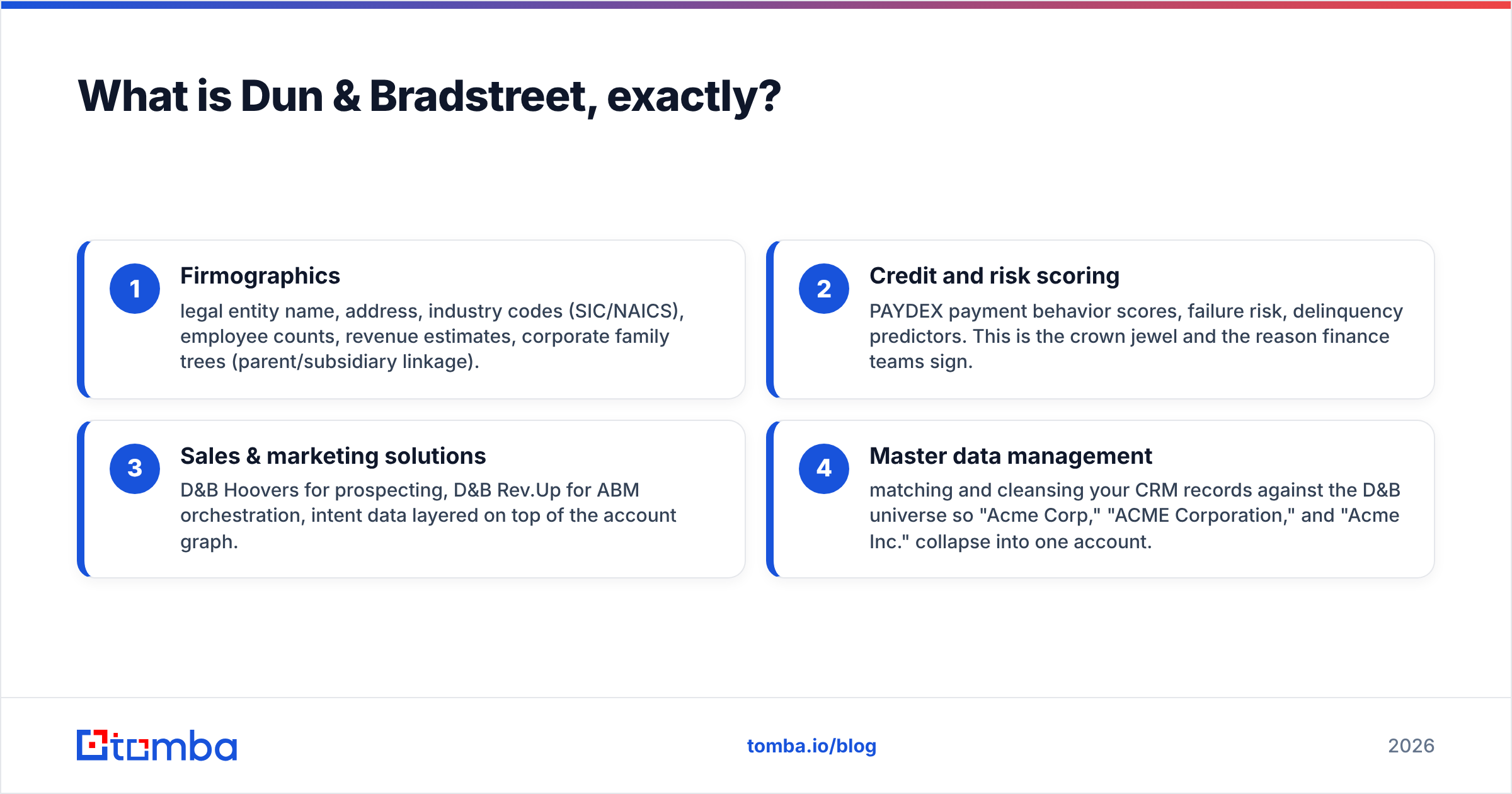
- Firmographics — legal entity name, address, industry codes (SIC/NAICS), employee counts, revenue estimates, corporate family trees (parent/subsidiary linkage).
- Credit and risk scoring — PAYDEX payment behavior scores, failure risk, delinquency predictors. This is the crown jewel and the reason finance teams sign.
- Sales & marketing solutions — D&B Hoovers for prospecting, D&B Rev.Up for ABM orchestration, intent data layered on top of the account graph.
- Master data management — matching and cleansing your CRM records against the D&B universe so "Acme Corp," "ACME Corporation," and "Acme Inc." collapse into one account.
The thing to internalize: D&B is fundamentally an account-level system. It tells you about companies. It is not built to hand you the verified personal inbox of the VP of Engineering at that company.
What is Tomba, and why is it a different category?#
Tomba is a B2B contact data platform built around one job: turn a name and a domain into a working email address, then prove that address is deliverable before you send.
The stack looks like this:
- Email finder — give it a first name, last name, and company domain; get the professional address plus a confidence score and the public sources it was derived from.
- Domain search — enter a company domain, get the people and departments Tomba has indexed there, along with the company's dominant email pattern.
- Email verifier — SMTP-level validation, MX record checks, disposable and role-account detection.
- Catch-all verifier — the hard case. Domains that accept everything at the server level need a different validation method, and this is where a lot of cheap tools quietly fail.
- Enrichment, phone finder, and reverse lookup — supporting layers for filling out a record you already partially have.
Tomba is a contact-level system. It assumes you already know which companies you care about — and its job starts at the moment you need to actually reach a person there.
Dun Bradstreet vs Tomba: how do they compare head to head?#
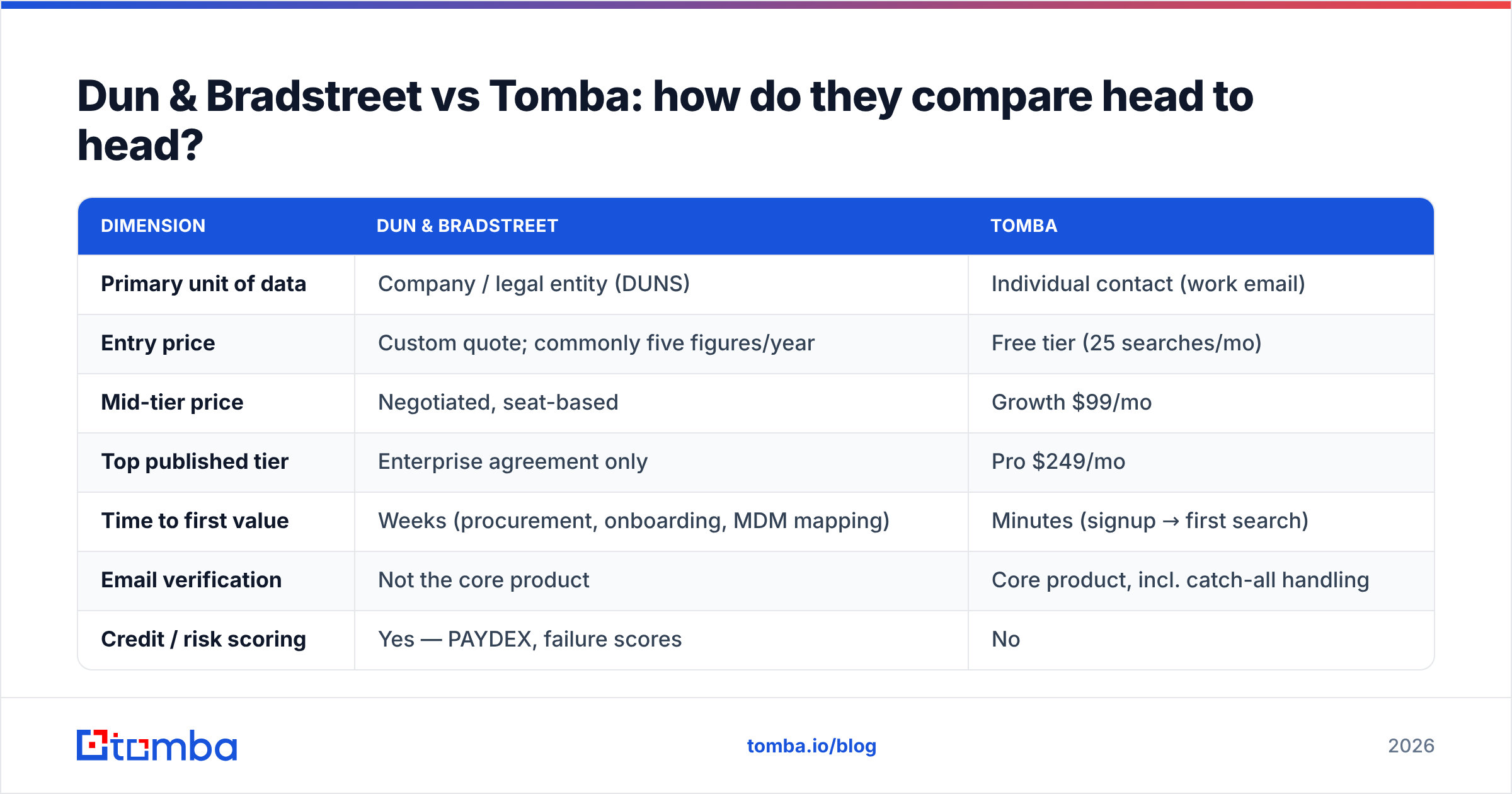
| Dimension | Dun & Bradstreet | Tomba |
|---|---|---|
| Primary unit of data | Company / legal entity (DUNS) | Individual contact (work email) |
| Entry price | Custom quote; commonly five figures/year | Free tier (25 searches/mo) |
| Mid-tier price | Negotiated, seat-based | Growth $99/mo |
| Top published tier | Enterprise agreement only | Pro $249/mo |
| Time to first value | Weeks (procurement, onboarding, MDM mapping) | Minutes (signup → first search) |
| Email verification | Not the core product | Core product, incl. catch-all handling |
| Credit / risk scoring | Yes — PAYDEX, failure scores | No |
| Corporate hierarchy data | Yes, industry-leading | No |
| API access | Yes, tiered and metered | Yes, on all paid plans |
| Contract length | Typically annual or multi-year | Month-to-month available |
| Best fit | Finance, procurement, compliance, enterprise ABM | SDR teams, agencies, recruiters, founders |
Read that table as a fork in the road, not a scoreboard. Say the rows that matter to you are "credit risk" and "corporate hierarchy." Then you aren't shopping for an email finder, and no blog post should talk you out of D&B. Say the rows that matter are "time to first value" and "email verification." Then a five-figure firmographic contract feels like buying a freight train to reach the grocery store.
Which one should you buy for your actual use case?#
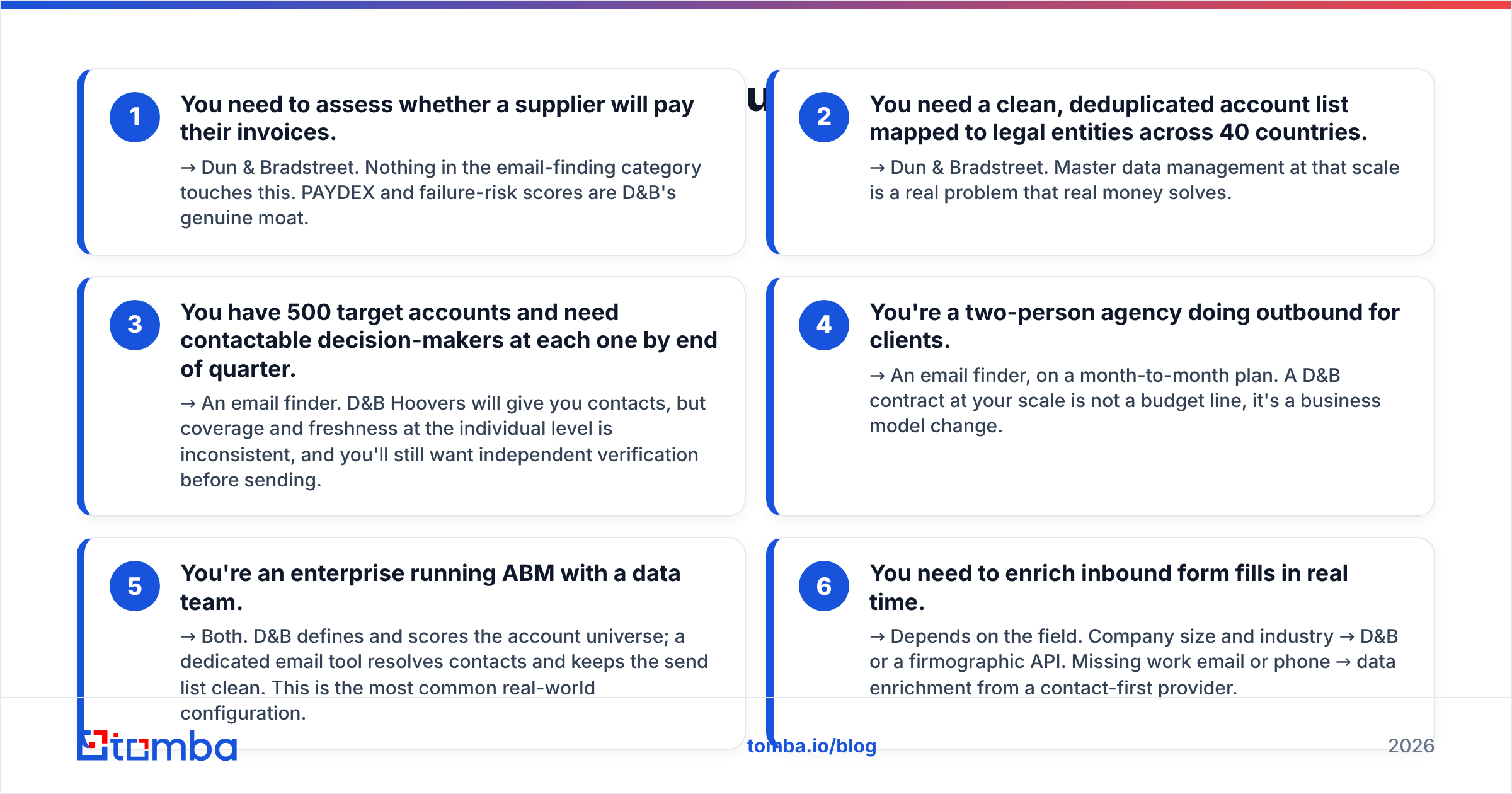
Use this as a decision framework, not a feature checklist. Start with the account-side cases:
- You need to check whether a supplier will pay their invoices. → Dun & Bradstreet. Nothing in the email-finding category touches this. PAYDEX and failure-risk scores are D&B's real moat.
- You need a clean, deduplicated account list mapped to legal entities across 40 countries. → Dun & Bradstreet. Master data management at that scale is a hard problem, and real money solves it.
- You need to enrich inbound form fills in real time. → It depends on the field. Company size and industry point to D&B or another firmographic API. A missing work email or phone points to data enrichment from a contact-first provider.
Now the contact-side cases:
- You have 500 target accounts and need a decision-maker at each one by end of quarter. → An email finder. D&B Hoovers will give you contacts, but coverage and freshness at the individual level are uneven. You'll still want independent verification before you send.
- You're a two-person agency doing outbound for clients. → An email finder, month to month. A D&B contract at your scale isn't a budget line. It's a business model change.
- You're an enterprise running ABM with a data team. → Both. D&B defines and scores the account universe. A dedicated email tool resolves the contacts and keeps the send list clean. This is the most common real-world setup.
The framing that trips people up is "which tool is better." A better question: what breaks in my funnel today? If the answer is "we don't know who to target," that's a firmographic problem. If the answer is "we know who to target but 30% of our sends bounce," that's a verification problem. No amount of DUNS-keyed hierarchy data fixes it.
How much does each one actually cost?#
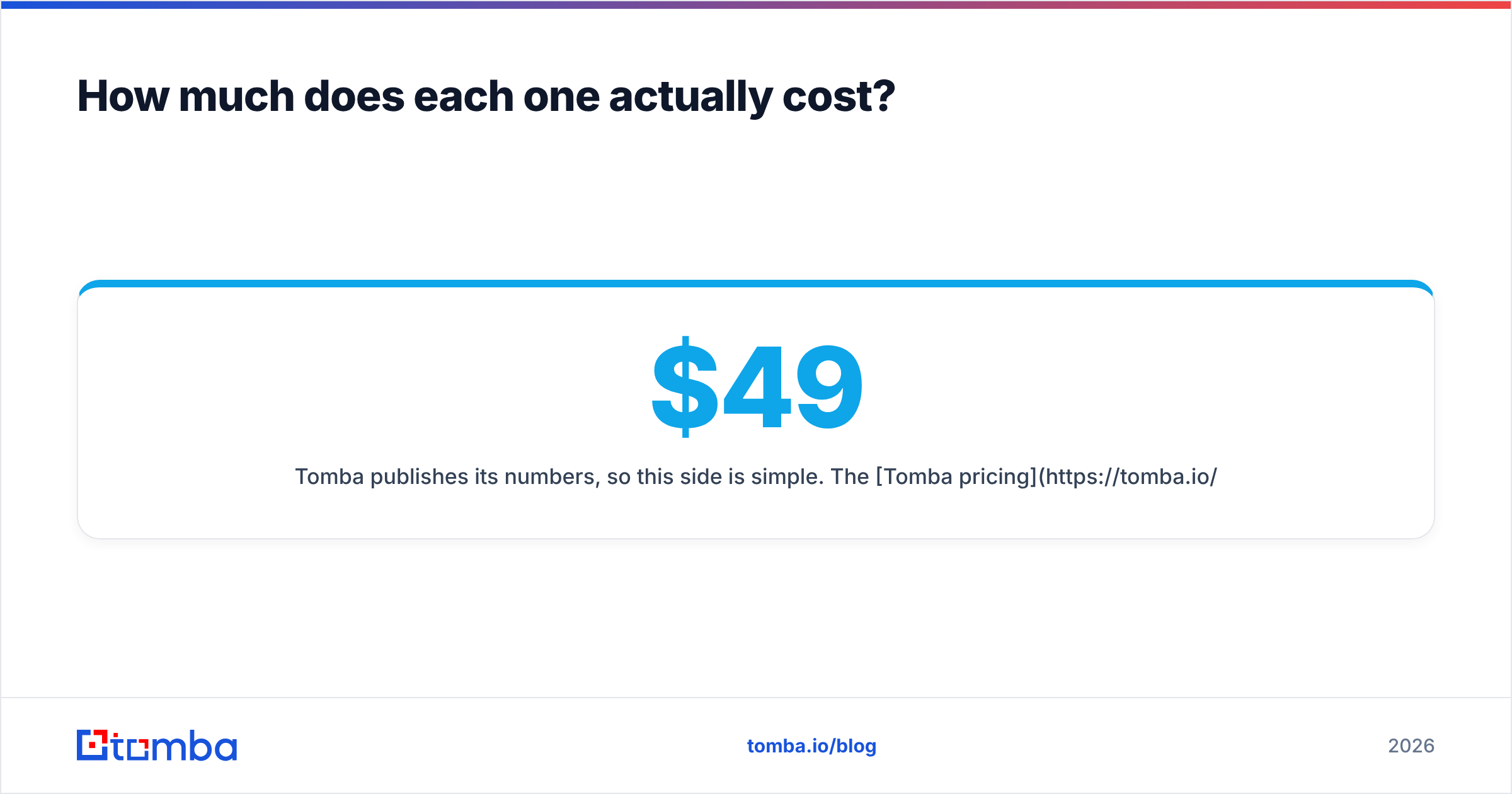
Tomba publishes its numbers, so this side is simple. The Tomba pricing ladder runs: Free at 25 searches per month, Starter at $49/mo, Growth at $99/mo, Pro at $249/mo, and custom Enterprise pricing above that. You can start on the free tier, test coverage against a list of domains you already know, and upgrade only if the hit rate holds.
Dun & Bradstreet does not publish list pricing, and that's the first thing to plan around. Public reviews on G2 and buyer reports consistently describe D&B Hoovers contracts in the low-to-mid five figures annually for small teams, scaling well past that for full Data Cloud access. The variables that move the number:
- Seats. Priced per user, with minimums.
- Record volume. How many records you can view, export, or match per year.
- API call tiers. Programmatic access is metered separately from UI access.
- Data modules. Risk scores, intent data, and hierarchy data are frequently separate line items rather than one bundle.
- Term length. Multi-year commitments get discounts; that's also how you get locked in.
Get a written quote with export limits spelled out before you compare anything. A "cheaper" D&B tier with a low export cap can cost more per usable record than a higher tier.
Is Dun & Bradstreet's data more accurate than an email finder's?#
This is the question that deserves the most nuance, because both vendors will claim accuracy and they're measuring different things.
D&B's accuracy claim is about entity resolution: does this record correspond to a real, correctly-identified legal business, with the right parent company and the right revenue band? On that axis, D&B is genuinely excellent. Its record-matching is why banks and governments use it.
An email finder's accuracy claim is about deliverability: if you send to this address, does it land in a human's inbox? That's a different measurement, tested a different way, and it decays much faster. Work emails churn constantly — people change jobs, companies migrate domains, aliases get retired. A firmographic record about a company might stay valid for years. A contact email might go stale in six months.
The practical implication: never treat a contact record pulled from any firmographic database as send-ready. Run it through a dedicated email verifier first. Bounce rates above 3% start to damage your sender reputation. Once that slides, even a perfectly-targeted D&B account list stops converting, because your messages land in spam.
What are the honest weaknesses of each?#
Where Dun & Bradstreet frustrates buyers:
- Contact-level coverage is thinner than account-level coverage. You may get a company perfectly and its people poorly, especially at SMBs and non-US firms.
- Procurement friction. Weeks from first call to first query is normal. If you need data next Tuesday, this is a dealbreaker.
- Freshness on people data. Firmographics update on a slower cadence than job changes happen.
- Cost opacity. Not knowing the price until you're three calls deep is a real tax on evaluation time.
- Overkill risk. Most teams buying it for prospecting are paying for risk and compliance infrastructure they'll never open.
Where Tomba (and email finders generally) fall short:
- No credit or risk data. If your workflow needs financial health signals, this category can't help you.
- No corporate hierarchy. You won't get parent-subsidiary trees or global ultimate linkage.
- Coverage varies by region and company size. Tiny local businesses with no web footprint are hard for any email finder — the data has to come from somewhere public.
- Catch-all domains remain genuinely hard. Better tools handle them better, but nobody has fully solved deliverability prediction on a server that accepts everything.
- You still have to build the target list. An email finder doesn't tell you which companies matter; it tells you how to reach the ones you picked.
For a fuller sense of where contact records originate, Tomba documents its data sources publicly — worth reading before any vendor comparison, since sourcing transparency varies wildly across this market.
What about the middle ground — other options worth checking?#
The D&B-vs-email-finder framing isn't the only one. A few adjacent categories are worth a look depending on the gap you're filling:
- ZoomInfo and Apollo sit between the two poles — account data plus contacts, at mid-market pricing. Both are heavier and pricier than a pure email finder, lighter than D&B on risk data. If you're evaluating that middle, the Apollo alternative breakdown covers the tradeoffs.
- BookYourData is a solid option if you want to buy pre-built, verified contact lists outright rather than run searches yourself — a different purchasing model that suits teams who'd rather own a list than query an API.
- Clearbit-style enrichment APIs are built for real-time form and CRM enrichment rather than list building. Different job again.
- Bulk workflows matter more than most buyers expect. If you're processing thousands of records at once, look hard at bulk email finder throughput and per-record cost before you commit to any platform.
Check independent reviews on G2 or Capterra for your specific vertical and geography — coverage quality is extremely uneven by market, and one team's 90% hit rate is another's 40%.
So which one wins?#
Neither one wins outright. The honest read on Dun Bradstreet vs Tomba is that each answers a different question. Dun & Bradstreet wins for account intelligence, credit risk, and enterprise data governance. Tomba wins for verified work emails — fast, cheap, and with no procurement cycle. They complement each other far more often than they compete.
Here's the sequencing most teams land on. Use firmographic data to decide which accounts deserve your attention. That data can come from D&B, a lighter provider, or your own ICP research. Then use a contact-first tool to find and verify who to reach at those accounts. Skip the first step and you're spraying. Skip the second and you're bouncing.
If your bottleneck is the second half — you know your accounts, you just need verified addresses without signing an annual contract — start with the Tomba Email Finder. The free tier gives you 25 searches a month, enough to test coverage against a domain list you already trust. If the hit rate holds up, Starter is $49/mo and month-to-month. That's a decision you can reverse next month, which is more than you can say for most enterprise data contracts.
Related guides#
Ready to find emails that actually work?
Join 150,000+ professionals who stopped guessing and started sending. Free credits on signup — no credit card required.
Get the Tomba newsletter
Practical outbound tactics and product updates — once every two weeks.
About the author