9 Best Easir Alternatives for Automotive Sales Teams 2026
Easir is a dealer-first CRM built for European automotive groups. If you need broader pipeline tooling, public pricing, or a data layer that actually fills the CRM, here are nine alternatives compared on price, fit, and honest weak spots.
TL;DR
Easir (stylised EASI'R) is a niche automotive CRM. Roughly 2,600 dealers and 16,000 users run on it across Europe. It is not a general B2B CRM. That gap is the main reason teams go looking for Easir alternatives.
Pricing is quote-only. There is no public per-seat number. If you need one to get budget signed off, most of the Easir alternatives below are easier to buy.
The best swap depends on why you leave. Dealer workflows: CDK Global, Dealersocket, VinSolutions. General pipeline: HubSpot, Pipedrive, Zoho, Close. Enterprise depth: Salesforce Automotive Cloud.
A CRM is a container, not a data source. You still need clean contact data going in. That is where an email finder and an enrichment layer sit.
Cheapest exit: Pipedrive or Zoho CRM, about $14–$29 per user each month. Best all-round non-dealer pick: HubSpot Sales Hub. Closest dealer swap: VinSolutions or Dealersocket.
What is Easir and who actually uses it?#
Easir is a cloud CRM for car retail. It sits between a dealer's DMS (dealer management system) and the sales floor. It pulls every lead source into one place. Then it scores each lead and tells reps who to call next.
The core pieces:
- Lead consolidation — web forms, marketplace enquiries, walk-ins, and DMS records land in one inbox instead of five.
- Journey mapping — the tool tracks the ownership cycle, from enquiry to test drive to sale to service. It nudges reps at each step.
- Repurchase prediction — a built-in model flags owners who look close to a trade-in.
- API-first integration — Easir ships developer docs. It plugs into DMS tools, car configurators, and finance calculators.
- Mobile-first rep experience — a native app, so the rep on the forecourt is not stuck at a desk.
Dealer networks for brands like Skoda and Audi use it. That focus is Easir's strength. It is also why a brand-free sales team, a fleet-leasing SaaS firm, or a B2B parts supplier tends to shop for Easir alternatives inside a year.
Why do teams look for Easir alternatives?#
Five reasons come up again and again. Here they are, in rough order of how often we hear them.
You are not a dealership. Easir assumes cars, VINs, trade-in cycles, and test drives. If your pipeline runs "lead, demo, contract", the whole data model fights you.
Pricing is opaque. There is no public per-seat number. That is normal in dealer software. It still means a demo, a security review, and a buying cycle before you know the cost. Pipedrive and HubSpot put the price on the page.
Reach. Easir is strongest in Europe. North American dealer groups often want tighter links to the DMS and stock vendors that own that market.
Marketing and outbound gaps. Easir handles inbound leads and lifecycle nudges well. Need sequences, cold outreach, landing pages, and a marketing database too? You will buy a second tool anyway.
The data problem it does not solve. Easir sorts the leads you already have. It does not go and find new B2B contacts. Fleet managers, procurement leads, and mobility buyers are on you. Teams moving into fleet sales hit this wall fast.
What should you compare when replacing Easir?#
Do not start from a feature grid. Judge Easir alternatives on these five questions instead. They rule out two-thirds of the market before you book a demo.
Depth or flexibility? Car-specific CRMs ship with stock, VIN decoding, desking, and F&I flows. Broad CRMs give you custom objects and a blank canvas. Pick one. Hybrids tend to mean paying an agency to rebuild what you gave up.
What is the true cost at your seat count? A $25 seat at 40 users is $12,000 a year, before setup. Quote-only tools often win at 200 seats and lose badly at 15. Model both.
What does it connect to? Your DMS, stock feed, call tracking, and accounting stack all matter. Check the vendor's own directory, not a review site. Easir's open API docs are a real plus here. Many Easir alternatives built for dealers are far more closed.
Is data going in, or just sitting there? A CRM with 3,000 stale records is a liability. Treat clean-up as a line item, not an afterthought. Run old records through an email verifier before you migrate, not after.
How fast is the first win? Dealer CRM moves run 8 to 16 weeks. Broad CRMs can be live in a week, but need 4 to 6 weeks of process design. Ask each vendor for a reference customer your size who went live this year.
What are the best Easir alternatives in 2026?#
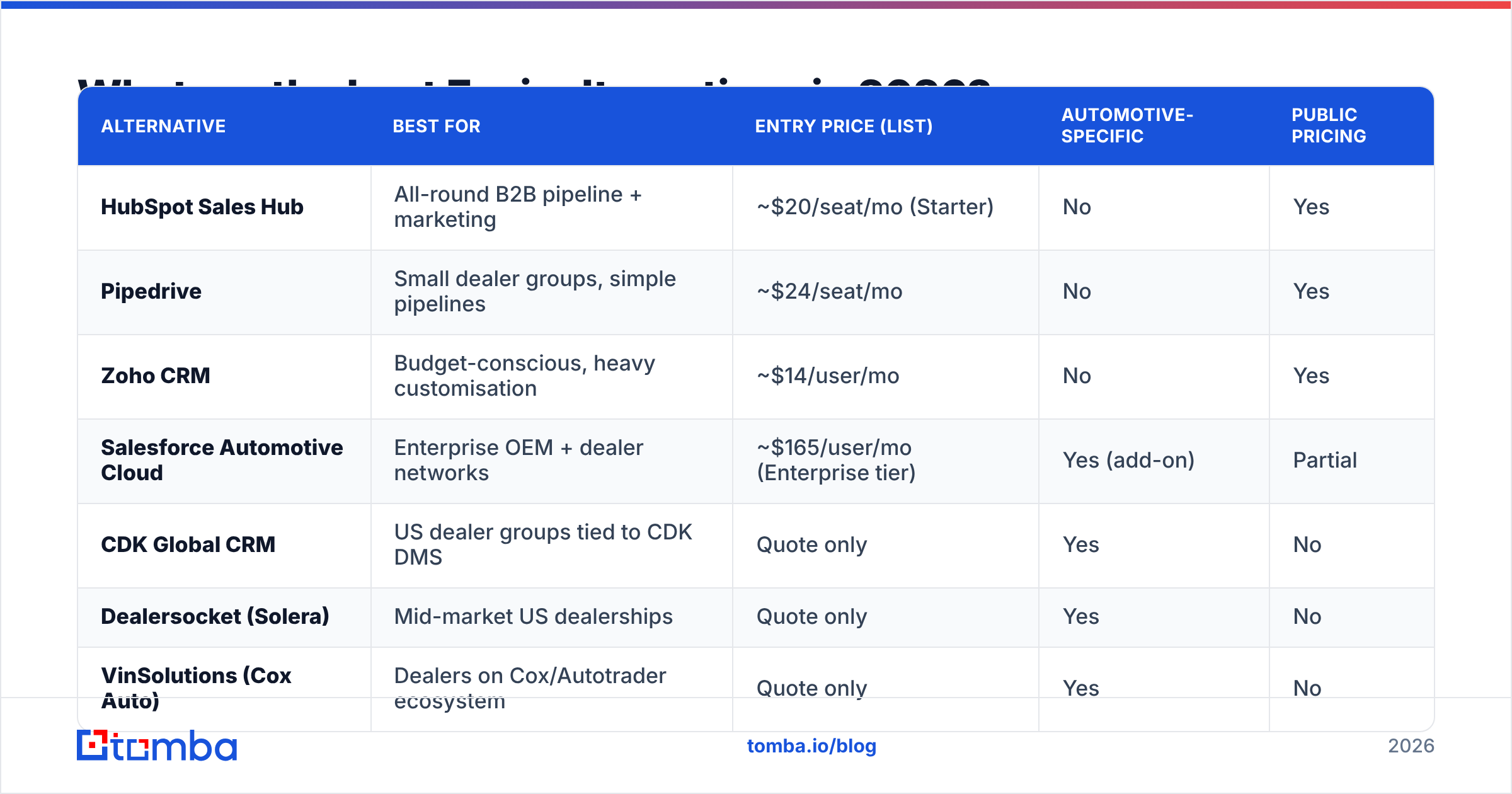
Here is the shortlist of Easir alternatives, grouped by the problem you are trying to solve.
| Alternative | Best for | Entry price (list) | Automotive-specific | Public pricing |
|---|---|---|---|---|
| HubSpot Sales Hub | All-round B2B pipeline + marketing | ~$20/seat/mo (Starter) | No | Yes |
| Pipedrive | Small dealer groups, simple pipelines | ~$24/seat/mo | No | Yes |
| Zoho CRM | Budget-conscious, heavy customisation | ~$14/user/mo | No | Yes |
| Salesforce Automotive Cloud | Enterprise OEM + dealer networks | ~$165/user/mo (Enterprise tier) | Yes (add-on) | Partial |
| CDK Global CRM | US dealer groups tied to CDK DMS | Quote only | Yes | No |
| Dealersocket (Solera) | Mid-market US dealerships | Quote only | Yes | No |
| VinSolutions (Cox Auto) | Dealers on Cox/Autotrader ecosystem | Quote only | Yes | No |
| Close | Outbound-heavy sales teams, calling | ~$29/seat/mo | No | Yes |
| Freshsales (Freshworks) | Lean teams wanting AI scoring cheap | ~$9–11/user/mo | No | Yes |
Prices are list prices at the time of writing and change often. Always check the vendor's own pricing page.
HubSpot Sales Hub#
The default pick when a dealer group also runs campaigns, service reminders, and a content site. You get CRM, sequences, forms, and reporting in one login. The free tier is good enough to test on. HubSpot's pricing is public and per seat.
Where it beats Easir: breadth. Marketing, ticketing, and quotes without a second vendor. Where it loses: no car logic at all. No VIN, no stock, no desking. You build custom objects or bolt on a partner app. Costs climb fast at the Professional tier.
Pipedrive#
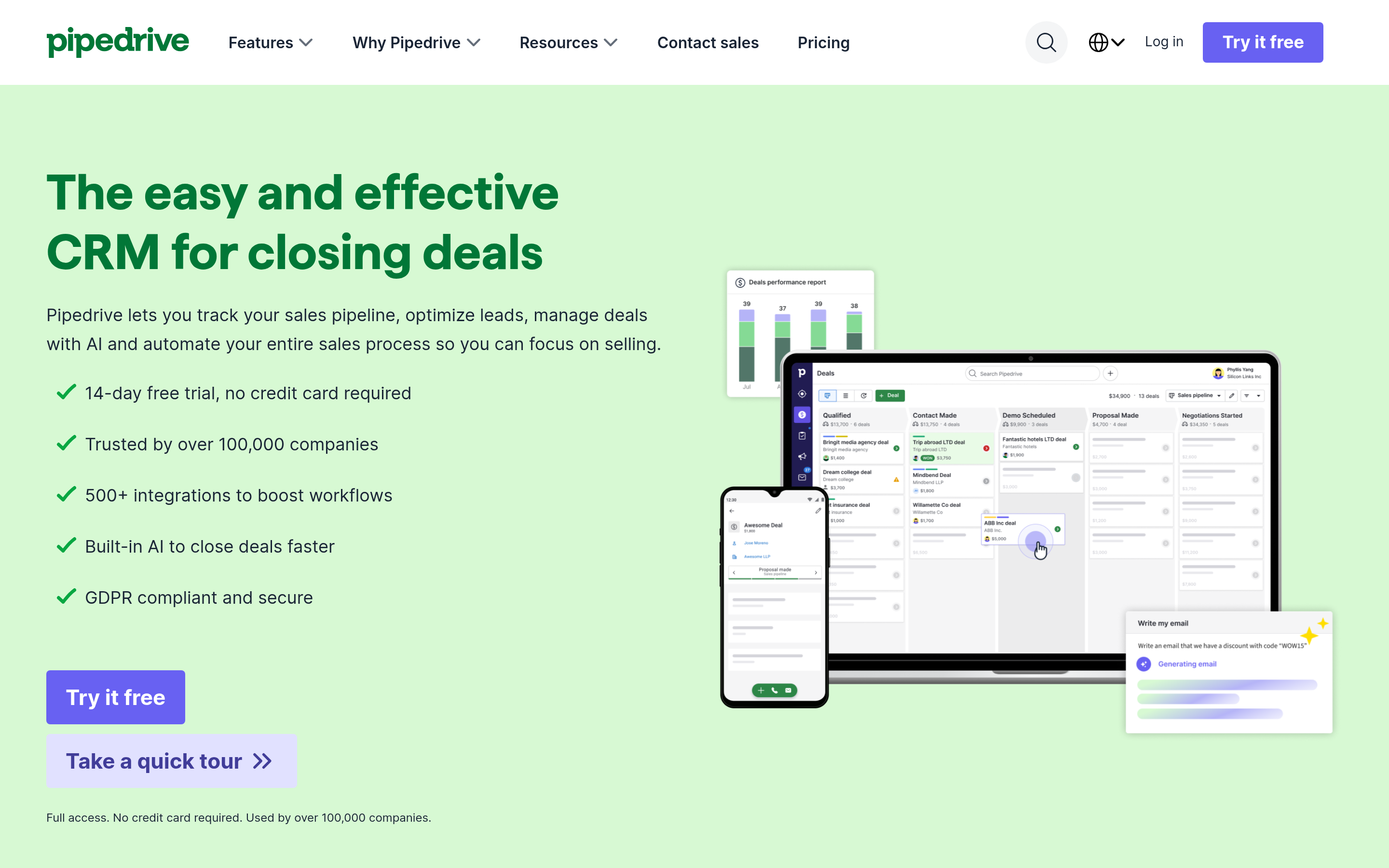
The simplest credible swap. Visual pipeline, activity-based selling, a sane mobile app. Small dealers and B2B fleet resellers get value fast.
Where it beats Easir: setup speed and clear pricing. Where it loses: reporting depth and lifecycle automation. Pipedrive tracks deals. It does not run a lifecycle. The repurchase model you get free in Easir becomes a manual job here.
Zoho CRM#
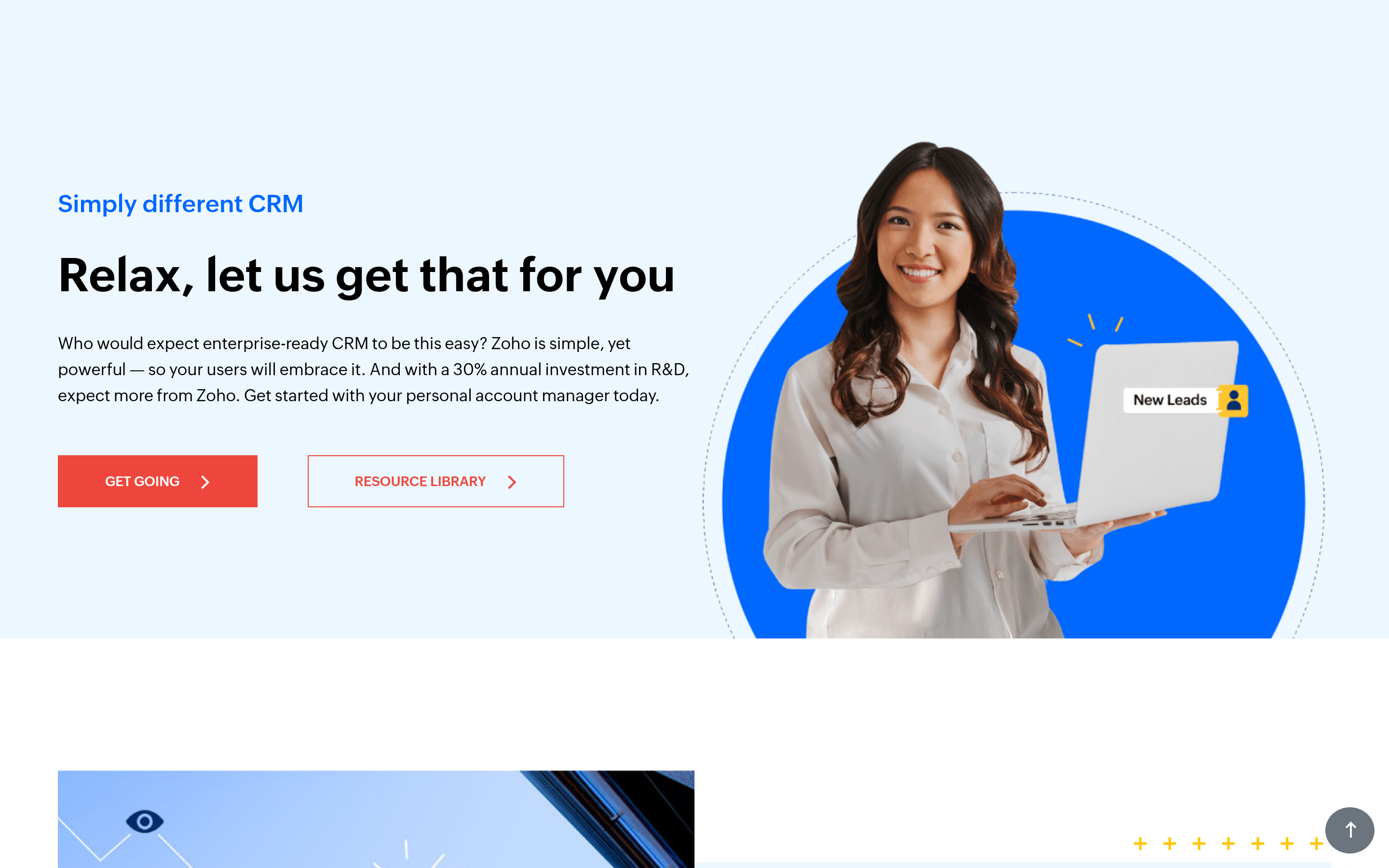
The value play. Deep customisation, low cost per user, and a huge suite around it. Desk, Books, and Campaigns all fit if you want one vendor for the back office.
Where it beats Easir: price per seat and how far you can bend it. Where it loses: polish and setup effort. Zoho hands you the Lego bricks. Someone still has to build the car.
Salesforce Automotive Cloud#
Salesforce ships a car-specific data model. It covers vehicles, drivers, and dealer links. It also connects to almost anything. If you are an OEM working across a dealer network, this is the enterprise option.
Where it beats Easir: scale, ecosystem, analytics. Where it loses: cost and complexity. All-in cost with setup runs several times Easir's. It rarely fits under 50 seats.
CDK Global, Dealersocket, and VinSolutions#
These three are the like-for-like Easir alternatives if you want to stay vertical. All are quote-only. All are strongest in North America. Each locks tightly to its parent. CDK ties to CDK DMS, VinSolutions to Cox Automotive and Autotrader leads, Dealersocket to Solera's F&I stack.
Where they beat Easir: US dealer workflows, desking, stock links, and local support. Where they lose: European coverage, open APIs, and pricing clarity. Contracts usually run for years.
Close and Freshsales#
Both deserve a look if your motion has drifted to outbound. Close is built around the phone. The dialer, call recording, and sequences are native, not add-ons. Freshsales bundles AI lead scoring at a price that undercuts almost everything here.
Where they beat Easir: outbound speed and cost per seat. Where they lose: they are pipeline tools, not lifecycle platforms. No service cycle, no ownership timeline.
How do the shortlists differ on total cost?#
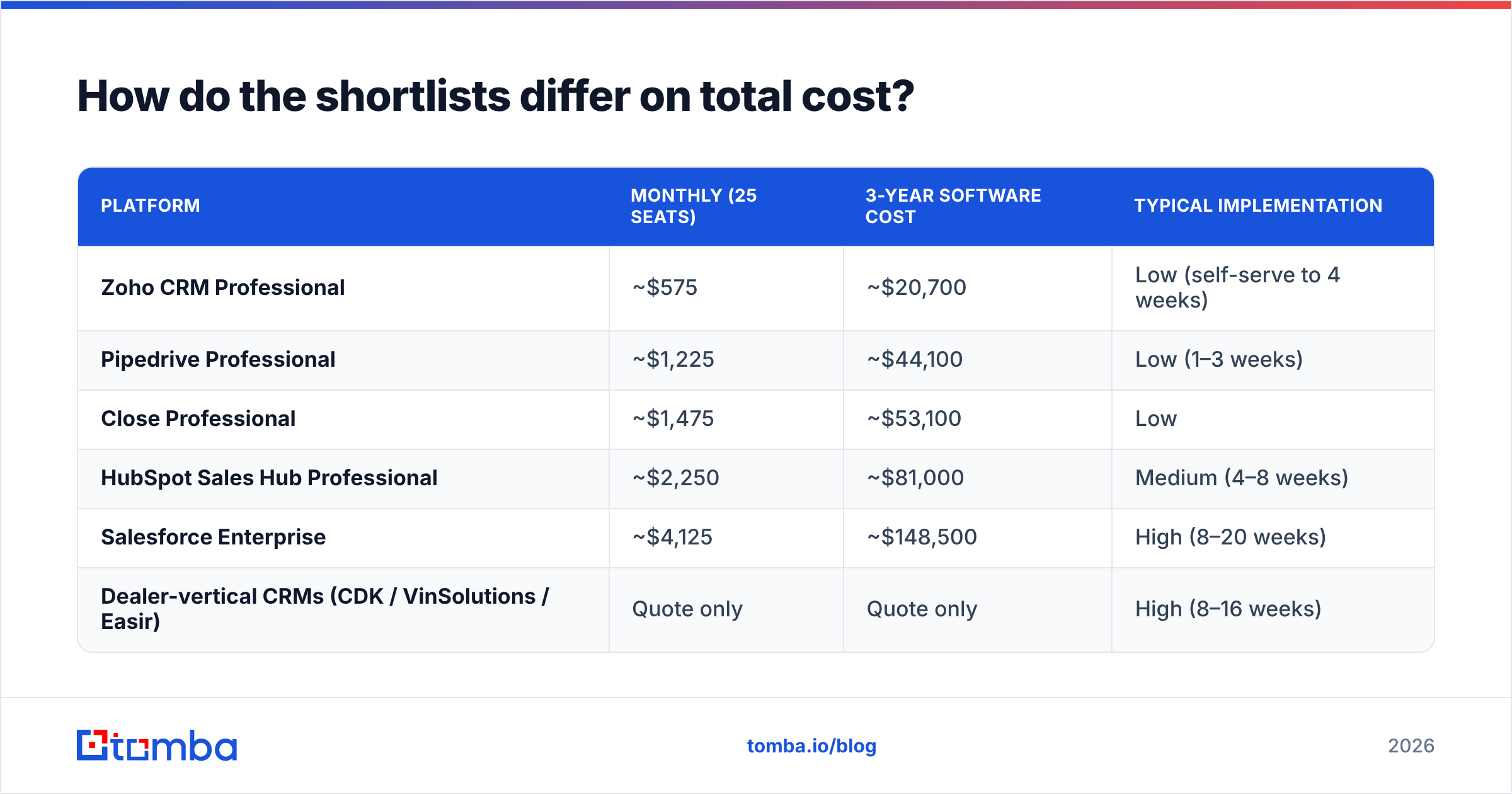
Seat count changes the answer. Here is rough three-year maths for a 25-seat team, at list price, before setup.
| Platform | Monthly (25 seats) | 3-year software cost | Typical implementation |
|---|---|---|---|
| Zoho CRM Professional | ~$575 | ~$20,700 | Low (self-serve to 4 weeks) |
| Pipedrive Professional | ~$1,225 | ~$44,100 | Low (1–3 weeks) |
| Close Professional | ~$1,475 | ~$53,100 | Low |
| HubSpot Sales Hub Professional | ~$2,250 | ~$81,000 | Medium (4–8 weeks) |
| Salesforce Enterprise | ~$4,125 | ~$148,500 | High (8–20 weeks) |
| Dealer-vertical CRMs (CDK / VinSolutions / Easir) | Quote only | Quote only | High (8–16 weeks) |
The pattern is steady. Broad Easir alternatives cost less and go live faster, but leave a gap you fill with process. Vertical ones close that gap and charge for it, usually on a multi-year deal. Check current numbers on G2 or Capterra first. Both publish verified user reviews next to vendor pricing.
Do you need a new CRM, or a better data layer?#
Most Easir alternatives comparisons skip this question. It is the one that decides whether the move pays off.
A CRM stores relationships. It does not create them. Say the real problem is "our reps have nothing to work on Monday". Moving from Easir to HubSpot changes nothing. You have moved an empty pipeline into a nicer interface.
Three signs the problem is data, not software:
- Bounce rate above 5% on outbound. Your records are stale. Fix that first.
- Reps googling companies by hand. They are doing enrichment at $40 an hour.
- Duplicates and half-filled records everywhere. Nobody checks anything at intake.
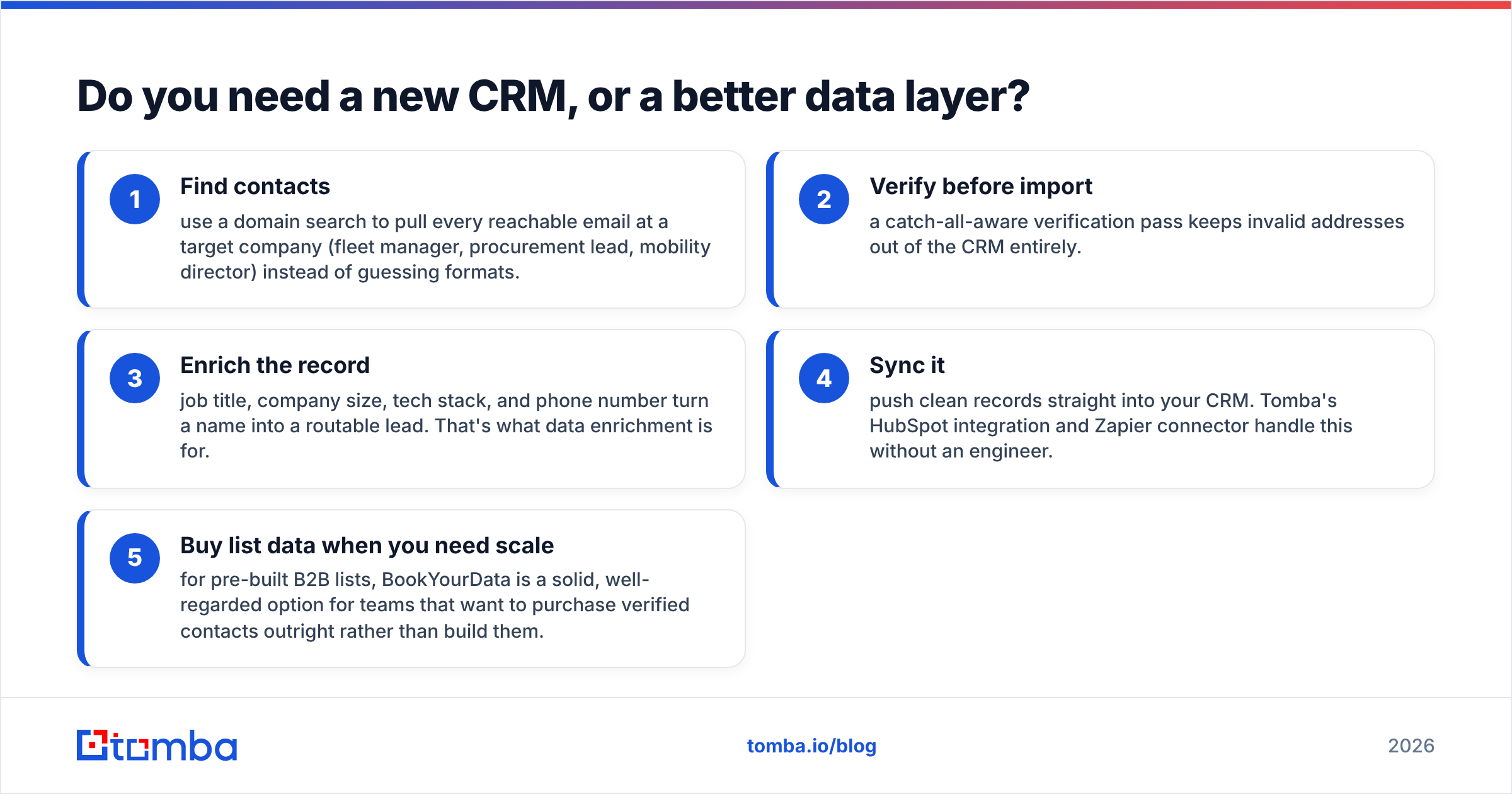
The fix is a data layer that feeds whichever CRM you pick:
- Find contacts — use a domain search to pull every reachable email at a target company, instead of guessing formats.
- Verify before import — a catch-all-aware check keeps bad addresses out of the CRM.
- Enrich the record — job title, company size, tech stack, and phone turn a name into a lead you can route. That is what data enrichment is for.
- Sync it — push clean records into your CRM. Tomba's HubSpot integration and Zapier connector do this without an engineer.
- Buy list data when you need scale — BookYourData is a solid option if you would rather buy verified contacts than build them.

Which Easir alternative is right for you?#
European dealer group, happy with the fit but not the cost — negotiate first. Vertical CRM pricing bends a lot at renewal. Get a quote from VinSolutions or Dealersocket even if you plan to stay.
US dealer group — VinSolutions if you live in the Cox ecosystem. CDK if your DMS is CDK. The integration matters more than the CRM.
OEM or a 50+ seat network — Salesforce Automotive Cloud. Nothing else at that size pairs the data model with the ecosystem.
You sell to businesses, not consumers — HubSpot or Pipedrive, plus a real data layer. The car-specific features you pay for in Easir are dead weight.
Under 15 seats and cost-sensitive — Zoho CRM or Freshsales. Both give you 80% of the job at a quarter of the price.
Outbound volume is the bottleneck — Close, plus verified contact data. The CRM is not the constraint. Pipeline creation is.
One honest note before you shop for Easir alternatives. Easir is a good product for the narrow job it does. If you are a European dealership using it as intended, most of this list is a downgrade. Switch because your business changed, not because a comparison post told you to.
What's the fastest way to fill whichever CRM you pick?#
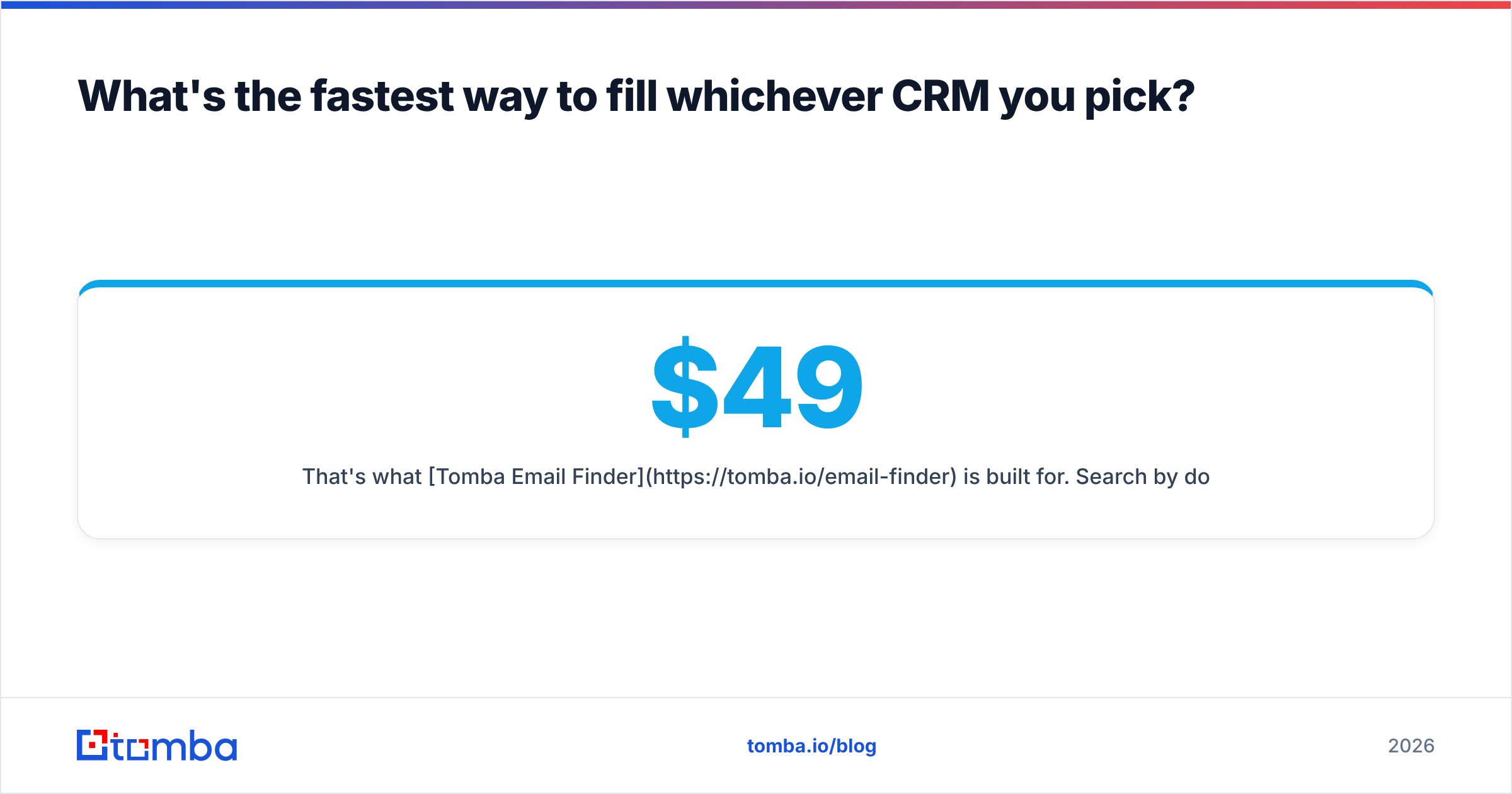
Every option above shares one blind spot. None of them find new contacts for you. Once you have picked a platform, the next bottleneck is verified emails and phone numbers. You need fleet managers, procurement leads, dealer principals, and mobility teams.
That is what Tomba Email Finder is built for. Search by domain, name, or company. Check each result before it touches your CRM. Then push clean records into HubSpot, Pipedrive, Salesforce, or a CSV. The free tier gives you 25 searches a month, so you can test accuracy on your own list. Paid Tomba pricing starts at $49 a month for Starter, $99 for Growth, and $249 for Pro. Test it against 50 companies you already know before you migrate. If the data holds up there, it will hold up at scale.
Related guides#
Ready to find emails that actually work?
Join 150,000+ professionals who stopped guessing and started sending. Free credits on signup — no credit card required.
Get the Tomba newsletter
Practical outbound tactics and product updates — once every two weeks.
About the author