EasyLeadz Pricing 2026: Plans, Credit Costs, and Verdict
EasyLeadz sells credits, not contacts. Here's what each tier really costs per usable phone number or email, where the limits bite, and when a cheaper stack wins.
TL;DR
- EasyLeadz is priced in credits, not contacts. One credit buys one reveal attempt — and the reveal you get back is usually a phone number, which is the expensive part of the B2B data market.
- Entry plans land in the $49–$99/month range for a few hundred credits; higher tiers push into the $199–$399/month band before you hit custom enterprise quotes. Always confirm current numbers on easyleadz.com — credit-based vendors re-price often.
- The number that matters is cost per usable contact, not sticker price. A $99 plan with 500 credits and a 60% hit rate costs you roughly $0.33 per usable record. A cheaper plan with a worse hit rate can cost more.
- Watch three things: credit expiry, whether a failed lookup still burns a credit, and how many seats the plan actually includes.
- If your outbound runs on email rather than dials, a dedicated finder-plus-verifier stack (Tomba starts at $49/mo, free tier included) typically produces a lower cost per booked meeting than a phone-first credit plan.
What is EasyLeadz and what are you actually paying for?#
EasyLeadz is an Indian B2B contact intelligence platform best known for Mr. E, its Chrome extension that reveals direct-dial mobile numbers from LinkedIn profiles. That positioning matters for pricing, because direct dials are structurally more expensive to source than work emails. Emails follow predictable corporate patterns you can infer and verify; mobile numbers do not. They come from partnerships, opt-in data, and user contribution networks, and every vendor pays for them.
So when you compare EasyLeadz pricing against an email finder's pricing, you are not comparing like for like. You are comparing a phone-heavy dataset against a pattern-plus-verification dataset. Both are legitimate purchases. They just serve different motions:
- Phone-first outbound — SDR teams that dial, use triple-tap sequences, and treat email as follow-up. Credit-based phone data earns its cost here.
- Email-first outbound — teams running sequenced cold email at volume, where you need thousands of verified addresses per month and deliverability is the constraint.
- Hybrid ABM — small named-account lists where you want every channel on 200 people and per-record cost barely matters.
- Data enrichment / RevOps — filling gaps in an existing CRM, where you care about match rate on records you already own, not on discovery.
- Recruiting and agency work — high-touch, low-volume, phone-heavy, and usually the best fit for a mid-tier credit plan.
Figure out which of those five you are before you read a single pricing page. Most buyers who complain about credit-based pricing bought a phone-heavy plan to run an email-heavy motion.
How does EasyLeadz pricing work in 2026?#
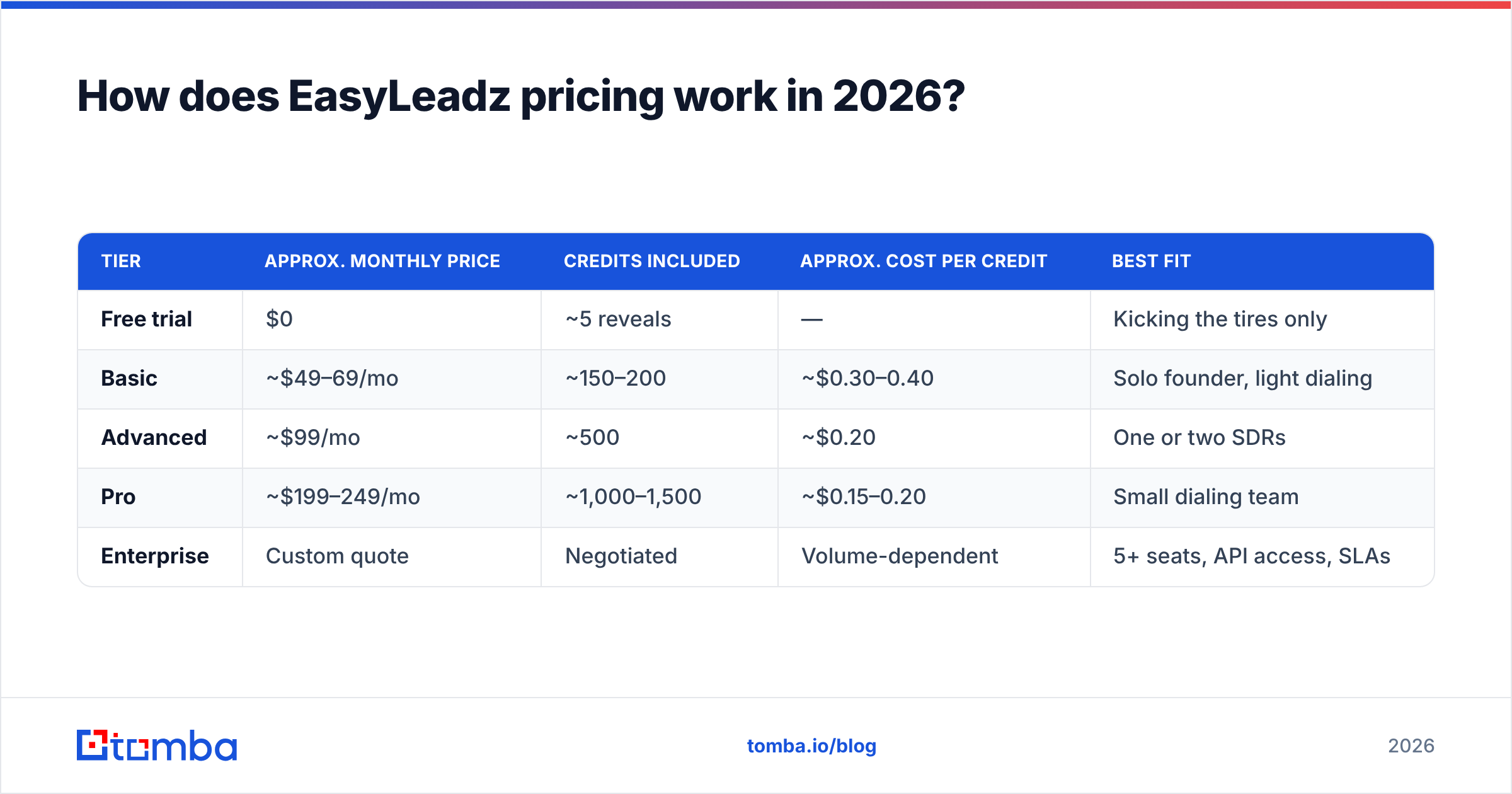
EasyLeadz uses a straightforward monthly or annual credit allotment. You pick a tier, you get N credits per month, and each successful reveal deducts credits. Annual commitments carry the usual discount, and enterprise volume moves to a quoted contract.
Here is the shape of the tiering as publicly listed at the time of writing. Treat the credit counts as the stable part and the dollar figures as approximate — verify both before you buy.
| Tier | Approx. monthly price | Credits included | Approx. cost per credit | Best fit |
|---|---|---|---|---|
| Free trial | $0 | ~5 reveals | — | Kicking the tires only |
| Basic | ~$49–69/mo | ~150–200 | ~$0.30–0.40 | Solo founder, light dialing |
| Advanced | ~$99/mo | ~500 | ~$0.20 | One or two SDRs |
| Pro | ~$199–249/mo | ~1,000–1,500 | ~$0.15–0.20 | Small dialing team |
| Enterprise | Custom quote | Negotiated | Volume-dependent | 5+ seats, API access, SLAs |
Two structural notes. First, credits are typically per workspace, not per seat, so a three-person team on one Advanced plan is really sharing 500 reveals. Second, the free trial is a trial, not a free tier — it exists to let you validate coverage on your own ICP, not to run outbound. Use it that way: pull 5 records from your worst-case segment, not your easiest.
What does a contact actually cost per credit?#
Sticker price per credit is the wrong metric. The right one is cost per usable record, which folds in hit rate and data quality.
Run this math before every data purchase:
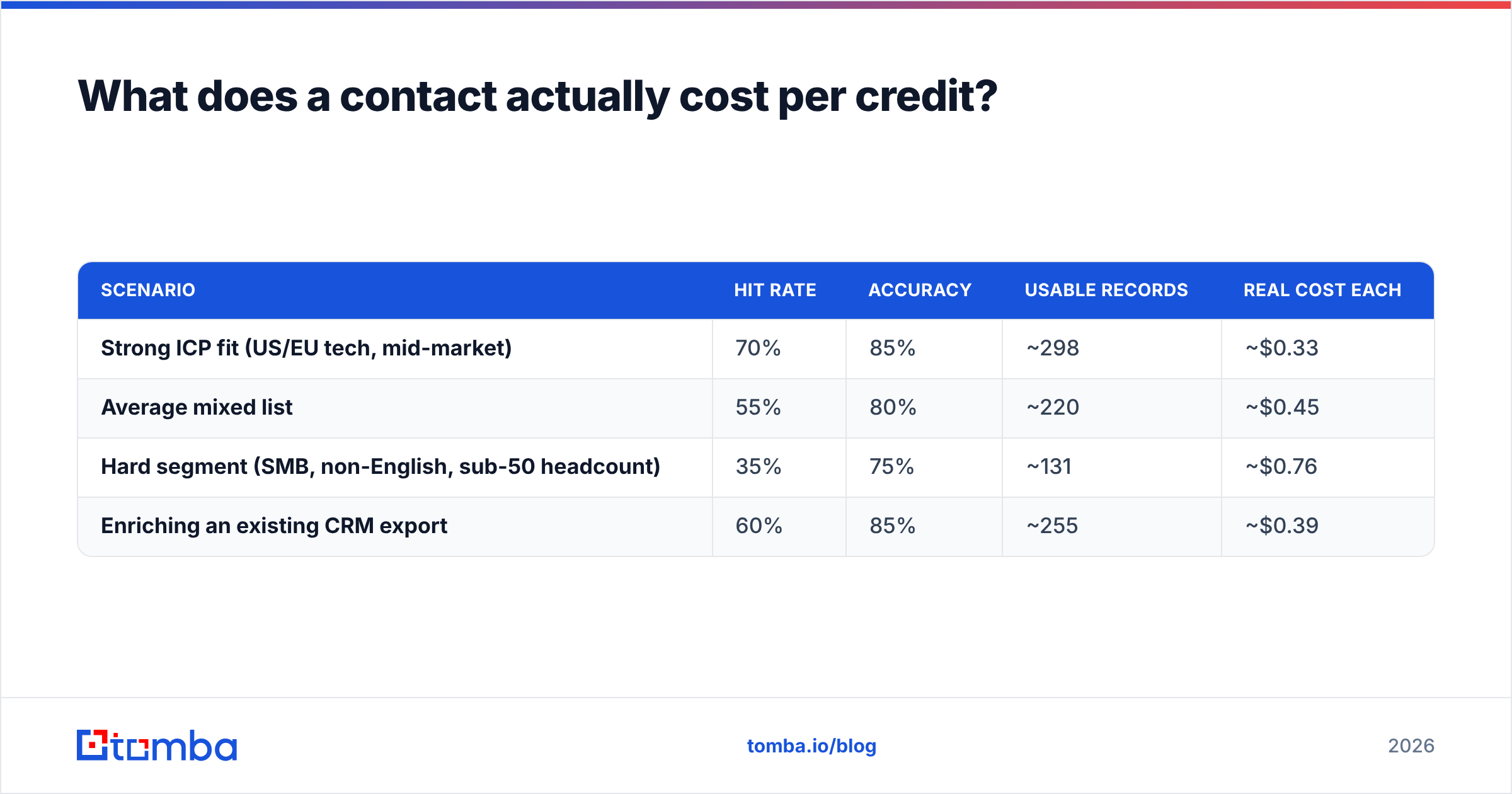
cost per usable record = (plan price ÷ credits) ÷ (hit rate × accuracy rate)Where hit rate is the share of lookups that return anything, and accuracy rate is the share of returned records that are actually correct and current. Here is how that plays out at a $99/500-credit tier:
| Scenario | Hit rate | Accuracy | Usable records | Real cost each |
|---|---|---|---|---|
| Strong ICP fit (US/EU tech, mid-market) | 70% | 85% | ~298 | ~$0.33 |
| Average mixed list | 55% | 80% | ~220 | ~$0.45 |
| Hard segment (SMB, non-English, sub-50 headcount) | 35% | 75% | ~131 | ~$0.76 |
| Enriching an existing CRM export | 60% | 85% | ~255 | ~$0.39 |
A 2x swing in real cost per record based on nothing but list composition. This is why "which vendor is cheaper" is an unanswerable question in the abstract and a very answerable one once you test 100 rows of your own data.
The tactical takeaway: never buy a credit plan before running the same 100-row sample through two or three vendors. Score each on hit rate and on how many returned records survive verification. Then compute the formula above. The winner is frequently not the one with the lowest headline price.

Where do the hidden costs show up?#
Credit-based pricing has four recurring gotchas. None of them are unique to EasyLeadz — they apply to nearly every contact-data vendor — but they are where budgets quietly leak.
- Credit expiry. Monthly credits that do not roll over mean any month you under-use is money burned. If your outbound is campaign-shaped (heavy bursts, quiet weeks), an annual plan with pooled credits is worth negotiating for explicitly.
- Failed-lookup accounting. Ask directly: does a lookup that returns nothing consume a credit? Most reputable vendors, including EasyLeadz, only charge on successful reveals — but get it in writing, because a "charge on attempt" policy silently doubles your effective cost on hard segments.
- Seat limits. A plan that includes one seat but is used by three reps means people share a login or you upgrade sooner than budgeted. Price the seat count you actually need on day one.
- The verification tax. Phone numbers need dialing to validate; emails need an SMTP-level check. If your data vendor does not verify on the way out, you pay a second vendor to do it — or you pay in bounce rate, which is far more expensive. Route every address through an email verifier before it reaches your sequencer.
- API access gating. Programmatic access is often reserved for higher tiers. If your plan is to enrich inside your CRM automatically, confirm which tier unlocks the API before you commit to the cheap one.
Add those five up and a nominal $99/month plan can behave like a $160/month plan. Budget for the real number.
Is EasyLeadz worth it for your use case?#
Yes, in one specific configuration: you dial, your ICP is well covered by the dataset, and your volume is a few hundred to a couple thousand contacts a month. In that lane, per-credit phone pricing is competitive, the Chrome extension workflow is genuinely fast, and reviewers on G2's sales intelligence category consistently rate mobile-number quality as the product's strength.
It is a poor fit in three cases. If you need 10,000+ verified emails a month, credit economics work against you — you want a plan priced for email volume. If your target market is outside the platform's strongest coverage regions, your hit rate will drag the real cost per record up sharply. And if you are buying primarily to enrich a large existing database, a bulk enrichment endpoint priced per row will beat a seat-and-credit product almost every time.
Be blunt with yourself about which motion you run. The most common expensive mistake in B2B data buying is picking a phone-first tool because dials feel more "sales-y," then never dialing.

How does EasyLeadz pricing compare to alternatives?#
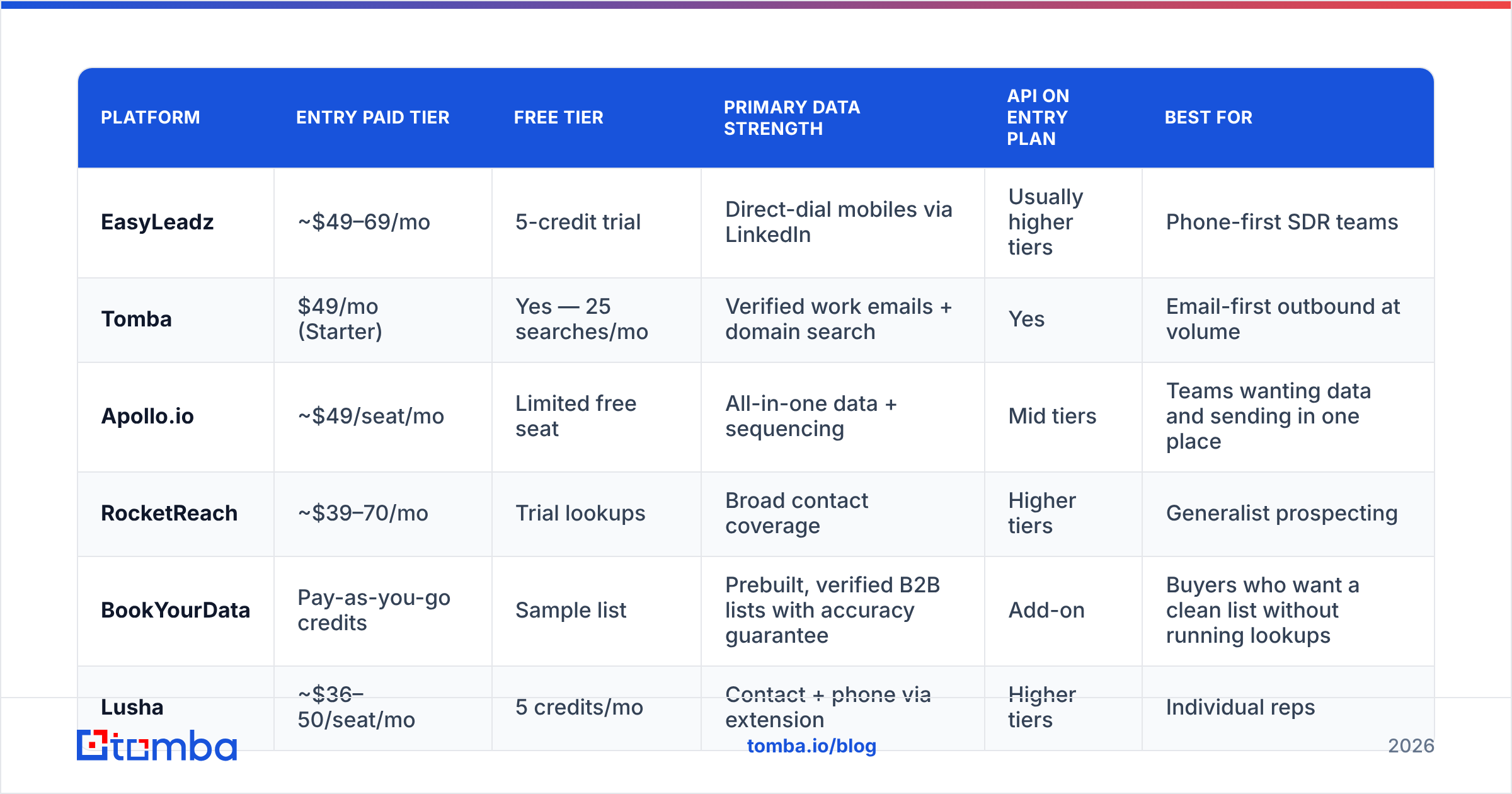
Below is a like-for-like look at entry pricing and what you get for it. Prices are approximate list rates at the time of writing; every vendor here changes them.
| Platform | Entry paid tier | Free tier | Primary data strength | API on entry plan | Best for |
|---|---|---|---|---|---|
| EasyLeadz | ~$49–69/mo | 5-credit trial | Direct-dial mobiles via LinkedIn | Usually higher tiers | Phone-first SDR teams |
| Tomba | $49/mo (Starter) | Yes — 25 searches/mo | Verified work emails + domain search | Yes | Email-first outbound at volume |
| Apollo.io | ~$49/seat/mo | Limited free seat | All-in-one data + sequencing | Mid tiers | Teams wanting data and sending in one place |
| RocketReach | ~$39–70/mo | Trial lookups | Broad contact coverage | Higher tiers | Generalist prospecting |
| BookYourData | Pay-as-you-go credits | Sample list | Prebuilt, verified B2B lists with accuracy guarantee | Add-on | Buyers who want a clean list without running lookups |
| Lusha | ~$36–50/seat/mo | 5 credits/mo | Contact + phone via extension | Higher tiers | Individual reps |

Read that table as a map of trade-offs, not a leaderboard. BookYourData wins when you would rather buy a finished, guaranteed list than operate a lookup tool. Apollo wins when consolidating data and sequencing into one contract matters more than best-in-class accuracy on either. EasyLeadz wins on mobiles. Email-heavy teams generally do better with a finder plus verifier they can call programmatically — see how Tomba plans map credits to searches, and how the bulk email finder prices large list runs versus per-seat credit models.
One more comparison axis nobody puts on a pricing page: how the tool fails. A vendor that returns "unknown" honestly is worth more than one that returns a plausible-looking guess, because the guess costs you a bounce, a spam complaint, and a slice of your sender reputation. Test for this deliberately during your trial by looking up three people you know are not in any database. Confident wrong answers are a red flag.
How do you cut your cost per usable contact?#
Five moves, in order of impact:
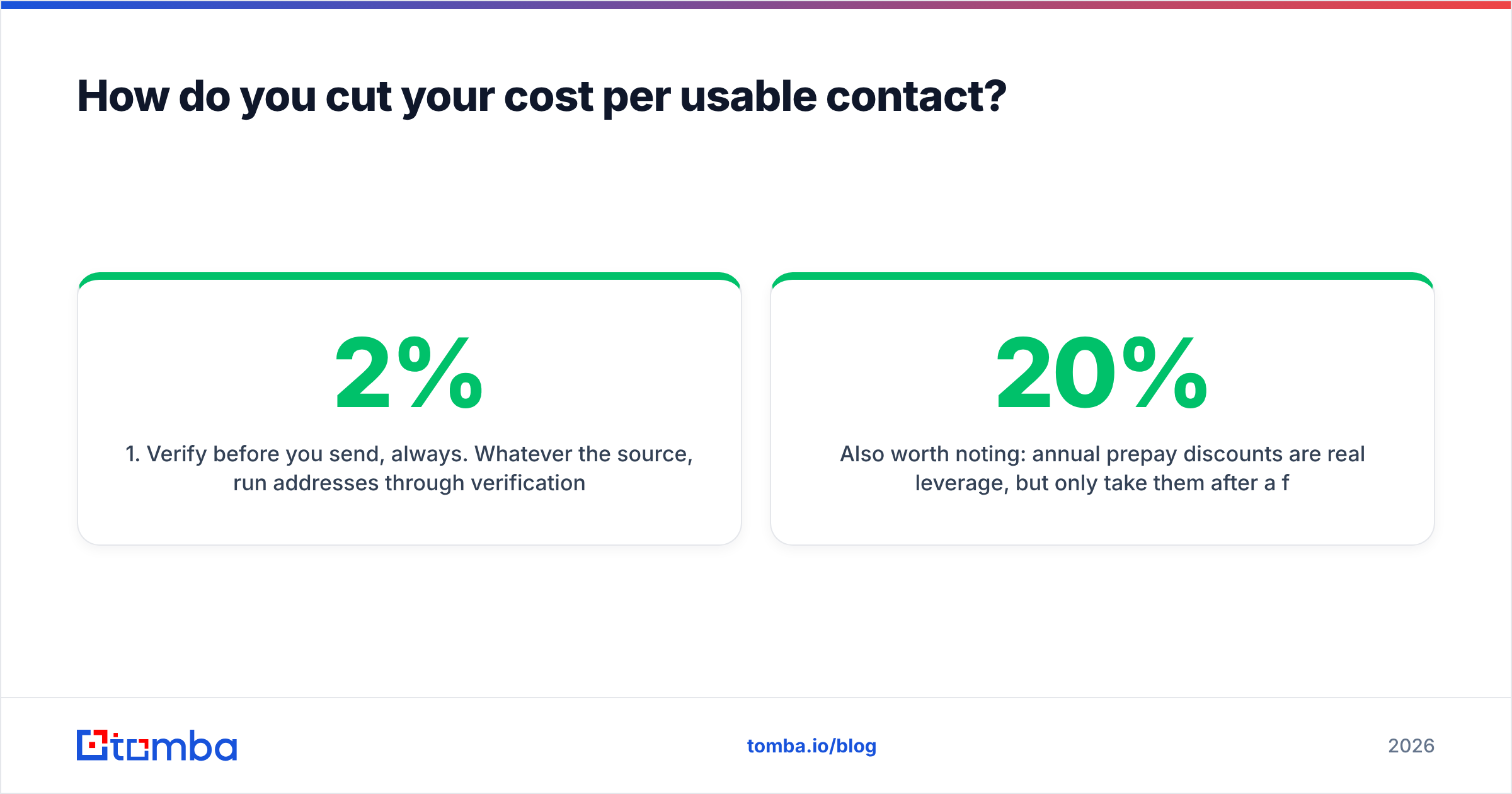
- Verify before you send, always. Whatever the source, run addresses through verification and drop the risky ones. A 2% bounce rate is a deliverability problem; a 6% one is an inbox-placement problem that costs you every campaign afterward.
- Split phone and email sourcing. Buy phones from the vendor that is best at phones and emails from the vendor that is best at emails. Bundling feels tidier and usually costs more per usable record.
- Enrich only what you will actually contact. Do not reveal 1,000 contacts to sequence 300. Filter by fit first, spend credits second. This single habit routinely cuts data spend by a third.
- Use the API instead of the extension for anything repeatable. Manual clicking through profiles is a hidden labor cost that dwarfs the credit cost. A scripted run through the email finder API does in minutes what a rep does in a morning.
- Re-test coverage every quarter. Datasets drift. The vendor that won your bake-off last year may not win it now, and switching costs on credit plans are low by design.
Also worth noting: annual prepay discounts are real leverage, but only take them after a full month of production use. A 20% discount on the wrong tool is a 100% loss.
What's the verdict on EasyLeadz pricing?#
Fairly priced for what it is — a phone-number product — and frequently mis-bought by email-first teams. If dials are your primary channel and your ICP sits in its strong coverage regions, an Advanced-tier plan around $99/month at roughly $0.20 per credit is a defensible line item, and the extension workflow saves real time. If you are running sequenced cold email at any volume, the credit math stops working somewhere around the low thousands of contacts per month, and you should be pricing a dedicated finder-and-verifier stack instead.
Do the 100-row bake-off. Compute cost per usable record, not cost per credit. Confirm expiry, failure-charging, seats, and API gating in writing. That process takes an afternoon and routinely saves four figures a year.
If your motion is email-led, start with the Tomba Email Finder. The free tier gives you 25 searches a month to test coverage on your own list with no card, Starter is $49/month, and every result can be pushed straight through verification and into your CRM via API before it ever touches a sequencer. Test it against your current vendor on the same 100 rows and let the cost-per-usable-record number decide.
Related guides#
Ready to find emails that actually work?
Join 150,000+ professionals who stopped guessing and started sending. Free credits on signup — no credit card required.
Get the Tomba newsletter
Practical outbound tactics and product updates — once every two weeks.
About the author