EasyLeadz vs Enrichley: Which B2B Contact Tool Wins in 2026?
EasyLeadz sells direct dials. Enrichley sells enrichment. They look similar on a pricing page and behave nothing alike in production. Here is the honest breakdown, plus where each one quietly fails.
TL;DR
- EasyLeadz is a phone-first tool. Its reason to exist is the Chrome extension that pulls direct mobile numbers off LinkedIn profiles. Email is a secondary output, and it shows.
- Enrichley is an enrichment-first tool. You feed it a partial record (domain, name, or existing email) and it fills in the gaps. It is weaker as a net-new prospecting engine.
- Credit math decides this, not features. EasyLeadz charges per revealed contact whether or not you dial it. Enrichley charges per enrichment attempt, and "no match" rows can still eat budget on some plans — always confirm the refund policy before you commit.
- Neither is a strong standalone email source. If your outbound motion is email-led, both leave you buying a second tool for verification anyway.
- Best combined setup: a dedicated email finder + verifier for the email layer, and a phone tool only for the accounts where calling actually converts.
If you are comparing EasyLeadz vs Enrichley, you are almost certainly trying to answer a narrower question: which one gets me more usable contacts per dollar this quarter? That question has a different answer depending on whether you dial or send. Here is the full breakdown.
What is EasyLeadz and who actually uses it?#
EasyLeadz built its reputation on one feature: a browser extension (marketed as "Mr. E") that sits on a LinkedIn profile and reveals a direct mobile number in one click. That is a genuinely hard data problem, and it is the reason the tool has a loyal base among APAC and India-focused sales teams, recruiters, and anyone whose pipeline depends on picking up the phone.
The typical EasyLeadz user is an SDR or recruiter working profile-by-profile. You are already on LinkedIn, you already know who you want, and you need a number in the next three seconds. That workflow is where the product is strongest.
Where it gets shakier:
- Bulk work. Reveal-per-profile is a manual motion. Bulk uploads exist, but the per-record economics get punishing fast.
- Email coverage outside its core geographies. Mobile coverage in India and parts of APAC is a genuine differentiator. Email coverage across US/EU mid-market is more ordinary.
- Credit consumption on misses. A revealed number that is stale still consumed a credit. Check the current policy on invalid-number credit returns before you scale spend.
- Compliance surface. Direct mobile numbers carry different regulatory weight than business emails in the EU and in US states with call-consent rules. That is a legal review item, not a footnote.
What is Enrichley and how is it different?#
Enrichley sits on the other side of the funnel. It is an enrichment layer: you already have something — a company domain, a first/last name, a form-fill email — and Enrichley returns the surrounding record. Job title, company size, social profiles, sometimes a work email, sometimes firmographics.
The archetypal Enrichley user is not an SDR. It is a RevOps or growth engineer wiring a workflow: inbound form submits → enrichment call → routing rules → CRM. Enrichment tools are judged on match rate and field completeness, not on "did I get a phone number in one click."
This is the single most important thing to understand before comparing them: EasyLeadz creates contacts, Enrichley completes them. Putting them head-to-head on a feature grid makes them look like competitors. In a real stack they often are not.

EasyLeadz vs Enrichley: how do they compare feature by feature?#
| Attribute | EasyLeadz | Enrichley |
|---|---|---|
| Primary job | Reveal direct mobile numbers | Fill gaps in existing records |
| Core interface | Chrome extension on LinkedIn | API + CSV enrichment |
| Net-new prospecting | Strong (profile-by-profile) | Weak — needs a seed record |
| Email finding | Secondary feature | Secondary feature |
| Email verification | Limited / third-party | Limited / third-party |
| Bulk throughput | Moderate, credit-heavy | Strong (built for batch) |
| Best geography | India / APAC mobile coverage | Varies; check by region |
| Typical buyer | SDR, recruiter, founder | RevOps, growth engineer |
| Pricing model | Credits per reveal | Credits per enrichment |
| CRM automation | Basic exports + integrations | API-first, automation-friendly |
Read that table as a fork in the road rather than a scoreboard. If the row that matters to you is "net-new prospecting," EasyLeadz wins by default because Enrichley is not trying to do that job. If the row that matters is "enrich 40,000 inbound signups overnight," Enrichley wins for the same reason in reverse.
Which one has better data accuracy?#
Accuracy claims from any vendor in this category should be treated as marketing until you run your own sample. Both companies publish high accuracy figures. Both are measuring something narrower than what you care about.
Here is how to test it properly, in about 90 minutes:
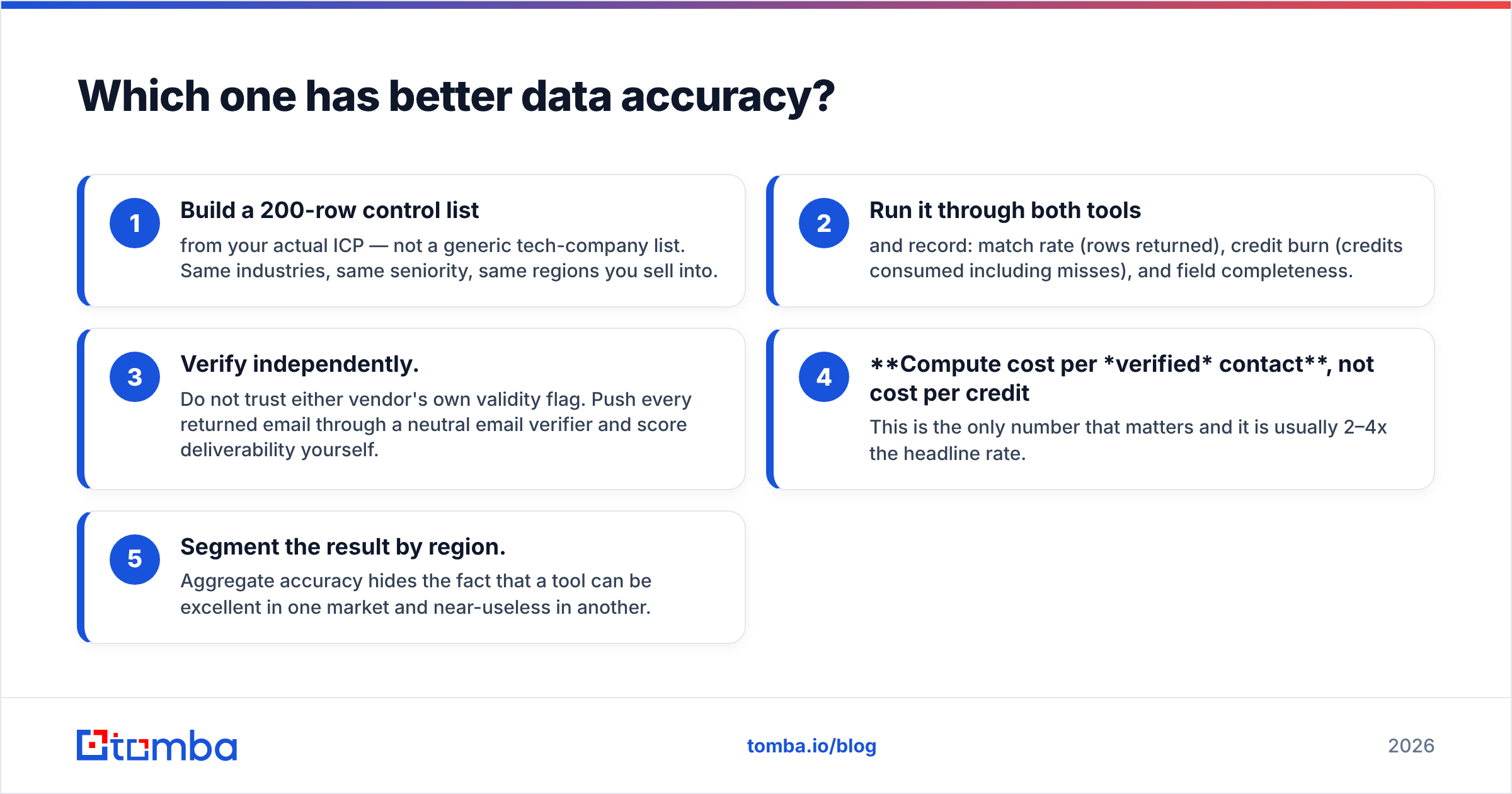
- Build a 200-row control list from your actual ICP — not a generic tech-company list. Same industries, same seniority, same regions you sell into.
- Run it through both tools and record: match rate (rows returned), credit burn (credits consumed including misses), and field completeness.
- Verify independently. Do not trust either vendor's own validity flag. Push every returned email through a neutral email verifier and score deliverability yourself.
- Compute cost per verified contact, not cost per credit. This is the only number that matters and it is usually 2–4x the headline rate.
- Segment the result by region. Aggregate accuracy hides the fact that a tool can be excellent in one market and near-useless in another.
That last step is where most EasyLeadz vs Enrichley evaluations go wrong. Teams run a global sample, see an unremarkable average, and miss that one tool is at 70%+ in the exact segment they sell into.

One structural warning on the email side: neither tool is built primarily as an email-accuracy engine, and both lean on pattern inference for a meaningful share of results. Pattern inference is fine — every provider does it — but it needs SMTP-level validation behind it, plus a real answer for catch-all domains. If your target accounts sit on Microsoft 365 tenants configured as catch-all, an unverified "valid" flag from any enrichment vendor is close to meaningless. Run those through a dedicated catch-all verifier before they touch a sequence.
How does pricing actually compare?#
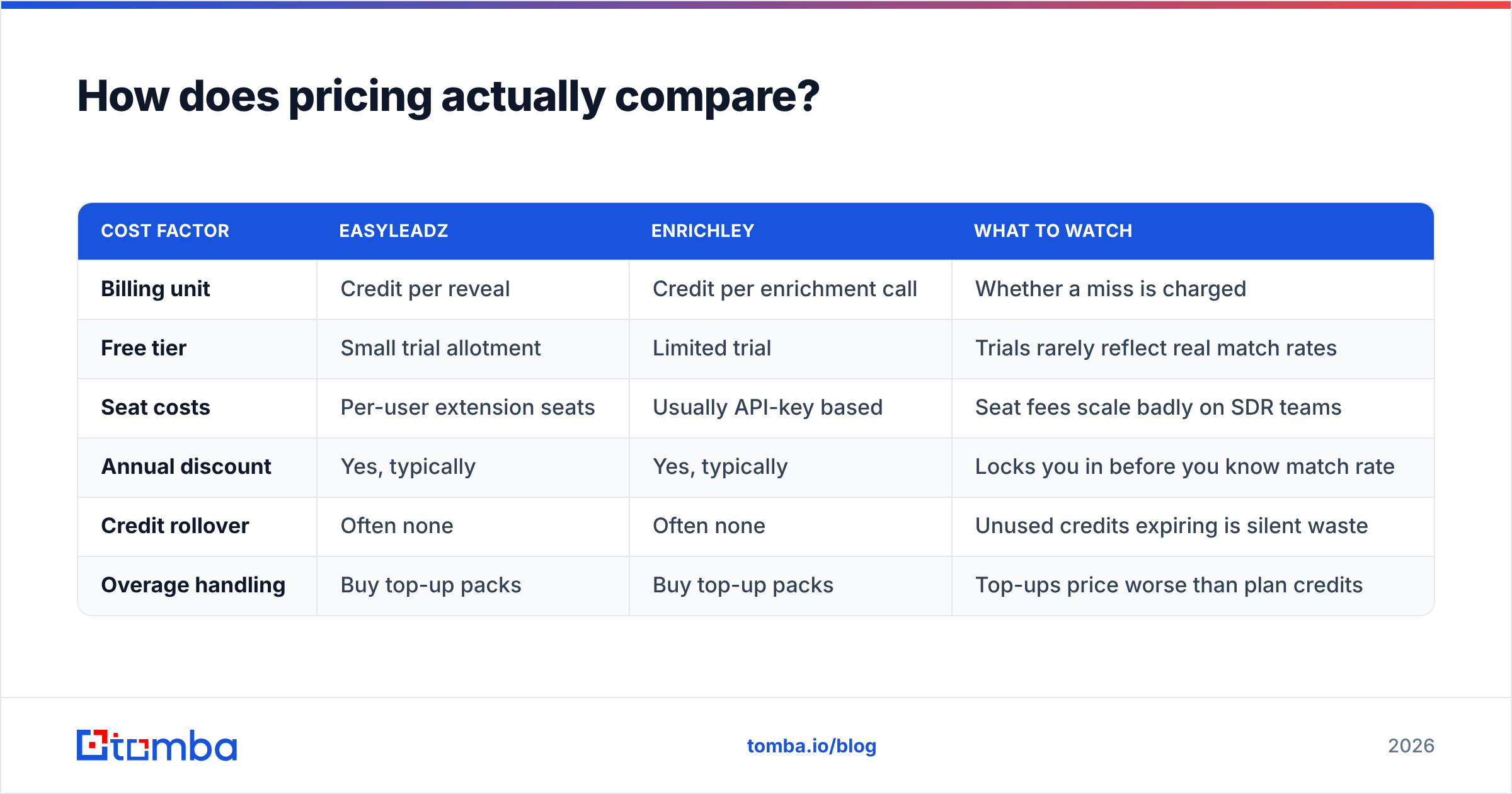
Both vendors iterate on packaging, so verify current numbers on their own sites before signing. The structural differences matter more than the specific dollar figures:
| Cost factor | EasyLeadz | Enrichley | What to watch |
|---|---|---|---|
| Billing unit | Credit per reveal | Credit per enrichment call | Whether a miss is charged |
| Free tier | Small trial allotment | Limited trial | Trials rarely reflect real match rates |
| Seat costs | Per-user extension seats | Usually API-key based | Seat fees scale badly on SDR teams |
| Annual discount | Yes, typically | Yes, typically | Locks you in before you know match rate |
| Credit rollover | Often none | Often none | Unused credits expiring is silent waste |
| Overage handling | Buy top-up packs | Buy top-up packs | Top-ups price worse than plan credits |
The trap in both models is identical and it is not the sticker price. It is the gap between credits consumed and contacts you can actually use. A plan at $99/month that returns 1,000 records with a 55% verified-deliverable rate costs you 18 cents per usable contact. The same plan at 80% costs 12 cents. The pricing page tells you nothing about which one you will get.
Compare that structure against a transparent per-search model. Tomba pricing starts with a free tier at 25 searches per month, then Starter at $49/mo, Growth at $99/mo, Pro at $249/mo, and custom Enterprise — with verification bundled rather than sold as a bolt-on. The point is not that cheaper is automatically better; it is that when verification lives inside the same tool, your cost-per-usable-contact stops being a guess.
Who should choose EasyLeadz?#
Pick EasyLeadz if all three of these are true:
- You dial. Not "we might call sometimes" — your team's primary conversion event happens on the phone. Direct mobile numbers are expensive data to acquire and you should only pay for them if you use them.
- Your ICP skews India/APAC. This is where EasyLeadz's coverage advantage is real and where generic global databases underperform.
- Your motion is profile-by-profile. Recruiters, founder-led sales, and account-based SDR teams working named lists get the most out of a click-to-reveal extension.
Skip it if you are running high-volume email outbound. You will pay phone-data prices for email data you could source better elsewhere.
Who should choose Enrichley?#
Pick Enrichley if:
- You have inbound volume to enrich. Form fills, trial signups, webinar registrations — records that arrive incomplete and need to be routed correctly within seconds.
- You have engineering capacity. Enrichment tools deliver value through automation. If nobody on your team will wire the API into your CRM and your routing logic, most of the value stays on the table.
- You need firmographics, not just contact points. Employee count, industry, and tech stack fields drive scoring and territory assignment in ways that a phone number cannot.
Skip it if your problem is "we don't have enough leads." Enrichment multiplies the value of records you already have. It does not create them.

Where does Tomba fit into this comparison?#
Honestly: Tomba is not a replacement for EasyLeadz if what you need is an Indian founder's personal mobile number. That is a specialised dataset and EasyLeadz is good at it.
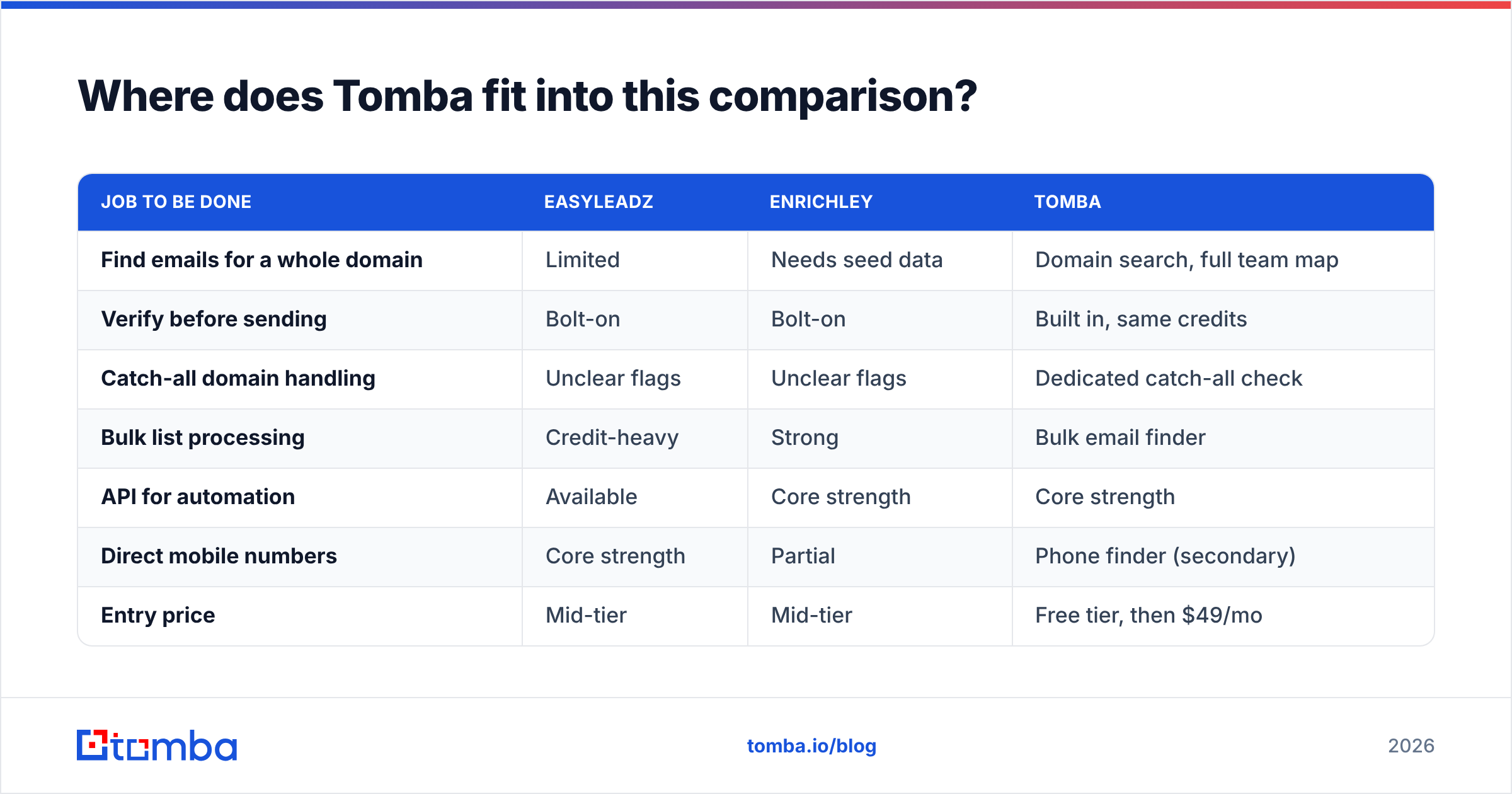
Tomba competes on the layer where both of these tools are weakest — net-new email discovery with verification built into the same pipeline.
| Job to be done | EasyLeadz | Enrichley | Tomba |
|---|---|---|---|
| Find emails for a whole domain | Limited | Needs seed data | Domain search, full team map |
| Verify before sending | Bolt-on | Bolt-on | Built in, same credits |
| Catch-all domain handling | Unclear flags | Unclear flags | Dedicated catch-all check |
| Bulk list processing | Credit-heavy | Strong | Bulk email finder |
| API for automation | Available | Core strength | Core strength |
| Direct mobile numbers | Core strength | Partial | Phone finder (secondary) |
| Entry price | Mid-tier | Mid-tier | Free tier, then $49/mo |
The practical stack most teams land on after running the test above is a split one: an email-finding-and-verification layer that handles 80–90% of outbound volume, plus a phone-data tool bought in smaller volume for the accounts worth calling. Trying to force one vendor to do both is how you end up paying premium rates for mediocre coverage on both sides.
What should you actually test before buying either?#
Run this checklist before your trial expires — most buyers discover the answers only after the annual invoice clears:
- Miss policy. Does a "no result found" consume a credit? Get it in writing, not from a support chat.
- Rollover. Do unused credits expire monthly? If so, your effective price is higher than advertised every month you underuse the plan.
- Verification status semantics. What exactly does "valid" mean? Syntax check, MX check, SMTP handshake, or a guess? These are wildly different guarantees.
- Region-level match rate. Ask for a sample run on your list, in your markets. Vendors that refuse are telling you something.
- Export and ownership. Can you export the full record set on cancellation, or does the data live behind their UI?
- Compliance documentation. GDPR lawful basis, opt-out handling, and data-sourcing disclosure. Independent review sites like G2 surface complaints here that vendor pages never will, and HubSpot's research on outbound performance is a useful sanity check on what response rates you should even expect from clean data.
If a vendor scores well on the first five and poorly on the sixth, that is not a small problem — it is a future legal expense priced into a monthly SaaS bill.
So which one wins: EasyLeadz or Enrichley?#
Neither wins outright, because they are answering different questions. EasyLeadz wins if your revenue depends on dialing mobile numbers, especially in India and APAC. Enrichley wins if you have inbound volume and engineering capacity to enrich records automatically. If you compared them because you assumed they overlapped, the real conclusion is that you probably need neither — you need a stronger email layer first.
That is the sequencing most teams get backwards. Email is still the highest-volume, lowest-cost outbound channel, and it is the one where data quality has the most brutal compounding effect: bad addresses do not just fail to convert, they degrade your sender reputation and drag down every clean address in the same sending domain. A phone number that is wrong costs you 30 seconds. An email that is wrong costs you deliverability for weeks.
Build the email layer on a tool where finding and verifying happen in the same pipeline, prove your cost per verified contact, and only then decide whether you need direct dials or automated enrichment on top.
Start with the Tomba Email Finder — the free tier gives you 25 searches a month to run your own head-to-head sample against whatever you are using now, with verification included rather than billed separately. Run the 200-row test from earlier, compute your real cost per usable contact, and let that number make the buying decision instead of a pricing page.
Related guides#
Ready to find emails that actually work?
Join 150,000+ professionals who stopped guessing and started sending. Free credits on signup — no credit card required.
Get the Tomba newsletter
Practical outbound tactics and product updates — once every two weeks.
About the author