EasyLeadz vs Enrow (2026): Which B2B Data Tool Wins?
EasyLeadz sells direct dials. Enrow sells verified emails you only pay for when they land. We compare accuracy, credit math, pricing and API depth so you buy the right one.
EasyLeadz vs Enrow looks like a fair fight. It isn't. One tool sells phone numbers. The other sells verified emails. This guide shows where each one wins, what a credit really costs, and which of the two fits the way your team sells.
TL;DR
- EasyLeadz is a phone-first tool. Its flagship product, the Mr. E extension, is built to surface direct dial and mobile numbers from LinkedIn profiles. Email is a secondary output.
- Enrow is an email-first tool. It runs waterfall enrichment across multiple providers and bills on the "only pay for valid emails" model, with a headline accuracy guarantee in the high 90s.
- They barely overlap. If you compare them feature-for-feature you will pick the wrong one — the real question is whether your motion is dial-led or inbox-led.
- Credit math decides the winner more than accuracy does. A tool with 95% hit rate that charges for misses can cost more per usable contact than one at 88% that doesn't.
- Neither is a full stack. Most teams that run both cold email and cold calling end up pairing a dedicated email finder with a phone source rather than paying two premium subscriptions.
What is EasyLeadz and who actually uses it?#
EasyLeadz is an Indian B2B contact data company. It is best known for Mr. E, a Chrome extension that pulls direct dial and mobile numbers while you browse LinkedIn. You open a profile, click the extension, and it returns a number. Often an email too. Both come from the EasyLeadz contact database.
The pitch is clear. Mobile numbers are the hard part of B2B data, so that is what they charge for. Their claims center on India and APAC, where most Western vendors thin out badly. That regional strength is the main thing to know. If your ICP sits in Bengaluru, Singapore or Dubai, this is a real edge. If your ICP is Series B SaaS in Austin, the edge mostly disappears.
Typical EasyLeadz buyers:
- SDR teams running call-first sequences where the dial is the primary touch and email is follow-up
- Recruiters sourcing candidates who need a phone number, not a work inbox
- Teams selling into APAC and MENA markets underserved by US-centric providers
- Anyone who has already burned credits on a US database and found 20% phone coverage
You can review the current product scope on the official EasyLeadz site, and independent user reviews sit on G2 if you want to sanity-check the coverage claims against real accounts.
What is Enrow and how is it different?#
Enrow is a French email finding and verification service. It is built on waterfall enrichment. Instead of querying one database, Enrow chains requests across several data sources and pattern-verification layers. It returns the first result that clears its confidence bar.
Two design decisions define the product:
- Accuracy guarantee. Enrow markets a high-90s accuracy figure on the emails it returns, backed by its verification layer rather than by raw database size.
- Pay-for-found billing. You are charged for emails Enrow successfully finds and validates, not for every lookup attempt. Misses cost you nothing.
That second point matters more than most buyers realize. In a traditional credit model, a 60% hit rate means you effectively pay 1.67x the sticker price per usable contact. Under a pay-for-found model, the sticker price is the real price. Details and current tiers are on the official Enrow site.
The tradeoff: Enrow does not sell phone numbers as a first-class product, and it is not a prospecting database. You bring the list — names plus company domains — and Enrow enriches it. There is no "search for 500 CFOs in fintech" motion inside the tool.

EasyLeadz vs Enrow: how do they compare head-to-head?#
Here is the honest side-by-side. Pricing moves; verify current tiers on each vendor's page before you commit budget.
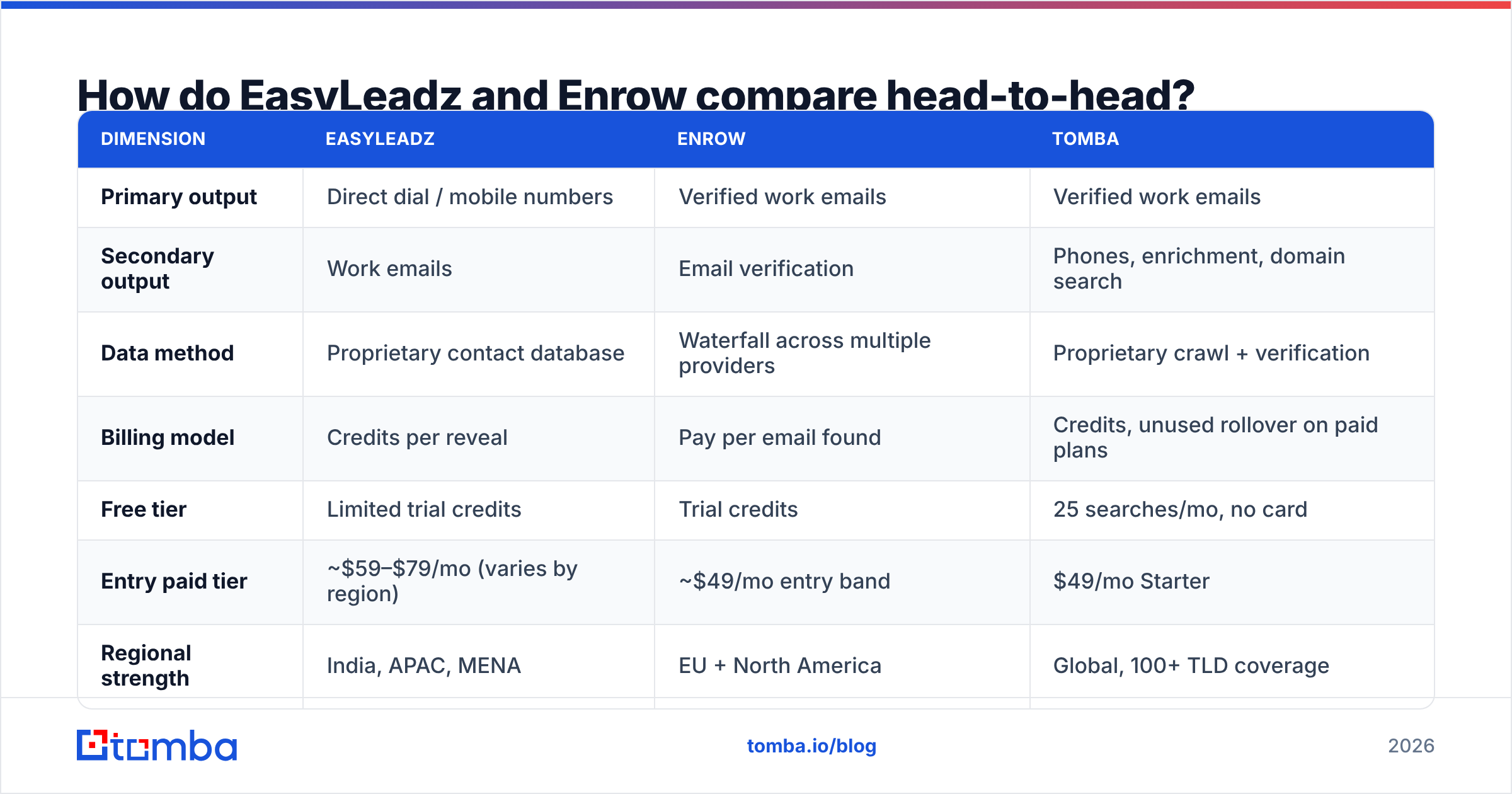
| Dimension | EasyLeadz | Enrow | Tomba |
|---|---|---|---|
| Primary output | Direct dial / mobile numbers | Verified work emails | Verified work emails |
| Secondary output | Work emails | Email verification | Phones, enrichment, domain search |
| Data method | Proprietary contact database | Waterfall across multiple providers | Proprietary crawl + verification |
| Billing model | Credits per reveal | Pay per email found | Credits, unused rollover on paid plans |
| Free tier | Limited trial credits | Trial credits | 25 searches/mo, no card |
| Entry paid tier | ~$59–$79/mo (varies by region) | ~$49/mo entry band | $49/mo Starter |
| Regional strength | India, APAC, MENA | EU + North America | Global, 100+ TLD coverage |
| Prospecting search | Limited | No — enrichment only | Yes — domain search |
| Catch-all handling | Not a focus | Included in verification | Dedicated catch-all verifier |
| Public API | Yes | Yes | Yes, plus CLI, MCP, Sheets, Excel |
| Best for | Cold callers in APAC | Clean email lists at scale | Mixed email + phone outbound |
Two rows deserve extra attention.
Billing model. EasyLeadz's credit-per-reveal model means a failed lookup still costs you something in most configurations. Enrow's model does not. Over a 10,000-contact enrichment run, that difference can be larger than the entire subscription fee.
Prospecting search. Neither tool replaces a database you can query. EasyLeadz gets closer via its LinkedIn workflow, but you are still browsing profiles one at a time. If you need to go from "ICP definition" to "500 contacts" without a source list, you need something else in the stack.
Which tool finds more accurate emails?#
Accuracy claims mean little without a defined test. Vendors compute numbers on their own sample sets. They use their own definition of "valid." And they rarely publish the miss rate behind the sample.
Here is how to run a test that actually tells you something:
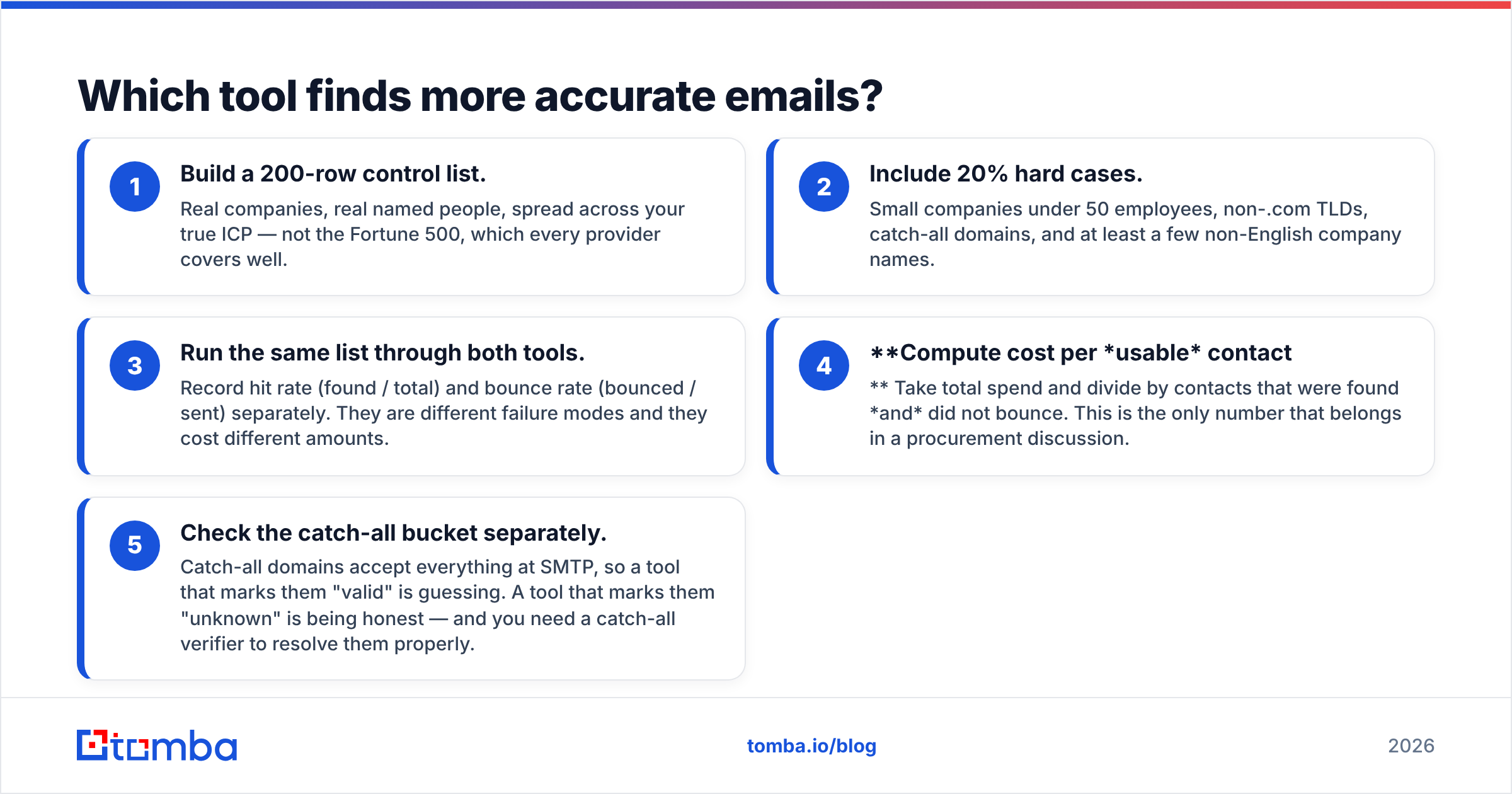
- Build a 200-row control list. Real companies, real named people, spread across your true ICP — not the Fortune 500, which every provider covers well.
- Include 20% hard cases. Small companies under 50 employees, non-.com TLDs, catch-all domains, and at least a few non-English company names.
- Run the same list through both tools. Record hit rate (found / total) and bounce rate (bounced / sent) separately. They are different failure modes and they cost different amounts.
- Compute cost per usable contact. Take total spend and divide by contacts that were found and did not bounce. This is the only number that belongs in a procurement discussion.
- Check the catch-all bucket separately. Catch-all domains accept everything at SMTP, so a tool that marks them "valid" is guessing. A tool that marks them "unknown" is being honest — and you need a catch-all verifier to resolve them properly.

Run that test and Enrow tends to do well on Western B2B domains. The waterfall approach picks up contacts that any single database would miss. EasyLeadz will lag on email, because email is not what the product is built for. Judging EasyLeadz on email accuracy is like judging a truck on lap times.
Where EasyLeadz wins outright is phone coverage in its home markets. No amount of waterfall email enrichment produces a mobile number.
What does each one actually cost?#
Both vendors use tiered pricing that scales with volume, and both change tiers regularly. The structural difference matters more than any specific number.
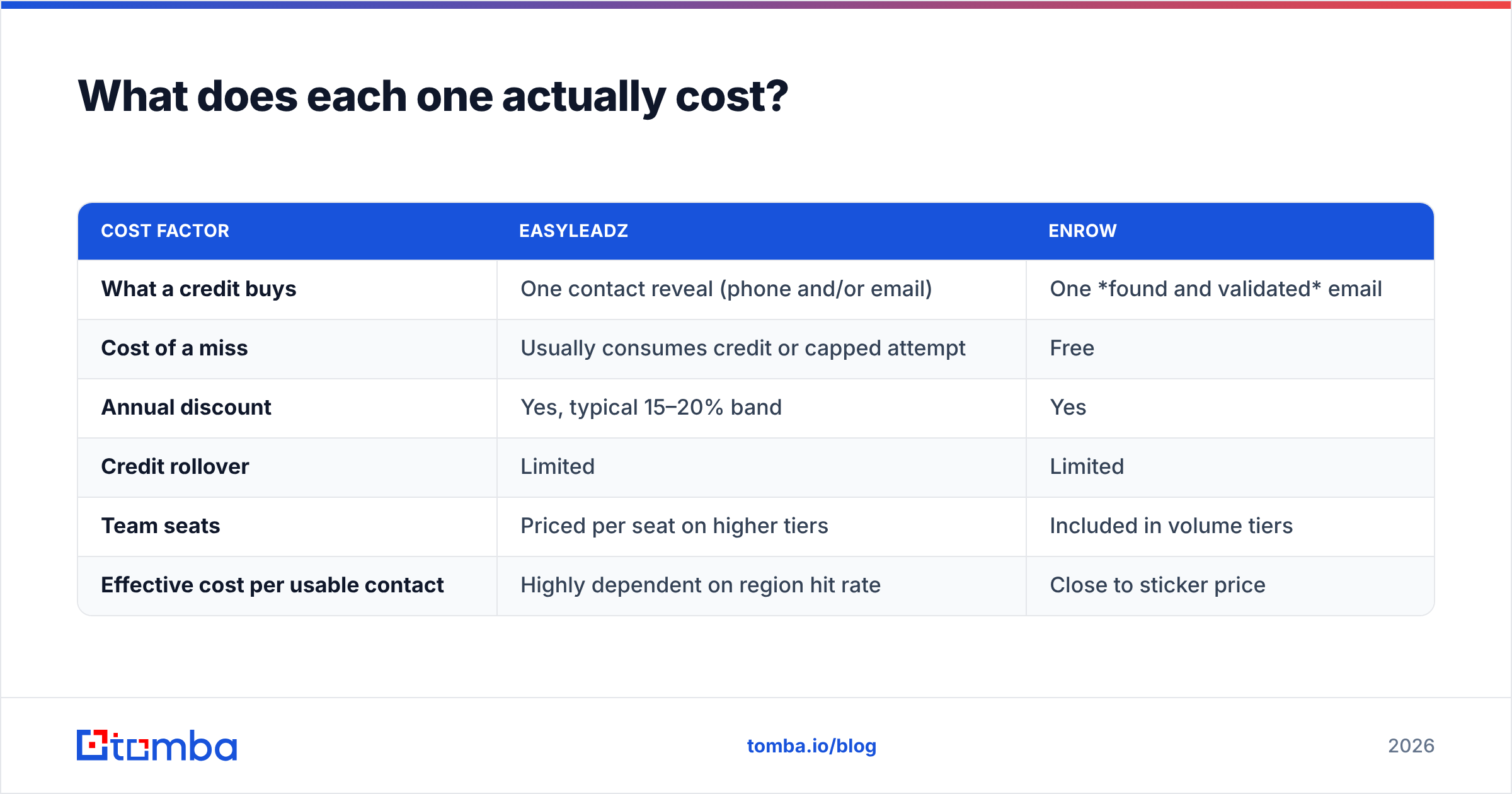
| Cost factor | EasyLeadz | Enrow |
|---|---|---|
| What a credit buys | One contact reveal (phone and/or email) | One found and validated email |
| Cost of a miss | Usually consumes credit or capped attempt | Free |
| Annual discount | Yes, typical 15–20% band | Yes |
| Credit rollover | Limited | Limited |
| Team seats | Priced per seat on higher tiers | Included in volume tiers |
| Effective cost per usable contact | Highly dependent on region hit rate | Close to sticker price |
The practical read: Enrow's pricing is more predictable. EasyLeadz has a higher ceiling, and wider variance. Enriching a 25,000-row list of European SaaS contacts? Enrow is easier to forecast. Need 400 verified Indian mobile numbers for an outbound calling week? EasyLeadz beats any generalist tool on cost per outcome. That includes the ones that claim global coverage and quietly return a 12% phone fill rate outside the US.
For reference, Tomba pricing runs a free tier at 25 searches/month, Starter at $49/mo, Growth at $99/mo and Pro at $249/mo, with Enterprise custom. Use it as a baseline when you weigh whether a specialist tool's premium is worth it.
Is a third option better than either?#
Often, yes — and this is where most comparison posts get dishonest, so let's be specific about when it is not.
Stick with EasyLeadz if: your primary motion is cold calling into India, Southeast Asia or the Gulf, and your reps measure success in connects. Nothing in the generalist market beats a purpose-built regional phone database on its home turf.
Stick with Enrow if: you run high-volume cold email into EU and North American accounts, you already have a source of names and domains, and your finance team wants a per-outcome cost line rather than a credit budget that evaporates unpredictably.
Look at a consolidated tool if: you run both motions, you need prospecting search as well as enrichment, or you are currently paying for two subscriptions that each solve half the problem.
That last case describes most 5–30 person sales teams. You need to find contacts, not just enrich a list you already have. You need to verify them so your domain reputation survives. And you need a phone number for the accounts worth calling. Running EasyLeadz plus Enrow plus a separate verifier means three vendors, three credit pools, three renewal dates, and three sets of API keys.

How does Tomba compare on the same axes?#
Tomba sits deliberately in the middle: an email finder first, with the adjacent tooling attached rather than sold separately.
- Finding. The email finder resolves by name plus domain, and domain search returns every discoverable address at a company — which is the prospecting step Enrow does not attempt.
- Verifying. The email verifier runs SMTP-level checks and, importantly, flags catch-all domains as catch-all rather than pretending they are confirmed.
- Phone. The phone finder covers the dial-led side. It will not beat EasyLeadz on Indian mobile coverage — that is a genuinely specialized dataset — but it closes the gap for Western B2B.
- Scale. Bulk email finder handles list-level runs, and the Tomba API plus CLI, MCP server, Google Sheets and Excel add-ins mean you can run enrichment wherever your data already lives.

The honest limitation: if your entire business is calling mobile numbers in Mumbai, buy the specialist. Consolidation is a cost and workflow argument, not a claim to beat every point solution on its strongest axis.
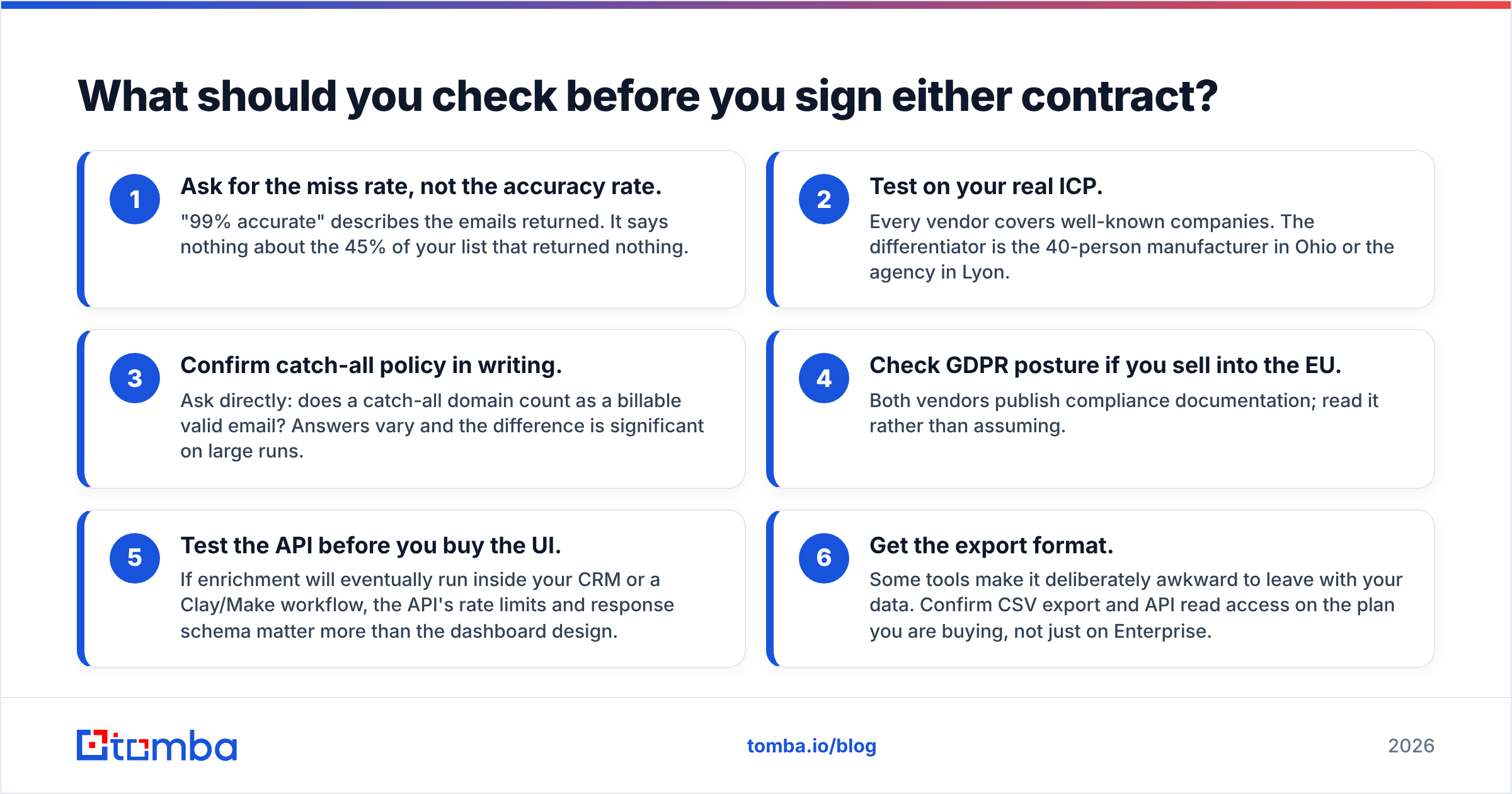
What should you check before you sign either contract?#
Run this list before the demo call ends, not after the invoice arrives.
- Ask for the miss rate, not the accuracy rate. "99% accurate" only describes the emails they return. It says nothing about the 45% of your list that came back empty.
- Test on your real ICP. Every vendor covers famous companies. The gap shows up on the 40-person manufacturer in Ohio.
- Confirm catch-all policy in writing. Does a catch-all domain count as a billable valid email? Answers vary, and it adds up on large runs.
- Check GDPR posture if you sell into the EU. Both vendors publish compliance docs. Read them.
- Test the API before you buy the UI. If enrichment runs inside your CRM, rate limits matter more than dashboard design.
- Get the export format. Some tools make it hard to leave with your data. Confirm CSV export on the plan you are buying, not just on Enterprise.
Frequently asked questions#
Does EasyLeadz find emails as well as phone numbers? Yes, but email is a secondary output. If email is your primary channel you are paying a phone-data premium for a capability you could get cheaper elsewhere.
Is Enrow's accuracy guarantee real? The pay-for-found billing model gives it teeth — Enrow has a direct financial incentive not to return junk, because it only bills on results it stands behind. Verify it against your own control list anyway.
Can I use both together? You can, and some teams do: Enrow for email enrichment, EasyLeadz for dials into APAC. Just price it as one line item and compare it honestly against a consolidated alternative.
Which is better for LinkedIn-based prospecting? EasyLeadz, because the Mr. E extension is built around the LinkedIn profile workflow. Enrow expects a structured list as input.
The bottom line#
EasyLeadz vs Enrow is not really a contest. The two tools answer different questions. EasyLeadz answers "how do I get this person on the phone in a market Western databases ignore?" Enrow answers "how do I turn 20,000 names into deliverable emails without paying for misses?" Pick the sentence that describes your quarter.
If neither sentence fits, start with the Tomba Email Finder. Maybe you need to find contacts rather than enrich them, verify before you send, and pull a number for the accounts worth calling. The free tier gives you 25 searches a month with no card. That is enough to run the 200-row control test above and see the hit rate on your own ICP before anyone signs anything. That is the only benchmark that matters.
Related guides#
Ready to find emails that actually work?
Join 150,000+ professionals who stopped guessing and started sending. Free credits on signup — no credit card required.
Get the Tomba newsletter
Practical outbound tactics and product updates — once every two weeks.
About the author