EasyLeadz vs FAC Intelligence: Which B2B Data Tool Wins in 2026
EasyLeadz sells direct dials. FAC Intelligence sells company intelligence. They look like competitors on a shortlist, but they solve different problems — and only one of them fills a cold email list. Here's the honest breakdown.
EasyLeadz vs FAC Intelligence is a matchup that shows up on a lot of shortlists. It probably shouldn't. One tool finds phone numbers. The other researches companies. Here is what each one is good at — and what to buy instead if what you really need is email addresses.
TL;DR
- EasyLeadz (Mr. E) is a phone-first contact finder. It is strongest on direct dials across India and APAC. You use it through a LinkedIn Chrome extension and pay with credits.
- FAC Intelligence is a company research tool. It sells firmographics and account context. Pricing is quote-based, not published.
- They are not true substitutes. One fills a dialer. The other fills a strategy deck.
- Neither is built for email at volume. Need 5,000 verified work emails this month? A dedicated email finder is cheaper and more accurate.
- Our pick depends on your motion. EasyLeadz for phone-heavy SDR teams in APAC. FAC Intelligence for account research. A finder like Tomba for email-driven pipeline.
What are EasyLeadz and FAC Intelligence, actually?#
Start with the honest framing, because most comparison pages skip it. These two tools land in the same buying conversation for one reason: both promise better B2B data. That is where the overlap ends.
EasyLeadz is best known for Mr. E, a browser extension. It surfaces contact details while you browse LinkedIn profiles and company pages, and it leans heavily toward mobile and direct dial numbers. You pay by credit, and you can sign up yourself. Its reputation was built on Indian and wider APAC phone coverage — a segment most North American databases handle poorly.
FAC Intelligence sits further upstream. Its output is company research: firmographic profiles, market context, account background. It is not a "give me this person's mobile number" tool. Commercially it behaves like an enterprise data vendor. Pricing is negotiated, not printed on a page you can screenshot. That matters for your evaluation, and we will come back to it.
New to how these categories differ? The B2B glossary entry on data providers is a decent primer. But the practical split is simpler than the taxonomy: contact data gets a human on the phone or in an inbox. Company intelligence tells you which humans are worth contacting.
EasyLeadz vs FAC Intelligence: how do they compare head-to-head?#
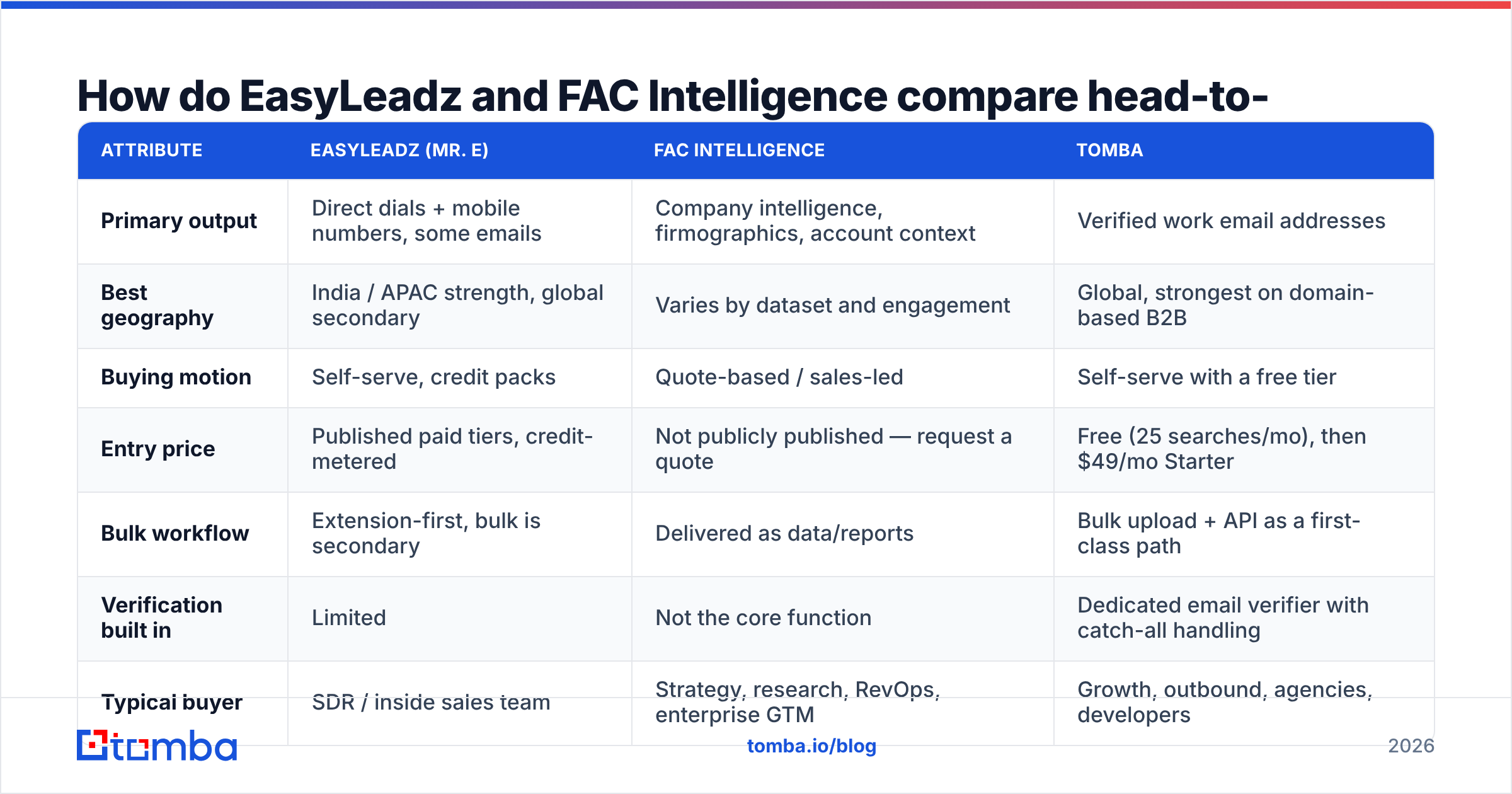
Here is the comparison most shortlists need. We added a dedicated email finder as a third reference point, because teams weighing these two are usually also asking a simpler question: do I just need emails?
| Attribute | EasyLeadz (Mr. E) | FAC Intelligence | Tomba |
|---|---|---|---|
| Primary output | Direct dials + mobile numbers, some emails | Company intelligence, firmographics, account context | Verified work email addresses |
| Best geography | India / APAC strength, global secondary | Varies by dataset and engagement | Global, strongest on domain-based B2B |
| Buying motion | Self-serve, credit packs | Quote-based / sales-led | Self-serve with a free tier |
| Entry price | Published paid tiers, credit-metered | Not publicly published — request a quote | Free (25 searches/mo), then $49/mo Starter |
| Bulk workflow | Extension-first, bulk is secondary | Delivered as data/reports | Bulk upload + API as a first-class path |
| Verification built in | Limited | Not the core function | Dedicated email verifier with catch-all handling |
| Typical buyer | SDR / inside sales team | Strategy, research, RevOps, enterprise GTM | Growth, outbound, agencies, developers |
| Time-to-first-record | Minutes | Days to weeks (procurement) | Minutes |
One row decides more evaluations than any other: time-to-first-record. A sales-led data vendor and a self-serve credit tool do not really compete on features. They compete on how long you will wait before your first outbound touch goes out. If you carry a quota this quarter, that question answers itself.

Which one gives you better data accuracy?#
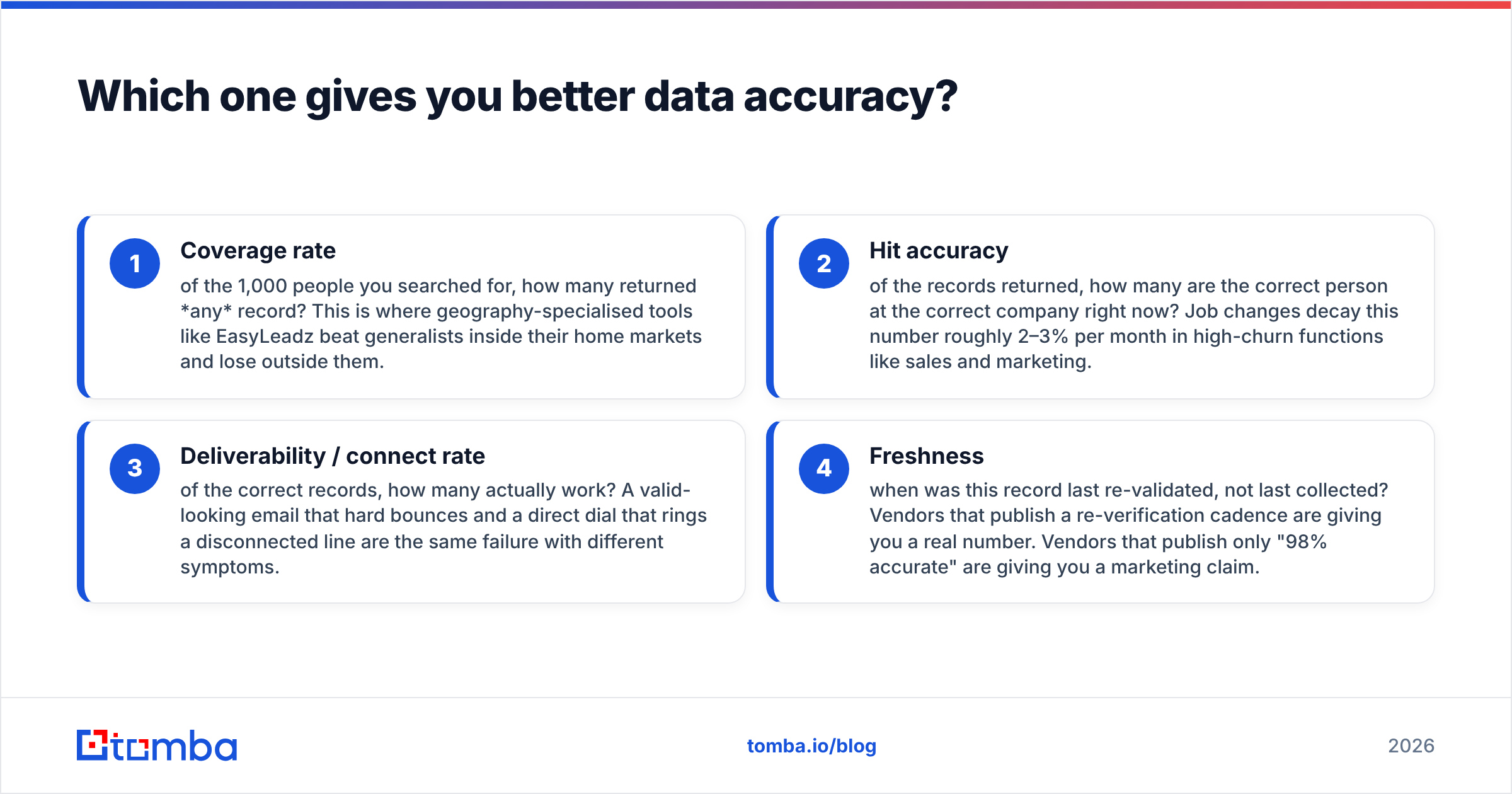
Accuracy is where vendor marketing gets slippery. Four different numbers all get called "accuracy," and they are not the same thing:
- Coverage rate — of the 1,000 people you searched for, how many returned any record? Region-focused tools like EasyLeadz beat generalists at home and lose abroad.
- Hit accuracy — of the records returned, how many are the right person at the right company today? Job changes eat 2–3% a month in sales and marketing roles.
- Deliverability, or connect rate — of the correct records, how many actually work? A hard bounce and a disconnected line are the same failure with different symptoms.
- Freshness — when was the record last re-checked, not first collected? A vendor that publishes a re-verification schedule is giving you a real number. "98% accurate" is a marketing claim.
Where each tool tends to land:
- EasyLeadz does well on coverage and hit accuracy for APAC mobile numbers. That dataset is genuinely hard to build. Outside that core, coverage thins. Phone data also decays faster than buyers expect, because a personal mobile follows the person, not the job.
- FAC Intelligence is judged on a different axis. Company data ages more slowly than contact data. Headcount bands and tech stacks shift by the quarter, not by the week. So accuracy here means depth and analyst quality, not bounce rates.
- Dedicated email finders live and die by connect-rate numbers. A bounced email is a visible, costly failure that damages sender reputation.
One test cuts through all of it. Run the same 100-row sample list through every finalist before you sign anything. Same accounts, same titles, same country, same week. Then measure match rate and bounce rate yourself. If a vendor will not test on your list instead of their demo list, that refusal tells you plenty.
Is EasyLeadz worth it for outbound teams?#
For a specific profile, yes.
Buy EasyLeadz if:
- Your motion is phone-first. You cold call into India, Southeast Asia, or the Middle East, where global databases return thin mobile coverage.
- Your reps live in LinkedIn. The extension is fast for one-at-a-time prospecting off a Sales Navigator list.
- You want self-serve without procurement. Card in, credits out, no six-week vendor review.
- Your volume is moderate. Credit pricing is friendly at hundreds of lookups a month. It gets much less friendly at tens of thousands.
Think twice if:
- Email is your primary channel. You would pay phone-tier prices for email records. A dedicated email finder returns those at higher match rates and lower cost.
- You need EU or US enterprise depth. Coverage strength is regional. That is the reason to buy it, and it cuts both ways.
- You need an API-first pipeline. Extension-led tools optimise for a human clicking. They do not optimise for the nightly enrichment job that runs against your CRM.
One compliance note. Phone data, especially personal mobiles, carries a heavier legal load than business email in most countries. Whichever vendor you pick, ask for their lawful basis and opt-out handling in writing. It is a normal request, and a serious vendor answers it within a day.
Is FAC Intelligence a better fit for enterprise GTM?#
FAC Intelligence earns its keep in a different part of the funnel. That changes how you should judge it.
Company research pays off when the expensive mistake is targeting the wrong accounts, not failing to reach the right ones. Say your average deal is $80,000 and your sales cycle runs nine months. Twenty well-researched accounts then beat two thousand scraped contacts, and the research layer pays for itself the first time it kills a dead-end pursuit. That is a real ROI case. It is also not a case a contact finder can make.
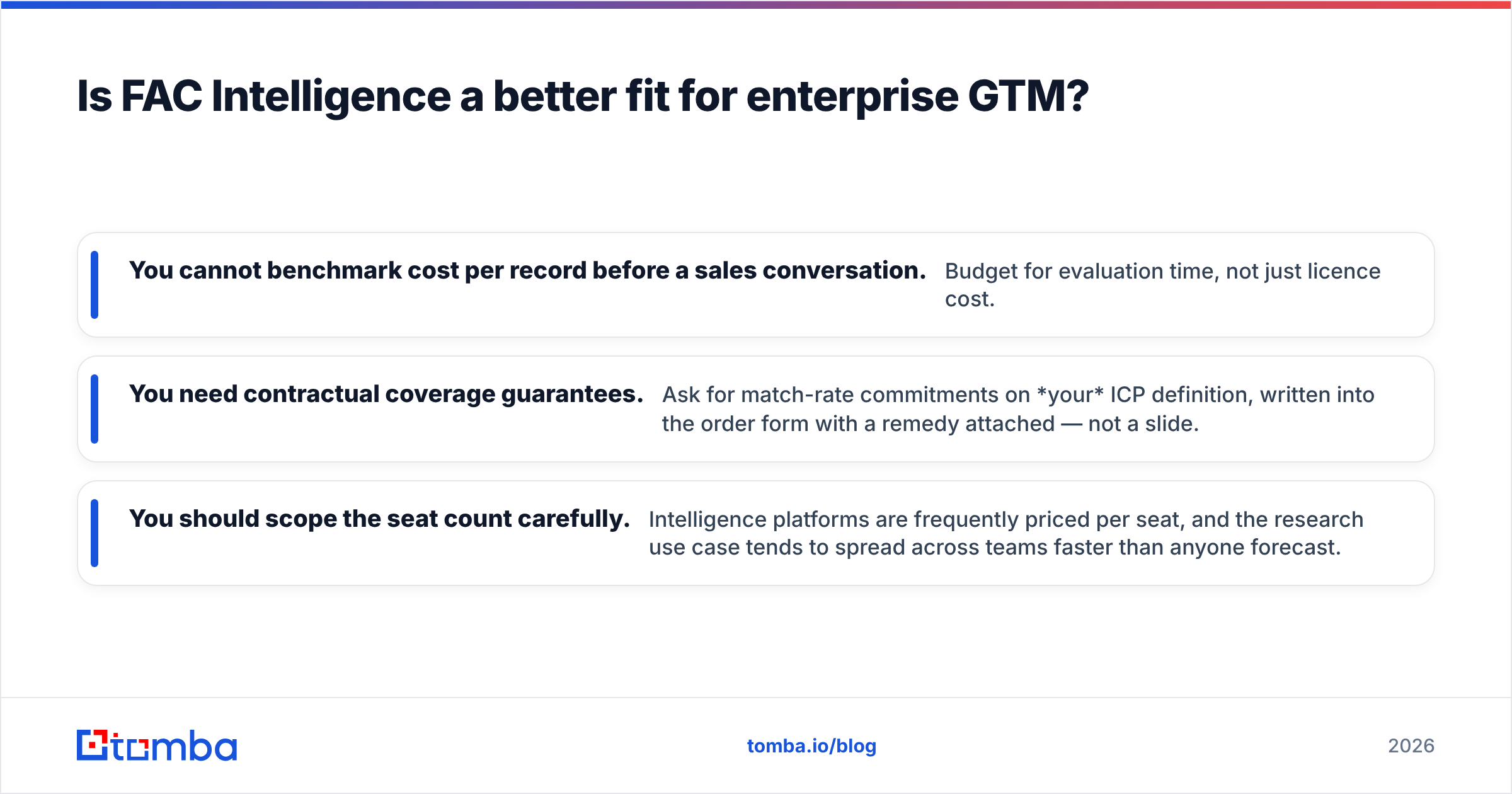
The commercial side is harder to judge. Quote-based pricing is not a red flag on its own — most enterprise data vendors work that way. But it changes your process in three ways:
- You cannot benchmark cost per record before a sales call. Budget for evaluation time, not just licence cost.
- You need coverage guarantees in writing. Ask for match-rate commitments on your ICP, written into the order form with a remedy attached. A slide is not a commitment.
- You should scope seats carefully. These platforms are usually priced per seat, and research use spreads across teams faster than anyone forecasts.
For an outside read on how buyers rate vendors here, G2's lead intelligence category beats any vendor comparison page, including this one. Filter reviews by company size first, because enterprise and SMB experiences of the same product diverge sharply.

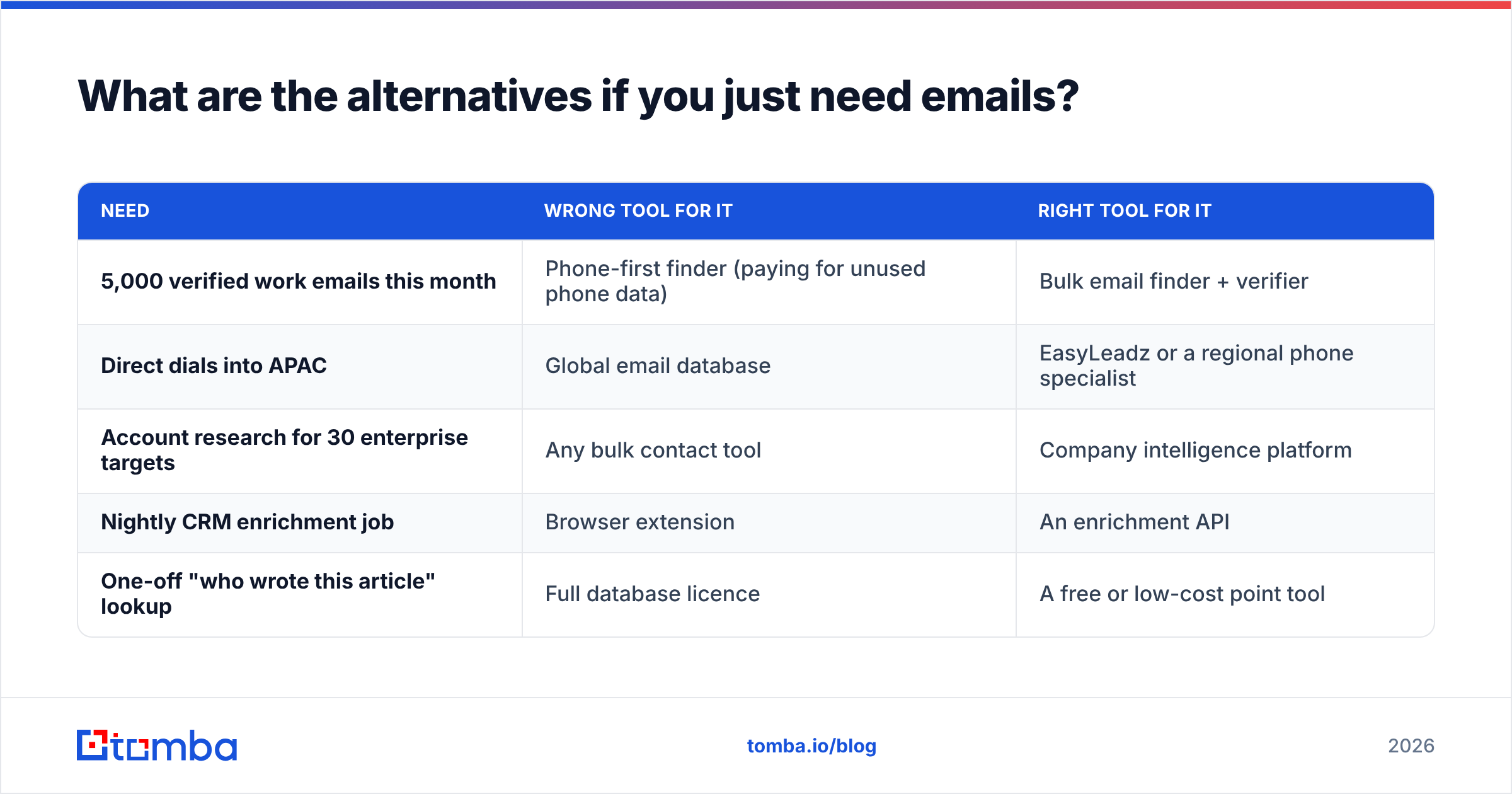
What are the alternatives if you just need emails?#
Here is the uncomfortable ending a lot of these evaluations reach. Neither tool is the cheapest or most accurate way to build a verified email list at volume. If that is the job, you are shopping in the wrong aisle.
| Need | Wrong tool for it | Right tool for it |
|---|---|---|
| 5,000 verified work emails this month | Phone-first finder (paying for unused phone data) | Bulk email finder + verifier |
| Direct dials into APAC | Global email database | EasyLeadz or a regional phone specialist |
| Account research for 30 enterprise targets | Any bulk contact tool | Company intelligence platform |
| Nightly CRM enrichment job | Browser extension | An enrichment API |
| One-off "who wrote this article" lookup | Full database licence | A free or low-cost point tool |
For an email-led motion, the workflow that holds up at volume looks like this:
- Build the account list first. Pull it from your CRM, a database, or intent signals — not from whatever an extension happens to surface.
- Run domain search on each target company. It returns every published address and reveals the company's email format.
- Find named contacts by first name, last name, and domain. Do not scrape profile pages one at a time.
- Verify before sending, always. Catch-all domains and role accounts quietly wreck email deliverability on lists that look clean.
- Re-verify anything older than 90 days. Contact decay is a recurring job, not a one-time cleanup.
- Layer phone data selectively. Use it on accounts that already replied or showed intent. Phone finder coverage is worth paying for on 200 warm accounts, not on 5,000 cold ones.
That last point is the gap most teams miss. Phone data costs more per record than email data at nearly every vendor. Buying it for your whole top-of-funnel is how a data budget vanishes in six weeks.
EasyLeadz vs FAC Intelligence: which should you choose in 2026?#
Choose EasyLeadz if you run a phone-first SDR team with real APAC exposure. You want to be prospecting this afternoon, and you are fine with credit-metered spend at moderate volume. It is good at a specific, genuinely hard thing.
Choose FAC Intelligence if your bottleneck is picking accounts, not reaching contacts. Your deal sizes need to justify research spend, and you need the patience for a sales-led evaluation. Insist on written match-rate commitments against your own ICP.
Choose a dedicated email finder if your pipeline runs on sequenced email. You need bulk and API workflows, and you want to know your cost per verified record before you sign. That is a different product category. Pretending otherwise is how teams pay enterprise rates for a job that costs a fraction of it.
A sensible stack for most mid-market teams is two of the three. Take a cheap, accurate email layer for volume. Add either phone data or account research for the segment where your reps' time is expensive. Buying one tool to do all three jobs leaves you with a licence that is overpriced for two of them.
If email is where your pipeline comes from, start with the layer that is easiest to test. Tomba's Email Finder returns verified work emails by name and domain. It ships with a built-in verifier, bulk processing, and a REST API for automated enrichment.
The free tier gives you 25 searches a month, so you can run your own 100-row sample test before spending anything. Paid plans start at $49/mo — see Tomba pricing for the full breakdown. Run it against the same list you send to EasyLeadz or FAC Intelligence. Compare match rate and bounce rate yourself, and let the numbers decide instead of the comparison page.
Related guides#
Ready to find emails that actually work?
Join 150,000+ professionals who stopped guessing and started sending. Free credits on signup — no credit card required.
Get the Tomba newsletter
Practical outbound tactics and product updates — once every two weeks.
About the author