EasyLeadz vs FinalScout (2026): Which One Should You Use?
EasyLeadz sells direct mobile numbers. FinalScout sells LinkedIn-sourced emails. They look like competitors but solve different halves of the same problem — here is which one actually fits your outbound motion, and what both cost once credits run out.
TL;DR
- EasyLeadz is a phone-number tool first. Its Chrome extension ("Mr. E") pulls direct mobile numbers off LinkedIn profiles. Email is a secondary output, not the core product.
- FinalScout is an email tool first. It scrapes LinkedIn profiles and Sales Navigator lists, returns work emails, and bolts on AI-written outreach copy.
- They are not really the same product. If you compare them credit-for-credit on email volume, FinalScout wins. If you compare them on mobile-number coverage, EasyLeadz wins.
- Both are LinkedIn-dependent. Neither gives you a clean domain-level workflow ("find everyone in marketing at acme.com") or a mature verification layer, and both meter you hard on credits.
- If email is your main channel, a dedicated finder-plus-verifier stack (Tomba, Hunter, Findymail) is usually cheaper per usable contact than either tool.
What is EasyLeadz and what does it actually do?#
EasyLeadz is an India-headquartered B2B contact-data company best known for its browser extension. You open a LinkedIn profile, click the extension, and it returns a direct dial or mobile number for that person — often a personal mobile rather than a switchboard line.
That single behavior explains most of the product:
- Primary asset: mobile numbers. EasyLeadz built its reputation on direct dials, with unusually deep coverage in India and decent coverage across APAC and parts of EMEA.
- Delivery method: one profile at a time. The extension is the main interface. Bulk enrichment and API access exist, but the day-one workflow is manual and profile-by-profile.
- Email is a bonus field. You will get emails back on many lookups, but email is not what the pricing, the marketing, or the data pipeline is optimized for.
- Best fit: SDR teams that call. If your pipeline moves on the phone — recruiting, real estate, fintech sales in APAC — the value is obvious.
- Weak fit: high-volume cold email. You will burn credits on records where the phone is the only genuinely differentiated field.
What is FinalScout and how is it different?#
FinalScout attacks the other half of the problem. It is a LinkedIn email finder with an AI writing layer on top. You point it at a profile, a search result page, a Sales Navigator list, or a group, and it extracts contacts and resolves work email addresses.
Three things define it:
- LinkedIn-native extraction. It is built around LinkedIn as the source of truth for who a person is, then resolves the email separately. Sales Navigator and group scraping are supported on higher tiers.
- Deliverability marketing. FinalScout leans heavily on a claimed ~98% deliverability figure. Treat vendor-published deliverability numbers from any tool as a marketing claim until you test them on your own list.
- AI email drafting. It will generate a personalized cold email from the scraped profile. Useful as a first draft, rarely good enough to send unedited.
The honest one-line summary: EasyLeadz answers "what is this person's phone number," FinalScout answers "what is this person's email and what should I say to them."
EasyLeadz vs FinalScout: how do they compare head-to-head?#

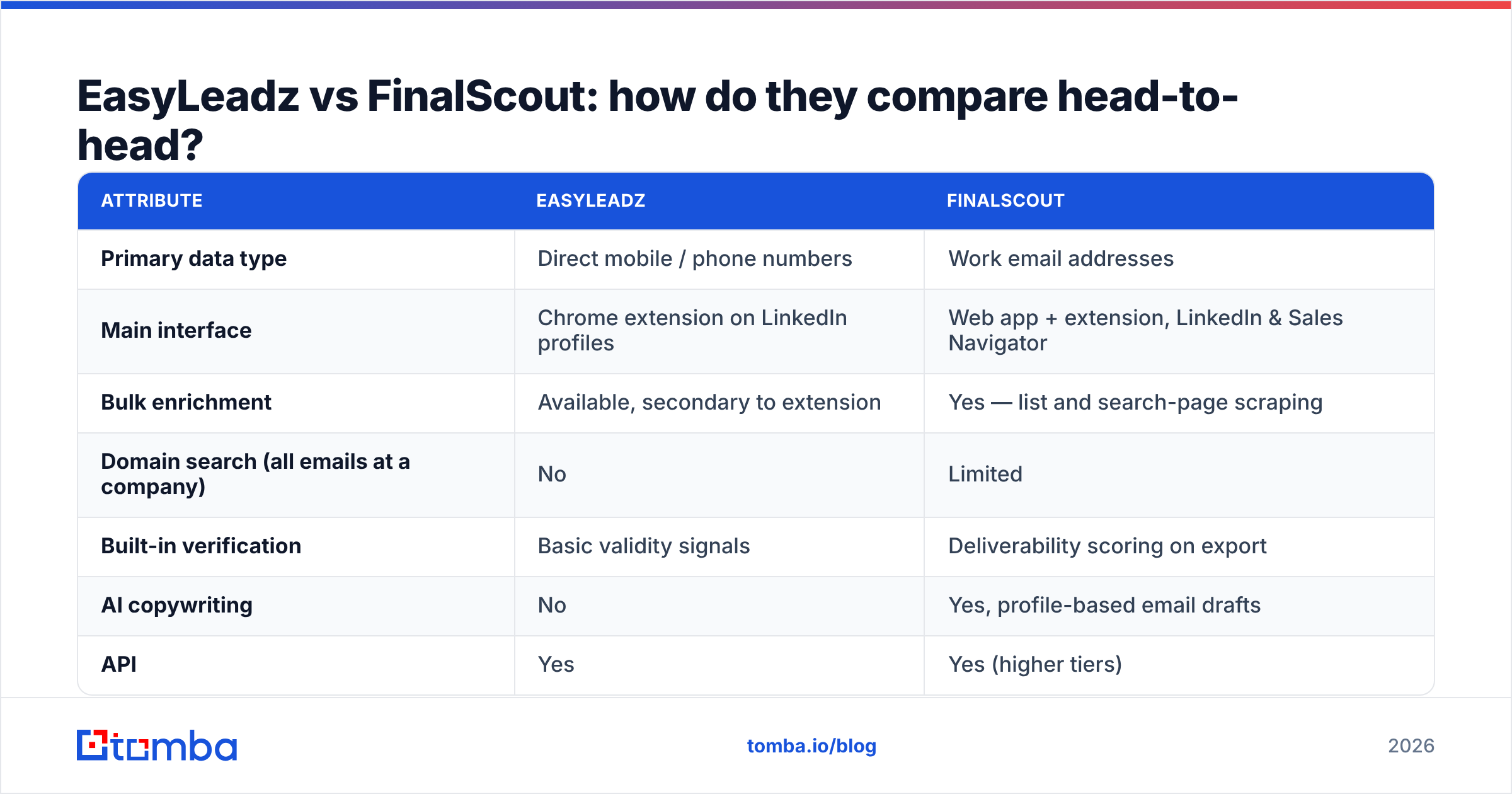
| Attribute | EasyLeadz | FinalScout |
|---|---|---|
| Primary data type | Direct mobile / phone numbers | Work email addresses |
| Main interface | Chrome extension on LinkedIn profiles | Web app + extension, LinkedIn & Sales Navigator |
| Bulk enrichment | Available, secondary to extension | Yes — list and search-page scraping |
| Domain search (all emails at a company) | No | Limited |
| Built-in verification | Basic validity signals | Deliverability scoring on export |
| AI copywriting | No | Yes, profile-based email drafts |
| API | Yes | Yes (higher tiers) |
| Free tier | Trial credits on signup | Small monthly free allowance (~20 credits) |
| Entry paid plan (list price, verify current) | ~$59/mo | ~$35/mo |
| Geographic sweet spot | India, APAC, parts of EMEA | US, EU, global LinkedIn coverage |
| Strongest use case | Cold calling, recruiting, field sales | Cold email at moderate volume |
| Weakest point | Thin email depth, credit cost per record | LinkedIn dependency, no true domain workflow |
Pricing on both products moves and both run annual discounts, so check the vendor pages before you budget. The shape of the pricing matters more than the exact number: both meter by credit, and both charge you for a lookup whether or not the result is usable. That is the line item that quietly doubles your real cost per contact.

Which tool returns more accurate data?#
There is no single answer, because they are accurate at different things.

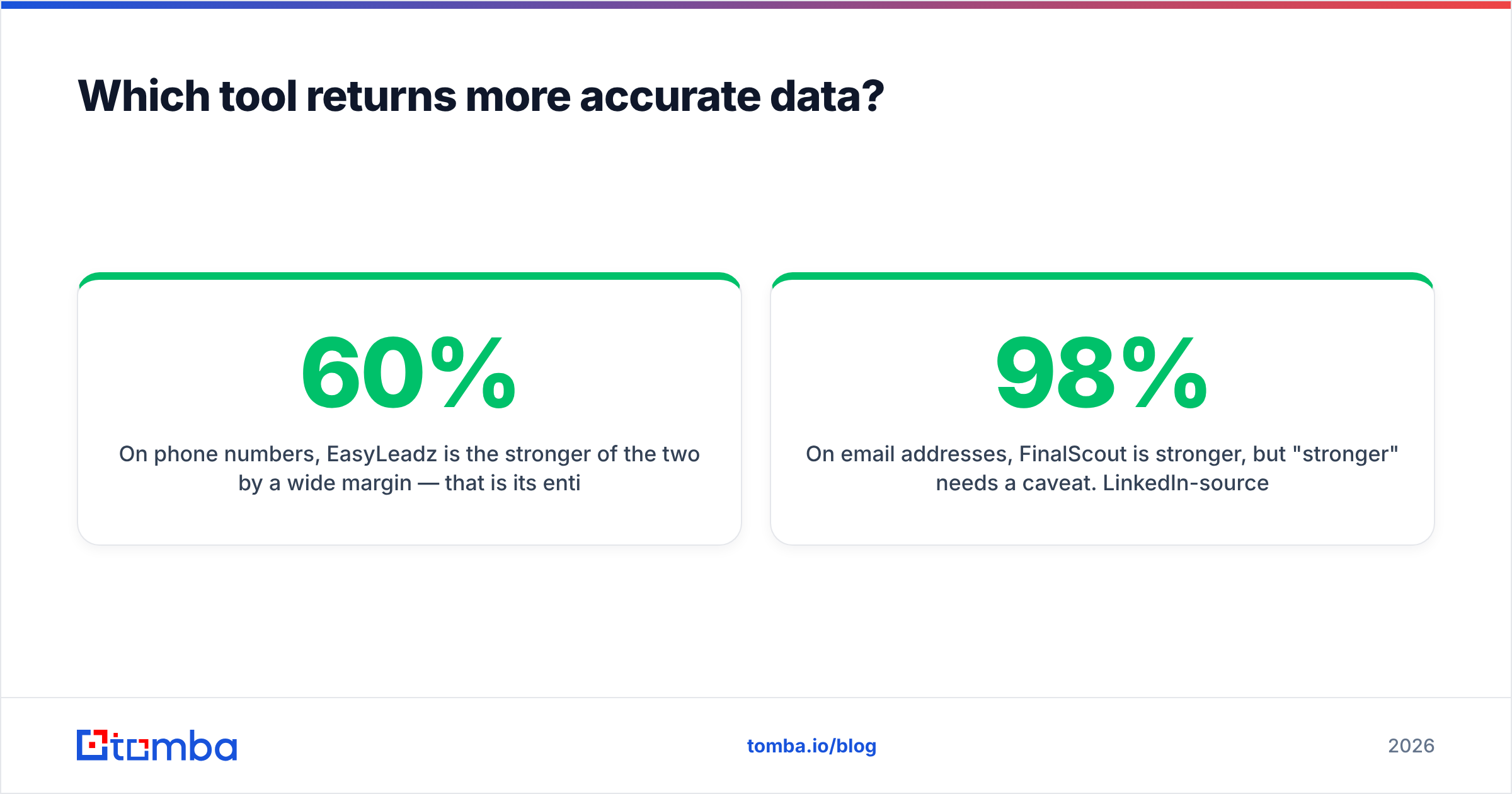
On phone numbers, EasyLeadz is the stronger of the two by a wide margin — that is its entire reason for existing. Reported hit rates in the 40–60% range on Indian and APAC prospects are common in user reviews on G2, dropping meaningfully for US and Western European mid-market titles. Number accuracy also decays faster than email accuracy: people change phones and carriers without leaving a public trail.
On email addresses, FinalScout is stronger, but "stronger" needs a caveat. LinkedIn-sourced email finding has a structural weakness: it resolves the person confidently and the mailbox speculatively. When a company runs a catch-all domain, most LinkedIn-first finders return a pattern guess marked "valid" because the server accepts everything. That is how a 98% deliverability claim and a 12% bounce rate coexist in the same account.
Two practical rules regardless of which tool you pick:
- Never send off a finder's own confidence score alone. Run the list through an independent email verifier before it touches your sending domain.
- Treat catch-all domains as a separate bucket. They need a dedicated catch-all verifier pass, not an optimistic "valid" flag.
If you are sending more than a few hundred emails a week, that second step is worth more to your reply rate than any difference between these two tools' raw find rates.
How does the pricing actually work out per usable contact?#
Sticker price is misleading on credit-based tools. What matters is cost per contact you can actually use.
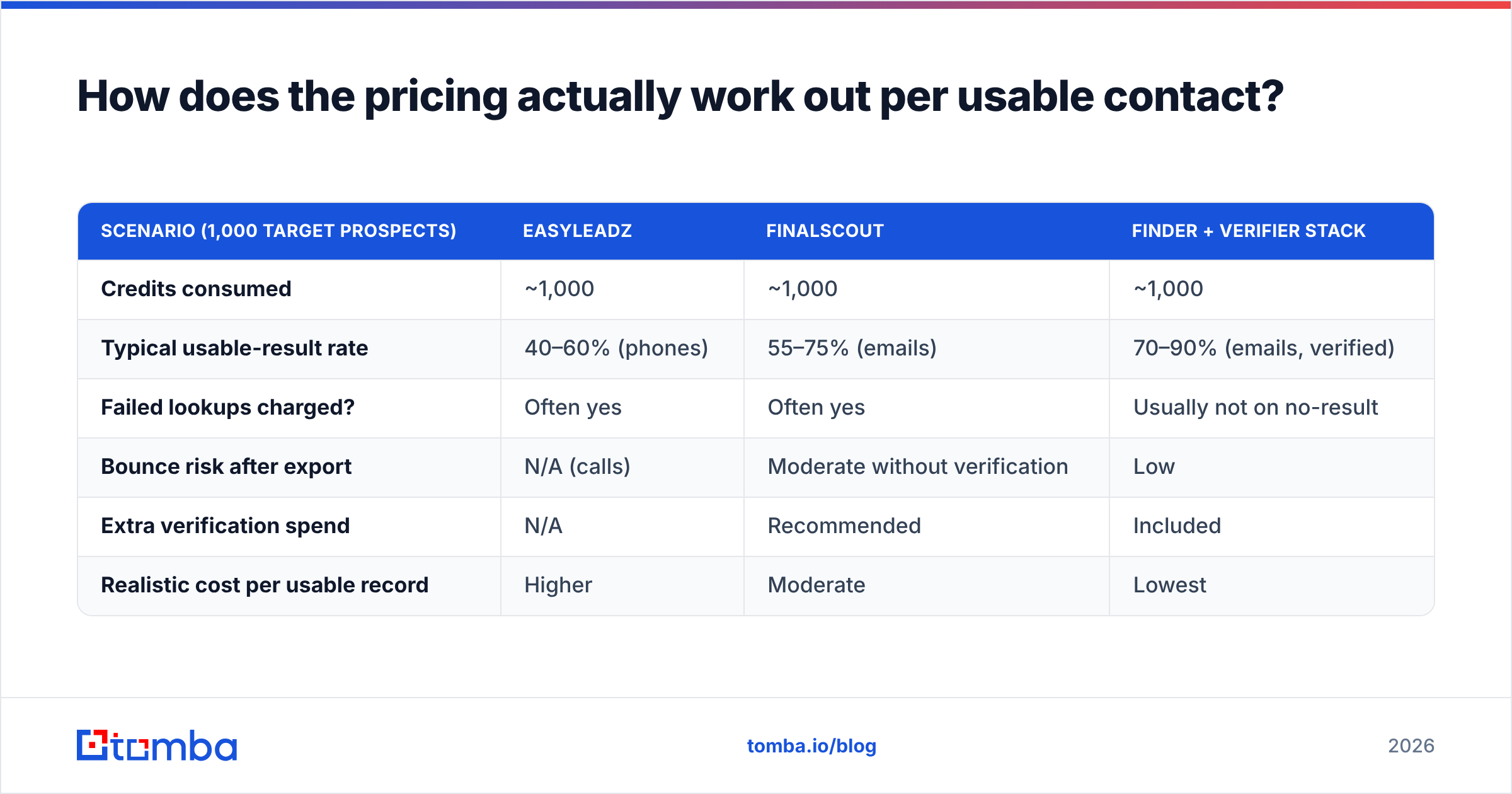
| Scenario (1,000 target prospects) | EasyLeadz | FinalScout | Finder + verifier stack |
|---|---|---|---|
| Credits consumed | ~1,000 | ~1,000 | ~1,000 |
| Typical usable-result rate | 40–60% (phones) | 55–75% (emails) | 70–90% (emails, verified) |
| Failed lookups charged? | Often yes | Often yes | Usually not on no-result |
| Bounce risk after export | N/A (calls) | Moderate without verification | Low |
| Extra verification spend | N/A | Recommended | Included |
| Realistic cost per usable record | Higher | Moderate | Lowest |
The pattern holds across the category: tools that charge on attempt rather than on result look cheap on the pricing page and expensive on the invoice. When you evaluate any of these, ask support one question — "do you charge a credit when no contact is found?" — and get the answer in writing.
For reference on the other end of the market, Tomba pricing runs a free tier at 25 searches/mo, Starter at $49/mo, Growth at $99/mo, and Pro at $249/mo, with verification bundled into the same credit pool rather than sold as a separate product.
Who should choose EasyLeadz?#
Pick EasyLeadz if three or more of these describe you:
- Phone is your primary channel. You dial before you email, and a mobile number is worth more to you than three email addresses.
- You sell into India or APAC. This is the clearest, least contested advantage EasyLeadz has. Nothing in the Western data vendor set matches its Indian mobile coverage.
- Your volume is low and your deal size is high. Manual profile-by-profile lookups are fine at 20 prospects a day, painful at 500.
- You already have email covered. Adding a phone layer to an existing email stack is a legitimate, well-scoped reason to buy it.
- Compliance is handled. Direct mobile outreach carries different regulatory weight than email in many jurisdictions. Confirm your obligations before you dial.
Do not buy EasyLeadz as your main email source. It will do the job badly and cost you credits doing it.
Who should choose FinalScout?#
Pick FinalScout if:
- LinkedIn is where you build lists. Your prospecting starts with a Sales Navigator search, not a target-account spreadsheet.
- You need moderate email volume, roughly a few hundred to a few thousand contacts a month.
- You want a copy assist. The AI drafting is genuinely convenient for reps who freeze at a blank editor, provided you edit before sending.
- Your ICP is US/EU knowledge-work titles. Coverage is strongest where LinkedIn adoption is highest.
Skip it if your workflow is domain-first. Asking "who works at acme.com" is a different query from "give me the email for this LinkedIn profile," and FinalScout is built for the second one. If you need the first, you want a proper domain search instead.
Where do both tools fall short?#
Four shared gaps show up repeatedly in reviews of both products:
- LinkedIn dependency. Both degrade when LinkedIn tightens scraping, when a prospect has a stale profile, or when your ICP simply is not on the platform (trades, manufacturing, local services, much of Japan and Germany).
- No real bulk-first workflow. Neither is designed around the "upload 5,000 rows, get them back enriched and verified" job that a growth team actually runs weekly. For that shape of work you want a bulk email finder with a proper queue and API.
- Credit models that punish misses. Charging for empty lookups is standard in this tier and it silently inflates your effective price.
- Verification as an afterthought. Both hand you a confidence label. Neither replaces an independent verification pass, and both will happily mark catch-all guesses as deliverable.

Is there a better alternative to both?#
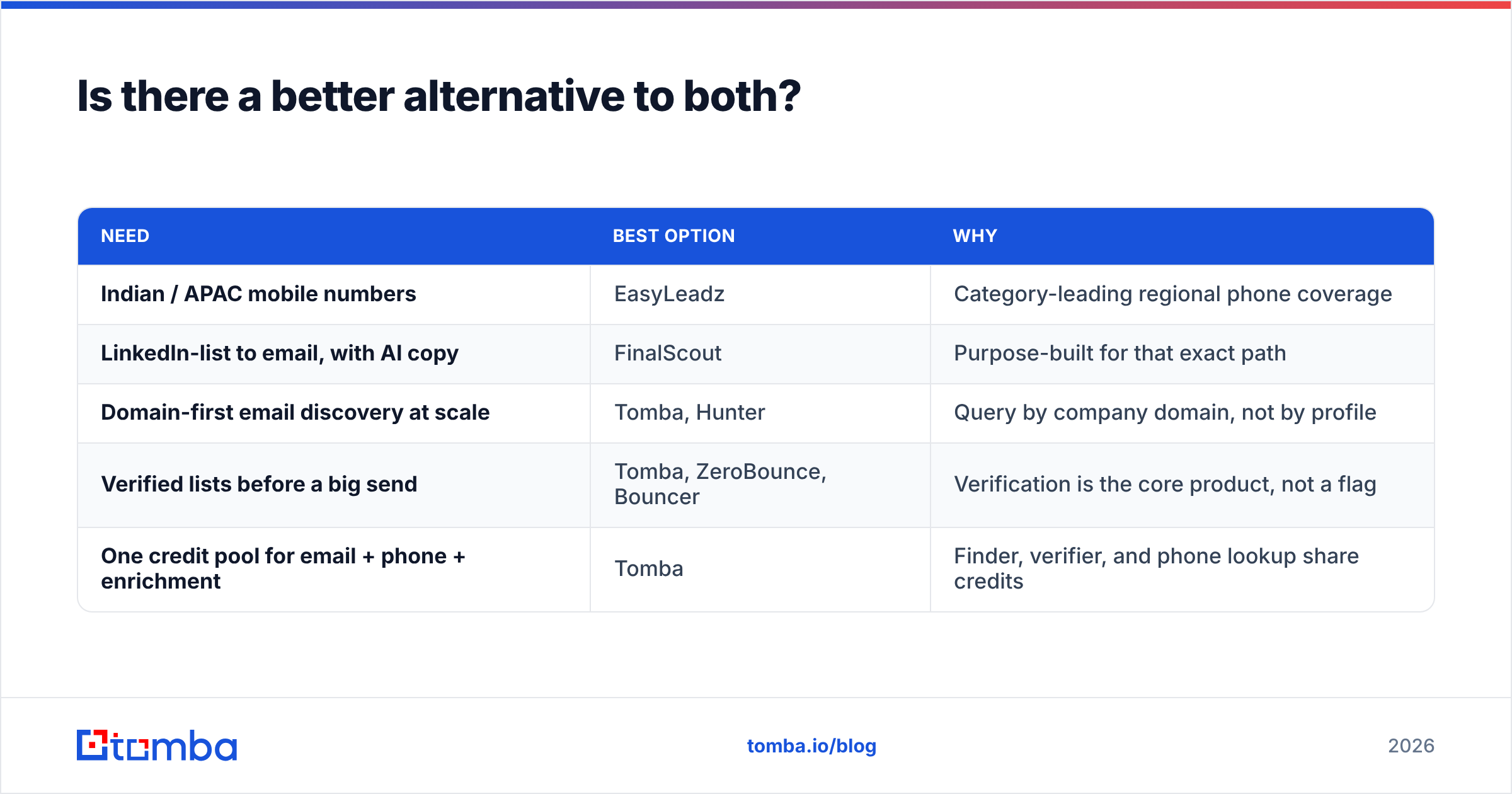
Depends on what you are optimizing for — and the honest answer is that most teams end up with two tools, not one.
| Need | Best option | Why |
|---|---|---|
| Indian / APAC mobile numbers | EasyLeadz | Category-leading regional phone coverage |
| LinkedIn-list to email, with AI copy | FinalScout | Purpose-built for that exact path |
| Domain-first email discovery at scale | Tomba, Hunter | Query by company domain, not by profile |
| Verified lists before a big send | Tomba, ZeroBounce, Bouncer | Verification is the core product, not a flag |
| One credit pool for email + phone + enrichment | Tomba | Finder, verifier, and phone lookup share credits |
Where Tomba fits honestly: it is a domain-and-name-first tool, not a LinkedIn scraper. If your prospecting starts from a list of target companies, the email finder plus domain search path is faster and cheaper per record than clicking through profiles. It also covers B2B phone numbers, which narrows — though does not erase — EasyLeadz's phone advantage outside India. If your prospecting genuinely starts inside LinkedIn Sales Navigator, FinalScout will feel more natural.
What should you actually test before buying?#
Run the same 50-prospect list through both trials and record five numbers:
- Hit rate — how many of the 50 returned any contact at all.
- Usable rate — how many returned a contact that passed independent verification or connected on the first dial.
- Credits charged on misses — the number that decides your real cost.
- Time per 50 — extension clicking versus list upload adds up fast.
- Export friction — CSV only, or does it push to your CRM without a Zapier tax?
Fifty records is enough to separate these two tools. Anyone who tells you their find rate without telling you their ICP and region is guessing.
The bottom line#
EasyLeadz and FinalScout are not rivals so much as neighbors. EasyLeadz is the better buy when a mobile number is the unlock and your market is India or APAC. FinalScout is the better buy when your list lives in LinkedIn and email is the channel. Neither is the right foundation for a high-volume, domain-first outbound program, because neither was built for one.
If your prospecting starts with a list of target companies rather than a list of LinkedIn profiles — and if you want find and verify running out of the same credit pool instead of two invoices — start with the Tomba Email Finder. The free tier gives you 25 searches a month to test coverage against your own ICP before you spend anything, and paid plans start at $49/mo. Run your 50-record benchmark on it alongside the other two, and let the usable-contact number pick the winner.
Related guides#
Ready to find emails that actually work?
Join 150,000+ professionals who stopped guessing and started sending. Free credits on signup — no credit card required.
Get the Tomba newsletter
Practical outbound tactics and product updates — once every two weeks.
About the author