EasyLeadz vs FindEmails.com (Toofr): Which Wins in 2026?
EasyLeadz sells direct mobile numbers. FindEmails.com (formerly Toofr) sells cheap email credits. They solve different problems badly if you pick the wrong one — here's the honest breakdown with pricing, accuracy and coverage.
EasyLeadz vs FindEmails.com is a strange match-up. One sells direct mobile numbers. The other sells cheap email credits. This guide compares pricing, accuracy and coverage so you can pick the right one — or skip both.
TL;DR
- They are not really competitors. EasyLeadz is a phone-first tool built around direct mobile numbers, and it is strongest in India and APAC. FindEmails.com — the product once known as Toofr — is a cheap, no-frills email finder and verifier for US and EU B2B lists.
- Pick EasyLeadz if you cold call or use WhatsApp, and your buyers sit in India, SEA or the Middle East. Its Chrome extension ("Mr. E") pulls mobile numbers off LinkedIn profiles that most Western databases never hold.
- Pick FindEmails.com if you want the lowest cost per email, you already know the names and domains, and you can live with a UI that has barely changed in years.
Two caveats before you choose:
- Neither is a full stack. EasyLeadz's email coverage is thin outside its core regions. FindEmails.com has no phone data, no enrichment and a limited API. Most teams bolt on a third tool anyway.
- The real question is scope. Do you need one source for email, verification, catch-all handling and phone? That is where a platform like Tomba, Apollo or Lusha changes the math.
EasyLeadz vs FindEmails.com: what is each tool built for?#
EasyLeadz is an Indian B2B contact data company best known for Mr. E, its Chrome extension. You open a LinkedIn profile, click the extension, and it tries to return that person's direct mobile number — not a switchboard, not a generic info@ line. That is the whole pitch, and it is an unusual one. Most Western data vendors treat mobile numbers as an expensive add-on, if they sell them at all.
The data comes mostly from Indian and wider APAC business registries, telecom-adjacent datasets and community contributions. So the hit rate is lopsided by region. Prospecting a SaaS founder in Bengaluru? Strong. Prospecting a VP Marketing in Dublin? Much weaker, and the emails it returns are often unverified pattern guesses. See the official EasyLeadz site for their own coverage claims.
FindEmails.com is what happened to Toofr, a long-running email-finding service built by Ryan Buckley. The tool does three things: guess likely email addresses from a name plus a domain, score how confident it is, and check whether the mailbox exists. It sells credits in bulk at prices that undercut nearly everyone, which is why it is still around. The FindEmails.com homepage makes no attempt to look like a modern revenue platform. That is deliberate positioning, not neglect.
So the honest framing: EasyLeadz is a phone tool that also does email. FindEmails.com is an email tool that does nothing else. Compare them head to head on one spec sheet and you get a misleading answer, because they are built for different jobs.

EasyLeadz vs FindEmails.com: features and pricing compared#
Here's the side-by-side. Prices move, so confirm on the vendor's own pricing page before you buy. Both companies have changed packaging more than once.
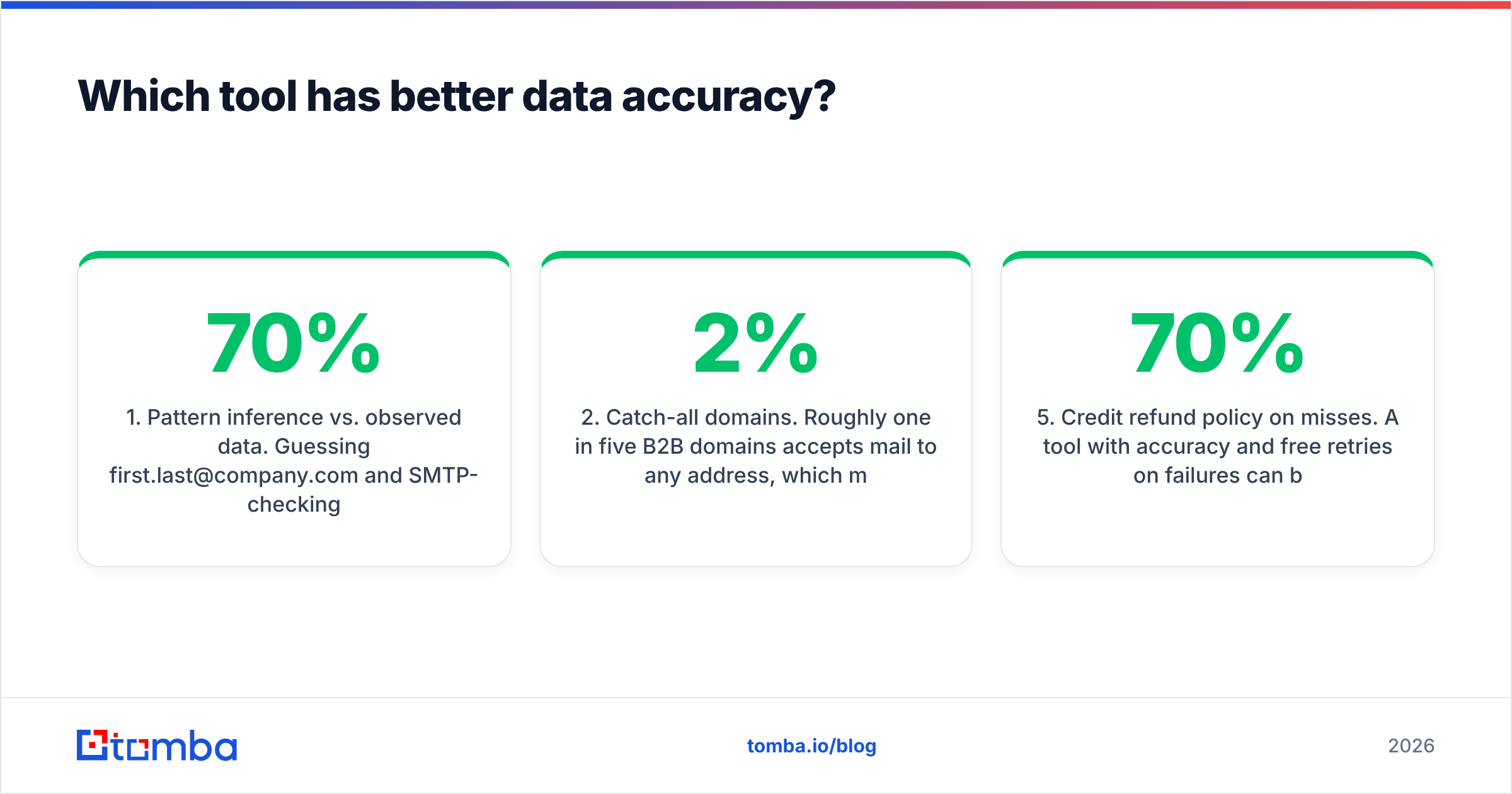
| Attribute | EasyLeadz (Mr. E) | FindEmails.com (Toofr) | Tomba |
|---|---|---|---|
| Primary data type | Direct mobile numbers | Business emails | Business emails + phone |
| Entry paid plan | ~$59/mo (credit packs) | ~$29/mo (1,000 credits) | $49/mo Starter |
| Free tier | Limited trial credits | Trial credits only | 25 searches/mo, no card |
| Email verification | Basic / bundled | Yes, core feature | Yes, dedicated verifier |
| Catch-all handling | Not addressed | Flags as risky, no resolution | Dedicated catch-all verifier |
| Domain-wide search | No | Limited | Yes |
| Bulk CSV processing | Yes | Yes | Yes |
| Public API | Limited | Basic REST | Full REST + CLI + MCP |
| Chrome extension | Yes (LinkedIn-focused) | No | Yes |
| Geographic sweet spot | India, SEA, Middle East | US, UK, Western Europe | Global |
| Native CRM sync | Limited | None | HubSpot, Salesforce, Pipedrive |
Two things jump out.
First, FindEmails.com wins on raw price per email and loses on everything else. A thousand credits for the cost of a team lunch is hard to beat. But on many low-cost tools, failed lookups still burn credits. So the real cost per usable contact is always higher than the sticker price. Ask any vendor — including this one — what happens to a credit when a search returns nothing.
Second, EasyLeadz charges a premium for a data type nobody else reliably sells in its region. That premium is fair if you run a phone-heavy motion. It is poor value if you only send email, because you pay mobile-number prices for email coverage that a dedicated email finder would beat.
Which tool has better data accuracy?#
Accuracy is where the marketing copy stops being useful. You need to run your own test.

Here's what actually drives the number, whichever vendor you pick:
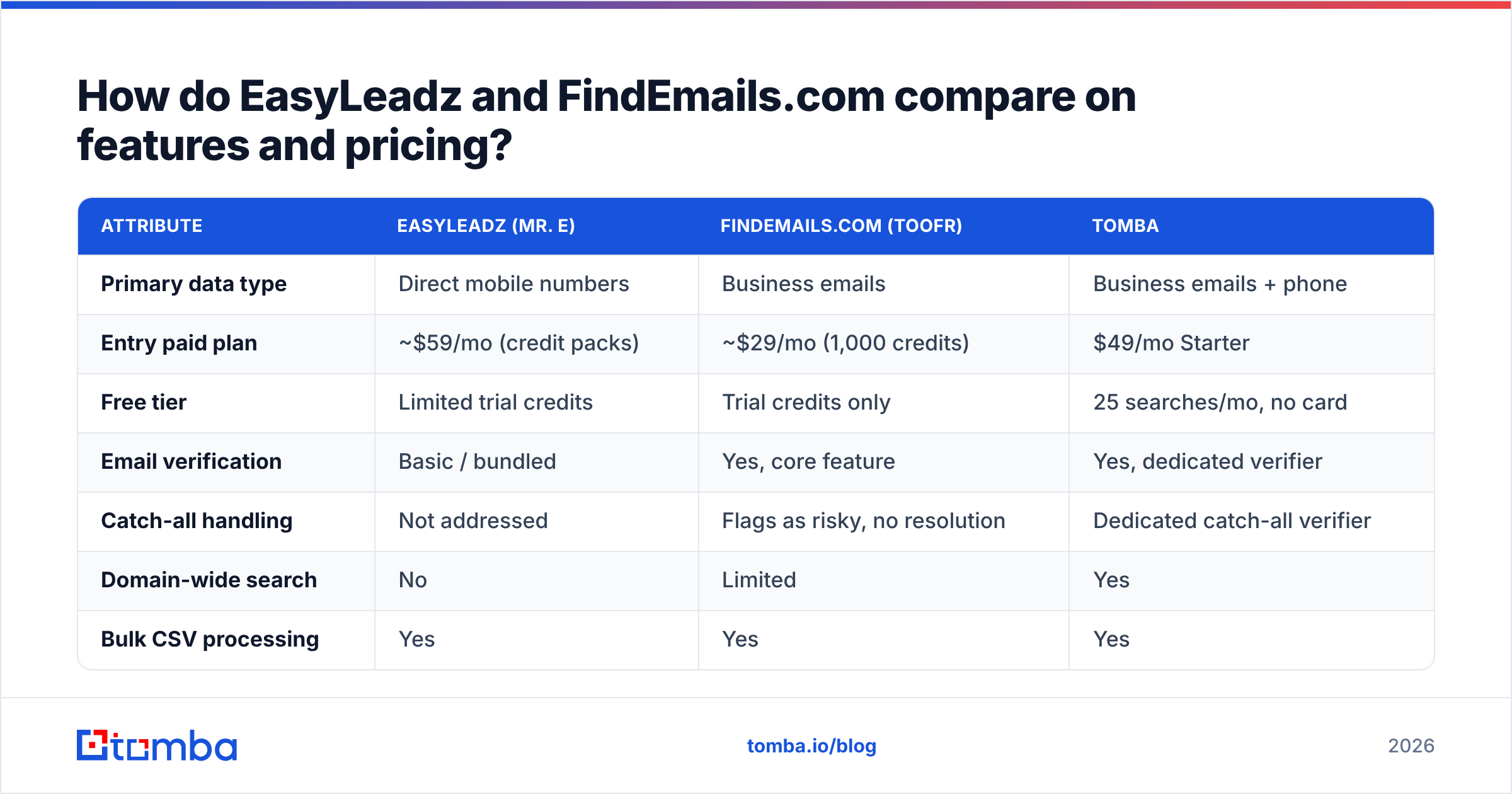
- Pattern inference vs. observed data. Guessing
first.last@company.comand SMTP-checking it is cheap. It works on maybe 60-70% of mid-market domains. Seeing that address in a crawled source is far stronger proof. FindEmails.com leans on inference. That is fine for standard corporate domains and falls apart on odd formats. - Catch-all domains. Roughly one in five B2B domains accepts mail to any address. SMTP checks then return "valid" for
asdfgh@company.com. Tools that skip this step quietly inflate their accuracy claims. At volume, a proper catch-all verifier is the gap between a 2% and a 12% bounce rate. - Data freshness. People change jobs all the time. A record that was right 14 months ago bounces today. Ask when it was last confirmed, not when it was first collected.
The last two are the ones buyers forget:
- Regional coverage bias. This is the EasyLeadz story in one line. Every vendor has a region where its sourcing is dense and one where it extrapolates. Test on your ICP, not on the vendor's demo list.
- Credit refund policy on misses. A tool with 70% accuracy and free retries can beat a tool with 85% accuracy that bills every attempt.
Practical test: take 100 contacts you already have verified emails for — from closed-won deals, ideally. Strip the emails and run the list through each tool's trial. Measure three things: match rate, exact-match accuracy, and bounce rate when you send. Twenty minutes of work saves you a year of a bad contract. Run the survivors through an email verifier before you count anything as a win.
Is EasyLeadz worth it for cold calling?#
If you call into India, Southeast Asia or the Gulf: probably yes. There is no close second among Western vendors.
Direct mobile numbers are the scarcest asset in B2B data. Most global databases give you a company switchboard and a LinkedIn URL. Getting a mobile that the prospect answers is a different sourcing problem. EasyLeadz built its business on that gap, in a region where LinkedIn use is high but Western data brokers are thin.
The caveats are real, though:
- Compliance is your problem, not theirs. Calling mobiles pulls in DNC registries, TCPA-style rules and GDPR arguments, depending on where you and the prospect sit. Sort your legal position before you dial.
- Credit burn is fast. Mobile lookups spend credits whether or not the number connects. Budget for a real miss rate.
- Email is the weak leg. If you plan a call-plus-email sequence, you need a second source for the email half. Many teams pair EasyLeadz with a dedicated phone finder and email stack, or replace it outright.
If your ICP is North American or Western European, EasyLeadz is a hard sell. The mobile edge mostly disappears, and you pay premium prices for mid-tier email data.
Is FindEmails.com still competitive in 2026?#
It is competitive on exactly one axis: cost.
FindEmails.com does what it says. You feed it names and domains. It returns scored guesses and tells you which ones verified. For a solo founder checking 300 prospects, or a freelancer who bills by the lead, that is enough. Spending $99/mo on a full platform would be silly.
Where it runs out of road:
- No enrichment. You get an email. No title, no company size, no tech stack, no LinkedIn URL. Everything after the email is manual.
- API depth. The REST endpoint exists, but it is not built for wiring email discovery into a product or an automated GTM workflow. If you need a proper email finder API, CLI access, or an MCP server for agent-driven prospecting, this is the wrong shape of tool.
- No native CRM path. Export CSV, import CSV, dedupe by hand, repeat. Fine at 200 rows a month. Painful at 2,000.
- Catch-all ambiguity. Like most low-cost verifiers, it flags catch-alls instead of resolving them. The risk call lands back on you.
The comparison table below shows how the low-cost tier stacks up against fuller platforms, once you count what you have to add back:


What should you use instead of either one?#
It depends on the constraint you are actually under.
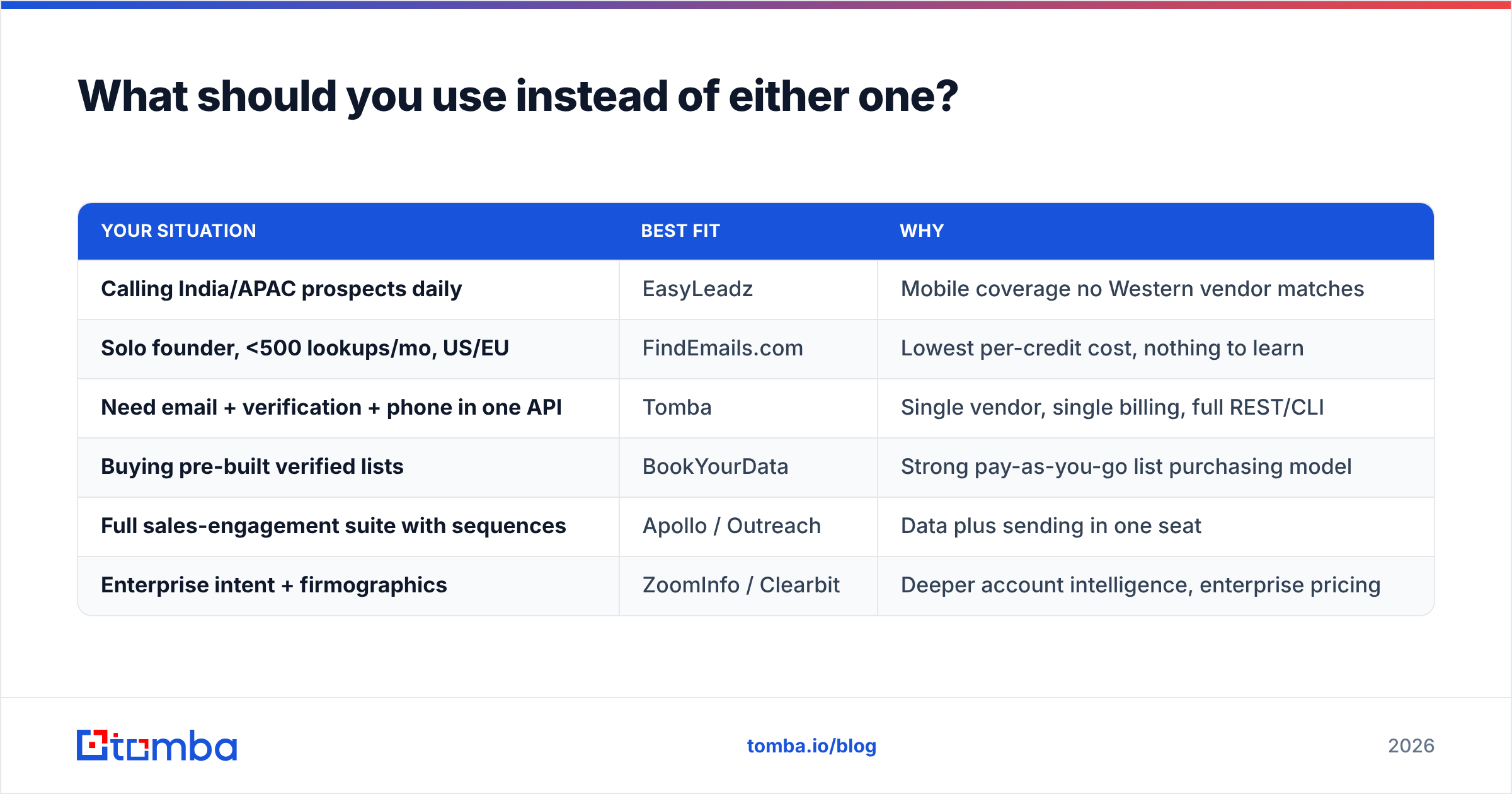
| Your situation | Best fit | Why |
|---|---|---|
| Calling India/APAC prospects daily | EasyLeadz | Mobile coverage no Western vendor matches |
| Solo founder, <500 lookups/mo, US/EU | FindEmails.com | Lowest per-credit cost, nothing to learn |
| Need email + verification + phone in one API | Tomba | Single vendor, single billing, full REST/CLI |
| Buying pre-built verified lists | BookYourData | Strong pay-as-you-go list purchasing model |
| Full sales-engagement suite with sequences | Apollo / Outreach | Data plus sending in one seat |
| Enterprise intent + firmographics | ZoomInfo / Clearbit | Deeper account intelligence, enterprise pricing |
Most teams hit the same wall around 5-10 reps. They start with a cheap point tool, add a second for phone, add a third for verification. Now they pay three vendors more than one good platform costs, and reconcile three exports. Consolidation is usually a cost cut, not an upgrade spend.
If you are weighing that move, judge these honestly:
- Coverage on your specific ICP — measured on your own test list, not a G2 average. G2's email-finder category is useful for shortlisting, useless for predicting your hit rate.
- Credit economics — does a failed search cost you? Do credits roll over? What is the overage rate?
- Verification depth — SMTP-only, or does it resolve catch-alls and role accounts?
- Automation surface — API, Google Sheets add-on, Chrome extension, CRM sync. Whichever one your team will use daily.
- Data provenance — where does it come from, and can the vendor tell you? Read the data sources page of any tool you consider. Vendors who dodge this question deserve caution.
How do you run a fair 30-minute bake-off?#
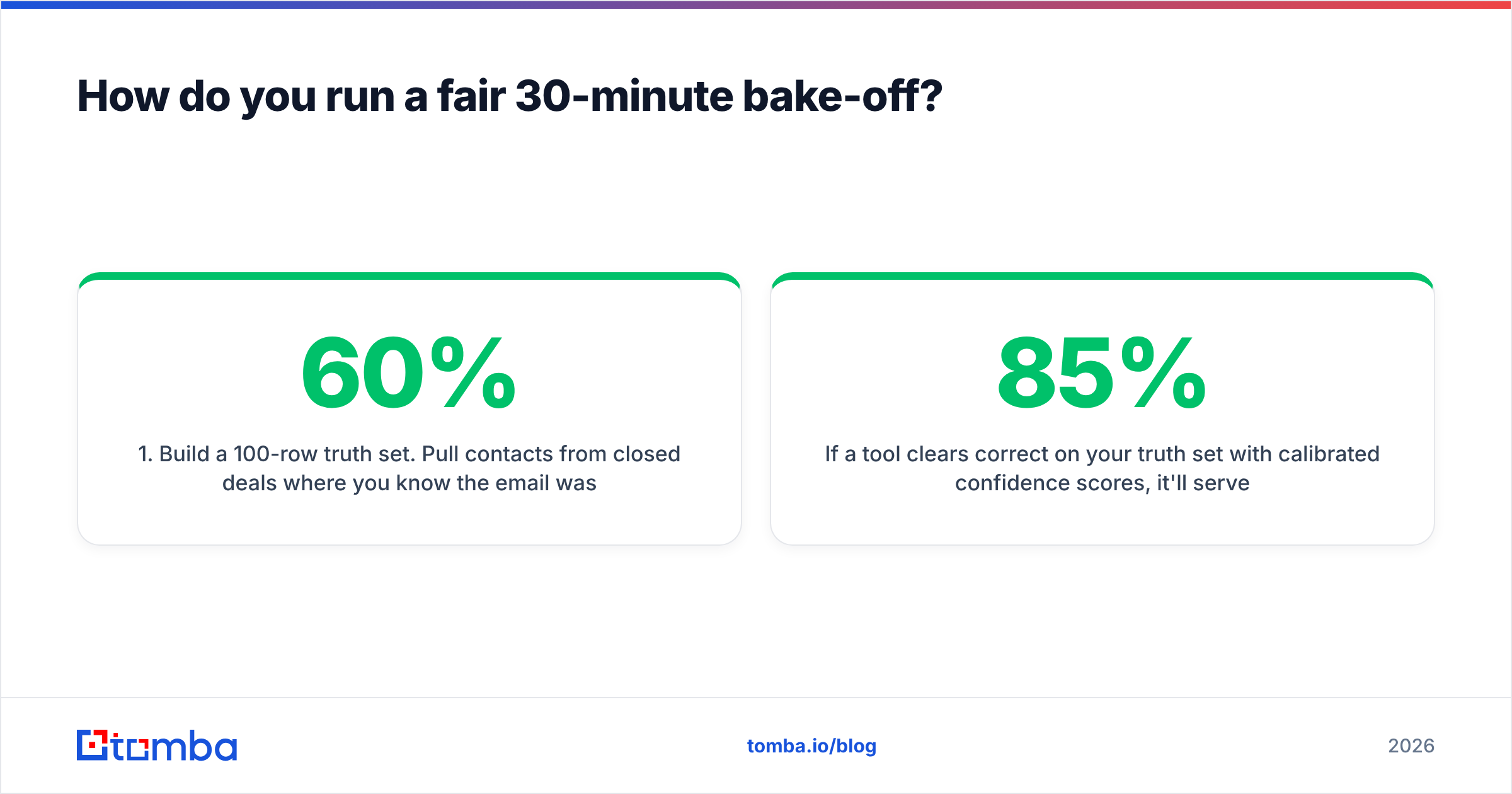
- Build a 100-row truth set. Pull contacts from closed deals where you know the email was right. Mix them: 60% your core geography, 20% adjacent, 20% hard cases (agencies, holding companies, non-Latin-script names).
- Strip the emails and phones. Keep name, company, domain and LinkedIn URL.
- Run all candidates on their free tier. EasyLeadz trial, FindEmails.com trial, plus one full platform. Tomba's free tier gives you 25 searches a month with no card, which is enough for a spot check.
- Score three columns: found (returned anything), correct (matched truth), and calibrated (did the tool's own confidence score predict correctness?). Everyone skips that third column, and it is the one that predicts your bounce rate.
- Send a 50-address test campaign from a warmed domain and record the real bounce rate. This is the only number that matters.
If a tool clears 85% correct on your truth set with calibrated confidence scores, it will serve you. Below 70%, you will spend more time cleaning than prospecting, however cheap the credits were.
The bottom line#
EasyLeadz vs FindEmails.com is a choice between opposite ends of the same market. One sells scarce phone data at a premium in a specific region. The other sells abundant email data at the lowest price it can. Neither is trying to be the other, so choosing by feature count will lead you wrong.
Ask what you are actually short of. Phone numbers in APAC → EasyLeadz. Cheap volume email guessing in the West → FindEmails.com. Both, plus verification, plus enrichment, through one API and one bill → you have outgrown this comparison and should look at a consolidated platform.
If that is where you landed, start with the Tomba Email Finder. The free tier gives you 25 searches a month without a credit card, which is enough to run the truth-set test above. The Starter plan is $49/mo when you are ready to scale. You get domain search, catch-all verification, phone lookup and enrichment on the same credit pool, instead of three separate invoices. Check the full Tomba pricing breakdown, or wire it into your workflow through the API and skip the CSV round-trip entirely.
Related guides#
Ready to find emails that actually work?
Join 150,000+ professionals who stopped guessing and started sending. Free credits on signup — no credit card required.
Get the Tomba newsletter
Practical outbound tactics and product updates — once every two weeks.
About the author