EasyLeadz vs Finderio (2026): Which Data Tool Wins?
EasyLeadz sells phone numbers. Finderio sells email lookups. They are not the same product, and picking wrong costs you a quarter. Here is the honest breakdown of pricing, coverage, and who each one actually fits.
EasyLeadz vs Finderio is not a fair fight, because the two tools do different jobs. One sells phone numbers. The other sells emails. This guide compares price, data quality, and fit in plain language.
TL;DR
- EasyLeadz (Mr. E) is a phone-first tool. It is built for Indian and APAC-heavy pipelines. Finderio (by Outscraper) is an email-first lookup tool, and it bills by credits.
- The two overlap less than the search volume suggests. If you cold call, EasyLeadz wins. If you cold email at volume, Finderio is closer. Its checks are still thin.
- EasyLeadz starts near $49/mo for about 100 credits. Finderio charges a fraction of a cent per lookup, with pay-as-you-go top-ups. Cost per usable record is the number that matters, not list price.
- Neither tool handles catch-all domains. That is the biggest bounce risk in both stacks.
- Best answer for most B2B teams in the EasyLeadz vs Finderio debate: pick one for its strength. Then put a dedicated finder and verifier under it, so your list survives contact with a mail server.
What are EasyLeadz and Finderio, actually?#
They solve different halves of one problem. That is why EasyLeadz vs Finderio feels like a slippery comparison.
EasyLeadz is an Indian-founded contact data platform. It is best known for its "Mr. E" Chrome extension, which pulls direct dials from LinkedIn profiles. Its edge is mobile coverage in markets where most Western databases go blank: India, Southeast Asia, and the Gulf. If you sell into Bangalore or Dubai, it holds records that Apollo and ZoomInfo do not carry. See the official EasyLeadz site for their current pitch.
Finderio is a lighter email finder from the Outscraper family of scraping tools. You give it a name and a domain, and it returns a likely email. It also offers bulk upload and a simple API. You pay by usage, not by seat. That suits agencies and one-off list builds. Their Outscraper parent docs explain the credit model.
Here is the plain framing. EasyLeadz answers "what is this person's phone number?" Finderio answers "what is this person's email address?" Both claim the other skill. Neither is strong at it.

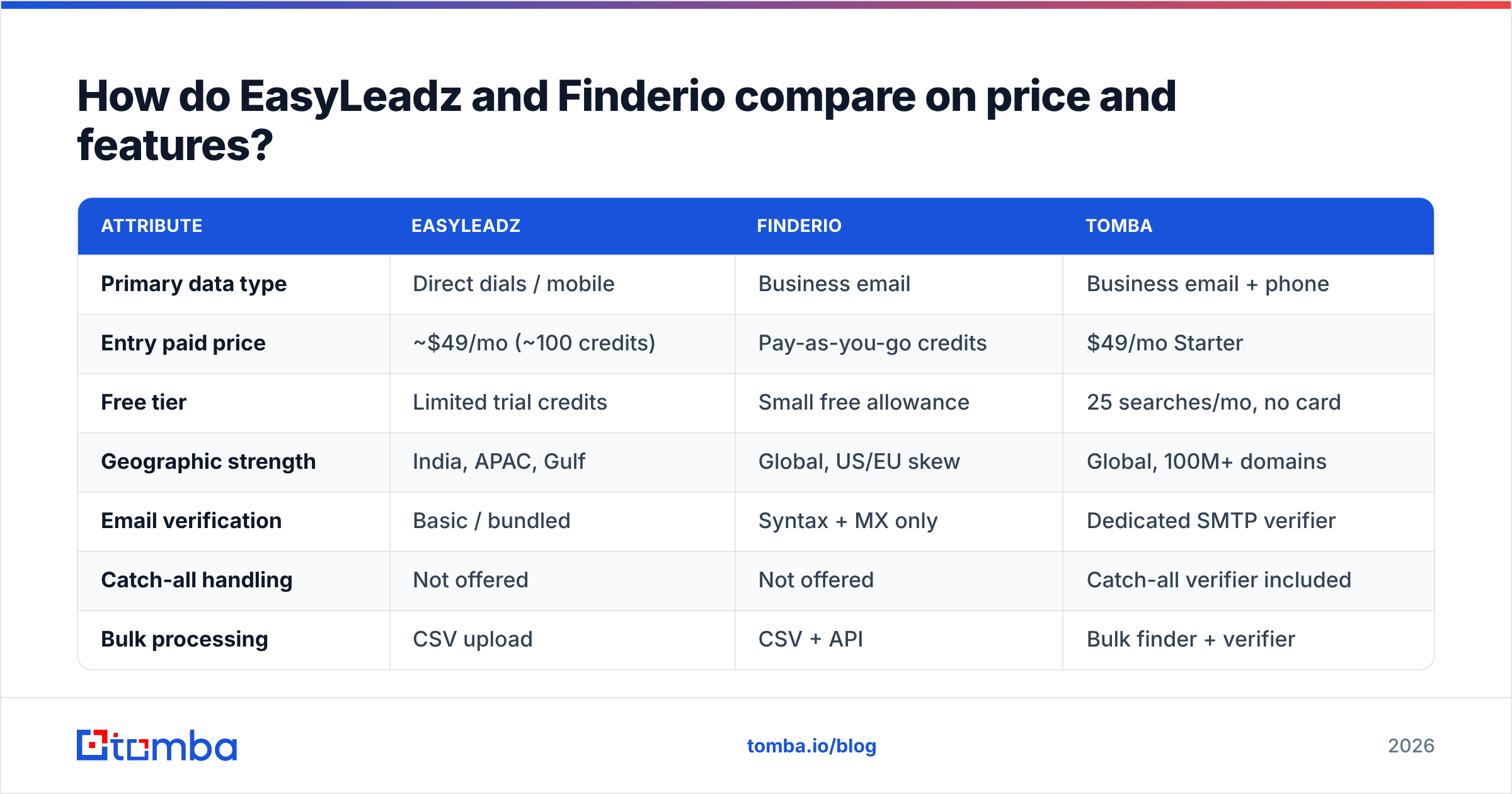
How do EasyLeadz vs Finderio compare on price and features?#
Here is the head-to-head on the details that change your cost per meeting.
| Attribute | EasyLeadz | Finderio | Tomba |
|---|---|---|---|
| Primary data type | Direct dials / mobile | Business email | Business email + phone |
| Entry paid price | ~$49/mo (~100 credits) | Pay-as-you-go credits | $49/mo Starter |
| Free tier | Limited trial credits | Small free allowance | 25 searches/mo, no card |
| Geographic strength | India, APAC, Gulf | Global, US/EU skew | Global, 100M+ domains |
| Email verification | Basic / bundled | Syntax + MX only | Dedicated SMTP verifier |
| Catch-all handling | Not offered | Not offered | Catch-all verifier included |
| Bulk processing | CSV upload | CSV + API | Bulk finder + verifier |
| Native API | Yes (limited endpoints) | Yes | Full REST API + CLI + MCP |
| Chrome extension | Yes (Mr. E) | No | Yes |
| CRM integrations | HubSpot, Zoho, Salesforce | Zapier only | HubSpot, Salesforce, Pipedrive, Zapier, Make |
Two rows deserve a closer look. Catch-all handling is blank on both tools. Any domain with a catch-all mail server returns "valid" when the truth is unknown. On enterprise domains, that is where 30-40% of your bounces come from.
CRM integrations is the second row. Finderio connects through Zapier only. So an ops person has to build that plumbing and keep it alive. Native connectors give you the same thing for free.
Which one has better data accuracy?#
They fail in different ways. So "better" depends on what breaks your quarter.
EasyLeadz mobile numbers are strong in its core regions. Reps report connect rates that beat local rivals. Outside those regions, coverage thins fast. Ask for a US VP of Engineering's direct dial and you often get a switchboard, or nothing at all.
Finderio has the classic pattern-guesser problem. It guesses first.last@domain.com from patterns it has seen before. Then it runs a light syntax and MX check. That catches typos and dead domains. It does not catch an address that was never created. It also misses one that was shut off eight months ago. On a 1,000-row list of mid-market SaaS contacts, expect a bounce rate well above the 2-3% that inbox providers accept.
There is a gap between "the address looks right" and "the address accepts mail." Sender reputation dies in that gap. If email deliverability is new to you, it is worth an hour of reading. G2's email verification category is a good place to check vendor claims against user reviews.

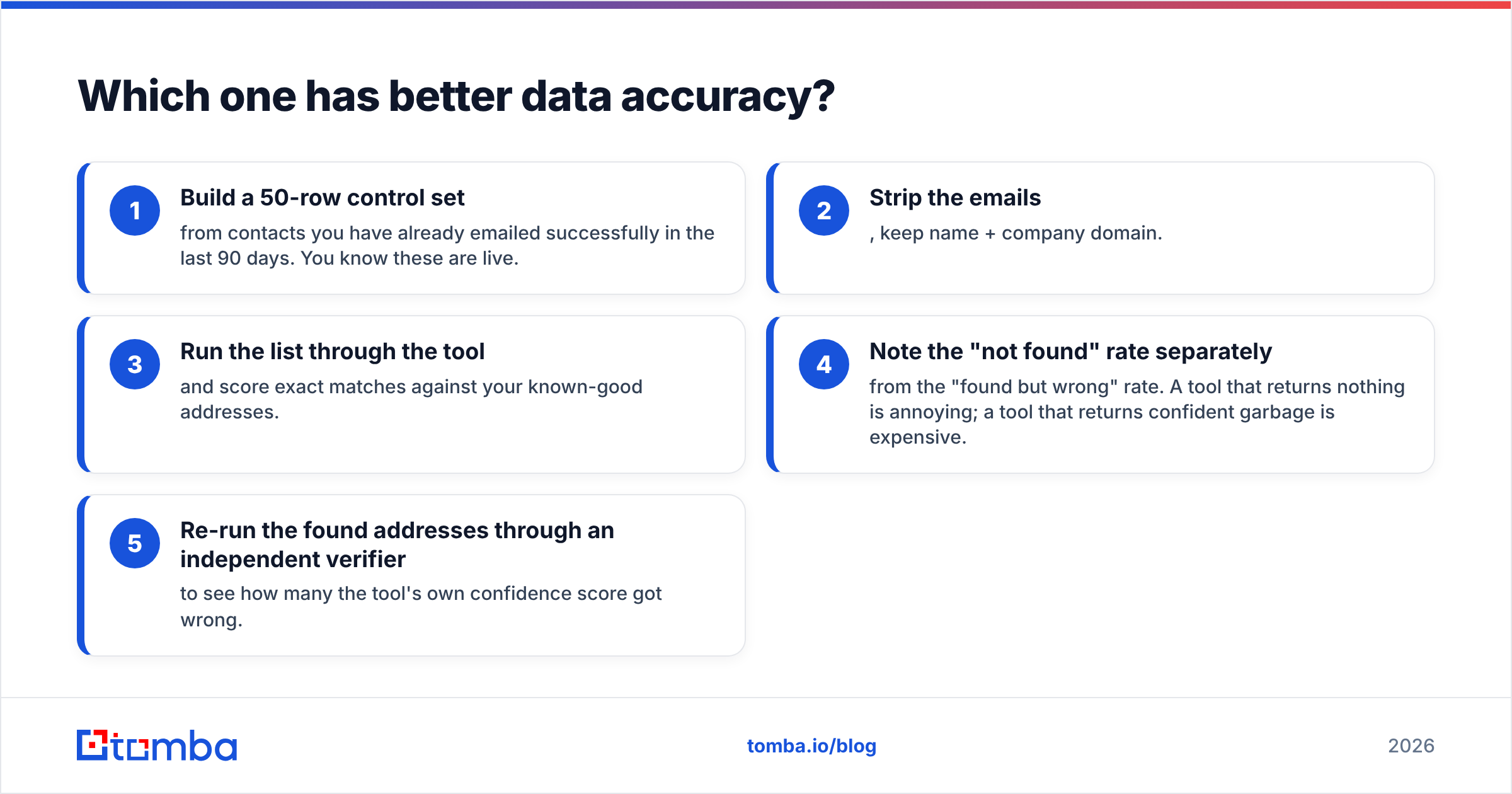
You can run this accuracy test on either tool in 20 minutes:
- Build a 50-row control set from contacts you emailed in the last 90 days. You know these addresses are live.
- Strip the emails. Keep the name and the company domain.
- Run the list through the tool. Score exact matches against your known-good addresses.
- Count "not found" and "found but wrong" apart. A tool that returns nothing is annoying. A tool that returns confident junk is expensive.
- Re-check the found addresses with an independent verifier. See how often the tool's own confidence score was wrong.
Most teams skip step five. It is the step that predicts your bounce rate.
Who should pick EasyLeadz?#
Pick EasyLeadz when the phone is your main channel and your buyers sit in Asia.
Concrete fits:
- India-focused SaaS and services sales. No Western database matches the mobile coverage. It is not close.
- Recruiting agencies in APAC markets. Direct dials shorten the sourcing loop far more than InMail.
- Teams running a call-first sequence, where email is the follow-up and not the opener.
- Small teams that want a Chrome extension and nothing else. Mr. E is quick to use inside LinkedIn.
Where it disappoints: European and North American coverage, email checks, and credit math at volume. Credits burn fast when a lookup returns half a record. Refund rules on bad records are patchy. Run a heavy LinkedIn outreach motion in the US and you hit the coverage wall in week two.
Who should pick Finderio?#
Pick Finderio when you want cheap, metered email lookups with no subscription.
Concrete fits:
- Agencies building one-off lists for clients, where a monthly seat makes no sense.
- Developers who want a simple endpoint and already use Outscraper's other scrapers.
- Low-volume founders doing 50-100 lookups a month, who will not pay $49 for the privilege.
- Data enrichment side projects where a 10% error rate is survivable.
Where it disappoints: anything that touches deliverability. There is no catch-all logic, no SMTP-level check, and no real role-account filter. You buy raw guesses and do the quality work yourself. Our Findymail alternative and Clearbit alternative breakdowns cover the same trade-off in more detail.

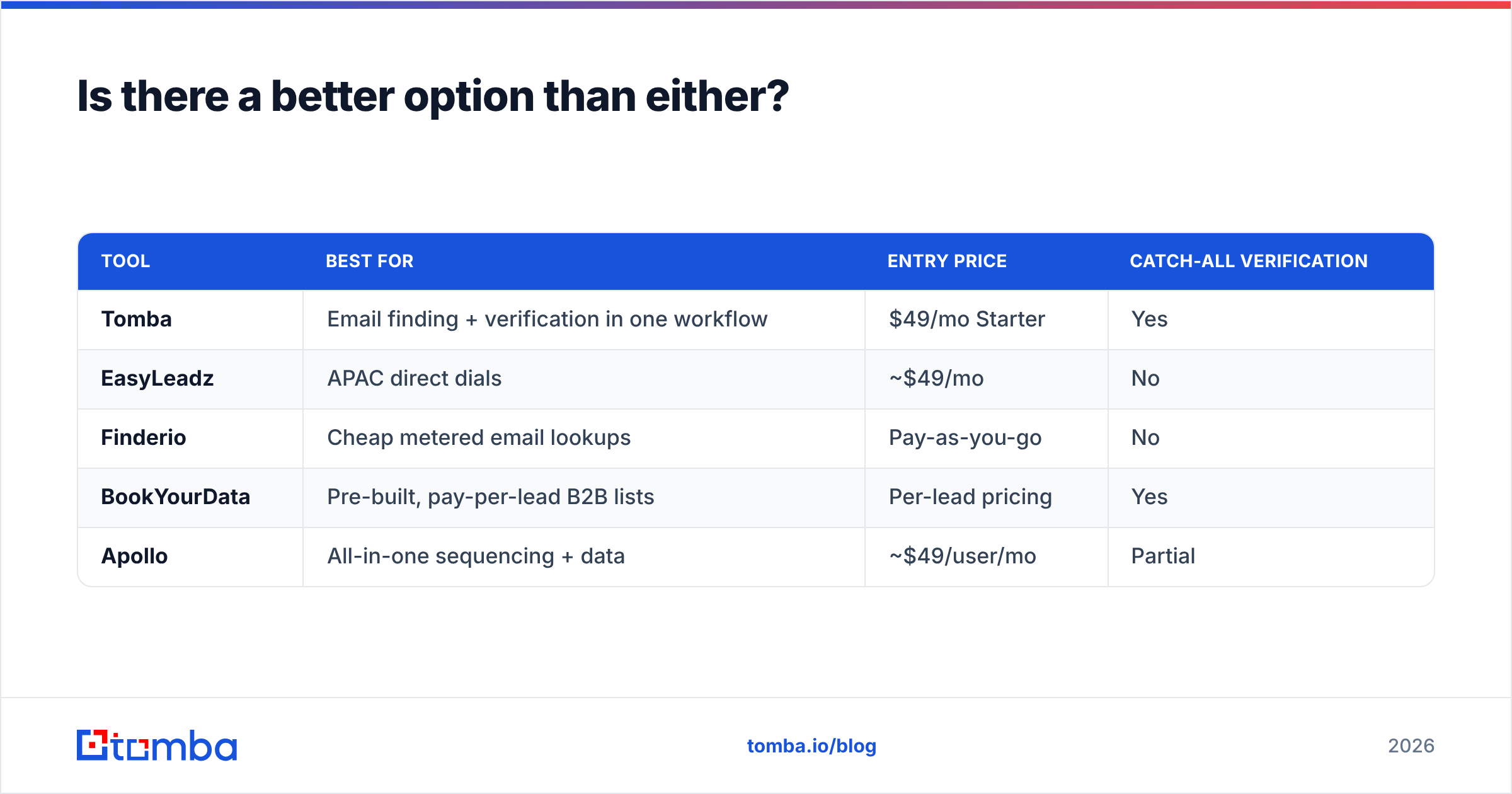
Is there a better option than either?#
Usually yes. The real need is almost never "phone only" or "email only."
Most B2B teams need three things in one pass. A correct email. A verification result they can trust. Enough company context to personalise. EasyLeadz gives you one of those in one region. Finderio gives you part of another. Run both and you juggle two vendors, two credit systems, and two CSV exports to reconcile.
The alternatives worth evaluating alongside them:
| Tool | Best for | Entry price | Catch-all verification |
|---|---|---|---|
| Tomba | Email finding + verification in one workflow | $49/mo Starter | Yes |
| EasyLeadz | APAC direct dials | ~$49/mo | No |
| Finderio | Cheap metered email lookups | Pay-as-you-go | No |
| BookYourData | Pre-built, pay-per-lead B2B lists | Per-lead pricing | Yes |
| Apollo | All-in-one sequencing + data | ~$49/user/mo | Partial |
BookYourData deserves a mention here. It is the closest real alternative if you would rather buy a pre-verified list than run lookups yourself. Its per-lead model also avoids the credit-expiry problem that annoys users of both tools. Different way to buy, same end goal.

How do you actually test these before committing?#
Run every candidate against the same list, in the same week. Score them on cost per deliverable record.
The workflow that gives you a defensible decision:
- Freeze a 200-row test set that matches your real buyers: right industry, right region, right seniority. Not a random export.
- Run every candidate against that same list. Same names, same domains, same day. Databases change weekly, so a test run three weeks later is not a comparison.
- Verify every returned address on its own. Use a tool that runs SMTP-level checks and flags catch-all domains apart from valid ones. A neutral email verifier means you are not grading a vendor with the vendor's own marker.
- Work out cost per deliverable record, not cost per credit. If Tool A costs half as much but returns 40% junk, Tool A costs more.
- Send a 50-address canary campaign from a warmed second domain. Measure the real bounce rate. It is the only number nobody self-reports.
- Check the refund policy on failed lookups before you buy a year. Some vendors refund "not found" credits, some refund only hard failures, some refund nothing.
Step three is where most comparisons fall apart. A tool that grades its own output will claim 95% accuracy. An independent SMTP check on the same list often reports something in the 70s.
Run a catch-all verifier pass before you scale any list. Catch-all domains are the largest source of false "valid" results in this product category. They are also most common at the enterprise accounts you most want to reach.
What does this cost over a year?#
Sticker price and real cost split apart once you count waste.
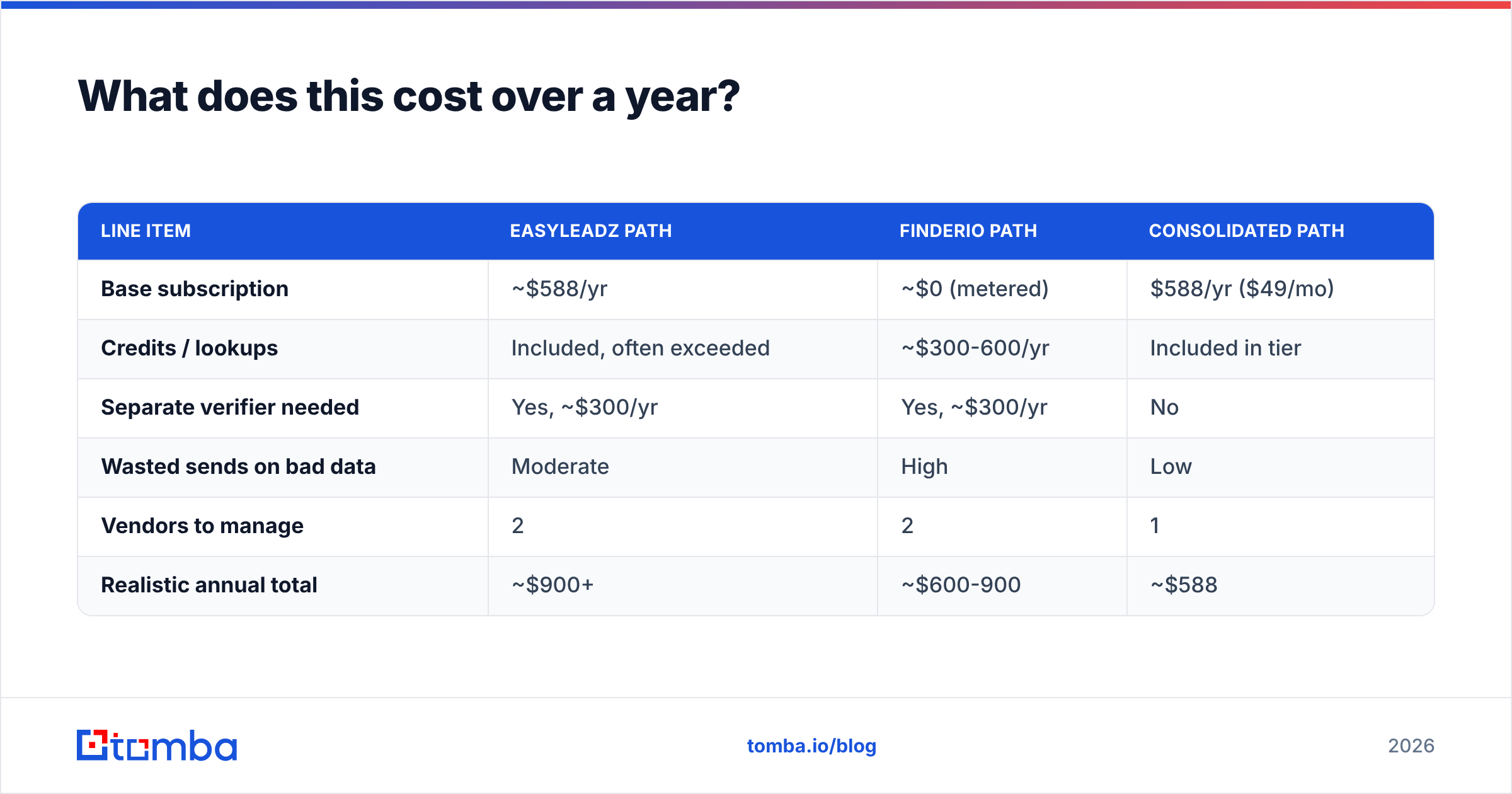
Take a modest case: 2,000 contacts sourced per month, with a 3% bounce ceiling.
| Line item | EasyLeadz path | Finderio path | Consolidated path |
|---|---|---|---|
| Base subscription | ~$588/yr | ~$0 (metered) | $588/yr ($49/mo) |
| Credits / lookups | Included, often exceeded | ~$300-600/yr | Included in tier |
| Separate verifier needed | Yes, ~$300/yr | Yes, ~$300/yr | No |
| Wasted sends on bad data | Moderate | High | Low |
| Vendors to manage | 2 | 2 | 1 |
| Realistic annual total | ~$900+ | ~$600-900 | ~$588 |
The consolidated column is not a rhetorical trick. It reflects a real structural difference. When finding and verifying happen in one system, the verifier's result feeds back into the finder's confidence score. Split them across two vendors and that loop breaks. You pay for the gap in bounces.
Check current Tomba pricing against your own volume first. The free tier is 25 searches per month. Starter is $49/mo, Growth is $99/mo, and Pro is $249/mo. Enterprise is quoted.
What is the verdict on EasyLeadz vs Finderio?#
Pick EasyLeadz if you dial APAC. Pick Finderio if you need cheap metered email lookups and nothing more. Pick neither if deliverability is your real constraint.
Here is the honest read on EasyLeadz vs Finderio. Both tools are good at a narrow job and oversold as full contact platforms. EasyLeadz has real phone data in specific regions, and that data is hard to copy. If it matches your territory, buy it and stop reading comparisons. Finderio is a fair utility at a fair price, as long as you treat every output as a guess rather than a fact.
What sinks most teams is not the choice between these two. It is picking one and skipping the verification layer. Then a warmed domain gets throttled after a 12% bounce campaign. That failure is preventable and cheap to prevent.
Is your bottleneck finding correct, verified business emails at scale, rather than APAC mobile numbers? Start with the Tomba Email Finder. You get email discovery, SMTP verification, and catch-all detection in one workflow. So the addresses you export are the addresses that land. Test it with 25 free searches on a list you already know the answers to. That takes 20 minutes and tells you more than any comparison post, including this one.
Related guides#
Ready to find emails that actually work?
Join 150,000+ professionals who stopped guessing and started sending. Free credits on signup — no credit card required.
Get the Tomba newsletter
Practical outbound tactics and product updates — once every two weeks.
About the author