EasyLeadz vs Grata (2026): Which B2B Data Tool Wins?
EasyLeadz sells direct dials. Grata sells company discovery for dealmakers. They barely overlap — and most teams buy the wrong one. Here's the honest breakdown, with pricing, data coverage, and who each tool actually fits.
EasyLeadz vs Grata is a strange matchup. One tool finds phone numbers. The other finds companies. Most teams need one, not both. Here is the short version.
TL;DR
- EasyLeadz is a contact-data tool. Give it a name or a LinkedIn profile, and it returns a mobile number. It is strongest in India and APAC. Pricing runs on credits, and it is cheap to start.
- Grata is a company-discovery and deal-sourcing platform. It was built for private equity, M&A, and corp dev. Give it a thesis — "vertical SaaS for dental practices, $5-20M revenue, bootstrapped" — and it returns a list of companies.
- In an EasyLeadz vs Grata comparison, the two are barely competitors. If you weigh them head to head, you have not yet named your bottleneck. Is it finding accounts or reaching people?
- Grata is priced for deal teams. Expect four to five figures a year, quote only. EasyLeadz starts under $50 a month on credits.
- If your real job is email-first outbound at volume, neither one wins. A dedicated email finder with an API costs a fraction of both.
EasyLeadz vs Grata: what does each tool actually do?#
Here is the honest answer. These two tools solve different halves of the go-to-market problem. They share search results, not features. The overlap says more about confused buying than about the products.
EasyLeadz (easyleadz.com) is best known for Mr. E, its Chrome extension. It pulls direct dial mobile numbers off LinkedIn profiles. Point it at a prospect, spend a credit, get a phone number. It also has an API and a bulk enrichment flow. Its company database leans heavily toward India and the wider APAC region. That is its real edge. If you sell into Bangalore, Mumbai, or Singapore mid-market, its mobile coverage often beats the big Western databases.
Grata (grata.com) is a deal-sourcing search engine. It indexes millions of private companies. It crawls their websites and reads what they say about themselves, rather than leaning on stale SIC/NAICS codes. You search in plain language — "companies that do HVAC compliance software" — and Grata returns a ranked list. Each result carries revenue estimates, headcount, ownership status, and funding history. It was built for private equity associates. They need to find the 300 companies in a fragmented niche before anyone else does. Datasite acquired Grata in 2024, which pushed it deeper into the M&A workflow.
So the EasyLeadz vs Grata split is simple. EasyLeadz answers "how do I reach this person?" Grata answers "which companies should I look at?"
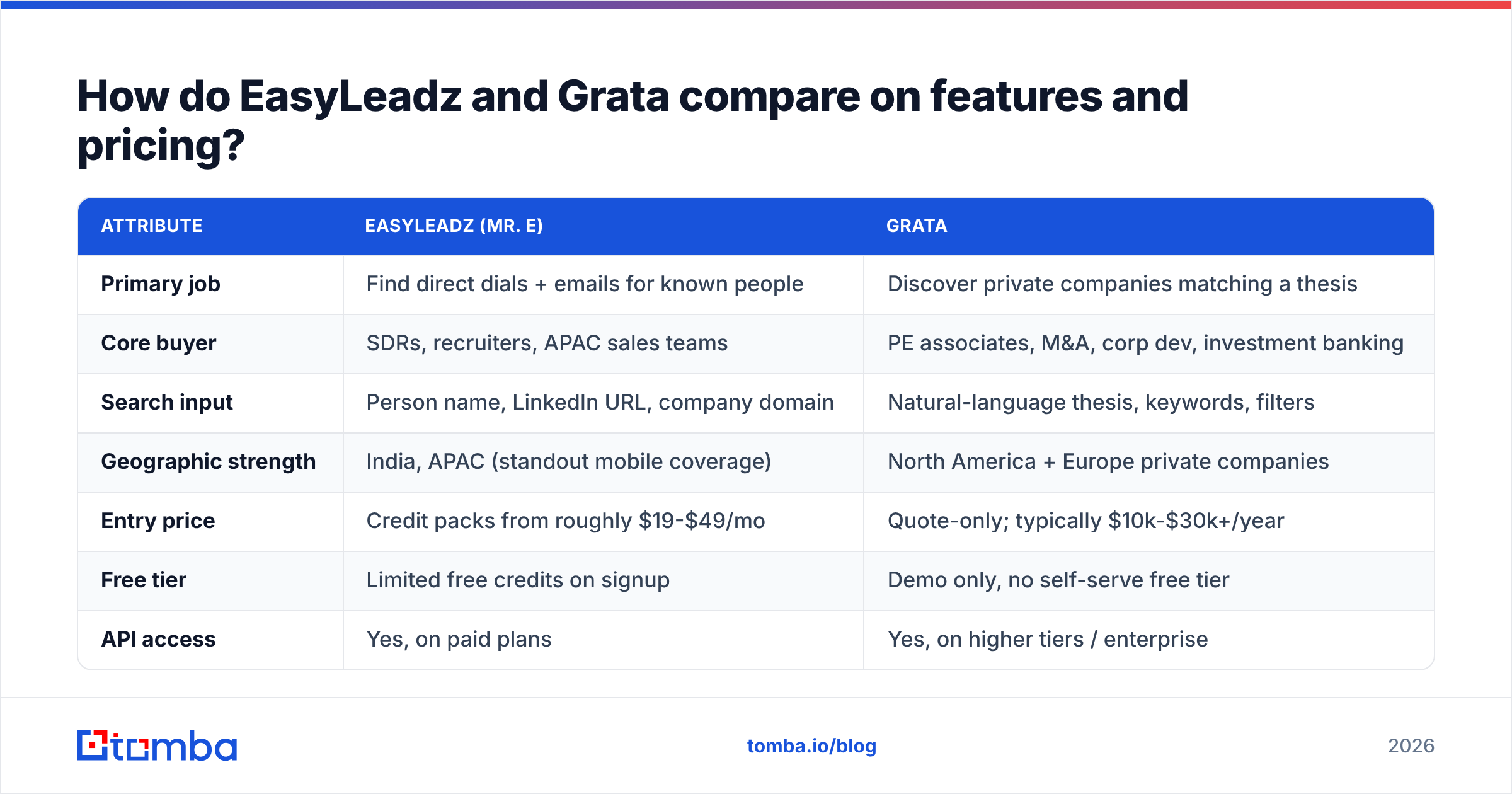
EasyLeadz vs Grata: features and pricing side by side#
Here is the table. Watch the pricing gap. It is the single biggest practical difference, and it rules one tool out for most SMB teams.
| Attribute | EasyLeadz (Mr. E) | Grata |
|---|---|---|
| Primary job | Find direct dials + emails for known people | Discover private companies matching a thesis |
| Core buyer | SDRs, recruiters, APAC sales teams | PE associates, M&A, corp dev, investment banking |
| Search input | Person name, LinkedIn URL, company domain | Natural-language thesis, keywords, filters |
| Geographic strength | India, APAC (standout mobile coverage) | North America + Europe private companies |
| Entry price | Credit packs from roughly $19-$49/mo | Quote-only; typically $10k-$30k+/year |
| Free tier | Limited free credits on signup | Demo only, no self-serve free tier |
| API access | Yes, on paid plans | Yes, on higher tiers / enterprise |
| Email data | Secondary — phones are the headline | Contact data added, but discovery is the product |
| Firmographic depth | Basic (size, industry, location) | Deep — revenue models, ownership, funding, similarity |
| CRM integrations | HubSpot, Zapier, Salesforce | Salesforce, HubSpot, DealCloud, Affinity |
| Best for | Calling a list you already have | Building the list in the first place |
The price gap is not a rounding error. It is close to two orders of magnitude. Grata is a research platform. It sells seats to teams whose deal value justifies five-figure software. EasyLeadz is a credit-metered utility. That is the whole story.
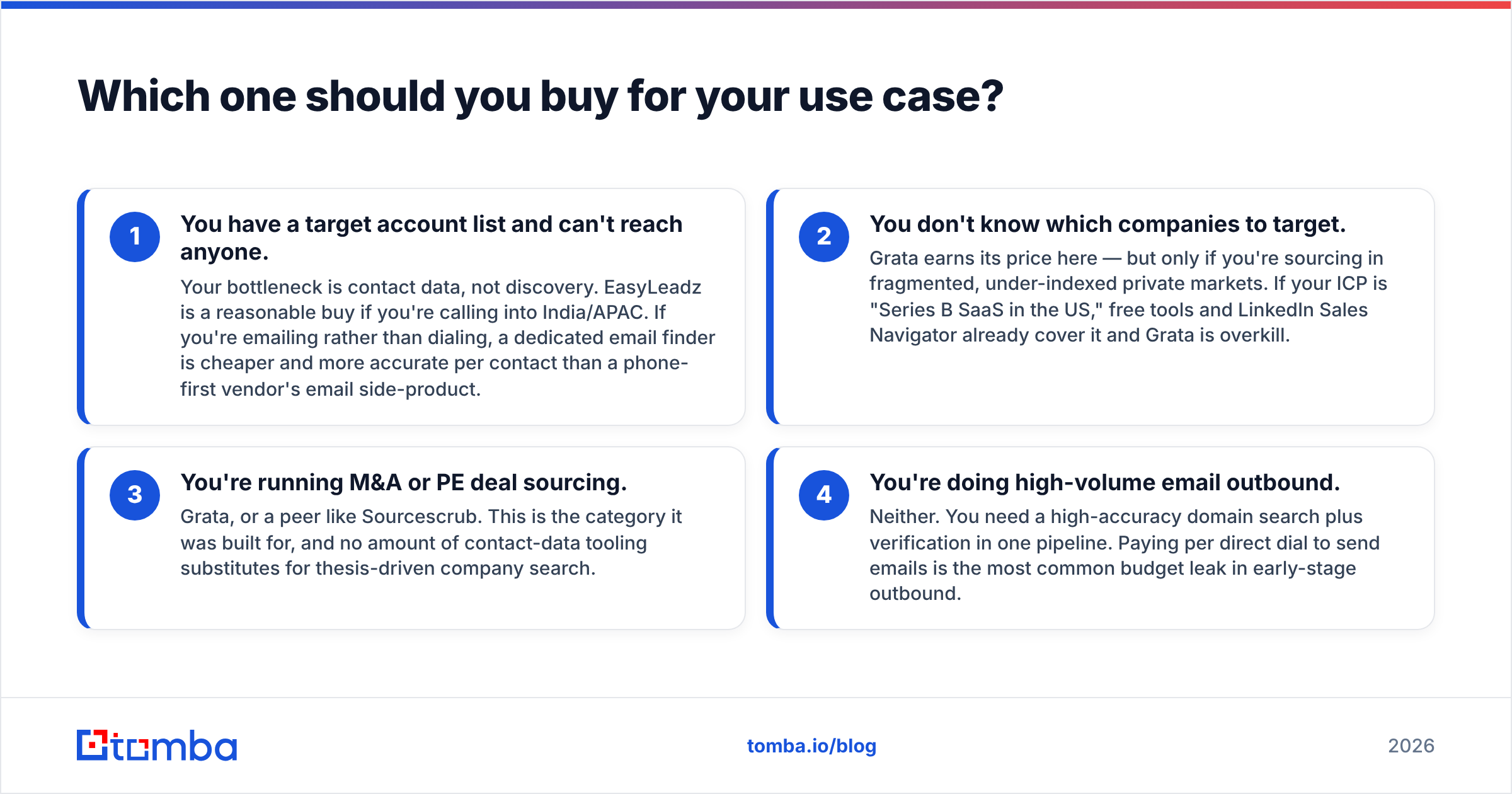
Which one should you buy for your use case?#
Name your bottleneck first. Four common cases:
You have a target account list and cannot reach anyone. Your problem is contact data, not discovery. EasyLeadz is a fair buy if you call into India and APAC. If you email rather than dial, a dedicated email finder costs less per contact. It is also more accurate than a phone-first vendor's email side-product.
You do not know which companies to target. Grata earns its price here. But it only pays off in fragmented, under-indexed private markets. If your ICP is "Series B SaaS in the US," free tools and LinkedIn Sales Navigator already cover it, and Grata is overkill.
You run M&A or PE deal sourcing. Pick Grata, or a peer like Sourcescrub. This is the job it was built for. No amount of contact-data tooling replaces thesis-driven company search.
You run high-volume email outbound. Neither. You need an accurate domain search plus verification in one pipeline. Paying per direct dial to send emails is the most common budget leak in early-stage outbound.
Here is the failure mode I see most often. A seed-stage startup buys a deal-sourcing platform because a board member named it. Then the reps still cannot get a working email address. Discovery without contactability is just a spreadsheet of names.
Is EasyLeadz accurate enough for outbound?#
It depends on geography and channel.
On mobile numbers in India, EasyLeadz is genuinely strong. It beats most US-centric databases, which treat APAC as an afterthought. Reviews on G2 flag this as the main reason teams keep it.
On email addresses, it is weaker. Phone-first vendors tend to license or infer email data. They rarely build it from primary sources, and bounce rates show it. Push an unverified list into a cold sequence and you damage deliverability. Run every list through an email verifier before it touches your sending domain. Above a 3% bounce rate, inbox placement starts to collapse. Google's own bulk sender guidelines spell out the spam-complaint limits.
On coverage in Western markets, EasyLeadz is mid-pack. That is no reason to drop a primary US or EU data provider.
Grata faces a different accuracy question. It does not try to be right about a person's phone number. It tries to be right that a company exists, is private, earns roughly $X, and fits your thesis. Revenue figures for private companies are modeled, not reported. Treat them as a sorting signal, not a fact. Ownership and funding data is generally solid. Recall is the real strength here. Grata surfaces firms that never show up in LinkedIn-based searches, because they have twelve employees and no social presence.
What are the real alternatives to both?#
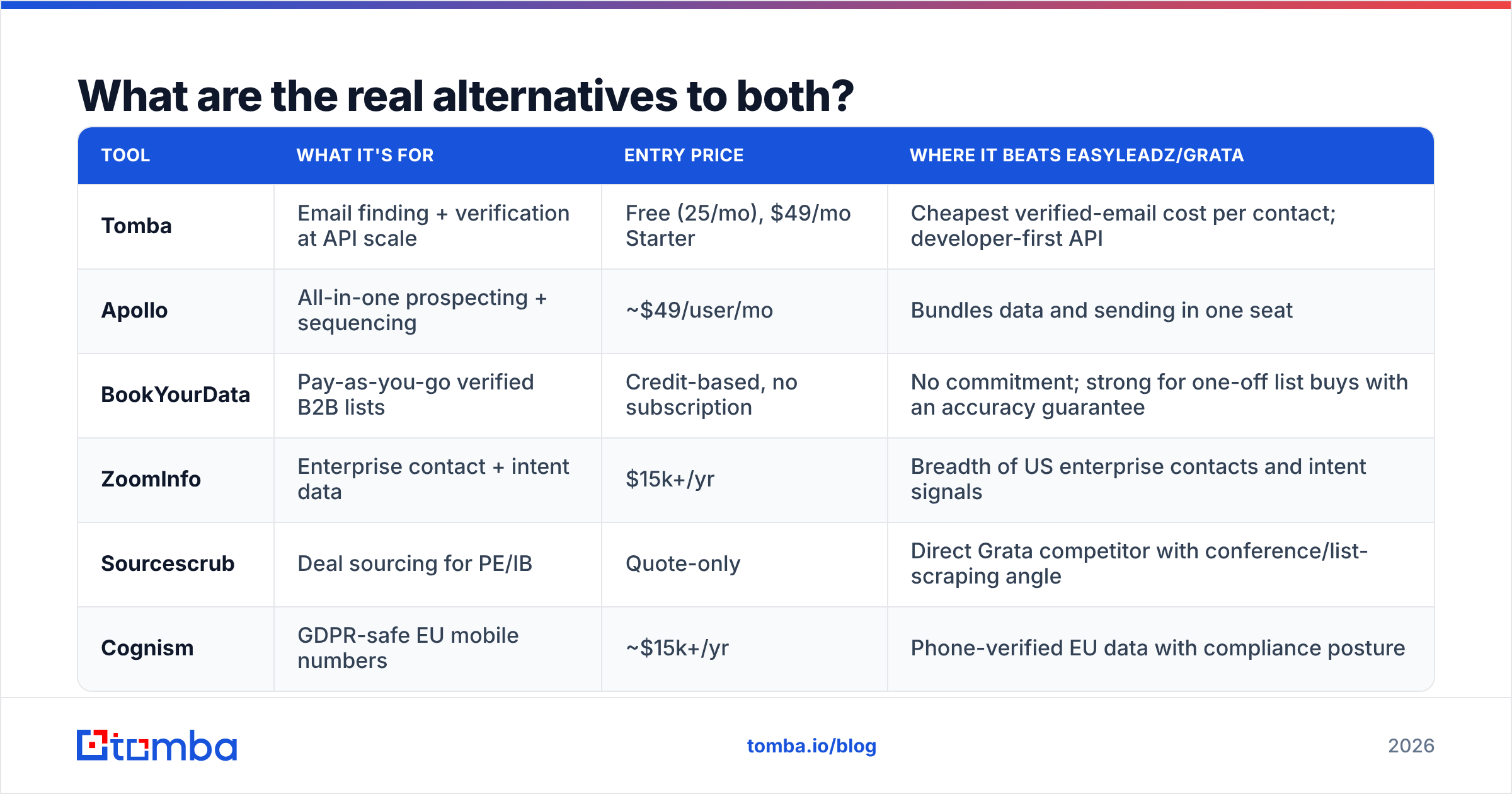
The EasyLeadz vs Grata choice often feels like a false one, because it usually is. Here is the wider field, mapped to the job you need done.
| Tool | What it's for | Entry price | Where it beats EasyLeadz/Grata |
|---|---|---|---|
| Tomba | Email finding + verification at API scale | Free (25/mo), $49/mo Starter | Cheapest verified-email cost per contact; developer-first API |
| Apollo | All-in-one prospecting + sequencing | ~$49/user/mo | Bundles data and sending in one seat |
| BookYourData | Pay-as-you-go verified B2B lists | Credit-based, no subscription | No commitment; strong for one-off list buys with an accuracy guarantee |
| ZoomInfo | Enterprise contact + intent data | $15k+/yr | Breadth of US enterprise contacts and intent signals |
| Sourcescrub | Deal sourcing for PE/IB | Quote-only | Direct Grata competitor with conference/list-scraping angle |
| Cognism | GDPR-safe EU mobile numbers | ~$15k+/yr | Phone-verified EU data with compliance posture |
Two notes on that table. First, BookYourData is worth a look if you want verified contacts without an annual contract. Its pay-as-you-go model sidesteps the seat-license problem. That problem is what makes both EasyLeadz and Grata awkward for small teams. Second, if you are weighing Grata, run one honest test. Can you name three deals that closed because you found the company first? If not, you are buying a research subscription, not a pipeline.

How do you build a stack that covers both jobs?#
A working setup splits discovery from contactability. It also refuses to overpay for either.
- Discovery layer. Most B2B SaaS teams: LinkedIn Sales Navigator plus a firmographic filter. PE and M&A teams: Grata or Sourcescrub, paid for by deal economics. Niche verticals: association directories and conference exhibitor lists still beat every paid database.
- Contact layer. Turn domains into people with a bulk email finder, then verify before you send. Add phones only for accounts where a call is the real next step, not as blanket enrichment.
- Enrichment layer. Fill firmographics and job-change signals with data enrichment on a schedule. Do not buy a second full database.
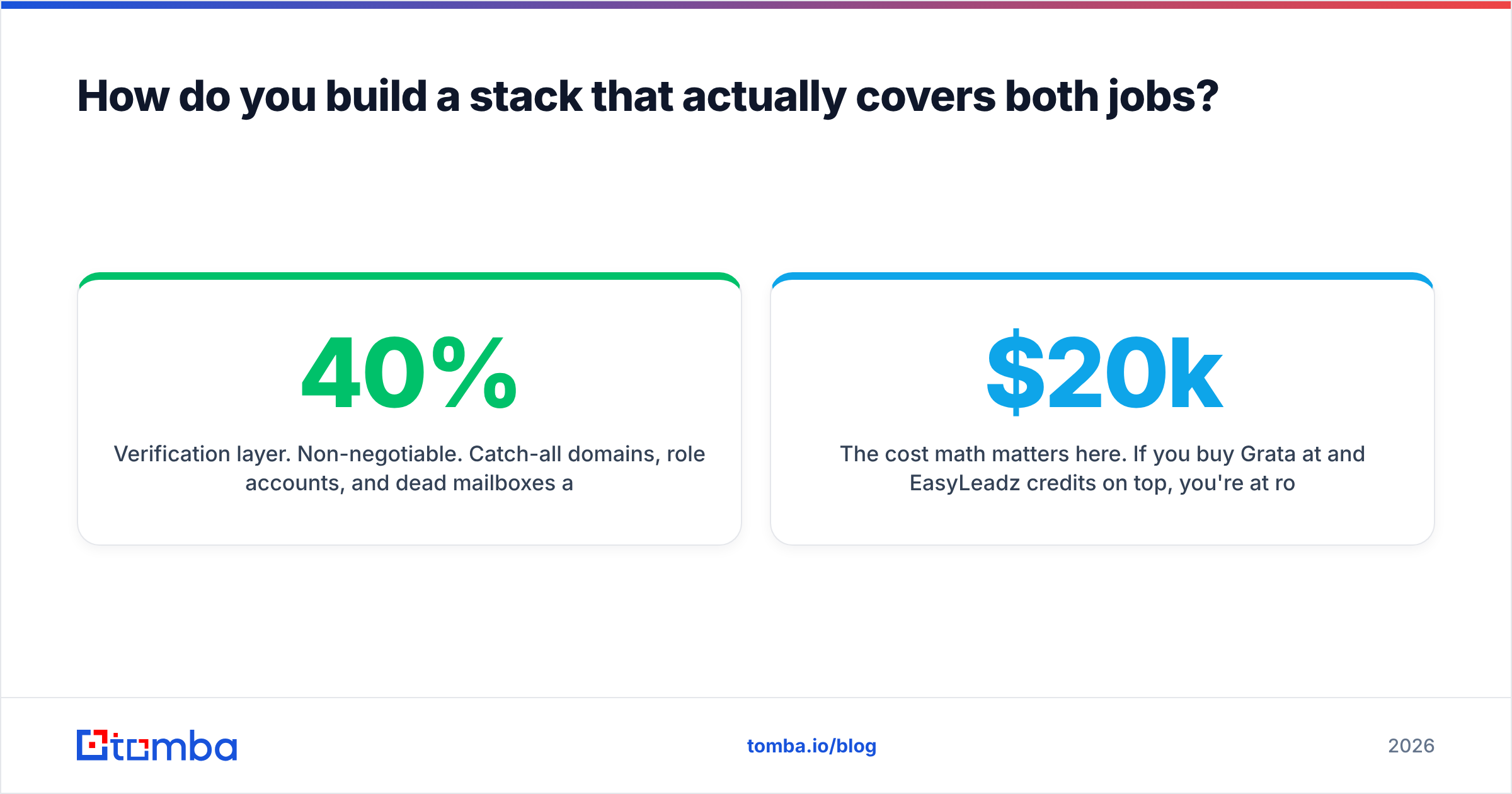
- Verification layer. Non-negotiable. Catch-all domains, role accounts, and dead mailboxes turn a 40% open rate into a 12% one. Handle catch-alls with a catch-all verifier instead of guessing.
- Automation layer. Pipe it all through an API or the HubSpot integration. Enrichment should fire on record creation, not in a monthly manual batch.
The cost math matters here. Buy Grata at $20k a year, add EasyLeadz credits on top, and you are near $22k before your first email goes out. A discovery source, a $49 email finder, and verification cost a fraction of that. Scale the spend to the deal size. That is the whole decision.
EasyLeadz vs Grata: which tool wins in 2026?#
Neither wins outright. The verdict is conditional, and it is short.
- Buy Grata if you source private-market deals for a living, and your average deal justifies five figures of software a year. Nothing on this list matches its recall on under-the-radar private companies.
- Buy EasyLeadz if you dial into India and APAC, and mobile connect rate is your main metric. It is the cheapest credible way to get those numbers.
- Buy neither if you run email-first outbound. That is the majority case. Both tools are the wrong shape for it. One is priced for dealmakers. The other is built for a channel you do not use.
One pattern runs through all three verdicts. Pay for the data type that unblocks your bottleneck. Refuse to pay for the bundled rest. Tools get expensive when you buy a platform to solve a single-field problem.
If your bottleneck is verified work emails at volume — and for most outbound teams it is — start with the Tomba Email Finder. The free tier gives you 25 searches a month. Test accuracy against your own known-good list before you spend a cent. Starter is $49 a month, and every result runs through verification before it reaches you. Check Tomba pricing to size a plan against your monthly contact volume. Or go straight to the Tomba API and enrich records at the point of creation, instead of managing another dashboard.
Related guides#
Ready to find emails that actually work?
Join 150,000+ professionals who stopped guessing and started sending. Free credits on signup — no credit card required.
Get the Tomba newsletter
Practical outbound tactics and product updates — once every two weeks.
About the author