EasyLeadz vs Interseller: Which B2B Contact Tool Wins?
EasyLeadz sells direct dials. Interseller sells recruiter sequences. They barely overlap — and picking the wrong one wastes a whole quarter of outbound. Here's the honest breakdown, with pricing, coverage and accuracy caveats.
EasyLeadz vs Interseller looks like a fair fight. It isn't. One tool sells phone numbers. The other sells email sequences for recruiters. Here is what each one does, what it costs, and when to skip both.
TL;DR
- These two tools barely compete. EasyLeadz sells contact data built around direct-dial mobile numbers, and it is strongest in India and the rest of APAC. Interseller finds emails and sends them. It was built for recruiters and is now owned by Greenhouse.
- Pick EasyLeadz if you cold call. Its Chrome extension pulls a mobile number off a LinkedIn profile in one click.
- Pick Interseller if you are an agency recruiter. You get sourcing, email discovery, and follow-up in one seat, inside the Greenhouse ecosystem.
- Pick neither if you need verified work emails in bulk at a steady per-credit price. That is a third category, and both tools are costly stand-ins for it.
- Pricing splits them the most. EasyLeadz sells credits, so you buy lookups. Interseller sells seats, so you buy users. Each model breaks in a different way as you grow.
EasyLeadz vs Interseller: what do these two tools do?#
They are different products, filed in the same mental drawer.
EasyLeadz is an Indian B2B contact data company. Its best-known product is Mr. E, a Chrome extension. You open a LinkedIn profile, click the extension, and it returns a direct-dial mobile number. Often it returns a work email too.
The pitch is phone-first. It suits sales teams that still dial and need numbers that reach a person, not a switchboard. Coverage is much better for Indian, Southeast Asian, and Middle Eastern companies than most US-built tools. That is its one real edge. You can see the positioning on easyleadz.com.
Interseller launched in 2016 in New York as an outbound tool for recruiters. It finds a candidate's work or personal email, drops them into an automated sequence, and syncs the whole thing back to your ATS.
In 2021, Greenhouse bought it. Interseller now sits inside Greenhouse's sourcing story. That matters more than any feature list. The roadmap serves Greenhouse's recruiting customers, not general B2B sales teams. If you sell SaaS and you are sizing up Interseller for outbound, you are no longer the buyer it was built for.
So the honest framing of EasyLeadz vs Interseller is simple: a phone-data vendor against a recruiting outreach platform. Most people comparing them want one of two things — contact data, or a way to send. The right answer follows from that.
EasyLeadz vs Interseller: the head-to-head table#
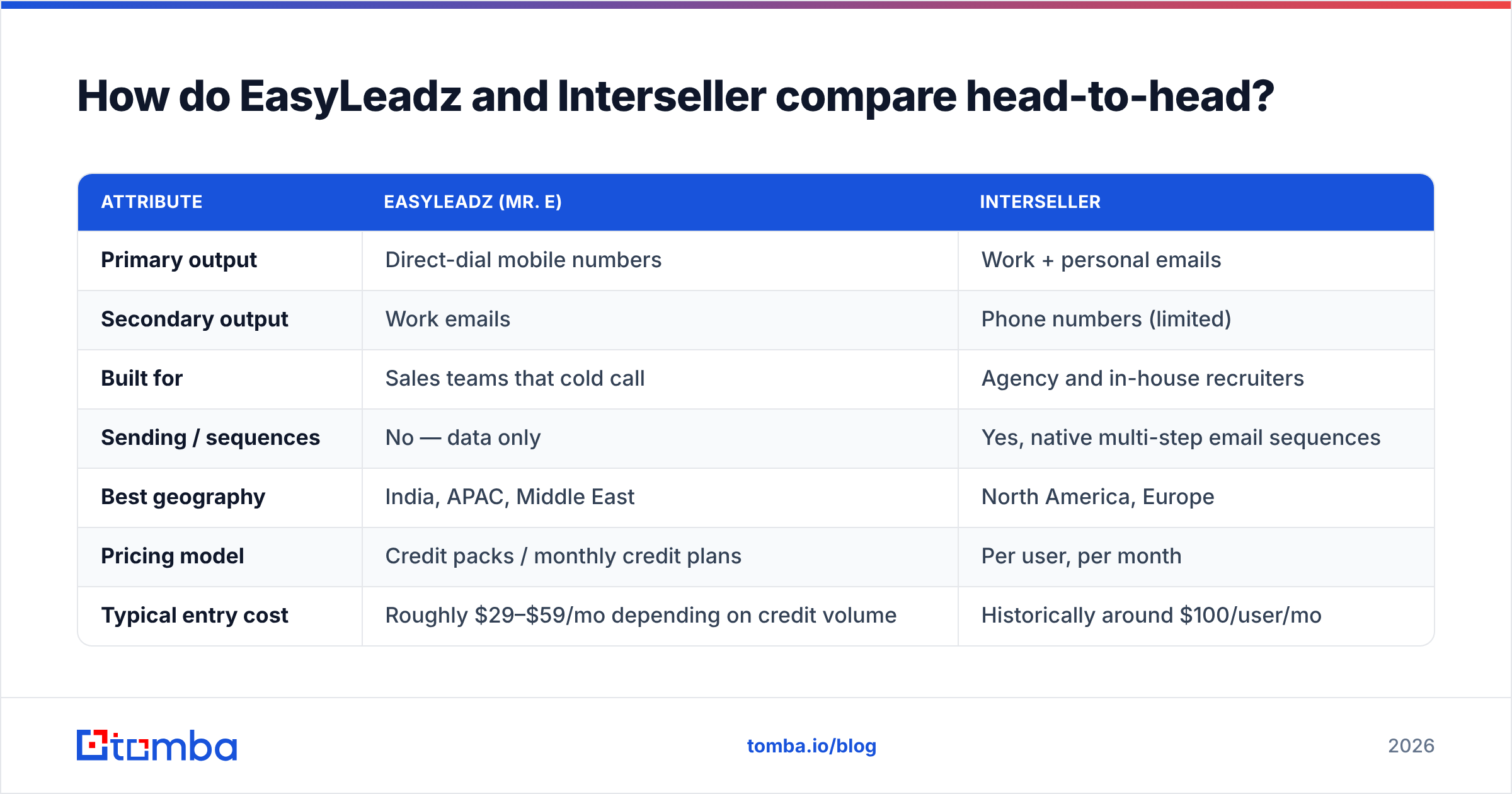
| Attribute | EasyLeadz (Mr. E) | Interseller |
|---|---|---|
| Primary output | Direct-dial mobile numbers | Work + personal emails |
| Secondary output | Work emails | Phone numbers (limited) |
| Built for | Sales teams that cold call | Agency and in-house recruiters |
| Sending / sequences | No — data only | Yes, native multi-step email sequences |
| Best geography | India, APAC, Middle East | North America, Europe |
| Pricing model | Credit packs / monthly credit plans | Per user, per month |
| Typical entry cost | Roughly $29–$59/mo depending on credit volume | Historically around $100/user/mo |
| Integrations | Chrome extension, API, CRM push | ATS-first (Greenhouse, Lever, Bullhorn), CRM |
| Ownership | Independent | Owned by Greenhouse since 2021 |
| Free option | Limited free credits on signup | Trial only |
Two things stand out. First, only one of these tools sends email. Buy EasyLeadz expecting sequences and you will need a separate sender.
Second, the pricing models differ in kind, and the gap widens over time. Credits punish volume. Seats punish headcount. A five-person SDR team running 2,000 lookups a month gets a very different bill than a two-person recruiting desk running 8,000.
Prices change. Treat the numbers above as a rough guide. Confirm them on each vendor's own pricing page before you sign an annual contract.
EasyLeadz vs Interseller: which one returns better data?#
It depends on the field you grade. That is not a dodge.
For mobile numbers, EasyLeadz is the stronger tool, especially outside North America. Reviewers on G2 report the same pattern. Hit rates run high on Indian and APAC contacts. Coverage thins out on US and European mid-market names. If you sell to engineering leaders in Bangalore, that is a real moat. If you sell to RevOps managers in Denver, the moat is gone.
For email addresses, Interseller has done well on recruiting profiles. Engineers, designers, and other people with a public footprint are easier to find. Part of the reason is that it surfaces personal emails, not just work ones. That helps in recruiting. It hurts in B2B sales, where a Gmail address is usually a spam risk rather than a win.
Neither tool publishes an audited accuracy number. Be wary of any vendor that claims one without showing its method. Run your own test instead. Take 100 contacts you have already verified and run them through a trial of each tool. Then measure three things: coverage (did it return anything?), correctness (was it right?), and freshness (has the person changed jobs?). Most teams check only the first one, then get burned by the third.

One more variable gets ignored: catch-all domains. Many B2B domains accept every address at the mail server. A basic verifier then marks them "valid," and your bounce rate creeps up. Neither tool gives you much control here. If your list skews enterprise, run the results through a catch-all verifier before you send. It is the difference between a 2% bounce rate and an 8% one.

EasyLeadz vs Interseller: how the costs really compare#
Model the cost against your real motion, not the sticker price. Six rules:
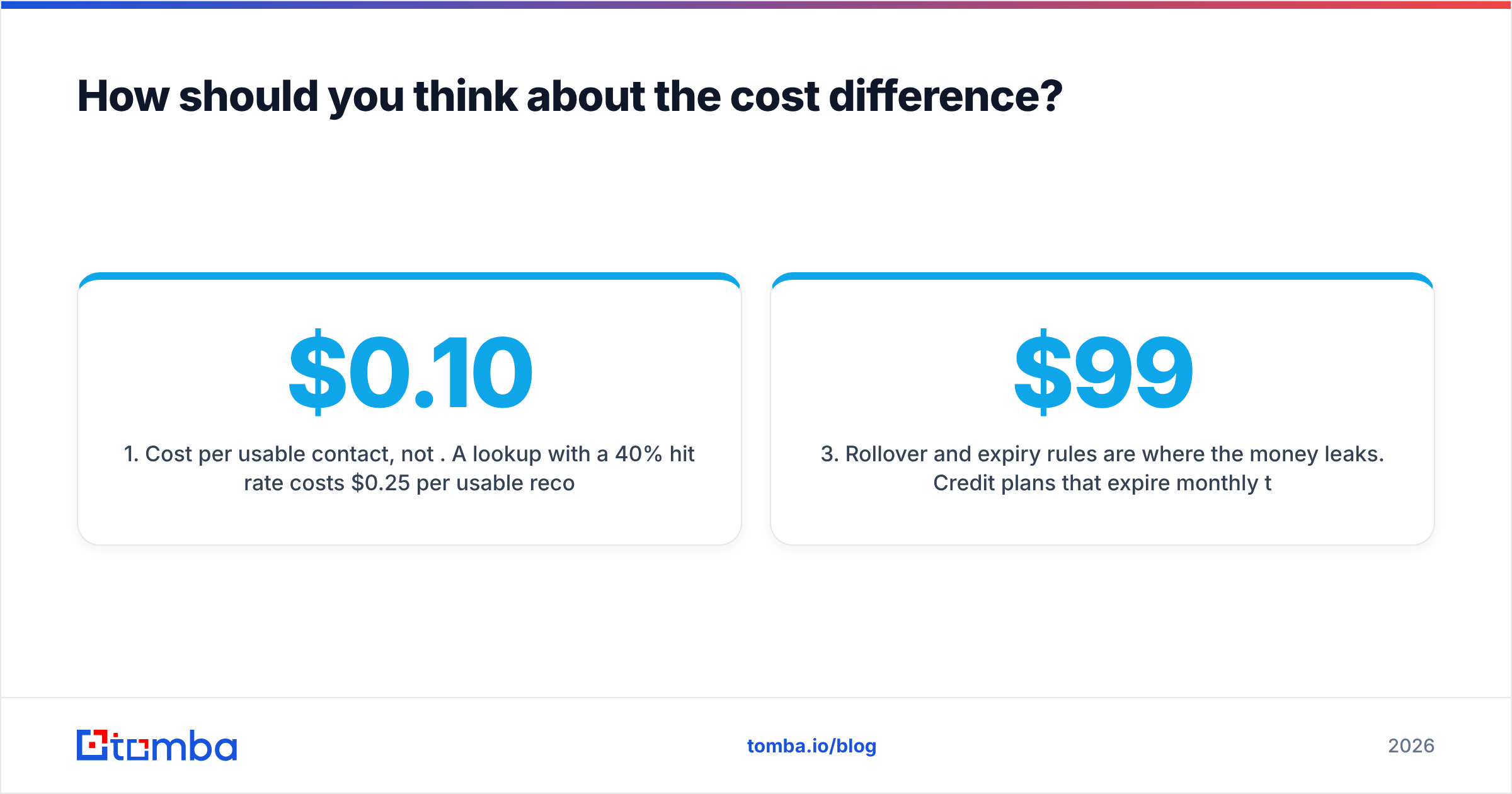
- Count cost per usable contact, not per credit. A $0.10 lookup with a 40% hit rate costs $0.25 per usable record. A $0.20 lookup at 90% costs $0.22. The cheap tool is the expensive one.
- Seats scale with headcount. Credits scale with activity. Two people doing heavy volume? Credits hurt. Ten people doing light volume? Seats hurt. Map the next twelve months, not this month.
- Rollover rules are where the money leaks. Credits that expire each month turn a $99 plan into a $99 tax on your slow week. Ask in writing whether unused credits roll over.
- Bounces are a hidden line item. Every bad address costs you sender reputation. Lost reputation then costs you replies on the good addresses. Budget for verification as part of the data cost.
- The sending tool is a separate bill. EasyLeadz gives you data and nothing else. Add your sequencer's price before you compare it to Interseller's all-in seat price.
- Check contract length and refund terms. Annual-only deals with no usage-based exit are common here. That is fine if the data works. It is brutal if it does not.
Run that list against both vendors. The "which is cheaper" question usually answers itself in twenty minutes.
EasyLeadz vs Interseller: where each tool falls short#
EasyLeadz limitations:
- No sending, no sequences, no reply tracking. It is a data layer, full stop.
- Coverage drops outside its core regions. Test your own market before you buy, not a generic sample.
- Phone data ages fast. People change numbers less often than jobs. Still, a title or company change makes the record wrong even when the number works.
- Compliance is on you. Direct-dial mobiles carry tighter rules than work emails in some countries. Know them before you dial.
Interseller limitations:
- The Greenhouse deal narrowed the audience. If you are not a recruiter, the roadmap does not include you.
- Per-seat pricing is awkward when you want data access without giving everyone a full sending license.
- Personal-email sourcing is normal in recruiting and a problem in B2B sales. Cold emailing a prospect's Gmail is a fast route to the spam folder.
- It is an all-in-one, so you inherit its sequencing whether you like it or not. Teams that already have a sender end up paying twice.

Which alternatives should you consider instead?#
Most teams comparing these two end up wanting a cleaner split: a strong data source plus a sender they already like. That opens up the field.
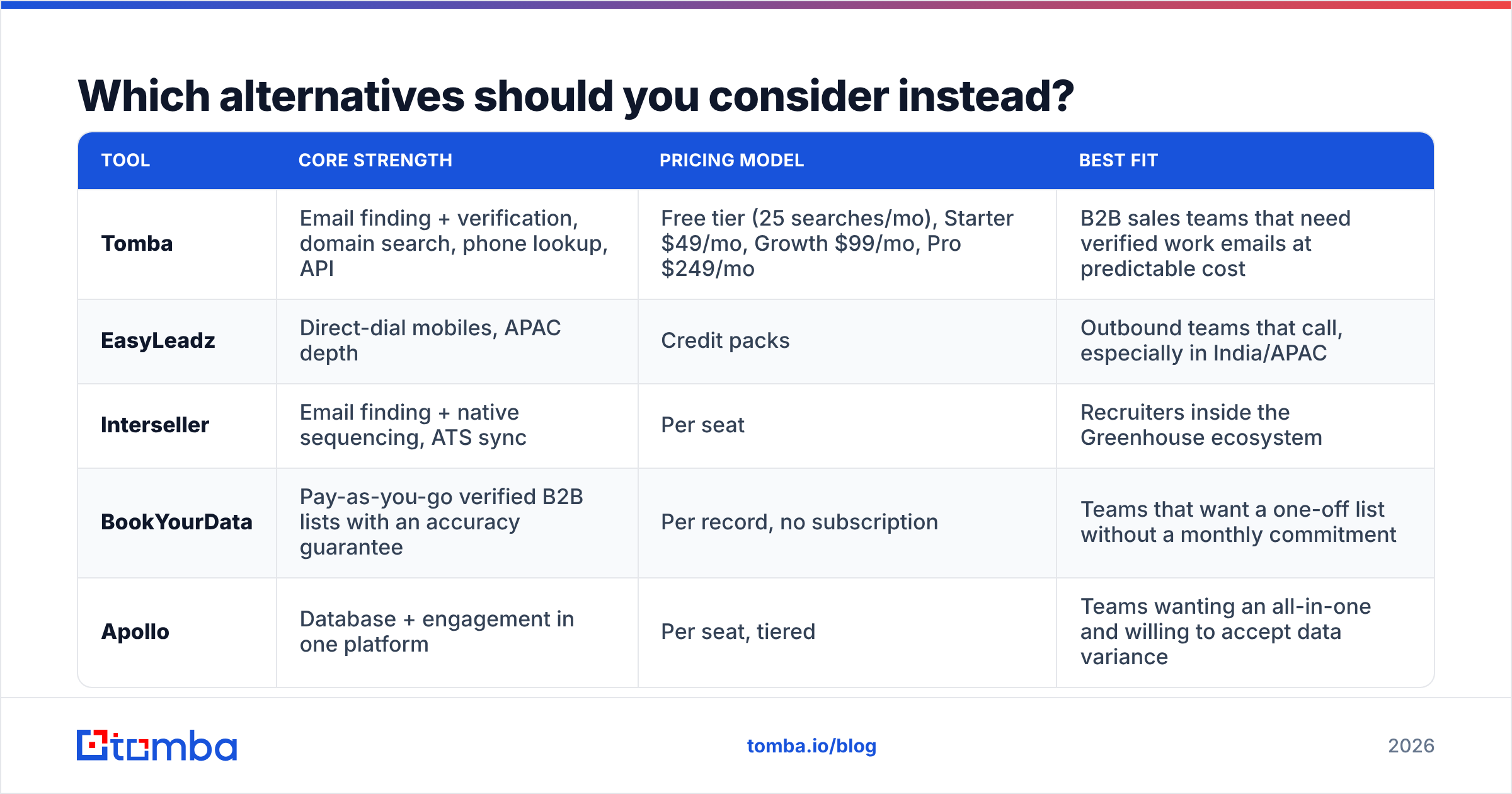
| Tool | Core strength | Pricing model | Best fit |
|---|---|---|---|
| Tomba | Email finding + verification, domain search, phone lookup, API | Free tier (25 searches/mo), Starter $49/mo, Growth $99/mo, Pro $249/mo | B2B sales teams that need verified work emails at predictable cost |
| EasyLeadz | Direct-dial mobiles, APAC depth | Credit packs | Outbound teams that call, especially in India/APAC |
| Interseller | Email finding + native sequencing, ATS sync | Per seat | Recruiters inside the Greenhouse ecosystem |
| BookYourData | Pay-as-you-go verified B2B lists with an accuracy guarantee | Per record, no subscription | Teams that want a one-off list without a monthly commitment |
| Apollo | Database + engagement in one platform | Per seat, tiered | Teams wanting an all-in-one and willing to accept data variance |
BookYourData deserves a look if your problem is "I need a clean list once, not a platform." You pay per record, with a stated accuracy guarantee. That drops the subscription-versus-usage argument entirely, which neither tool in this comparison does.
On the Tomba side, the honest pitch is narrow. Tomba is an email finder first. Give it a name and a domain, or just a domain. It returns work email addresses with a confidence score and the sources it used.
The email verifier runs on its own, so you can check lists from anywhere — including EasyLeadz or Interseller exports. There is also a phone finder for B2B numbers. If direct-dial mobiles in India are your whole business case, though, EasyLeadz has the deeper regional data, and you should test both. Tomba pricing starts free at 25 searches a month. That is enough to run the 100-contact test above at no cost.

So which should you actually pick?#
Three clean paths:
You cold call, and your market is India, Southeast Asia, or the Middle East. Buy EasyLeadz. Nothing here beats it on that job. Pair it with a separate email source and a sender you already trust. Budget for verification on the email side, because email is not what you are buying it for.
You are an agency or in-house recruiter, ideally already on Greenhouse. Interseller works as a bundle: sourcing, contact discovery, sequencing, and ATS sync in one place. Check current terms with Greenhouse first, since the standalone product's status has shifted since the deal.
You run B2B outbound sales and want verified work emails at volume. Neither tool fits. You want a finder plus a verifier, priced per credit, with an API, feeding the sender you already run. That stack costs less and is easier to swap out when a vendor's coverage slips.
The wider lesson from EasyLeadz vs Interseller: do not buy a platform to fix a data problem, and do not buy a data provider to fix a workflow problem. Most of the pain in this category starts right there.
How do you run a fair 30-minute test?#
Before any contract, do this:
- Export 100 contacts whose data you have already confirmed. Strip the emails and phones.
- Run the same 100 through each trial. Record coverage, correctness, and job-change staleness separately.
- Push every returned email through an independent verifier, so you grade the data and not the vendor's own scoring.
- Work out the cost per correct record, not per lookup.
- Only then look at features.
Teams that run this test rarely end up with the tool they walked in planning to buy. That is the point.
Ready to test the data layer on its own? Start with the free tier of Tomba's Email Finder — 25 searches a month, no card needed. That is enough to run the 100-contact test above against your real market. If the results hold up, the Starter plan is $49/month, and the Tomba API drops the same lookups into whatever sequencer or CRM you already run. Grade any vendor against your own list before you sign.
Related guides#
Ready to find emails that actually work?
Join 150,000+ professionals who stopped guessing and started sending. Free credits on signup — no credit card required.
Get the Tomba newsletter
Practical outbound tactics and product updates — once every two weeks.
About the author