EasyLeadz vs Istariai (2026): Which B2B Data Tool Wins?
EasyLeadz sells direct dials. Istari AI sells firmographic intelligence scraped from company websites. They solve different problems — and picking wrong costs you a quarter of pipeline.
easyleadz vs istariai looks like a head-to-head. It is not. EasyLeadz sells direct-dial phone numbers. Istari AI sells web-scraped company intelligence. Two different jobs, two different buyers.
TL;DR
- EasyLeadz and Istari AI are not competitors. EasyLeadz (Mr. E) sells verified direct-dial mobile numbers, mostly for India and APAC. Istari AI sells AI-derived firmographic and technographic data, scraped from company websites at national scale.
- Pick EasyLeadz if your SDRs cold-call and you need a mobile number attached to a LinkedIn profile. Pick Istari AI if you research markets and need to segment a whole economy by what companies actually do.
- Neither is a complete outbound stack. EasyLeadz is thin on email outside its phone core. Istari AI hands you no contact records at all.
- Credit models differ sharply. EasyLeadz burns a credit per revealed contact. Istari AI runs on data licensing and custom quotes.
- If you need email + phone + enrichment in one API, both leave a gap. A dedicated finder like Tomba at $49/mo covers the contact layer either one leaves open.
EasyLeadz vs Istariai: what does each tool actually do?#
They sit on opposite ends of the B2B data spectrum. Most comparison posts miss that and line them up feature for feature.
EasyLeadz is a contact-data company with one strong asset: direct-dial mobile numbers. Its flagship product, Mr. E, is a Chrome extension. It sits on a LinkedIn profile and reveals a phone number in one click.
It was built in India, and the coverage shows it. Indian and wider APAC mobile data beats what most US-centric vendors carry. Everything else — emails, company data, some intent signals — is secondary to the phone.
Istari AI is a different animal. The company is German, spun out of academic work on web mining and AI-based firm classification. It crawls company websites at scale and turns raw web text into structured variables.
Those variables describe what a firm sells, which technologies it names, whether it exports, and how digitally mature it looks. Researchers have used it for national economic mapping. Think how many German mid-market manufacturers mention machine learning, not get me Priya's mobile number.
So the honest framing of easyleadz vs istariai is not which one is better. It is simpler: do you need a person's phone, or a market's shape?

EasyLeadz vs Istariai: how do they compare head-to-head?#
Here is the practical breakdown. These are the attributes that change a buying decision.
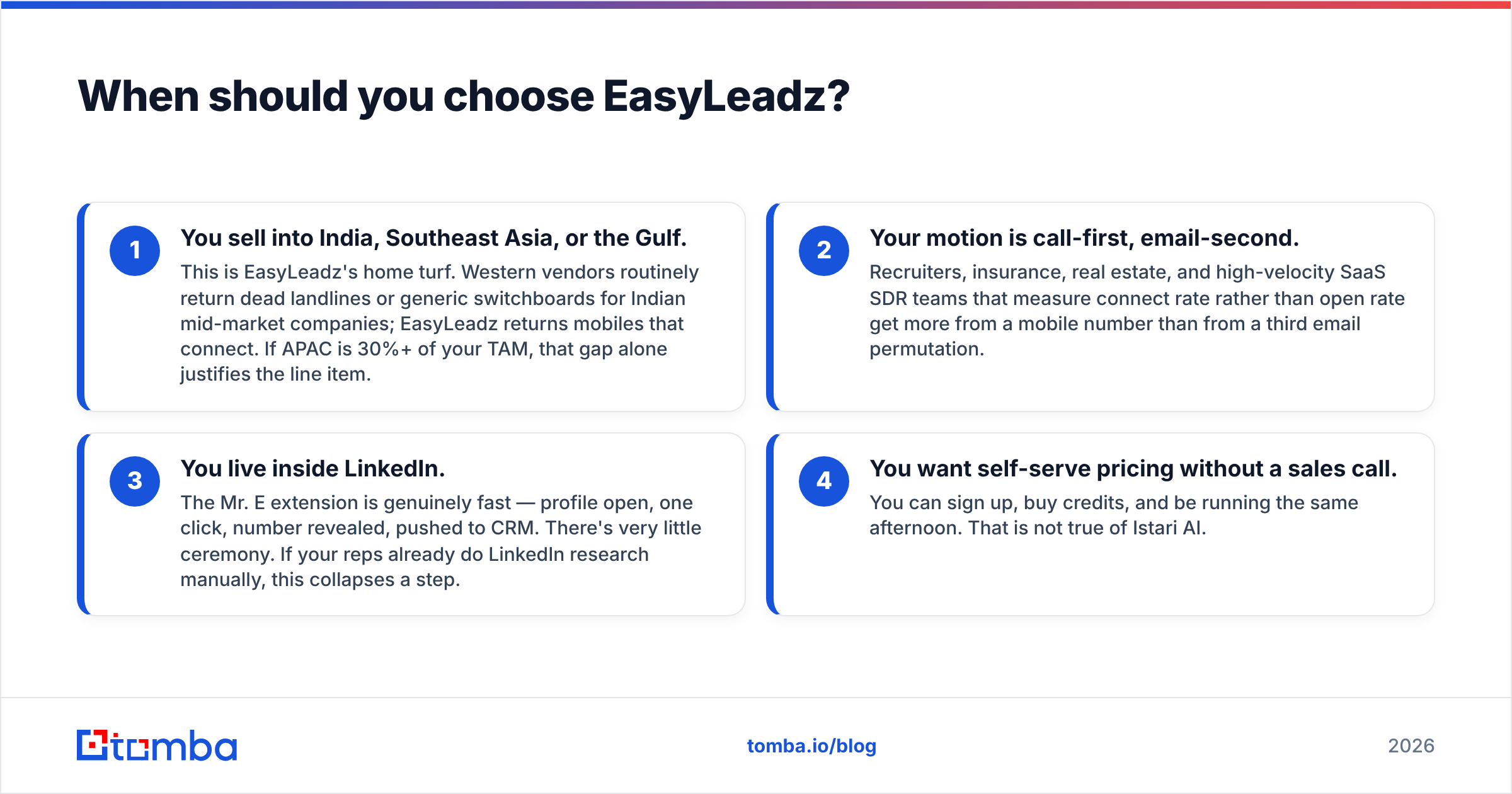
| Attribute | EasyLeadz (Mr. E) | Istari AI | Tomba |
|---|---|---|---|
| Primary data type | Direct-dial mobile numbers | Firmographic + technographic intelligence from web crawls | Professional emails + phones |
| Best geography | India, APAC, decent Middle East | DACH, EU (national coverage depth) | Global, strongest US/EU |
| Delivery | Chrome extension, dashboard, API | API, bulk datasets, custom research delivery | API, extension, Sheets/Excel, CLI, MCP |
| Contact-level records | Yes (phone-first) | No — company-level only | Yes (email-first, phone available) |
| Entry price | ~$29–$59/mo range depending on plan and region | Custom quote / enterprise licensing | Free tier (25 searches), $49/mo Starter |
| Free tier | Limited trial credits | No self-serve free tier | Yes — 25 searches/mo |
| Verification built in | Phone validation | N/A (not contact data) | SMTP-level email verification |
| Typical buyer | SDR teams, recruiters, agency prospectors | Analysts, economists, ABM/strategy, VC research | Growth, RevOps, agencies, developers |
| Learning curve | Minutes | Days (you're working with datasets, not lists) | Minutes |
The split is obvious. Does your workflow end with someone picking up the phone? Then EasyLeadz is on the shortlist and Istari AI is not. Does it end with a segmentation model or a market map? Then flip that.
When should you choose EasyLeadz?#
Choose EasyLeadz when the phone number is the deliverable.
It earns its seat when:
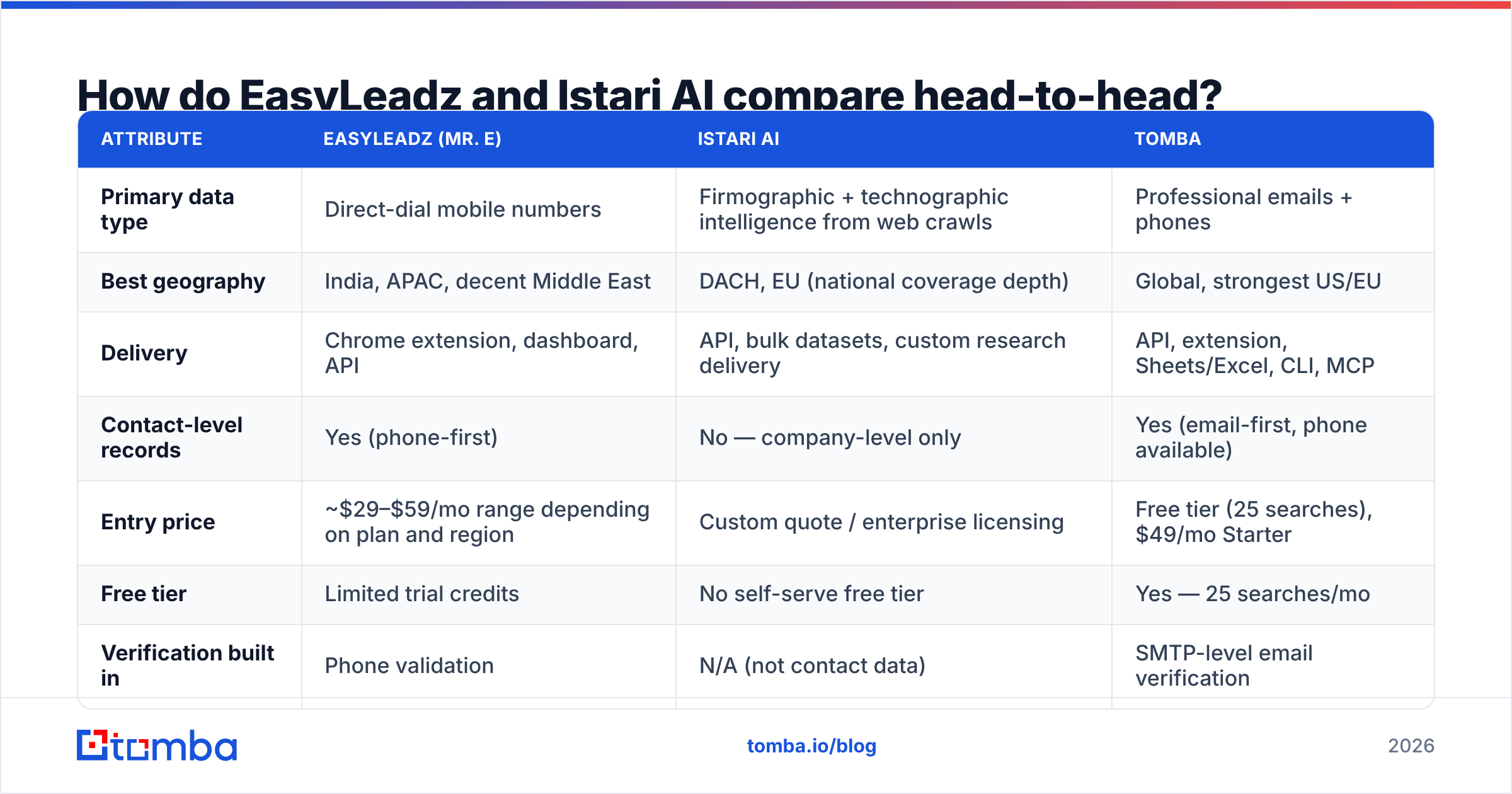
- You sell into India, Southeast Asia, or the Gulf. This is EasyLeadz's home turf. Western vendors often return dead landlines for Indian mid-market firms. EasyLeadz returns mobiles that connect. If APAC is 30%+ of your TAM, that gap alone pays for the line item.
- Your motion is call-first, email-second. Recruiters, insurance, real estate, and high-velocity SaaS teams measure connect rate, not open rate. A mobile number beats a third email guess.
- You live inside LinkedIn. The Mr. E extension is fast. Open a profile, click once, get the number, push it to your CRM. If reps already research on LinkedIn, this collapses a step.
- You want self-serve pricing without a sales call. Sign up, buy credits, and run the same afternoon. Istari AI does not work that way.
Where EasyLeadz disappoints: email coverage. Pull a list of 500 contacts and you get strong phone fill. Verified-email fill is much weaker, especially in North America and Western Europe.
Teams that run both channels usually bolt on an email verifier or a dedicated finder. Credit burn is unforgiving, too. A reveal costs a credit even when the number is dead. Audit your hit rate in month one.
When should you choose Istari AI?#
Choose Istari AI when you need to describe a market, not contact it.
These use cases are genuinely hard to replace:
- Economic and policy research. You want to know how many firms in a region use a given technology. The answer sits in what those firms publish about themselves. Traditional databases lean on self-reported SIC or NACE codes, which go stale. A crawl of the live website is current by definition.
- ABM segment definition. Say your ICP is manufacturers that mention ISO 13485 and run an English export page. No standard filter in Apollo or ZoomInfo expresses that. Derived variables do.
- VC and M&A sourcing. Find the 40 companies in a country doing one niche thing, when no commercial database tags them that way.
- Competitive and technographic mapping. See which vendor logos, SDKs, or terms appear across a defined universe of firms.
Where Istari AI disappoints: it will not fill your sequencer. There are no contact records, no email addresses, no names. You get an entity list with rich attributes, and you still need a contact layer to act on it.
Pricing is opaque as well. Expect a scoping call, a custom quote, and a procurement cycle rather than a credit card form. For a five-person startup that needs 2,000 emails this week, that is a non-starter.
Is one better than the other for cold outreach?#
For cold outreach, EasyLeadz wins on directness. Istari AI wins on targeting. Neither closes the loop alone.
Here is the sequence most sophisticated teams end up running:
- Define the universe. That is Istari AI's job, or a lighter filter if your ICP is simple.
- Resolve companies to domains. A domain search pass handles this.
- Find the humans. Decision-maker names and verified work emails.
- Add the phone where the motion is call-first. That is EasyLeadz's job, especially in APAC.
- Verify before send. Catch-alls, role accounts, and stale mailboxes wreck email deliverability. Your copy is rarely the problem.
Step 3 is the gap. Istari AI does not do it at all. EasyLeadz does it as a side feature. That is the structural reason so many teams weighing easyleadz vs istariai buy one of them plus a dedicated email finder.

What do the pricing models actually cost you?#
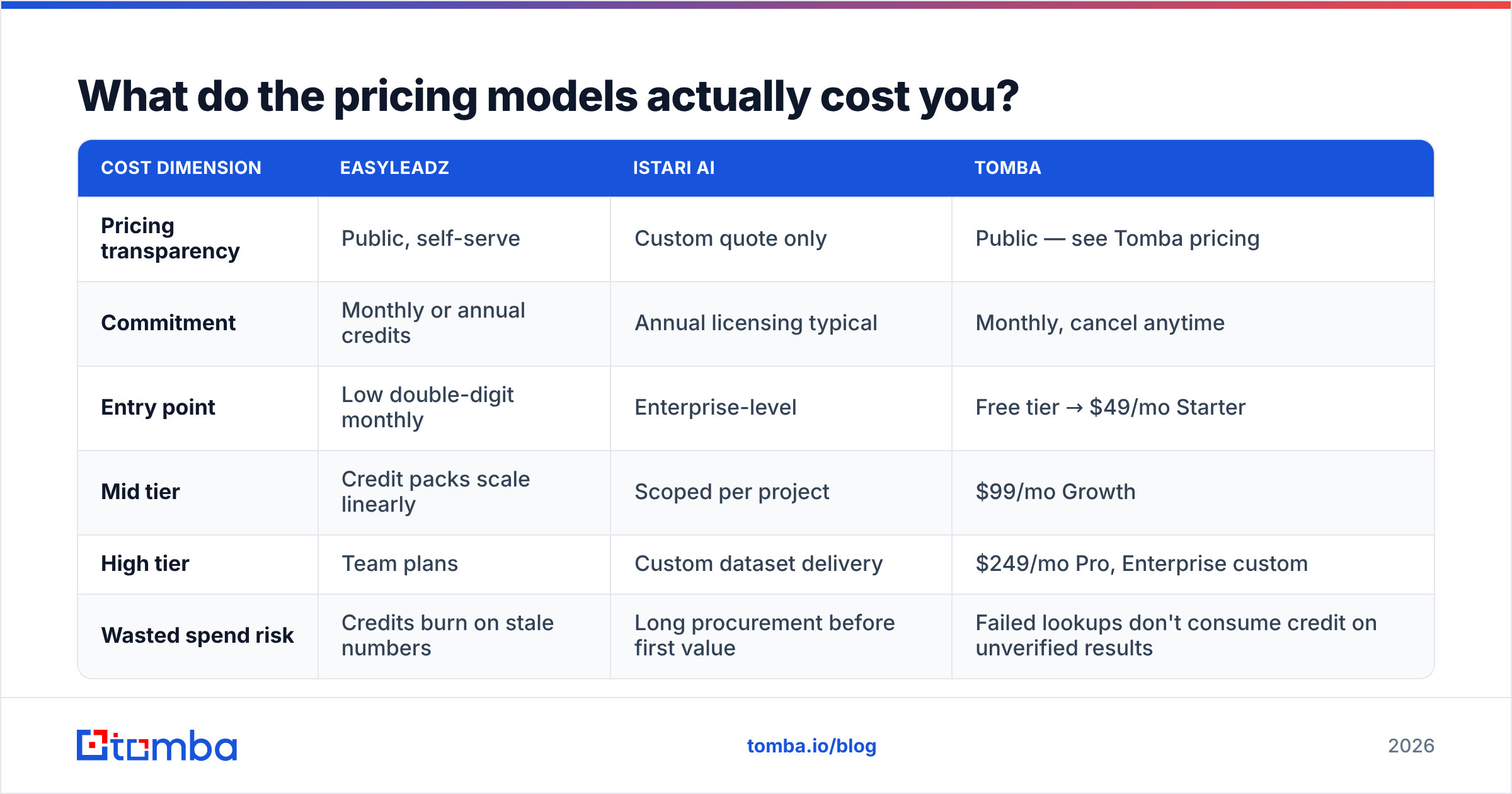
| Cost dimension | EasyLeadz | Istari AI | Tomba |
|---|---|---|---|
| Pricing transparency | Public, self-serve | Custom quote only | Public — see Tomba pricing |
| Commitment | Monthly or annual credits | Annual licensing typical | Monthly, cancel anytime |
| Entry point | Low double-digit monthly | Enterprise-level | Free tier → $49/mo Starter |
| Mid tier | Credit packs scale linearly | Scoped per project | $99/mo Growth |
| High tier | Team plans | Custom dataset delivery | $249/mo Pro, Enterprise custom |
| Wasted spend risk | Credits burn on stale numbers | Long procurement before first value | Failed lookups don't consume credit on unverified results |
The failure mode differs by vendor. With EasyLeadz you overspend in small increments — a few hundred wasted credits a month on numbers that ring out.
With Istari AI you overspend once, in a big way. You license a dataset for a year, then find it answers a question your GTM team was not asking. Pilot both narrowly.
Worth noting: some rivals handle the buy-a-list job differently again. BookYourData sells pay-as-you-go verified B2B lists with a per-record accuracy guarantee. It is a reasonable middle path if you want a clean list without a credit meter or a procurement cycle.
What are the realistic alternatives to both?#
These two tools cover different jobs, so the alternative set splits too.
If you're evaluating EasyLeadz (contact data):
- Tomba — email-first with a phone finder alongside, transparent pricing, strong API and integrations.
- Apollo.io — bigger all-in-one, weaker per-record accuracy at scale. See Apollo alternatives for the trade-offs.
- RocketReach / ContactOut — solid LinkedIn-adjacent coverage in North America, thinner in APAC. RocketReach alternative.
- Lusha — clean UX, aggressive credit pricing, decent EU coverage.
If you're evaluating Istari AI (market intelligence):
- Vainu — firmographic and signal data with Nordic and EU depth. Vainu alternative.
- Clearbit (now part of HubSpot) — enrichment-first, weaker on derived attributes. See HubSpot's data offering.
- 6sense / Demandbase — intent-led ABM rather than descriptive firmography.
- Public statistical registers — free, slow, and years behind the live web. Still useful as a cross-check.
Independent review sites are worth a look before you commit. Check current user reviews on G2 and Capterra. Read the vendor docs too — easyleadz.com and istari.ai — rather than trusting any single comparison post, including this one.
How should you run the evaluation?#
Do not take the demo. Test against a list where you already know the answers.
- Build a 100-record truth set. Pick companies and people where you already have a confirmed phone or email. Run both tools against it blind.
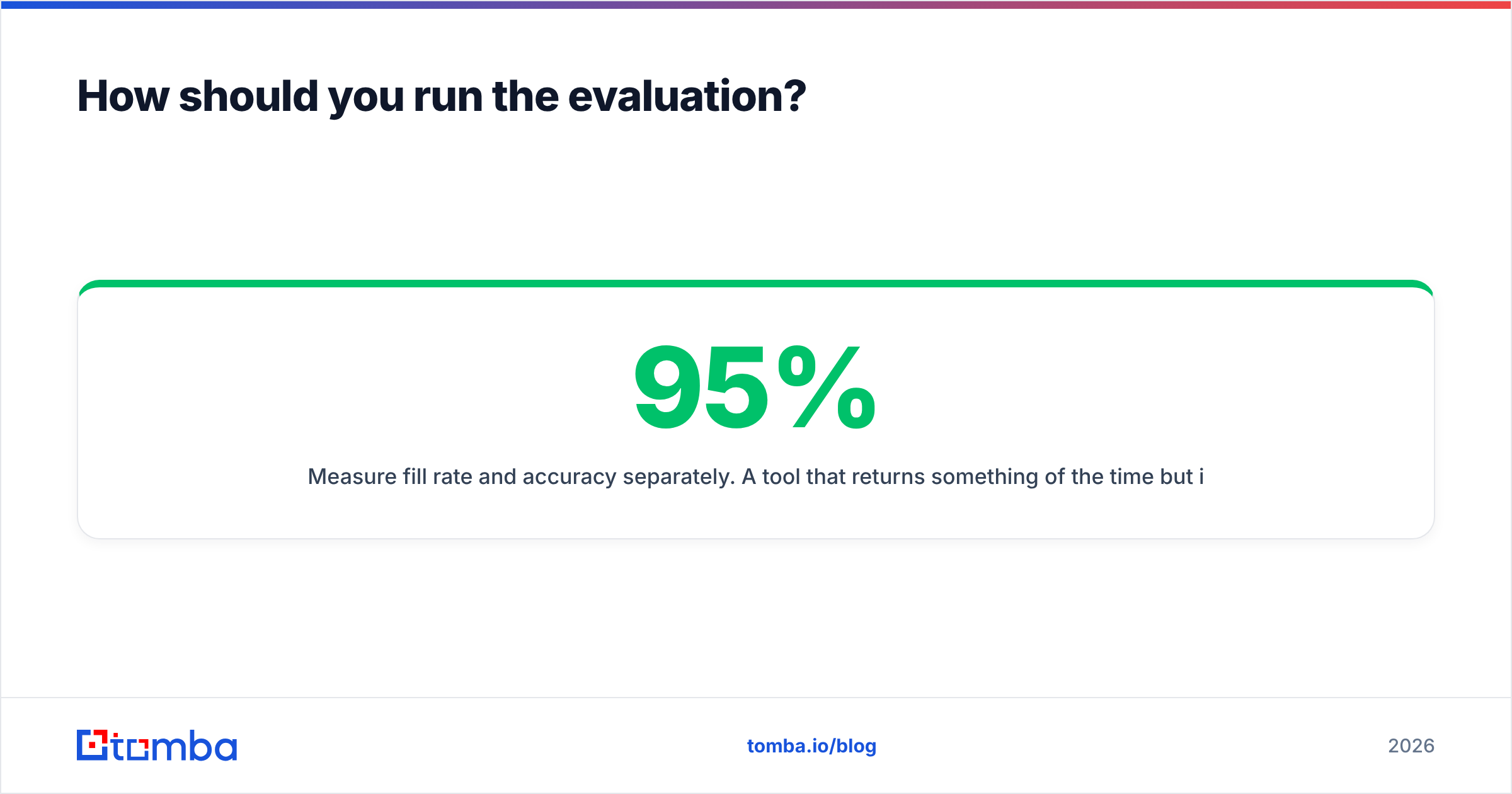
- Measure fill rate and accuracy separately. A tool that answers 95% of the time but is right 60% of the time is worse than one that answers 70% and is right 95%. Bounce rate and connect rate are the metrics that matter.
- Test your actual geography. EasyLeadz's India strength means nothing if you sell to Ohio. Test the segment you will really work.
- Check the integration path early. Whatever you buy has to reach your CRM. Confirm native support or a Zapier integration path before signing.
- Price the full stack, not the tool. EasyLeadz may need an email finder next to it. Istari AI may need a contact layer under it. That combined number is your real cost.
EasyLeadz vs Istariai: which should you pick?#
Buy EasyLeadz if you are an SDR or recruiting team calling into India and APAC. You want self-serve pricing, and the phone number is the thing that unblocks your day. Budget for a separate email source.
Buy Istari AI if you do research-grade market mapping. Your questions cannot be expressed as filters in a standard sales database, and you have the budget and timeline for an enterprise data engagement. Budget for a separate contact source.
Buy neither — at least not first — if what you need is verified work emails at volume with a clean API. That is a different product category from both. It is also the layer most teams underinvest in until their domain reputation takes the hit.
If the contact layer is your real gap, start with the Tomba Email Finder. The free tier gives you 25 searches a month with no card, and Starter is $49/mo. Every result runs through SMTP-level verification first, so you learn an address is bad before your sequencer does. Pair it with whichever side of easyleadz vs istariai fits your motion, and each piece of the stack does the job it is actually good at.
Related guides#
Ready to find emails that actually work?
Join 150,000+ professionals who stopped guessing and started sending. Free credits on signup — no credit card required.
Get the Tomba newsletter
Practical outbound tactics and product updates — once every two weeks.
About the author