EasyLeadz vs LeadIQ (2026): Which B2B Data Tool Wins?
EasyLeadz sells direct mobile numbers. LeadIQ sells a CRM-connected prospecting workflow. Here is how the two compare on coverage, credits, pricing, and the hidden costs neither vendor puts on its pricing page.
TL;DR
- EasyLeadz (the company behind the Mr. E extension) is built around direct mobile numbers, with its deepest coverage in India and the wider APAC region. Credits are cheap, the product is thin.
- LeadIQ is built around workflow: capture a prospect from LinkedIn, enrich it, and push it into Salesforce, HubSpot, Outreach, or Salesloft in one click. It costs more and is priced per seat.
- If your reps live on the phone in APAC, EasyLeadz usually wins on cost-per-connected-call. If your reps live in the CRM and run multichannel sequences in North America and EMEA, LeadIQ wins on time saved.
- Neither is a strong email verification layer. Both expect you to trust their status labels, and both charge you again when a bounced address burns a credit.
- The cheapest path for most teams in 2026 is a split stack: one provider for phone data, one accuracy-first email finder with pay-per-valid pricing, and a verifier in front of your sending tool.
What are EasyLeadz and LeadIQ, exactly?#
They get lumped into the same G2 category, but they solve different halves of the prospecting problem.
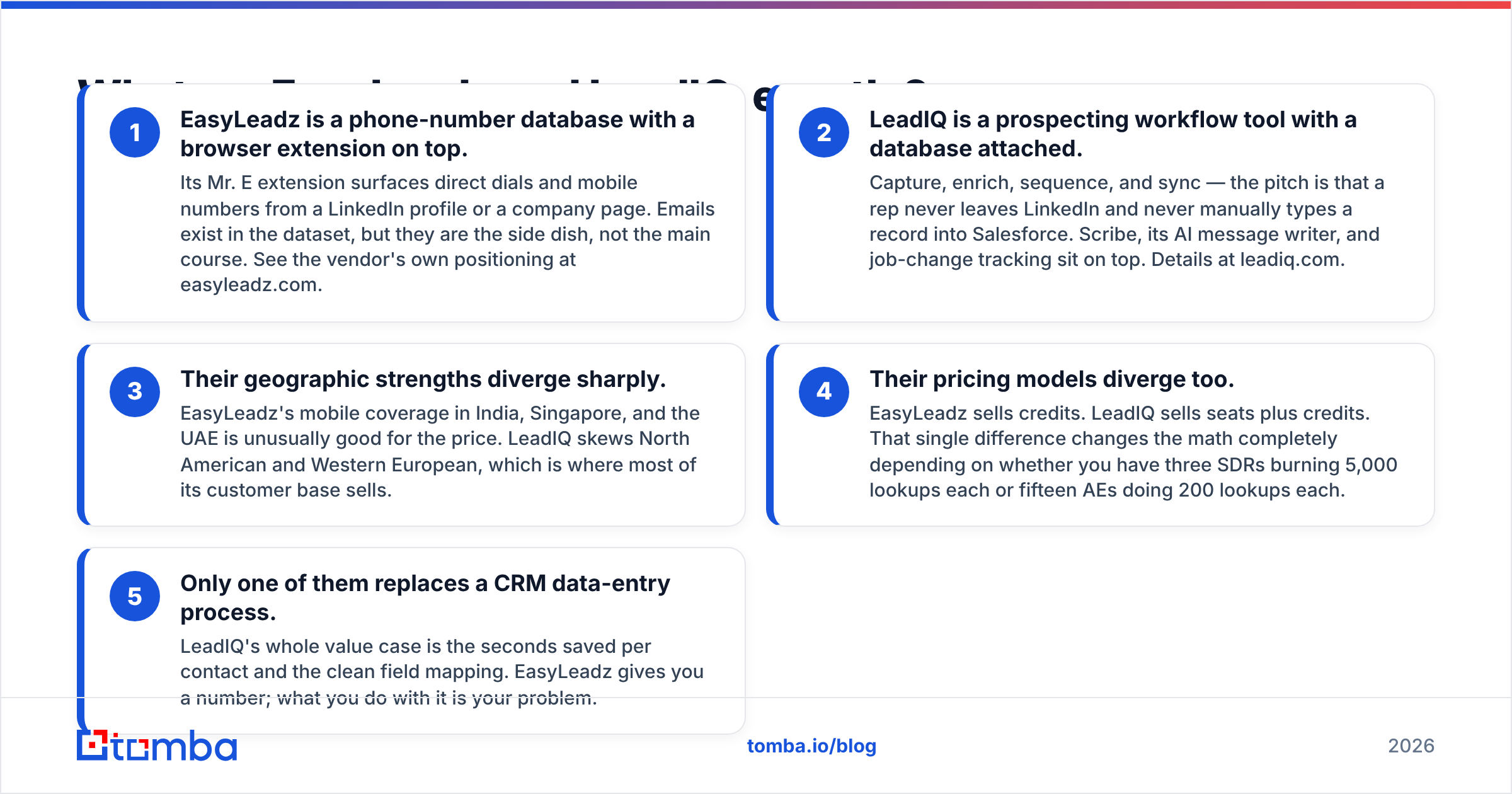
EasyLeadz is a phone-number database with a browser extension on top. Its Mr. E extension surfaces direct dials and mobile numbers from a LinkedIn profile or a company page. Emails exist in the dataset, but they are the side dish, not the main course. See the vendor's own positioning at easyleadz.com.
LeadIQ is a prospecting workflow tool with a database attached. Capture, enrich, sequence, and sync — the pitch is that a rep never leaves LinkedIn and never manually types a record into Salesforce. Scribe, its AI message writer, and job-change tracking sit on top. Details at leadiq.com.
Their geographic strengths diverge sharply. EasyLeadz's mobile coverage in India, Singapore, and the UAE is unusually good for the price. LeadIQ skews North American and Western European, which is where most of its customer base sells.
Their pricing models diverge too. EasyLeadz sells credits. LeadIQ sells seats plus credits. That single difference changes the math completely depending on whether you have three SDRs burning 5,000 lookups each or fifteen AEs doing 200 lookups each.
Only one of them replaces a CRM data-entry process. LeadIQ's whole value case is the seconds saved per contact and the clean field mapping. EasyLeadz gives you a number; what you do with it is your problem.
The practical question is not "which tool is better." It is "which half of the problem is currently costing you more."

How do EasyLeadz and LeadIQ compare feature by feature?#
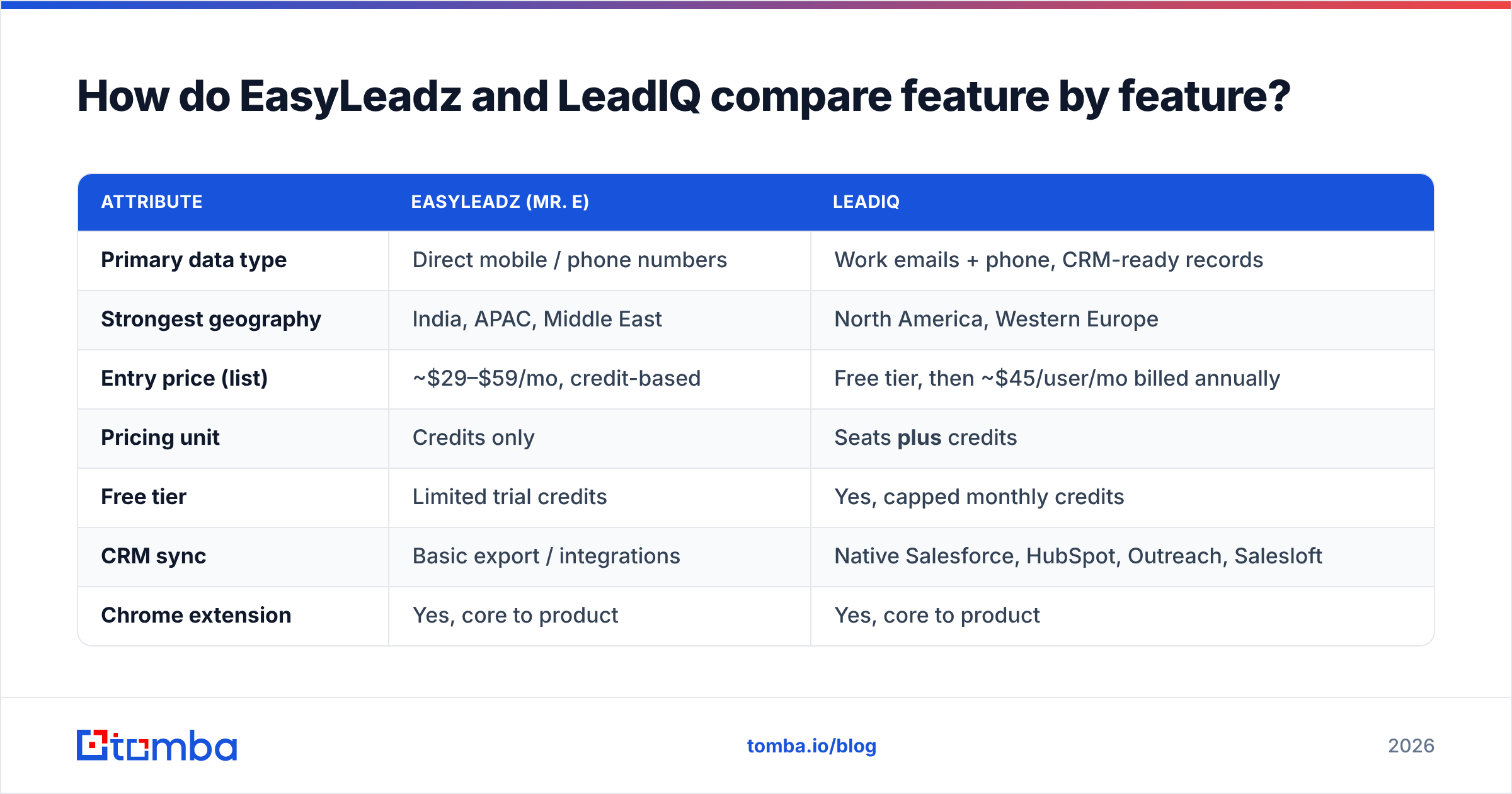
Here is the head-to-head on the attributes that actually change a buying decision. Verify current numbers on each vendor's pricing page before you sign anything — both have repriced within the last 18 months.
| Attribute | EasyLeadz (Mr. E) | LeadIQ |
|---|---|---|
| Primary data type | Direct mobile / phone numbers | Work emails + phone, CRM-ready records |
| Strongest geography | India, APAC, Middle East | North America, Western Europe |
| Entry price (list) | ~$29–$59/mo, credit-based | Free tier, then ~$45/user/mo billed annually |
| Pricing unit | Credits only | Seats plus credits |
| Free tier | Limited trial credits | Yes, capped monthly credits |
| CRM sync | Basic export / integrations | Native Salesforce, HubSpot, Outreach, Salesloft |
| Chrome extension | Yes, core to product | Yes, core to product |
| Email verification | Minimal, status flags only | Basic validity signals |
| AI message writing | No | Yes (Scribe) |
| Job-change tracking | No | Yes |
| API access | Yes, on higher tiers | Yes, enterprise-oriented |
| Best for | Phone-heavy outbound in APAC | Multichannel SDR teams in the CRM |
Read that table twice before you look at the price columns. A tool that is $30 cheaper per month but delivers a 40% connect rate instead of a 65% connect rate is not cheaper — it is more expensive per meeting booked, which is the only unit that matters.

Which one is more accurate?#
Neither vendor publishes an audited accuracy figure, so treat every number on either homepage as marketing until you test it on your own list.
What holds up across user reviews on G2 and in the tests we have seen run:
- EasyLeadz mobile numbers in India are genuinely strong — reps report connect rates that competitors with 10x the funding do not match in that region. Outside APAC, coverage drops noticeably.
- LeadIQ email accuracy in North America is solid but not exceptional. The common complaint is not that emails are wrong, it is that coverage gaps force reps to fall back to a second tool.
- Both tools return "valid" for catch-all domains more often than they should. A catch-all server accepts everything at the SMTP handshake, so a provider that does not run a dedicated pattern-and-signal check will happily label a guess as deliverable. That is where bounce rates come from, and neither tool refunds the credit.
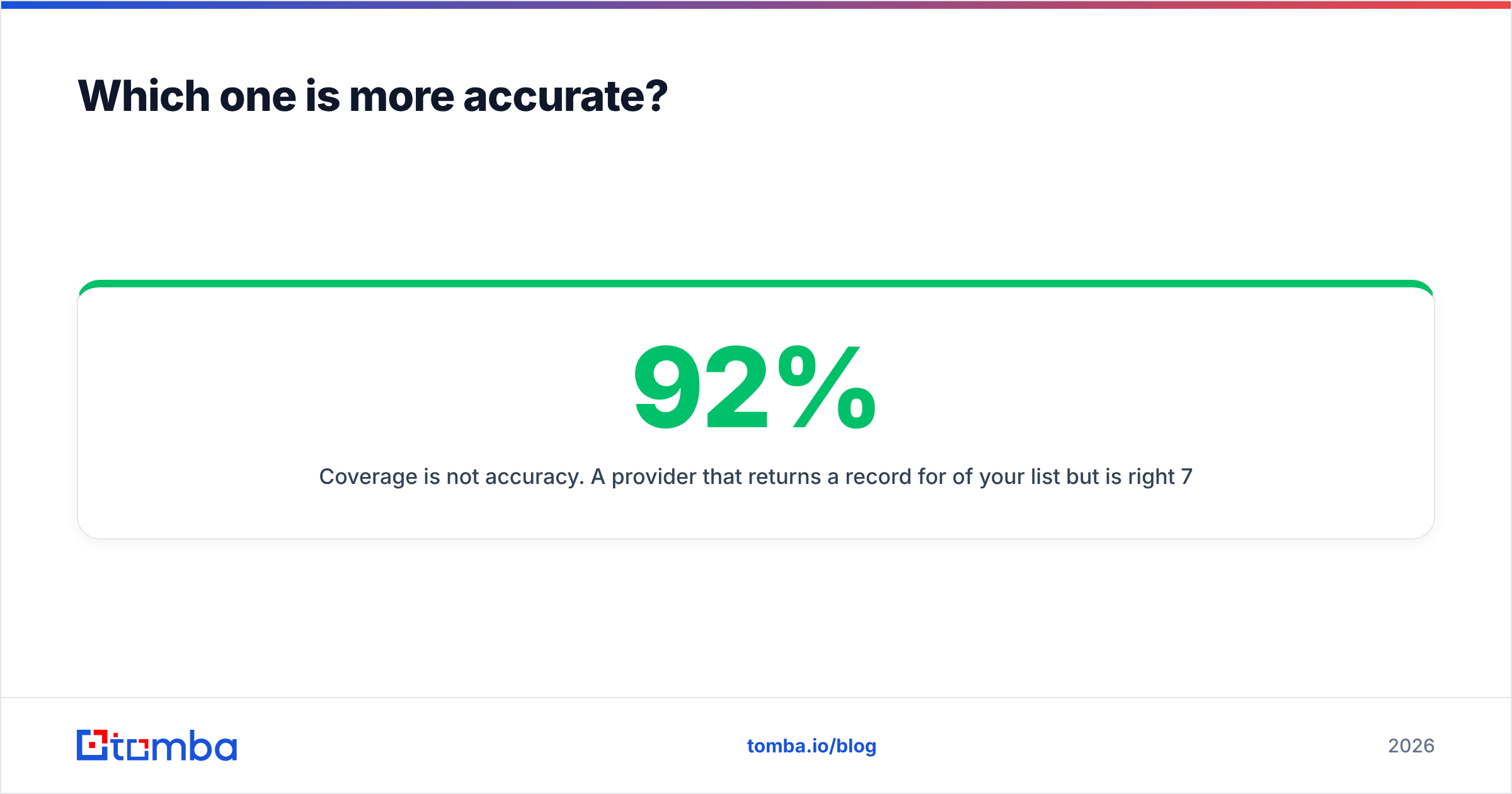
- Coverage is not accuracy. A provider that returns a record for 92% of your list but is right 70% of the time is worse than one that returns 68% and is right 96%. Measure both, separately.
The fix is boring but works: run every export through an independent email verifier before it touches your sending tool, and use a catch-all verifier for the domains that come back ambiguous. That step alone typically cuts bounce rate by more than any provider swap.
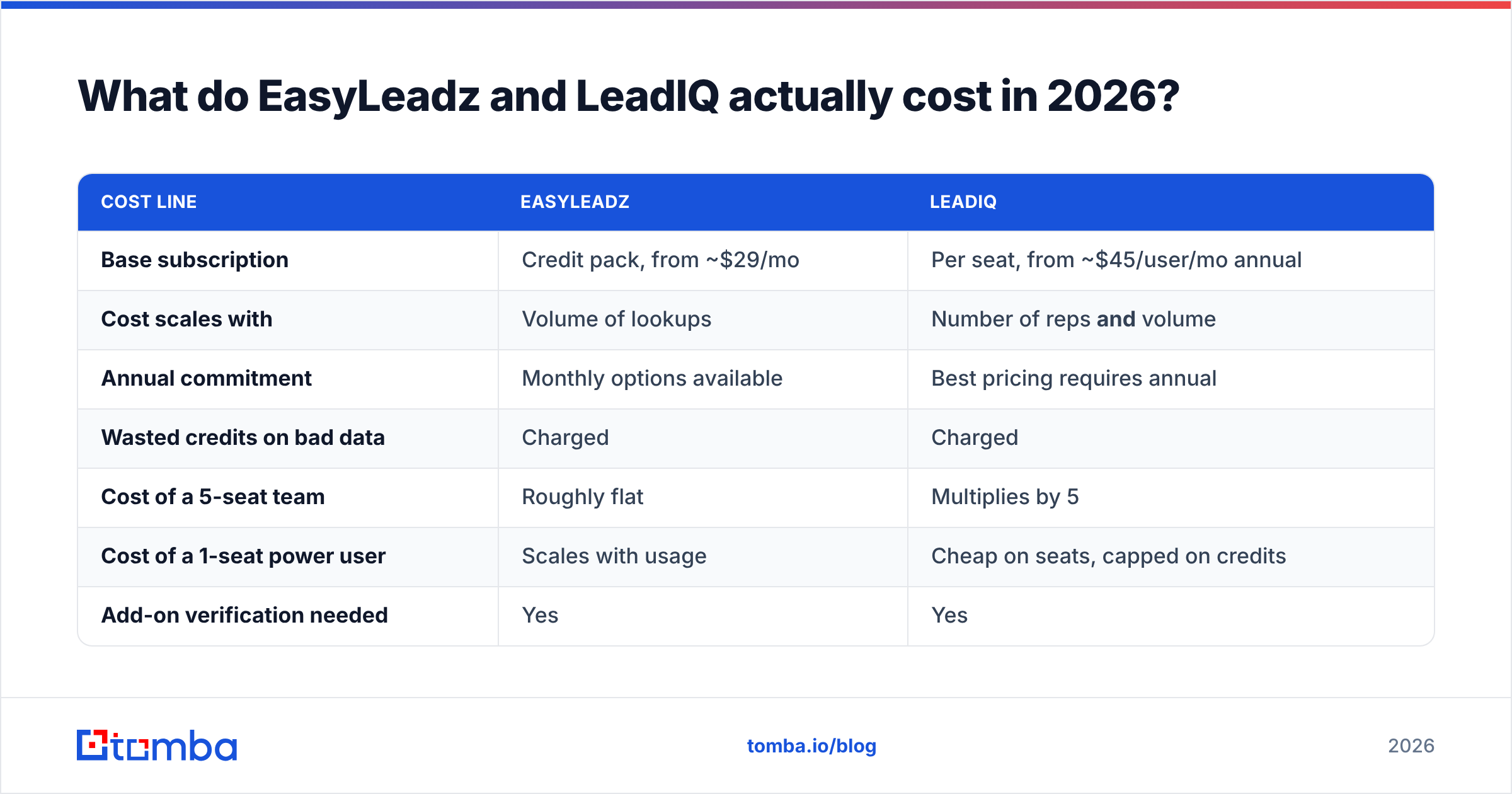
What do EasyLeadz and LeadIQ actually cost in 2026?#
List price is the first number you see and the least useful one. Here is the total-cost view.
| Cost line | EasyLeadz | LeadIQ |
|---|---|---|
| Base subscription | Credit pack, from ~$29/mo | Per seat, from ~$45/user/mo annual |
| Cost scales with | Volume of lookups | Number of reps and volume |
| Annual commitment | Monthly options available | Best pricing requires annual |
| Wasted credits on bad data | Charged | Charged |
| Cost of a 5-seat team | Roughly flat | Multiplies by 5 |
| Cost of a 1-seat power user | Scales with usage | Cheap on seats, capped on credits |
| Add-on verification needed | Yes | Yes |
The structural trap is different on each side. With EasyLeadz, you can burn a credit pack fast on a large list and discover that half the returns were landline switchboards. With LeadIQ, you pay for seats that go dormant — the AE who logs in twice a quarter still costs you a full license, and annual billing means you cannot trim mid-year.
For comparison, transparent flat-rate options exist. Tomba pricing runs a free tier at 25 searches/month, Starter at $49/mo, Growth at $99/mo, and Pro at $249/mo — no per-seat multiplier, so adding a rep does not re-trigger the whole invoice. BookYourData takes a different and equally honest route with pay-as-you-go credits and a bounce guarantee, which suits teams that buy in bursts rather than monthly.
Which tool should you pick for your team?#

Match the tool to the motion, not to the feature list.
Pick EasyLeadz if:
- Your ICP sits in India, Southeast Asia, or the Gulf.
- Cold calling is your primary channel and email is secondary.
- You have one or two researchers pulling lists for a larger calling team — credit pricing rewards that shape.
- Budget is genuinely tight and you can live without CRM automation.
Pick LeadIQ if:
- Your reps run LinkedIn-plus-email sequences and already live in Outreach or Salesloft.
- Manual CRM entry is eating real hours every week — that is the cost LeadIQ actually removes.
- You sell into North America or Western Europe.
- Job-change alerts matter to your motion (they matter a lot in expansion-led SaaS).
Pick neither, or supplement both, if:
- Email is your primary channel. Both are compromises there.
- You need programmatic enrichment inside your own product or data pipeline — that is an API job, and neither tool's API is the reason people buy it.
- You are enriching more than a few thousand records a month and need predictable cost per valid record.

Where do both tools disappoint?#
Every honest comparison needs this section, because vendor pages never have one.
- Credit burn on failures. Both charge for lookups that return nothing usable. Over a quarter this is the single largest hidden line item.
- Refresh cadence is opaque. Neither tells you when a specific record was last verified. A mobile number from 2022 looks identical to one confirmed last week in the export.
- Compliance homework is yours. If you are calling or emailing EU or UK contacts, GDPR legitimate-interest documentation, suppression lists, and DNC checks are your responsibility regardless of which vendor you use. Read the guidance on data handling in HubSpot's compliance resources before you scale.
- Extension-first workflows do not scale to bulk. Both shine on one-off LinkedIn lookups and struggle when you need 10,000 records enriched overnight. That is a bulk email finder job.
- Support tiers differ wildly. Enterprise plans get responsive help; entry plans get a ticket queue. Ask about SLA in the demo, not after the invoice.
How do you run a fair 14-day bake-off?#
Do not decide from review sites. Run this, it takes an afternoon of setup.
- Build one golden list of 200 contacts from your real ICP — same names, same companies, same seniority mix. No cherry-picking easy targets.
- Run the identical list through both tools. Record match rate (how many returned anything) and field completeness (email, mobile, direct dial) separately.
- Verify every returned email independently. Use a neutral third-party checker so the provider is not grading its own homework. Log hard bounces, soft bounces, and catch-alls as three distinct buckets.
- Dial 50 mobile numbers from each provider. Log connected / wrong person / dead line. This is the only test that separates EasyLeadz's core claim from marketing.
- Time the workflow. Stopwatch how long a rep takes to get 20 contacts from LinkedIn into your CRM with each tool. LeadIQ's whole value case lives or dies here.
- Divide total cost by validated, usable records. Not by credits. Not by seats. By records you could actually contact.
Whichever tool wins that spreadsheet wins your budget. In practice, teams often find the answer is "both, for different fields" — phone from one provider, email from another, verification from a third.
What about a simpler stack?#
If the bake-off shows you are paying twice for overlapping coverage, the consolidation move is usually to keep the phone specialist and replace the email side with something accuracy-first and API-driven.
That is where a dedicated finder earns its keep: domain search to map an entire company's addressable contacts in one call, pattern detection to handle the formats a database has never seen, and a verification layer that flags catch-alls instead of guessing. If you are evaluating the workflow side specifically, the breakdown of LeadIQ alternatives covers where each option actually differs rather than repeating feature checklists.
The point is not to buy more tools. It is to stop paying premium seat pricing for a data field you could get more accurately and more cheaply somewhere else.
The verdict#
EasyLeadz vs LeadIQ comes down to one question: are you buying phone numbers or buying back rep hours? EasyLeadz is the better value for APAC-focused calling teams who need direct mobiles and nothing else. LeadIQ is the better value for CRM-native SDR teams in North America and Europe where the real cost is manual data entry, not the data itself. Neither is a complete answer for email-led outbound, and neither should be trusted as your only verification step.
Test both on the same 200 contacts, verify every result independently, and let cost-per-usable-record settle it.
Ready to fix the email side of your stack? The Tomba Email Finder finds professional addresses by domain, name, or company, flags catch-all domains instead of guessing at them, and runs from a Chrome extension, Google Sheets, or the API — with no per-seat pricing to inflate the bill as your team grows. Start on the free tier with 25 searches a month, run it against the same golden list you used for your EasyLeadz and LeadIQ trial, and compare the bounce rates yourself.
Related guides#
Ready to find emails that actually work?
Join 150,000+ professionals who stopped guessing and started sending. Free credits on signup — no credit card required.
Get the Tomba newsletter
Practical outbound tactics and product updates — once every two weeks.
About the author