EasyLeadz vs LeadRocks 2026: Which B2B Data Tool Wins?
EasyLeadz sells mobile numbers, LeadRocks sells a lifetime-deal contact database. They solve different problems badly if you pick wrong. Here's the honest breakdown and our pick.
TL;DR
- EasyLeadz is a phone-number tool first. Its Chrome extension pulls direct mobile numbers off LinkedIn profiles. Email is a secondary output, and coverage outside India and APAC drops off fast.
- LeadRocks is a static database play. You buy access (often via a lifetime deal), search a pre-scraped set of ~100M+ contacts, and export. No real-time verification at the moment of export.
- They are not really competitors. One is a per-lookup enrichment tool, the other is a bulk list source. Choosing between them means choosing between call-first and email-first outbound.
- Both leak money on unusable records. Static databases decay ~25-30% a year, and mobile-number tools charge you for a lookup whether or not the number connects.
- If your motion is email-led, a verification-first email finder like Tomba costs less per usable contact than either — $49/mo for Starter versus paying twice for records you then have to clean.
What are EasyLeadz and LeadRocks, exactly?#
EasyLeadz (easyleadz.com) built its reputation on one thing: the "Mr. E" Chrome extension that surfaces direct dial mobile numbers from a LinkedIn profile in about a second. It's a per-contact enrichment tool. You browse, you click, you burn a credit, you get a number (or you don't).
LeadRocks (leadrocks.io) is the opposite architecture. It's a searchable database — roughly 100M+ B2B contact records with emails, phone numbers, job titles, and company data — that you filter and export in bulk. It got wide distribution through AppSumo lifetime deals, which is why you see it recommended in "cheap prospecting stack" threads far more often than its market share would suggest.
That difference matters more than any feature checklist. EasyLeadz answers "what's this specific person's number?" LeadRocks answers "give me 3,000 marketing directors at SaaS companies in Germany." If you compare them head-to-head on price per credit, you'll pick the wrong one.

How do EasyLeadz and LeadRocks compare on paper?#
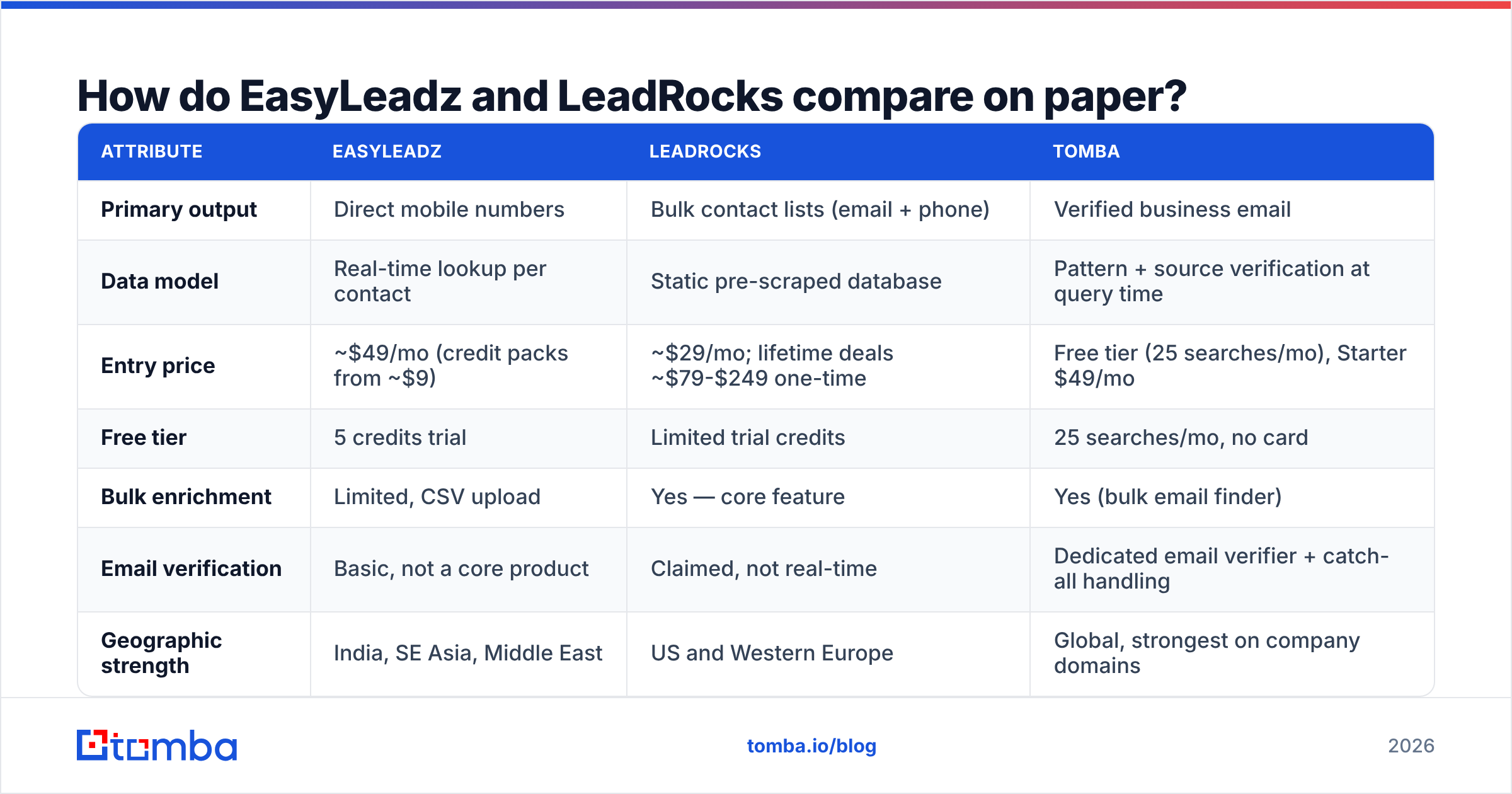
Here's the practical comparison. Pricing reflects publicly listed plans as of mid-2026 — always confirm on the vendor's own page before you buy, since both change tiers frequently.
| Attribute | EasyLeadz | LeadRocks | Tomba |
|---|---|---|---|
| Primary output | Direct mobile numbers | Bulk contact lists (email + phone) | Verified business email |
| Data model | Real-time lookup per contact | Static pre-scraped database | Pattern + source verification at query time |
| Entry price | ~$49/mo (credit packs from ~$9) | ~$29/mo; lifetime deals ~$79-$249 one-time | Free tier (25 searches/mo), Starter $49/mo |
| Free tier | 5 credits trial | Limited trial credits | 25 searches/mo, no card |
| Bulk enrichment | Limited, CSV upload | Yes — core feature | Yes (bulk email finder) |
| Email verification | Basic, not a core product | Claimed, not real-time | Dedicated email verifier + catch-all handling |
| Geographic strength | India, SE Asia, Middle East | US and Western Europe | Global, strongest on company domains |
| API | Yes | Limited / higher tiers | Yes — full Tomba API, CLI, MCP |
| Best for | Call-first SDR teams | Cheap list building on a budget | Email-led outbound at scale |
The rows that decide the purchase are data model and geographic strength. Everything else is noise.
Is EasyLeadz worth it for phone numbers?#
If you run a call-first motion and your ICP sits in India, Southeast Asia, or the Gulf, EasyLeadz is genuinely hard to beat. Mobile coverage in those regions is where most Western data vendors fall apart — ZoomInfo and Apollo have thin direct-dial coverage outside North America, and EasyLeadz was built from local sources.
Three things to know before you commit:
- Credits burn on attempts, not successes. Different vendors handle this differently. Check the current policy at signup — a 40% hit rate on a credit pack that charges for misses is effectively 2.5x the sticker price.
- Number type is not always labeled clearly. A "direct dial" that turns out to be a company switchboard costs your SDR three minutes of navigation. Sample 50 records before scaling.
- Email is not the strength. If you need email at volume, you're using a phone tool as an email tool, and the economics get bad quickly. Pair it with a dedicated email finder instead of forcing one tool to do both.
The honest verdict: EasyLeadz is a specialist. Specialists are excellent inside their lane and mediocre outside it. Don't buy it as your primary data source unless calling is genuinely your primary channel.
Is LeadRocks good value, or just cheap?#
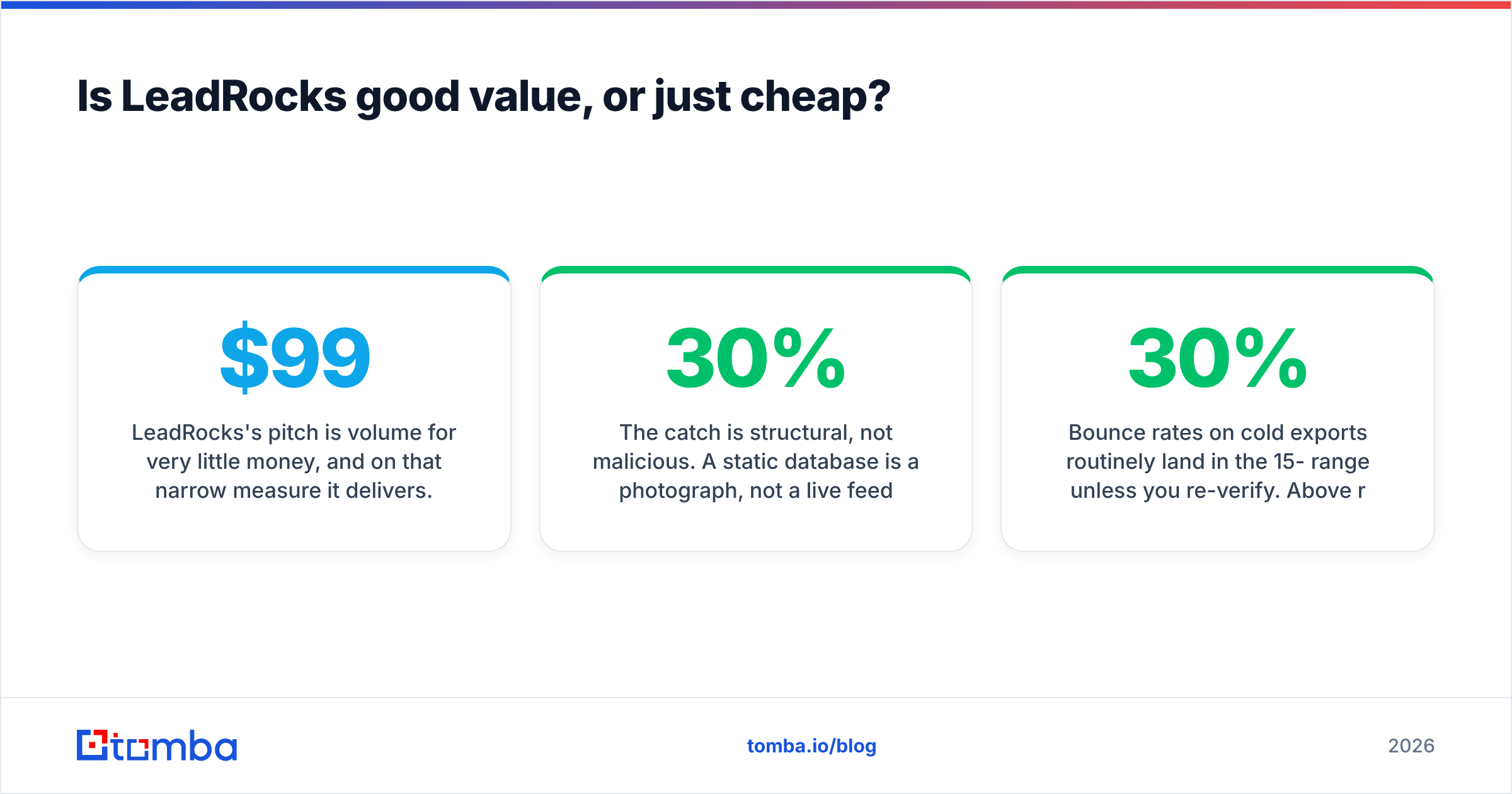
LeadRocks's pitch is volume for very little money, and on that narrow measure it delivers. A one-time lifetime payment for millions of exportable records looks unbeatable next to a $99/mo subscription.
The catch is structural, not malicious. A static database is a photograph, not a live feed. Gartner has long put B2B data decay somewhere around 25-30% annually — people change jobs, companies get acquired, domains get retired. A record scraped 18 months ago has a meaningful chance of being dead. Nobody re-verifies your export the day you download it.
That plays out in three ways:
- Bounce rates on cold exports routinely land in the 15-30% range unless you re-verify. Above roughly 3%, mailbox providers start treating you as a spammer. That's a sender reputation problem, and it's expensive to unwind.
- You pay twice. Cheap list plus a verification vendor to clean it equals the cost of a good tool that verified in the first place.
- Filter depth is shallower than enterprise platforms. Fine for broad ICPs, frustrating if you need "companies using Segment with 50-200 employees that raised in the last 9 months."
None of that makes LeadRocks a bad buy at its price. It makes it a raw material, not a finished product. Budget for the cleanup step and it's fine. Skip the cleanup step and you'll torch a sending domain.

What does each one actually cost per usable contact?#
Sticker price is the wrong metric. Cost per usable contact — a record that's accurate, deliverable, and matches your ICP — is the number that governs pipeline.
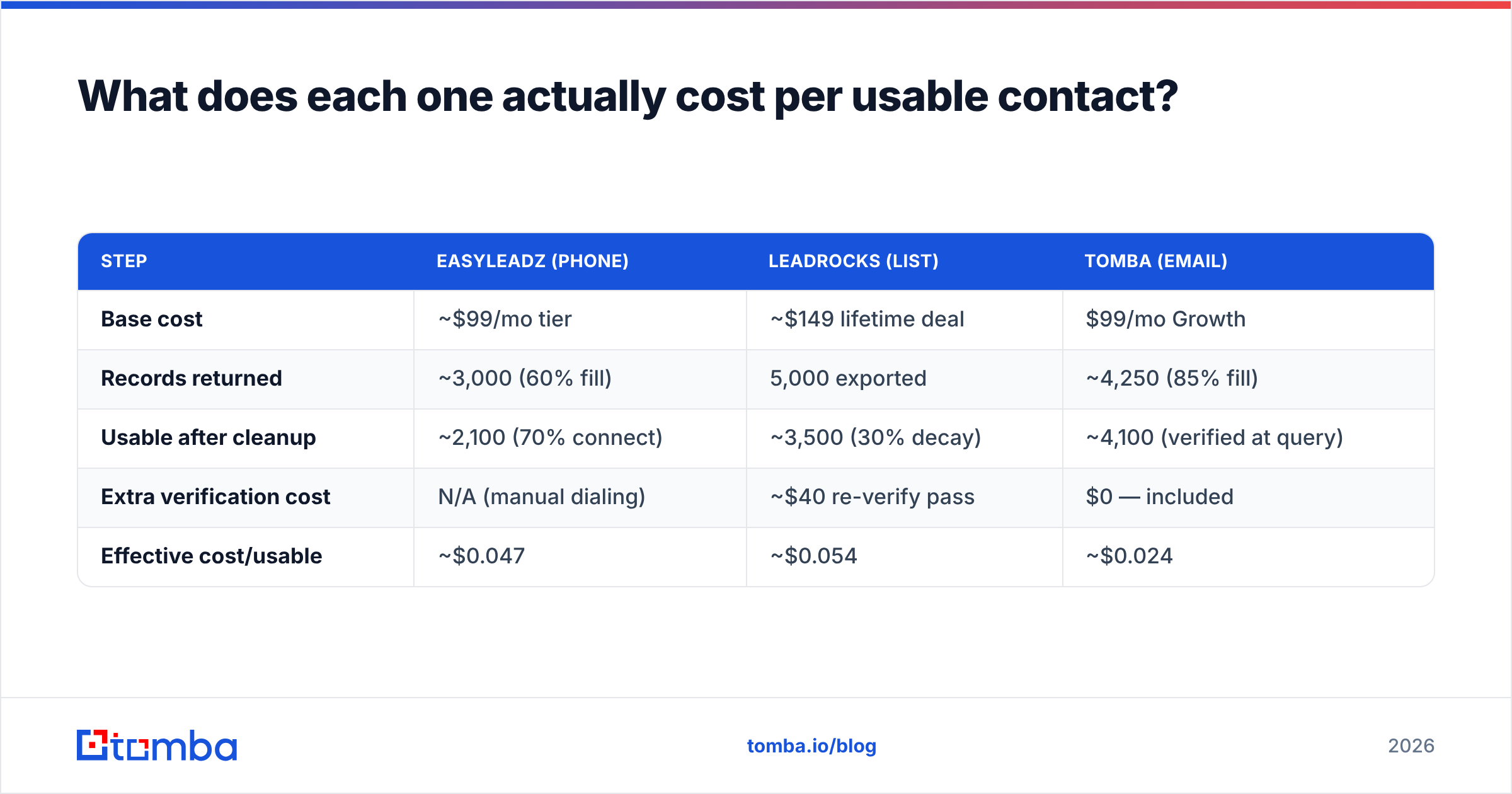
Work it through on a 5,000-contact list:
| Step | EasyLeadz (phone) | LeadRocks (list) | Tomba (email) |
|---|---|---|---|
| Base cost | ~$99/mo tier | ~$149 lifetime deal | $99/mo Growth |
| Records returned | ~3,000 (60% fill) | 5,000 exported | ~4,250 (85% fill) |
| Usable after cleanup | ~2,100 (70% connect) | ~3,500 (30% decay) | ~4,100 (verified at query) |
| Extra verification cost | N/A (manual dialing) | ~$40 re-verify pass | $0 — included |
| Effective cost/usable | ~$0.047 | ~$0.054 | ~$0.024 |
Numbers are illustrative modeling, not vendor-published benchmarks — run your own sample. But the shape holds across every audit I've done: the tool that verifies at the moment of query wins on cost-per-usable even when it loses on sticker price. Cheap data has a cleanup tax attached, and the tax is invisible until your bounce rate spikes.
If you want to sanity-check any list before it goes near your sending domain, run a sample through a free email checker first. Ten minutes of checking beats a month of domain rehab.
Which one should you actually pick?#
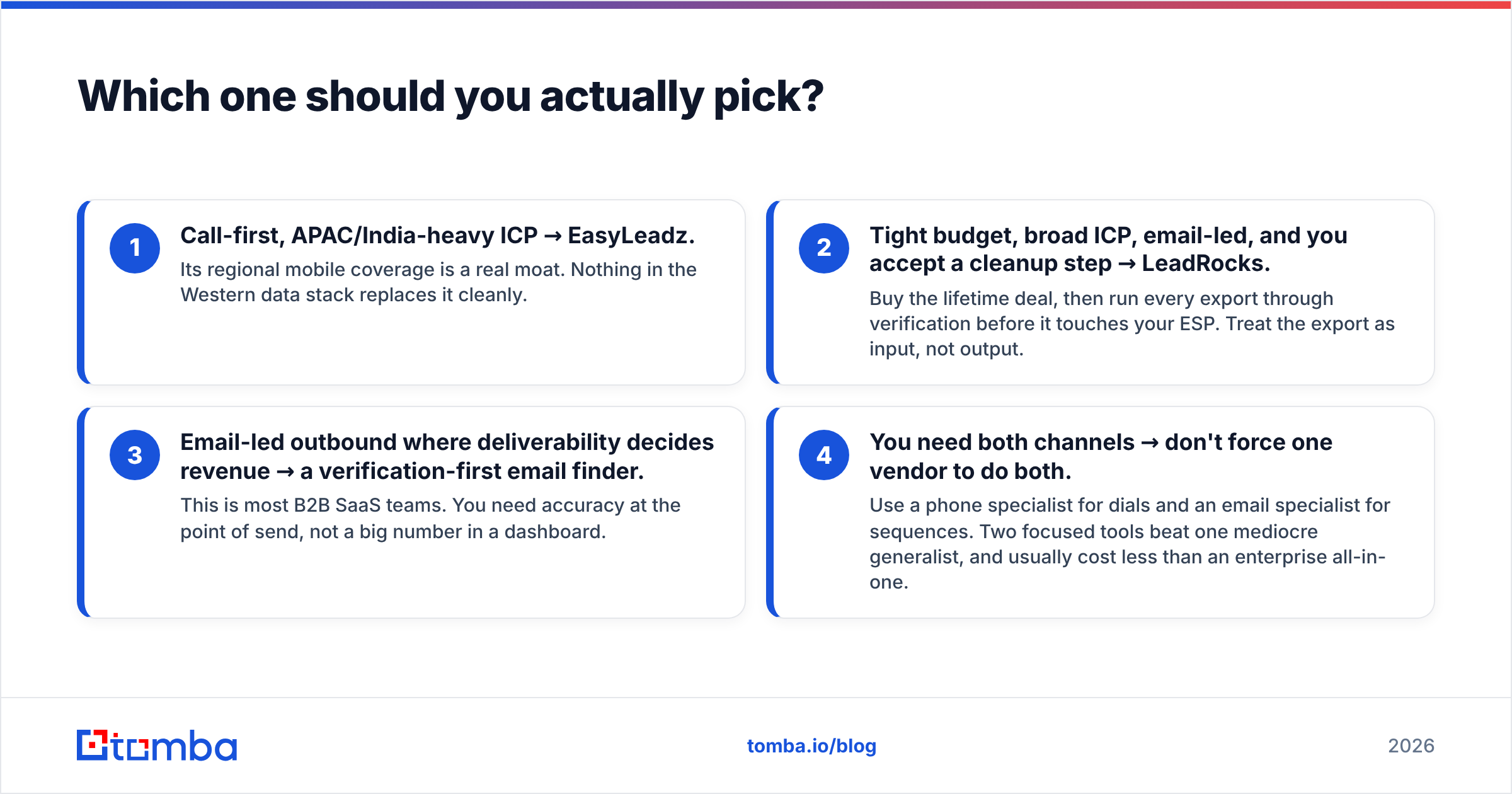
Match the tool to the motion. Here's the decision in four rules:
- Call-first, APAC/India-heavy ICP → EasyLeadz. Its regional mobile coverage is a real moat. Nothing in the Western data stack replaces it cleanly.
- Tight budget, broad ICP, email-led, and you accept a cleanup step → LeadRocks. Buy the lifetime deal, then run every export through verification before it touches your ESP. Treat the export as input, not output.
- Email-led outbound where deliverability decides revenue → a verification-first email finder. This is most B2B SaaS teams. You need accuracy at the point of send, not a big number in a dashboard.
- You need both channels → don't force one vendor to do both. Use a phone specialist for dials and an email specialist for sequences. Two focused tools beat one mediocre generalist, and usually cost less than an enterprise all-in-one.
A fourth option worth naming: if you want a large curated database with human-verified records and you're comfortable buying credits outright, BookYourData is a solid peer in this category — pay-as-you-go, no subscription lock-in, and a stronger verification guarantee than most lifetime-deal databases offer. It's a legitimate alternative to LeadRocks if list-buying is your model and quality matters more than the absolute floor price.
How do you avoid the mistakes both tools invite?#
Whichever you buy, the operating discipline is the same:
- Verify at the point of use, not the point of purchase. A list verified in March means nothing in July. Re-verify before every send with an email verifier, especially catch-all domains where naive checks return false positives.
- Sample before you scale. Pull 100 records, verify them independently, and calculate the real hit rate. Vendors quote best-case coverage; your ICP is a subset.
- Segment by data confidence. Send to your highest-confidence tier first. If bounces stay under 2%, expand. If they spike, you've found the bad segment before it damaged the domain.
- Warm up separately from list size. More contacts don't help if your sending infrastructure isn't ready. G2 reviews across this category are full of teams who bought volume and never fixed sending.
- Track cost per booked meeting, not cost per credit. It's the only metric that survives a QBR.
What about the API and workflow side?#
For anything beyond manual lookups, integration quality decides how much the tool actually gets used.
EasyLeadz offers an API, but it's built around single-contact enrichment — good for a "reveal number" button in your CRM, less good for nightly batch jobs. LeadRocks is export-centric; the CSV is the interface, and API access sits on higher tiers when available at all.
If your data flow is automated — CRM enrichment on record creation, list-building from a scraper, an agent pipeline — you want an API-first vendor. Tomba exposes the full stack through its Tomba API, a CLI, an MCP server for LLM agents, and native connections via HubSpot, Zapier, Google Sheets, and Airtable. That matters more than a 3% coverage difference once you're past 1,000 contacts a month, because manual CSV shuffling is where prospecting programs quietly die.
The bottom line#
EasyLeadz and LeadRocks are both defensible purchases for narrow use cases. EasyLeadz if you dial and your market is APAC. LeadRocks if your budget is the binding constraint and you'll do the cleanup work. Neither is a general-purpose foundation for email-led outbound in 2026, because neither verifies at the moment you need the address to be correct.
If email is your primary channel, start with the piece that actually gates your results: address accuracy. The Tomba Email Finder verifies at query time, handles catch-all domains explicitly instead of guessing, and runs through API, CLI, spreadsheet add-ons, and browser extension so it fits whatever workflow you already have. The free tier gives you 25 searches a month with no card — enough to benchmark it against whatever list you're considering before you spend a dollar. If it holds up, Starter is $49/mo and Growth is $99/mo; full Tomba pricing is public. Run your own sample, compare the hit rates, and let the numbers decide.
Related guides#
Ready to find emails that actually work?
Join 150,000+ professionals who stopped guessing and started sending. Free credits on signup — no credit card required.
Get the Tomba newsletter
Practical outbound tactics and product updates — once every two weeks.
About the author