EasyLeadz vs LeadsRush: Which B2B Data Tool Wins in 2026?
EasyLeadz sells direct dials. LeadsRush sells volume lead lists. We break down coverage, accuracy, pricing traps, and which one actually fits your outbound motion in 2026 — plus where a dedicated email finder beats both.
TL;DR
- EasyLeadz is phone-first. Its reputation is built on direct dials, especially in India and APAC, delivered through the Mr. E Chrome extension on top of LinkedIn profiles. Email is a secondary output, not the headline product.
- LeadsRush is volume-first. It positions around building large prospect lists fast — bulk exports, list-style workflows, and lower per-record economics. Accuracy claims are thinner and harder to independently verify.
- Neither is a drop-in replacement for the other. If your SDRs dial, EasyLeadz wins. If your team runs high-volume email sequences, LeadsRush's export model is closer to what you need — but you'll pay for it in verification work downstream.
- Both leave a gap: verified, deliverable email at a predictable price. That's where a dedicated email finder plus verifier (Tomba, Hunter, Findymail) usually ends up in the stack alongside one of these.
- Watch the credit math. Per-seat pricing, credit rollover rules, and "enriched but unverified" records are where both tools quietly get expensive.
What are EasyLeadz and LeadsRush, actually?#
Short answer: they solve adjacent problems and get compared because both show up when you search "B2B contact data tool" — not because they're the same product.
EasyLeadz launched as a contact intelligence layer for sales teams, and its wedge is the direct dial. You install the Mr. E browser extension, land on a LinkedIn profile, click, and get a mobile number. That's the whole pitch, and it's a good one — direct dials are the hardest B2B data type to source, they decay fast, and almost nobody does them well outside a few regions. EasyLeadz's coverage is strongest for India, Southeast Asia, and the Middle East, with thinner but usable US/EU coverage.
LeadsRush sits on the other side of the fence: list building at volume. The workflow is filter → build list → export → load into your sequencer. It's a familiar shape — the same shape Apollo, Seamless, and a dozen others use — and it's optimized for teams that need 5,000 rows on Monday, not 40 perfect direct dials.
The practical consequence: EasyLeadz is a precision tool, LeadsRush is a throughput tool. Comparing them on a single "which is better" axis is how teams end up buying the wrong one.
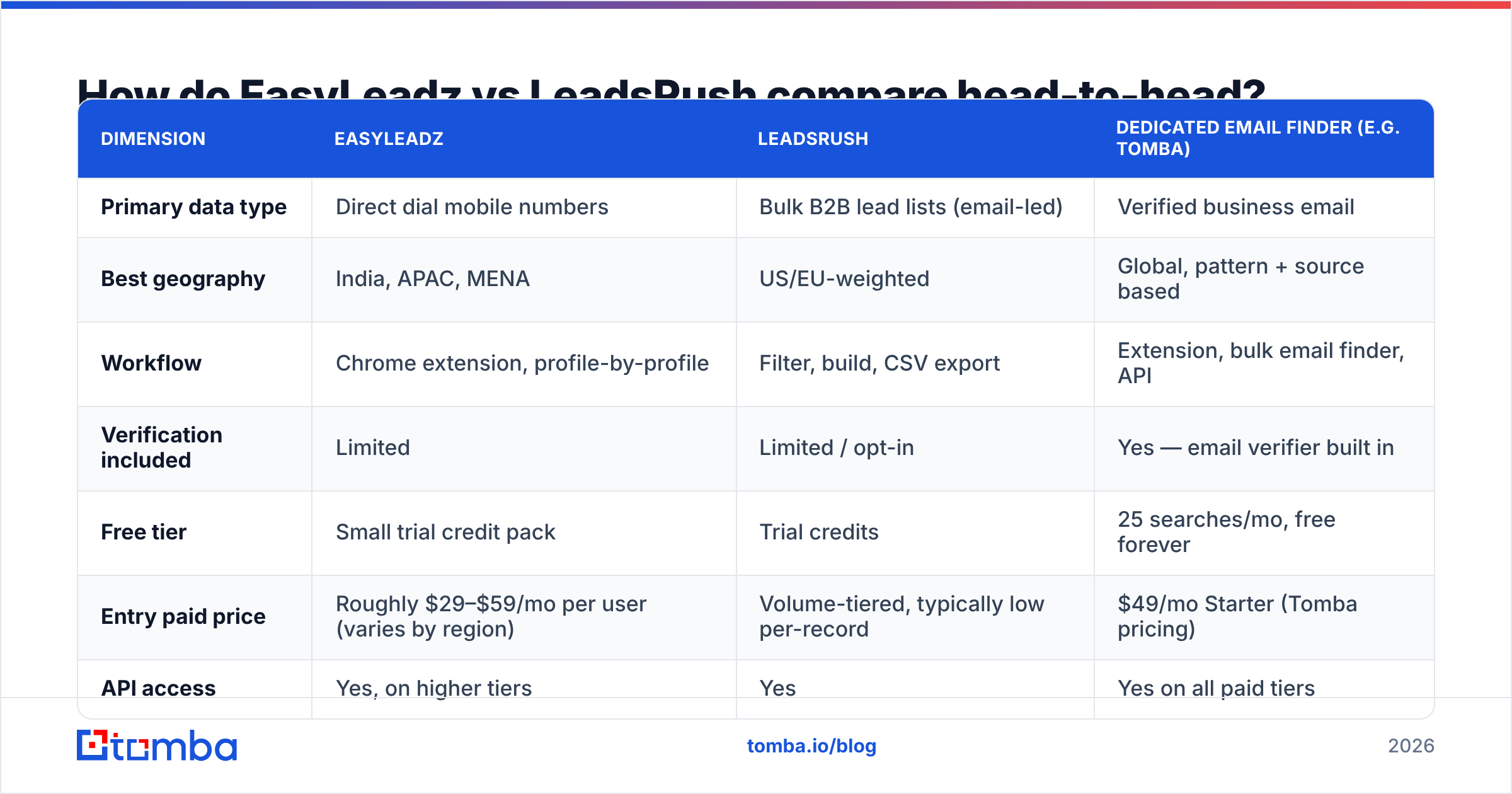
How do EasyLeadz vs LeadsRush compare head-to-head?#
Here's the honest side-by-side. Treat pricing as directional — both vendors adjust plans, and credit definitions shift more often than the headline numbers do. Always confirm on the vendor's own pricing page before you sign.
| Dimension | EasyLeadz | LeadsRush | Dedicated email finder (e.g. Tomba) |
|---|---|---|---|
| Primary data type | Direct dial mobile numbers | Bulk B2B lead lists (email-led) | Verified business email |
| Best geography | India, APAC, MENA | US/EU-weighted | Global, pattern + source based |
| Workflow | Chrome extension, profile-by-profile | Filter, build, CSV export | Extension, bulk email finder, API |
| Verification included | Limited | Limited / opt-in | Yes — email verifier built in |
| Free tier | Small trial credit pack | Trial credits | 25 searches/mo, free forever |
| Entry paid price | Roughly $29–$59/mo per user (varies by region) | Volume-tiered, typically low per-record | $49/mo Starter (Tomba pricing) |
| API access | Yes, on higher tiers | Yes | Yes on all paid tiers |
| Credit model | Per reveal (phone reveal costs more) | Per exported record | Per search / per verification |
| Who it fits | Dialing-heavy SDR teams | High-volume email outbound | Anyone sending cold email at scale |
The row that matters most for budget planning is credit model. EasyLeadz charges you for the reveal — and a phone reveal is the expensive one. LeadsRush charges per exported record, which sounds cheaper until you realize you're paying for rows you'd never contact. Email-finder pricing is usually the most predictable of the three because a search is a search.

Is EasyLeadz worth it for direct dials?#
Yes — if and only if your motion is phone-led and your ICP sits in EasyLeadz's strong regions.
Direct dial data is genuinely hard. Mobile numbers aren't published in company directories, they don't appear in DNS or web crawls, and they churn as people switch carriers and jobs. Any vendor with real mobile coverage has either a contribution network, a partner network, or a regional data-sharing arrangement doing the heavy lifting. EasyLeadz has built that for India and neighboring markets, and users on G2's lead intelligence category consistently flag APAC coverage as the differentiator.
Where EasyLeadz gets frustrating:
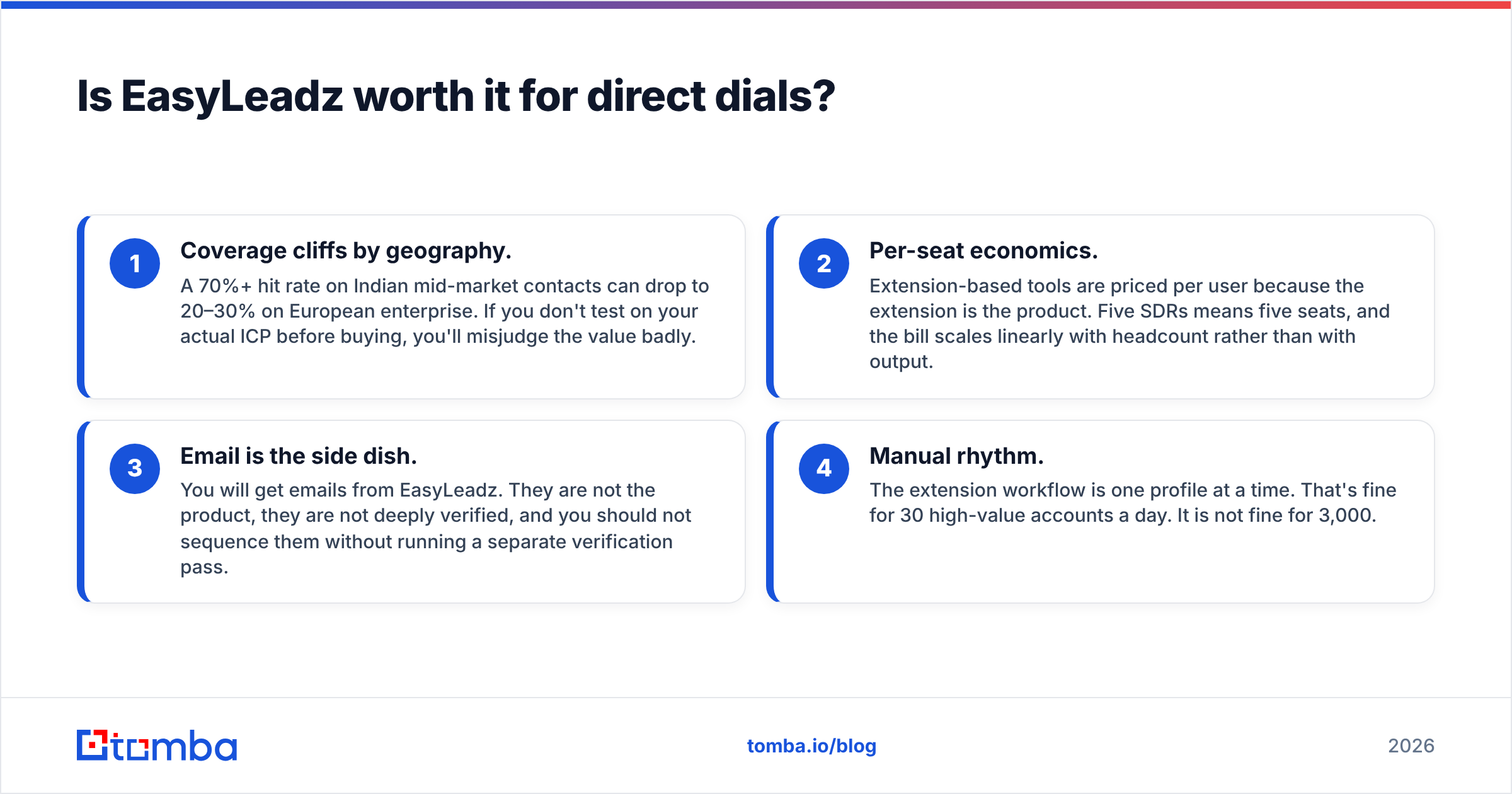
- Coverage cliffs by geography. A 70%+ hit rate on Indian mid-market contacts can drop to 20–30% on European enterprise. If you don't test on your actual ICP before buying, you'll misjudge the value badly.
- Per-seat economics. Extension-based tools are priced per user because the extension is the product. Five SDRs means five seats, and the bill scales linearly with headcount rather than with output.
- Email is the side dish. You will get emails from EasyLeadz. They are not the product, they are not deeply verified, and you should not sequence them without running a separate verification pass.
- Manual rhythm. The extension workflow is one profile at a time. That's fine for 30 high-value accounts a day. It is not fine for 3,000.
The right frame: EasyLeadz is a dialer's tool that also returns email, not an email tool that also returns phones. If you need B2B phone numbers as a first-class data type, that's the category you're shopping in — and you should evaluate it against other phone-first vendors, not against list builders.
Is LeadsRush better for volume outbound?#
For raw throughput, yes. For deliverability, be careful.
LeadsRush's model — filter, export, sequence — is the correct shape for a team running thousands of emails a week. You're not clicking through profiles; you're defining a segment and pulling it down. Per-record costs at volume tend to be materially lower than per-seat extension pricing when you're moving real numbers.
The trade-off is the one every volume list vendor makes: coverage breadth beats record depth. When a database promises tens of millions of contacts, a meaningful slice of those records are stale, role-changed, or algorithmically inferred. Nobody re-verifies 200 million rows weekly — the economics don't allow it.
That produces the failure mode you already know:
- You export 5,000 contacts.
- You load them straight into your sequencer.
- Bounce rate lands at 9–14%.
- Your domain reputation takes the hit, and inbox placement drops for the good contacts in the same campaign.
Google and Yahoo's bulk-sender requirements made this materially more expensive than it was three years ago. A sustained bounce rate above roughly 3% is a reputation problem, not a data problem you can ignore. HubSpot's sales blog and every deliverability vendor say the same thing: verify before you send, every time, regardless of what the source vendor promises.

So the honest read on LeadsRush: it's a sourcing layer, not a sending-ready layer. Budget for verification as a line item, not an afterthought. Running a bulk list through an email verifier before it touches your sequencer typically costs a fraction of what a reputation recovery costs.
Which one should you pick for your team?#
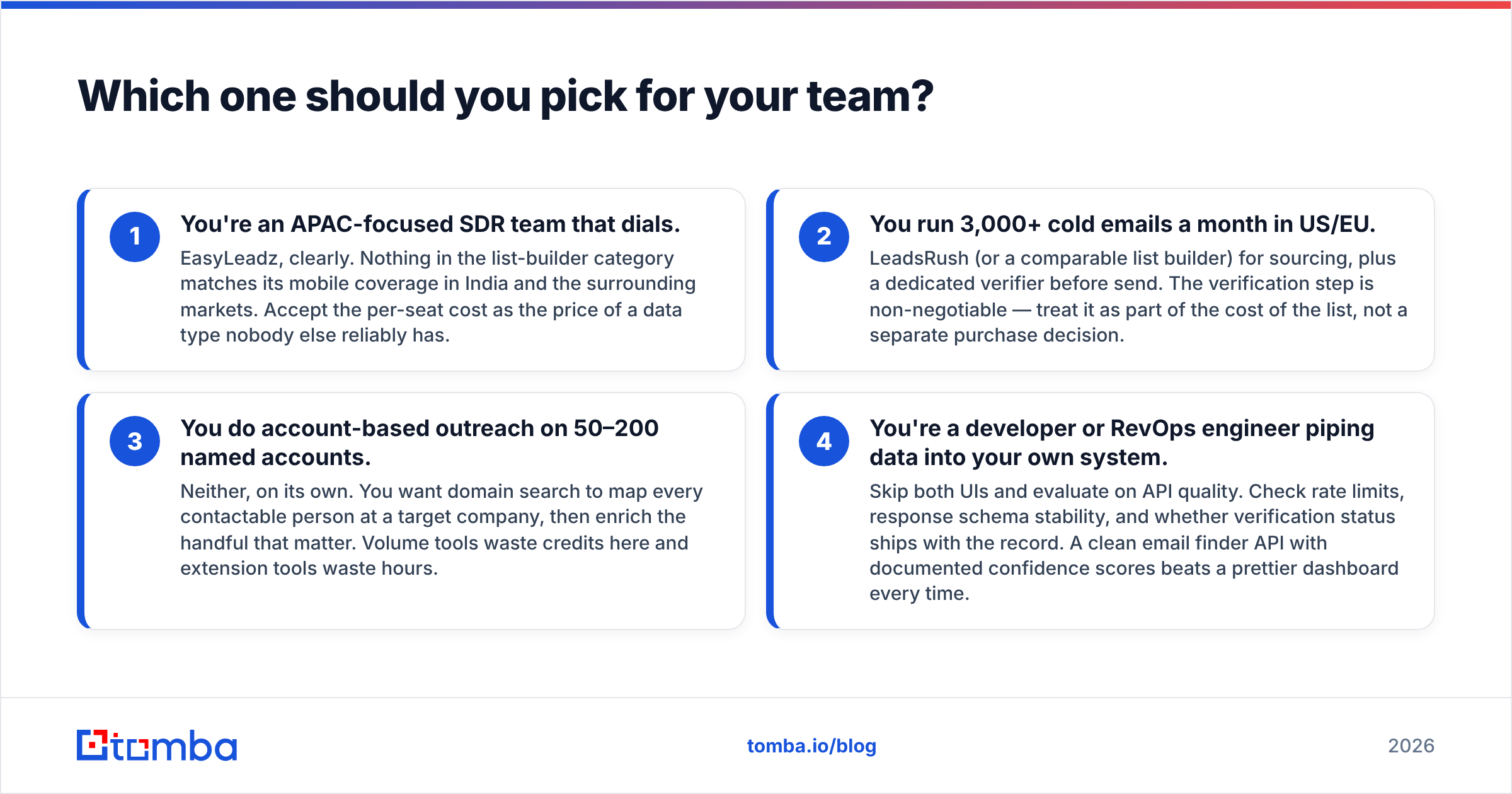
Match the tool to your motion, not to the review scores. Four scenarios:
- You're an APAC-focused SDR team that dials. EasyLeadz, clearly. Nothing in the list-builder category matches its mobile coverage in India and the surrounding markets. Accept the per-seat cost as the price of a data type nobody else reliably has.
- You run 3,000+ cold emails a month in US/EU. LeadsRush (or a comparable list builder) for sourcing, plus a dedicated verifier before send. The verification step is non-negotiable — treat it as part of the cost of the list, not a separate purchase decision.
- You do account-based outreach on 50–200 named accounts. Neither, on its own. You want domain search to map every contactable person at a target company, then enrich the handful that matter. Volume tools waste credits here and extension tools waste hours.
- You're a developer or RevOps engineer piping data into your own system. Skip both UIs and evaluate on API quality. Check rate limits, response schema stability, and whether verification status ships with the record. A clean email finder API with documented confidence scores beats a prettier dashboard every time.
What do both tools get wrong about email data?#
Both under-invest in the same thing: proving the address actually accepts mail.
There's a real distinction between three states that vendors routinely collapse into one:
- Found — the address exists in some source or matches a known company pattern. Weakest signal.
- Pattern-inferred — the tool knows
firstname.lastname@company.comis the convention and generated the address. Often right, frequently wrong for people with common names, hyphenated surnames, or non-Latin name transliterations. - Verified — an SMTP-level check confirmed the mailbox accepts mail, plus checks for role accounts, disposable domains, and catch-all configuration.
Most tools return states one and two, label them "valid," and hand you the deliverability risk. And catch-all domains — where the mail server accepts everything and sorts later — are the specific case that breaks naive verification. A basic verifier marks a catch-all as valid; it isn't necessarily. That's a distinct problem needing a catch-all verifier rather than a standard SMTP ping.
If you're only auditing one thing before you buy, audit this: run 100 known-good contacts through the tool's trial and check what percentage of returned emails survive independent verification. The gap between "records returned" and "records you can safely send to" is the real cost of the tool.
How do you run a fair 30-day evaluation?#
Vendor benchmarks are marketing. Build your own test — it takes an afternoon.
Step 1 — Build a truth set. Take 100 contacts you already have confirmed emails and phone numbers for. Pull them from your CRM's closed-won accounts. This is your answer key.
Step 2 — Match your real ICP. Same industries, same seniority, same geographies you actually sell into. Testing US enterprise when you sell to Indian SMBs tells you nothing useful.
Step 3 — Run the same list through every candidate. EasyLeadz, LeadsRush, and at least one dedicated email finder. Use trial credits — every vendor here has them, and a free email checker covers the spot-check work at zero cost.
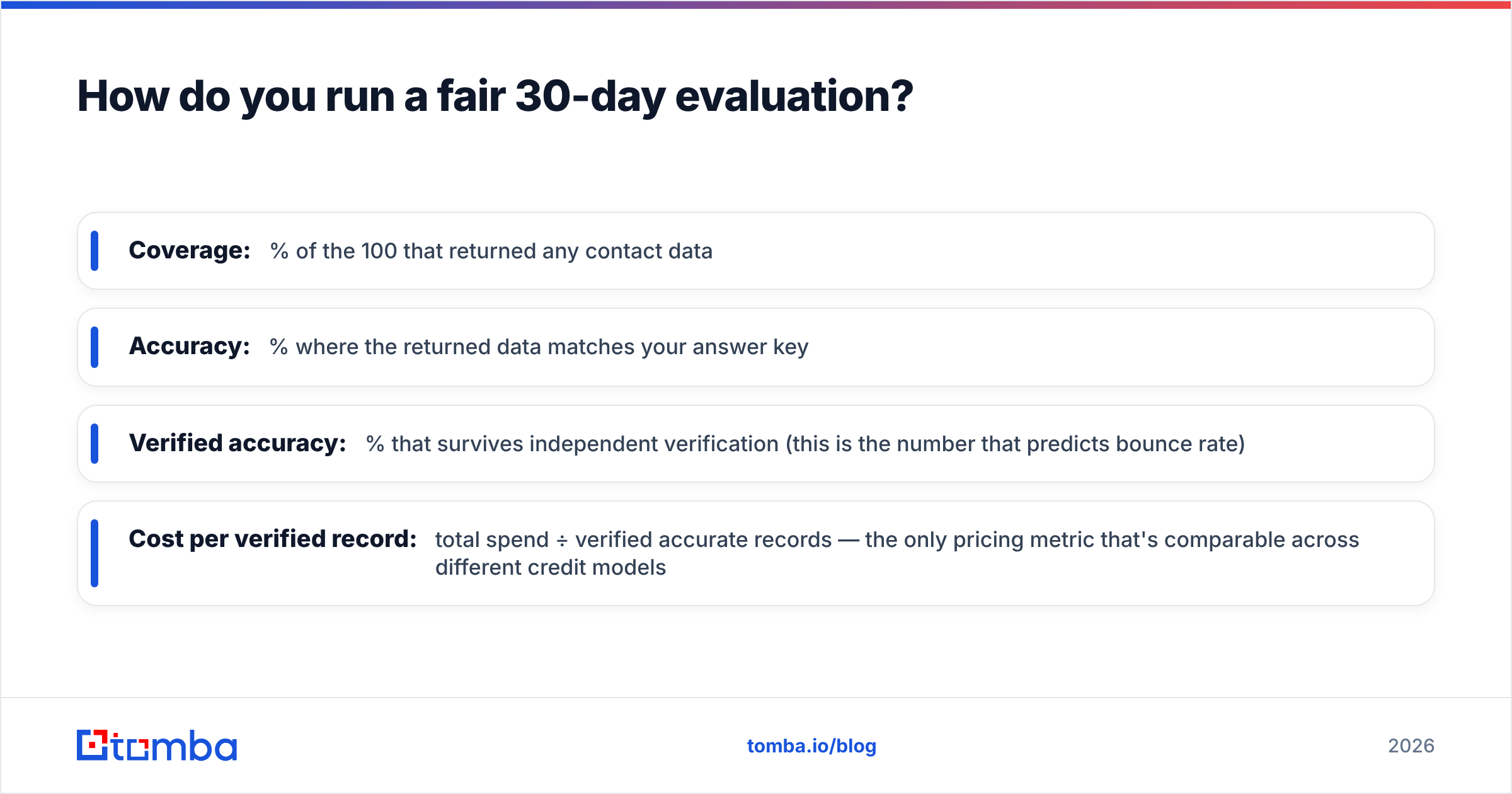
Step 4 — Score four numbers, not one:
- Coverage: % of the 100 that returned any contact data
- Accuracy: % where the returned data matches your answer key
- Verified accuracy: % that survives independent verification (this is the number that predicts bounce rate)
- Cost per verified record: total spend ÷ verified accurate records — the only pricing metric that's comparable across different credit models
Step 5 — Note the operational friction. How long did the export take? Did the CSV need cleanup? Did the API return usable JSON on the first try? A tool that scores 5 points higher on accuracy but costs your ops person two hours a week isn't winning.
Teams that run this test are consistently surprised by step four. Headline pricing that looks 40% cheaper often works out more expensive per usable record once coverage gaps and verification failures are priced in.
What's the verdict on EasyLeadz vs LeadsRush?#
EasyLeadz wins on direct dials in APAC. LeadsRush wins on list volume and per-record cost. Neither wins on verified email deliverability — and for most cold-outbound teams, that's the metric that determines whether the campaign works.
The stack most teams converge on after a few quarters looks like this: one specialist tool for the hard data type they actually need (phones from EasyLeadz, or volume from a list builder), plus a dedicated email finder and verifier handling the layer that touches the sending domain. It costs slightly more than a single all-in-one subscription and produces materially better results, because no single vendor is genuinely best-in-class at phones, lists, and email verification simultaneously.
One last budgeting note: check whether unused credits roll over, whether the price is per seat or per workspace, and what happens at renewal. Those three answers move the annual cost more than the headline monthly number does.
Ready to fix the email layer of your stack? Start with the Tomba Email Finder — free tier includes 25 searches a month with no card, Starter runs $49/mo, and every result ships with verification status attached rather than a vague confidence label. Test it against whatever EasyLeadz or LeadsRush returns on the same 100 contacts, compare verified accuracy, and let the numbers decide.
Related guides#
Ready to find emails that actually work?
Join 150,000+ professionals who stopped guessing and started sending. Free credits on signup — no credit card required.
Get the Tomba newsletter
Practical outbound tactics and product updates — once every two weeks.
About the author