EasyLeadz vs LeadzenAI: Which B2B Contact Finder Wins in 2026?
EasyLeadz built its name on Indian mobile numbers. LeadzenAI sells AI-driven lead intelligence. We compare data coverage, accuracy, pricing and export limits so you know which one actually fits your pipeline.
TL;DR
- EasyLeadz (the company behind Mr. E) is strongest on direct mobile numbers, especially for India and APAC. It is a phone-first tool with email as a secondary field.
- LeadzenAI positions itself as AI lead intelligence: search by natural-language-ish filters, get enriched profiles, social handles, and contact data in one card.
- Neither is a general-purpose email finder for global B2B outbound. Both carry credit models that get expensive once you move past manual, one-lead-at-a-time prospecting.
- If your outbound runs on email, you need a dedicated finder plus verification. If it runs on calls in India, EasyLeadz has a real edge.
- Practical setup for most teams: pick one of these for phone/intent depth, and pair it with a verified email source so your sequences don't bounce.
What are EasyLeadz and LeadzenAI, exactly?#
Both tools get grouped into "B2B contact data," but they solve different problems.
EasyLeadz is a contact-discovery product best known for its Chrome extension, Mr. E. You open a LinkedIn profile, click the extension, and it returns a direct dial (often a mobile number) plus, where available, a work email. The company's positioning is unambiguous: it sells the phone number that gets picked up. Its coverage is deepest in India and reasonably strong across Southeast Asia and the Middle East, thinner in North America and Western Europe. See easyleadz.com for their current plan structure.
LeadzenAI takes a wider swing. It markets itself as an AI-powered lead intelligence platform: you describe or filter a target segment, and it returns enriched profiles that combine company data, role, social presence, and contact details. There's a browser extension too, plus a search interface for building lists without starting from a LinkedIn URL. Their site is leadzen.ai.
The one-sentence version: EasyLeadz is a phone-number tool that also returns emails. LeadzenAI is a lead-research tool that also returns contact details. Where you land depends on whether your first touch is a dial or a sequence.

How do EasyLeadz and LeadzenAI compare head to head?#
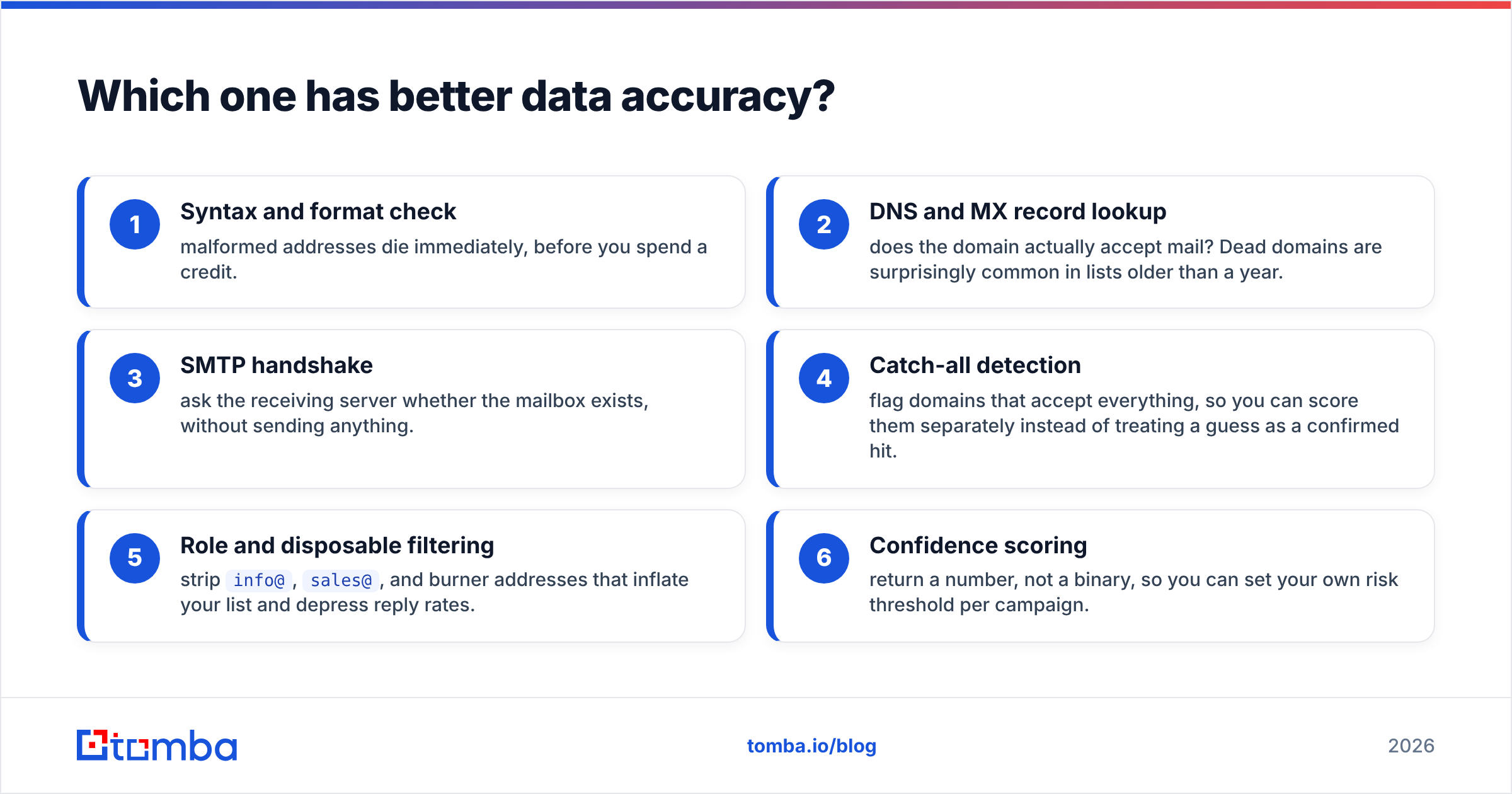
Here's the practical breakdown. Pricing moves, so treat these as directional and confirm on each vendor's page before you buy.
| Dimension | EasyLeadz (Mr. E) | LeadzenAI | Tomba |
|---|---|---|---|
| Primary strength | Direct mobile numbers | AI lead search + enrichment | Work email discovery + verification |
| Geographic sweet spot | India, APAC, MENA | India, growing global | Global (US, EU, APAC) |
| Email accuracy focus | Secondary field | Secondary field | Core product, verified before delivery |
| Bulk processing | Limited on lower tiers | Available, credit-gated | Bulk finder and bulk verify included |
| Free tier | Trial credits | Trial credits | 25 searches/mo, no card |
| Entry paid plan | ~$29–$59/mo range | ~$25–$50/mo range | $49/mo Starter |
| API access | Yes, higher tiers | Yes, higher tiers | Yes, all paid tiers |
| Catch-all handling | Not addressed | Not addressed | Dedicated catch-all verifier |
| Best for | Cold callers in India | Researchers building segments | Email-led outbound at scale |
Two things jump out of that table.
First, both tools treat email as a byproduct. Neither publishes a verification methodology or a bounce-rate guarantee the way dedicated verification vendors do. That matters more than it sounds — a 6% bounce rate on a 5,000-send campaign is enough to drag your domain reputation down, and Google and Microsoft both tightened bulk-sender rules in ways that punish exactly that.
Second, credit models diverge sharply from flat-rate models once volume climbs. Phone credits are expensive to source, so phone-first vendors price conservatively. If you're pulling 2,000 contacts a month and only need email, you're subsidizing a data type you never use.

Which one has better data accuracy?#
Accuracy is the only metric that survives contact with reality, and it splits by data type.
Phone numbers: EasyLeadz wins in its home markets. Reported connect rates from users in Indian SaaS and recruiting are consistently better than what generic global databases return for the same profiles. That's a sourcing advantage, not a marketing claim — the vendor has invested in region-specific data partnerships that US-first providers haven't.
Emails: this is where both tools get soft. Neither runs the layered checking that a dedicated finder does. A serious email verifier chain looks like this:
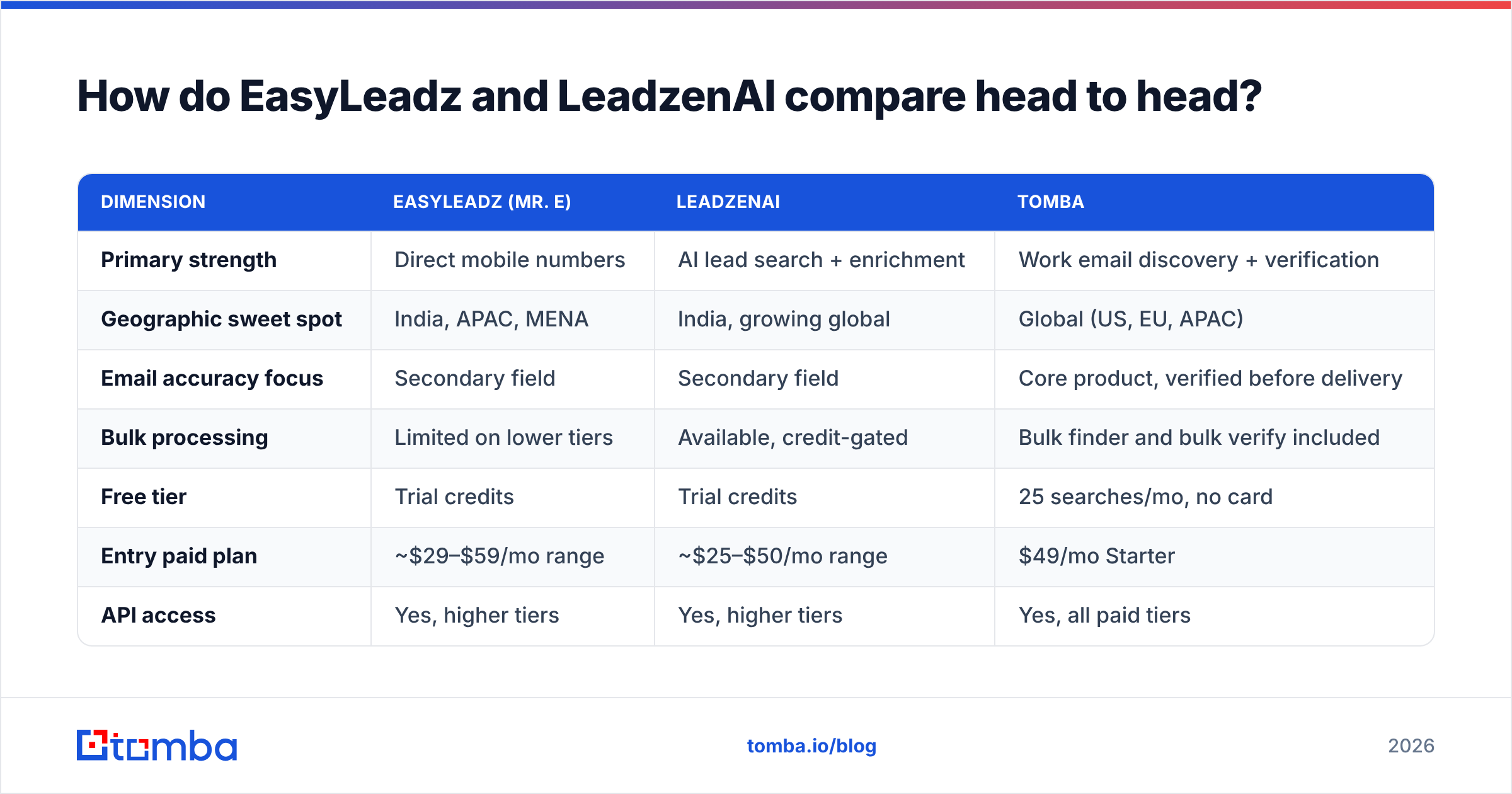
- Syntax and format check — malformed addresses die immediately, before you spend a credit.
- DNS and MX record lookup — does the domain actually accept mail? Dead domains are surprisingly common in lists older than a year.
- SMTP handshake — ask the receiving server whether the mailbox exists, without sending anything.
- Catch-all detection — flag domains that accept everything, so you can score them separately instead of treating a guess as a confirmed hit.
- Role and disposable filtering — strip
info@,sales@, and burner addresses that inflate your list and depress reply rates. - Confidence scoring — return a number, not a binary, so you can set your own risk threshold per campaign.
If a tool doesn't publish steps 3 through 6, assume it's pattern-guessing. Pattern guessing is fine for a manual, ten-lead-a-day workflow. It's a liability at 500 sends a week.
Firmographic and profile data: LeadzenAI has the edge here. Its enriched cards pull together role, company, and social signals in a way EasyLeadz doesn't attempt. If your workflow is "research first, reach out second," that context saves real time.
Is EasyLeadz better than LeadzenAI for outbound sales?#
It depends entirely on your first-touch channel. Map yourself to one of these:
- You cold call India-based prospects. EasyLeadz, without much debate. The mobile-number coverage is the product, and no global competitor matches it in that region at that price.
- You build ICP lists before you reach out. LeadzenAI. The search-and-filter layer means you're not starting every session from a LinkedIn URL, and the enrichment gives you personalization hooks.
- You run email sequences at 1,000+ sends per month. Neither, as your primary source. Use a dedicated email finder that verifies before it charges you, and add a phone tool only if calls are a real part of your motion.
- You do all three. Stack them. A phone tool plus an email tool costs less than the pipeline you lose to bounces and dead dials.
The mistake teams make is buying one contact-data tool and forcing every workflow through it. Contact data isn't one market — phone sourcing, email discovery, and firmographic enrichment have different economics and different winners.
What does each tool cost in practice?#
Sticker price is the least interesting number. What matters is cost per usable contact, and that's a function of three things: plan price, credit consumption, and hit rate.
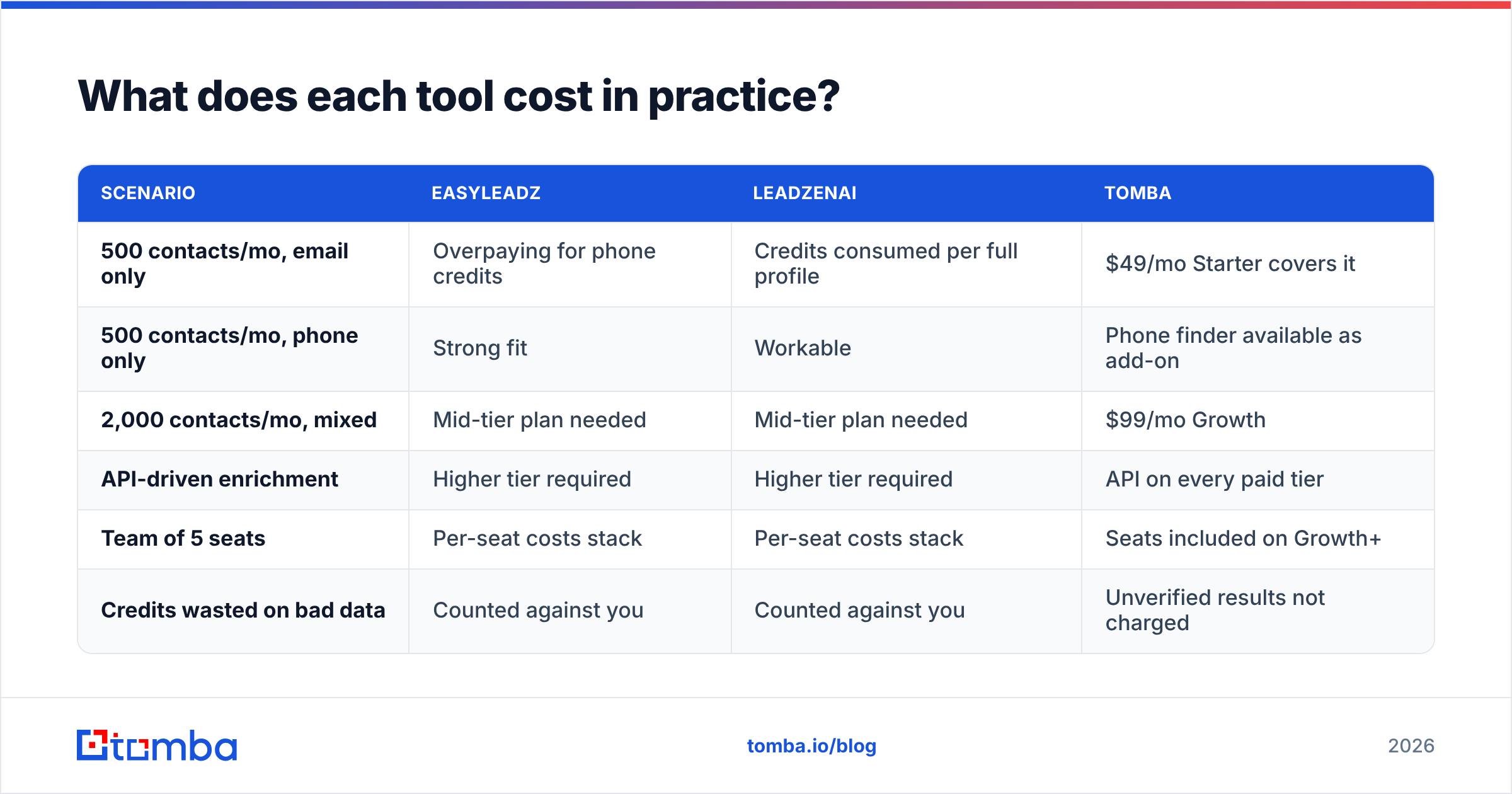
| Scenario | EasyLeadz | LeadzenAI | Tomba |
|---|---|---|---|
| 500 contacts/mo, email only | Overpaying for phone credits | Credits consumed per full profile | $49/mo Starter covers it |
| 500 contacts/mo, phone only | Strong fit | Workable | Phone finder available as add-on |
| 2,000 contacts/mo, mixed | Mid-tier plan needed | Mid-tier plan needed | $99/mo Growth |
| API-driven enrichment | Higher tier required | Higher tier required | API on every paid tier |
| Team of 5 seats | Per-seat costs stack | Per-seat costs stack | Seats included on Growth+ |
| Credits wasted on bad data | Counted against you | Counted against you | Unverified results not charged |
That last row is the one to interrogate during your trial. Ask every vendor: do I pay for a result you can't verify? Some charge for any returned record, verified or not. If a tool returns a guessed address with 62% confidence and bills you a full credit, your effective cost per usable email is much higher than the price page suggests.
For a like-for-like reference point, Tomba pricing runs Free (25 searches/mo), Starter at $49/mo, Growth at $99/mo, and Pro at $249/mo, with Enterprise custom — flat tiers rather than a phone-credit economy.

What are the real limitations of each?#
Every vendor's marketing page is a list of strengths. Here's the other side.
EasyLeadz limitations:
- Geographic ceiling. Outside India and nearby markets, hit rates drop noticeably. If your ICP is US mid-market SaaS, you'll burn credits on misses.
- Email is not the priority. You get an address when one is available, but without the verification layer that keeps bounce rates under 2%.
- Extension-first workflow. Great for one-off lookups, awkward for building a 1,000-row list. Bulk work pushes you to higher tiers.
LeadzenAI limitations:
- "AI" does a lot of work in the positioning. The underlying value is a search index plus enrichment. Useful — but evaluate it as a database, not as a reasoning engine.
- Credit burn on exploration. Search-and-browse workflows consume credits fast when you're still narrowing your ICP. Define your filters before you start spending.
- Global coverage still maturing. Strong in its core markets, uneven elsewhere. Test your exact segment during the trial, not a generic one.
Shared limitation, and the important one: neither publishes a catch-all strategy. Catch-all domains — servers configured to accept mail to any address — are the single biggest source of false positives in B2B email data. Roughly one in five corporate domains runs catch-all. A tool that returns firstname.lastname@catchalldomain.com and marks it valid is telling you nothing. This is why a catch-all verifier exists as a separate function: it scores deliverability on domains where a standard SMTP check can't give a clean answer.
How should you actually build your contact-data stack?#
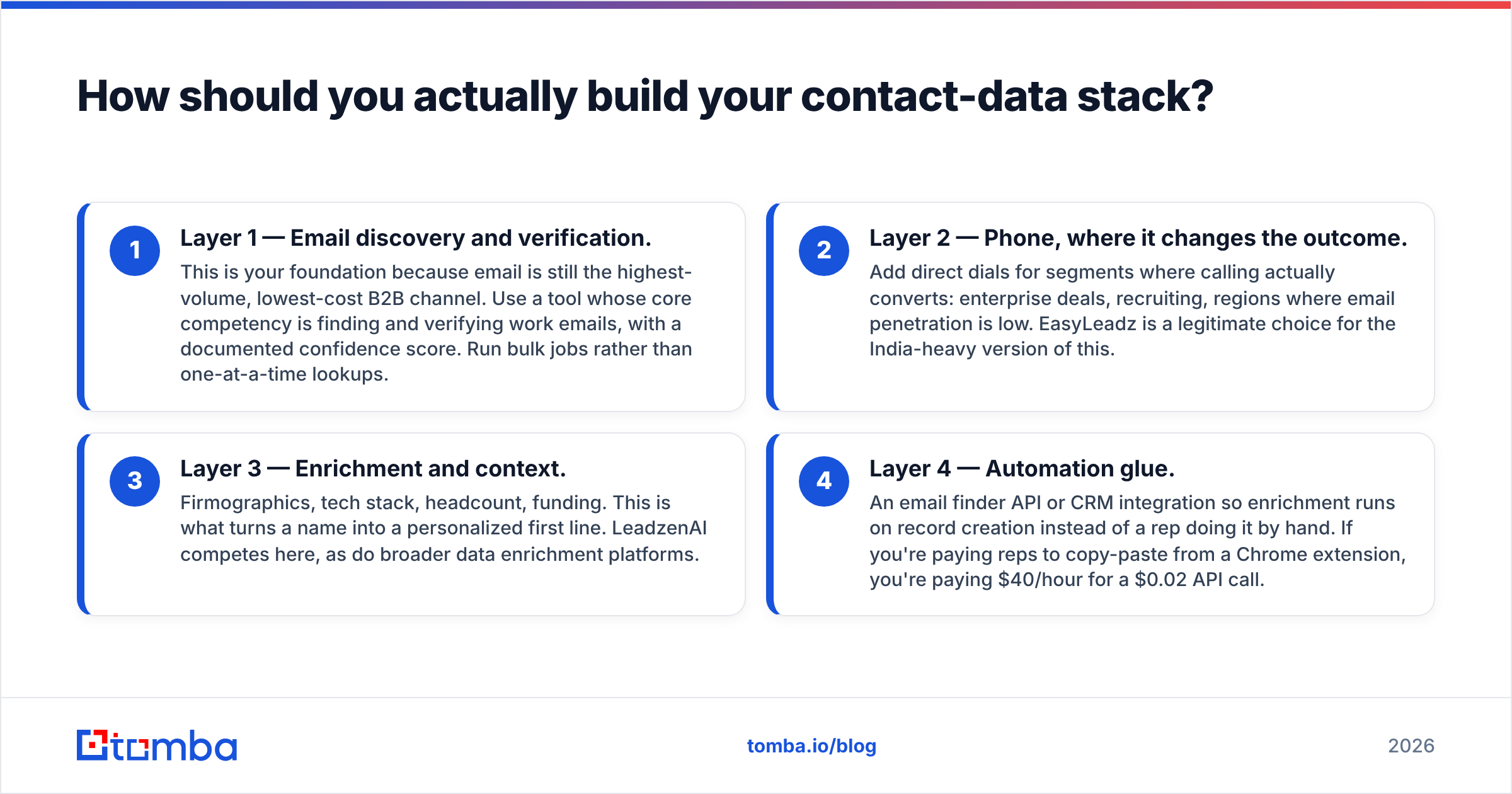
Stop looking for one tool that does everything. Build in layers.
- Layer 1 — Email discovery and verification. This is your foundation because email is still the highest-volume, lowest-cost B2B channel. Use a tool whose core competency is finding and verifying work emails, with a documented confidence score. Run bulk jobs rather than one-at-a-time lookups.
- Layer 2 — Phone, where it changes the outcome. Add direct dials for segments where calling actually converts: enterprise deals, recruiting, regions where email penetration is low. EasyLeadz is a legitimate choice for the India-heavy version of this.
- Layer 3 — Enrichment and context. Firmographics, tech stack, headcount, funding. This is what turns a name into a personalized first line. LeadzenAI competes here, as do broader data enrichment platforms.
- Layer 4 — Automation glue. An email finder API or CRM integration so enrichment runs on record creation instead of a rep doing it by hand. If you're paying reps to copy-paste from a Chrome extension, you're paying $40/hour for a $0.02 API call.
Order matters. Teams that start at Layer 3 buy an expensive intelligence platform and then discover their emails bounce. Teams that start at Layer 1 have a working outbound motion within a week and add depth as the ICP sharpens.

How do you evaluate these tools in a two-week trial?#
Vendor demos use their best data. Your test should use yours.
Build a 50-contact control list. Pull 50 real prospects from your actual ICP — same industries, same seniority, same geography you'll target in production. Include a handful you already have verified contact details for. Those are your ground truth.
Run identical searches in both tools. Record four numbers per tool:
- Hit rate — what percentage returned any contact detail?
- Verified rate — what percentage returned a detail you'd stake a send on?
- Accuracy on known contacts — of the ones you already had, how many did each tool get right?
- Credits consumed — including misses.
Then compute cost per verified contact. Plan price divided by verified results. That single number is the honest comparison, and it routinely reorders the ranking that the pricing pages imply.
Finally, send a small test batch. 100 emails, real sequence, and watch the bounce rate. Under 2% is healthy. Over 5% means the data source is guessing, and no feature list makes up for that. Cross-checking against a broader B2B database before the send catches most of it.
For third-party signal beyond your own test, G2's lead intelligence category is worth a scan — though weight the reviews by whether the reviewer's market matches yours. A five-star review from a Bangalore recruiter tells you little about US enterprise coverage.
The verdict#
EasyLeadz vs LeadzenAI comes down to channel and geography. EasyLeadz is the better buy if you're dialing prospects in India and APAC — the mobile-number depth is genuinely differentiated and hard to replicate. LeadzenAI is the better buy if your bottleneck is finding and researching the right accounts before outreach, and you value enriched profiles over raw dial coverage.
Neither should be your primary email source. Both treat email as a secondary field, neither addresses catch-all domains, and both charge credits for results they can't verify. That's fine for the workflows they're built for. It's expensive for email-led outbound.
If email is where your pipeline comes from, start with a tool built for it. Tomba's Email Finder verifies before it returns a result, handles catch-all domains as a distinct problem rather than pretending they don't exist, and runs on flat pricing — Free at 25 searches/mo to test it against your own control list, $49/mo Starter when you're ready to scale. Run the 50-contact test above, compare cost per verified contact, and let the bounce rate settle the argument.
Related guides#
Ready to find emails that actually work?
Join 150,000+ professionals who stopped guessing and started sending. Free credits on signup — no credit card required.
Get the Tomba newsletter
Practical outbound tactics and product updates — once every two weeks.
About the author