EasyLeadz vs Ninjapear (2026): Which Lead Data Tool Wins?
EasyLeadz is phone-first and India-strong. Ninjapear is a lean, credit-based email finder. We break down coverage, accuracy, pricing and workflow fit — plus when a third option beats both.
EasyLeadz vs Ninjapear is a common shortlist, but the two tools barely overlap. One hunts phone numbers. The other finds work emails. Here is how they compare on coverage, accuracy, and price — and when neither is the right call.
TL;DR
- EasyLeadz is phone-first. Its "Mr. E" extension is built around direct dials, with strong coverage of India and South Asia. Email is a side output.
- Ninjapear is email-first and lean. It is a credit-based email finder aimed at solo founders and small outbound teams.
- They rarely compete head-to-head. Cold calling APAC SMBs? EasyLeadz wins. Cold email into Western B2B? Ninjapear fits better.
- Both are thin on verification. Neither replaces a real verifier, and unverified lists drive most bounce damage.
- Check pricing first. Both sell credit bundles. The sticker price is not the cost per usable contact.
What are EasyLeadz and Ninjapear?#
EasyLeadz is an Indian B2B contact intelligence company. It is best known for Mr. E, a browser extension that reveals direct phone numbers from LinkedIn profiles and company pages. The positioning has always been the number, not the inbox. Sales teams install it to skip gatekeepers. Its edge is depth in markets that US-centric databases treat as an afterthought — India, the UAE, Singapore, and parts of Southeast Asia.
Ninjapear belongs to the newer wave of lightweight email-finding tools. Give it a name and a company domain, or just a domain, and it returns work email addresses. Pricing is per credit, not per seat. There is no sequencer, no dialer, no intent data. It is a lookup utility, and it does not pretend otherwise.
That difference in shape matters more than any feature scorecard. One tool tries to make your phone ring back. The other fills a column in a CSV. Comparing them is like comparing a locksmith to a key-cutting kiosk — both get you through a door, but only one comes to your house.
EasyLeadz vs Ninjapear: how do they compare on data coverage?#
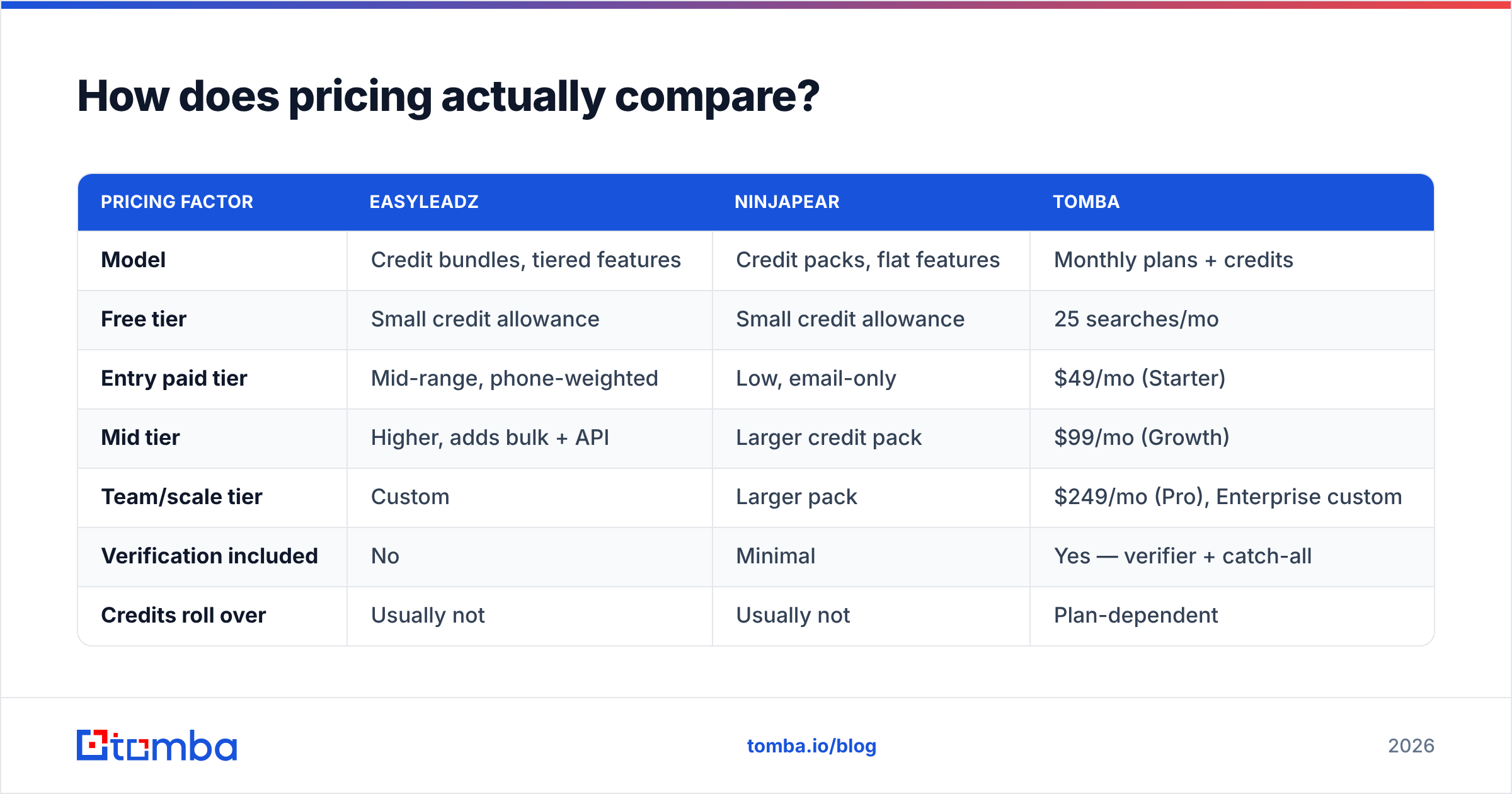
Coverage is where the two diverge hardest. EasyLeadz indexes company and contact records with a heavy phone bias and a regional skew. Ninjapear leans on domain-level email pattern discovery plus a contact index. It works best when a company has a public, guessable email format and a decent web footprint.
| Dimension | EasyLeadz (Mr. E) | Ninjapear |
|---|---|---|
| Primary output | Direct dials + mobile numbers | Work email addresses |
| Secondary output | Work email, company firmographics | Domain patterns, company metadata |
| Strongest geography | India, UAE, SEA | US, UK, EU |
| Best-fit persona | SDRs cold calling, recruiters | Founders, small cold-email teams |
| Typical workflow | LinkedIn extension, one profile at a time | Bulk CSV upload / single lookup |
| Built-in verification | Limited | Basic syntax/MX-level checks |
| API access | Yes, on higher tiers | Yes, credit-metered |
| Free entry point | Limited free credits | Limited free credits |
Two notes on that table. First, "strongest geography" is not marketing fluff. It is the single variable that decides this comparison for most buyers. A UK SaaS team selling to Manchester manufacturers will get thin results from a phone database tuned for Bengaluru. The reverse is just as true.
Second, neither free tier is big enough to judge quality properly. Run the same 50-row sample list through both before you buy anything.

Which tool is more accurate — and how would you even know?#
Accuracy claims here mean little without a definition. Vendors quote two different numbers and call both "accuracy":
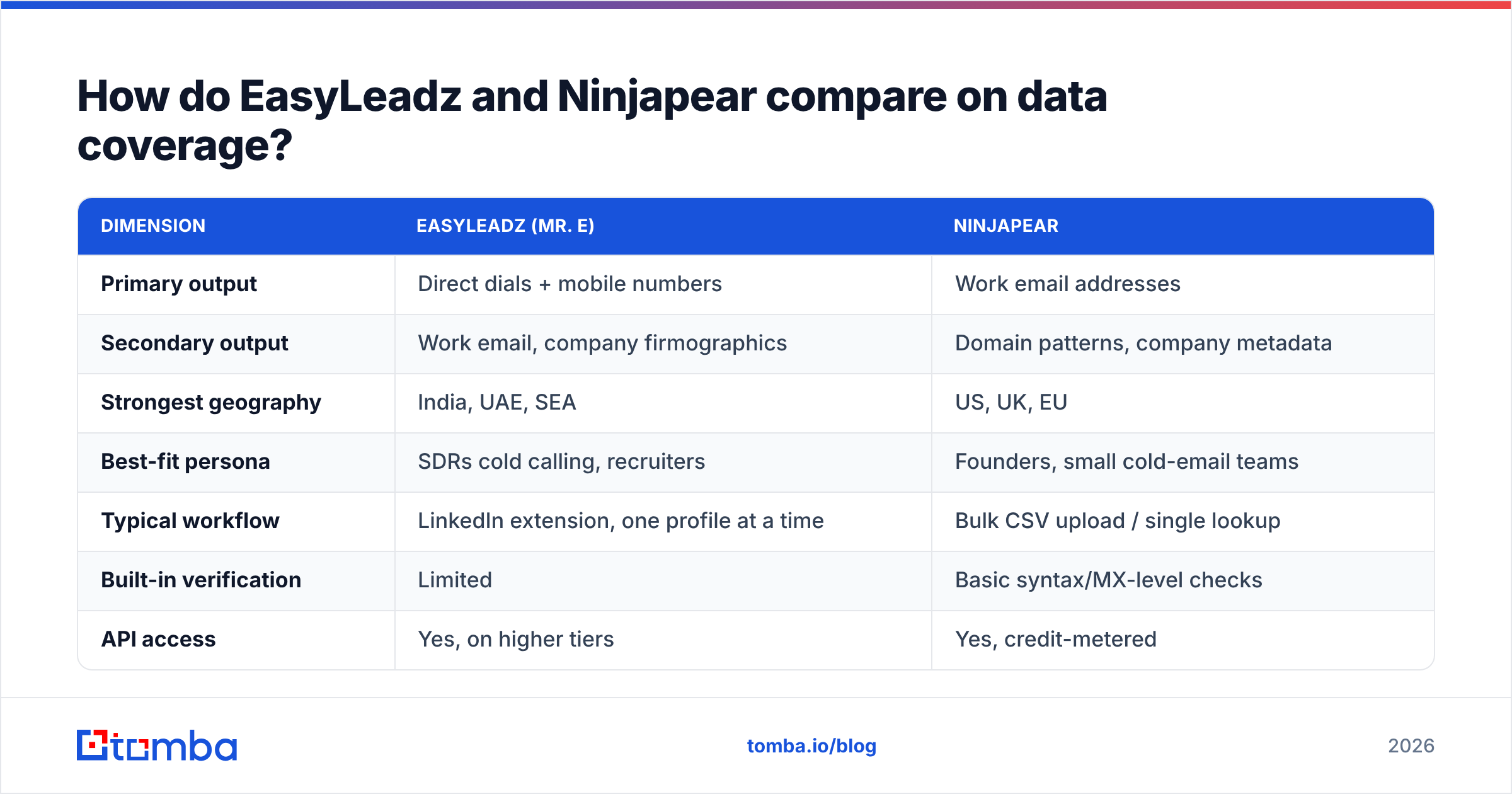
- Match rate — the share of your input rows that come back with any contact. Easy to inflate: return a guessed pattern for every row and you hit 100%.
- Deliverable rate — the share of returned emails that actually accept mail. This is the number that decides whether your domain survives the quarter.
- Bounce rate — the inverse, and the one your ESP cares about. Google and Yahoo put the practical ceiling near 2–3%. Go above that and you lose inbox placement across every campaign, not just the bad one.
- Catch-all share — results on domains that accept everything. Not wrong, but unproven. Counting them as valid is how a 95% claim becomes a 70% reality.
Run your own test and both tools usually land in the 60–80% deliverable range on a mixed list. EasyLeadz scores higher on phone match in APAC. Ninjapear scores higher on email match for well-indexed Western domains. The gap between vendor claims and your measured result is almost always the catch-all bucket.
This is also the clearest gap in both products. Neither ships a serious verification layer. Most teams bolt on a separate email verifier, plus a catch-all verifier for the ambiguous domains. Once you add that second vendor, the cheap tool is no longer the cheap tool — and that is the arithmetic most buyers skip.

How does pricing actually compare?#
Both vendors have restructured pricing more than once. Treat any number you read — here or anywhere — as a starting point to verify on their site. What stays stable is the shape of each model.
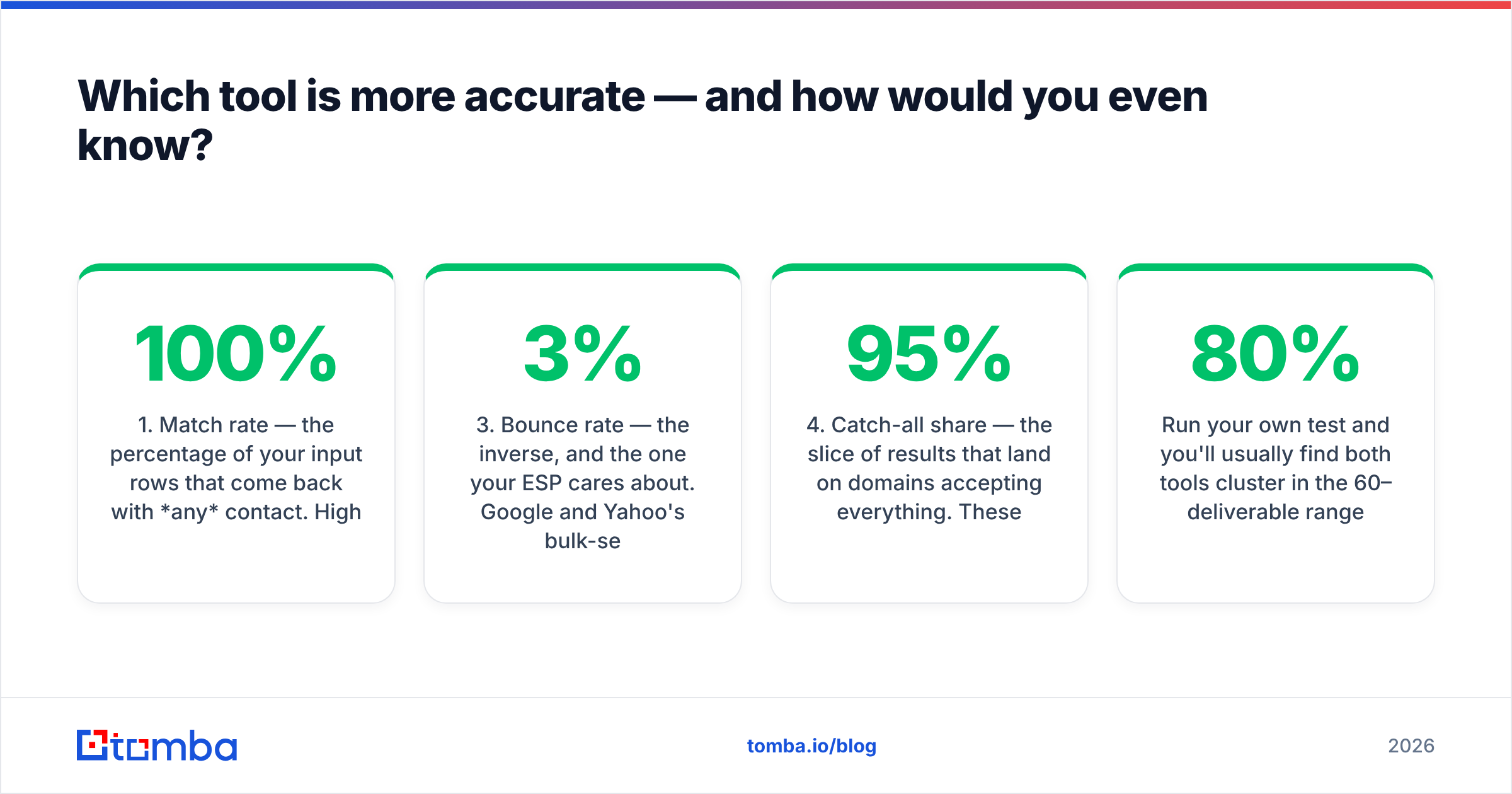
EasyLeadz sells credit bundles. A credit is usually consumed per revealed contact, and API access and bulk operations sit on higher tiers. Ninjapear sells straight credit packs with lower entry pricing and fewer feature gates. That is what makes it attractive to one-person outbound teams.
| Pricing factor | EasyLeadz | Ninjapear | Tomba |
|---|---|---|---|
| Model | Credit bundles, tiered features | Credit packs, flat features | Monthly plans + credits |
| Free tier | Small credit allowance | Small credit allowance | 25 searches/mo |
| Entry paid tier | Mid-range, phone-weighted | Low, email-only | $49/mo (Starter) |
| Mid tier | Higher, adds bulk + API | Larger credit pack | $99/mo (Growth) |
| Team/scale tier | Custom | Larger pack | $249/mo (Pro), Enterprise custom |
| Verification included | No | Minimal | Yes — verifier + catch-all |
| Credits roll over | Usually not | Usually not | Plan-dependent |
The trap in credit models is not the price per credit. It is the failure charge. Ask both vendors one question before you buy: do you charge a credit for a lookup that returns nothing, or returns a guess you can't verify?
A $0.03 credit that fails 35% of the time is really a $0.046 credit. Add external verification and it is closer to $0.06. Published Tomba pricing is worth comparing on that normalized basis, not sticker to sticker.


What does each tool do best?#
Neither wins outright. Here is where each one earns its keep.
EasyLeadz
- Direct dials in APAC. If your ICP sits in India, the Gulf, or Southeast Asia, Mr. E returns mobile numbers the big US databases simply do not have. Recruiters and calling-heavy SDR teams gain the most.
- LinkedIn-native workflow. Reps live in LinkedIn. An extension that reveals a number in the profile sidebar removes a tab switch, and removed tab switches are how tools get adopted.
Ninjapear
- Cheap volume email discovery. For a founder sending 500 cold emails a month to Western domains, the cost per usable address is hard to beat at the entry tier.
- No onboarding tax. Upload, download, done. No CRM mapping, no admin console, no seat management. For a two-person team that is a feature, not a limitation.
Both work best as a supplement, not a spine. Teams that get good results run one of these alongside a broader provider, using it to fill the one gap it covers well.
Where do both tools fall short?#
Be honest about the ceiling on each. Two problems hit deliverability:
- Verification is an afterthought. Neither product treats deliverability as a first-class concern. You will need a separate verification step. Skip it and you risk a burned sending domain and a two-month recovery project. A sender reputation check costs you ten minutes.
- Coverage cliffs are sharp. Both degrade fast outside their sweet spot. Ninjapear on a list of Indian SMBs, or EasyLeadz on a list of Nordic startups, gives results that look fine in aggregate and fall apart row by row.
Three more hit scale and workflow:
- Bulk workflows are limited. EasyLeadz gates bulk and API behind higher tiers. Ninjapear handles CSVs but adds little enrichment beyond the email itself. Neither is a comfortable home for a 50,000-row list refresh.
- Enrichment depth is shallow. You get a contact. You often do not get seniority, department, tech stack, headcount band, or a clean company mapping — the fields that make routing and scoring possible downstream.
- Integration surface is narrow. Expect Zapier and a CSV before a native, field-mapped CRM sync. If your RevOps process depends on clean writeback to HubSpot or Salesforce, budget engineering time.
Independent buyer reviews on G2 show the same pattern: high satisfaction inside the sweet spot, sharp frustration just outside it. Read the two-star reviews first. They tell you the geography and company size where the data thins out.
Which one should you choose?#
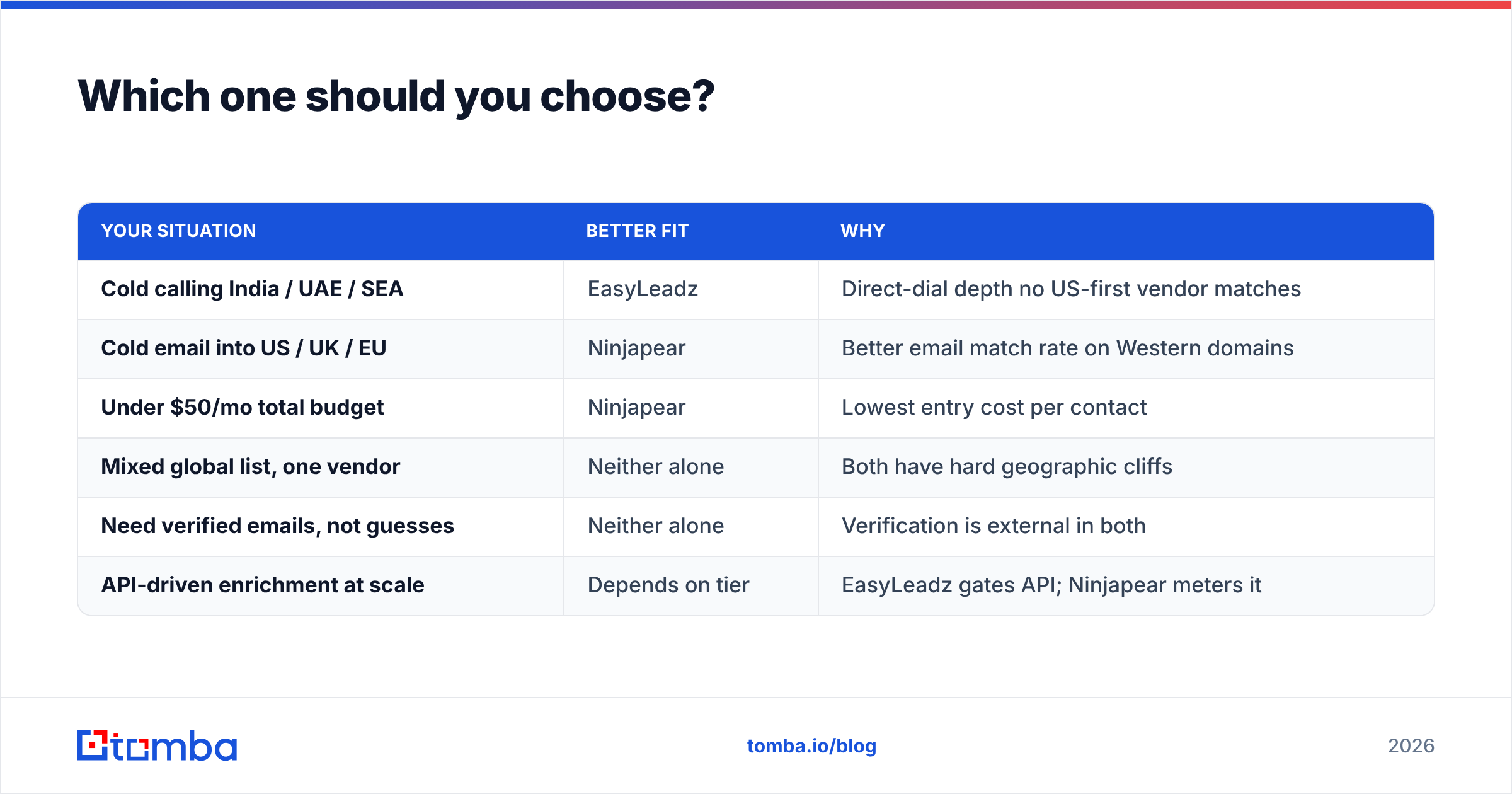
Pick by motion, not by feature list:
| Your situation | Better fit | Why |
|---|---|---|
| Cold calling India / UAE / SEA | EasyLeadz | Direct-dial depth no US-first vendor matches |
| Cold email into US / UK / EU | Ninjapear | Better email match rate on Western domains |
| Under $50/mo total budget | Ninjapear | Lowest entry cost per contact |
| Mixed global list, one vendor | Neither alone | Both have hard geographic cliffs |
| Need verified emails, not guesses | Neither alone | Verification is external in both |
| API-driven enrichment at scale | Depends on tier | EasyLeadz gates API; Ninjapear meters it |
If your answer keeps landing in the bottom half of that table — mixed geography, verification required, API needed — then EasyLeadz vs Ninjapear is not the real question. Both are point solutions. Your requirement is a platform.
That is the case for a consolidated option. A single provider that handles domain search, name-based lookup, verification, catch-all handling, and data enrichment removes the stitching work. It also removes the argument about who owns a bad address when one slips through.
How do you run a fair head-to-head test?#
Do not trust anyone's benchmark, including this one. Run your own:
- Build a 100-row control list from your real ICP — companies you would genuinely prospect, spread across the geographies you sell into. Skip the famous tech companies; everyone's data is good on those.
- Run the identical list through every candidate. Same rows, same order, same day. Record the match rate, and keep the nulls.
- Verify every returned address with a neutral third tool. Not the tool that produced it. Bucket results into valid, invalid, catch-all, and unknown.
- Calculate true cost per verified contact. Total spend divided by rows in the valid bucket only. Catch-alls count as half at best.
- Spot-check 10 phone numbers by hand if calling matters to you. Phone match rate is far less reliable than email, and a wrong number costs a rep more time than a missing one.
- Test the failure case. Feed each tool 10 rows you know are hard — tiny companies, non-English domains, recently rebranded firms. This is where vendors separate.
That process takes an afternoon. It routinely saves teams four figures a year in credits spent on contacts that never had a chance of landing.
Frequently asked questions#
Is EasyLeadz better than Ninjapear? For phone-led outbound in APAC, yes. For email-led outbound in Western markets, no. Neither is universally better.
Can I use both? Yes, and some teams do — EasyLeadz for dials, Ninjapear for addresses. Just note you are now paying two vendors and still lack verification.
Do either of them replace a verification tool? No. Treat every returned address as unverified until a dedicated verifier says otherwise. Watch your email deliverability signals closely in the first two weeks of sending.
What about catch-all domains? Both will return addresses on catch-all domains and mark them ambiguously at best. This is the most common source of the gap between a vendor's claimed accuracy and your measured bounce rate.
The bottom line#
EasyLeadz vs Ninjapear comes down to which half of the problem you need solved. EasyLeadz gives you the number. Ninjapear gives you the address. Both leave verification to you. If you only need one half, and you sell inside that tool's geographic sweet spot, either can be a reasonable, cheap choice.
If you need both halves — accurate addresses and proof they will deliver — consolidate. The Tomba Email Finder returns work emails by name, domain, or company, with verification and catch-all handling built into the same workflow instead of bolted on afterward. Start on the free tier with 25 searches. Run your 100-row control list against whatever you use today, and let the verified-contact math make the decision for you.
Related guides#
Ready to find emails that actually work?
Join 150,000+ professionals who stopped guessing and started sending. Free credits on signup — no credit card required.
Get the Tomba newsletter
Practical outbound tactics and product updates — once every two weeks.
About the author