EasyLeadz vs Nymeria 2026: Which B2B Contact Tool Wins?
EasyLeadz sells direct dials. Nymeria sells people data. Both promise contacts your CRM is missing — but they fail in different places. Here's the honest breakdown of coverage, accuracy, pricing and which one fits your outbound motion.
EasyLeadz vs Nymeria comes up on most B2B shortlists. One tool sells phone numbers. The other sells people data. This guide compares EasyLeadz vs Nymeria on coverage, accuracy, price and fit.
TL;DR
- EasyLeadz is a phone-first tool. Its "Mr. E" browser extension pulls direct dials off LinkedIn. Coverage is strongest in India, Southeast Asia and the Middle East. Email is a side output, not the main event.
- Nymeria is a people-data platform. It returns work and personal emails, phone numbers and social profiles. You get a LinkedIn extension and bulk enrichment on top.
- Neither tool checks emails hard enough for cold outreach at scale. EasyLeadz has no real verify layer. Nymeria's data goes stale when people switch jobs.
- Cost per usable contact lands in the same $0.30–$0.80 range for both. A finder-plus-verifier stack usually beats both on email.
- The quick EasyLeadz vs Nymeria call: pick EasyLeadz if you dial APAC. Pick Nymeria if you need personal emails and social handles for hiring. Pick neither if cold email is the whole game — pair a verified email finder with a real email verifier instead.
EasyLeadz vs Nymeria: what does each tool do?#
People compare these two all the time. They shouldn't. The tools solve nearby, but different, problems.
EasyLeadz (easyleadz.com) is an Indian B2B contact data company. Its flagship is Mr. E, a Chrome extension. Open a LinkedIn profile and it reveals a direct mobile number.
The pitch is blunt. Reps who cold call want a mobile, not a switchboard. EasyLeadz built its data around that goal. It also buys from regions where other vendors are thin. Prospecting into Bangalore, Dubai, Jakarta or Singapore? EasyLeadz will surface numbers that ZoomInfo and Apollo simply do not have.
Nymeria (nymeria.io) is a people-data company. It maps a person to a full profile: work email, personal email, mobile, LinkedIn, GitHub, Twitter, sometimes a personal site.
It sells through a browser extension, a bulk upload screen and an API. Its home turf is hiring and technical sourcing. A personal Gmail beats a work address there, because nobody reads job offers in work mail.
So the honest framing of EasyLeadz vs Nymeria is simple. It is phone-first regional depth versus broad people data. Judge them both as email finders and both will let you down.

EasyLeadz vs Nymeria: head-to-head comparison#
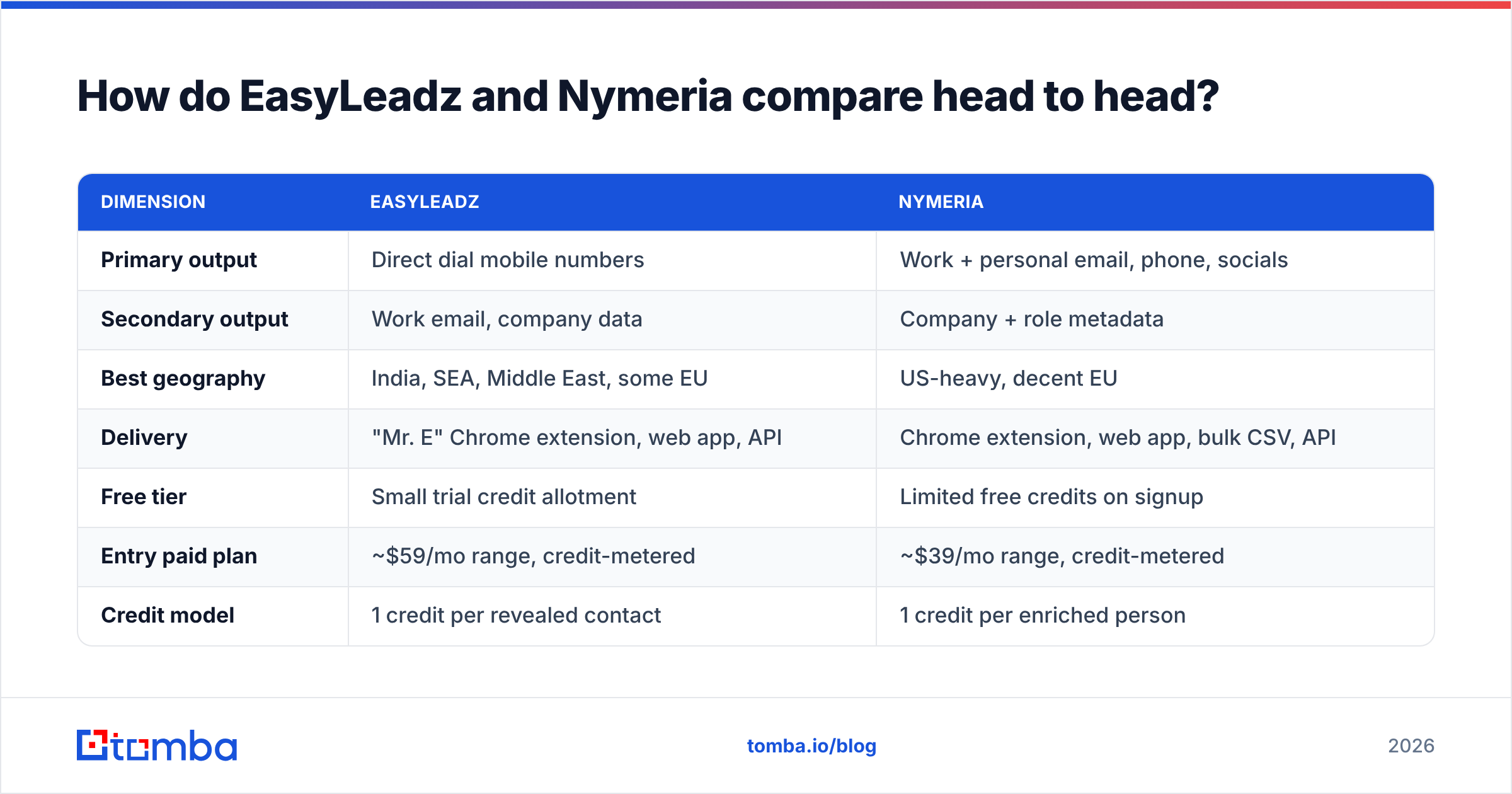
Here is the practical view. Treat pricing as a rough guide. Both vendors move tiers and credit bundles often, so check their own pages before you buy.
| Dimension | EasyLeadz | Nymeria |
|---|---|---|
| Primary output | Direct dial mobile numbers | Work + personal email, phone, socials |
| Secondary output | Work email, company data | Company + role metadata |
| Best geography | India, SEA, Middle East, some EU | US-heavy, decent EU |
| Delivery | "Mr. E" Chrome extension, web app, API | Chrome extension, web app, bulk CSV, API |
| Free tier | Small trial credit allotment | Limited free credits on signup |
| Entry paid plan | ~$59/mo range, credit-metered | ~$39/mo range, credit-metered |
| Credit model | 1 credit per revealed contact | 1 credit per enriched person |
| Email verification | Minimal / not a core feature | Basic validity signal, not SMTP-grade |
| Bulk enrichment | Available on higher tiers | Core feature, CSV in/out |
| Typical buyer | SDR teams dialing APAC | Recruiters, technical sourcers |
| Weak spot | Email accuracy, Western coverage | Data freshness on job changes |
User reviews on G2 show a steady pattern. EasyLeadz earns praise for phone hit rate in markets others skip. It draws fire for email quality.
Nymeria earns praise for the number of identifiers per person. It draws fire for stale records on people who moved jobs in the last 6–12 months.
EasyLeadz vs Nymeria: which one finds better emails?#
Nymeria wins. But the caveat matters more than the winner.
EasyLeadz treats email as a bonus field on a phone record. Many of its emails are pattern guesses. The system sees that a company uses first.last@domain.com and applies the rule.
That guess is fair. It lands maybe 60–70% of the time on well-known domains. It fails on firms with mixed formats. It fails on two staff with the same name. It fails after an acquisition changes the mail domain.
Nymeria pulls email from a much wider identity graph. It returns both work and personal addresses. For hiring, the personal email is a real edge.
For sales, you want the work email. Freshness there depends on when the record was last refreshed. A 2024 record for someone who moved in 2025 hands you a clean address at a company they left.
That is the caveat: neither tool gets you out of verifying. Both return addresses that look right. Looking right is not the same as landing. A guessed address at a dead mailbox will hard bounce. Hard bounces are the fastest way to burn sender reputation on a new domain.

The gap between "a tool returned a string" and "that string accepts mail" kills most cold email programs. Pick either tool, then run the output through SMTP-level checks before it hits a sequence.
EasyLeadz vs Nymeria: cost per usable contact#
Sticker price lies here. Everyone quotes a monthly fee and a credit count. Nobody quotes the credits you burn on rows you cannot use.
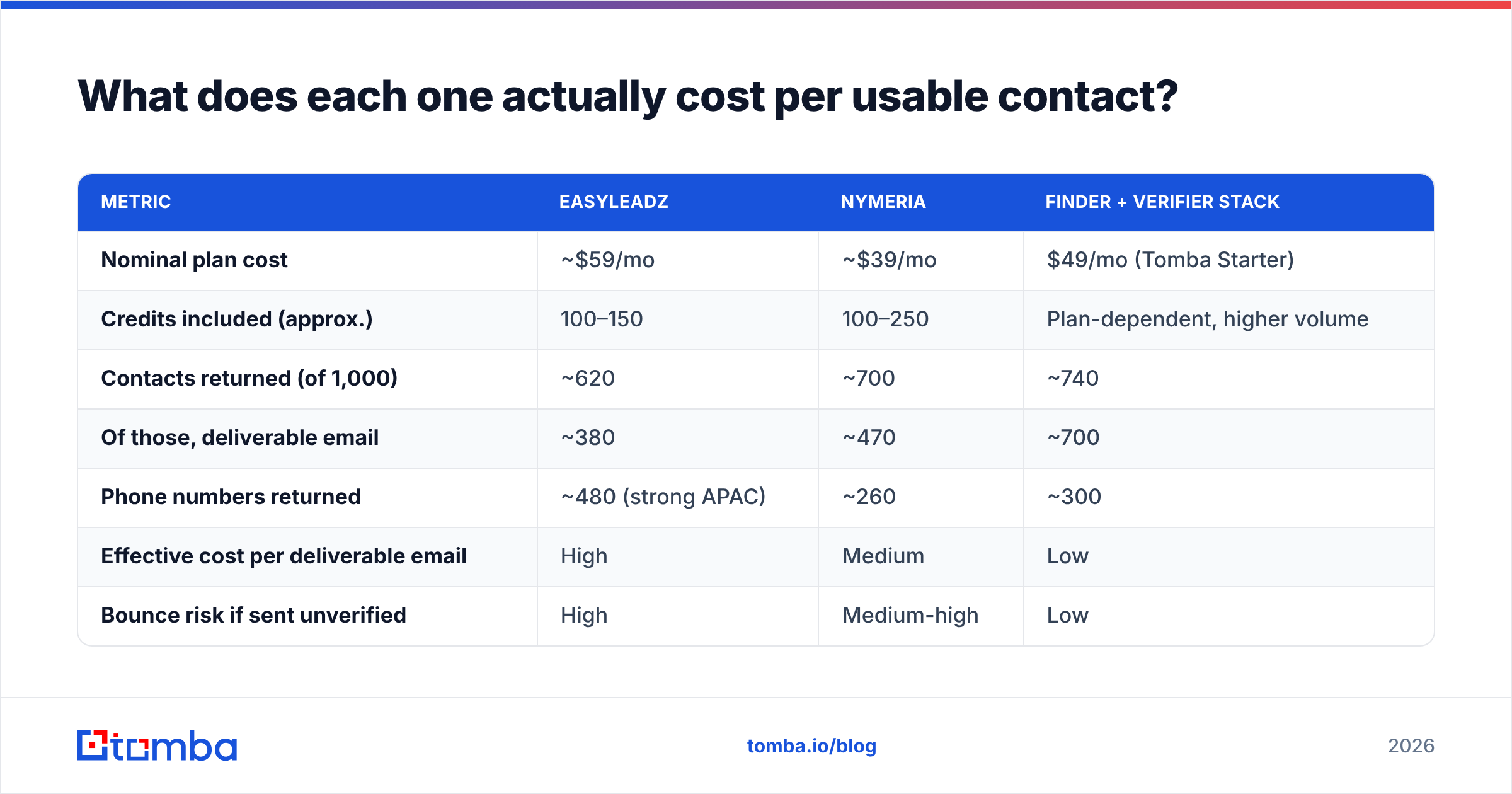
Work through a real case. You need 1,000 contacts, mid-market SaaS buyers, split across the US and APAC.
| Metric | EasyLeadz | Nymeria | Finder + verifier stack |
|---|---|---|---|
| Nominal plan cost | ~$59/mo | ~$39/mo | $49/mo (Tomba Starter) |
| Credits included (approx.) | 100–150 | 100–250 | Plan-dependent, higher volume |
| Contacts returned (of 1,000) | ~620 | ~700 | ~740 |
| Of those, deliverable email | ~380 | ~470 | ~700 |
| Phone numbers returned | ~480 (strong APAC) | ~260 | ~300 |
| Effective cost per deliverable email | High | Medium | Low |
| Bounce risk if sent unverified | High | Medium-high | Low |
Two things fall out of that table. First, EasyLeadz looks weak on email and strong on phone. That is exactly what it promises, so it is not a knock.
Second, both tools spend credits on records you will throw away. Neither charges you less for a bad row.
That is the case for splitting discovery from validation. Find with one system, verify with another. You then pay full price only on contacts that survive the second gate.
Tomba pricing runs Free (25 searches/mo), Starter $49/mo, Growth $99/mo, Pro $249/mo, and Enterprise custom. Verification sits in the same workflow, not in a second subscription you forget to renew.

EasyLeadz vs Nymeria for cold calling#
EasyLeadz wins, clearly — if your territory is one of its strong ones.
Direct dial coverage is not the same everywhere. It depends on which local sources a vendor has bought. EasyLeadz has Indian and Middle Eastern sources that US vendors never touched. Teams selling into APAC often report double the mobile hit rate of a US-first database.
Flip the map and the edge is gone. In US mid-market, EasyLeadz is plain. You get the switchboard, the odd mobile, and a lot of blanks.
Nymeria is not much better on US mobile. Phone is its third-best field, behind work email and social profiles.
If dialing drives your pipeline, the real question is not EasyLeadz vs Nymeria. It is which vendor has depth in your territory. Test both against 50 real accounts in your ICP before you sign an annual deal. Keep a phone validator in the loop too. A dead number costs a rep the same 90 seconds as a live one.
How to choose: the EasyLeadz vs Nymeria decision tree#
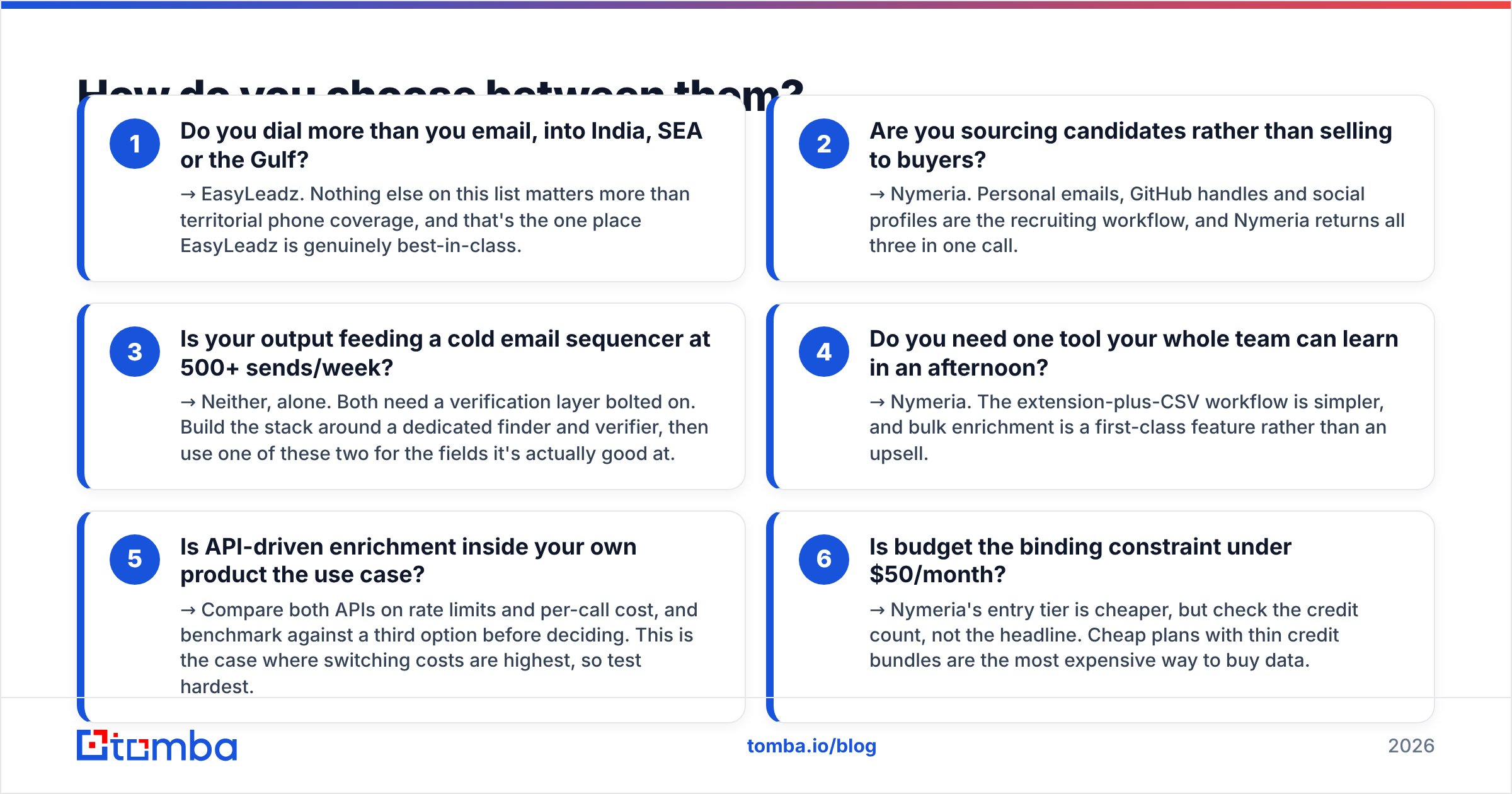
Run these in order. The first match decides it.
- Do you dial more than you email, into India, SEA or the Gulf? → EasyLeadz. Nothing else here beats territory coverage, and that is where EasyLeadz is best in class.
- Are you sourcing candidates, not selling to buyers? → Nymeria. Personal emails, GitHub handles and social profiles are the hiring workflow. Nymeria returns all three in one call.
- Is the output feeding a cold email tool at 500+ sends a week? → Neither, on its own. Both need a verify layer. Build around a finder and a verifier. Then use one of these for the field it is good at.
- Do you want one tool the team can learn in an afternoon? → Nymeria. The extension-plus-CSV flow is simpler, and bulk work is a core feature, not an upsell.
- Is API enrichment inside your own product the use case? → Compare both APIs on rate limits and cost per call. Benchmark a third option too. Switching costs are highest here, so test hardest.
- Is budget the hard limit under $50 a month? → Nymeria's entry tier is cheaper. Check the credit count, not the headline. Cheap plans with thin credits are the priciest way to buy data.

What are the real limits nobody advertises?#
EasyLeadz limits. Email comes second here. Expect pattern guesses, and plan to verify all of them. Coverage outside its core regions is patchy, so a US-only team will feel short-changed.
The credit model bills you for a reveal even when the field is one you do not need. Bulk workflows also lag the extension, so large list builds feel clunky.
Nymeria limits. Freshness is the common complaint. Static people data ages fast when job tenure keeps falling. A record that was perfect 18 months ago may point at the wrong company today.
Its email validity signal is a guess, not an SMTP handshake. So "valid" in the UI and "accepted by the mail server" are two different claims. Personal email data also raises GDPR questions. Ask your legal team before you build a motion on it.
Shared limit. Both run on a single source. When that source is wrong, there is no second opinion. Waterfall enrichment — where a miss on provider A retries against B and C — beats any single vendor on coverage. Build it or buy it. Just know that a one-vendor stack hits a coverage ceiling within a quarter.
What about catch-all domains and enterprise targets?#
Both tools get shaky here. It deserves its own section, because it hits your best accounts hardest.
Large firms often run catch-all mail servers. Those servers accept every address at the domain and sort it out later. A naive check hits a catch-all, sees "accepted", and marks the address valid.
It is not valid. The mail was accepted, then dropped into a void. That is worse than a bounce. You never learn it failed. You just watch reply rates sag and blame the copy.
Neither EasyLeadz nor Nymeria flags this well. You get an address, a green-ish status, and you send.
If your ICP skews enterprise, use a dedicated catch-all verifier. A good one weighs pattern confidence and past engagement instead of trusting the SMTP reply. Skip that step and a clean-looking list still underperforms. No dashboard in either tool will tell you why.
EasyLeadz vs Nymeria: which should you buy in 2026?#
Short verdict: EasyLeadz if you dial APAC. Nymeria if you source talent. A finder-plus-verifier stack if cold email drives revenue.
The mistake is treating this as one winner. These are specialist tools with narrow peaks. EasyLeadz peaks at regional mobile coverage, and that edge is real. Nymeria peaks at multi-identifier people data, which is a gift for recruiters.
Neither peak is "verified work email at volume." That is what most B2B outbound teams need on day one.
Build the stack in that order. Solve email discovery and verification first. It is the channel with the most volume and the least room for bad data. Then add a specialist for your second channel — phone, LinkedIn, or personal outreach.
Buying the specialist first and hoping it covers email is how teams end up with a 12% bounce rate and a domain they have to drop.
Whatever you pick, measure it. Track deliverable-address rate per source, not credits spent. Track cost per replied-to contact, not cost per record. The cheapest tool on the pricing page is rarely the cheapest on that second number. And that second number is the one your CFO will ask about.
Ready to fix the email half of the problem? Tomba's Email Finder does one job: return a work email that accepts mail. It ships with SMTP-level checks, catch-all handling, and a bulk email finder for list-scale work. You stop paying credits for rows you will delete.
Start free with 25 searches a month. Run your own head-to-head against whatever EasyLeadz or Nymeria returned, and let the bounce rate settle the argument.
Related guides#
// get started
Find, verify and enrich your first contacts today
Start on the free plan with 25 searches a month, then scale when your team is ready.
Free plan · No credit card required · GDPR & CCPA
Get the Tomba newsletter
Product and data updates
// about the author