EasyLeadz vs RampedUp (2026): Which B2B Data Tool Wins?
EasyLeadz sells direct dials. RampedUp sells CRM data hygiene. They barely compete on the same axis — and picking wrong costs you a quarter. Here's the honest breakdown.
TL;DR
- EasyLeadz is a mobile-number-first tool built around its Chrome extension for LinkedIn. Strong in India and APAC, weaker on verified work emails and Western enterprise coverage.
- RampedUp is a CRM-native enrichment and data-hygiene layer. It shines when your Salesforce or HubSpot records are stale, not when you need net-new contacts fast.
- These two tools are rarely a real head-to-head. If you're comparing them, you probably have a data problem you haven't defined yet.
- Neither is a strong pure email-finder. If email is your primary outbound channel, a dedicated email finder plus verification will outperform both on cost-per-valid-contact.
- Budget reality: EasyLeadz credits get expensive fast at scale; RampedUp prices per seat and per record, which punishes large dirty databases.
What are EasyLeadz and RampedUp actually built for?#
Start with the honest framing: these two products solve different problems that happen to overlap in a Google search.
EasyLeadz is a contact-discovery tool. Its flagship is "Mr. E," a Chrome extension that sits on LinkedIn profiles and returns a direct dial mobile number, sometimes an email. It was built by an India-based team and its data density reflects that origin — coverage of Indian and broader APAC professionals is genuinely good, often better than the big US players. Pricing is credit-based, and one credit typically buys one revealed contact.
RampedUp is an enrichment and data-management platform. It plugs into your CRM, scans existing records, flags job changes, fills missing firmographics, and appends contacts at target accounts. Its pitch is not "find me a number right now" — it's "your Salesforce instance is 40% decayed and you don't know which 40%."
That distinction matters more than any feature grid. A rep who needs a phone number in the next 90 seconds is not the same buyer as a RevOps lead staring at 180,000 stale records.

The four questions that decide this for you#
- Is your bottleneck net-new contacts or decaying existing contacts? Net-new → EasyLeadz side of the spectrum. Decay → RampedUp side.
- What's your primary channel? Cold calling favors EasyLeadz's mobile depth. Cold email favors neither — you'll want a dedicated finder plus email verification.
- Where are your buyers? India/SEA/Middle East → EasyLeadz has a real edge. North America/EU enterprise → RampedUp's sources and the broader vendor pool are more competitive.
- Who's operating the tool? Individual reps in a browser → EasyLeadz. A RevOps admin running scheduled jobs → RampedUp.
- What does one bad record cost you? If you're calling, a wrong number wastes 40 seconds. If you're emailing, a wrong address damages sender reputation for weeks. That asymmetry should drive your verification spend.
How do EasyLeadz and RampedUp compare head to head?#
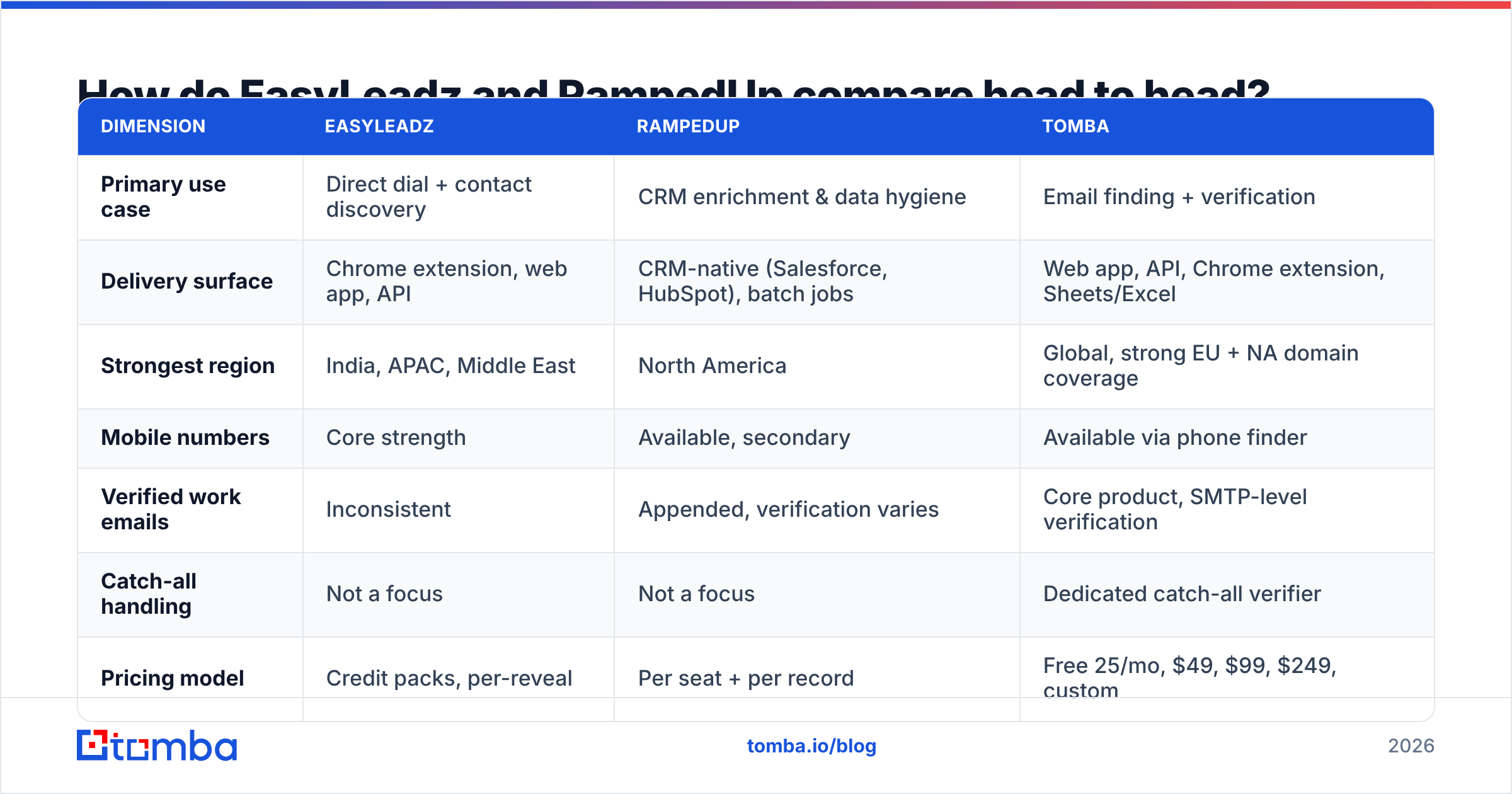
| Dimension | EasyLeadz | RampedUp | Tomba |
|---|---|---|---|
| Primary use case | Direct dial + contact discovery | CRM enrichment & data hygiene | Email finding + verification |
| Delivery surface | Chrome extension, web app, API | CRM-native (Salesforce, HubSpot), batch jobs | Web app, API, Chrome extension, Sheets/Excel |
| Strongest region | India, APAC, Middle East | North America | Global, strong EU + NA domain coverage |
| Mobile numbers | Core strength | Available, secondary | Available via phone finder |
| Verified work emails | Inconsistent | Appended, verification varies | Core product, SMTP-level verification |
| Catch-all handling | Not a focus | Not a focus | Dedicated catch-all verifier |
| Pricing model | Credit packs, per-reveal | Per seat + per record | Free 25/mo, $49, $99, $249, custom |
| Free tier | Limited trial credits | Demo/trial, sales-gated | Yes — 25 searches/mo, no card |
| Best for | SDRs cold calling APAC | RevOps cleaning a stale CRM | Email-led outbound at any scale |
Three things jump out of that table.
First, the overlap is narrower than the marketing suggests. EasyLeadz wants to live in a rep's browser. RampedUp wants to live in your CRM's background jobs. If you buy one expecting the other's job to be done, you'll be disappointed within two weeks.
Second, neither is optimized for email. Both will return email addresses. Neither treats email accuracy as the product's reason to exist, which shows up in bounce rates once you're sending at volume.
Third, pricing structures fail at opposite ends. EasyLeadz's per-reveal credits are fine at 200 contacts a month and painful at 5,000. RampedUp's per-record enrichment is fine on a clean 20k database and painful on a bloated 300k one — you pay to enrich records you should have deleted.
Which one has better data accuracy?#
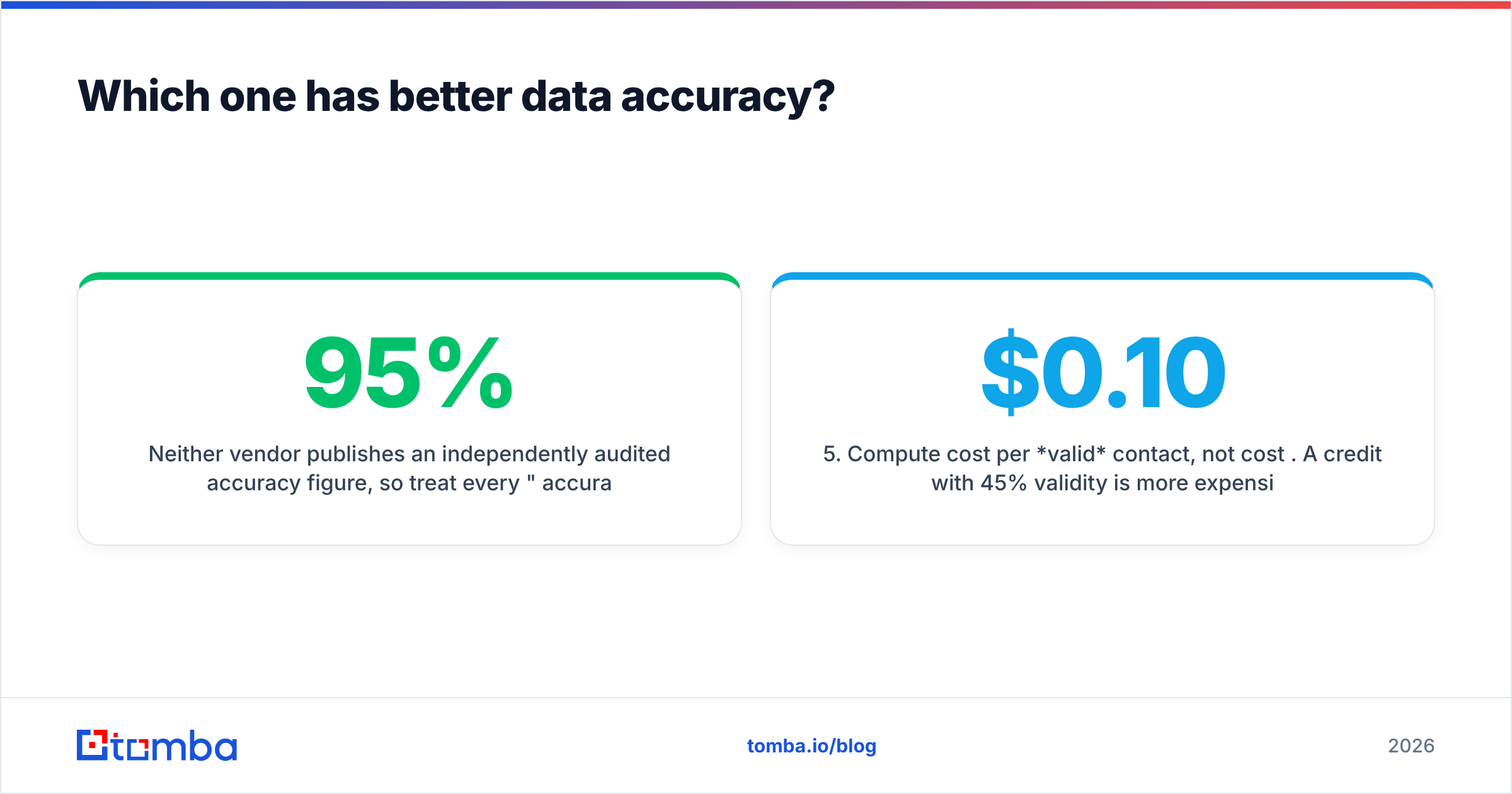
Neither vendor publishes an independently audited accuracy figure, so treat every "95% accurate" claim — from anyone, including us — as a marketing number until you test it on your own ICP.
What you can reason about is sourcing, and here the two differ sharply.
EasyLeadz leans on a contributory and partner-sourced model concentrated around LinkedIn profile matching. That works well when the profile is active and the person is in a region where EasyLeadz has density. It degrades on stale profiles, on people who changed jobs recently, and on markets outside its core.
RampedUp aggregates from multiple licensed data partners and layers job-change detection on top. Its accuracy story is less about "is this number right today" and more about "did this contact move, and did we catch it." That's a genuinely different quality axis — and for a CRM with a three-year-old contact table, arguably the more valuable one.

The practical test, which takes an afternoon:
- Pull 100 contacts from your actual ICP — not a demo list the vendor hands you.
- Run them through both tools during trials, same list, same day.
- Measure fill rate first — what percentage returned any contact at all? This is where vendors diverge most.
- Measure validity second — for phones, dial 20 at random. For emails, run them through a free email checker or a bulk verifier before sending anything.
- Compute cost per valid contact, not cost per credit. A $0.10 credit with 45% validity is more expensive than a $0.25 credit at 92%.
That last line is the whole ballgame. Vendors compete on list price because cost-per-valid-contact makes most of them look worse.
Is EasyLeadz better than RampedUp for cold outbound?#
For cold calling, yes, in most cases. EasyLeadz's entire design assumes a rep on a LinkedIn profile who needs a mobile number now. The extension workflow is fast, the mobile coverage is its genuine differentiator, and reps adopt it without training. If your motion is dials-first and your market skews APAC, it's a reasonable buy.
For cold email, no — and neither is RampedUp. This is the most common mistake in this comparison. Teams buy a phone-first tool, get emails as a bonus, blast a sequence, and watch their bounce rate cross 8%. At that point Google and Microsoft start filtering your domain, and the cheap credits you saved cost you a quarter of pipeline.
Cold email requires three things these tools treat as secondary:
- Pattern-level domain intelligence — knowing that a company uses
first.last@versusflast@before you guess. A domain search solves this directly. - SMTP-level verification — an actual mailbox handshake, not a syntax check.
- Catch-all resolution — roughly a fifth of B2B domains accept everything, and treating those as "valid" is how good-looking lists still bounce. A dedicated catch-all verifier is the only honest answer here.
For account-based motions with an existing CRM, RampedUp is the better fit of the two. Job-change alerts on closed-won contacts are a legitimately high-ROI signal — a champion who moves to a new company is your warmest possible lead, and most teams never catch it.
What are the real costs and hidden limits?#
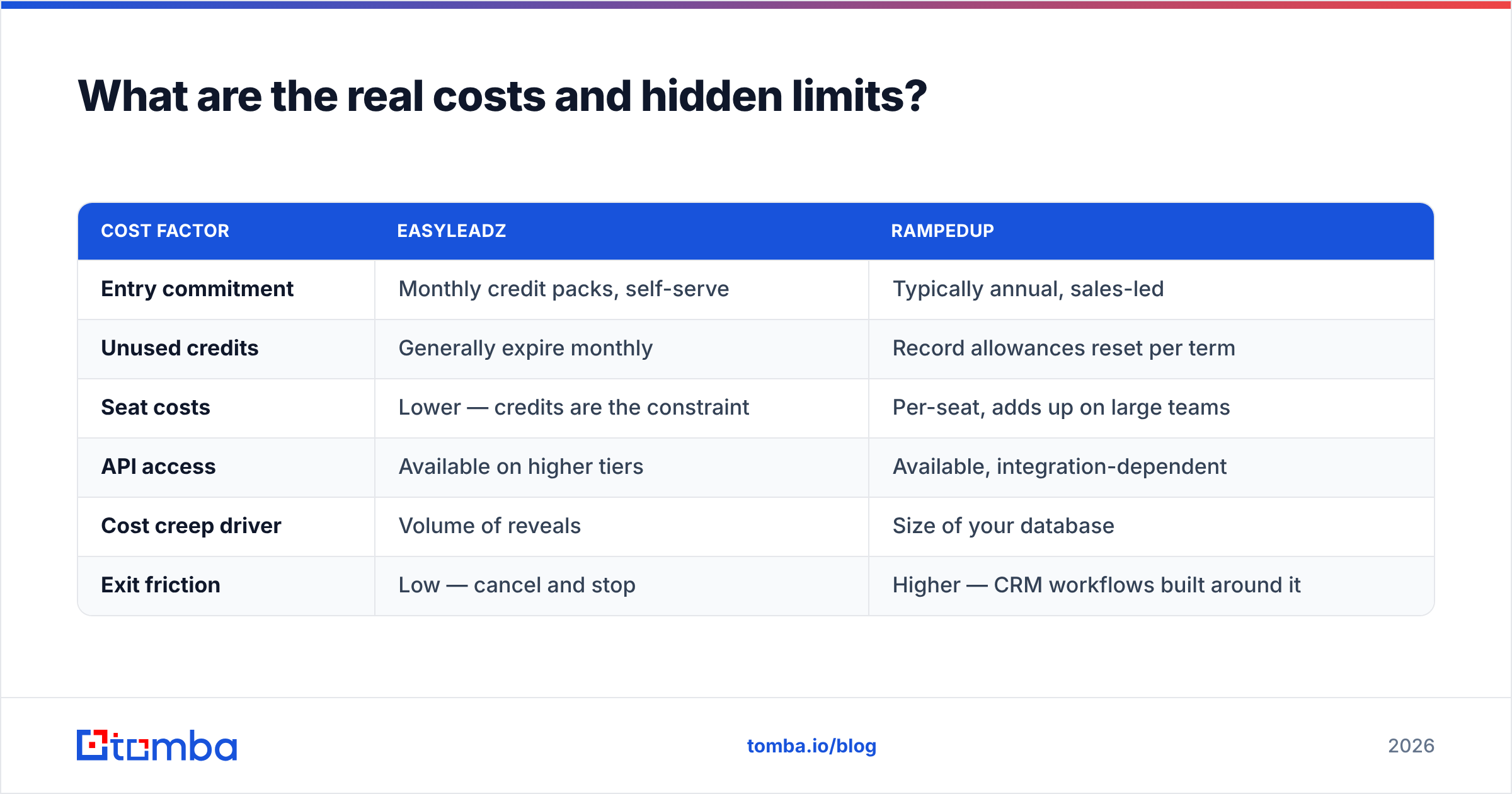
| Cost factor | EasyLeadz | RampedUp |
|---|---|---|
| Entry commitment | Monthly credit packs, self-serve | Typically annual, sales-led |
| Unused credits | Generally expire monthly | Record allowances reset per term |
| Seat costs | Lower — credits are the constraint | Per-seat, adds up on large teams |
| API access | Available on higher tiers | Available, integration-dependent |
| Cost creep driver | Volume of reveals | Size of your database |
| Exit friction | Low — cancel and stop | Higher — CRM workflows built around it |
The hidden cost nobody quotes: rework. Every invalid contact costs you a rep's time to discover, a CRM record to clean up, and — on email — a slice of email deliverability you can't buy back. Price that in and the cheapest list price is rarely the cheapest tool.
A second hidden cost on the RampedUp side: enriching junk. If 30% of your CRM records are dead accounts, defunct companies, or duplicate rows, per-record enrichment charges you to polish them. Deduplicate first — a duplicate removal pass before enrichment routinely cuts the billable record count by double digits.
When should you use something else entirely?#
Skip both if any of these describe you:
- Email is your primary channel. You need a finder built around email accuracy, not a phone tool that also returns addresses. Run a bulk email finder against your target company list and verify before send.
- You need a single API for finding and verifying. Stitching a discovery vendor to a separate verification vendor adds latency, cost, and a failure point. A unified email finder API collapses that.
- You're a small team testing the motion. Sales-gated demos and annual contracts are the wrong shape for a two-person team validating a channel. A free tier that gives you real searches — Tomba's free plan includes 25 searches a month, no card — lets you test before committing.
- Your buyers are outside APAC and you mostly email them. EasyLeadz's regional edge doesn't help you, and you're paying for phone data you won't dial.
It's also worth naming the honest alternative set. BookYourData is a solid option if you want pay-as-you-go prebuilt lists with a bounce guarantee rather than a search-and-reveal workflow — a genuinely different buying model that suits teams who'd rather buy a vetted list than run queries. Apollo bundles data with sequencing if you want one platform. And on the verification side, tools reviewed on G2 will give you real user data on bounce rates that no vendor page will.
How do you actually run the evaluation?#
Give yourself two weeks and follow this order.
- Define the unit. Decide whether success is "valid mobile number" or "deliverable work email." You cannot optimize both with one vendor at one price.
- Build the test list. 100 real accounts, real titles, real geographies. Include 20 that you know the answer for — contacts already in your CRM you've verified by hand. This is your accuracy control group.
- Trial both simultaneously. Sequential trials get contaminated by seasonality, list changes, and your own learning curve.
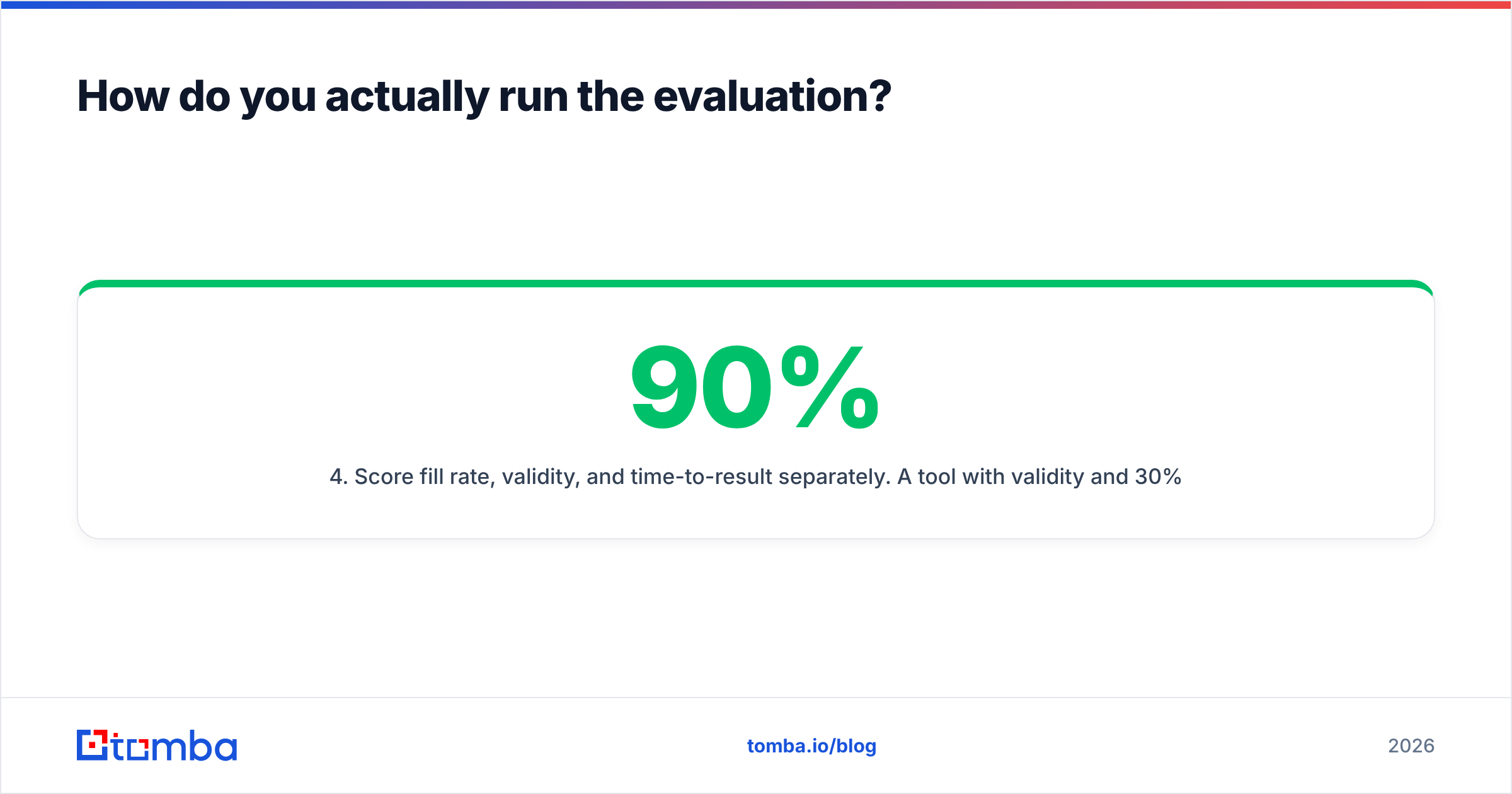
- Score fill rate, validity, and time-to-result separately. A tool with 90% validity and 30% fill rate is worse than one with 80% validity and 75% fill for most outbound teams.
- Model the annual cost at 3x your current volume. Both vendors' pricing behaves non-linearly. Find where it breaks before you sign.
- Check the exit. Can you export enriched records? Does cancellation strand data in the vendor's system? Ask this before the contract, not during the renewal fight.
Run that and the answer stops being a blog post's opinion and becomes your own number.
The verdict#
Choose EasyLeadz if you're a calling-led team selling into India, Southeast Asia, or the Middle East, your reps live in LinkedIn, and mobile numbers are the constraint on your day. Its regional depth is a real, defensible advantage that the big US vendors haven't matched.
Choose RampedUp if you're a RevOps function with a large, aging CRM, you care more about job-change signal and record completeness than net-new discovery, and you have the admin capacity to actually operationalize enrichment jobs.
Choose neither if your outbound is email-led. That's the most common case among the teams asking this question, and it's the case both tools serve worst. You'll spend less and bounce less with a purpose-built finder and verifier stack.
If email is where your pipeline comes from, start with the Tomba Email Finder. Search by domain, name, or company, get pattern-aware results with confidence scores, verify at SMTP level before you send, and handle catch-all domains instead of pretending they're clean. The free tier gives you 25 searches a month with no card, and paid plans start at $49/mo — see Tomba pricing for the full breakdown. Test it against whatever you're using today on the same 100-account list. Cost per valid contact is the only number that matters, and it's the one we'd rather be judged on.
Related guides#
Ready to find emails that actually work?
Join 150,000+ professionals who stopped guessing and started sending. Free credits on signup — no credit card required.
Get the Tomba newsletter
Practical outbound tactics and product updates — once every two weeks.
About the author