EasyLeadz vs ReachStream: Which B2B Data Tool Wins in 2026?
EasyLeadz sells phone-first contact data with a Chrome extension. ReachStream sells downloadable list segments. We compare coverage, accuracy, credits and real cost so you can pick the right one.
TL;DR
- EasyLeadz is a phone-first contact tool built around its "Mr. E" Chrome extension. You look up one prospect at a time from LinkedIn and get direct dials. Strongest coverage in India and APAC.
- ReachStream is a list-first database. You filter by industry, geography and job function, then export a CSV. Strongest in US healthcare, tech and manufacturing segments.
- They are not really competitors. One is a per-contact reveal tool, the other is a bulk list vendor. Choosing between them is mostly a question of whether you prospect one account at a time or buy segments.
- Both charge credit-based pricing that gets expensive fast at volume, and both have thinner email verification than dedicated email tools.
- If your bottleneck is verified work email at scale rather than phone numbers or raw list volume, a dedicated email finder like Tomba typically costs less per usable contact.
What are EasyLeadz and ReachStream?#
EasyLeadz launched out of India and built its reputation on direct dial phone numbers. Its flagship product is the Mr. E browser extension: you open a LinkedIn profile, click the icon, and it returns a mobile number and often a work email. Everything is metered in credits, and the workflow is inherently one-profile-at-a-time. There is an API and a bulk enrichment path, but the extension is what most teams actually use daily.
ReachStream works from the opposite direction. It is a B2B contact database you query with filters — industry, employee count, revenue band, job title, country — and the output is a downloadable list. You are effectively buying a segment, not researching a person. That makes it closer to a traditional data vendor than to a reveal tool.
The practical consequence: EasyLeadz fits an SDR who researches 30 accounts a day and wants a phone number for each. ReachStream fits a demand gen or marketing ops person who needs 5,000 contacts in "US hospitals, 200-1000 employees, Director+" loaded into a nurture sequence next Tuesday.
Confusing the two is the most common mistake buyers make. Teams buy ReachStream expecting deep per-person research, or buy EasyLeadz expecting to fill a 10,000-row campaign, and then blame the data.
How do EasyLeadz and ReachStream compare head-to-head?#
Here is the honest side-by-side. Pricing moves, so treat these as published list prices at the time of writing and confirm on each vendor's site before you buy.
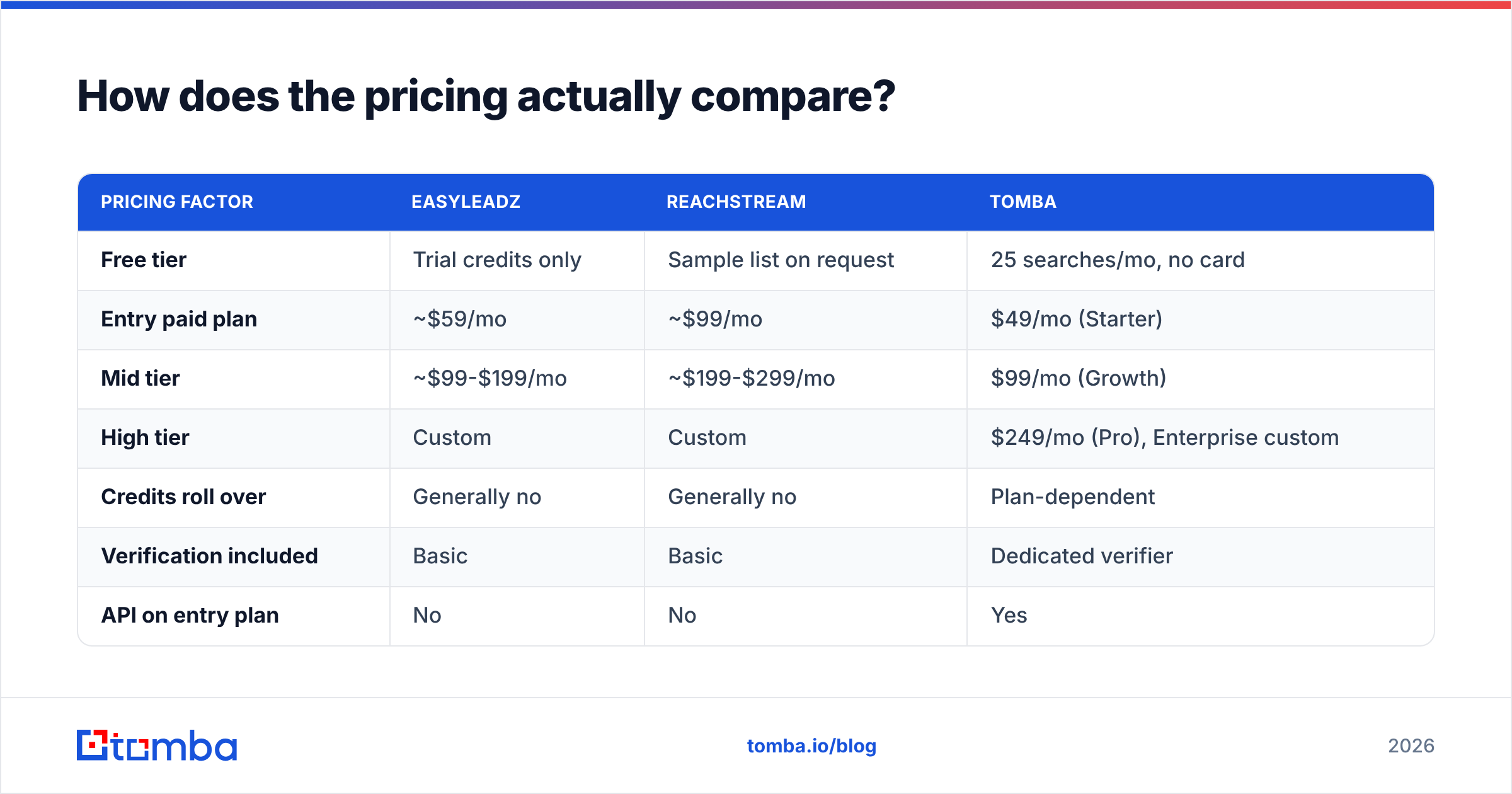
| Attribute | EasyLeadz | ReachStream |
|---|---|---|
| Primary format | Per-contact reveal (Chrome extension) | Bulk list download (CSV) |
| Core strength | Direct dial mobile numbers | Segment volume and filters |
| Geographic sweet spot | India, SEA, Middle East | US, Canada, Western Europe |
| Entry price | Roughly $59/mo for a small credit pack | Roughly $99/mo entry tier |
| Free access | Limited trial credits | Sample list on request |
| Email verification | Basic, bundled | Basic, bundled |
| API access | Yes, on higher tiers | Limited |
| CRM integrations | HubSpot, Zoho, Salesforce | CSV-first, fewer native syncs |
| Best for | SDRs doing account-by-account research | Marketers buying whole segments |
| Weakest point | Cost per contact at volume | Data freshness on niche segments |

Two structural differences matter more than any feature row above.
First, credit burn behaves differently. With EasyLeadz you spend a credit per reveal whether or not the number is current, so a bad month of stale records is a real cash cost. With ReachStream you buy volume up front, which caps your downside but means you eat whatever percentage of the list is dead.
Second, verification is an afterthought in both. Neither vendor is primarily an email hygiene company. If you are running cold email, you will still want an independent email verifier pass before you load anything into a sending tool, regardless of which one you pick.
Which one has better data accuracy?#
Neither wins outright, because they are accurate at different things.
EasyLeadz consistently performs better on phone numbers, especially non-US mobile. That is its whole reason for existing, and independent reviews on G2 reflect it — reviewers praise the direct dials and complain about email coverage. If you are a team that actually picks up the phone, this matters enormously.
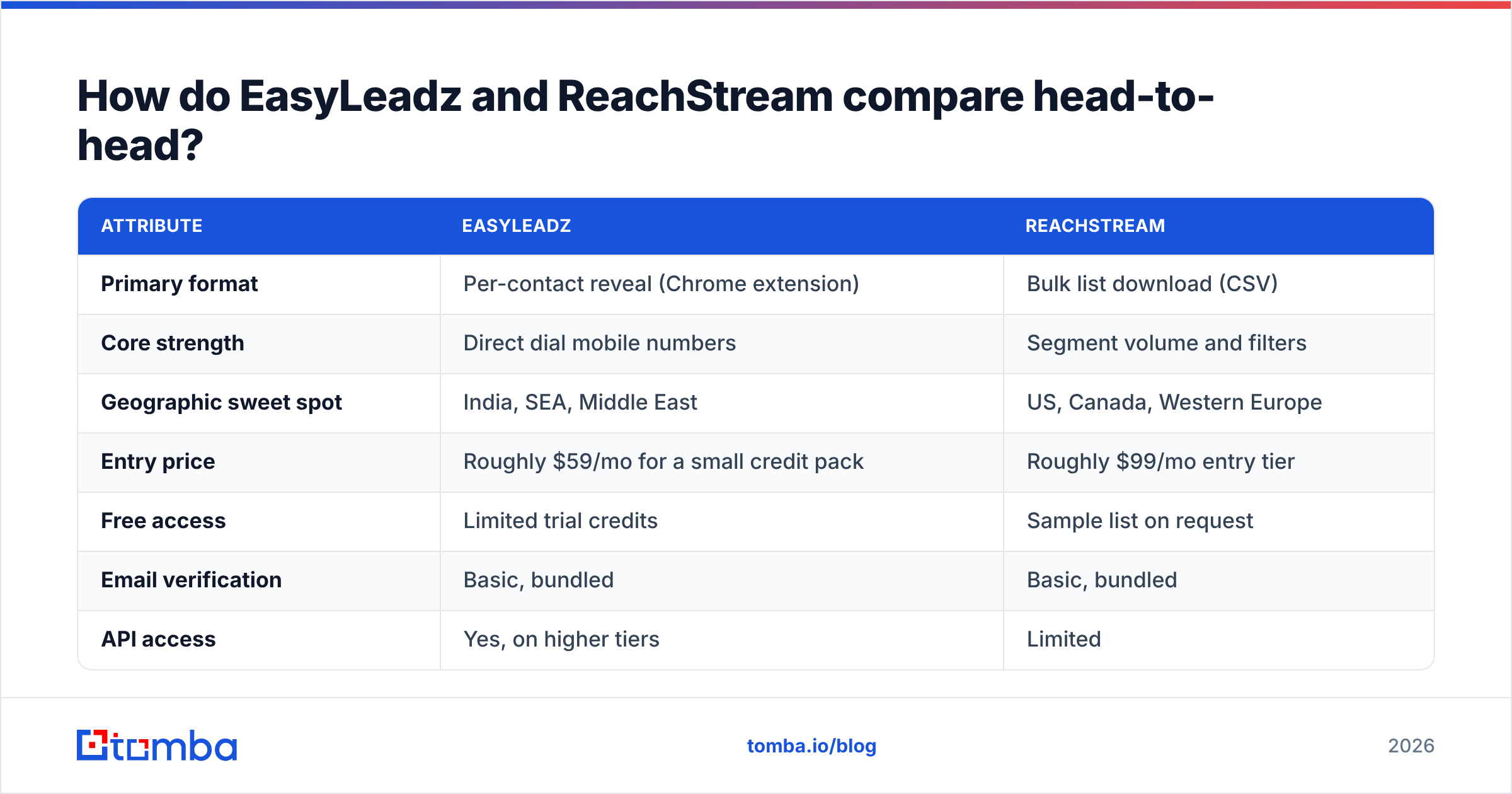
ReachStream performs better on breadth of firmographic fields. A ReachStream export typically arrives with company size, revenue estimate, SIC/NAIC codes, and technology hints already populated. That saves an enrichment step. The tradeoff is freshness: bulk databases decay, and B2B contact data decays fast — roughly 25-30% of contact records go stale per year through job changes alone.

Here is the part most comparison posts skip: accuracy claims are unfalsifiable unless you test them yourself. Both vendors publish confidence figures. Neither publishes the methodology. The only number that matters is your own bounce rate on your own ICP.
Run this test before you sign anything:
- Pull 100 contacts from each vendor against the exact same filter — same country, same title band, same company size.
- Strip duplicates across both lists so you are measuring unique records, not overlap.
- Run all of them through a neutral verifier you do not buy from either vendor. Record valid, invalid, catch-all and unknown.
- Send a small warm-up batch of 50 from each and log hard bounces at 48 hours.
- Divide the price paid by the number of contacts that survived step 3 and step 4. That is your real cost per usable contact.
Almost every buyer skips step 5, and it is the only number that decides the purchase. A $99 list where 40% bounces is more expensive than a $150 list where 3% bounces.
How does the pricing actually compare?#
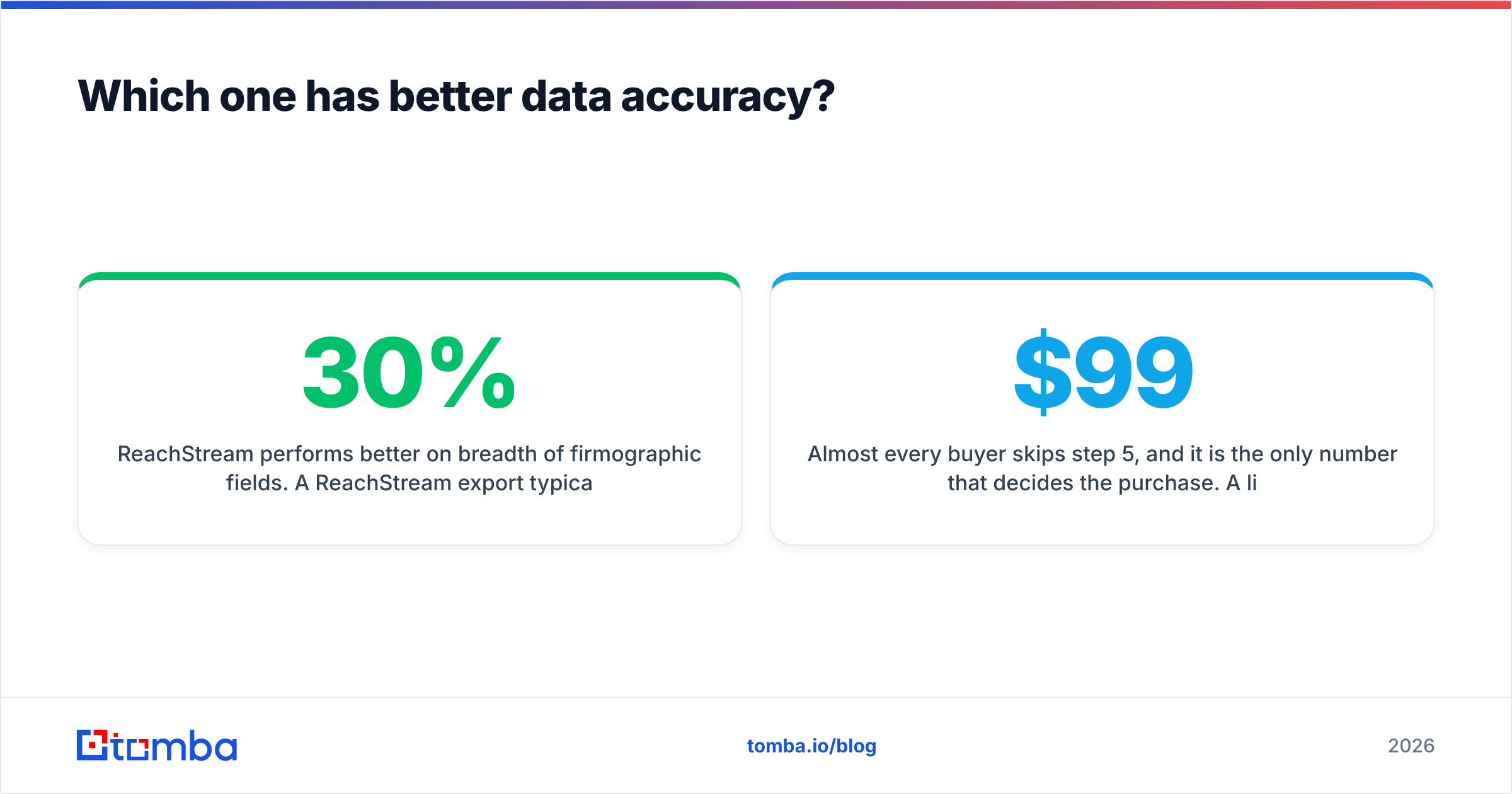
Both use credit models, which makes headline prices misleading. A "credit" at EasyLeadz buys one contact reveal. A "credit" in a bulk database buys one exported row. Those are not the same unit of value, because the reveal is targeted and the export row is speculative.
| Pricing factor | EasyLeadz | ReachStream | Tomba |
|---|---|---|---|
| Free tier | Trial credits only | Sample list on request | 25 searches/mo, no card |
| Entry paid plan | ~$59/mo | ~$99/mo | $49/mo (Starter) |
| Mid tier | ~$99-$199/mo | ~$199-$299/mo | $99/mo (Growth) |
| High tier | Custom | Custom | $249/mo (Pro), Enterprise custom |
| Credits roll over | Generally no | Generally no | Plan-dependent |
| Verification included | Basic | Basic | Dedicated verifier |
| API on entry plan | No | No | Yes |
Three cost traps worth knowing before you commit:
- Non-rollover credits punish uneven months. Outbound is seasonal. If December is quiet, you paid for credits you burned nowhere.
- Failed lookups often still consume budget. Ask each vendor in writing whether a "no result" returns the credit. The answers differ, and the sales page rarely says.
- Annual discounts hide the real commitment. A 20% annual discount on a tool you abandon in month four is a 100% loss, not a 20% saving.
You can compare the equivalent tiers on Tomba pricing to sanity-check what a per-contact rate should look like in 2026.
Which tool fits which use case?#
Skip the feature matrix and match the tool to how you actually work:
- You cold call India, SEA or the Middle East — EasyLeadz, without much debate. Mobile coverage in those regions is its moat and few Western vendors come close.
- You need 5,000 US contacts in one segment by Friday — ReachStream. The filter-and-export flow is built for exactly this, and buying a segment is faster than revealing 5,000 profiles one at a time.
- You run cold email and live or die by bounce rate — neither, as your primary source. Use a dedicated email finder with a verification layer built in, and add a phone vendor only if calling is a real channel for you.
- You are enriching an existing CRM of 20,000 stale records — a bulk enrichment API, not an extension. Check whether your candidate's API is on the entry plan or gated behind enterprise pricing; this is where budgets blow up.
- You are a solo founder testing whether outbound works at all — start on a free tier and validate the channel before you commit to a contract. Anything with a mandatory annual term is the wrong first purchase.
- You need both emails and phone numbers in one workflow — pair a strong email tool with a dedicated phone finder rather than accepting one vendor's weak second product.

What do real users complain about?#
Reading past the five-star reviews, the recurring themes are consistent and worth weighing.
For EasyLeadz, the two most common complaints are cost at volume and email quality relative to phone quality. Teams that adopt it for phones are happy; teams that adopt it hoping to replace their email source often end up running a second tool anyway. Credits disappearing on partial matches is the third recurring theme.
For ReachStream, the complaints cluster around freshness and support responsiveness on niche segments. Broad segments — "US SaaS, 50-500 employees" — tend to perform fine. Narrow ones — "German medical device QA managers" — are where bulk databases thin out and the delivered row count falls well short of what the filter preview implied. Always ask for the actual match count before purchase, not the estimate.
A fair note on both: they are honest about what they are. Neither claims to be an all-in-one revenue platform, and that focus is a feature. The problem is buyers treating a phone tool as an email tool, or a list vendor as a research tool.
Is there a better option than either for email-led outbound?#
If your primary channel is email, yes — and this is where being specific matters more than being diplomatic.
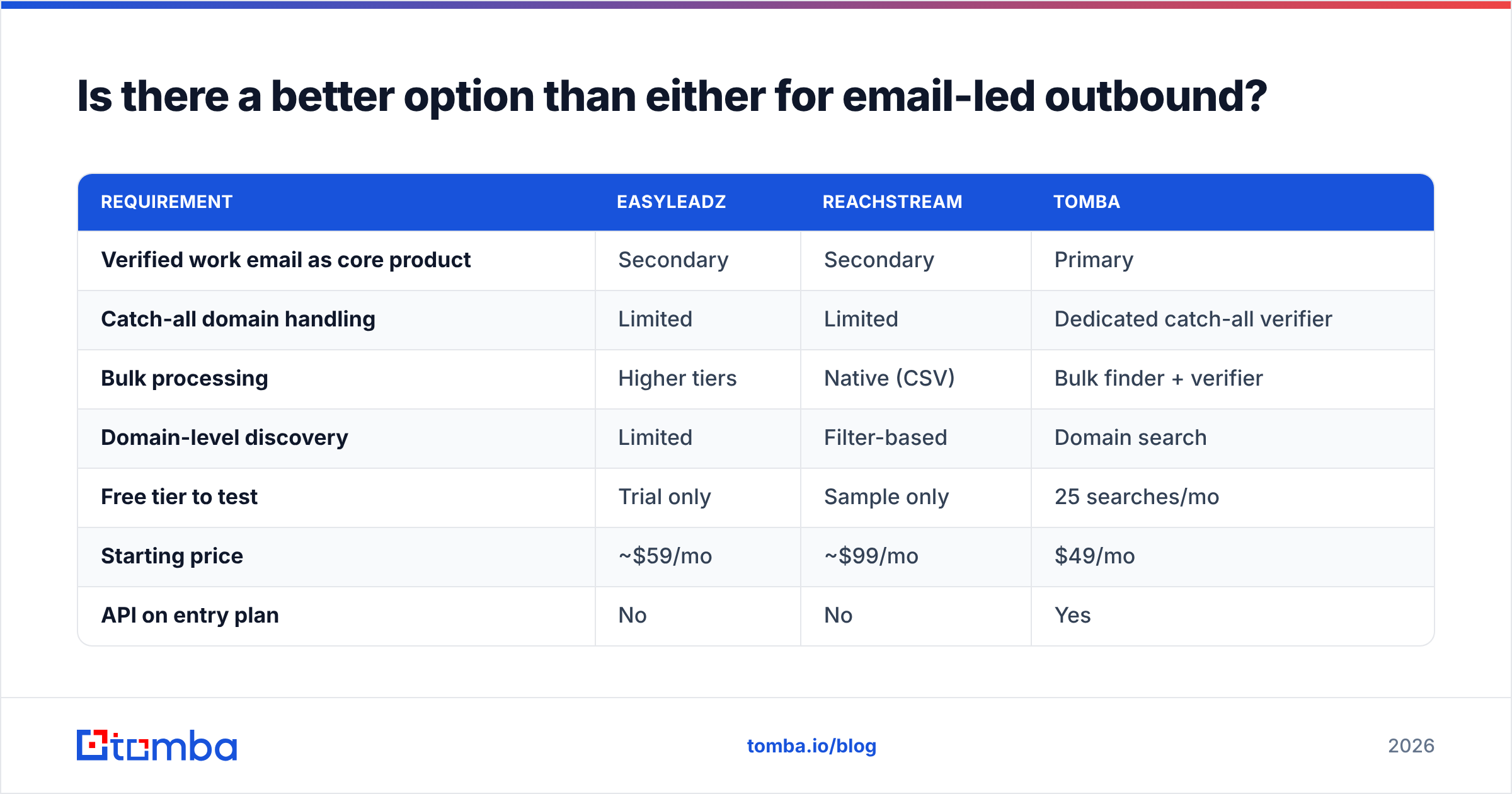
EasyLeadz and ReachStream both treat email as a secondary field attached to a record. A dedicated email finder treats it as the product, which changes the engineering priorities: pattern detection per domain, SMTP validation, catch-all handling, and re-verification cadence.

| Requirement | EasyLeadz | ReachStream | Tomba |
|---|---|---|---|
| Verified work email as core product | Secondary | Secondary | Primary |
| Catch-all domain handling | Limited | Limited | Dedicated catch-all verifier |
| Bulk processing | Higher tiers | Native (CSV) | Bulk finder + verifier |
| Domain-level discovery | Limited | Filter-based | Domain search |
| Free tier to test | Trial only | Sample only | 25 searches/mo |
| Starting price | ~$59/mo | ~$99/mo | $49/mo |
| API on entry plan | No | No | Yes |
| Direct dial phones | Strong | Moderate | Available via phone finder |
The honest limitation: if direct dials in India are your business, Tomba is not a replacement for EasyLeadz, and you should not read this table as claiming otherwise. If bulk US segment purchasing at 10,000-row scale is your model, ReachStream's filter depth has real value.
But for the most common B2B motion in 2026 — targeted outbound to a defined account list, delivered by email, measured on reply rate — a verification-first email tool with a bulk email finder and a free tier to test on is the lower-risk starting point. You can validate the data on your own ICP before spending anything.
How should you make the final call?#
Run the same 100-contact test against your own ICP for all three, including whatever you use today. Measure verified-valid rate, bounce rate at 48 hours, and cost per usable contact. Then pick.
If the test comes back close, default to the vendor with the better free tier and the shorter contract, because the thing you are actually buying is optionality while you learn what works.
Ready to test the email side properly? Start with the Tomba Email Finder — the free tier gives you 25 searches a month with no card, which is enough to run the 100-contact comparison above against your real target list. If the numbers beat what you are paying now, the $49/mo Starter plan is there. If they do not, you have lost nothing but an afternoon, and you will know exactly which vendor deserves your budget.
Related guides#
Ready to find emails that actually work?
Join 150,000+ professionals who stopped guessing and started sending. Free credits on signup — no credit card required.
Get the Tomba newsletter
Practical outbound tactics and product updates — once every two weeks.
About the author