EasyLeadz vs Seamless.AI (2026): Which Data Tool Wins?
EasyLeadz sells direct dials. Seamless.AI sells a database plus a sales contract. We break down accuracy, credits, pricing traps, and which one actually belongs in your 2026 outbound stack.
EasyLeadz vs Seamless.AI comes down to one question: do you need phone numbers, or do you need database volume? EasyLeadz sells direct dials. Seamless.AI sells a large US contact index and, usually, an annual contract. Here is how the two compare on accuracy, credits, and real cost in 2026.
TL;DR
- EasyLeadz is a phone-number tool first. Its Mr. E extension is built around pulling direct dials off LinkedIn profiles, with unusually strong coverage in India, the Middle East, and parts of APAC. Email is a secondary output.
- Seamless.AI is a database plus a sales motion. You get a large US-centric contact index, an AI search layer, and — for most buyers — an annual contract negotiated with a rep. Credits are the currency and they run out faster than the demo suggests.
- Neither is a verification tool. Both hand you addresses. Neither guarantees the address survives contact with a mail server, which is where most cold campaigns actually die.
The bottom line:
- Cost per usable contact is the only metric that matters. A $0.02 record that bounces costs more than a $0.12 record that lands, once you price in domain reputation.
- The honest answer for most teams is a split stack: one accurate email source, one phone source when you genuinely dial, and a verifier between them and your sequencer.
What are EasyLeadz and Seamless.AI?#
They solve overlapping problems from opposite ends.
EasyLeadz is an Indian B2B contact intelligence company best known for Mr. E, a Chrome extension that surfaces direct mobile numbers when you're sitting on a LinkedIn profile. The product is credit-metered, lightweight, and self-serve. Its reputation was built on phone data — specifically, on returning mobile numbers for markets where US-headquartered vendors return nothing at all.
Seamless.AI is a US company selling a full contact database with an AI-flavored search interface, buyer intent add-ons, a Chrome extension, and CRM writeback. It positions itself as a real-time "search engine for leads" rather than a static list. There is a free tier (50 lifetime credits). But for most teams the real deal is an annual, per-seat contract sold by a rep. The Seamless.AI sales team is famously persistent. Skim the G2 reviews and you'll see the pattern: praise for volume, complaints about renewal terms and data staleness in equal measure.
So the framing isn't "which database is bigger." It's: do you need dials, do you need volume, or do you need addresses that don't bounce?
EasyLeadz vs Seamless.AI: how do they compare head-to-head?#
Here's the practical comparison, with Tomba included as a third reference point since most teams evaluating these two are also pricing an email-first option.
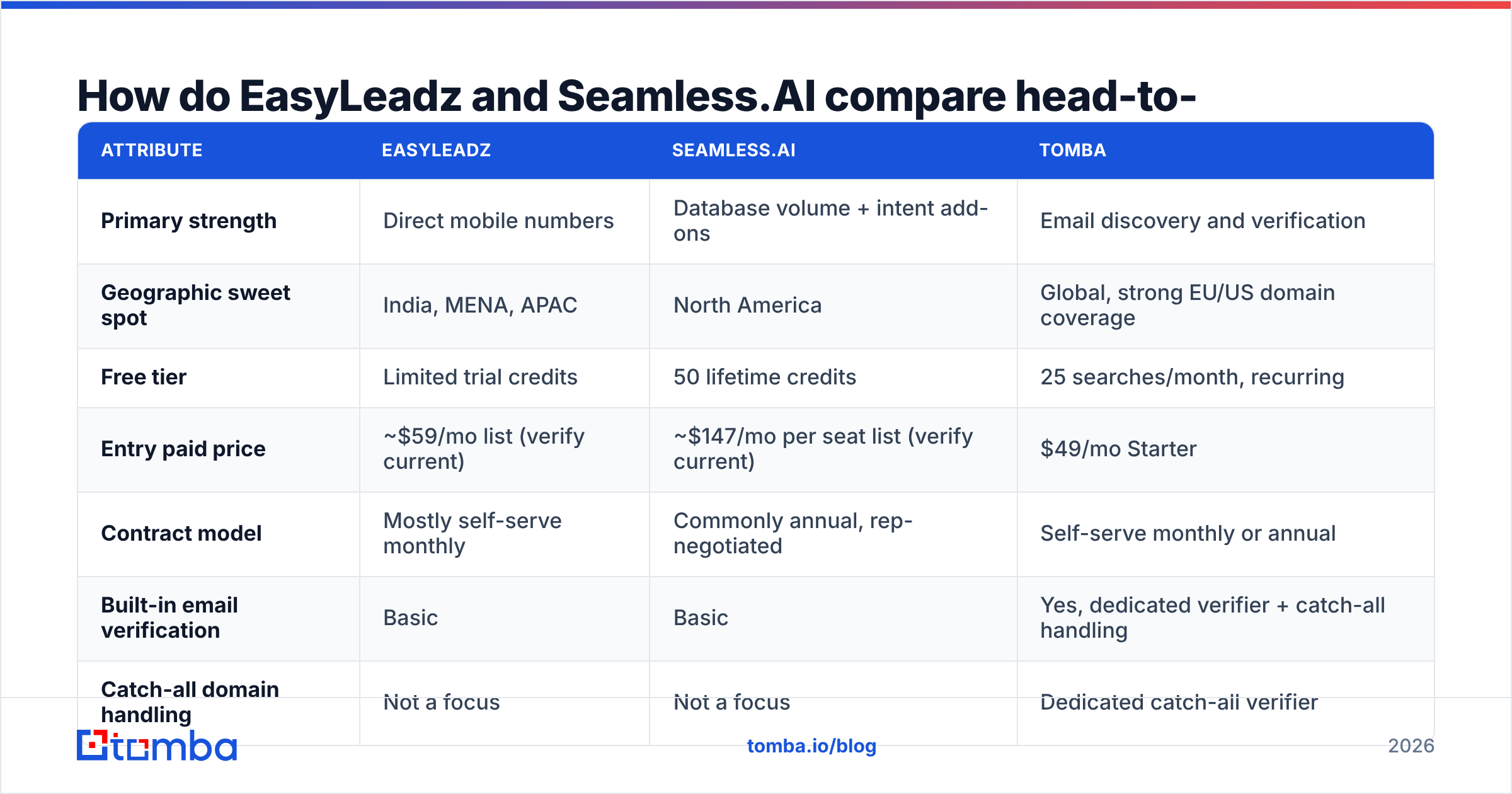
| Attribute | EasyLeadz | Seamless.AI | Tomba |
|---|---|---|---|
| Primary strength | Direct mobile numbers | Database volume + intent add-ons | Email discovery and verification |
| Geographic sweet spot | India, MENA, APAC | North America | Global, strong EU/US domain coverage |
| Free tier | Limited trial credits | 50 lifetime credits | 25 searches/month, recurring |
| Entry paid price | ~$59/mo list (verify current) | ~$147/mo per seat list (verify current) | $49/mo Starter |
| Contract model | Mostly self-serve monthly | Commonly annual, rep-negotiated | Self-serve monthly or annual |
| Built-in email verification | Basic | Basic | Yes, dedicated verifier + catch-all handling |
| Catch-all domain handling | Not a focus | Not a focus | Dedicated catch-all verifier |
| Bulk processing | Yes, credit-metered | Yes, credit-metered | Yes, bulk finder + bulk verify |
| Public API | Yes | Yes | Yes, documented REST API |
| Credit rollover | Limited | Generally no | Plan-dependent |
Two things jump out of that table.
First, the price gap is not marginal. The realistic entry point for a Seamless.AI seat is roughly triple EasyLeadz's, and multiple times a $49/mo email-first plan. That gap only makes sense if you're consuming genuinely large volumes and using the intent and enrichment add-ons.
Second, neither of the two headline tools treats verification as a first-class product. Both will hand you firstname.lastname@company.com with a confidence label. Neither is architected to tell you what happens when a catch-all domain accepts every address you throw at it.
Which tool has better data accuracy?#
Accuracy is where vendor marketing gets slipperiest, so define the term before comparing.
There are three separate numbers vendors blur together:
- Coverage — of 1,000 target contacts, how many does the tool return anything for?
- Match precision — of the records returned, how many are the right person at the right company?
- Deliverability — of the emails returned, how many actually accept mail today?
EasyLeadz tends to win on coverage in non-US geographies and on phone-number precision. If your ICP is a CTO in Bengaluru or a procurement lead in Dubai, EasyLeadz will frequently return a mobile number when a US-first database returns a blank row. That's a real, defensible edge.
Seamless.AI tends to win on raw coverage in North America — it will return something for almost any US-based prospect. The tradeoff shows up in dimension three. The index leans on aggregated and inferred data, refreshed on its own schedule. So users routinely report bounce rates well above what a verified list produces. Contacts who changed jobs in the last two quarters are the worst offenders. The volume is real; the freshness is uneven.

The lesson from benchmark data like the above is consistent: tools optimized for volume trade away precision, and tools optimized for precision return fewer rows. No vendor has quietly solved both. What separates a good stack from a bad one is whether you verify after export — running your list through an email verifier before it reaches your sequencer, regardless of which database produced it.
If you export 10,000 records from any of these tools and mail them raw, you are running an experiment on your own sending domain.
How does pricing actually work on each platform?#
Both use credits. That's where the similarity ends.
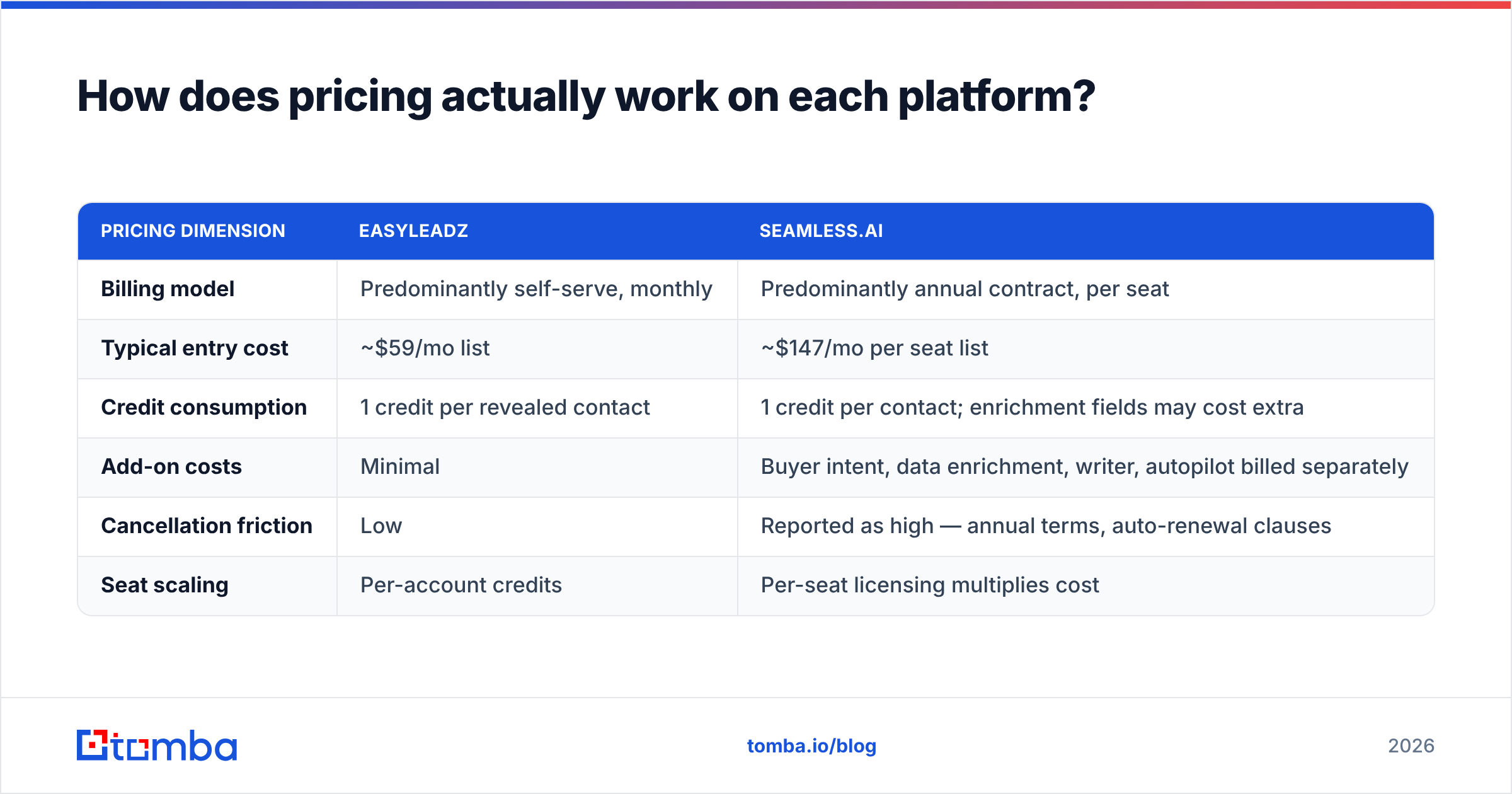
| Pricing dimension | EasyLeadz | Seamless.AI |
|---|---|---|
| Billing model | Predominantly self-serve, monthly | Predominantly annual contract, per seat |
| Typical entry cost | ~$59/mo list | ~$147/mo per seat list |
| Credit consumption | 1 credit per revealed contact | 1 credit per contact; enrichment fields may cost extra |
| Add-on costs | Minimal | Buyer intent, data enrichment, writer, autopilot billed separately |
| Cancellation friction | Low | Reported as high — annual terms, auto-renewal clauses |
| Seat scaling | Per-account credits | Per-seat licensing multiplies cost |
Read the cancellation row twice. The most common complaint in public reviews of Seamless.AI isn't data quality — it's contract structure. Buyers describe signing an annual agreement after a demo. Then they discover the renewal terms are less flexible than expected. That's not a data problem, but it is a purchasing risk, and it should be priced into your evaluation. If you're comparing options, our Seamless.AI alternative breakdown covers the self-serve routes in more detail.
EasyLeadz's model is friendlier: monthly plans, less negotiation, less rep involvement. The tradeoff is that per-credit cost climbs faster at volume, and phone credits are the expensive unit.
For reference, transparent published pricing is not a small feature. Tomba pricing is Free (25 searches/month), Starter $49/mo, Growth $99/mo, Pro $249/mo, and Enterprise custom — no demo required to see it. That matters when you're modeling cost per usable contact rather than cost per row.
What does cost per usable contact actually look like?#
Run the math the way your CFO would.
Assume you need 1,000 contactable prospects this month.
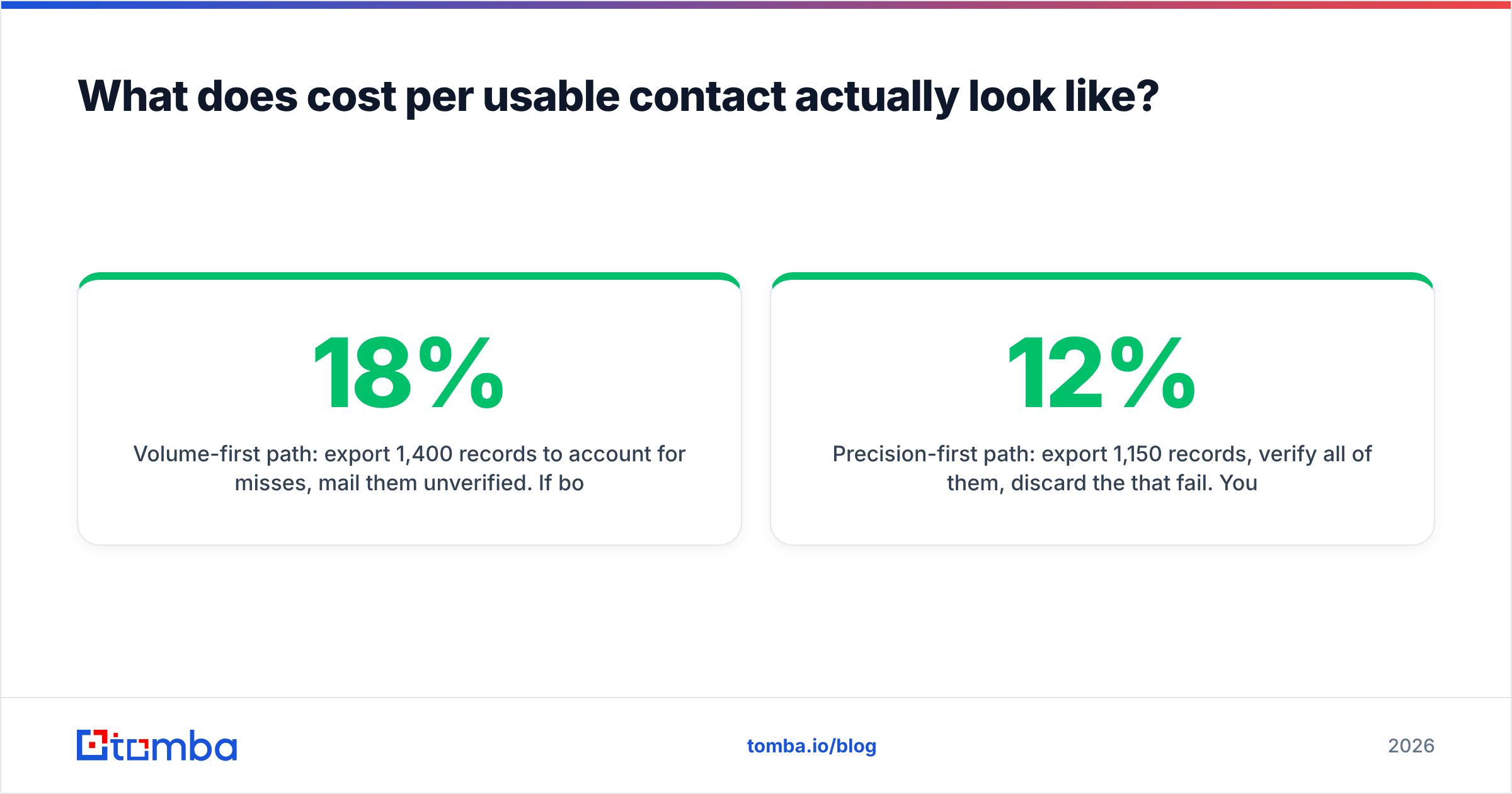
- Volume-first path: export 1,400 records to account for misses, mail them unverified. If 18% bounce, you land ~1,148 delivered — but you've also spiked your bounce rate above the 2% threshold that Google and Microsoft treat as a spam signal. The next campaign underperforms even with a clean list. The true cost includes domain recovery time.
- Precision-first path: export 1,150 records, verify all of them, discard the 12% that fail. You land ~1,012 delivered at a 1.1% bounce rate. Sending reputation stays intact. Cost per row is higher; cost per reply is lower.
The second path wins nearly every time once you're sending at any real volume. This is why email deliverability belongs in a data-tool comparison at all — the database you pick determines the shape of your bounce curve two weeks later.
Who should choose EasyLeadz?#
Pick EasyLeadz when these are true:
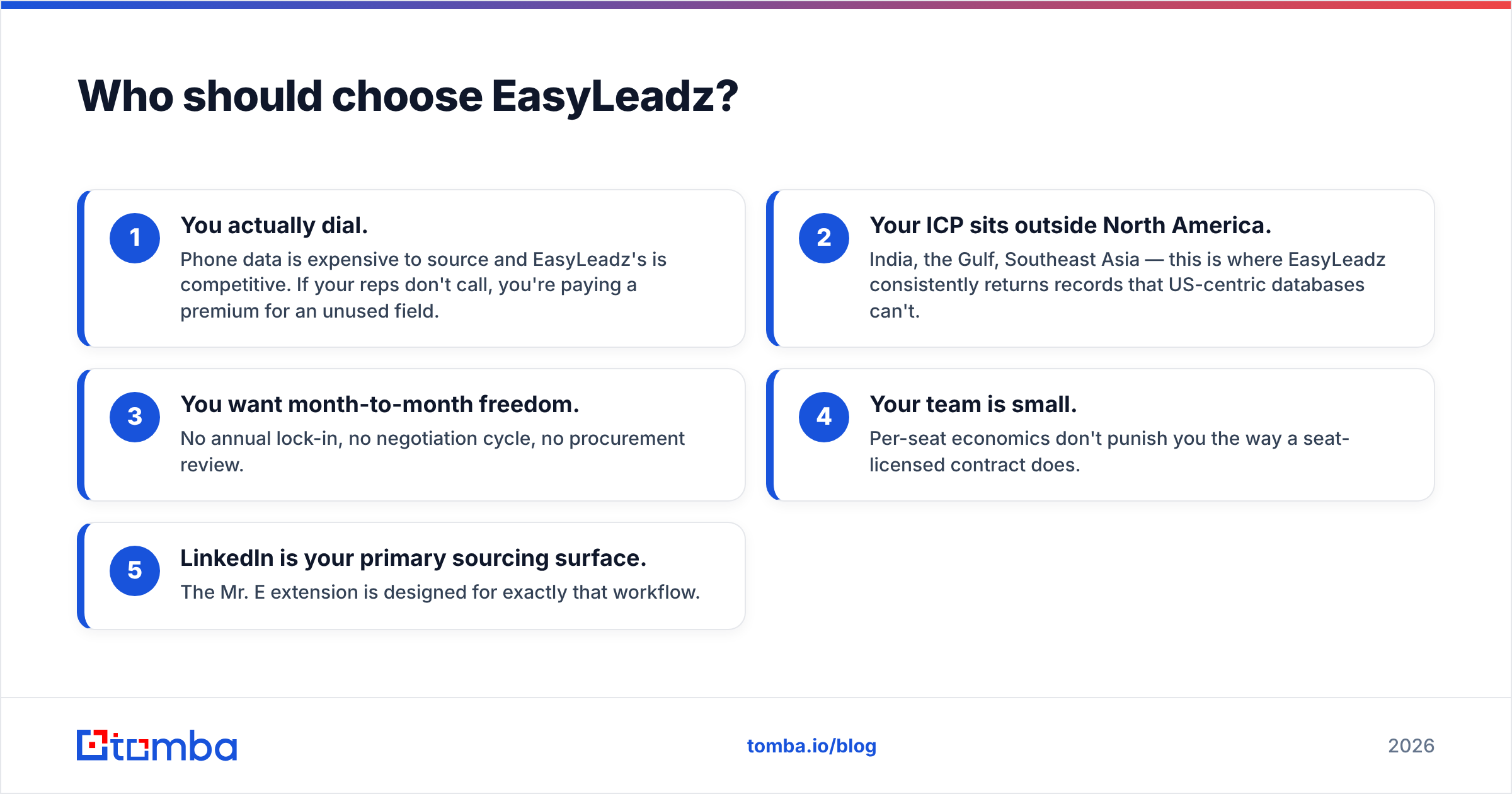
- You actually dial. Phone data is expensive to source and EasyLeadz's is competitive. If your reps don't call, you're paying a premium for an unused field.
- Your ICP sits outside North America. India, the Gulf, Southeast Asia — this is where EasyLeadz consistently returns records that US-centric databases can't.
- You want month-to-month freedom. No annual lock-in, no negotiation cycle, no procurement review.
- Your team is small. Per-seat economics don't punish you the way a seat-licensed contract does.
- LinkedIn is your primary sourcing surface. The Mr. E extension is designed for exactly that workflow.
Where it falls short: email coverage in Western markets is thinner than a dedicated email finder, and there's no serious catch-all strategy. Pair it with a catch-all verifier if catch-all domains are common in your list.
Who should choose Seamless.AI?#
Pick Seamless.AI when these are true:
- You're mid-market or enterprise with a real SDR team. The per-seat model only pencils out when each seat produces pipeline.
- Your market is North American. Coverage strength is concentrated there.
- You want intent signals bundled. The buyer-intent add-on has genuine value if you have the process to act on it.
- You have CRM discipline. Writeback into Salesforce or HubSpot is where the platform earns its keep — a well-maintained CRM turns volume into a working pipeline instead of a swamp.
- You'll negotiate the contract properly. Get renewal terms, credit rollover, and seat flexibility in writing before signing.
Where it falls short: cost, contract rigidity, and freshness. Budget for a verification layer — the platform's volume advantage becomes a liability the moment you mail it raw.
Where does Tomba fit in this comparison?#
Honestly: not as a replacement for EasyLeadz's phone data, and not as a replacement for an enterprise intent platform. Tomba is narrower on purpose.
The overlap is the part most teams actually spend credits on — finding and validating work email addresses at scale. That's the email finder, plus domain search, catch-all handling, bulk processing, and a documented API. If your outbound is email-led and your phone usage is occasional, buying a $147/seat database to extract email addresses is an expensive way to solve a $49 problem.

Where Tomba genuinely differentiates is the verification layer sitting alongside discovery rather than sold as a separate product — including catch-all domains, which are the single largest source of silent list rot. And when you do need dials, a dedicated phone finder covers the gap without a per-seat license.
What does a sane 2026 data stack look like?#
Stop shopping for one tool that does everything. Nobody sells it.
- Layer 1 — Discovery. One email-first source for your core market. Optimize for match precision, not row count.
- Layer 2 — Phone (conditional). Add EasyLeadz or an equivalent only if dial activity is a tracked metric on your team. Otherwise skip it entirely.
- Layer 3 — Verification. Non-negotiable. Every record passes through verification before it touches a sequencer. This is the cheapest insurance in your stack.
- Layer 4 — Enrichment. Fill firmographics and role data after the contact is confirmed valid, not before. Enriching records that bounce is pure waste.
- Layer 5 — Sequencing. Whatever you already use. Data quality upstream matters more than the sending tool.
Teams that assemble the stack this way spend less in total than teams that buy one expensive platform and skip layer three.
Frequently asked questions#
Is Seamless.AI's free plan enough to evaluate it? For a sanity check on coverage, yes. Fifty lifetime credits will tell you whether your ICP exists in the index. It won't tell you anything about bounce rates or renewal terms.
Does EasyLeadz work outside India? Yes, but coverage quality varies sharply by region. Test against 50 real target accounts in your actual market before committing credits.
Can I use both? Plenty of teams do — EasyLeadz for dials, something else for email. The cost only justifies itself if both fields get used.
Which has better GDPR posture? Both publish compliance documentation. If you sell into the EU, request the DPA and confirm opt-out handling directly with the vendor rather than trusting a marketing page.
Ready to fix the email half of your stack?#
If your outbound lives and dies on whether the address is right, start there. Tomba's Email Finder gives you 25 free searches a month. That's enough to run your own EasyLeadz vs Seamless.AI test on the same 25 prospects. Compare the hit rate, then compare the bounce rate a week later. That second number is the one that decides your budget.
Related guides#
Ready to find emails that actually work?
Join 150,000+ professionals who stopped guessing and started sending. Free credits on signup — no credit card required.
Get the Tomba newsletter
Practical outbound tactics and product updates — once every two weeks.
About the author