EasyLeadz vs SMARTe (2026): Which B2B Contact Data Wins?
EasyLeadz sells India-first direct dials. SMARTe sells global contact data with compliance paperwork. Here's how the two actually differ on coverage, credits, and cost per usable contact in 2026.
TL;DR
- EasyLeadz is a phone-first tool. Its core product, the Mr. E extension, exists to pull direct dials and mobile numbers off LinkedIn profiles. India and wider APAC coverage is its strongest asset by a wide margin.
- SMARTe is a global contact database. It sells breadth — North America, EMEA, and APAC records with emails, mobiles, firmographics, and compliance documentation — usually on an annual contract rather than a card-swipe subscription.
- They are not really competitors for the same buyer. A two-person SDR team hunting Indian mid-market gets more from EasyLeadz. A 30-seat outbound org selling into the US and EU gets more from SMARTe.
- Neither is a great email-first system of record. Both surface emails, but if your channel is cold email, you will still want a dedicated finder plus verification in front of your sequencer.
- Cost per usable contact is the only number that matters. A $0.10 credit that returns an unreachable mobile costs more than a $0.30 credit that connects.
What are EasyLeadz and SMARTe, exactly?#
EasyLeadz is an India-headquartered contact intelligence company best known for Mr. E, a browser extension that reveals direct phone numbers for people you're looking at on LinkedIn. The pitch is blunt: you already found the person, you just can't call them. EasyLeadz sells the number. Everything else in the product — company search, list building, API access — grew outward from that single job.
SMARTe comes at the same problem from the enterprise data side. It's a global B2B contact and account database with mobile numbers, verified business emails, technographics, and buying-committee mapping, sold primarily to revenue teams who need one source feeding a CRM and a sequencer at the same time. It leans hard on compliance posture — consent records, regional data handling, opt-out processing — because its buyers are running outbound into GDPR territory and their legal team asks questions.
That difference in origin explains almost every practical difference you'll hit in evaluation. One tool was built to answer "what's this person's mobile?" The other was built to answer "give me every reachable contact at 400 accounts that match this ICP."
How do EasyLeadz and SMARTe compare head to head?#
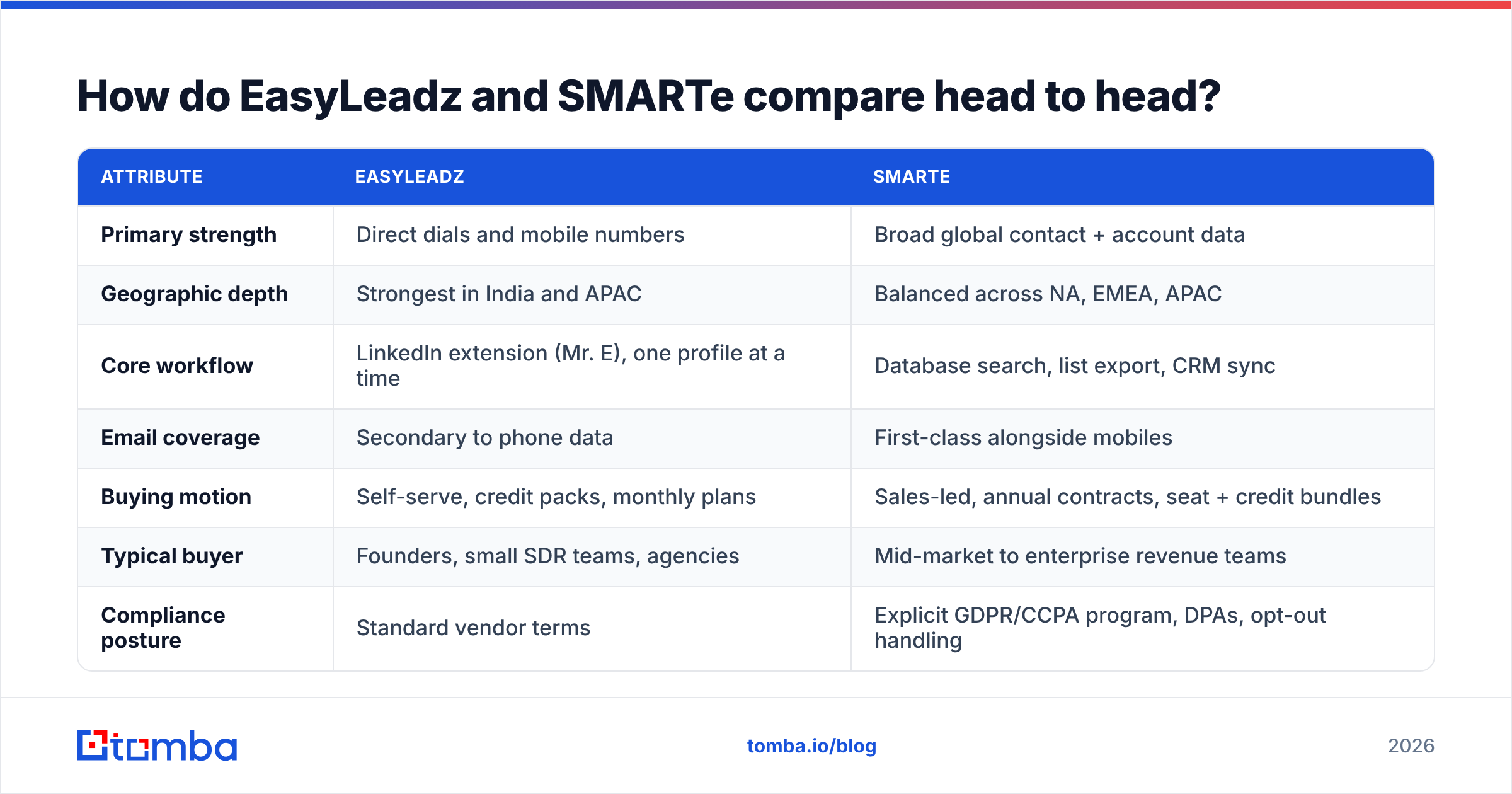
| Attribute | EasyLeadz | SMARTe |
|---|---|---|
| Primary strength | Direct dials and mobile numbers | Broad global contact + account data |
| Geographic depth | Strongest in India and APAC | Balanced across NA, EMEA, APAC |
| Core workflow | LinkedIn extension (Mr. E), one profile at a time | Database search, list export, CRM sync |
| Email coverage | Secondary to phone data | First-class alongside mobiles |
| Buying motion | Self-serve, credit packs, monthly plans | Sales-led, annual contracts, seat + credit bundles |
| Typical buyer | Founders, small SDR teams, agencies | Mid-market to enterprise revenue teams |
| Compliance posture | Standard vendor terms | Explicit GDPR/CCPA program, DPAs, opt-out handling |
| API | Yes, credit-metered | Yes, enterprise-oriented |
| Where it struggles | Non-APAC email depth, list-scale workflows | Cost and commitment for small teams |
The table is the short version. The longer version is that these two tools fail in different directions, and knowing which failure you can tolerate is the actual decision.
Which one gives you better phone number accuracy?#
If your territory is India, EasyLeadz wins and it isn't especially close. Local mobile data is hard to source and harder to keep current, and EasyLeadz has spent years concentrated there while global vendors spread their sourcing budget across forty countries. Users consistently report hit rates on Indian mid-market contacts that global providers can't match.
Outside India, that advantage narrows fast. In the US and Western Europe, SMARTe's mobile coverage is the more reliable of the two, and its records come attached to more context — job function, seniority, department, technographic signals — which matters when you're routing a list to reps rather than dialing one number yourself.
Here's how to actually test either one instead of taking a demo's word for it:
- Build a 100-row control list from closed-won accounts. You already know these companies are real and in-ICP. Skew the list to the geography you actually sell into, not a global sample.
- Run the same list through both tools on trial credits. Do not let a vendor run it for you. Vendor-run tests are curated, every time.
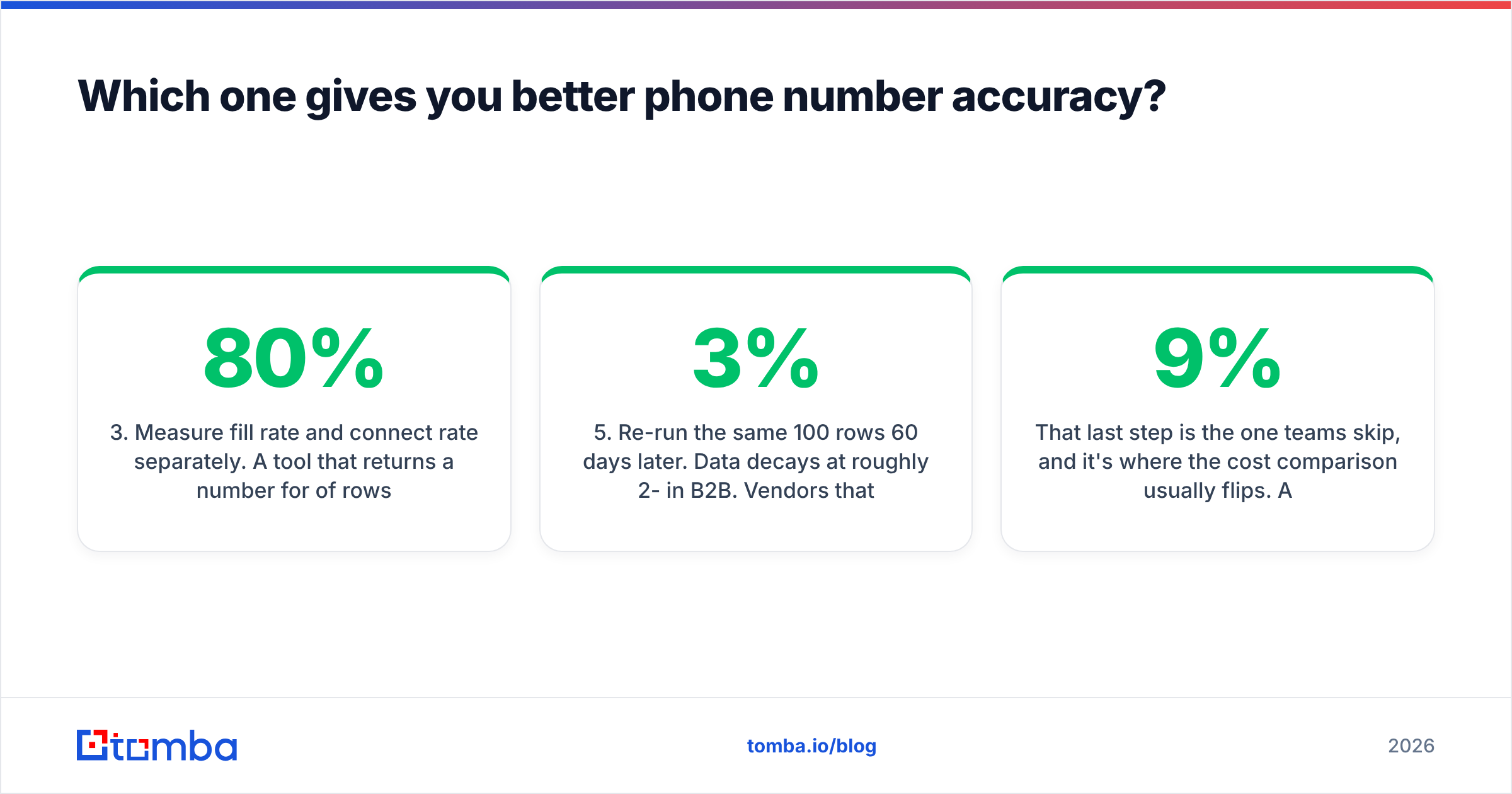
- Measure fill rate and connect rate separately. A tool that returns a number for 80% of rows but connects on 30% of dials is worse than one that returns 55% and connects on 65%.
- Log the credit burn per usable contact. Divide total credits spent by contacts that produced a live conversation or a delivered email. This is your real unit cost.
- Re-run the same 100 rows 60 days later. Data decays at roughly 2-3% per month in B2B. Vendors that refresh well look identical on day one and very different on day 60.
- Check bounce, not just deliverability claims. Push the emails through an email verifier before they touch your sequencer, and count how many each source loses.
That last step is the one teams skip, and it's where the cost comparison usually flips. A provider that hands you 1,000 emails with a 9% invalid rate has effectively sold you 910 emails at a 10% markup — plus the reputation damage those 90 bounces cause.
How does pricing compare between EasyLeadz and SMARTe?#
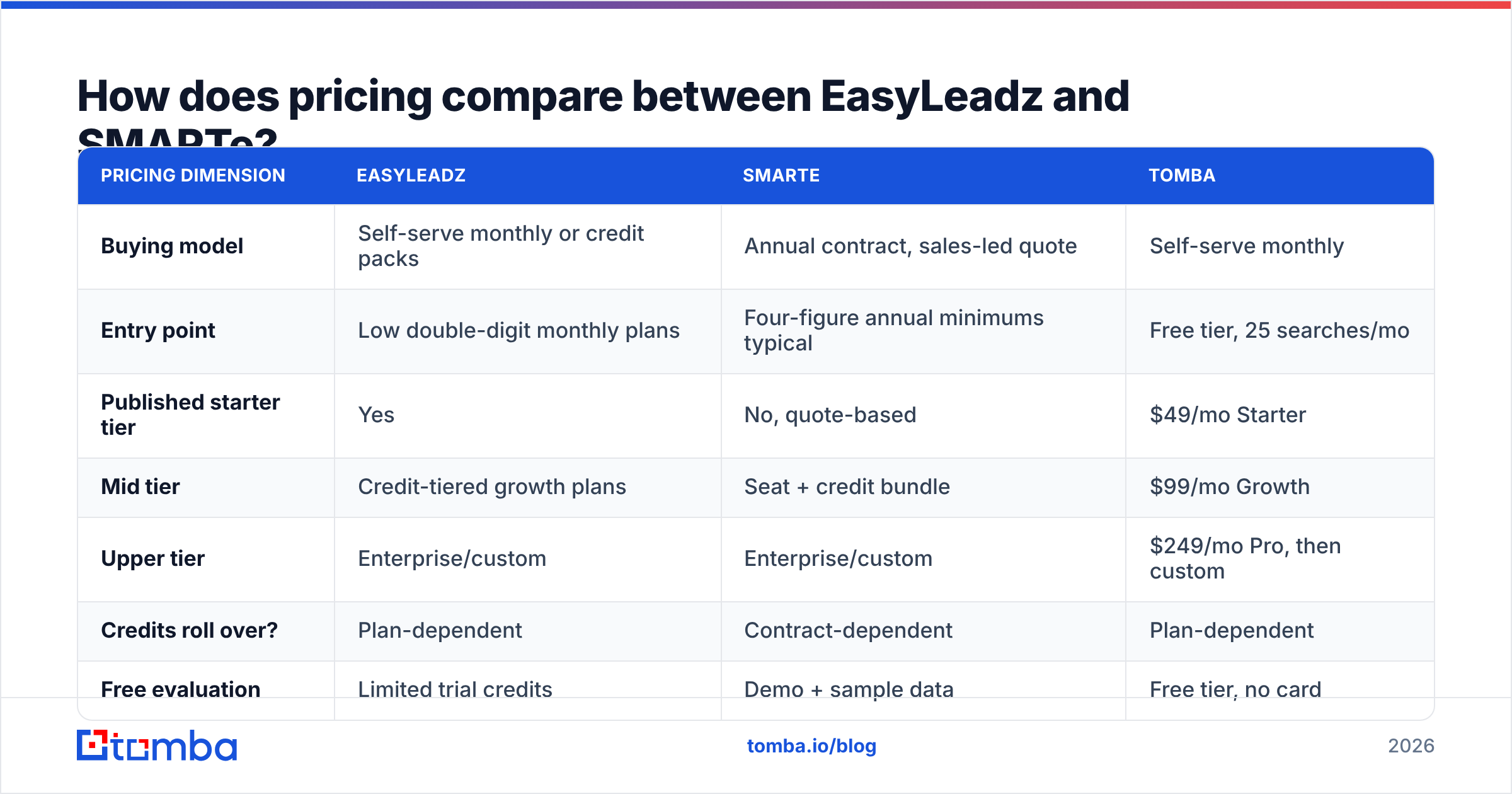
Both vendors move their tiers around, so treat published numbers as a starting point and confirm on their own pricing pages before you budget. What's stable is the shape of each model, and the shape tells you more than the sticker.
| Pricing dimension | EasyLeadz | SMARTe | Tomba |
|---|---|---|---|
| Buying model | Self-serve monthly or credit packs | Annual contract, sales-led quote | Self-serve monthly |
| Entry point | Low double-digit monthly plans | Four-figure annual minimums typical | Free tier, 25 searches/mo |
| Published starter tier | Yes | No, quote-based | $49/mo Starter |
| Mid tier | Credit-tiered growth plans | Seat + credit bundle | $99/mo Growth |
| Upper tier | Enterprise/custom | Enterprise/custom | $249/mo Pro, then custom |
| Credits roll over? | Plan-dependent | Contract-dependent | Plan-dependent |
| Free evaluation | Limited trial credits | Demo + sample data | Free tier, no card |
The structural point: EasyLeadz is priced for someone who wants to swipe a card on Tuesday and dial on Wednesday. SMARTe is priced for someone building a data layer for a year. If you're a three-person team and a vendor won't quote you without a discovery call, that's not a red flag — it's a signal that you're not the buyer, and the contract will be shaped for someone with a bigger seat count than you.
There's a third pattern worth naming, because it's what most email-led teams actually end up on: flat monthly search-and-verify pricing that isn't tied to per-record data resale. That's how Tomba pricing is structured, and it's why the cost math looks different when your primary channel is email rather than phone.
Is EasyLeadz better than SMARTe for cold email?#
For email specifically, SMARTe is the stronger of the two — it treats business email as a first-class field with its own validation pipeline, while EasyLeadz treats it as a companion to the phone number. If you buy EasyLeadz expecting an email engine, you'll be disappointed for reasons that have nothing to do with product quality; you bought a dialer's data source.
But there's a bigger structural issue that applies to both. Database vendors sell you a stored record. The email in that record was correct when it was ingested. Whether it's correct today depends entirely on refresh cadence, and refresh cadence is the thing every vendor describes vaguely.
A finder-and-verifier approach works differently: it resolves the pattern for a domain and checks the mailbox at query time, so you're getting an answer about now rather than an answer about whenever the crawl ran. That's the argument for pairing whichever database you choose with a live email finder at the point of send — you use the database for discovery and ICP filtering, and the finder for the address you're actually going to mail.
If most of your list is catch-all domains — common in enterprise and in a lot of European mid-market — neither database will help you much, because catch-all servers accept everything and tell you nothing. That's a job for a catch-all verifier, which uses pattern confidence and secondary signals instead of a plain SMTP handshake.
What about compliance and data sourcing?#
If you sell into the EU or UK, this section decides the vendor, not the feature grid.
SMARTe publishes an explicit compliance program — data processing agreements, documented lawful basis, opt-out and deletion handling, regional storage. That's not marketing decoration; it's what your legal reviewer will ask for before you can put EU contacts into a sequencer. Under GDPR, you carry obligations as a controller regardless of where the data came from, and a vendor that can't hand you paperwork makes those obligations your problem alone.
EasyLeadz operates under standard vendor terms, which is fine for domestic Indian outbound and for teams whose primary channel is the phone, but it's a thinner package if you're being audited on European personal data.
Three questions to ask either vendor — and any third option you're comparing:
- Where does each field come from? Public web, partner contribution, community sharing, and purchased lists carry different risk. Vendors who publish their data sources make this easy to check.
- What is the deletion SLA? When a contact asks to be removed, how fast does it propagate to your exports, and do you get notified?
- Is there a suppression list you control? If your own do-not-contact list can't be enforced at the vendor level, you'll re-import the same person every quarter.
Are there better alternatives to both in 2026?#
Depends entirely on your channel. Some honest routing:
- Phone-led outbound into India or APAC: EasyLeadz. Nothing in this comparison changes that, and paying a global vendor for coverage they don't have is a slow way to waste budget.
- Multi-region enterprise ABM with a CRM to feed: SMARTe. The account-level structure and compliance package earn their contract.
- Verified-email lists at scale, budget under $150/mo: a dedicated finder plus verifier. This is where bulk email finder workflows and API-first tooling beat both database vendors on cost per delivered message.
- Recruiting or partner-facing outreach with real volumes: look at credit rollover terms more carefully than accuracy claims — spiky usage punishes use-it-or-lose-it plans.
- A blend of email and phone: run two sources on purpose. Use one for dials and one for verified addresses instead of forcing a single vendor to be good at both.
The blended approach is more common than vendor comparison articles admit. Teams rarely find one provider that's simultaneously best at Indian mobiles, European emails, and US account mapping — because no such provider exists. What they find is a primary source plus a verification layer that stops the primary source's decay from reaching their sending domain.
Which should you actually pick?#
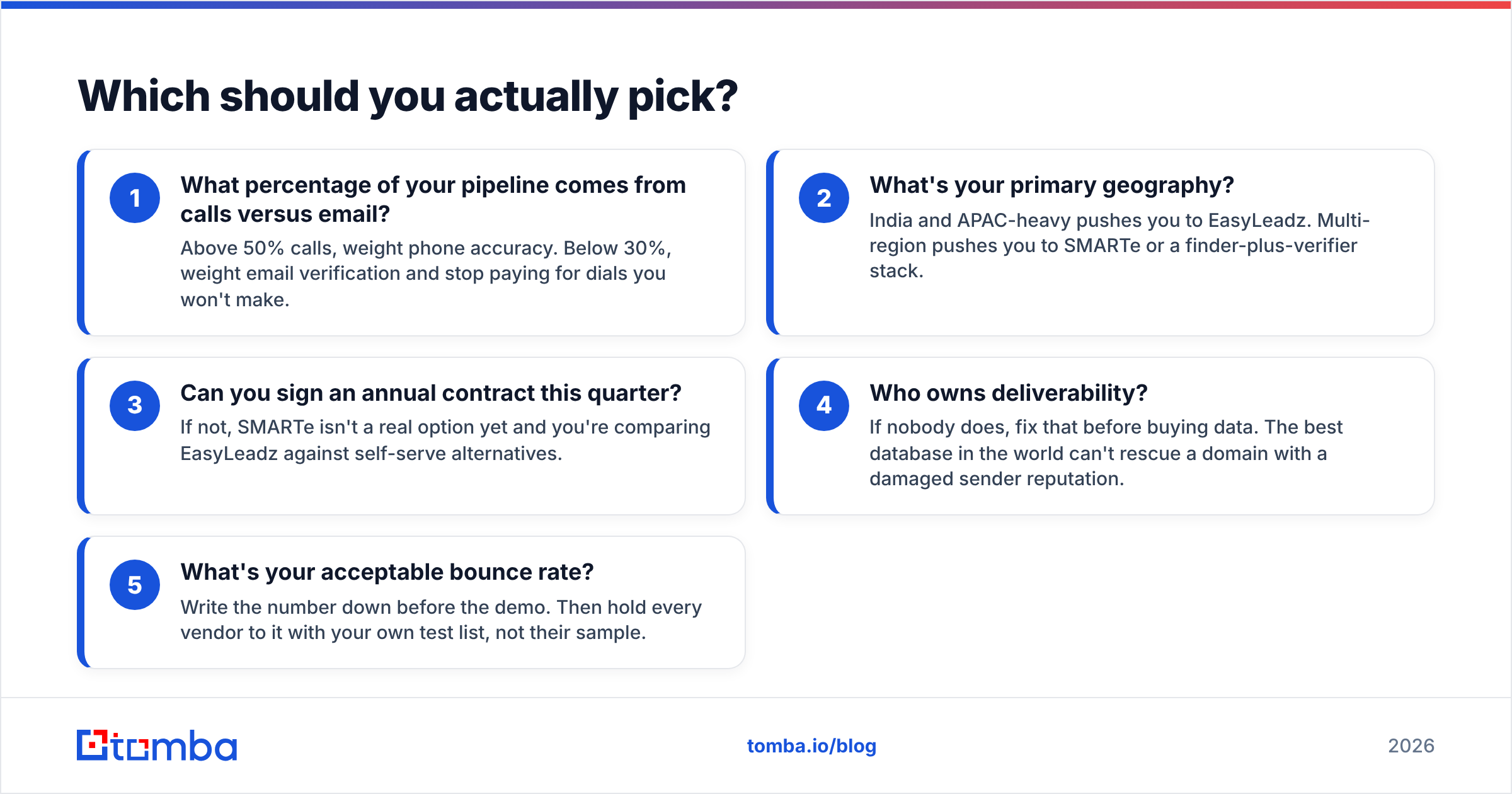
Answer these in order, and the choice makes itself:
- What percentage of your pipeline comes from calls versus email? Above 50% calls, weight phone accuracy. Below 30%, weight email verification and stop paying for dials you won't make.
- What's your primary geography? India and APAC-heavy pushes you to EasyLeadz. Multi-region pushes you to SMARTe or a finder-plus-verifier stack.
- Can you sign an annual contract this quarter? If not, SMARTe isn't a real option yet and you're comparing EasyLeadz against self-serve alternatives.
- Who owns deliverability? If nobody does, fix that before buying data. The best database in the world can't rescue a domain with a damaged sender reputation.
- What's your acceptable bounce rate? Write the number down before the demo. Then hold every vendor to it with your own test list, not their sample.
Most teams that run this exercise end up buying less data than they planned and verifying more of it than they planned. That's usually the correct outcome.
Where does Tomba fit into this comparison?#
Tomba isn't trying to be a global mobile database, so it's not a direct swap for either tool in a dialing motion. It's a search-and-verify layer: find the address by domain or name, verify it before it enters a sequence, and enrich the rest through the same API. If your outbound is email-first and your current problem is bounce rate rather than dial coverage, that's the layer that fixes it — and the free tier gives you 25 searches to test the hit rate against your own control list before spending anything.
Run your last 100 closed-won domains through the Tomba Email Finder alongside whichever database you're evaluating. Compare fill rate, bounce rate, and cost per delivered message. Whichever combination wins on that table is the one to buy — not the one with the better demo.
Related guides#
Ready to find emails that actually work?
Join 150,000+ professionals who stopped guessing and started sending. Free credits on signup — no credit card required.
Get the Tomba newsletter
Practical outbound tactics and product updates — once every two weeks.
About the author