EasyLeadz vs Snappy Leads: Which Lead Data Tool Wins in 2026?
EasyLeadz is built around mobile numbers; Snappy Leads is built around verified work emails. We break down coverage, accuracy, pricing and export limits so you can pick the one your pipeline actually needs.
TL;DR
- EasyLeadz vs Snappy Leads comes down to one question: do you dial, or do you email?
- EasyLeadz is phone-first. Its Mr. E extension pulls direct mobile numbers from LinkedIn profiles. Coverage runs deepest in India and APAC. Email is a side output.
- Snappy Leads is email-first. It finds verified work emails from LinkedIn profiles and company domains. Phone data exists, but it comes second. The tool is built for cold-email teams, not dialers.
- Neither is a full data platform. Both sit on top of LinkedIn as enrichment layers. If you need domain-wide discovery, catch-all handling, or an API that scales, you will outgrow both.
- Credit rules decide the real cost. Per-seat pricing and rollover matter more than the sticker price once three SDRs share a plan.
- Pick by channel, not by brand. Calling into APAC? EasyLeadz. Cold email at volume? Snappy Leads, or a dedicated email finder with an API and verification built in.
EasyLeadz vs Snappy Leads: what are these two tools?#
Think of these two as specialist mechanics, not full garages. Both plug into the same car — your LinkedIn prospecting workflow. One is best at engines. The other is best at brakes.
EasyLeadz is an Indian B2B contact data company. It is best known for Mr. E, its Chrome extension. You open a LinkedIn profile, click the extension, and it tries to return that person's direct mobile number. It also sells company data and an API. The brand has always leaned toward phone. Coverage is strongest in India, Southeast Asia and the Middle East. North America and Europe are thinner, though not empty.
Snappy Leads sits on the other side of the channel divide. It is a lighter, newer tool built to find verified business email addresses. Sources include LinkedIn profiles, Sales Navigator lists and company domains. Phone numbers come as a secondary field. The pitch is speed: install the extension, click, export, load into your sequencer.
That gap in focus is the whole EasyLeadz vs Snappy Leads debate. Everything below follows from it.

EasyLeadz vs Snappy Leads: how do they compare head to head?#
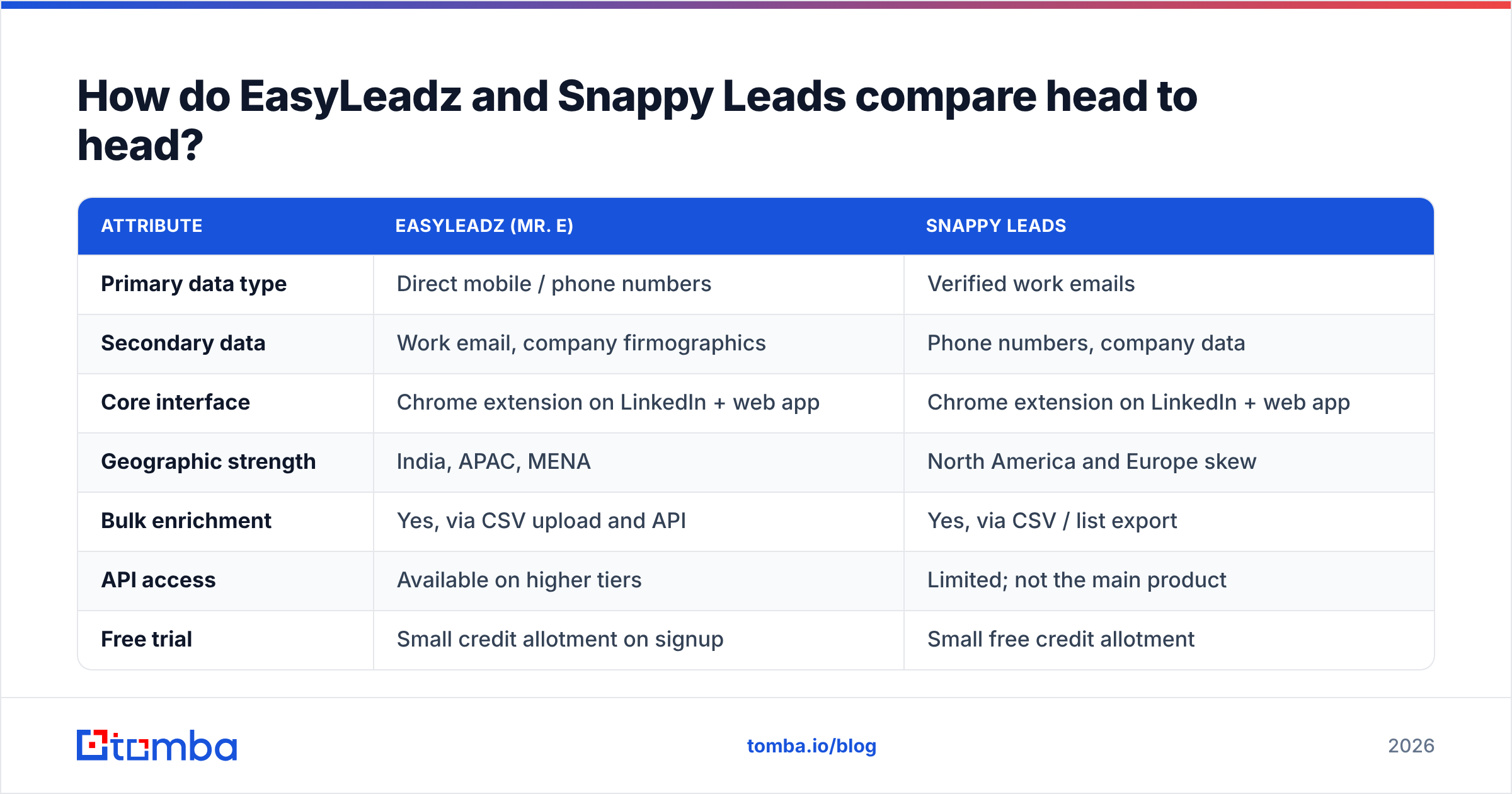
Here is the practical breakdown. Prices and limits move. Treat the pricing row as the shape of the plan, then confirm the current numbers on each vendor's own page before you buy.
| Attribute | EasyLeadz (Mr. E) | Snappy Leads |
|---|---|---|
| Primary data type | Direct mobile / phone numbers | Verified work emails |
| Secondary data | Work email, company firmographics | Phone numbers, company data |
| Core interface | Chrome extension on LinkedIn + web app | Chrome extension on LinkedIn + web app |
| Geographic strength | India, APAC, MENA | North America and Europe skew |
| Bulk enrichment | Yes, via CSV upload and API | Yes, via CSV / list export |
| API access | Available on higher tiers | Limited; not the main product |
| Free trial | Small credit allotment on signup | Small free credit allotment |
| Entry pricing shape | Low-cost credit packs, scaling per user | Low-cost monthly credit tiers |
| Verification depth | Phone validity checks | Email verification before delivery |
| Best fit | Dialer-led teams selling into APAC | Cold-email teams in NA/EU |
Most buyers miss the pattern: these are not substitutes. Teams that run both channels often end up buying two tools. Or one tool plus a generic enrichment provider. That is where the budget math falls apart.
Which tool returns more accurate data?#
Accuracy is where vendor marketing gets loosest. Define your terms before you test.
For phone numbers, accurate means the number reaches the named person. Not a switchboard. Not a stale carrier record. Not a personal line the person will resent you calling. EasyLeadz wins this on its home turf. Its mobile coverage for Indian and APAC contacts is hard for Western-built tools to match. Outside those regions, hit rates drop. You will see more company mainlines in place of direct dials.
For email, accurate means the mailbox exists, accepts mail, and belongs to the person. Snappy Leads is built for that, and it verifies before it hands you the address. Still, every email finder hits the same three problems:
- Catch-all domains. The server accepts everything, so SMTP checks cannot prove a mailbox exists. Weak tools mark these "valid" and quietly inflate your accuracy number. Use a dedicated catch-all verifier if your ICP skews enterprise. Large companies are far more likely to be catch-all.
- Role accounts.
info@,sales@andcontact@are deliverable but useless for one-to-one outbound. - Stale records. Someone who changed jobs eight months ago still has a "valid" old address. It bounces, or it forwards to nobody.

The only accuracy number that matters is the one you produce yourself. Take 100 contacts you already know: customers, past deals, friends at other companies. Run them through both tools. Score the results by hand.
Vendor accuracy claims are marketing. Your own 100-row test is evidence. Then re-run everything through an independent email verifier so you grade the data, not the vendor's report card.
How does pricing actually work for each?#
Both companies sell credits, and credits hide the cost surprises. In an EasyLeadz vs Snappy Leads price check, watch four things:
- Per-seat vs pooled credits. If credits lock to a seat, a three-SDR team cannot move unused volume around. You pay for idle capacity.
- Charge on attempt vs charge on result. Some tools bill a credit even when they return nothing. On a low-hit-rate list, that is a silent 30–50% price rise.
- Phone credits cost more than email credits. This is common across the category. It is also why phone-first tools look expensive next to email-first ones per credit.
- Rollover and expiry. Monthly credits that expire punish spiky prospecting cycles.
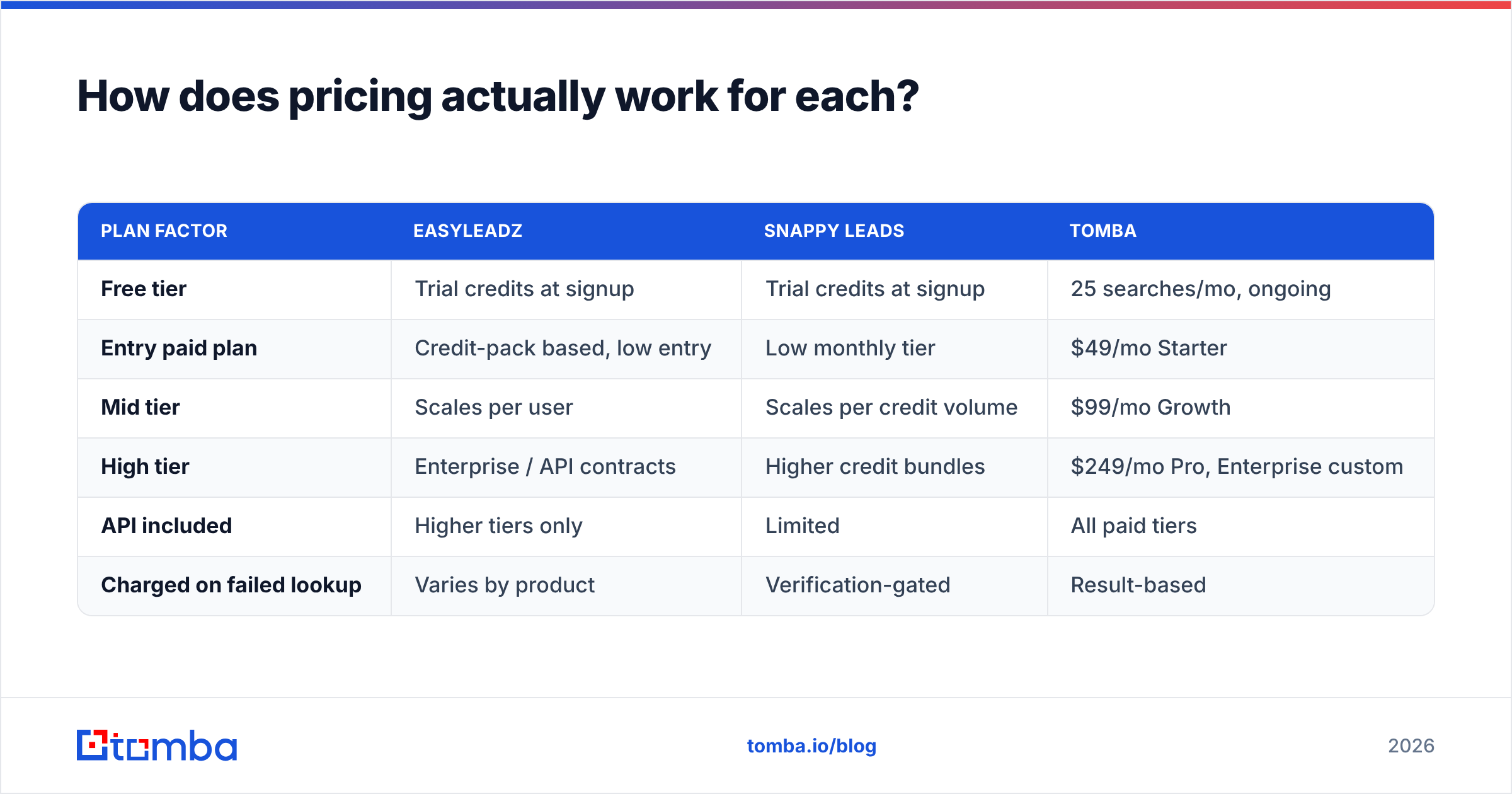
Here is how the main options stack up on cost structure, plus two alternatives worth pricing against:
| Plan factor | EasyLeadz | Snappy Leads | Tomba |
|---|---|---|---|
| Free tier | Trial credits at signup | Trial credits at signup | 25 searches/mo, ongoing |
| Entry paid plan | Credit-pack based, low entry | Low monthly tier | $49/mo Starter |
| Mid tier | Scales per user | Scales per credit volume | $99/mo Growth |
| High tier | Enterprise / API contracts | Higher credit bundles | $249/mo Pro, Enterprise custom |
| API included | Higher tiers only | Limited | All paid tiers |
| Charged on failed lookup | Varies by product | Verification-gated | Result-based |
Two honest notes. First, EasyLeadz can look cheaper than everything else here. A phone-only credit pack is simply a narrower product than a finder, verifier and enrichment suite in one account. Compare like for like. Second, price the whole stack, not one tool. Check what a flat plan with API access costs against two point solutions — see Tomba pricing for the shape of that comparison.
Who should choose EasyLeadz?#
Choose EasyLeadz if three or more of these are true:
- Phone is your primary channel. You measure connects and conversations, not opens and replies.
- You sell into India, Southeast Asia or the Middle East. This is the single strongest reason to pick it. Western providers have thin mobile coverage in these markets.
- Your SDRs live inside LinkedIn. Mr. E is one click per profile. That is fast for manual work, and poor for programmatic list building.
- You want company data next to contacts. EasyLeadz sells firmographic and company-search data in the same account.
- Calling compliance is already handled. Direct mobile numbers carry real legal weight: DNC registries, consent rules, regional telemarketing law. That is your problem, not the vendor's.
Where it falls short: email coverage outside APAC, export ergonomics on large lists, and API access gated to higher tiers. That gating makes it awkward to embed in an automated enrichment pipeline.
Who should choose Snappy Leads?#
Choose Snappy Leads if you run an email-led motion and want little friction:
- Cold email is your main channel. You want verified addresses that protect your sender reputation.
- Your ICP sits in North America or Europe. Coverage skews that way.
- You prospect from Sales Navigator searches. The path from extension to export is short.
- You have no engineering support. Nothing to build. You get value on day one.
- You want verification bundled, not bolted on. Getting the check in the same click is genuinely convenient.
Where it falls short: it is a smaller vendor with a shallower data moat than the established players. Phone coverage is a feature, not a strength. And there is little depth for anyone who wants enrichment as infrastructure — scheduled jobs, CRM syncs, dedupe against existing records. Check current reviews on G2 before you sign an annual plan. Sentiment on newer tools moves fast.
What are the best alternatives to both?#
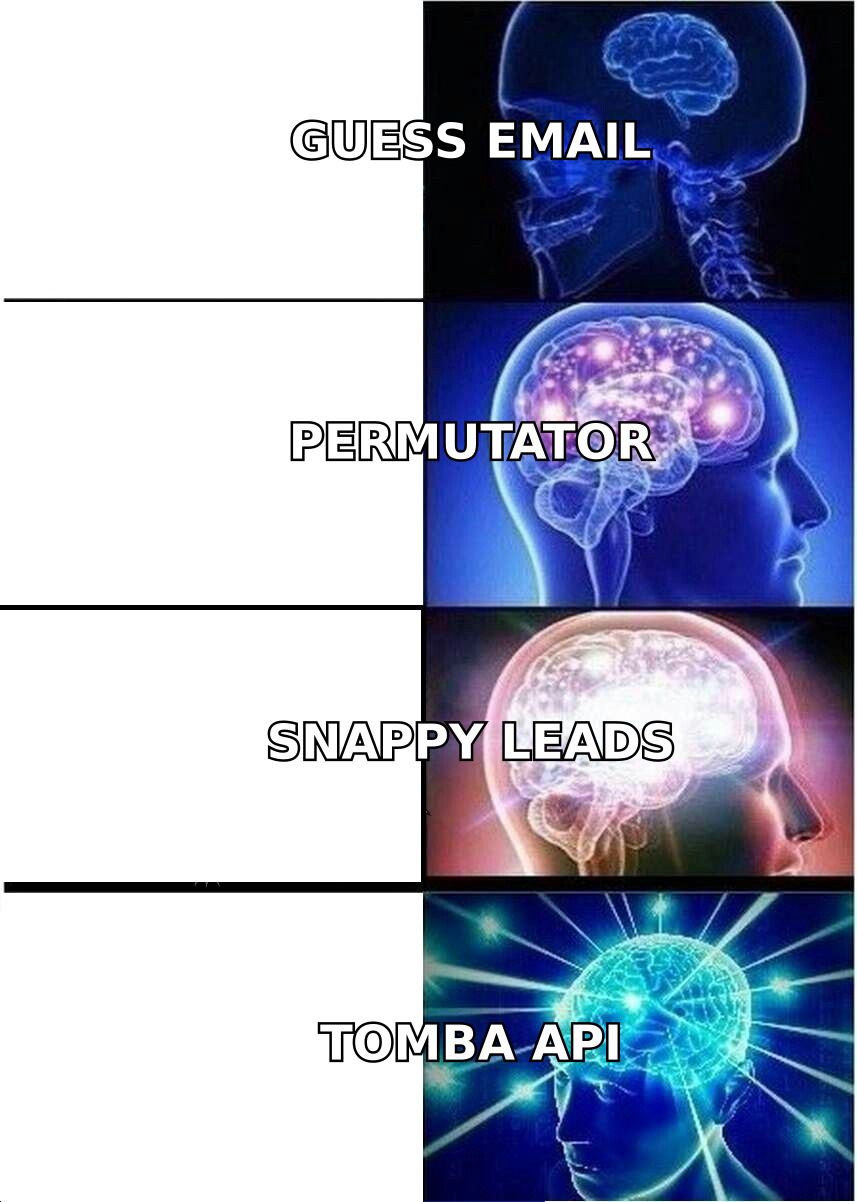
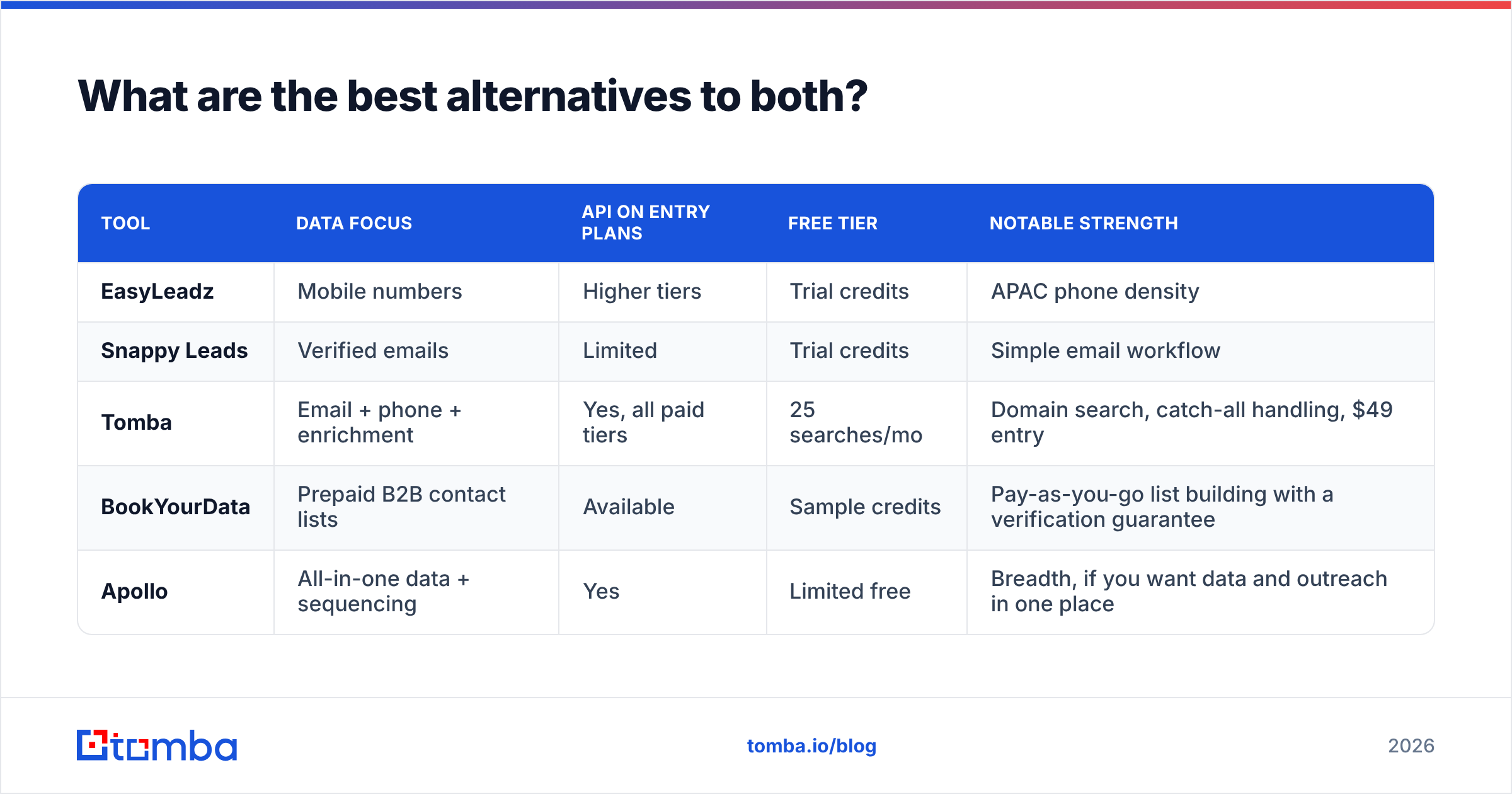
Most teams weighing EasyLeadz vs Snappy Leads are really asking something broader. What is the cheapest reliable way to get contact data into my sequencer without paying for three subscriptions? That question changes the shortlist.
| Tool | Data focus | API on entry plans | Free tier | Notable strength |
|---|---|---|---|---|
| EasyLeadz | Mobile numbers | Higher tiers | Trial credits | APAC phone density |
| Snappy Leads | Verified emails | Limited | Trial credits | Simple email workflow |
| Tomba | Email + phone + enrichment | Yes, all paid tiers | 25 searches/mo | Domain search, catch-all handling, $49 entry |
| BookYourData | Prepaid B2B contact lists | Available | Sample credits | Pay-as-you-go list building with a verification guarantee |
| Apollo | All-in-one data + sequencing | Yes | Limited free | Breadth, if you want data and outreach in one place |

A few honest calls on that table.
BookYourData fits teams that would rather buy one clean, targeted list than pay every month. The prepaid model suits campaign-based work and one-off market tests.
Apollo is a different category. You are buying a platform, with the trade-offs a platform brings.
Tomba sits between the point tools and the platforms. Domain search maps every contact at a target company. Verification and catch-all handling live in the same account. API access comes with every paid plan, so you can run it as infrastructure rather than a manual click-tool. Replacing a LinkedIn-extension workflow? The LinkedIn finder covers the same job.
How should you run the evaluation?#
Don't buy on feature lists. Run a five-day bake-off:
- Build one shared test list. 200 real prospects that match your ICP, with LinkedIn URLs and company domains. Same list into every tool. No cherry-picking.
- Add a known-answer control group. 25 contacts whose email or phone you already have. This is the only way to measure accuracy instead of coverage.
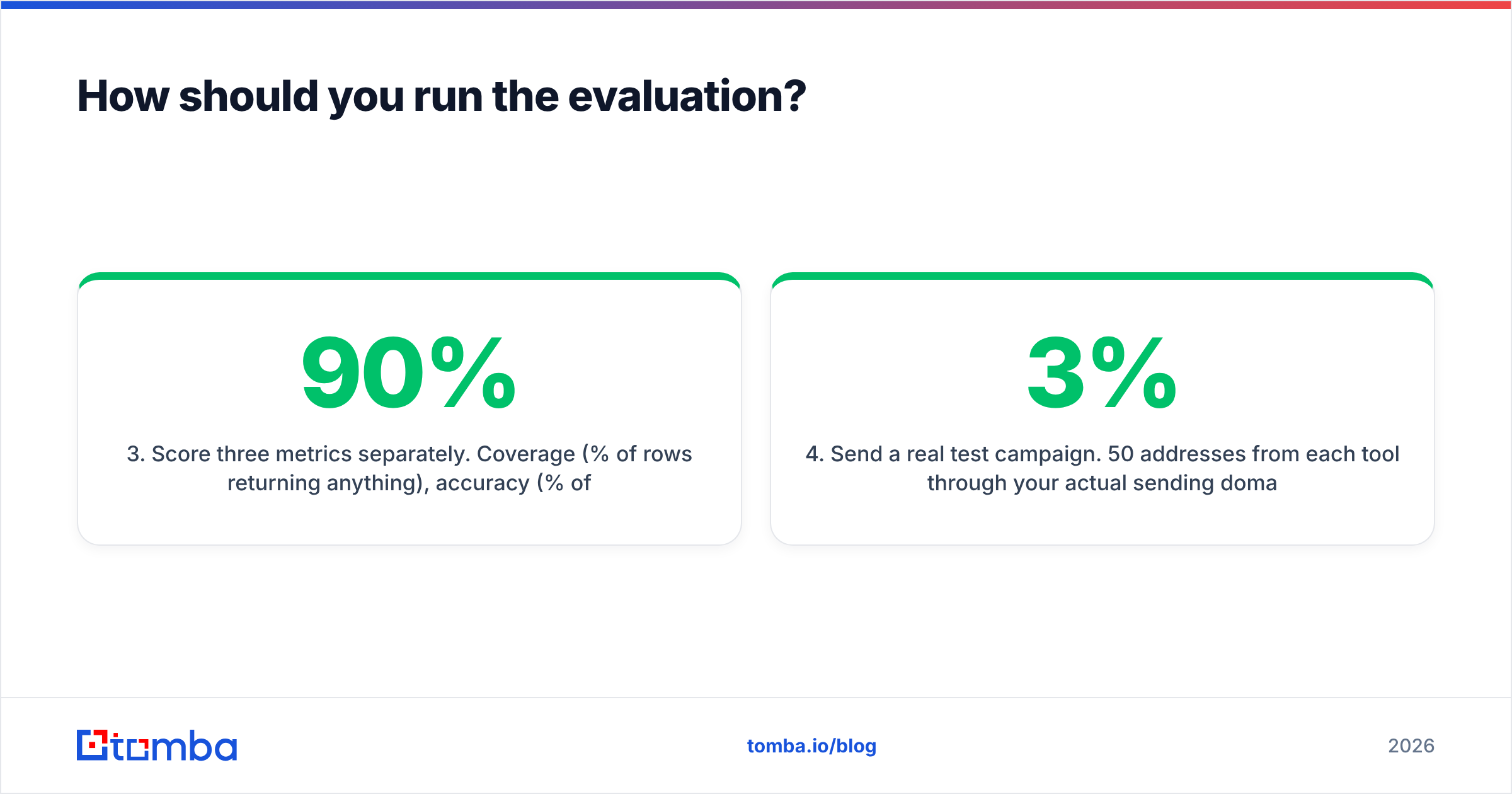
- Score three metrics separately. Coverage is the share of rows that return anything. Accuracy is the share of returned values that are correct. Then divide spend by correct records. A tool with 90% coverage and 60% accuracy loses to one with 60% coverage and 95% accuracy, and it costs more in bounces.
- Send a real test campaign. 50 addresses from each tool, through your real sending domain. Watch the bounce rate. Anything over 3% is a data problem, and it will hurt your email deliverability within a week.
- Time the workflow. Count clicks per 100 contacts. Extension-only tools feel fast until you need 2,000 rows. At that point a bulk email finder or an API is the only sane path.
- Check exports and compliance. Can you pull a clean CSV? Does the vendor document its data sources? Does it handle GDPR and CCPA deletion requests? Ask in writing.
So which one wins?#
There is no single winner. Any post that names one is selling something.
EasyLeadz wins if you are a phone-led team selling into India or APAC. Nothing else here matches its mobile-number density in those markets. That edge beats a nicer UI or a cheaper credit.
Snappy Leads wins if you are a small NA or EU cold-email team. You want verified addresses with almost no setup, and you don't need the data through an API.
Neither wins if you are building a repeatable outbound engine. Then you need one account for email discovery, verification, catch-all domains, phone numbers and enrichment, with an API you can wire into your CRM. Otherwise you pay two vendors and reconcile two exports forever.
That is the gap the Tomba Email Finder fills. Find verified professional emails by domain, name or company. Verify them in the same account before they reach your sequencer. Call all of it over the API on any paid plan. Start free with 25 searches a month. Run it beside your current tool on your own 100-row control list, and let the bounce rate settle the EasyLeadz vs Snappy Leads question.
Related guides#
Ready to find emails that actually work?
Join 150,000+ professionals who stopped guessing and started sending. Free credits on signup — no credit card required.
Get the Tomba newsletter
Practical outbound tactics and product updates — once every two weeks.
About the author