EasyLeadz vs Thomson Data: Which B2B Data Tool Wins in 2026?
EasyLeadz sells real-time contact discovery; Thomson Data sells pre-built list files. They solve different problems badly if you pick wrong. Here's the honest breakdown of pricing, accuracy, coverage, and who should buy which.
EasyLeadz vs Thomson Data is not really a feature fight. It is a choice between two models: pay per live contact lookup, or buy a pre-built list file. This guide compares both on price, accuracy, coverage, and refund terms.
TL;DR
- EasyLeadz is a real-time contact lookup tool built around Indian and APAC mobile numbers, sold per credit with a Chrome extension and API. Thomson Data is a list vendor: you brief them on an audience, they deliver a pre-built file of contacts.
- They are not the same category. One gives you a contact when you need it. The other gives you 40,000 rows you have to clean, verify, and hope are still current.
On accuracy and price:
- Accuracy is where the money leaks. Static list files decay 22-30% per year. Real-time lookups pull fresher data, but they cost more per record and cover fewer regions than they advertise.
- Pricing is opaque on both sides. EasyLeadz publishes credit packs. Thomson Data quotes per project and per record count, so your cost per usable contact is unknowable until after delivery.
- If you need verified work emails at predictable prices, a dedicated finder-plus-verifier stack (Tomba, for instance, starts at $49/mo with a free tier) is usually a cheaper baseline than either. Layer a list vendor on top only for niche audiences.
What are EasyLeadz and Thomson Data, actually?#
They sit at opposite ends of the B2B data market. That gap matters more than any feature checkbox.
EasyLeadz (marketed heavily as "Mr. E by EasyLeadz") is a contact discovery tool. You install a browser extension, land on a LinkedIn profile or company page, click, and it returns a direct dial or work email. It leans hard on mobile numbers. Coverage is strongest in India and parts of Southeast Asia. You buy credits; each revealed contact burns one. There's an API for programmatic pulls.
Thomson Data is a data vendor in the older sense. You describe a target audience — "IT decision makers at US healthcare companies with 200+ employees" — and their team assembles and delivers a file. They also sell pre-packaged lists by industry, technology stack, or job function. Delivery is CSV or Excel, sometimes via an integration hand-off. Pricing is quoted per engagement.
The practical difference: EasyLeadz is a faucet, Thomson Data is a tank. A faucet gives you water when you turn it on, and you pay per liter. A tank gives you a large volume up front. Whether it is still drinkable in six months depends on how it was filled.

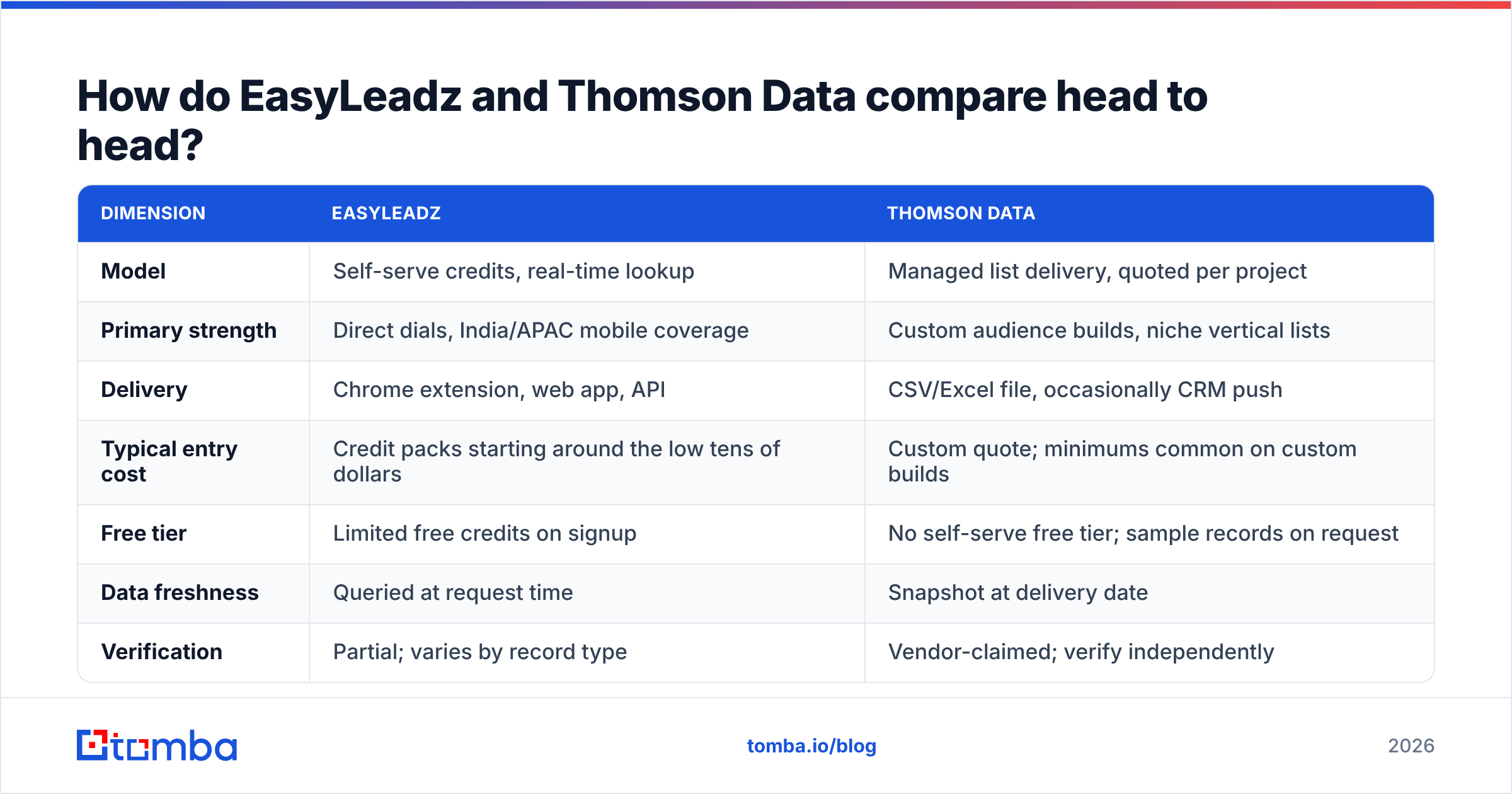
EasyLeadz vs Thomson Data: how do they compare head to head?#
| Dimension | EasyLeadz | Thomson Data |
|---|---|---|
| Model | Self-serve credits, real-time lookup | Managed list delivery, quoted per project |
| Primary strength | Direct dials, India/APAC mobile coverage | Custom audience builds, niche vertical lists |
| Delivery | Chrome extension, web app, API | CSV/Excel file, occasionally CRM push |
| Typical entry cost | Credit packs starting around the low tens of dollars | Custom quote; minimums common on custom builds |
| Free tier | Limited free credits on signup | No self-serve free tier; sample records on request |
| Data freshness | Queried at request time | Snapshot at delivery date |
| Verification | Partial; varies by record type | Vendor-claimed; verify independently |
| Best for | SDRs doing manual, high-intent prospecting | Marketers running large one-off campaigns |
| Worst for | Bulk list building at volume | Anything needing this-week accuracy |
| Compliance posture | Standard opt-out handling | Ask explicitly for sourcing documentation |
The row that should decide most purchases is data freshness. Everything else is negotiable; that one isn't.
Which one has better data accuracy?#
Neither publishes an audited accuracy number you can rely on. Judge them structurally instead.
Real-time lookup tools like EasyLeadz have a structural advantage: the record is assembled or re-checked when you ask for it. The trade-off is coverage. Ask for a mid-market CFO in Mumbai and you'll likely get a mobile number. Ask for a VP of Engineering in Stuttgart and the hit rate drops sharply. Regional providers are strong inside their region and thin outside it. That is the pattern across the whole category, not a knock on EasyLeadz.
List vendors like Thomson Data have the opposite profile: broad coverage on paper, but a file is a photograph. Gartner has long estimated that B2B contact data decays at roughly 20-30% annually — job changes, domain migrations, company restructures. If your file was built eight months before it reached you, a quarter of it is already dead. You paid for those rows anyway.
Three habits protect you regardless of which you pick:
- Demand a sample before you pay. 100 records, your exact criteria, delivered as a file. Run them through an email verifier and count the valid rate yourself. If a vendor won't sample, that's your answer.
- Verify at send time, not purchase time. A file verified at delivery is not a file verified today. Re-verify anything older than 30 days before it enters a sequence.
- Track bounce rate per source. Tag every contact with its origin in your CRM. After two campaigns you'll have real cost-per-usable-contact numbers for each vendor, which beats any review site.
If you're evaluating vendors, cross-check the marketing claims against user reviews on G2 rather than the vendor's own case studies. Look specifically at reviews from the last 12 months and from your region.
What does each one actually cost?#
Cost per record is the wrong metric. Cost per usable record is the only one that matters.
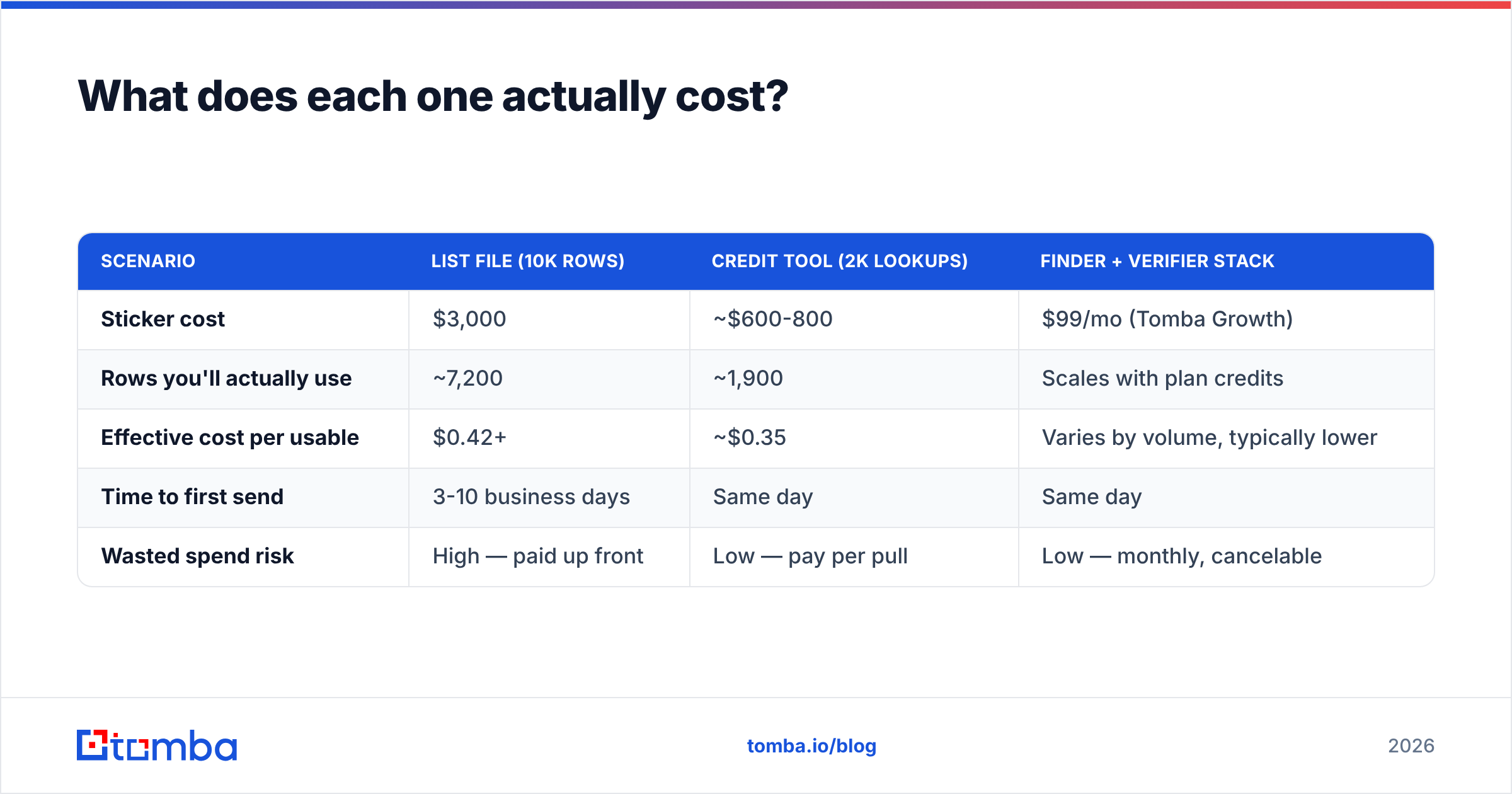
Say a list vendor delivers 10,000 contacts for $3,000 — $0.30 each, which sounds excellent. If 28% have bounced or moved, you have 7,200 usable rows, so you're at $0.42. Now strip the rows outside your real ICP, padded in to hit the row count. A true cost of $0.55-0.60 is realistic. Compare that to a credit tool at $0.25-0.40 per lookup, where you only spend a credit on someone you already decided to contact.
| Scenario | List file (10k rows) | Credit tool (2k lookups) | Finder + verifier stack |
|---|---|---|---|
| Sticker cost | $3,000 | ~$600-800 | $99/mo (Tomba Growth) |
| Rows you'll actually use | ~7,200 | ~1,900 | Scales with plan credits |
| Effective cost per usable | $0.42+ | ~$0.35 | Varies by volume, typically lower |
| Time to first send | 3-10 business days | Same day | Same day |
| Wasted spend risk | High — paid up front | Low — pay per pull | Low — monthly, cancelable |
Tomba's published Tomba pricing runs Free (25 searches/mo), Starter $49/mo, Growth $99/mo, Pro $249/mo, Enterprise custom. That is not a like-for-like swap for a managed list build. A vendor doing custom audience research is selling labor, not software. But for standard work-email discovery at scale, the per-record math is hard to argue with.
One more line item people forget: cleanup labor. A raw list file needs deduplication, format normalization, domain matching, and suppression-list checks. That's 4-12 hours of someone's time on a 10k file. Budget it.
When should you buy a list instead of finding contacts live?#
There are genuine cases for a list vendor, and pretending otherwise is dishonest.
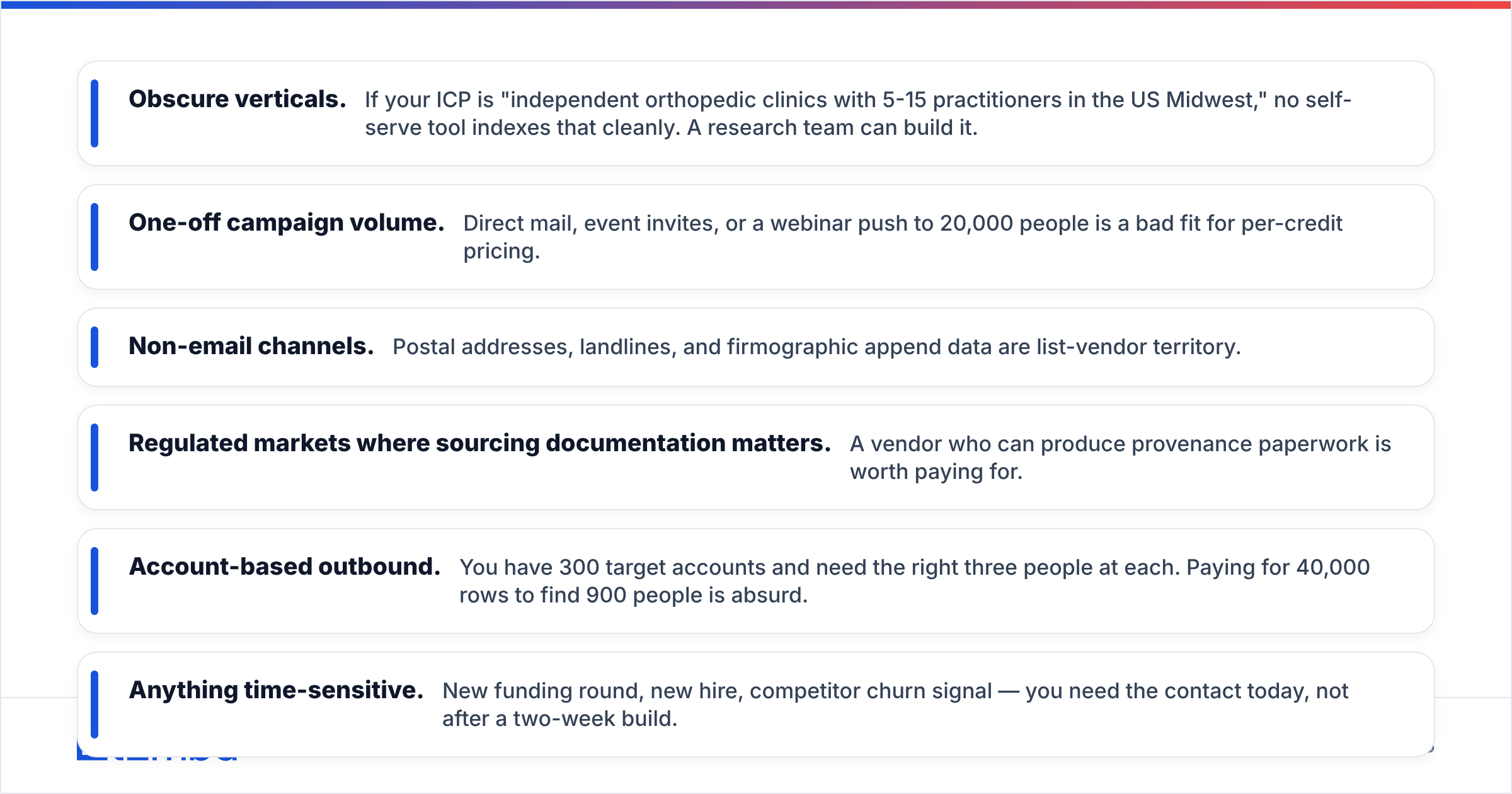
- Obscure verticals. If your ICP is "independent orthopedic clinics with 5-15 practitioners in the US Midwest," no self-serve tool indexes that cleanly. A research team can build it.
- One-off campaign volume. Direct mail, event invites, or a webinar push to 20,000 people is a bad fit for per-credit pricing.
- Non-email channels. Postal addresses, landlines, and firmographic append data are list-vendor territory.
- Regulated markets where sourcing documentation matters. A vendor who can produce provenance paperwork is worth paying for.
And the cases where live lookup wins:
- Account-based outbound. You have 300 target accounts and need the right three people at each. Paying for 40,000 rows to find 900 people is absurd.
- Anything time-sensitive. New funding round, new hire, competitor churn signal — you need the contact today, not after a two-week build.
- Testing a new segment. Spend $200 on lookups to validate an ICP before committing $5,000 to a file.

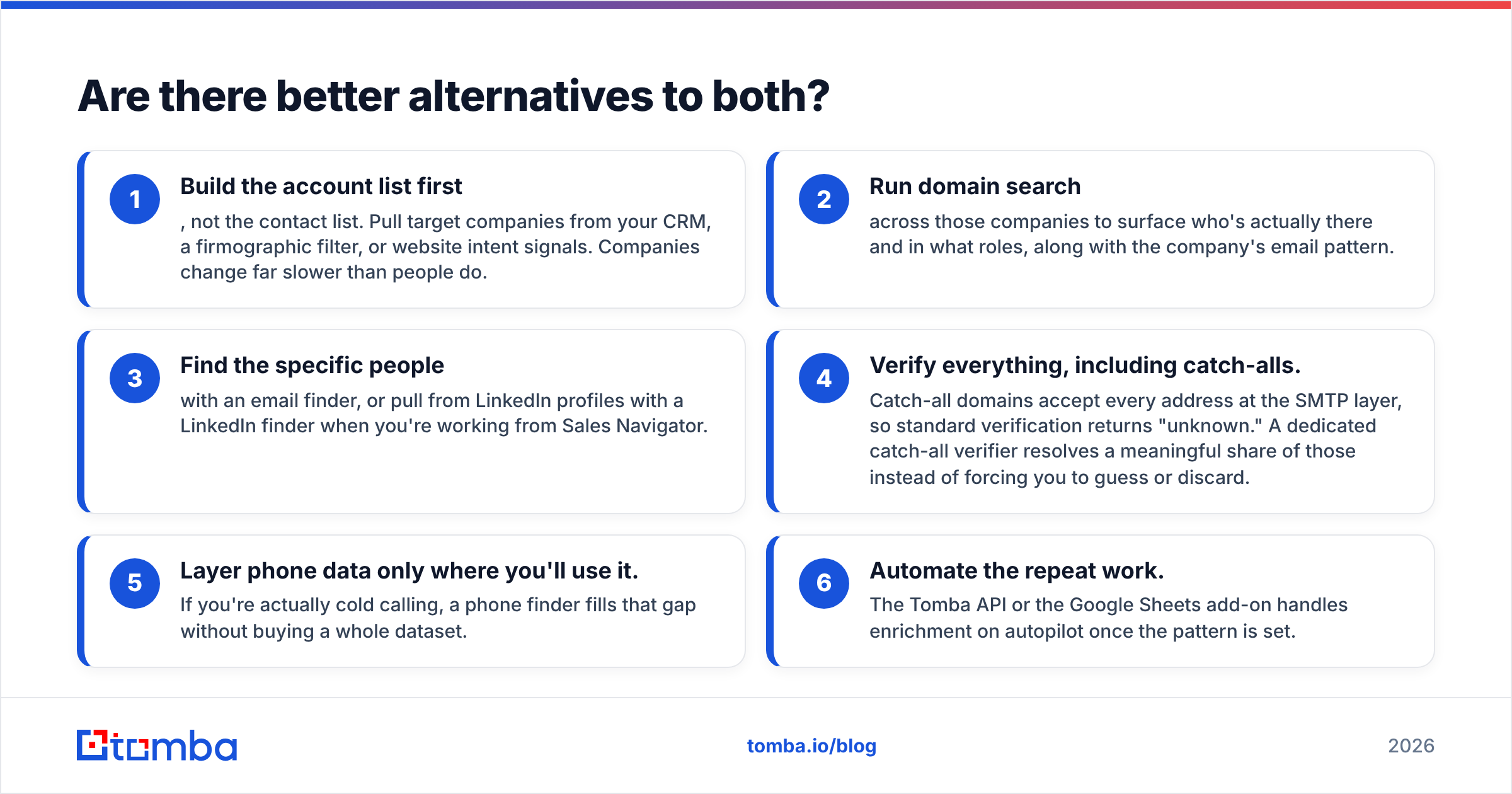
Are there better alternatives to both?#
For most B2B teams sending email, yes. A purpose-built finder-and-verifier stack covers 80% of what either vendor is sold for, at a lower and more predictable cost.
The workflow that actually holds up:
- Build the account list first, not the contact list. Pull target companies from your CRM, a firmographic filter, or website intent signals. Companies change far slower than people do.
- Run domain search across those companies to surface who's actually there and in what roles, along with the company's email pattern.
- Find the specific people with an email finder, or pull from LinkedIn profiles with a LinkedIn finder when you're working from Sales Navigator.
Then comes the part most teams skip.
- Verify everything, including catch-alls. Catch-all domains accept every address at the SMTP layer, so standard verification returns "unknown." A dedicated catch-all verifier resolves a meaningful share of those instead of forcing you to guess or discard.
- Layer phone data only where you'll use it. If you're actually cold calling, a phone finder fills that gap without buying a whole dataset.
- Automate the repeat work. The Tomba API or the Google Sheets add-on handles enrichment on autopilot once the pattern is set.
Where does EasyLeadz still earn its keep in that stack? Mobile numbers in India and APAC. If that's your market and you're phone-first, it's a reasonable line item. And where does Thomson Data? Custom research for audiences nothing indexes. Treat it as a services purchase, not a software one, and price it accordingly.
Worth noting: other list providers compete in Thomson Data's lane too. BookYourData, for example, sells self-serve, pay-as-you-go B2B lists with a published bounce guarantee. That removes some of the quote-opacity problem that makes traditional list buying uncomfortable. If you want a file but hate the "request a quote" dance, that model is worth a look.
How should you run the evaluation?#
Don't take anyone's word for it — including this post's. Run a controlled bake-off. It costs less than one bad list purchase.
The 200-contact test:
- Pick 200 real target contacts from your ICP. Same companies, same seniority, same geography for every vendor.
- Request or pull those exact contacts from each vendor being evaluated.
- Measure match rate (how many did they find at all), validity rate (how many pass independent verification), and precision (how many are the actual right person, not a same-name mismatch).
- Send a small, low-risk campaign to each cohort. Measure bounce rate and reply rate separately per source.
- Compute cost per reply, not cost per record.
Most teams discover the cheapest-per-record source is the most expensive per reply. That gap is where budgets quietly die.
Also check the boring contractual stuff before signing anything: refund or replacement terms on invalid records, whether credits roll over or expire, data ownership after cancellation, and how the vendor documents consent for the regions you're mailing. HubSpot's guidance on buying email lists is a useful reality check on the deliverability and compliance risk of purchased data generally — worth reading before you commit budget to a file.
What's the verdict?#
Choose EasyLeadz if you're an SDR or small sales team working India/APAC accounts, phone outreach is central to your motion, and you want to pay only for contacts you'll actually dial. It's a focused tool that does one geography well.
Choose Thomson Data if your audience is genuinely hard to build with self-serve tools, you need non-email data like postal or firmographic append, and you have the volume to justify a project-based engagement. Insist on a sample, insist on replacement terms for invalid records, and budget for cleanup time.
Choose neither — or use one as a supplement rather than a foundation — if your core need is verified work email addresses for account-based outbound in North America or Europe. That's the case for most B2B SaaS teams, and it's where a finder-plus-verifier stack wins on cost, speed, and freshness at the same time.
The real mistake in the EasyLeadz vs Thomson Data debate isn't picking the wrong vendor. It's treating contact data as a one-time purchase instead of a continuously maintained asset. Whatever you buy, re-verify on a schedule, tag every record with its source, and kill the sources that underperform on replies.
Start with the layer that actually gates your pipeline. Before you commit to a list build or a credit pack, test how many of your target contacts you can find and verify yourself. Tomba Email Finder gives you 25 free searches a month with no card required, and paid plans start at $49/mo — enough to run the 200-contact bake-off above and get real numbers before you sign anything larger.
Related guides#
Ready to find emails that actually work?
Join 150,000+ professionals who stopped guessing and started sending. Free credits on signup — no credit card required.
Get the Tomba newsletter
Practical outbound tactics and product updates — once every two weeks.
About the author